

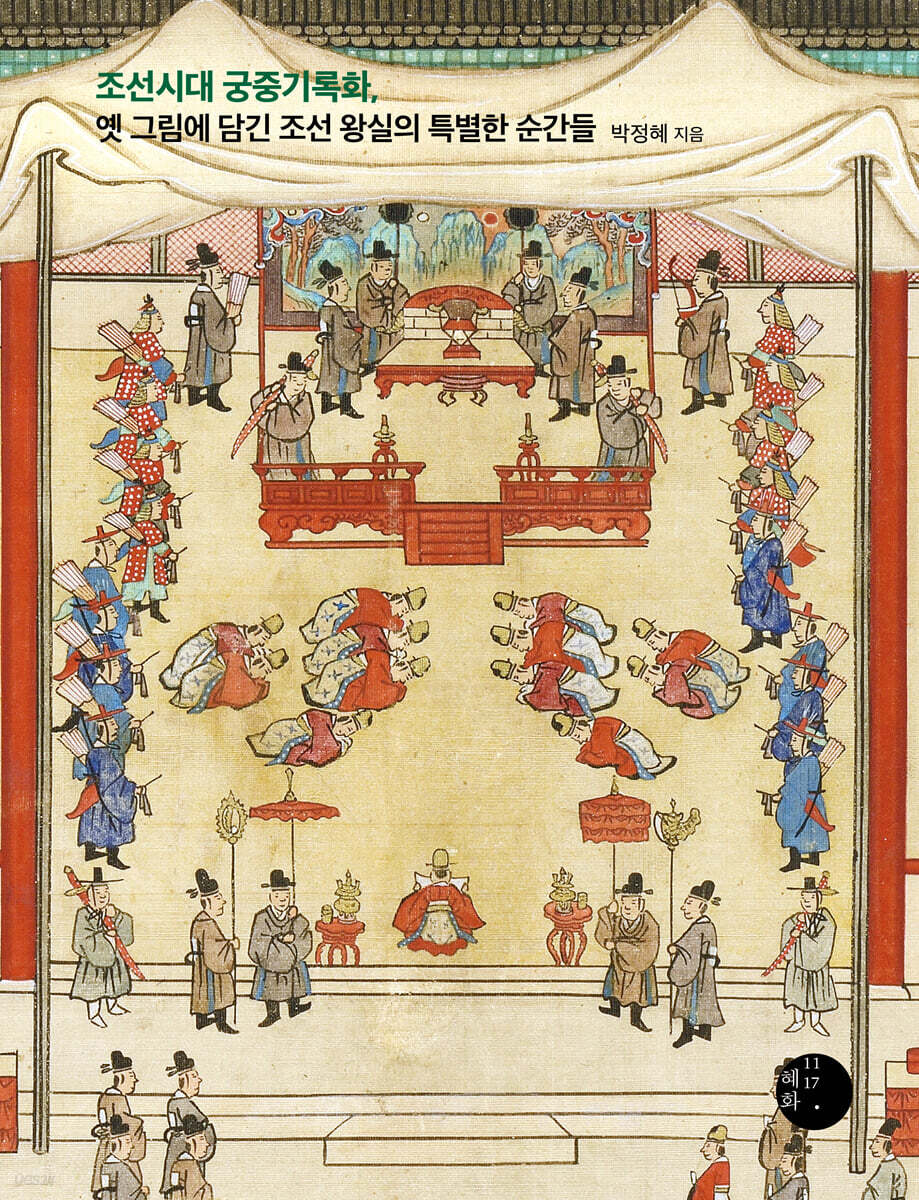
Joseon Dynasty Royal Records: Special Moments of the Joseon Royal Family Captured in Old Paintings
 |
Description
Book Introduction
- A word from MD
-
A Time Machine to Joseon: A masterpiece that will be hard to replicateApproximately 3,000 pages of manuscript paper, including 600 illustrations.
This book, which covers almost everything about the Joseon royal court, delves into everything from official events to the detailed daily lives of the Joseon royal family.
The numerous characters and events depicted in the various full-color plates stimulate our curiosity and guide us back to the Joseon Dynasty.
December 6, 2024. Humanities PD Son Min-gyu
A colorful monument left by the Joseon royal family in an era before cameras!
From the beginning of the royal court records to the reigns of King Sukjong, King Yeongjo, and King Jeongjo, and up to the Korean Empire,
Official events of the Joseon Dynasty and the daily lives of the royal family, recorded in great detail in pictures,
It is undeniable that this is the completion of a unique genre in Korean art history that no one has ever achieved before!
The history of documentary exploration itself, presented before us as a result of over 30 years of accumulation!
In the Joseon Dynasty, before the advent of photography, documentary paintings served as a record and memorial, much like today's full-color photographs.
In order to establish and pass down the foundation of the nation's etiquette and formalities, and to prevent mistakes and errors before the execution of state events, the royal family would draw pictures and rehearse them in advance, and also leave behind records of what actually happened for future generations.
From the beginning of the royal court records to the reigns of King Sukjong, King Yeongjo, and King Jeongjo, and up to the Korean Empire,
Official events of the Joseon Dynasty and the daily lives of the royal family, recorded in great detail in pictures,
It is undeniable that this is the completion of a unique genre in Korean art history that no one has ever achieved before!
The history of documentary exploration itself, presented before us as a result of over 30 years of accumulation!
In the Joseon Dynasty, before the advent of photography, documentary paintings served as a record and memorial, much like today's full-color photographs.
In order to establish and pass down the foundation of the nation's etiquette and formalities, and to prevent mistakes and errors before the execution of state events, the royal family would draw pictures and rehearse them in advance, and also leave behind records of what actually happened for future generations.
- You can preview some of the book's contents.
Preview
index
ㆍPublishing a book
Introduction | The First Step to Understanding Royal Records
Court records: Capturing special moments of the king and nation in paintings | The founders of Joseon devoted themselves to establishing examples and compiling ritual books | The five rites, including auspicious, happy, conspicuous, military, and inauspicious, depicted in court records | The primary value placed on court paintings by kings and officials: utilitarian efficacy | The production of records to meet the diverse needs of the court
Chapter 1 | The Beginning of the Royal Ceremony
The Gyehoe of the newly rising aristocracy in the late Goryeo Dynasty | The sense of kinship that spread to the bureaucrats of the Joseon Dynasty, and the spread of the Gye organization | From Gyechuk to Gyecheop and Gyebyeong, the changing form | From Gyehoe paintings of bureaucrats to commemorative paintings of state events | The indispensable seat, a preface filled with loyalty, filial piety, and pride | A court ceremony painting that began with Yeonhyangdo, a place for peace and friendship among all people | The value of different versions of the court ceremony painting, 〈Seochongdaechinrimsa Yeondo〉
Chapter 2 | Royal Ceremonies of King Sukjong's Reign
100 years after the end of the Imjin War, the production of royal banquet halls began to flourish.
The royal banquets found stability during King Sukjong's reign | The first royal banquet in over a century, "Injeongjeonjinyeondocheop" | The royal banquet celebrating King Sukjong's 50th birthday, "Sungjeongjeonjinyeondo"
『Gisa Gyecheop』, a pictorial record of King Sukjong's entrance to Giroso
Giroso, a Joseon Dynasty institution that honored national officials | King Sukjong, who carried out the ritual of Taejo, held the Giroso | 『Gisa Gyecheop』, a complete text and illustration of the entire event | Six 『Gisa Gyecheop』 pieces, each painted similarly or differently
The event also heralded the rise of the personnel administration's popularity.
Gye-byeong, which began with portraits and landscapes in the early 17th century | The beginning of Gye-byeong, a compromise between event paintings and royal portraits, and the royal portraits depicting the king's personal visits | The earliest extant work commemorating the king's personal visits, 『Sukjong Shinmi Chinjeong Gye-byeong』 | 『Gyeongjong Shinchuk Chinjeong Gye-byeong』, produced only by the Ministry of War
Chapter 3 | Royal Ceremonies of King Yeongjo's Reign
King Yeongjo reestablishes the foundation of late Joseon Dynasty etiquette
King Yeongjo, who revived the dynasty's history | King Yeongjo, who showed a keen interest in documentary records
『Gisa Gyeonghoecheop』, a pictorial record of King Yeongjo's entrance to Giroso
King Yeongjo entered Giroso at the age of 51 | 『Gisa Gyeonghoecheop』, which was copied from King Sukjong's 『Gisa Gyecheop』 | The contents and characteristics of 『Gisa Gyeonghoecheop』
Half a Century of King Yeongjo's Reign as Seen Through the Royal Banquet Hall
A more diverse array of banquets than any other dynasty | A banquet honoring King Yeongjo's entrance to Giroso, 〈Sungjeongjeongapjajinyeondobyeong〉 | A story about King Yeongjo's preferential treatment of royal relatives and the government office, 〈Jongchinbusayeondo〉 | King Yeongjo's frequent visits to Yeongsugak and the production of Giroso's genealogy | Jinjakrye, first held to commemorate the 40th anniversary of his accession to the throne, 〈Yeongjo Eulyugiroyeon·Gyeonghyeondangsujakyeondo〉 | A record of banquets revived on the same date and at the same place after 60 years, 〈Yeongjo Byeongsulnyeonjinyeondobyeong〉 | Frequent good deeds and private praises bestowed upon his subjects
The trend of kinship continued in various ways
A Compromised Scene of the Parents' Home on a Calligraphic Screen: "Yeongjo Eulmyo Chinjeonghu Seonon Gye Byeong" | A Newly Appeared Album of Parents' Home
King Yeongjo revived and visualized the archery ritual between the king and his subjects.
Reorganization and Clarification of the Ambassadorial Procedure | Contents and Features of the Ambassadorial Procedure
King Yeongjo used the former site of Gyeongbokgung Palace to strengthen the legitimacy of the dynasty.
A ceremony held at Gyeongbokgung Palace, which was reduced to ruins after the Imjin War | The first ceremony held on the site of the old palace, "Chinrim Gwanghwamun-nae Geunjeongjeon Jeongsi-do" | A banquet reviving King Taejong's story on the site of Geunjeongjeon, "Yeongmyojogukgwoljinjakdo"
Juncheon, who worked hard to realize peace and security for the people
A feat that will endure for generations: the stream restoration project | The entire story of the Juncheon project, captured in two types of records | The artist who created the "Yeoje Juncheon Gyecheop" (a collection of records) by order of King Yeongjo | The contents and characteristics of the "Yeoje Juncheon Gyecheop" | The contents and characteristics of the "Gangjin Juncheon Gyecheop"
King Yeongjo left behind the most interesting and dynamic court ceremonies of the Joseon Dynasty.
King Yeongjo, who introduced court ceremonial paintings into the royal court and changed production practices | Screens that became established as the representative form of court ceremonial paintings | Pictorial characteristics of court ceremonial paintings during the reign of King Yeongjo
Chapter 4 | Court Events of the Jeongjo Dynasty
Efforts to strengthen the status of the Crown Prince and record events
The elevation of the Crown Prince's office to Sejashigangwon | The reorganization of the Donggung Palace area and the construction of Jungheedang | The "Ceremonial Order of Crown Prince Munhyo" commemorates the investiture of King Jeongjo's eldest son as Crown Prince.
Maintenance of the Hyang-ui-do-byeong for accurate execution of examples
The Importance of Visualizing and Utilizing the Precedent | A New Attempt at the Ritual Dobyeong, the Gyeongmogung Hyangui Dobyeong
Hyangui Dobyeong of Jongmyo and Sajikdan | Contents and Production Period of the Jongmyo Hyangui Dobyeong
The pinnacle of court ceremonial painting, born from King Jeongjo's planning prowess: Hwaseongwonhaengdobyeong
A son's meticulous preparations to commemorate his father's 60th birthday and his mother's 60th birthday | "Wonhaeng Eulmyo Jeongni Uigwe," which records all of the Eulmyo year's Wonhaeng | King Jeongjo's special commission for the Naeipdo Byeong and Jeongriso Gye Byeong | The folding screens entrusted to the Chabi Daeryung Hwawon of the Gyujanggak | "Hwaseong Wonhaeng Dobyeong," which showcases the painting prowess of the late 18th century
New changes in the royal court ceremonial paintings of the reign of King Jeongjo
The leap forward in Hwawon painting: the free use of folding screens | The adoption of Western painting techniques and the achievement of realistic expression
Chapter 5 | Royal Ceremonies from the Sunjo to Gojong Periods
The completion of palace architecture, "Donggwoldo"
The Golden Age of Palace Architectural Paintings, the Peak of "Donggwoldo" | The Production Period and Artist of "Donggwoldo" | Similarities and Differences Between the Two "Donggwoldo" Paintings | The 19th Century, a Time When Large-Scale Palace Architectural Paintings Were Popular
Visualization of the Crown Prince's Rituals in the Crown Prince's Palace
Prince Hyomyeong's entrance ceremony at Sungkyunkwan, 『Crown Prince Entrance Ceremony Illustrated by Illustrated Prince Hyomyeong』 | Prince Hyomyeong's educational evaluation ceremony, 『Hoegang Bancha Docheop』 | Illustrated Crown Prince's inauguration ceremony, 『Sugyo Docheop』 | Strengthening royal authority and the prevalence of documenting events related to Prince Hyomyeong
The 19th century was the golden age of court banquets.
The longevity of the royal family and frequent court banquets | The court banquet painting of the reign of King Sunjo | The typical 19th-century banquet painting established during the reign of King Heonjong, 『Heonjongmusinjinchandobyeong』 | The court banquet painting of the reign of King Gojong | The characteristics of the 19th-century banquet painting established through multifaceted exploration
Jinhado, a royal rite symbolizing the authority of the dynasty
The evolution of the Jinha-rye ceremony and its iconographic characteristics | A folding screen of Jinha-do, a frontal bird's-eye view of the ceremony venue from the front | A folding screen of Jinha-do, a parallel oblique bird's-eye view of the ceremony venue from an angle
Chapter 6 | Court Ceremonies of the Korean Empire
1897, the royal family's banquet after the establishment of the Korean Empire
King Heonjong's second wife, Empress Dowager Myeongheon's Mangpal and 『Gojong Shinchuk Jinchan Dobyeong』
Preparation for the only Jinchanrye ceremony during the Korean Empire | The production of Naeipgyebyeong and Dangranggyebyeong continued even during the Korean Empire | The contents and characteristics of the "Gojong Shinchuk Jinchandobyeong"
Emperor Gojong's Osun Ching-gyeong and 『Gojong Shinchukjin Yeondobyeong』
『Gojong Iminsa Woljin Yeondobyeong』 commemorating Emperor Gojong's entry into Giroso
Preparations for Jinyeon and the Making of Dobyeong | A painting depicting the ceremony of entering Giroso, the fourth and last royal residence of the Joseon Dynasty | A painting celebrating the entrance to Giroso
『Gojong Im-in 11th Month Jinyeon Do-byeong』, celebrating the 40th anniversary of King Gojong's accession to the throne
Characteristics of the royal banquet tableware during the Korean Empire
Preparation and execution of the ceremonial rites, inheriting 19th-century forms and methods | The production of rituals and the development of their schematics | Changes in ceremonial equipment, attire, and political arrangements befitting the status of the empire | The composition and perspective of the rituals and military parade
supplement
ㆍNote
ㆍData
ㆍReferences
ㆍSearch
Introduction | The First Step to Understanding Royal Records
Court records: Capturing special moments of the king and nation in paintings | The founders of Joseon devoted themselves to establishing examples and compiling ritual books | The five rites, including auspicious, happy, conspicuous, military, and inauspicious, depicted in court records | The primary value placed on court paintings by kings and officials: utilitarian efficacy | The production of records to meet the diverse needs of the court
Chapter 1 | The Beginning of the Royal Ceremony
The Gyehoe of the newly rising aristocracy in the late Goryeo Dynasty | The sense of kinship that spread to the bureaucrats of the Joseon Dynasty, and the spread of the Gye organization | From Gyechuk to Gyecheop and Gyebyeong, the changing form | From Gyehoe paintings of bureaucrats to commemorative paintings of state events | The indispensable seat, a preface filled with loyalty, filial piety, and pride | A court ceremony painting that began with Yeonhyangdo, a place for peace and friendship among all people | The value of different versions of the court ceremony painting, 〈Seochongdaechinrimsa Yeondo〉
Chapter 2 | Royal Ceremonies of King Sukjong's Reign
100 years after the end of the Imjin War, the production of royal banquet halls began to flourish.
The royal banquets found stability during King Sukjong's reign | The first royal banquet in over a century, "Injeongjeonjinyeondocheop" | The royal banquet celebrating King Sukjong's 50th birthday, "Sungjeongjeonjinyeondo"
『Gisa Gyecheop』, a pictorial record of King Sukjong's entrance to Giroso
Giroso, a Joseon Dynasty institution that honored national officials | King Sukjong, who carried out the ritual of Taejo, held the Giroso | 『Gisa Gyecheop』, a complete text and illustration of the entire event | Six 『Gisa Gyecheop』 pieces, each painted similarly or differently
The event also heralded the rise of the personnel administration's popularity.
Gye-byeong, which began with portraits and landscapes in the early 17th century | The beginning of Gye-byeong, a compromise between event paintings and royal portraits, and the royal portraits depicting the king's personal visits | The earliest extant work commemorating the king's personal visits, 『Sukjong Shinmi Chinjeong Gye-byeong』 | 『Gyeongjong Shinchuk Chinjeong Gye-byeong』, produced only by the Ministry of War
Chapter 3 | Royal Ceremonies of King Yeongjo's Reign
King Yeongjo reestablishes the foundation of late Joseon Dynasty etiquette
King Yeongjo, who revived the dynasty's history | King Yeongjo, who showed a keen interest in documentary records
『Gisa Gyeonghoecheop』, a pictorial record of King Yeongjo's entrance to Giroso
King Yeongjo entered Giroso at the age of 51 | 『Gisa Gyeonghoecheop』, which was copied from King Sukjong's 『Gisa Gyecheop』 | The contents and characteristics of 『Gisa Gyeonghoecheop』
Half a Century of King Yeongjo's Reign as Seen Through the Royal Banquet Hall
A more diverse array of banquets than any other dynasty | A banquet honoring King Yeongjo's entrance to Giroso, 〈Sungjeongjeongapjajinyeondobyeong〉 | A story about King Yeongjo's preferential treatment of royal relatives and the government office, 〈Jongchinbusayeondo〉 | King Yeongjo's frequent visits to Yeongsugak and the production of Giroso's genealogy | Jinjakrye, first held to commemorate the 40th anniversary of his accession to the throne, 〈Yeongjo Eulyugiroyeon·Gyeonghyeondangsujakyeondo〉 | A record of banquets revived on the same date and at the same place after 60 years, 〈Yeongjo Byeongsulnyeonjinyeondobyeong〉 | Frequent good deeds and private praises bestowed upon his subjects
The trend of kinship continued in various ways
A Compromised Scene of the Parents' Home on a Calligraphic Screen: "Yeongjo Eulmyo Chinjeonghu Seonon Gye Byeong" | A Newly Appeared Album of Parents' Home
King Yeongjo revived and visualized the archery ritual between the king and his subjects.
Reorganization and Clarification of the Ambassadorial Procedure | Contents and Features of the Ambassadorial Procedure
King Yeongjo used the former site of Gyeongbokgung Palace to strengthen the legitimacy of the dynasty.
A ceremony held at Gyeongbokgung Palace, which was reduced to ruins after the Imjin War | The first ceremony held on the site of the old palace, "Chinrim Gwanghwamun-nae Geunjeongjeon Jeongsi-do" | A banquet reviving King Taejong's story on the site of Geunjeongjeon, "Yeongmyojogukgwoljinjakdo"
Juncheon, who worked hard to realize peace and security for the people
A feat that will endure for generations: the stream restoration project | The entire story of the Juncheon project, captured in two types of records | The artist who created the "Yeoje Juncheon Gyecheop" (a collection of records) by order of King Yeongjo | The contents and characteristics of the "Yeoje Juncheon Gyecheop" | The contents and characteristics of the "Gangjin Juncheon Gyecheop"
King Yeongjo left behind the most interesting and dynamic court ceremonies of the Joseon Dynasty.
King Yeongjo, who introduced court ceremonial paintings into the royal court and changed production practices | Screens that became established as the representative form of court ceremonial paintings | Pictorial characteristics of court ceremonial paintings during the reign of King Yeongjo
Chapter 4 | Court Events of the Jeongjo Dynasty
Efforts to strengthen the status of the Crown Prince and record events
The elevation of the Crown Prince's office to Sejashigangwon | The reorganization of the Donggung Palace area and the construction of Jungheedang | The "Ceremonial Order of Crown Prince Munhyo" commemorates the investiture of King Jeongjo's eldest son as Crown Prince.
Maintenance of the Hyang-ui-do-byeong for accurate execution of examples
The Importance of Visualizing and Utilizing the Precedent | A New Attempt at the Ritual Dobyeong, the Gyeongmogung Hyangui Dobyeong
Hyangui Dobyeong of Jongmyo and Sajikdan | Contents and Production Period of the Jongmyo Hyangui Dobyeong
The pinnacle of court ceremonial painting, born from King Jeongjo's planning prowess: Hwaseongwonhaengdobyeong
A son's meticulous preparations to commemorate his father's 60th birthday and his mother's 60th birthday | "Wonhaeng Eulmyo Jeongni Uigwe," which records all of the Eulmyo year's Wonhaeng | King Jeongjo's special commission for the Naeipdo Byeong and Jeongriso Gye Byeong | The folding screens entrusted to the Chabi Daeryung Hwawon of the Gyujanggak | "Hwaseong Wonhaeng Dobyeong," which showcases the painting prowess of the late 18th century
New changes in the royal court ceremonial paintings of the reign of King Jeongjo
The leap forward in Hwawon painting: the free use of folding screens | The adoption of Western painting techniques and the achievement of realistic expression
Chapter 5 | Royal Ceremonies from the Sunjo to Gojong Periods
The completion of palace architecture, "Donggwoldo"
The Golden Age of Palace Architectural Paintings, the Peak of "Donggwoldo" | The Production Period and Artist of "Donggwoldo" | Similarities and Differences Between the Two "Donggwoldo" Paintings | The 19th Century, a Time When Large-Scale Palace Architectural Paintings Were Popular
Visualization of the Crown Prince's Rituals in the Crown Prince's Palace
Prince Hyomyeong's entrance ceremony at Sungkyunkwan, 『Crown Prince Entrance Ceremony Illustrated by Illustrated Prince Hyomyeong』 | Prince Hyomyeong's educational evaluation ceremony, 『Hoegang Bancha Docheop』 | Illustrated Crown Prince's inauguration ceremony, 『Sugyo Docheop』 | Strengthening royal authority and the prevalence of documenting events related to Prince Hyomyeong
The 19th century was the golden age of court banquets.
The longevity of the royal family and frequent court banquets | The court banquet painting of the reign of King Sunjo | The typical 19th-century banquet painting established during the reign of King Heonjong, 『Heonjongmusinjinchandobyeong』 | The court banquet painting of the reign of King Gojong | The characteristics of the 19th-century banquet painting established through multifaceted exploration
Jinhado, a royal rite symbolizing the authority of the dynasty
The evolution of the Jinha-rye ceremony and its iconographic characteristics | A folding screen of Jinha-do, a frontal bird's-eye view of the ceremony venue from the front | A folding screen of Jinha-do, a parallel oblique bird's-eye view of the ceremony venue from an angle
Chapter 6 | Court Ceremonies of the Korean Empire
1897, the royal family's banquet after the establishment of the Korean Empire
King Heonjong's second wife, Empress Dowager Myeongheon's Mangpal and 『Gojong Shinchuk Jinchan Dobyeong』
Preparation for the only Jinchanrye ceremony during the Korean Empire | The production of Naeipgyebyeong and Dangranggyebyeong continued even during the Korean Empire | The contents and characteristics of the "Gojong Shinchuk Jinchandobyeong"
Emperor Gojong's Osun Ching-gyeong and 『Gojong Shinchukjin Yeondobyeong』
『Gojong Iminsa Woljin Yeondobyeong』 commemorating Emperor Gojong's entry into Giroso
Preparations for Jinyeon and the Making of Dobyeong | A painting depicting the ceremony of entering Giroso, the fourth and last royal residence of the Joseon Dynasty | A painting celebrating the entrance to Giroso
『Gojong Im-in 11th Month Jinyeon Do-byeong』, celebrating the 40th anniversary of King Gojong's accession to the throne
Characteristics of the royal banquet tableware during the Korean Empire
Preparation and execution of the ceremonial rites, inheriting 19th-century forms and methods | The production of rituals and the development of their schematics | Changes in ceremonial equipment, attire, and political arrangements befitting the status of the empire | The composition and perspective of the rituals and military parade
supplement
ㆍNote
ㆍData
ㆍReferences
ㆍSearch
Detailed image
Publisher's Review
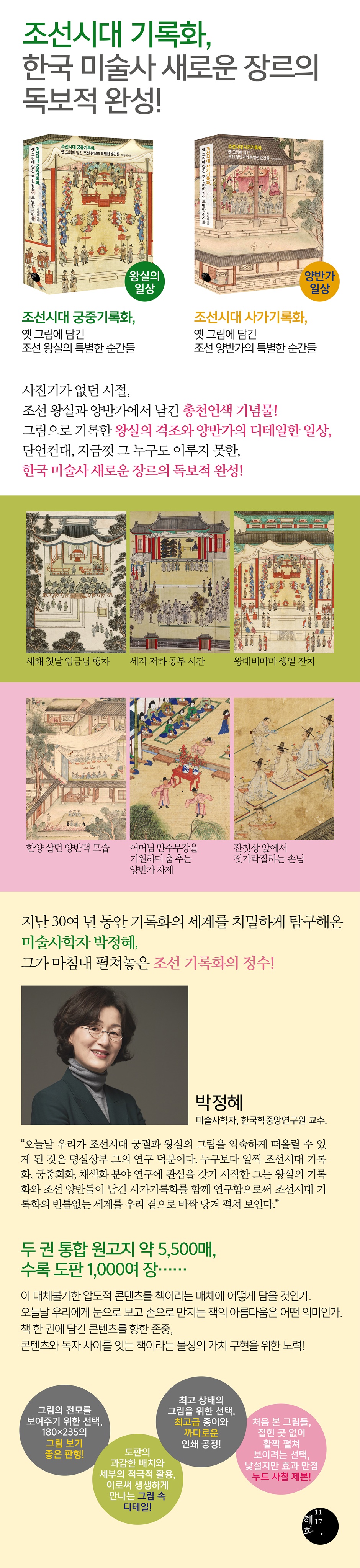
The records and commemorative paintings of the Joseon Dynasty and the noble families,
Who drew it, why, how, and what does it mean?
Art historian Park Jeong-hye finally finds the answer to this question.
We cannot leave out the name of art historian Park Jeong-hye when it comes to how we can now so familiarly recall Joseon Dynasty palaces and royal paintings.
Thanks to his steady and silent exploration of Joseon Dynasty documentary paintings, court paintings, and color paintings, which he took an interest in earlier than anyone else, the world of Korean art, which had been centered on literati paintings and ink paintings, expanded significantly, and before we knew it, the various documentary paintings and beautiful color paintings produced in palaces and government offices became an indispensable genre in our art history.
Since he first revealed to us the extraordinary world of the so-called private records left by the Joseon yangban class in 2022, he has once again revealed to us the entirety of the Joseon court records that he has been paving the way for over the past 30 years.
Because he had been engrossed in the study of documentary painting for a long time, earlier than anyone else, Korean colored painting and documentary painting, which had been considered as mere references among popular subjects in Korean art history before his eyes, have now become a genre in their own right.
He did not stop there, but steadily honed this path throughout his life as a scholar.
The accumulation of that time eventually became the history of the exploration of documentary painting itself in Korean art history, and the vast world of Korean painting history finally unfolded before us in a grand and beautiful way.
The result of the author's meticulous research over 30 years,
Approximately 3,000 pages of manuscript paper, 600 illustrations included…
What does the beauty of books that we see with our eyes and touch with our hands mean to us today?
Respect for the content contained in a book,
Efforts to realize the physical value of books as a link between content and readers
What does the beauty of books that we see with our eyes and touch with our hands mean to us today?
How should the author's decades of intense research be honored through a book?
How should the authority of the overwhelming content—approximately 3,000 pages of manuscript paper and 600 illustrations—be realized in a single book?
In this age where dozens, even hundreds, of books are published every day, in this age where lighthearted and easy-to-read content is gaining traction, how can we properly and accurately convey this irreplaceable content through the medium of books?
In line with these concerns, this book adopted a large format to show the true nature of the paintings, a bold layout of the plates and active use of details, a binding method to properly display the paintings that most readers will encounter for the first time in their lives, and selection of paper to ensure high-quality printing.
The final product is 880 pages and costs 70,000 won.
Behind this book, which we first encounter with these overwhelming numbers, flows an attitude of respect for the content and readers that cannot be expressed in numbers, something that can only be possessed through the physical properties of a book.
Who drew it, why, how, and what does it mean?
Art historian Park Jeong-hye finally finds the answer to this question.
We cannot leave out the name of art historian Park Jeong-hye when it comes to how we can now so familiarly recall Joseon Dynasty palaces and royal paintings.
Thanks to his steady and silent exploration of Joseon Dynasty documentary paintings, court paintings, and color paintings, which he took an interest in earlier than anyone else, the world of Korean art, which had been centered on literati paintings and ink paintings, expanded significantly, and before we knew it, the various documentary paintings and beautiful color paintings produced in palaces and government offices became an indispensable genre in our art history.
Since he first revealed to us the extraordinary world of the so-called private records left by the Joseon yangban class in 2022, he has once again revealed to us the entirety of the Joseon court records that he has been paving the way for over the past 30 years.
Because he had been engrossed in the study of documentary painting for a long time, earlier than anyone else, Korean colored painting and documentary painting, which had been considered as mere references among popular subjects in Korean art history before his eyes, have now become a genre in their own right.
He did not stop there, but steadily honed this path throughout his life as a scholar.
The accumulation of that time eventually became the history of the exploration of documentary painting itself in Korean art history, and the vast world of Korean painting history finally unfolded before us in a grand and beautiful way.
The result of the author's meticulous research over 30 years,
Approximately 3,000 pages of manuscript paper, 600 illustrations included…
What does the beauty of books that we see with our eyes and touch with our hands mean to us today?
Respect for the content contained in a book,
Efforts to realize the physical value of books as a link between content and readers
What does the beauty of books that we see with our eyes and touch with our hands mean to us today?
How should the author's decades of intense research be honored through a book?
How should the authority of the overwhelming content—approximately 3,000 pages of manuscript paper and 600 illustrations—be realized in a single book?
In this age where dozens, even hundreds, of books are published every day, in this age where lighthearted and easy-to-read content is gaining traction, how can we properly and accurately convey this irreplaceable content through the medium of books?
In line with these concerns, this book adopted a large format to show the true nature of the paintings, a bold layout of the plates and active use of details, a binding method to properly display the paintings that most readers will encounter for the first time in their lives, and selection of paper to ensure high-quality printing.
The final product is 880 pages and costs 70,000 won.
Behind this book, which we first encounter with these overwhelming numbers, flows an attitude of respect for the content and readers that cannot be expressed in numbers, something that can only be possessed through the physical properties of a book.
GOODS SPECIFICS
- Date of issue: November 30, 2024
- Format: Guide to book binding methods for four-sided binding
- Page count, weight, size: 880 pages | 180*235*40mm
- ISBN13: 9791191133288
- ISBN10: 1191133281
You may also like
카테고리
korean


korean

![GQ KOREA Mark (Monthly): December [2025]](http://librairie.coreenne.fr/cdn/shop/files/8ef265dbbfbf186523ed75ba7319009d.jpg?v=1765340328&width=3840)


