

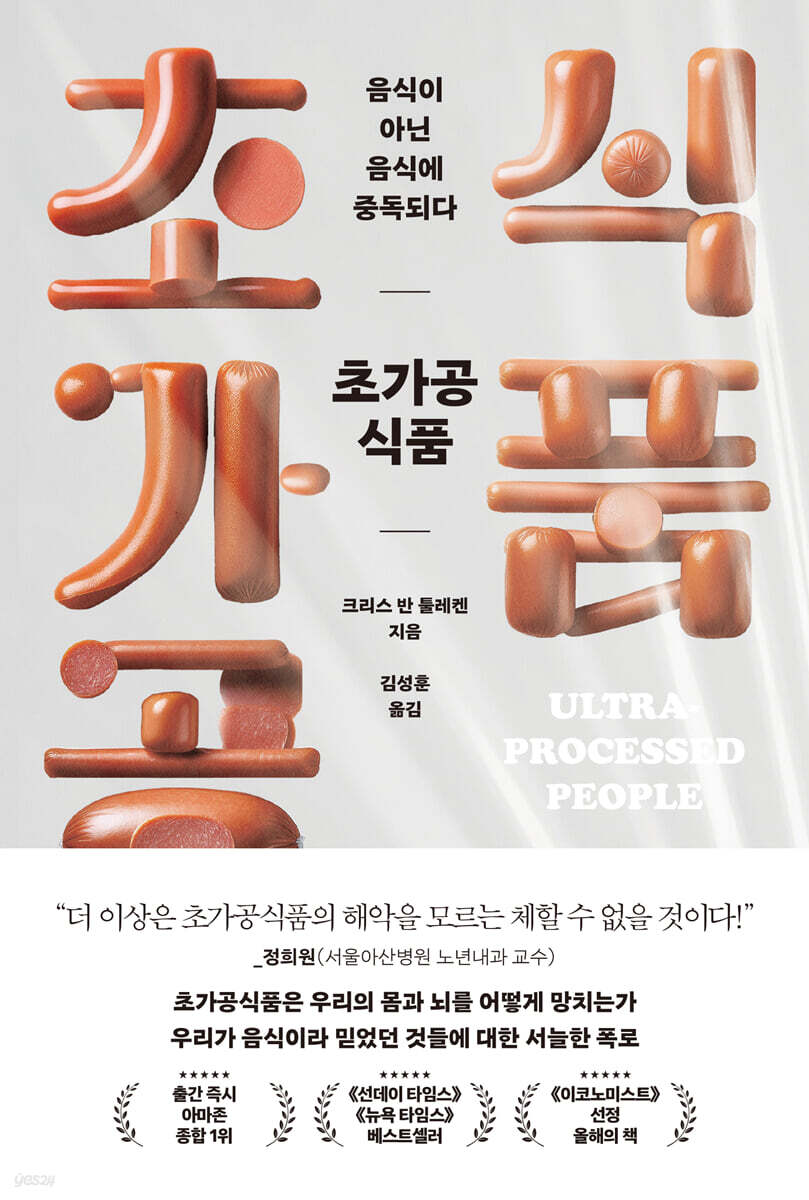
Ultra-processed foods, addicted to non-food foods
 |
Description
Book Introduction
- A word from MD
-
What we ate was poisonWhen you think of ultra-processed foods, what comes to mind? Most people think of fast food like hamburgers, but the scope of ultra-processed foods is much broader.
Organic foods can also be ultra-processed foods.
This book defines the ultra-processed foods that have taken over our tables and exposes their dangers.
The food we eat is actually poison.
October 18, 2024. Humanities PD Son Min-gyu
How Ultra-Processed Foods Destroy Our Bodies and Brains
A chilling revelation about what we thought was food.
“The process of learning about what really happens behind the food we eat on a daily basis has been a series of surprises.
"
- Jeong Hee-won (Professor of Geriatrics, Seoul Asan Medical Center)
☆ #1 Amazon Comprehensive Bestseller immediately after publication
☆《Sunday Times》Bestseller
☆New York Times Bestseller
☆ Selected as the 2023 Economist Book of the Year
☆ Selected as Amazon's Book of the Year 2023
Why do some hamburgers never go bad, ice cream never melt, and potato chips keep us eating even when we're full? "Ultra-Processed Foods: Addicted to Food That's Not Food" is a book that provides concrete and honest answers to the questions I've encountered while eating some rather unsavory foods.
Ultra-processed foods are the result of meticulous engineering designed to extend shelf life as much as possible, facilitate distribution, and accustom consumers to stimulating tastes.
The ultra-processed food industry, which is created solely for profit, will not hesitate to do things that should never be done to human food, as long as it can make a lot of profit.
What on earth are we eating? According to this book, the answer can be summarized in a single sentence.
“Ultra-processed foods are not food.
“It is just an industrially produced edible substance.”
It can be said that everyone knows that ultra-processed foods are bad.
But it's different when we eat knowing what we're eating and how it affects us.
Ultra-processed foods have been leading the charge for several years now as some of the most dangerous foods, but the reasons for their danger have not been clearly revealed.
This book is a reportage that exposes the disgusting truth about the food industry, a courageous and controversial accusation, and a persuasive health guide that suggests a healthy diet to readers.
By the time you finish reading, you will naturally develop an aversion to ultra-processed foods and gradually distance yourself from them.
A chilling revelation about what we thought was food.
“The process of learning about what really happens behind the food we eat on a daily basis has been a series of surprises.
"
- Jeong Hee-won (Professor of Geriatrics, Seoul Asan Medical Center)
☆ #1 Amazon Comprehensive Bestseller immediately after publication
☆《Sunday Times》Bestseller
☆New York Times Bestseller
☆ Selected as the 2023 Economist Book of the Year
☆ Selected as Amazon's Book of the Year 2023
Why do some hamburgers never go bad, ice cream never melt, and potato chips keep us eating even when we're full? "Ultra-Processed Foods: Addicted to Food That's Not Food" is a book that provides concrete and honest answers to the questions I've encountered while eating some rather unsavory foods.
Ultra-processed foods are the result of meticulous engineering designed to extend shelf life as much as possible, facilitate distribution, and accustom consumers to stimulating tastes.
The ultra-processed food industry, which is created solely for profit, will not hesitate to do things that should never be done to human food, as long as it can make a lot of profit.
What on earth are we eating? According to this book, the answer can be summarized in a single sentence.
“Ultra-processed foods are not food.
“It is just an industrially produced edible substance.”
It can be said that everyone knows that ultra-processed foods are bad.
But it's different when we eat knowing what we're eating and how it affects us.
Ultra-processed foods have been leading the charge for several years now as some of the most dangerous foods, but the reasons for their danger have not been clearly revealed.
This book is a reportage that exposes the disgusting truth about the food industry, a courageous and controversial accusation, and a persuasive health guide that suggests a healthy diet to readers.
By the time you finish reading, you will naturally develop an aversion to ultra-processed foods and gradually distance yourself from them.
- You can preview some of the book's contents.
Preview
index
Part 1: Ultra-processed foods, food that isn't food
Chapter 1: Ice Cream That Doesn't Melt
Chapter 2: Chocolate-flavored cereal is an incredible feat of engineering.
Chapter 3: How Ultra-Processed Foods Destroy Your Health
Chapter 4: The Ultimate Ultra-Processed Food: Coal Butter
Part 2: Misconceptions and Truths Surrounding Eating
Chapter 5: How We Evolved to Eat
Chapter 6: Why Self-Regulation is at Risk
Chapter 7: Sugar gets too much flak
Chapter 8 It's Not Your Willpower
Chapter 9: Poor Children Stuck in the Food Swamp
Chapter 10: Some Foods Hack Your Brain
Part 3: How Our Bodies and Brains Destroy
Chapter 11: Ultra-processed foods are pre-chewed.
Chapter 12 Ultra-processed foods have a fishy smell.
Chapter 13: Ultra-processed foods taste weird.
Chapter 14: The World of Food Additives
Part 4: The Dangerous Table
Chapter 15 Regulatory Blind Spots
Chapter 16 The End of the Traditional Diet
Chapter 17 The Real Price of Pringles
Part 5 What We Can Do
Chapter 18 How to Induce Overeating
Chapter 19 What You Can Ask the Government to Do
Chapter 20 What to do if you want to change
Chapter 1: Ice Cream That Doesn't Melt
Chapter 2: Chocolate-flavored cereal is an incredible feat of engineering.
Chapter 3: How Ultra-Processed Foods Destroy Your Health
Chapter 4: The Ultimate Ultra-Processed Food: Coal Butter
Part 2: Misconceptions and Truths Surrounding Eating
Chapter 5: How We Evolved to Eat
Chapter 6: Why Self-Regulation is at Risk
Chapter 7: Sugar gets too much flak
Chapter 8 It's Not Your Willpower
Chapter 9: Poor Children Stuck in the Food Swamp
Chapter 10: Some Foods Hack Your Brain
Part 3: How Our Bodies and Brains Destroy
Chapter 11: Ultra-processed foods are pre-chewed.
Chapter 12 Ultra-processed foods have a fishy smell.
Chapter 13: Ultra-processed foods taste weird.
Chapter 14: The World of Food Additives
Part 4: The Dangerous Table
Chapter 15 Regulatory Blind Spots
Chapter 16 The End of the Traditional Diet
Chapter 17 The Real Price of Pringles
Part 5 What We Can Do
Chapter 18 How to Induce Overeating
Chapter 19 What You Can Ask the Government to Do
Chapter 20 What to do if you want to change
Detailed image

Into the book
Let's put everything aside and fully experience the horror of ultra-processed foods.
This does not mean that you should binge or overeat.
Just stop resisting ultra-processed foods.
I did that for 4 weeks.
If you feel like you should try it, I encourage you to do so until you finish reading this book.
You might question whether it's ethically right to encourage you to do this, but I actually don't feel particularly uncomfortable about it.
First, you are already surrounded by an environment that promotes ultra-processed foods all day long.
Second, if you're a typical person, you're already getting about 60 percent of your calories from ultra-processed foods, so increasing that to 80 percent for a month won't make much of a difference.
While you're reading this book, I encourage you to also read the ingredient lists on the back of the food packaging you're eating.
The list would contain too many substances to list in detail in this book.
But by the end of this book, I hope you understand that everything from marketing strategies to why you strangely don't feel full after eating is harming your health.
And you may come to understand that many of the problems in your life that you thought were caused by getting older, having children, or work stress are actually caused by the food you eat.
--- From the "Preface"
Things like pies, fried chicken, pizza, butter, pancake mix, pastries, gravy, and mayonnaise all started as real food.
However, because non-ultra-processed foods are expensive, traditional ingredients are often replaced with cheaper ones.
Synthetic materials are also used.
These alternative ingredients are typically derived from crops grown for animal feed.
In some countries, these crops are heavily subsidized, making them extremely cheap.
Paul said that he refines and denatures the molecules from here so that he can make anything from them.
--- From "Chapter 1: Ice Cream That Doesn't Melt"
And I ate, and ate, and ate.
As I watched, it seemed like a child had completely lost control.
The packaging said the recommended serving size for an adult was 30 grams, or roughly a handful.
But Lira ate 30 grams without even taking a deep breath.
Usually at mealtimes, I have to do all sorts of tricks to get my child to eat.
But in the blink of an eye, a bowl of Coco Pops disappeared.
I told the child that one bowl would be enough, but the child didn't listen.
What I meant was like telling a smoker to only smoke one cigarette at a time.
The child went beyond just eating mindlessly; he ate as if he were in a state of trance.
--- From "Chapter 2 Chocolate Flavored Cereal is an Amazing Triumph of Engineering"
A study published in 2022 in the journal Neurology looked at data from more than 72,000 people.
As a result, a 10 percent increase in ultra-processed food intake was associated with a 25 percent increase in the risk of dementia and a 14 percent increase in the risk of Alzheimer's disease.
These various impacts on health are by no means small.
A large study in Italy found that even after adjusting for dietary patterns, the quarter of participants who ate the most ultra-processed foods had a 26 percent higher risk of death compared to the quarter who ate the least.
A similarly adjusted American study reported similar results.
A study of 60,000 British patients found a 22 percent increased risk of all-cause mortality.
A Spanish study found a 62 percent increased risk of all-cause mortality.
Effects of this magnitude are typical of almost all studies.
--- From "Chapter 3 How Ultra-Processed Foods Ruin Your Health"
The cold hard logic that applies to all industrial foods is that workers' meal times must be reduced.
I think of this every time I see a lunch box consisting of ultra-processed potato chips, ultra-processed soft drinks, and ultra-processed sandwiches.
When I interviewed the Brazilian research team that came up with the definition of ultra-processed foods and conducted numerous studies on the concept, I asked them about their eating habits.
They answered that they take the time to prepare a meal of rice and beans every day at lunchtime.
I did that too when I worked in Brazil.
In the modern world, sitting down to eat lunch has become a symbol of a healthy life.
--- From "Chapter 4: The Ultimate Ultra-Processed Food, Coal Butter"
By the fourth week of the diet experiment, noticeable physical effects were immediately apparent.
I didn't weigh myself, but I had to loosen my belt two notches.
And as I gained weight, my family gained weight too.
It was impossible to stop the kids from going after Coco Pops, pizza, oven-baked chips, lasagna, and chocolate.
Whenever I tried to sneak out and eat, Lira would find me and throw a tantrum, insisting that we eat together.
It is difficult to separate the impact of ultra-processed foods from the impact of our normal lifestyle.
I was having a lot of disturbing dreams.
Usually, it was a dream about the death of my daughters.
That's not to say I've never had dreams like this before, but I don't remember having them during the time I was purging my body and not eating ultra-processed foods.
I was now eating a lot of salt.
So I had to drink more water and urinate more.
Could this be why I'm dreaming? I often wake up around 3 or 4 a.m. from nightmares, the need to urinate, or both.
Then I couldn't sleep, so I went to the kitchen and had a snack.
Usually, I ate it because I was bored.
--- From "Chapter 10: Some Foods Hack Your Brain"
A hamburger from McDonald's, Burger King, or any other ultra-processed food supplier is another perfect example of this illusion.
The series of textures you experience when you take your first bite are rewarding and satisfying.
The sweet bun provides a dry, crispy texture on top of the creamy, spongy matrix, and the patty has a rubbery chewiness and a salty, seawater flavor.
And the pickled cucumbers and onions add a crunch, the mustard tickles your trigeminal nerves, and the acidity of the ketchup enhances the whole experience.
Although they are described as 'spongy', 'rubbery', and 'crunchy', they are actually all as soft as cotton.
So, you can almost inhale and finish off a burger in less than a minute.
And I have to eat one more.
Because I'm still hungry.
This does not mean that you should binge or overeat.
Just stop resisting ultra-processed foods.
I did that for 4 weeks.
If you feel like you should try it, I encourage you to do so until you finish reading this book.
You might question whether it's ethically right to encourage you to do this, but I actually don't feel particularly uncomfortable about it.
First, you are already surrounded by an environment that promotes ultra-processed foods all day long.
Second, if you're a typical person, you're already getting about 60 percent of your calories from ultra-processed foods, so increasing that to 80 percent for a month won't make much of a difference.
While you're reading this book, I encourage you to also read the ingredient lists on the back of the food packaging you're eating.
The list would contain too many substances to list in detail in this book.
But by the end of this book, I hope you understand that everything from marketing strategies to why you strangely don't feel full after eating is harming your health.
And you may come to understand that many of the problems in your life that you thought were caused by getting older, having children, or work stress are actually caused by the food you eat.
--- From the "Preface"
Things like pies, fried chicken, pizza, butter, pancake mix, pastries, gravy, and mayonnaise all started as real food.
However, because non-ultra-processed foods are expensive, traditional ingredients are often replaced with cheaper ones.
Synthetic materials are also used.
These alternative ingredients are typically derived from crops grown for animal feed.
In some countries, these crops are heavily subsidized, making them extremely cheap.
Paul said that he refines and denatures the molecules from here so that he can make anything from them.
--- From "Chapter 1: Ice Cream That Doesn't Melt"
And I ate, and ate, and ate.
As I watched, it seemed like a child had completely lost control.
The packaging said the recommended serving size for an adult was 30 grams, or roughly a handful.
But Lira ate 30 grams without even taking a deep breath.
Usually at mealtimes, I have to do all sorts of tricks to get my child to eat.
But in the blink of an eye, a bowl of Coco Pops disappeared.
I told the child that one bowl would be enough, but the child didn't listen.
What I meant was like telling a smoker to only smoke one cigarette at a time.
The child went beyond just eating mindlessly; he ate as if he were in a state of trance.
--- From "Chapter 2 Chocolate Flavored Cereal is an Amazing Triumph of Engineering"
A study published in 2022 in the journal Neurology looked at data from more than 72,000 people.
As a result, a 10 percent increase in ultra-processed food intake was associated with a 25 percent increase in the risk of dementia and a 14 percent increase in the risk of Alzheimer's disease.
These various impacts on health are by no means small.
A large study in Italy found that even after adjusting for dietary patterns, the quarter of participants who ate the most ultra-processed foods had a 26 percent higher risk of death compared to the quarter who ate the least.
A similarly adjusted American study reported similar results.
A study of 60,000 British patients found a 22 percent increased risk of all-cause mortality.
A Spanish study found a 62 percent increased risk of all-cause mortality.
Effects of this magnitude are typical of almost all studies.
--- From "Chapter 3 How Ultra-Processed Foods Ruin Your Health"
The cold hard logic that applies to all industrial foods is that workers' meal times must be reduced.
I think of this every time I see a lunch box consisting of ultra-processed potato chips, ultra-processed soft drinks, and ultra-processed sandwiches.
When I interviewed the Brazilian research team that came up with the definition of ultra-processed foods and conducted numerous studies on the concept, I asked them about their eating habits.
They answered that they take the time to prepare a meal of rice and beans every day at lunchtime.
I did that too when I worked in Brazil.
In the modern world, sitting down to eat lunch has become a symbol of a healthy life.
--- From "Chapter 4: The Ultimate Ultra-Processed Food, Coal Butter"
By the fourth week of the diet experiment, noticeable physical effects were immediately apparent.
I didn't weigh myself, but I had to loosen my belt two notches.
And as I gained weight, my family gained weight too.
It was impossible to stop the kids from going after Coco Pops, pizza, oven-baked chips, lasagna, and chocolate.
Whenever I tried to sneak out and eat, Lira would find me and throw a tantrum, insisting that we eat together.
It is difficult to separate the impact of ultra-processed foods from the impact of our normal lifestyle.
I was having a lot of disturbing dreams.
Usually, it was a dream about the death of my daughters.
That's not to say I've never had dreams like this before, but I don't remember having them during the time I was purging my body and not eating ultra-processed foods.
I was now eating a lot of salt.
So I had to drink more water and urinate more.
Could this be why I'm dreaming? I often wake up around 3 or 4 a.m. from nightmares, the need to urinate, or both.
Then I couldn't sleep, so I went to the kitchen and had a snack.
Usually, I ate it because I was bored.
--- From "Chapter 10: Some Foods Hack Your Brain"
A hamburger from McDonald's, Burger King, or any other ultra-processed food supplier is another perfect example of this illusion.
The series of textures you experience when you take your first bite are rewarding and satisfying.
The sweet bun provides a dry, crispy texture on top of the creamy, spongy matrix, and the patty has a rubbery chewiness and a salty, seawater flavor.
And the pickled cucumbers and onions add a crunch, the mustard tickles your trigeminal nerves, and the acidity of the ketchup enhances the whole experience.
Although they are described as 'spongy', 'rubbery', and 'crunchy', they are actually all as soft as cotton.
So, you can almost inhale and finish off a burger in less than a minute.
And I have to eat one more.
Because I'm still hungry.
--- From "Chapter 11 Ultra-processed foods are pre-chewed"
Publisher's Review
Ultra-processed foods aren't actually food.
It is just an industrially produced edible substance.
Let's take out the food you bought at the supermarket and stored in the kitchen cupboard and take a look at the ingredient list.
Modified corn starch, soy lecithin, acidity regulator, guar gum, maltodextrin, palm stearin, protein isolate, dextrose, artificial colors, flavors, sweeteners, stabilizers…
It is filled with small letters that are difficult to read.
These ingredients are made using sophisticated equipment and complex processes.
Crops such as corn and soybeans are broken down into components such as oil, protein, and starch, chemically denatured, and then combined with additives and assembled using industrial techniques such as molding, extrusion, and pressure.
It is no exaggeration to say that ultra-processed foods are a triumph of ever-evolving processing science.
Chris Van Tulleken, author of the book "Ultra-Processed Foods: Addicted to Food That Isn't Food," says that if a food's ingredients list contains even one ingredient that is not commonly found in an average kitchen, then that food is considered "ultra-processed."
By this standard, it is difficult to find food that is not ultra-processed.
However, at some point, ultra-processed foods emerged as a leading example of dangerous foods.
How do ultra-processed foods affect our bodies?
Cancer, cardiovascular disease, dementia, obesity, type 2 diabetes, metabolic diseases, eating disorders…
Ultra-processed foods may be the primary cause of all diseases.
Chris decided to use his own body to find out how ultra-processed foods affect his body.
It was a four-week dietary experiment in which more than 80 percent of daily calories were consumed from ultra-processed foods.
(This experiment is covered in detail in the viral BBC documentary, What Are We Feeding Our Kids?) After the experiment, Chris's body underwent several changes.
I gained 7 kilograms, developed indigestion, constipation, and anal fissures, had difficulty concentrating, and had trouble sleeping.
One of the most significant changes Chris noticed was that his appetite hormones were completely out of whack.
Hormones that signal fullness barely responded even after a full meal, while hunger hormones spiked immediately afterward.
Leptin, a hormone produced by fat, was five times higher, and levels indicating inflammation doubled.
These results, which suggest that appetite hormones are not functioning normally, are similar to those of a 2019 experiment conducted by Kevin Hall's research team.
The researchers fed 20 adults an ultra-processed diet and an unprocessed diet for two weeks, and then switched the diets between the two groups after two weeks.
Salt, sugar, and fat content were strictly limited, and participants were allowed to eat as much food as they wanted.
The results of the experiment showed that people on the ultra-processed diet ate an average of 500 more calories per day than those on the unprocessed diet, and of course, gained weight.
What's surprising is that participants on the unprocessed diet actually lost weight, even though they could eat as much as they wanted.
It's not like ultra-processed foods are any tastier.
Beyond the 'taste', there was something else that made us overeat ultra-processed foods.
Since this study, a growing body of evidence has emerged showing that ultra-processed foods may be a primary cause of the global surge in health problems.
Ultra-processed foods are foods that have been pre-chewed.
How Soft, Dry Textures Lead to Overeating
Some argue that ultra-processed foods are unhealthy simply because they are high in saturated fat, sodium, and sugar, while being poor in nutrients.
However, studies that correct for all these factors also yield the same results.
This book presents various research examples and argues that the reason ultra-processed foods are harmful is not simply because they are high in fat, salt, or sugar.
It's not the nutritional content that's the problem, but the way it's processed.
For example, industrially denatured, powdered, and compressed foods have their fiber structure completely destroyed, while at the same time they become very soft and easy to chew.
In fact, it is like 'something that was chewed up in advance'.
The softer the food, the more we eat it, and the faster and more we eat it, which not only hinders the development of the jawbone, but also causes dental problems.
Additionally, ultra-processed foods are not only soft but also very dry.
Dryness is extremely important in ultra-processed foods because it significantly extends shelf life by preventing microbial growth within the food.
This is contributing to increasing the profitability of ultra-processed foods.
Cheap ingredients, long shelf life, strong branding
The goal of ultra-processed foods is to create profitable products.
This book delves beyond the health risks of ultra-processed foods and delves deeply into the detrimental impacts of ultra-processed foods on our social and cultural contexts.
Ultra-processed foods are made to maximize profits using extremely cheap ingredients and long shelf lives.
When we think of food processing, we usually think of physically handling food.
But 'hyper-processing' also involves indirect processes such as deceptive marketing, secret lobbying, and fraudulent research to mislead consumers.
All of these factors play a key role in helping companies squeeze money out of consumers' pockets.
This book provides a macroscopic view of how the greed of the food industry has led to the production of edible substances that are no longer food, and the extent to which eating behaviors can affect the world today.
Chris uses examples like the food swamp (areas where there are too many fast food outlets selling ultra-processed foods, making fresh food difficult to find) and the aggressive marketing of ultra-processed foods to children to show that we can no longer ignore this problem and that the issue of what to eat is a pressing one when we think about our children.
We think we choose our own food, but how we choose food is not our personal choice, and no one is free within a food environment designed from which we can never escape.
“We have the right to good food.”
The first step toward solving the ultra-processed food problem
On September 27, 2023, about five months after the book was published in the UK, articles making similar claims appeared simultaneously in all major daily newspapers.
The Times ran an article titled "Are Ultra-Processed Foods Bad for You? Scientists Say Not Always," and The Independent ran an article titled "10 Ultra-Processed Foods That Are Actually Good for You."
The articles featured material from a recent press conference in which five scientists stated that the science behind ultra-processed foods “cannot prove causation.”
However, four of the scientists had significant ties to ultra-processed food manufacturers.
This book argues strongly that researchers publishing research on food should have no conflicts of interest with the food industry.
According to the book, countless studies were funded by giant food companies such as Coca-Cola and Nestlé.
So now we cannot help but ask:
Are the numerous health news stories we see in the media truly trustworthy?
This book presents two fundamental solutions to the problem of ultra-processed foods.
First, put warning labels on hazardous foods.
A labeling system alone would allow people to identify which foods to avoid, a policy that is already working in several Latin American countries.
Second, end conflicts of interest.
Nutrition professionals and organizations should absolutely avoid financial relationships, partnerships, and co-branding with food companies.
This book tells readers that dietary issues, which are greatly influenced by food environment and policies, are by no means individual problems.
We know we should make healthy choices, but we live in a food environment that makes it nearly impossible.
So this book is about our rights.
The right to know what we are eating and how it affects our bodies, and the right to eat good food.
It is just an industrially produced edible substance.
Let's take out the food you bought at the supermarket and stored in the kitchen cupboard and take a look at the ingredient list.
Modified corn starch, soy lecithin, acidity regulator, guar gum, maltodextrin, palm stearin, protein isolate, dextrose, artificial colors, flavors, sweeteners, stabilizers…
It is filled with small letters that are difficult to read.
These ingredients are made using sophisticated equipment and complex processes.
Crops such as corn and soybeans are broken down into components such as oil, protein, and starch, chemically denatured, and then combined with additives and assembled using industrial techniques such as molding, extrusion, and pressure.
It is no exaggeration to say that ultra-processed foods are a triumph of ever-evolving processing science.
Chris Van Tulleken, author of the book "Ultra-Processed Foods: Addicted to Food That Isn't Food," says that if a food's ingredients list contains even one ingredient that is not commonly found in an average kitchen, then that food is considered "ultra-processed."
By this standard, it is difficult to find food that is not ultra-processed.
However, at some point, ultra-processed foods emerged as a leading example of dangerous foods.
How do ultra-processed foods affect our bodies?
Cancer, cardiovascular disease, dementia, obesity, type 2 diabetes, metabolic diseases, eating disorders…
Ultra-processed foods may be the primary cause of all diseases.
Chris decided to use his own body to find out how ultra-processed foods affect his body.
It was a four-week dietary experiment in which more than 80 percent of daily calories were consumed from ultra-processed foods.
(This experiment is covered in detail in the viral BBC documentary, What Are We Feeding Our Kids?) After the experiment, Chris's body underwent several changes.
I gained 7 kilograms, developed indigestion, constipation, and anal fissures, had difficulty concentrating, and had trouble sleeping.
One of the most significant changes Chris noticed was that his appetite hormones were completely out of whack.
Hormones that signal fullness barely responded even after a full meal, while hunger hormones spiked immediately afterward.
Leptin, a hormone produced by fat, was five times higher, and levels indicating inflammation doubled.
These results, which suggest that appetite hormones are not functioning normally, are similar to those of a 2019 experiment conducted by Kevin Hall's research team.
The researchers fed 20 adults an ultra-processed diet and an unprocessed diet for two weeks, and then switched the diets between the two groups after two weeks.
Salt, sugar, and fat content were strictly limited, and participants were allowed to eat as much food as they wanted.
The results of the experiment showed that people on the ultra-processed diet ate an average of 500 more calories per day than those on the unprocessed diet, and of course, gained weight.
What's surprising is that participants on the unprocessed diet actually lost weight, even though they could eat as much as they wanted.
It's not like ultra-processed foods are any tastier.
Beyond the 'taste', there was something else that made us overeat ultra-processed foods.
Since this study, a growing body of evidence has emerged showing that ultra-processed foods may be a primary cause of the global surge in health problems.
Ultra-processed foods are foods that have been pre-chewed.
How Soft, Dry Textures Lead to Overeating
Some argue that ultra-processed foods are unhealthy simply because they are high in saturated fat, sodium, and sugar, while being poor in nutrients.
However, studies that correct for all these factors also yield the same results.
This book presents various research examples and argues that the reason ultra-processed foods are harmful is not simply because they are high in fat, salt, or sugar.
It's not the nutritional content that's the problem, but the way it's processed.
For example, industrially denatured, powdered, and compressed foods have their fiber structure completely destroyed, while at the same time they become very soft and easy to chew.
In fact, it is like 'something that was chewed up in advance'.
The softer the food, the more we eat it, and the faster and more we eat it, which not only hinders the development of the jawbone, but also causes dental problems.
Additionally, ultra-processed foods are not only soft but also very dry.
Dryness is extremely important in ultra-processed foods because it significantly extends shelf life by preventing microbial growth within the food.
This is contributing to increasing the profitability of ultra-processed foods.
Cheap ingredients, long shelf life, strong branding
The goal of ultra-processed foods is to create profitable products.
This book delves beyond the health risks of ultra-processed foods and delves deeply into the detrimental impacts of ultra-processed foods on our social and cultural contexts.
Ultra-processed foods are made to maximize profits using extremely cheap ingredients and long shelf lives.
When we think of food processing, we usually think of physically handling food.
But 'hyper-processing' also involves indirect processes such as deceptive marketing, secret lobbying, and fraudulent research to mislead consumers.
All of these factors play a key role in helping companies squeeze money out of consumers' pockets.
This book provides a macroscopic view of how the greed of the food industry has led to the production of edible substances that are no longer food, and the extent to which eating behaviors can affect the world today.
Chris uses examples like the food swamp (areas where there are too many fast food outlets selling ultra-processed foods, making fresh food difficult to find) and the aggressive marketing of ultra-processed foods to children to show that we can no longer ignore this problem and that the issue of what to eat is a pressing one when we think about our children.
We think we choose our own food, but how we choose food is not our personal choice, and no one is free within a food environment designed from which we can never escape.
“We have the right to good food.”
The first step toward solving the ultra-processed food problem
On September 27, 2023, about five months after the book was published in the UK, articles making similar claims appeared simultaneously in all major daily newspapers.
The Times ran an article titled "Are Ultra-Processed Foods Bad for You? Scientists Say Not Always," and The Independent ran an article titled "10 Ultra-Processed Foods That Are Actually Good for You."
The articles featured material from a recent press conference in which five scientists stated that the science behind ultra-processed foods “cannot prove causation.”
However, four of the scientists had significant ties to ultra-processed food manufacturers.
This book argues strongly that researchers publishing research on food should have no conflicts of interest with the food industry.
According to the book, countless studies were funded by giant food companies such as Coca-Cola and Nestlé.
So now we cannot help but ask:
Are the numerous health news stories we see in the media truly trustworthy?
This book presents two fundamental solutions to the problem of ultra-processed foods.
First, put warning labels on hazardous foods.
A labeling system alone would allow people to identify which foods to avoid, a policy that is already working in several Latin American countries.
Second, end conflicts of interest.
Nutrition professionals and organizations should absolutely avoid financial relationships, partnerships, and co-branding with food companies.
This book tells readers that dietary issues, which are greatly influenced by food environment and policies, are by no means individual problems.
We know we should make healthy choices, but we live in a food environment that makes it nearly impossible.
So this book is about our rights.
The right to know what we are eating and how it affects our bodies, and the right to eat good food.
GOODS SPECIFICS
- Date of issue: October 5, 2024
- Page count, weight, size: 544 pages | 744g | 145*215*28mm
- ISBN13: 9788901288475
- ISBN10: 8901288478
You may also like
카테고리
korean


korean

![ELLE 엘르 스페셜 에디션 A형 : 12월 [2025]](http://librairie.coreenne.fr/cdn/shop/files/b8e27a3de6c9538896439686c6b0e8fb.jpg?v=1766436872&width=3840)


