

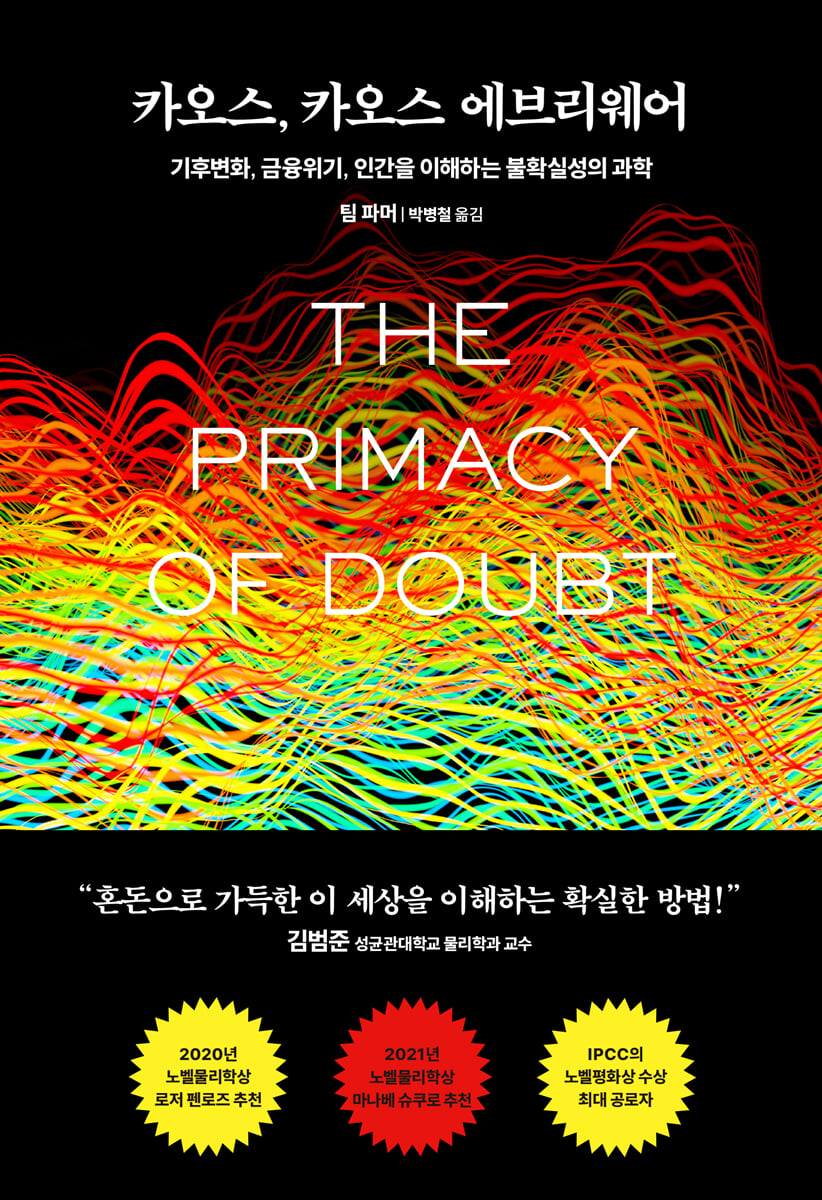
Chaos, Chaos Everywhere
 |
Description
Book Introduction
Understanding uncertainty is understanding the nature of the world. Physics of almost everything: climate, disease, economics, war, etc. “It is a sure way to understand this chaotic world.” - Kim Beom-jun (Professor of Physics, Sungkyunkwan University, author of "Physics of Worldly Affairs") ★Recommended by Nobel Prize in Physics winners Roger Penrose (2020) and Shukuro Manabe (2021)★ ★A scientist who established a probabilistic forecasting system and played a central role in the IPCC winning the Nobel Peace Prize★ Is it possible to predict the unpredictable? Tim Palmer, a theoretical physicist and meteorologist, delves deep into the core of this question: uncertainty. Being uncertain is no different from being difficult to predict. The 'ensemble forecasting technique' he laid the foundation for enabled probabilistic forecasting that helps in making rational decisions, rather than deterministic forecasting that does not sufficiently reflect reality. It is safe to say that Palmer is the person who created the current weather forecast system, which can express the appearance of the ever-changing weather with probability up to two weeks in advance. He starts with the weather, a representative example of nonlinearity (a property in which the change in output is not proportional to the change in input, i.e. a property in which cause and effect are not directly proportional), and analyzes and predicts viruses, the economy, and conflicts between countries in his own way. And he also shows himself as a philosopher who goes into the realm of free will, consciousness, and God. The world he saw was a place where nonlinear characteristics existed everywhere. It was chaos, uncertainty itself. The science of uncertainty, which allows us to see order in chaos and disorder in order, gives us a slightly more 'accurate tomorrow.' |
- You can preview some of the book's contents.
Preview
index
Translator's Note
introduction
Entering
Part 1: The Science of Uncertainty
Chapter 1: Chaos Everywhere
Chapter 2: Chaos Geometry
Chapter 3 Noise, Million Dollar Butterflies
Chapter 4 Quantum Uncertainty: The Lost Truth?
Part 2: Predicting Chaos
Chapter 5: Two Ways to Monte Carlo
Chapter 6 Climate Change: Catastrophe or Just a Blip?
Chapter 7: The Pandemic: Between the Virus and Politicians
Chapter 8: The Financial Crash: What if Meteorologists Could Forecast the Economy?
Chapter 9: Deadly Conflict: The Physics of War, Conflict, and Survival
Chapter 10: Make a Decision, Make a Decision!: How Science Communicates a Message
Part 3: What Are We and Where Do We Stand in a Chaotic Universe?
Chapter 11 Quantum Uncertainty: Reality Rediscovered?
Chapter 12 Our Brains Are Filled with Noise
Chapter 13 Free Will, Consciousness, and God
Acknowledgements
References
annotation
Search
introduction
Entering
Part 1: The Science of Uncertainty
Chapter 1: Chaos Everywhere
Chapter 2: Chaos Geometry
Chapter 3 Noise, Million Dollar Butterflies
Chapter 4 Quantum Uncertainty: The Lost Truth?
Part 2: Predicting Chaos
Chapter 5: Two Ways to Monte Carlo
Chapter 6 Climate Change: Catastrophe or Just a Blip?
Chapter 7: The Pandemic: Between the Virus and Politicians
Chapter 8: The Financial Crash: What if Meteorologists Could Forecast the Economy?
Chapter 9: Deadly Conflict: The Physics of War, Conflict, and Survival
Chapter 10: Make a Decision, Make a Decision!: How Science Communicates a Message
Part 3: What Are We and Where Do We Stand in a Chaotic Universe?
Chapter 11 Quantum Uncertainty: Reality Rediscovered?
Chapter 12 Our Brains Are Filled with Noise
Chapter 13 Free Will, Consciousness, and God
Acknowledgements
References
annotation
Search
Detailed image

Into the book
Towards the end of my PhD, I became an expert on black holes and was given the opportunity to work as a postdoctoral researcher in Hawking's research group at the University of Cambridge.
This was my first step as a theoretical physicist studying gravity.
But as graduation approached, I began to doubt whether this was really what I wanted to do.
Above all, the problem was that what I was going to do had nothing to do with people's well-being or happiness.
Moreover, I learned that there are very few physicists in the world who are truly interested in the details of my research.
--- From the "Preface"
Uncertainty is the essence of life.
The word itself doesn't sound very pleasant, but our lives are full of uncertainties.
No one knows if they will have a car accident next week or win the lottery and change their fate.
The further ahead you look, the greater the uncertainty.
What if another global financial crisis strikes in a few years, destroying all my investments? Or a global pandemic, the outbreak of World War III, or a drastic climate change? No matter how hard you look at it, nothing is certain.
But what kind of lives would we lead if we had the ability to accurately predict the future? Even if we could foresee what the future holds, would we still remain a creative and vibrant species?
--- From "Entering"
To conclude, there is no need to worry about the Earth being deviated from its orbit.
A team of researchers at Princeton University ran numerous simulations using an ensemble of different initial conditions, and never once did they reproduce the dire scenario of Earth leaving the solar system in the next few billion years.
That means the odds of Earth leaving the solar system are close to zero (though not completely zero!). Worryingly, however, this ensemble prediction suggests that in billions of years, Mercury's orbit will begin to drift slightly, giving it about a 1 percent chance of colliding with Venus.
Here we need to pay attention to the word nonlinear.
In general, a physical system in which input and output are not directly proportional is called a nonlinear system.
A close example is the relationship between lottery winnings and the level of joy.
If you won a million won lottery ticket, you would jump for joy.
But would winning 2 million won make you twice as happy? Sure, you'd be happier than if you'd won 1 million won, but the joy wouldn't be doubled.
Even if you win 10 million won in the super lottery, you won't be 10 times happier. (If you're incredibly rich, imagine converting 1 million won into 10 billion won.) This is the characteristic of nonlinear systems.
--- From "Chapter 1: Chaos Existing Everywhere"
The dimensions of the weather state space are truly beyond imagination.
Considering all the eddies that occur in the atmosphere, the space of weather states is larger than anything that can be represented on a computer.
It is impossible to express it, not to mention the supercomputers that currently exist, or even if a super-supercomputer appears in the future.
The state space of currently used weather forecast models easily exceeds 1 billion dimensions.
Of course, this can be processed to a supercomputer, but it is nothing compared to the dimensionality of the actual state space that weather can have.
The reason that future uncertainty varies greatly depending on the position of the initial uncertainty ring (small circle) is because the equations describing the system are nonlinear.
This characteristic can explain why large-scale events, such as the hurricane of October 1987 or the financial crisis of 2008, occur.
However, using an ensemble system, it is possible to issue advance warning when the system is moving into an unstable state where 'dramatic events may occur, but are not necessarily'.
--- From "Chapter 2: Chaos Geometry"
Experts in the 1950s believed that the atmosphere was so volatile and had vortices of varying sizes everywhere that it was impossible to predict.
Lorenz also said that the degrees of freedom of the atmosphere are only three, making it difficult to predict.
Both are correct.
In 1963, Lorenz concluded that models with three variables were too chaotic to be predictable, and in 1969 he proved that physical systems with many variables (large and small eddies) were more difficult to predict than systems with fewer variables.
However, the real reason why it is difficult to predict the state of the atmosphere lies in the latter, not the former.
--- From "Chapter 3: Noise, Million Dollar Butterflies"
Is the nature of uncertainty epistemological or ontological? If it's epistemological, quantum uncertainty means "physical systems are precisely defined, but our knowledge of them is incomplete." If it's ontological, it means "uncertainty is inherent in nature, whether we care about it or not."
Most physicists believe that quantum uncertainty is an ontological property (for reasons we will discuss later). Since the world we call reality is made up of innumerable quantum particles, this means that reality itself (which we take for granted) is uncertain.
--- From "Chapter 4 Quantum Uncertainty: The Lost Truth?"
Richardson's dream was finally realized after World War II with the advent of the first electronic digital computers.
After that, John von Neumann, a genius mathematician and physicist at Princeton University, organized a research team led by meteorologist Jul Charney and began developing a full-scale weather forecasting system.
Such models are based on physical laws such as the Navier-Stokes equations.
To distinguish them from the earlier models proposed by Fitzroy, Blandford, and Walker (also called data-driven models, models based on experience and statistics), we will call them physics-based models.
To run their physics-based model, Charney's research team used a "programmable electronic digital computer," known as the ENIAC, the first known computer.
How can we inject probabilistic concepts into models based on determinism? There are ways.
We can introduce the Monte Carlo calculation method developed by Reese a few years ago.
However, instead of taking the average of the forecasts like in Reese's, we need to predict the probability that various weather patterns will appear from the ensemble members.
In 1985, Murphy and I successfully built the world's first ensemble forecasting system based on a physics-based model.
--- From "Chapter 5 Two Roads to Monte Carlo"
Simply put, to accurately understand the impact of climate change on us, we need to accurately understand the level of uncertainty in the information provided.
How can we achieve this task? The ensemble technique used in weather forecasting in Chapter 5 is a classic method for assessing uncertainty.
In fact, we can never scientifically understand climate change without knowing the three functions of the ensemble.
The three functions I just mentioned are, first, estimating the uncertain feedback effects of climate science, second, evaluating the effectiveness of policies designed to address climate change, and third, distinguishing between naturally occurring and human-induced chaos.
It is a clear fact that the chaos world never takes the same path twice.
Therefore, we cannot be 100 percent sure that actual weather phenomena are caused by carbon emissions.
But that's not the point.
What's important is that the probability of the aforementioned disasters occurring due to climate change has increased by a factor of 100, from once in 1,000 years to once in 10 years.
Using these statistics, we can identify areas that need urgent improvement, such as strengthening forest management laws or building flood defense facilities.
--- From Chapter 6, “Climate Change: A Catastrophe or Just a Small Change”
British politicians have insisted that science should be followed as closely as possible when dealing with the pandemic.
But as with climate change, science itself doesn't advocate for any particular policy.
When we want to reduce the risks of climate change, climate science only recommends that reducing carbon emissions is beneficial, but does not mandate that we must reduce carbon emissions.
It is not science but humans who consider this to be an obligation.
Likewise, when trying to prevent a situation where medical services are paralyzed, scientific theories related to the coronavirus only recommend that "reducing interpersonal contact is advantageous," but do not mandate that "interpersonal contact must be completely eliminated."
This too can have different weights depending on human judgment.
As with climate change, it's experts who provide the information, and politicians who then decide on policies (strengthening or relaxing social distancing measures, border closures, etc.).
Of course, the more uncertain the prediction, the more difficult it will be to make policy decisions. However, it is not the duty of a scientist to make predictions that are easy to make policy decisions but have low reliability.
If that policy fails, politicians will look for scapegoats among scientists.
--- From "Chapter 7 Pandemic: Between Viruses and Politicians"
Good models are needed to quantify the predictability of the economy.
But what constitutes a "good economic model"? In 2008, after discussions with several economists, French economist Xavier Gabe and his colleagues published a paper titled "Seven Properties of a Good Model."
The items they ultimately proposed were simplicity, manageability, conceptual insight, generalizability, falsifiability, agreement with experience, and predictive accuracy.
However, many economists are said to have accepted only the first four items and reacted somewhat negatively to the remaining three.
I couldn't understand economists.
If I were to ask my fellow meteorologists what makes a good model for weather forecasting and what makes a bad model, the obvious answer would be, "If it's accurate, it's a good model; if it's inaccurate, it's a bad model."
One might question the criteria for judging the accuracy of weather forecasts (e.g., whether they are better at predicting normal weather versus extreme weather), but these are merely details.
In other words, the items that economists scored lowest on (falsifiability, consistency with experience, and forecast accuracy) were scored highest by meteorologists, and vice versa.
Moreover, I have never met a single meteorologist who listed 'simplicity' as a requirement for a weather forecast.
--- From "Chapter 8 Financial Collapse: What if Meteorologists Could Predict the Economy?"
As I mentioned in Chapter 8, around the time I was finishing this book, Russia invaded Ukraine.
This was predicted by a forecasting system that runs every few months, mainly because Russian forces had been concentrating on the border for several months before the invasion.
But even beyond this, Richardson's conflict conditions had already been met.
For example, the fact that Russia and Ukraine have shared a border for many years, the Russian president's persistent dissatisfaction with Ukraine since the collapse of the Soviet Union, and the comprehensive buildup of Russia's military in recent years are all evidence of a deepening conflict.
In fact, Ukraine had been classified as a conflict risk zone in Guo's conflict model for several years before the war broke out.
--- From "Chapter 9 Fatal Conflict: The Physics of War, Conflict, and Survival"
Ensemble forecasting can help you make much more discerning decisions about when to take action.
Relief agencies and aid organizations call preemptive action the act of determining who to target for relief before a disaster strikes.
Just as my friend decided whether to rent a tent based on a critical probability, relief organizations predetermine a critical probability based on an estimate of the cost-loss ratio and take preventive measures when the probability of a disaster is greater than this value.
Climate change can be considered from a similar perspective.
Does burning fossil fuels increase atmospheric carbon dioxide levels? Science tells us the answer is yes.
Is carbon dioxide a greenhouse gas? This too is scientifically confirmed as a "yes."
Will continued greenhouse gas emissions lead to dangerous climate change? Science is never a "yes man," but this answer is a clear "yes."
The atmosphere seems to be getting more and more gloomy.
So, should we reduce greenhouse gas emissions as soon as possible? Science suddenly adopts an agnostic stance on this crucial question.
Environmentalists who insist on listening to science seem to have overlooked this point.
German physicist Sabine Hosenfelder metaphorically explained the way science communicates its message (she was no doubt inspired by the antics of drunken Germans on railway bridges): Science does not warn us not to urinate on high-voltage power lines.
It just tells us that urine is a good conductor.
--- From "Chapter 10: Make a Decision, Make a Decision!: How Science Conveys its Message"
“The smaller the better.” This is one of the core philosophies that has underpinned theoretical physics throughout the 20th and 21st centuries, sometimes referred to as methodological reductionism.
Even now, particle physicists have installed a giant particle accelerator under Lake Geneva in Switzerland and are colliding particles with enormous energies to explore the ultra-small realm.
Because I believe that the smaller the subject of inquiry, the deeper the understanding of nature becomes.
However, I believe that methodological reductionism is a flawed philosophy and that physics is headed in the wrong direction because of it.
--- From Chapter 11, Quantum Uncertainty: Reality Rediscovered?
Couldn't we glean a hint from the eureka moments of renowned scientists? Their creativity, their groundbreaking breakthroughs, stemmed from the subtle interplay between these two modes.
There are clear limits to the creativity that can be expressed in full-power mode.
The decisive eureka moments often come in low-power mode, perhaps because the brain is more sensitive to noise in this mode.
When you have to make a difficult and important decision, you should list all the pros and cons of each decision and then think about it carefully for several days.
This is the lesson that the Eureka moment teaches us.
Another good way is to build an ensemble of all possible futures resulting from individual decisions.
There is no need to bother calculating the probability of every ensemble member individually.
It is enough to simply establish a 'storyline' for each ensemble member to draw.
In climate science, too, when calculating probabilities is difficult, establishing the "most plausible storyline" for each ensemble member is emerging as an important issue.
--- From "Chapter 12: Our Brains Full of Noise"
As someone who has resisted family encouragement to go to church since childhood, I tend to think of the universal immutable set as an alternative to religion whenever I find myself thinking metaphysically.
The points in each set are things that once existed in the past, things that exist now, things that will exist in the future, things that could have existed in the past, things that might exist now, and things that might exist in the future.
This set is truly the collection of all possible things and is an omniscient structure.
Although we cannot distinguish what is real due to the constraints of algorithmic undecidability, these points know precisely which states in the state space of the universe are physically real and which are not.
Additionally, invariant sets are timeless entities and are not subject to time constraints.
So, can an invariant set hear our prayers? In a sense, the answer is yes, since prayers containing our hopes and wishes are part of the self-referential process discussed earlier in this chapter—the process that holds us morally accountable.
This was my first step as a theoretical physicist studying gravity.
But as graduation approached, I began to doubt whether this was really what I wanted to do.
Above all, the problem was that what I was going to do had nothing to do with people's well-being or happiness.
Moreover, I learned that there are very few physicists in the world who are truly interested in the details of my research.
--- From the "Preface"
Uncertainty is the essence of life.
The word itself doesn't sound very pleasant, but our lives are full of uncertainties.
No one knows if they will have a car accident next week or win the lottery and change their fate.
The further ahead you look, the greater the uncertainty.
What if another global financial crisis strikes in a few years, destroying all my investments? Or a global pandemic, the outbreak of World War III, or a drastic climate change? No matter how hard you look at it, nothing is certain.
But what kind of lives would we lead if we had the ability to accurately predict the future? Even if we could foresee what the future holds, would we still remain a creative and vibrant species?
--- From "Entering"
To conclude, there is no need to worry about the Earth being deviated from its orbit.
A team of researchers at Princeton University ran numerous simulations using an ensemble of different initial conditions, and never once did they reproduce the dire scenario of Earth leaving the solar system in the next few billion years.
That means the odds of Earth leaving the solar system are close to zero (though not completely zero!). Worryingly, however, this ensemble prediction suggests that in billions of years, Mercury's orbit will begin to drift slightly, giving it about a 1 percent chance of colliding with Venus.
Here we need to pay attention to the word nonlinear.
In general, a physical system in which input and output are not directly proportional is called a nonlinear system.
A close example is the relationship between lottery winnings and the level of joy.
If you won a million won lottery ticket, you would jump for joy.
But would winning 2 million won make you twice as happy? Sure, you'd be happier than if you'd won 1 million won, but the joy wouldn't be doubled.
Even if you win 10 million won in the super lottery, you won't be 10 times happier. (If you're incredibly rich, imagine converting 1 million won into 10 billion won.) This is the characteristic of nonlinear systems.
--- From "Chapter 1: Chaos Existing Everywhere"
The dimensions of the weather state space are truly beyond imagination.
Considering all the eddies that occur in the atmosphere, the space of weather states is larger than anything that can be represented on a computer.
It is impossible to express it, not to mention the supercomputers that currently exist, or even if a super-supercomputer appears in the future.
The state space of currently used weather forecast models easily exceeds 1 billion dimensions.
Of course, this can be processed to a supercomputer, but it is nothing compared to the dimensionality of the actual state space that weather can have.
The reason that future uncertainty varies greatly depending on the position of the initial uncertainty ring (small circle) is because the equations describing the system are nonlinear.
This characteristic can explain why large-scale events, such as the hurricane of October 1987 or the financial crisis of 2008, occur.
However, using an ensemble system, it is possible to issue advance warning when the system is moving into an unstable state where 'dramatic events may occur, but are not necessarily'.
--- From "Chapter 2: Chaos Geometry"
Experts in the 1950s believed that the atmosphere was so volatile and had vortices of varying sizes everywhere that it was impossible to predict.
Lorenz also said that the degrees of freedom of the atmosphere are only three, making it difficult to predict.
Both are correct.
In 1963, Lorenz concluded that models with three variables were too chaotic to be predictable, and in 1969 he proved that physical systems with many variables (large and small eddies) were more difficult to predict than systems with fewer variables.
However, the real reason why it is difficult to predict the state of the atmosphere lies in the latter, not the former.
--- From "Chapter 3: Noise, Million Dollar Butterflies"
Is the nature of uncertainty epistemological or ontological? If it's epistemological, quantum uncertainty means "physical systems are precisely defined, but our knowledge of them is incomplete." If it's ontological, it means "uncertainty is inherent in nature, whether we care about it or not."
Most physicists believe that quantum uncertainty is an ontological property (for reasons we will discuss later). Since the world we call reality is made up of innumerable quantum particles, this means that reality itself (which we take for granted) is uncertain.
--- From "Chapter 4 Quantum Uncertainty: The Lost Truth?"
Richardson's dream was finally realized after World War II with the advent of the first electronic digital computers.
After that, John von Neumann, a genius mathematician and physicist at Princeton University, organized a research team led by meteorologist Jul Charney and began developing a full-scale weather forecasting system.
Such models are based on physical laws such as the Navier-Stokes equations.
To distinguish them from the earlier models proposed by Fitzroy, Blandford, and Walker (also called data-driven models, models based on experience and statistics), we will call them physics-based models.
To run their physics-based model, Charney's research team used a "programmable electronic digital computer," known as the ENIAC, the first known computer.
How can we inject probabilistic concepts into models based on determinism? There are ways.
We can introduce the Monte Carlo calculation method developed by Reese a few years ago.
However, instead of taking the average of the forecasts like in Reese's, we need to predict the probability that various weather patterns will appear from the ensemble members.
In 1985, Murphy and I successfully built the world's first ensemble forecasting system based on a physics-based model.
--- From "Chapter 5 Two Roads to Monte Carlo"
Simply put, to accurately understand the impact of climate change on us, we need to accurately understand the level of uncertainty in the information provided.
How can we achieve this task? The ensemble technique used in weather forecasting in Chapter 5 is a classic method for assessing uncertainty.
In fact, we can never scientifically understand climate change without knowing the three functions of the ensemble.
The three functions I just mentioned are, first, estimating the uncertain feedback effects of climate science, second, evaluating the effectiveness of policies designed to address climate change, and third, distinguishing between naturally occurring and human-induced chaos.
It is a clear fact that the chaos world never takes the same path twice.
Therefore, we cannot be 100 percent sure that actual weather phenomena are caused by carbon emissions.
But that's not the point.
What's important is that the probability of the aforementioned disasters occurring due to climate change has increased by a factor of 100, from once in 1,000 years to once in 10 years.
Using these statistics, we can identify areas that need urgent improvement, such as strengthening forest management laws or building flood defense facilities.
--- From Chapter 6, “Climate Change: A Catastrophe or Just a Small Change”
British politicians have insisted that science should be followed as closely as possible when dealing with the pandemic.
But as with climate change, science itself doesn't advocate for any particular policy.
When we want to reduce the risks of climate change, climate science only recommends that reducing carbon emissions is beneficial, but does not mandate that we must reduce carbon emissions.
It is not science but humans who consider this to be an obligation.
Likewise, when trying to prevent a situation where medical services are paralyzed, scientific theories related to the coronavirus only recommend that "reducing interpersonal contact is advantageous," but do not mandate that "interpersonal contact must be completely eliminated."
This too can have different weights depending on human judgment.
As with climate change, it's experts who provide the information, and politicians who then decide on policies (strengthening or relaxing social distancing measures, border closures, etc.).
Of course, the more uncertain the prediction, the more difficult it will be to make policy decisions. However, it is not the duty of a scientist to make predictions that are easy to make policy decisions but have low reliability.
If that policy fails, politicians will look for scapegoats among scientists.
--- From "Chapter 7 Pandemic: Between Viruses and Politicians"
Good models are needed to quantify the predictability of the economy.
But what constitutes a "good economic model"? In 2008, after discussions with several economists, French economist Xavier Gabe and his colleagues published a paper titled "Seven Properties of a Good Model."
The items they ultimately proposed were simplicity, manageability, conceptual insight, generalizability, falsifiability, agreement with experience, and predictive accuracy.
However, many economists are said to have accepted only the first four items and reacted somewhat negatively to the remaining three.
I couldn't understand economists.
If I were to ask my fellow meteorologists what makes a good model for weather forecasting and what makes a bad model, the obvious answer would be, "If it's accurate, it's a good model; if it's inaccurate, it's a bad model."
One might question the criteria for judging the accuracy of weather forecasts (e.g., whether they are better at predicting normal weather versus extreme weather), but these are merely details.
In other words, the items that economists scored lowest on (falsifiability, consistency with experience, and forecast accuracy) were scored highest by meteorologists, and vice versa.
Moreover, I have never met a single meteorologist who listed 'simplicity' as a requirement for a weather forecast.
--- From "Chapter 8 Financial Collapse: What if Meteorologists Could Predict the Economy?"
As I mentioned in Chapter 8, around the time I was finishing this book, Russia invaded Ukraine.
This was predicted by a forecasting system that runs every few months, mainly because Russian forces had been concentrating on the border for several months before the invasion.
But even beyond this, Richardson's conflict conditions had already been met.
For example, the fact that Russia and Ukraine have shared a border for many years, the Russian president's persistent dissatisfaction with Ukraine since the collapse of the Soviet Union, and the comprehensive buildup of Russia's military in recent years are all evidence of a deepening conflict.
In fact, Ukraine had been classified as a conflict risk zone in Guo's conflict model for several years before the war broke out.
--- From "Chapter 9 Fatal Conflict: The Physics of War, Conflict, and Survival"
Ensemble forecasting can help you make much more discerning decisions about when to take action.
Relief agencies and aid organizations call preemptive action the act of determining who to target for relief before a disaster strikes.
Just as my friend decided whether to rent a tent based on a critical probability, relief organizations predetermine a critical probability based on an estimate of the cost-loss ratio and take preventive measures when the probability of a disaster is greater than this value.
Climate change can be considered from a similar perspective.
Does burning fossil fuels increase atmospheric carbon dioxide levels? Science tells us the answer is yes.
Is carbon dioxide a greenhouse gas? This too is scientifically confirmed as a "yes."
Will continued greenhouse gas emissions lead to dangerous climate change? Science is never a "yes man," but this answer is a clear "yes."
The atmosphere seems to be getting more and more gloomy.
So, should we reduce greenhouse gas emissions as soon as possible? Science suddenly adopts an agnostic stance on this crucial question.
Environmentalists who insist on listening to science seem to have overlooked this point.
German physicist Sabine Hosenfelder metaphorically explained the way science communicates its message (she was no doubt inspired by the antics of drunken Germans on railway bridges): Science does not warn us not to urinate on high-voltage power lines.
It just tells us that urine is a good conductor.
--- From "Chapter 10: Make a Decision, Make a Decision!: How Science Conveys its Message"
“The smaller the better.” This is one of the core philosophies that has underpinned theoretical physics throughout the 20th and 21st centuries, sometimes referred to as methodological reductionism.
Even now, particle physicists have installed a giant particle accelerator under Lake Geneva in Switzerland and are colliding particles with enormous energies to explore the ultra-small realm.
Because I believe that the smaller the subject of inquiry, the deeper the understanding of nature becomes.
However, I believe that methodological reductionism is a flawed philosophy and that physics is headed in the wrong direction because of it.
--- From Chapter 11, Quantum Uncertainty: Reality Rediscovered?
Couldn't we glean a hint from the eureka moments of renowned scientists? Their creativity, their groundbreaking breakthroughs, stemmed from the subtle interplay between these two modes.
There are clear limits to the creativity that can be expressed in full-power mode.
The decisive eureka moments often come in low-power mode, perhaps because the brain is more sensitive to noise in this mode.
When you have to make a difficult and important decision, you should list all the pros and cons of each decision and then think about it carefully for several days.
This is the lesson that the Eureka moment teaches us.
Another good way is to build an ensemble of all possible futures resulting from individual decisions.
There is no need to bother calculating the probability of every ensemble member individually.
It is enough to simply establish a 'storyline' for each ensemble member to draw.
In climate science, too, when calculating probabilities is difficult, establishing the "most plausible storyline" for each ensemble member is emerging as an important issue.
--- From "Chapter 12: Our Brains Full of Noise"
As someone who has resisted family encouragement to go to church since childhood, I tend to think of the universal immutable set as an alternative to religion whenever I find myself thinking metaphysically.
The points in each set are things that once existed in the past, things that exist now, things that will exist in the future, things that could have existed in the past, things that might exist now, and things that might exist in the future.
This set is truly the collection of all possible things and is an omniscient structure.
Although we cannot distinguish what is real due to the constraints of algorithmic undecidability, these points know precisely which states in the state space of the universe are physically real and which are not.
Additionally, invariant sets are timeless entities and are not subject to time constraints.
So, can an invariant set hear our prayers? In a sense, the answer is yes, since prayers containing our hopes and wishes are part of the self-referential process discussed earlier in this chapter—the process that holds us morally accountable.
--- From "Chapter 13 Free Will, Consciousness, and God"
Publisher's Review
A promising black hole physicist rejects Hawking's offer and dives into the physics of climate change.
Few scientists have a background as unique as Palmer's.
He is a theoretical physicist who received his PhD in general relativity from Oxford University.
Having mentored Dennis Sciamma, who also advised Stephen Hawking and Martin Riess, and Roger Penrose, winner of the 2020 Nobel Prize in Physics, as his mentors, he has built a solid foundation as an expert on gravity, especially black holes.
Towards the end of his PhD, he was offered a position in Hawking's research group at Cambridge University.
But suddenly, he submits his resume to the British Meteorological Office.
When he was contemplating his future path, he thought, “The problem was that what I would do in the future had nothing to do with people’s well-being or happiness.”
In the end, I chose the path of an ordinary scientific civil servant, following my heart.
Later, as a meteorologist with a background in theoretical physics, he became one of the authors of the assessment reports regularly published by the Intergovernmental Panel on Climate Change (IPCC).
He was also officially recognized for his contributions to the IPCC's Nobel Peace Prize in 2007.
He is still actively working as a climate scientist, and this year he won the International Meteorological Organization (IMO) Prize, which can be called the 'Nobel Prize of meteorology.'
This award was also given to Edward Lorenz, who is also known as a pioneer of chaos theory.
In Palmer's life, the black hole did not fully function.
The all-consuming black hole couldn't even capture his heart, which was drawn to the complex and mysterious phenomenon called weather.
Thanks to him, he gave us weather forecasts, which have become a part of our daily lives, and became the scientist who delivers the most accurate message about climate change.
"There's a 60 percent chance of rain tomorrow." The birth of probabilistic forecasting, a new era in forecasting.
An ensemble forecasting system is a method that statistically analyzes the results obtained by running simulations multiple times while slightly changing the initial conditions.
For example, if tomorrow's atmospheric conditions are simulated 50 times with different initial conditions and it rains 20 of them, then the probability of rain tomorrow is 40 percent.
The 'probability of rainfall' that we encounter in weather forecasts can be seen as a result derived through this ensemble forecast.
“Probability is not a means of glossing over the inaccuracy of weather forecasts.
Probability forecasting is a great help in making wise decisions.” We can derive values such as cost-loss ratios based on the probability of a phenomenon or event and use them as the basis for judgment.
Chapter 10 of this book tells the story of a man who is having a garden party at home in ten days and is wondering whether he should rent a tent or not.
Renting a tent when it's not raining is an unnecessary waste, and not renting a tent when it's raining is a huge disrespect to your party guests.
He makes the best choice based on the probability of rain given by the weather forecast.
But what if it wasn't just about renting a tent for a garden party, but about making a living, or even putting your life on the line?
This could include events such as overflowing rivers in specific areas or large-scale floods.
Decision-making based on probability and statistics can be applied not only to the weather but to almost everything that makes up our lives.
Palmer demonstrates this by analyzing the virus infection routes and death toll trends (Chapter 7), predicting when the financial ecosystem will collapse (Chapter 8), and explaining how to recognize conflicts between nations, such as war, in advance (Chapter 9).
Ensemble forecasting techniques can be applied widely to making decisions about survival, development, and prosperity, and can help us make slightly wiser decisions.
That's why useful, that is, accurate probabilities are important, and Palmer dedicated his life to making sure probabilities could be put to good use.
His achievement could be said to be the advancement from “It is going to rain” to “There is a 60 percent chance of rain.”
At the forefront of science, delving into the crises of climate change, the global economy, and pandemics.
“Science itself does not advocate any particular policy.
His statement, “When we want to reduce the risks of climate change, climate science only recommends that ‘reducing carbon emissions is beneficial,’ but does not force us to ‘absolutely reduce carbon emissions,’” clearly reveals his true identity as a scientist.
It would be the virtue of a scientist to observe reality as it is and to describe it accurately.
He has a scientific attitude and accurately points out the limitations of what some people claim.
First, he defines climate minimists, who argue that climate change is greatly exaggerated, and their counterparts, climate maximalists, and points out that both camps downplay the message of science (Chapter 6).
The former is underestimating the possibility of a fatal situation, while the latter is overly imposing a sense of legitimacy, as if it were 'inevitable'.
Although Palmer considers himself closer to a maximalist, he differs markedly from them in his clear unwillingness to stray from his duties and ethics as a scientist.
Palmer also sharply criticizes economists, especially those who consider the criteria for a good model (Chapter 8).
He says he “couldn’t understand” economists who gave his predictions low marks for accuracy, consistency with experience, and falsifability.
The conceptual models favored by economists have been criticized as being helpful in understanding the reasons for phenomena but largely useless for prediction.
It can be understood that he believes that economists' models are of little use in decision-making.
He also unfilteredly states that methodological reductionism, the core philosophy that has supported theoretical physics throughout the 20th and 21st centuries, is “a flawed philosophy, and because of it, physics is moving in the wrong direction 180 degrees” (Chapter 11).
His ideas, which have shaken the foundations of scientists who are still exploring the ultra-small realm, are highly provocative and, at the same time, uncomfortable.
Breakthrough is a word that best captures the spirit of science.
If I could explain it better, I would say it is the courage to boldly let go of the old.
If so, Palmer is a groundbreaking scientist.
About our unique ability to cope with uncertainty in life
Palmer urges readers to remember that “our innate flaws are not signs of irrationality or failure, but rather are simply manifestations of our inherent ability to cope with uncertainty.”
He does not specifically mention this 'flaw'.
What is our unique ability to cope with uncertainty?
How about we replace the answer with a message from James March, Professor Emeritus at Stanford University, who has made outstanding achievements in the fields of organization and decision-making?
He said that the essence of humanity is 'the will to act regardless of the consequences.'
He said that if we only trust when we are guaranteed trust, love only when there is some reward, and learn only when we deem it worthwhile, we are abandoning the essence of humanity.
The phrase “regardless of the outcome” perfectly captures the uncertainty we perceive in almost every moment of our lives.
It also embodies Palmer's lesson that we must accept the inevitability and importance of uncertainty.
Focusing on the process by which uncertainty manifests itself in reality and predicting and understanding an uncertain world.
This is the science of uncertainty that we can learn from this book.
That could be the case
If I had made different choices, would the outcome have been different? Once you're captivated by this fascinating question, it's hard to escape.
I think of a world that might have been different from the one we have now, a world that might never be reached.
There is a strange joy that comes from this kind of imagination.
Things like the relief that a worse outcome could have been avoided, or the consolation of 'Lucky Vicky', who interprets life with a transcendental positive attitude.
As I refined the manuscript of this book, which is densely packed with the vast vocabulary of science, I learned a new attitude toward understanding those imaginations.
Accepting that any choice or outcome is just one of n scenarios.
There are orders that exist as a result of human actions, even though they were neither intended nor desired by humans.
You can't always reap what you sow.
This is the wisdom that the "science of uncertainty" has taught me: the influence of initial conditions, the universal nonlinearity, physical variables that exceed the limits of cognitive ability, and predictability.
During the editing process, I reflect on the events that happened in my world.
The death of my grandmother, which was planned but unexpected, the strange flow of the seasons, a leg injured after falling in the rain…
And then I bring back the question I asked at the beginning and write down the answer.
That could be the case.
But today might be different.
Few scientists have a background as unique as Palmer's.
He is a theoretical physicist who received his PhD in general relativity from Oxford University.
Having mentored Dennis Sciamma, who also advised Stephen Hawking and Martin Riess, and Roger Penrose, winner of the 2020 Nobel Prize in Physics, as his mentors, he has built a solid foundation as an expert on gravity, especially black holes.
Towards the end of his PhD, he was offered a position in Hawking's research group at Cambridge University.
But suddenly, he submits his resume to the British Meteorological Office.
When he was contemplating his future path, he thought, “The problem was that what I would do in the future had nothing to do with people’s well-being or happiness.”
In the end, I chose the path of an ordinary scientific civil servant, following my heart.
Later, as a meteorologist with a background in theoretical physics, he became one of the authors of the assessment reports regularly published by the Intergovernmental Panel on Climate Change (IPCC).
He was also officially recognized for his contributions to the IPCC's Nobel Peace Prize in 2007.
He is still actively working as a climate scientist, and this year he won the International Meteorological Organization (IMO) Prize, which can be called the 'Nobel Prize of meteorology.'
This award was also given to Edward Lorenz, who is also known as a pioneer of chaos theory.
In Palmer's life, the black hole did not fully function.
The all-consuming black hole couldn't even capture his heart, which was drawn to the complex and mysterious phenomenon called weather.
Thanks to him, he gave us weather forecasts, which have become a part of our daily lives, and became the scientist who delivers the most accurate message about climate change.
"There's a 60 percent chance of rain tomorrow." The birth of probabilistic forecasting, a new era in forecasting.
An ensemble forecasting system is a method that statistically analyzes the results obtained by running simulations multiple times while slightly changing the initial conditions.
For example, if tomorrow's atmospheric conditions are simulated 50 times with different initial conditions and it rains 20 of them, then the probability of rain tomorrow is 40 percent.
The 'probability of rainfall' that we encounter in weather forecasts can be seen as a result derived through this ensemble forecast.
“Probability is not a means of glossing over the inaccuracy of weather forecasts.
Probability forecasting is a great help in making wise decisions.” We can derive values such as cost-loss ratios based on the probability of a phenomenon or event and use them as the basis for judgment.
Chapter 10 of this book tells the story of a man who is having a garden party at home in ten days and is wondering whether he should rent a tent or not.
Renting a tent when it's not raining is an unnecessary waste, and not renting a tent when it's raining is a huge disrespect to your party guests.
He makes the best choice based on the probability of rain given by the weather forecast.
But what if it wasn't just about renting a tent for a garden party, but about making a living, or even putting your life on the line?
This could include events such as overflowing rivers in specific areas or large-scale floods.
Decision-making based on probability and statistics can be applied not only to the weather but to almost everything that makes up our lives.
Palmer demonstrates this by analyzing the virus infection routes and death toll trends (Chapter 7), predicting when the financial ecosystem will collapse (Chapter 8), and explaining how to recognize conflicts between nations, such as war, in advance (Chapter 9).
Ensemble forecasting techniques can be applied widely to making decisions about survival, development, and prosperity, and can help us make slightly wiser decisions.
That's why useful, that is, accurate probabilities are important, and Palmer dedicated his life to making sure probabilities could be put to good use.
His achievement could be said to be the advancement from “It is going to rain” to “There is a 60 percent chance of rain.”
At the forefront of science, delving into the crises of climate change, the global economy, and pandemics.
“Science itself does not advocate any particular policy.
His statement, “When we want to reduce the risks of climate change, climate science only recommends that ‘reducing carbon emissions is beneficial,’ but does not force us to ‘absolutely reduce carbon emissions,’” clearly reveals his true identity as a scientist.
It would be the virtue of a scientist to observe reality as it is and to describe it accurately.
He has a scientific attitude and accurately points out the limitations of what some people claim.
First, he defines climate minimists, who argue that climate change is greatly exaggerated, and their counterparts, climate maximalists, and points out that both camps downplay the message of science (Chapter 6).
The former is underestimating the possibility of a fatal situation, while the latter is overly imposing a sense of legitimacy, as if it were 'inevitable'.
Although Palmer considers himself closer to a maximalist, he differs markedly from them in his clear unwillingness to stray from his duties and ethics as a scientist.
Palmer also sharply criticizes economists, especially those who consider the criteria for a good model (Chapter 8).
He says he “couldn’t understand” economists who gave his predictions low marks for accuracy, consistency with experience, and falsifability.
The conceptual models favored by economists have been criticized as being helpful in understanding the reasons for phenomena but largely useless for prediction.
It can be understood that he believes that economists' models are of little use in decision-making.
He also unfilteredly states that methodological reductionism, the core philosophy that has supported theoretical physics throughout the 20th and 21st centuries, is “a flawed philosophy, and because of it, physics is moving in the wrong direction 180 degrees” (Chapter 11).
His ideas, which have shaken the foundations of scientists who are still exploring the ultra-small realm, are highly provocative and, at the same time, uncomfortable.
Breakthrough is a word that best captures the spirit of science.
If I could explain it better, I would say it is the courage to boldly let go of the old.
If so, Palmer is a groundbreaking scientist.
About our unique ability to cope with uncertainty in life
Palmer urges readers to remember that “our innate flaws are not signs of irrationality or failure, but rather are simply manifestations of our inherent ability to cope with uncertainty.”
He does not specifically mention this 'flaw'.
What is our unique ability to cope with uncertainty?
How about we replace the answer with a message from James March, Professor Emeritus at Stanford University, who has made outstanding achievements in the fields of organization and decision-making?
He said that the essence of humanity is 'the will to act regardless of the consequences.'
He said that if we only trust when we are guaranteed trust, love only when there is some reward, and learn only when we deem it worthwhile, we are abandoning the essence of humanity.
The phrase “regardless of the outcome” perfectly captures the uncertainty we perceive in almost every moment of our lives.
It also embodies Palmer's lesson that we must accept the inevitability and importance of uncertainty.
Focusing on the process by which uncertainty manifests itself in reality and predicting and understanding an uncertain world.
This is the science of uncertainty that we can learn from this book.
That could be the case
If I had made different choices, would the outcome have been different? Once you're captivated by this fascinating question, it's hard to escape.
I think of a world that might have been different from the one we have now, a world that might never be reached.
There is a strange joy that comes from this kind of imagination.
Things like the relief that a worse outcome could have been avoided, or the consolation of 'Lucky Vicky', who interprets life with a transcendental positive attitude.
As I refined the manuscript of this book, which is densely packed with the vast vocabulary of science, I learned a new attitude toward understanding those imaginations.
Accepting that any choice or outcome is just one of n scenarios.
There are orders that exist as a result of human actions, even though they were neither intended nor desired by humans.
You can't always reap what you sow.
This is the wisdom that the "science of uncertainty" has taught me: the influence of initial conditions, the universal nonlinearity, physical variables that exceed the limits of cognitive ability, and predictability.
During the editing process, I reflect on the events that happened in my world.
The death of my grandmother, which was planned but unexpected, the strange flow of the seasons, a leg injured after falling in the rain…
And then I bring back the question I asked at the beginning and write down the answer.
That could be the case.
But today might be different.
GOODS SPECIFICS
- Date of issue: October 21, 2024
- Format: Hardcover book binding method guide
- Page count, weight, size: 436 pages | 720g | 135*195*30mm
- ISBN13: 9791193591239
- ISBN10: 1193591236
You may also like
카테고리
korean


korean

![GQ KOREA Mark (Monthly): December [2025]](http://librairie.coreenne.fr/cdn/shop/files/8ef265dbbfbf186523ed75ba7319009d.jpg?v=1765340328&width=3840)


