

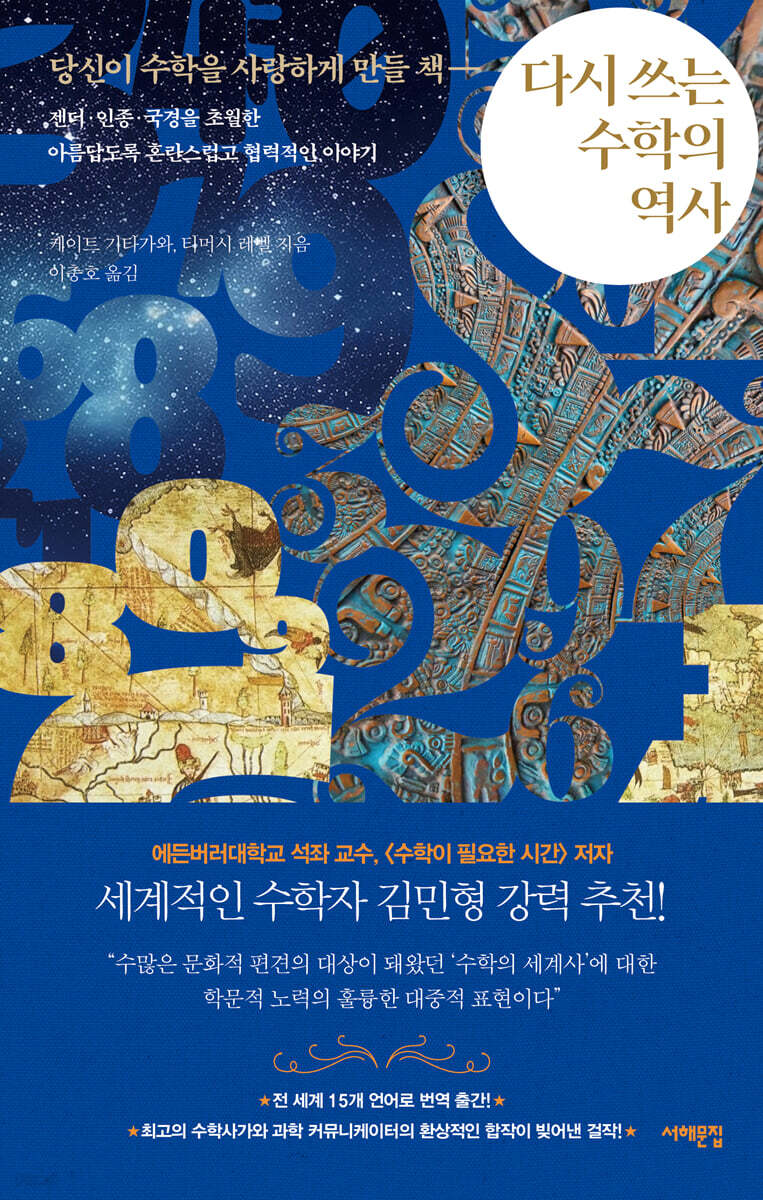
Rewriting the History of Mathematics
 |
Description
Book Introduction
- A word from MD
-
Real Math World HistoryPythagoras, Descartes, Leibniz, Newton.
Most famous mathematicians are European men.
Even though there were many great non-European mathematicians.
『Rewriting the History of Mathematics』 fills in the gaps in the history of mathematics written so far.
It contains a fascinating story of the intersection of mathematics developed in different continents, including India, China, and Maya.
November 5, 2024. Natural Science PD Son Min-gyu
The greatest history of mathematics, encompassing the entire world beyond the Western sphere! The history of mathematics is far deeper, broader, and richer than we've ever known.
This book critically reflects on the fact that the history of mathematics up to now has been a Western/male-centered, half-true history of mathematics, and reveals the hidden history of mathematics over thousands of years, restoring it to a 'complete' history of mathematics.
From Banzo, the world's first female mathematician; Hypatia, the great female mathematician who revolutionized ancient geometry; Al-Khwarizmi, the founder of algebra and algorithms; Madhava, the Indian genius mathematician who pioneered calculus 300 years before Newton; and even Black mathematicians of the civil rights movement who pioneered the field of information theory in the 20th century, this book contains the amazing achievements and intense lives of hidden pioneers from around the world, transcending gender, race, and borders.
It could be called a 'world history of mathematics', spanning thousands of years, six continents, and encompassing almost all fields of mathematics.
This book critically reflects on the fact that the history of mathematics up to now has been a Western/male-centered, half-true history of mathematics, and reveals the hidden history of mathematics over thousands of years, restoring it to a 'complete' history of mathematics.
From Banzo, the world's first female mathematician; Hypatia, the great female mathematician who revolutionized ancient geometry; Al-Khwarizmi, the founder of algebra and algorithms; Madhava, the Indian genius mathematician who pioneered calculus 300 years before Newton; and even Black mathematicians of the civil rights movement who pioneered the field of information theory in the 20th century, this book contains the amazing achievements and intense lives of hidden pioneers from around the world, transcending gender, race, and borders.
It could be called a 'world history of mathematics', spanning thousands of years, six continents, and encompassing almost all fields of mathematics.
- You can preview some of the book's contents.
Preview
index
Preface / Recommendation
At the very beginning of Chapter 1
On the banks of the Babylonian river | The mathematician with the scroll under his armpit
Chapter 2 The Turtle and the Emperor
The Book of Changes | The Book of Changes, Where the Principles of All Things in the Universe Are Hidden | Nine Chapters That Changed the World | But What Is Proof? | A Lesson for Women | The Rebellious Geometers
Chapter 3 Alexandria
The Veiled Figure, Euclid | The Great City, Alexandria | Hypatia | Later Evaluations
Chapter 4.
Dawn of Time
The Cosmic Calendar | A God for Every Day | The Rise of the Clock | On Time
Chapter 5: On the Origin of 0
India's Golden Age | Why We Won't Fall Off the Earth | Numbers with Holes | The Proliferation of Zero
Chapter 6: The House of Wisdom
Calculations for the Caliph | Algebra, Algorithms, and Al-Khwarizmi | What is an Algorithm? | The Rotation of the Celestial Bodies | Burning the House of Wisdom
Chapter 7: The Impossible Dream
The Gambler's Ambition | The Republic of Letters | Elizabeth and Descartes in Exile
Chapter 8: Pioneers of (the First) Calculus
The Kerala School | What is Calculus? | Newton's Calculus Research | Leibniz Creates a Mathematical Machine | The Old Englishman's Laughter | The Verdict
Chapter 9 Newtonianism for Ladies
The Foundations of Newtonian Mechanics | The Flat Earth | A Woman Who Strongly Supported Newton in France | Vassy's Experiments at Home | The Excessive Imagination | Newtonianism Spreads to America
Chapter 10: General Summary
The Activities of Jesuit Missionaries | East Meets West | Selecting the Best Observational Data
Chapter 11: The Mermaid of Mathematics
The First Female Mathematics Professor | Equations Written on the Wall | A Productive Partner | Meeting a Mermaid | The Top Problem | Posthumous Reviews
Chapter 12 Revolution
The Trends of Euclidean Geometry | When Parallel Lines Intersect | Fundamental Speed Limits | The Equations of the Universe
Chapter 13 =
Civil Rights | Education for All | How to Win a Duel
Chapter 14: Map the Stars
Sky Observation | Harvard's Human Computers | The Effort to Obtain More Photos and Data | The Space Race
Chapter 15 Numerical Processing
The mathematician known as Hardy-Littlewood | Mathematics taught directly by God | Chaos from cooperation | Fundamental theorems and problems | Skews numbers | The riddle that even Turing couldn't solve
Epilogue
Math is a Relay Race | Problems Still Unsolved
Acknowledgments / List of Plates / Notes / Index
At the very beginning of Chapter 1
On the banks of the Babylonian river | The mathematician with the scroll under his armpit
Chapter 2 The Turtle and the Emperor
The Book of Changes | The Book of Changes, Where the Principles of All Things in the Universe Are Hidden | Nine Chapters That Changed the World | But What Is Proof? | A Lesson for Women | The Rebellious Geometers
Chapter 3 Alexandria
The Veiled Figure, Euclid | The Great City, Alexandria | Hypatia | Later Evaluations
Chapter 4.
Dawn of Time
The Cosmic Calendar | A God for Every Day | The Rise of the Clock | On Time
Chapter 5: On the Origin of 0
India's Golden Age | Why We Won't Fall Off the Earth | Numbers with Holes | The Proliferation of Zero
Chapter 6: The House of Wisdom
Calculations for the Caliph | Algebra, Algorithms, and Al-Khwarizmi | What is an Algorithm? | The Rotation of the Celestial Bodies | Burning the House of Wisdom
Chapter 7: The Impossible Dream
The Gambler's Ambition | The Republic of Letters | Elizabeth and Descartes in Exile
Chapter 8: Pioneers of (the First) Calculus
The Kerala School | What is Calculus? | Newton's Calculus Research | Leibniz Creates a Mathematical Machine | The Old Englishman's Laughter | The Verdict
Chapter 9 Newtonianism for Ladies
The Foundations of Newtonian Mechanics | The Flat Earth | A Woman Who Strongly Supported Newton in France | Vassy's Experiments at Home | The Excessive Imagination | Newtonianism Spreads to America
Chapter 10: General Summary
The Activities of Jesuit Missionaries | East Meets West | Selecting the Best Observational Data
Chapter 11: The Mermaid of Mathematics
The First Female Mathematics Professor | Equations Written on the Wall | A Productive Partner | Meeting a Mermaid | The Top Problem | Posthumous Reviews
Chapter 12 Revolution
The Trends of Euclidean Geometry | When Parallel Lines Intersect | Fundamental Speed Limits | The Equations of the Universe
Chapter 13 =
Civil Rights | Education for All | How to Win a Duel
Chapter 14: Map the Stars
Sky Observation | Harvard's Human Computers | The Effort to Obtain More Photos and Data | The Space Race
Chapter 15 Numerical Processing
The mathematician known as Hardy-Littlewood | Mathematics taught directly by God | Chaos from cooperation | Fundamental theorems and problems | Skews numbers | The riddle that even Turing couldn't solve
Epilogue
Math is a Relay Race | Problems Still Unsolved
Acknowledgments / List of Plates / Notes / Index
Detailed image

Into the book
Let's take calculus as an example.
This mathematical theory, which describes and determines how things change over time, is one of the most important and useful developments in human history.
Calculus is essential to engineering (without it, you couldn't build bridges or rockets accurately), and it's used in almost every scientific discipline, helping us better understand the world.
(…) So who invented calculus? It is often said that the British mathematician Isaac Newton and the German mathematician Gottfried Wilhelm Leibniz each invented it independently, almost simultaneously, in the 17th century.
(…) There were people who thought about the concepts that form the background of calculus much earlier.
In the 14th century, Kerala, India, had a school of astronomy and mathematics in which many mathematicians were active.
Its founder, Madhava of Sangamagrama, was a very brilliant mathematician, and among his achievements was the explanation of the theory of calculus.
Madhava explored the core concepts that made calculus possible, and mathematicians of the Kerala school further refined and developed them.
--- p.10
The ruins of a Mayan scribe's workshop, known as the "House of the Calendar," reveal how astronomers recorded data.
The walls and ceilings of this studio, built in the early 9th century BC, are decorated with colorful paintings of various figures, numbers, and hieroglyphs.
The wall was probably used as a kind of blackboard.
The walls are covered with colorful hieroglyphs that appear to have been used for calendars and astronomical calculations.
The traces on the two tables show the movements of the moon, and perhaps also of Mars and Venus.
(…) They could accurately predict solar eclipses and even predicted the strange movements of Venus that repeat in an eight-year cycle.
(…) The Mayans measured the movements of the moon and stars with amazing accuracy.
For example, 149 lunar months were calculated to be 4400 days.
This means that one lunar month is 29.5302 days long, which is the value we measure today as 29.5306 days.
He also calculated that the length of a year was 365.242 days, which we now know to be 365.242198 days.
--- p.41
Gottfried Wilhelm Leibniz, a 17th-century German mathematician and polymath, succeeded in obtaining a copy of the I Ching.
While reading it, Leibniz was greatly surprised to learn that the hexagrams in the Book of Changes were pictorial representations of the number system he was studying.
So, in a letter to the Jesuit missionary Joachim Bouvet, who had brought the book to his attention, he wrote:
“I am so amazed that the system matches perfectly with my new method of arithmetic.”
--- p.59
[Mathematician of the 3rd century] Liu Hui's 『Gujangsansulju』 was a work that could be called a feast of mathematics.
What was particularly noteworthy in Yu Hui's book was the approximation of pi, commonly represented today by the symbol π.
Although Yu Hui was not the first to discover the value of π, he obtained a more accurate value than anyone before him.
The Babylonians knew that the value of π was approximately 3.
In the 3rd century BC, the Greek mathematician Archimedes narrowed the range of values to between 3.140 and 3.142.
Using the same method as Archimedes, Yu Hui calculated the value of π to be 3.14159, accurate to five decimal places.
Now, using supercomputers, we have succeeded in calculating the value of π up to the 50 trillionth decimal place.
However, since knowing only up to the fourteenth decimal place is sufficient for accurately controlling a rocket sent into space, knowing values that are more precise than that is practically meaningless.
(…) The method that Yu Hui used to find the value of π was rather ingenious, using polygons.
(…) In the 5th century, the Chinese mathematician Zhao Chongzhi used the 24576-gon in the same way as Liu Hui to calculate the value of π with greater precision up to the seventh decimal place.
This remained the world record for a while, until it was broken in the early 15th century when Arab mathematician Jamshid al-Kashi calculated the value of π accurately to sixteen decimal places.
Even now, a value that is more precise than what is actually needed was already calculated by a mathematician 600 years ago.
--- p.62
One of the things that Liu Hui proved is what we now call the 'Pythagorean theorem', but in China it was called the 'Nine-Gu Theorem'.
For mathematicians of that time, triangles were figures of particular practical importance.
For example, it was useful for calculating the height of an island as seen from the mainland, the size of a distant walled city, the depth of a canyon as seen from a distance, or the width of an estuary.
Books such as 『Gujangsansul』 deal with many problems using examples like this.
The nine-go theorem in 『Gujangsansul』 is the earliest record of this theorem, so it seems more appropriate to call this theorem the 'nine-go theorem' instead of the 'Pythagorean theorem'.
In any case, this theorem was rediscovered in various parts of the world, including Babylonia, Egypt, India, and Greece.
--- p.65
In April 1883, the Council of the University of Bombay, India, held an unusual meeting.
About 40 university professors, city officials, and judges gathered to discuss important issues, a meeting designed to determine the fundamental principles that will govern public life in India in the future.
At the heart of the issue was a seemingly simple mathematical question, but it sparked huge controversy, leading to protests and riots.
It was the question, “What time is it now?”
--- p.105
The high rock walls of Yazilikaya stretch majestically toward the sky.
It was intentionally made that way by the Bronze Age Hittite Empire sometime before the late 16th century BC.
Carved into the rock face are carvings depicting gods and symbols, and this site may have been used as an outdoor retreat.
Although this structure has stood here for over 3,000 years, its purpose was not exactly known until recently.
(…) In one passage of the Yazilikaya limestone quarry, there are more than 90 relief carvings of gods, humans, animals and mythical figures on the rock walls.
In 2019, a research team argued that these would have been used to record the days of the lunar month, with stone markers being rolled in front of the figures on each day.
The first day would have started from the day the new moon rose.
If this is true, this sacred site would be like a three-dimensional calendar that you can walk around and see.
--- p.111
However, the water clock had the disadvantage of not being very accurate.
At least that's how it was at first.
Then, in 1206, Ismail al-Jazari, a polymath and inventor from Mesopotamia, created the elephant clock.
The elephant clock was a truly remarkable invention, and is one reason why Al-Jazari is sometimes referred to today as the father of robotics.
The machinery was housed in a canopy atop a giant model elephant, complete with singing birds, snakes that moved up and down to pass balls, and even a human-shaped automaton that perched on the elephant's back and beat a drum every half hour.
Inside the elephant clock was a water tank, and a bowl was floating in it.
As the water slowly dripped into the bowl for half an hour, the bowl became heavier and sank deeper into the water, until a rope attached to the top of the elephant was pulled, causing the ball to fall.
The ball went into the snake's mouth, and the snake then leaned forward and pulled on the attached string, lifting the sunken bowl out of the water bowl.
Then a bird would chime and a man would strike a cymbal to signal the end of half an hour, and the cycle would begin again from the beginning.
All elements work in mathematical harmony to ensure that the watch measures time accurately.
--- p.117
The number 0 was used before Brahmagupta, the earliest known use of which occurred in the Mayan civilization between 300 and 200 BC.
They used a symbol that looked like a clamshell as a placeholder (one of the most basic functions of 0).
The concept of using zero as a placeholder was a surprisingly useful development in the way we think about numbers, and it is still used today.
(…) Compare this to Roman numerals, which do not use placeholders in this way.
In Roman numerals, 201 is written as CCI, where C stands for 100 and I stands for 1.
Since Roman numerals do not have a symbol for zero, this number does not appear in the tens place at all.
This isn't a huge problem in some situations, but it can cause problems even when trying to do simple calculations like addition.
The calculation of adding 201 to 99 is easy.
First, add the ones digits, then the tens digits, and finally the hundreds digits.
But try adding CCI to XCIX.
I wonder how the Romans calculated with these numbers.
--- p.143
While introducing the decimal system to the world may seem like a remarkable achievement for a single person, it was only one of al-Khwarizmi's many accomplishments.
His book, "Calculus of Restoration and Contrast," eventually became the dominant mathematics textbook throughout West Asia and Europe.
Two of the most important concepts in all of science are presented in this book: algebra and algorithms.
The English word 'algebra', meaning algebra, comes from 'Al Jabur', which is used in the title of this book.
Today, algebra refers to the branch of mathematics that studies the relationships and properties of numbers using letters instead of numbers and finds the values of unknown variables in equations.
However, originally, al-Jabre referred to 'reconstruction', a specific technique for rearranging equations in order to solve them.
Throughout the book, al-Khwarizmi focuses on solving practical problems encountered in real life, such as those related to inheritance, land division, litigation, trade, and canal construction.
One important mathematical concept he developed was how to solve linear and quadratic equations.
--- p.168
This story also illustrates one of the main ways in which mathematics developed in 17th-century Europe: through the exchange of letters.
A person wrestles with a problem and writes down his thoughts in a letter to someone else.
Then another person steps in and approaches the issue from a different perspective or approach.
With each exchange of letters, progress was made little by little, and finally a solution was reached.
The letter was not kept secret.
Instead, the scholarly discussions written in the letters were read and shared with others.
From the late 17th century to the early 18th century, intellectual communities in Europe and America flourished by building rich scholarly networks.
This movement later came to be known as the 'Republic of Letters'.
--- p.194
[Descartes and Elizabeth] The two also had a conversation about mathematics.
Descartes was sent to solve a particularly difficult problem called the 'Problem of Apollonius'.
At the same time, I secretly thought that the limitations of the mathematical skills I had learned from Jan Stampiun would be revealed.
(…) Descartes said he felt “somewhat sorry” to send such a problem to Elizabeth, as he felt that “not even an angel could solve it without some miracle.”
But Descartes's blunder turned out to be a complete misjudgment.
Not only did Elizabeth solve the problem, she solved it in two ways.
(…) Clearly, Elizabeth was a talented mathematician.
Descartes, who was continuing his research, dedicated his 1644 publication of Principles of Philosophy to Elisabeth, writing, “You are the only person I know who has completely understood all the work I have previously published.”
--- p.203
Many people are afraid of calculus.
Strange formulas whose meaning is difficult to grasp are enough to make people anxious or give up on mathematics.
This is understandable enough, but it is also a gross misrepresentation of the facts.
Although the detailed calculations of calculus can be somewhat difficult, conceptually it is not only easy to understand, but also very elegant and beautiful.
When I see calculus neatly organize a given problem, it feels like watching magic.
Fundamentally, calculus is simply the realization of the concept that it is best to break down large problems into smaller ones.
(…) Our cake is a perfect cylinder with radius r.
Regardless of taste, the obvious question that arises here is this:
How big is this cake? In other words, what is its volume? Following the concept that it's best to break down large problems into smaller ones, let's break the cake down.
Then, put those pieces together in a different way so that when you look at it from above, it looks like a parallelogram.
However, the upper and lower sides are curved.
(…) The secret to calculus is to keep cutting the cake and making the pieces smaller and smaller.
As the size of the pieces gets smaller, the curves of the upper and lower sides become more and more half-round, so if you cut it into infinite pieces, it will actually become a perfect parallelogram.
--- p.220
On one occasion, Leibniz sent Newton a result he had obtained on infinite series (a result similar to that known to the Kerala school).
Leibniz had hoped to impress, but the reply he received was nothing more than the sneer of an old Englishman.
“I already know three ways to get to that kind of level.
So I don't expect to receive any new methods." In other words, Newton replied that not only did he already know the mathematics Leibniz had sent him, but he also knew three ways to arrive at the same conclusion.
It was said that Leibniz was the one who beat the drum.
Newton's ridicule continued.
Instead of ending the letter with some mathematical information that might be helpful to Leibniz, he wrote:
“The basis of this operation is actually quite obvious.
But I can't reveal the details right now, so I'll choose to keep it a secret.
'6accdae13eff7i3l9n4o4qrr4s8t12vx.'” This was a mockery.
These strange numbers and strings of letters were a coded message expressing the fundamental theorem of calculus in Latin.
--- p.235
Published in 1737, Newtonianism for Ladies became a huge bestseller and sparked great interest in the Principia among both women and men.
The author was Count Francesco Algarotti, a polymath and erudite Italian intellectual of the 18th century.
He was caught up in the prejudices of his time, believing that women had "too many imaginations" to properly understand mathematics.
Even if it is true that women have a slightly greater imagination than men, that is hardly a disadvantage.
Isn't mathematics, after all, a discipline that imagines things that don't actually exist? Even something as simple as a circle (a mathematically perfect circle) doesn't exist in reality.
(…) In the book, Algarotti tried to introduce Newton's concepts more familiarly through a fictional conversation between a knight and a marchioness.
The knight modeled himself after himself, and the marchioness after du Châtelet.
(…) In addition, Algarotti romanticized Newtonianism a bit.
In one scene, the Marchioness says, “I keep thinking that this ratio of the square of the distance between places… appears even in love.”
“So, if you’re apart for eight days, your love will be 64 times weaker than it was on the first day.”
--- p.266
When solving such simultaneous equations, Chinese mathematicians represented negative numbers with black branches and positive numbers with red branches.
And to solve the equation efficiently, we did the calculations by moving the mountain branches here and there using various methods.
Solving simultaneous equations using the European method, which was strongly supported by Chinese Jesuit mathematicians, was often more difficult.
They moved the terms around to put the problem into a standard form similar to the one first described by al-Khwarizmi, to which certain rules could be applied.
(…) When trying to solve equations of higher order, the European method was much more cumbersome.
They used separate names for the various powers of the unknown, such as radix, zenth, and qubus, but this practice actually made the expression of these polynomial equations more difficult.
Chinese mathematicians, on the other hand, were able to handle equations of this form much more elegantly using mountain branches.
--- p.287
Paris, 1888.
Papers submitted to the prestigious Bordin Prize competition hosted by the French Academy of Sciences were entered.
To ensure that the judges were not influenced by the applicants' reputations, all papers were marked with only specific phrases instead of the applicants' names.
Among them, one paper that stood out like a military academy caught the attention of the judges.
It was a paper that provided an answer to a mathematical problem that had remained unsolved for over 100 years, leaving even famous mathematicians Leonhard Euler and Joseph-Louis Lagrange scratching their heads.
The box that displays the author's name says, "Say only what you know, and do what you must.
There was only the phrase, “Whatever happens will happen.”
It was the pen name of a man who had finally achieved his goal after a lifetime of discrimination, frustration, and personal misfortune.
Perhaps it was this strong mentality, like his motto, and his unwavering determination to persevere through any adversity that brought him to this point.
Astronomer Jules Janssen, president of the French Academy of Sciences, announced the winners, saying:
“Gentlemen, the most beautiful and difficult to obtain crown we have ever bestowed will now be placed upon the brow of a woman.” The winner of that year’s Bordin Prize was Sofia Kovalevskaya, the world’s first female professor of mathematics.
--- p.297
Kovalevskaya began corresponding with Mittag-Lefleur, and in 1881 Kovalevskaya wrote that she was obsessed with a beautiful yet difficult problem, which she had decided to call "the mermaid of mathematics."
It's a problem that any ballerina can solve intuitively.
When performing a pirouette on one foot, a ballerina can vary the speed of the rotation by adjusting the position of her arm or the other leg.
By slightly changing your posture while spinning, you can speed up or slow down the rotation.
They understand the relevant variables (shape, acceleration, and velocity) so easily.
If you change one variable, the other variables will change.
By mastering the relationships between variables, a ballerina can perfectly control the speed of her rotation.
But mathematicians are far from that lucky.
Even a top could not be properly described mathematically unless it was perfectly round.
The movement seemed so random and difficult that it could not be expressed in equations.
Kovalevskaya aimed to properly describe the mathematics of spinning tops.
In the letter, he wrote, “This research was so interesting and fascinating that for a while I forgot everything else and devoted myself to it with all my passion.”
--- p.315
We, as authors, are well aware that we are not free from existing concepts and biases.
We've tried our best to be as factual as possible, but this has its drawbacks.
Deciding what to include and what to exclude from the history of mathematics is, to some extent, an ethical decision.
Who should be given credit? Who should be omitted or left out? No history book can ever be perfect.
Instead, we hope to shift the narrative arc of mathematics toward a more fair and representative history.
This is not for any ideological purpose, but because it properly reflects the way mathematics has developed (and will continue to develop) over thousands of years.
Mathematics remains vibrant and has become more of an international team sport than ever before.
For example, let's look at the biggest breakthroughs in mathematics over the past 30 years.
It was Andrew Wiles who proved Fermat's Last Theorem in 1995.
(…) Pierre de Fermat wrote in the margin of a book that he had proved this about 400 years ago, but no one has proved it since.
Many mathematicians, including Sophie Germain, attempted to prove this theorem, but ultimately it took all the power and talent of modern mathematics to prove it.
--- p.436
Erdős Pál was born and raised in Hungary, but as Nazi Germany raged and persecuted the Jews, he left his homeland and lived around the world.
In the process, I conducted collaborative research with various mathematicians.
There is a famous anecdote about him suddenly visiting a colleague's house without notice and saying, "My brain is open."
After staying for quite some time and completing a few papers through collaborative research, I went to visit my next colleague. I also asked the owner of the house where I was staying for advice on who I should visit next.
During his lifetime, he collaborated with more than 500 mathematicians and published about 1,500 papers.
This is more records than any mathematician has ever published.
Because Erdős published so many papers, some mathematicians use the Erdős number to track how close they were to him in their collaborative research.
Erdős number 1 means you published a paper with Erdős, Erdős number 2 means you published a paper with someone who published a paper with Erdős, and so on.
There is only one person whose Erdős number is 0, and that is Erdős himself.
There are over 11,000 people with an Erdös number of 2, which shows how widespread cooperation can be.
(For reference, the Erdős number of Timothy Revell, the author of this book, is 4, and that of Kate Kitagawa is 5.)
This mathematical theory, which describes and determines how things change over time, is one of the most important and useful developments in human history.
Calculus is essential to engineering (without it, you couldn't build bridges or rockets accurately), and it's used in almost every scientific discipline, helping us better understand the world.
(…) So who invented calculus? It is often said that the British mathematician Isaac Newton and the German mathematician Gottfried Wilhelm Leibniz each invented it independently, almost simultaneously, in the 17th century.
(…) There were people who thought about the concepts that form the background of calculus much earlier.
In the 14th century, Kerala, India, had a school of astronomy and mathematics in which many mathematicians were active.
Its founder, Madhava of Sangamagrama, was a very brilliant mathematician, and among his achievements was the explanation of the theory of calculus.
Madhava explored the core concepts that made calculus possible, and mathematicians of the Kerala school further refined and developed them.
--- p.10
The ruins of a Mayan scribe's workshop, known as the "House of the Calendar," reveal how astronomers recorded data.
The walls and ceilings of this studio, built in the early 9th century BC, are decorated with colorful paintings of various figures, numbers, and hieroglyphs.
The wall was probably used as a kind of blackboard.
The walls are covered with colorful hieroglyphs that appear to have been used for calendars and astronomical calculations.
The traces on the two tables show the movements of the moon, and perhaps also of Mars and Venus.
(…) They could accurately predict solar eclipses and even predicted the strange movements of Venus that repeat in an eight-year cycle.
(…) The Mayans measured the movements of the moon and stars with amazing accuracy.
For example, 149 lunar months were calculated to be 4400 days.
This means that one lunar month is 29.5302 days long, which is the value we measure today as 29.5306 days.
He also calculated that the length of a year was 365.242 days, which we now know to be 365.242198 days.
--- p.41
Gottfried Wilhelm Leibniz, a 17th-century German mathematician and polymath, succeeded in obtaining a copy of the I Ching.
While reading it, Leibniz was greatly surprised to learn that the hexagrams in the Book of Changes were pictorial representations of the number system he was studying.
So, in a letter to the Jesuit missionary Joachim Bouvet, who had brought the book to his attention, he wrote:
“I am so amazed that the system matches perfectly with my new method of arithmetic.”
--- p.59
[Mathematician of the 3rd century] Liu Hui's 『Gujangsansulju』 was a work that could be called a feast of mathematics.
What was particularly noteworthy in Yu Hui's book was the approximation of pi, commonly represented today by the symbol π.
Although Yu Hui was not the first to discover the value of π, he obtained a more accurate value than anyone before him.
The Babylonians knew that the value of π was approximately 3.
In the 3rd century BC, the Greek mathematician Archimedes narrowed the range of values to between 3.140 and 3.142.
Using the same method as Archimedes, Yu Hui calculated the value of π to be 3.14159, accurate to five decimal places.
Now, using supercomputers, we have succeeded in calculating the value of π up to the 50 trillionth decimal place.
However, since knowing only up to the fourteenth decimal place is sufficient for accurately controlling a rocket sent into space, knowing values that are more precise than that is practically meaningless.
(…) The method that Yu Hui used to find the value of π was rather ingenious, using polygons.
(…) In the 5th century, the Chinese mathematician Zhao Chongzhi used the 24576-gon in the same way as Liu Hui to calculate the value of π with greater precision up to the seventh decimal place.
This remained the world record for a while, until it was broken in the early 15th century when Arab mathematician Jamshid al-Kashi calculated the value of π accurately to sixteen decimal places.
Even now, a value that is more precise than what is actually needed was already calculated by a mathematician 600 years ago.
--- p.62
One of the things that Liu Hui proved is what we now call the 'Pythagorean theorem', but in China it was called the 'Nine-Gu Theorem'.
For mathematicians of that time, triangles were figures of particular practical importance.
For example, it was useful for calculating the height of an island as seen from the mainland, the size of a distant walled city, the depth of a canyon as seen from a distance, or the width of an estuary.
Books such as 『Gujangsansul』 deal with many problems using examples like this.
The nine-go theorem in 『Gujangsansul』 is the earliest record of this theorem, so it seems more appropriate to call this theorem the 'nine-go theorem' instead of the 'Pythagorean theorem'.
In any case, this theorem was rediscovered in various parts of the world, including Babylonia, Egypt, India, and Greece.
--- p.65
In April 1883, the Council of the University of Bombay, India, held an unusual meeting.
About 40 university professors, city officials, and judges gathered to discuss important issues, a meeting designed to determine the fundamental principles that will govern public life in India in the future.
At the heart of the issue was a seemingly simple mathematical question, but it sparked huge controversy, leading to protests and riots.
It was the question, “What time is it now?”
--- p.105
The high rock walls of Yazilikaya stretch majestically toward the sky.
It was intentionally made that way by the Bronze Age Hittite Empire sometime before the late 16th century BC.
Carved into the rock face are carvings depicting gods and symbols, and this site may have been used as an outdoor retreat.
Although this structure has stood here for over 3,000 years, its purpose was not exactly known until recently.
(…) In one passage of the Yazilikaya limestone quarry, there are more than 90 relief carvings of gods, humans, animals and mythical figures on the rock walls.
In 2019, a research team argued that these would have been used to record the days of the lunar month, with stone markers being rolled in front of the figures on each day.
The first day would have started from the day the new moon rose.
If this is true, this sacred site would be like a three-dimensional calendar that you can walk around and see.
--- p.111
However, the water clock had the disadvantage of not being very accurate.
At least that's how it was at first.
Then, in 1206, Ismail al-Jazari, a polymath and inventor from Mesopotamia, created the elephant clock.
The elephant clock was a truly remarkable invention, and is one reason why Al-Jazari is sometimes referred to today as the father of robotics.
The machinery was housed in a canopy atop a giant model elephant, complete with singing birds, snakes that moved up and down to pass balls, and even a human-shaped automaton that perched on the elephant's back and beat a drum every half hour.
Inside the elephant clock was a water tank, and a bowl was floating in it.
As the water slowly dripped into the bowl for half an hour, the bowl became heavier and sank deeper into the water, until a rope attached to the top of the elephant was pulled, causing the ball to fall.
The ball went into the snake's mouth, and the snake then leaned forward and pulled on the attached string, lifting the sunken bowl out of the water bowl.
Then a bird would chime and a man would strike a cymbal to signal the end of half an hour, and the cycle would begin again from the beginning.
All elements work in mathematical harmony to ensure that the watch measures time accurately.
--- p.117
The number 0 was used before Brahmagupta, the earliest known use of which occurred in the Mayan civilization between 300 and 200 BC.
They used a symbol that looked like a clamshell as a placeholder (one of the most basic functions of 0).
The concept of using zero as a placeholder was a surprisingly useful development in the way we think about numbers, and it is still used today.
(…) Compare this to Roman numerals, which do not use placeholders in this way.
In Roman numerals, 201 is written as CCI, where C stands for 100 and I stands for 1.
Since Roman numerals do not have a symbol for zero, this number does not appear in the tens place at all.
This isn't a huge problem in some situations, but it can cause problems even when trying to do simple calculations like addition.
The calculation of adding 201 to 99 is easy.
First, add the ones digits, then the tens digits, and finally the hundreds digits.
But try adding CCI to XCIX.
I wonder how the Romans calculated with these numbers.
--- p.143
While introducing the decimal system to the world may seem like a remarkable achievement for a single person, it was only one of al-Khwarizmi's many accomplishments.
His book, "Calculus of Restoration and Contrast," eventually became the dominant mathematics textbook throughout West Asia and Europe.
Two of the most important concepts in all of science are presented in this book: algebra and algorithms.
The English word 'algebra', meaning algebra, comes from 'Al Jabur', which is used in the title of this book.
Today, algebra refers to the branch of mathematics that studies the relationships and properties of numbers using letters instead of numbers and finds the values of unknown variables in equations.
However, originally, al-Jabre referred to 'reconstruction', a specific technique for rearranging equations in order to solve them.
Throughout the book, al-Khwarizmi focuses on solving practical problems encountered in real life, such as those related to inheritance, land division, litigation, trade, and canal construction.
One important mathematical concept he developed was how to solve linear and quadratic equations.
--- p.168
This story also illustrates one of the main ways in which mathematics developed in 17th-century Europe: through the exchange of letters.
A person wrestles with a problem and writes down his thoughts in a letter to someone else.
Then another person steps in and approaches the issue from a different perspective or approach.
With each exchange of letters, progress was made little by little, and finally a solution was reached.
The letter was not kept secret.
Instead, the scholarly discussions written in the letters were read and shared with others.
From the late 17th century to the early 18th century, intellectual communities in Europe and America flourished by building rich scholarly networks.
This movement later came to be known as the 'Republic of Letters'.
--- p.194
[Descartes and Elizabeth] The two also had a conversation about mathematics.
Descartes was sent to solve a particularly difficult problem called the 'Problem of Apollonius'.
At the same time, I secretly thought that the limitations of the mathematical skills I had learned from Jan Stampiun would be revealed.
(…) Descartes said he felt “somewhat sorry” to send such a problem to Elizabeth, as he felt that “not even an angel could solve it without some miracle.”
But Descartes's blunder turned out to be a complete misjudgment.
Not only did Elizabeth solve the problem, she solved it in two ways.
(…) Clearly, Elizabeth was a talented mathematician.
Descartes, who was continuing his research, dedicated his 1644 publication of Principles of Philosophy to Elisabeth, writing, “You are the only person I know who has completely understood all the work I have previously published.”
--- p.203
Many people are afraid of calculus.
Strange formulas whose meaning is difficult to grasp are enough to make people anxious or give up on mathematics.
This is understandable enough, but it is also a gross misrepresentation of the facts.
Although the detailed calculations of calculus can be somewhat difficult, conceptually it is not only easy to understand, but also very elegant and beautiful.
When I see calculus neatly organize a given problem, it feels like watching magic.
Fundamentally, calculus is simply the realization of the concept that it is best to break down large problems into smaller ones.
(…) Our cake is a perfect cylinder with radius r.
Regardless of taste, the obvious question that arises here is this:
How big is this cake? In other words, what is its volume? Following the concept that it's best to break down large problems into smaller ones, let's break the cake down.
Then, put those pieces together in a different way so that when you look at it from above, it looks like a parallelogram.
However, the upper and lower sides are curved.
(…) The secret to calculus is to keep cutting the cake and making the pieces smaller and smaller.
As the size of the pieces gets smaller, the curves of the upper and lower sides become more and more half-round, so if you cut it into infinite pieces, it will actually become a perfect parallelogram.
--- p.220
On one occasion, Leibniz sent Newton a result he had obtained on infinite series (a result similar to that known to the Kerala school).
Leibniz had hoped to impress, but the reply he received was nothing more than the sneer of an old Englishman.
“I already know three ways to get to that kind of level.
So I don't expect to receive any new methods." In other words, Newton replied that not only did he already know the mathematics Leibniz had sent him, but he also knew three ways to arrive at the same conclusion.
It was said that Leibniz was the one who beat the drum.
Newton's ridicule continued.
Instead of ending the letter with some mathematical information that might be helpful to Leibniz, he wrote:
“The basis of this operation is actually quite obvious.
But I can't reveal the details right now, so I'll choose to keep it a secret.
'6accdae13eff7i3l9n4o4qrr4s8t12vx.'” This was a mockery.
These strange numbers and strings of letters were a coded message expressing the fundamental theorem of calculus in Latin.
--- p.235
Published in 1737, Newtonianism for Ladies became a huge bestseller and sparked great interest in the Principia among both women and men.
The author was Count Francesco Algarotti, a polymath and erudite Italian intellectual of the 18th century.
He was caught up in the prejudices of his time, believing that women had "too many imaginations" to properly understand mathematics.
Even if it is true that women have a slightly greater imagination than men, that is hardly a disadvantage.
Isn't mathematics, after all, a discipline that imagines things that don't actually exist? Even something as simple as a circle (a mathematically perfect circle) doesn't exist in reality.
(…) In the book, Algarotti tried to introduce Newton's concepts more familiarly through a fictional conversation between a knight and a marchioness.
The knight modeled himself after himself, and the marchioness after du Châtelet.
(…) In addition, Algarotti romanticized Newtonianism a bit.
In one scene, the Marchioness says, “I keep thinking that this ratio of the square of the distance between places… appears even in love.”
“So, if you’re apart for eight days, your love will be 64 times weaker than it was on the first day.”
--- p.266
When solving such simultaneous equations, Chinese mathematicians represented negative numbers with black branches and positive numbers with red branches.
And to solve the equation efficiently, we did the calculations by moving the mountain branches here and there using various methods.
Solving simultaneous equations using the European method, which was strongly supported by Chinese Jesuit mathematicians, was often more difficult.
They moved the terms around to put the problem into a standard form similar to the one first described by al-Khwarizmi, to which certain rules could be applied.
(…) When trying to solve equations of higher order, the European method was much more cumbersome.
They used separate names for the various powers of the unknown, such as radix, zenth, and qubus, but this practice actually made the expression of these polynomial equations more difficult.
Chinese mathematicians, on the other hand, were able to handle equations of this form much more elegantly using mountain branches.
--- p.287
Paris, 1888.
Papers submitted to the prestigious Bordin Prize competition hosted by the French Academy of Sciences were entered.
To ensure that the judges were not influenced by the applicants' reputations, all papers were marked with only specific phrases instead of the applicants' names.
Among them, one paper that stood out like a military academy caught the attention of the judges.
It was a paper that provided an answer to a mathematical problem that had remained unsolved for over 100 years, leaving even famous mathematicians Leonhard Euler and Joseph-Louis Lagrange scratching their heads.
The box that displays the author's name says, "Say only what you know, and do what you must.
There was only the phrase, “Whatever happens will happen.”
It was the pen name of a man who had finally achieved his goal after a lifetime of discrimination, frustration, and personal misfortune.
Perhaps it was this strong mentality, like his motto, and his unwavering determination to persevere through any adversity that brought him to this point.
Astronomer Jules Janssen, president of the French Academy of Sciences, announced the winners, saying:
“Gentlemen, the most beautiful and difficult to obtain crown we have ever bestowed will now be placed upon the brow of a woman.” The winner of that year’s Bordin Prize was Sofia Kovalevskaya, the world’s first female professor of mathematics.
--- p.297
Kovalevskaya began corresponding with Mittag-Lefleur, and in 1881 Kovalevskaya wrote that she was obsessed with a beautiful yet difficult problem, which she had decided to call "the mermaid of mathematics."
It's a problem that any ballerina can solve intuitively.
When performing a pirouette on one foot, a ballerina can vary the speed of the rotation by adjusting the position of her arm or the other leg.
By slightly changing your posture while spinning, you can speed up or slow down the rotation.
They understand the relevant variables (shape, acceleration, and velocity) so easily.
If you change one variable, the other variables will change.
By mastering the relationships between variables, a ballerina can perfectly control the speed of her rotation.
But mathematicians are far from that lucky.
Even a top could not be properly described mathematically unless it was perfectly round.
The movement seemed so random and difficult that it could not be expressed in equations.
Kovalevskaya aimed to properly describe the mathematics of spinning tops.
In the letter, he wrote, “This research was so interesting and fascinating that for a while I forgot everything else and devoted myself to it with all my passion.”
--- p.315
We, as authors, are well aware that we are not free from existing concepts and biases.
We've tried our best to be as factual as possible, but this has its drawbacks.
Deciding what to include and what to exclude from the history of mathematics is, to some extent, an ethical decision.
Who should be given credit? Who should be omitted or left out? No history book can ever be perfect.
Instead, we hope to shift the narrative arc of mathematics toward a more fair and representative history.
This is not for any ideological purpose, but because it properly reflects the way mathematics has developed (and will continue to develop) over thousands of years.
Mathematics remains vibrant and has become more of an international team sport than ever before.
For example, let's look at the biggest breakthroughs in mathematics over the past 30 years.
It was Andrew Wiles who proved Fermat's Last Theorem in 1995.
(…) Pierre de Fermat wrote in the margin of a book that he had proved this about 400 years ago, but no one has proved it since.
Many mathematicians, including Sophie Germain, attempted to prove this theorem, but ultimately it took all the power and talent of modern mathematics to prove it.
--- p.436
Erdős Pál was born and raised in Hungary, but as Nazi Germany raged and persecuted the Jews, he left his homeland and lived around the world.
In the process, I conducted collaborative research with various mathematicians.
There is a famous anecdote about him suddenly visiting a colleague's house without notice and saying, "My brain is open."
After staying for quite some time and completing a few papers through collaborative research, I went to visit my next colleague. I also asked the owner of the house where I was staying for advice on who I should visit next.
During his lifetime, he collaborated with more than 500 mathematicians and published about 1,500 papers.
This is more records than any mathematician has ever published.
Because Erdős published so many papers, some mathematicians use the Erdős number to track how close they were to him in their collaborative research.
Erdős number 1 means you published a paper with Erdős, Erdős number 2 means you published a paper with someone who published a paper with Erdős, and so on.
There is only one person whose Erdős number is 0, and that is Erdős himself.
There are over 11,000 people with an Erdös number of 2, which shows how widespread cooperation can be.
(For reference, the Erdős number of Timothy Revell, the author of this book, is 4, and that of Kate Kitagawa is 5.)
--- p.438
Publisher's Review
Professor Emeritus, University of Edinburgh, author of "Time for Mathematics"
Highly recommended by world-renowned mathematician Kim Min-hyung!
“The ‘world history of mathematics’ has been the subject of numerous cultural prejudices.
“It is a wonderful popular expression of scholarly endeavor.”
★Translated and published in 15 languages worldwide!★
★The greatest history of mathematics, encompassing the entire world beyond the Western sphere!★
A delicate and insightful narrative that shines with a love of mathematics and a warm humanity!
★Persuasive narrative, vivid immersion, and captivating plot!★
★Over 100 beautiful illustrations and colorful mathematical symbols!★
“The history of mathematics is much deeper, broader, and richer than we have ever known.”
The greatest history of mathematics, encompassing the entire world beyond the Western centric!
This book critically reflects on the fact that the history of mathematics up to now has been a Western/male-centered, half-true history of mathematics, and reveals the hidden history of mathematics over thousands of years, restoring it to a 'complete' history of mathematics.
This book can also be called a 'world history of mathematics in one volume' that surprisingly concisely compresses a vast story that spans thousands of years and six continents, transcending gender, race, and national borders, including Banzo, the world's first female mathematician; Hypatia, the great female mathematician who revolutionized ancient geometry; Al-Khwarizmi, the founder of algebra and algorithms; Madhava, the Indian genius mathematician who pioneered calculus 300 years before Newton; and even black mathematicians of the civil rights movement era who pioneered the field of information theory in the 20th century.
The stories about the various origins of mathematics are beautifully varied.
Rather than a concept suddenly appearing in one place, there are many cases where concepts that have been transformed over a long period of history have appeared here and there.
In other words, the development of mathematics did not occur linearly.
As we delve into the thousands of years of history of mathematics, almost everything we thought we knew has been called into question in one way or another.
Some famous stories have turned out to be distortions of fact, and some have even been completely fabricated.
Many mathematicians and mathematics have been unfairly neglected by history.
This book reveals several ways in which the story of mathematics has been distorted.
And the 'real story' that finally emerges is a story of truly global effort.
Translated and published in 15 languages worldwide!
A masterpiece, a fantastic collaboration between a leading historian of mathematics and a science communicator!
This book is a rare achievement, a fantastic collaboration between a world-renowned authority on the history of mathematics and an exceptional science communicator.
Living up to its reputation, it has been ambitiously published by Penguin Random House, a major global publisher, and has been translated and published in numerous countries in 15 languages around the world.
Kate Kitagawa is one of the world's leading experts on the history of mathematics. She graduated from Princeton University, taught history at Harvard University, and has held research positions at UC Berkeley, Cambridge University, the Max Planck Institute, the University of Pretoria, and the University of Oxford.
He is also active as a broadcaster, appearing on Netflix, CNN, the History Channel, and the BBC.
His first book became a national bestseller.
Timothy Revell is a popular British math journalist who has worked across a variety of professions, including computer scientist, author, journalist, science editor, and popular podcaster.
With a master's degree in mathematics and a doctorate in computer science, he is renowned for his ability to communicate the mathematical principles hidden in everyday life in an easily understandable way.
He also gained fame by participating in the internationally popular BBC science documentary Horizon and hosting the popular radio show The Naked Scientist.
He also works as an editor for the world-renowned science magazine New Scientist, striving to popularize mathematics.
It takes a village to publish a book, and the authors confess that this book was no exception.
This long, one-thousand-one-nights-like story began when two people met for tea in a bookshop in Charing Cross, London, and talked about how much they both loved mathematics.
In this book, the culmination of five years of work, the authors tell the "real story of mathematics."
The “beautifully chaotic and collaborative story” that has shaped “the world of mathematics” for thousands of years.
From the dawn of mathematics to the era of the "Grand Synthesis," from the origin of zero to the map of the stars.
Such a vast and complex story has been compressed into an amazingly concise narrative!
This book vividly reveals the remarkable lives and achievements of hidden pioneers who have struggled for thousands of years to leave behind a wondrous legacy across six continents.
For example, there are stories like this:
- Origins of the Babylonian sexagesimal system, the Mayan xigneous system, and the Chinese and Incan decimal systems.
- Ancient Asian mathematics that established the 'Nine-Go Theorem' before the 'Pythagorean Theorem'
- The birth of the most influential books in history: 『The Book of Changes』, 『The Nine Chapters of Arithmetic』, and 『Euclid's Elements』
- Ban So, an extraordinary historian and mathematician, the world's first female mathematician
- Hypatia, the great female mathematician who revolutionized geometry in ancient Greece
- The mathematics of 'time', about the profound question, "What time is it now?"
- From the origin of zero to the concept of 'infinity', a number with a hole
The House of Wisdom, an Arab mathematical temple that sought to gather all the world's knowledge under one roof.
- Al-Khwarizmi, the founder of algebra and algorithms
The 'Republic of Letters', the driving force behind the development of mathematics in 17th-century Europe
- Madhava, the Indian genius mathematician who pioneered calculus 300 years before Newton
Mathematicians who achieved the 'grand synthesis' of mathematics, where East and West meet.
- Sofya Kovalevskaya, a Russian genius mathematician who became the world's first female mathematics professor
- A new revolution in mathematics, those who rebelled against Euclidean geometry
Black mathematicians of the civil rights era who overcame racial discrimination and rewrote the history of mathematics.
- 'Female Computers' Around the World Who Revolutionized Our Knowledge of the Night Sky
- The first female mathematicians to win the Fields Medal in 2014 and the Abel Prize in 2019
(…)
Additionally, this book contains over 100 beautiful illustrations and various mathematical symbols and diagrams placed throughout, providing a vivid and deep sense of immersion into the 'world of mathematics.'
For example, Babylonian cuneiform and Egyptian hieroglyphs for representing numbers, Brahmi and Gupta numerals, the Chinese 'San Zazi' calculation method, the Hittite temples that served as calendars, the 'elephant water clock', a wondrous invention of Al-Jazari in the early 13th century who is considered the father of robotics today, traces of zero discovered in the Maya and Indonesia, the 'House of Wisdom' of the Abbasid Dynasty, Pascal's Pascaline, the first arithmetic calculator called 'Leibniz's wheel', the spinning top called the 'Mermaid of Mathematics', the 'female computers' of the Harvard University Observatory...
Their panoramic scenes, combined with an exciting narrative, lead us into a colorful world of mathematics.
If you want to learn the "real" history of mathematics through a delicate and insightful narrative that shines with love for mathematics and warm humanity, I recommend this book.
Also, if there is a teacher looking for a single 'must-read' book on mathematics, I recommend this book.
I also recommend this book to students who want to read 'math stories that even liberal arts students will enjoy' or 'history stories that even science students will enjoy.'
No matter who you are, this book will make you love math.
Highly recommended by world-renowned mathematician Kim Min-hyung!
“The ‘world history of mathematics’ has been the subject of numerous cultural prejudices.
“It is a wonderful popular expression of scholarly endeavor.”
★Translated and published in 15 languages worldwide!★
★The greatest history of mathematics, encompassing the entire world beyond the Western sphere!★
A delicate and insightful narrative that shines with a love of mathematics and a warm humanity!
★Persuasive narrative, vivid immersion, and captivating plot!★
★Over 100 beautiful illustrations and colorful mathematical symbols!★
“The history of mathematics is much deeper, broader, and richer than we have ever known.”
The greatest history of mathematics, encompassing the entire world beyond the Western centric!
This book critically reflects on the fact that the history of mathematics up to now has been a Western/male-centered, half-true history of mathematics, and reveals the hidden history of mathematics over thousands of years, restoring it to a 'complete' history of mathematics.
This book can also be called a 'world history of mathematics in one volume' that surprisingly concisely compresses a vast story that spans thousands of years and six continents, transcending gender, race, and national borders, including Banzo, the world's first female mathematician; Hypatia, the great female mathematician who revolutionized ancient geometry; Al-Khwarizmi, the founder of algebra and algorithms; Madhava, the Indian genius mathematician who pioneered calculus 300 years before Newton; and even black mathematicians of the civil rights movement era who pioneered the field of information theory in the 20th century.
The stories about the various origins of mathematics are beautifully varied.
Rather than a concept suddenly appearing in one place, there are many cases where concepts that have been transformed over a long period of history have appeared here and there.
In other words, the development of mathematics did not occur linearly.
As we delve into the thousands of years of history of mathematics, almost everything we thought we knew has been called into question in one way or another.
Some famous stories have turned out to be distortions of fact, and some have even been completely fabricated.
Many mathematicians and mathematics have been unfairly neglected by history.
This book reveals several ways in which the story of mathematics has been distorted.
And the 'real story' that finally emerges is a story of truly global effort.
Translated and published in 15 languages worldwide!
A masterpiece, a fantastic collaboration between a leading historian of mathematics and a science communicator!
This book is a rare achievement, a fantastic collaboration between a world-renowned authority on the history of mathematics and an exceptional science communicator.
Living up to its reputation, it has been ambitiously published by Penguin Random House, a major global publisher, and has been translated and published in numerous countries in 15 languages around the world.
Kate Kitagawa is one of the world's leading experts on the history of mathematics. She graduated from Princeton University, taught history at Harvard University, and has held research positions at UC Berkeley, Cambridge University, the Max Planck Institute, the University of Pretoria, and the University of Oxford.
He is also active as a broadcaster, appearing on Netflix, CNN, the History Channel, and the BBC.
His first book became a national bestseller.
Timothy Revell is a popular British math journalist who has worked across a variety of professions, including computer scientist, author, journalist, science editor, and popular podcaster.
With a master's degree in mathematics and a doctorate in computer science, he is renowned for his ability to communicate the mathematical principles hidden in everyday life in an easily understandable way.
He also gained fame by participating in the internationally popular BBC science documentary Horizon and hosting the popular radio show The Naked Scientist.
He also works as an editor for the world-renowned science magazine New Scientist, striving to popularize mathematics.
It takes a village to publish a book, and the authors confess that this book was no exception.
This long, one-thousand-one-nights-like story began when two people met for tea in a bookshop in Charing Cross, London, and talked about how much they both loved mathematics.
In this book, the culmination of five years of work, the authors tell the "real story of mathematics."
The “beautifully chaotic and collaborative story” that has shaped “the world of mathematics” for thousands of years.
From the dawn of mathematics to the era of the "Grand Synthesis," from the origin of zero to the map of the stars.
Such a vast and complex story has been compressed into an amazingly concise narrative!
This book vividly reveals the remarkable lives and achievements of hidden pioneers who have struggled for thousands of years to leave behind a wondrous legacy across six continents.
For example, there are stories like this:
- Origins of the Babylonian sexagesimal system, the Mayan xigneous system, and the Chinese and Incan decimal systems.
- Ancient Asian mathematics that established the 'Nine-Go Theorem' before the 'Pythagorean Theorem'
- The birth of the most influential books in history: 『The Book of Changes』, 『The Nine Chapters of Arithmetic』, and 『Euclid's Elements』
- Ban So, an extraordinary historian and mathematician, the world's first female mathematician
- Hypatia, the great female mathematician who revolutionized geometry in ancient Greece
- The mathematics of 'time', about the profound question, "What time is it now?"
- From the origin of zero to the concept of 'infinity', a number with a hole
The House of Wisdom, an Arab mathematical temple that sought to gather all the world's knowledge under one roof.
- Al-Khwarizmi, the founder of algebra and algorithms
The 'Republic of Letters', the driving force behind the development of mathematics in 17th-century Europe
- Madhava, the Indian genius mathematician who pioneered calculus 300 years before Newton
Mathematicians who achieved the 'grand synthesis' of mathematics, where East and West meet.
- Sofya Kovalevskaya, a Russian genius mathematician who became the world's first female mathematics professor
- A new revolution in mathematics, those who rebelled against Euclidean geometry
Black mathematicians of the civil rights era who overcame racial discrimination and rewrote the history of mathematics.
- 'Female Computers' Around the World Who Revolutionized Our Knowledge of the Night Sky
- The first female mathematicians to win the Fields Medal in 2014 and the Abel Prize in 2019
(…)
Additionally, this book contains over 100 beautiful illustrations and various mathematical symbols and diagrams placed throughout, providing a vivid and deep sense of immersion into the 'world of mathematics.'
For example, Babylonian cuneiform and Egyptian hieroglyphs for representing numbers, Brahmi and Gupta numerals, the Chinese 'San Zazi' calculation method, the Hittite temples that served as calendars, the 'elephant water clock', a wondrous invention of Al-Jazari in the early 13th century who is considered the father of robotics today, traces of zero discovered in the Maya and Indonesia, the 'House of Wisdom' of the Abbasid Dynasty, Pascal's Pascaline, the first arithmetic calculator called 'Leibniz's wheel', the spinning top called the 'Mermaid of Mathematics', the 'female computers' of the Harvard University Observatory...
Their panoramic scenes, combined with an exciting narrative, lead us into a colorful world of mathematics.
If you want to learn the "real" history of mathematics through a delicate and insightful narrative that shines with love for mathematics and warm humanity, I recommend this book.
Also, if there is a teacher looking for a single 'must-read' book on mathematics, I recommend this book.
I also recommend this book to students who want to read 'math stories that even liberal arts students will enjoy' or 'history stories that even science students will enjoy.'
No matter who you are, this book will make you love math.
GOODS SPECIFICS
- Date of issue: October 22, 2024
- Page count, weight, size: 472 pages | 642g | 140*220*28mm
- ISBN13: 9791192988917
You may also like
카테고리
korean


korean

![GQ KOREA Mark (Monthly): December [2025]](http://librairie.coreenne.fr/cdn/shop/files/8ef265dbbfbf186523ed75ba7319009d.jpg?v=1765340328&width=3840)


