

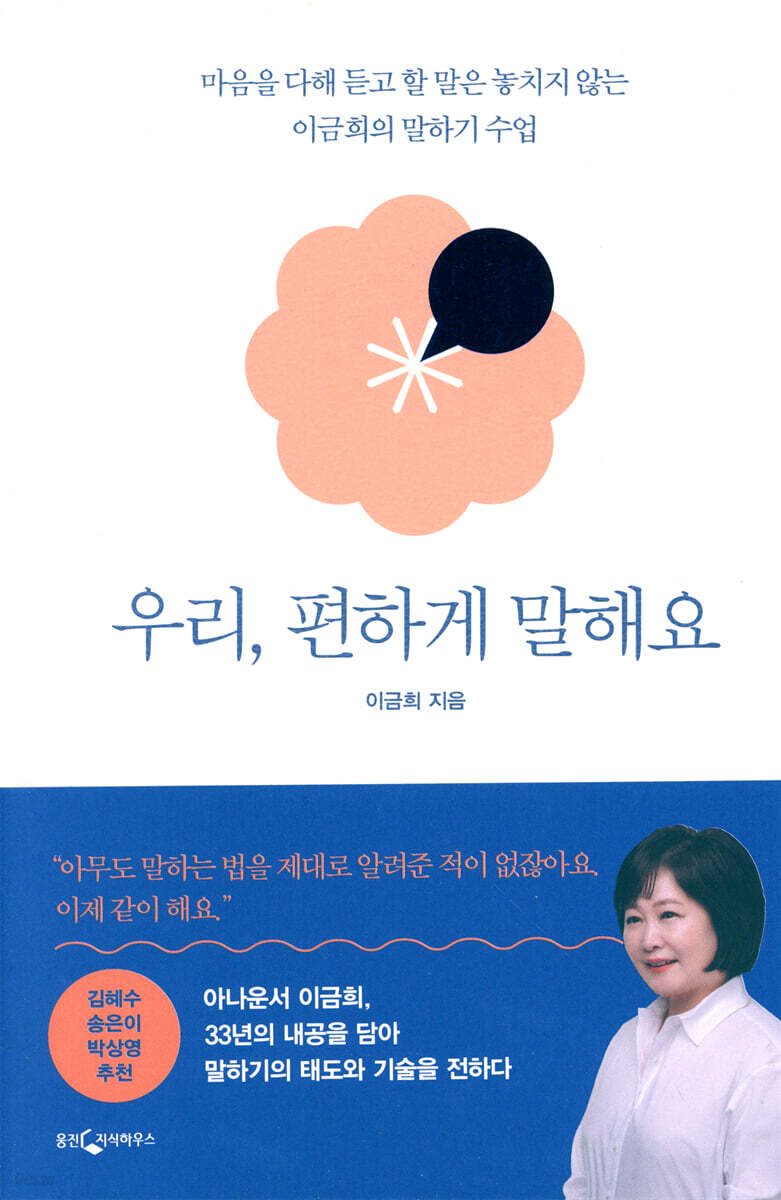
Let's talk comfortably
 |
Description
Book Introduction
- A word from MD
-
Lee Geum-hee's speaking classThis is the first book by Lee Geum-hee, a national announcer who has been in the broadcasting industry for 33 years and is much loved by the public.
In today's world where speaking skills have become important, this book is packed with broadcaster Lee Geum-hee's speaking know-how.
It properly teaches the fundamentals of speaking so that anyone can listen well to others and speak confidently.
October 25, 2022. Self-Development PD Kim Sang-geun
“No one ever taught me how to speak properly.
“Let’s do it together now.”
With over 30,000 people over 18 years
A legendary broadcaster who talks about work, love, and life.
Announcer Lee Geum-hee has 33 years of experience
Conveying speaking attitudes and skills
“A book that gives courage to those who find it unfamiliar and awkward to speak.”
_Han Ji-min, actress
“A guide who helps you speak appropriate and fluent language,
“It will become a standard of living for some people.”
_Park Sang-young, novelist
“He has a special charm that allows him to host a show without putting himself in the forefront, yet to lead smoothly so that no one overshadows anyone else.” A unique host who approaches speaking through attitude rather than technique, he is the most dedicated speaker in Korea.
Everyone is disarmed in front of Lee Geum-hee, freely telling their stories.
Moreover, broadcaster Lee Geum-hee's abilities stand out when she encounters those who are in pain and wounds, and those who find it difficult to share their stories.
How is this gentle charisma that moves the hearts of others created?
How can people's tightly closed hearts and mouths be opened?
He is the announcer who has heard the most honest stories from people in Korea, and he is a legendary broadcaster who has interviewed over 23,400 people on his morning talk show alone for 18 years and nearly 30,000 people including those on other broadcasts. He reveals for the first time the speaking attitude and techniques he has learned so far in “Let’s Talk Comfortably.”
In addition to his broadcasting career, he has taught students at Sookmyung Women's University for the past 22 years, and through one-on-one tea time with approximately 1,500 students, he has been able to get up close and personal with the concerns of young people.
That is why the book is filled with encouragement and advice for those who feel lost about life and speaking.
Lee Geum-hee's speaking know-how, which she knew better than anyone else but had never properly expressed until now, is now starting a speaking class for modern people for whom speaking well is becoming more important.
Broadcaster Song Eun-i, who first encountered this book, said, “Becoming a symbol or icon in a field is an incredible thing.
Sister Lee Geum-hee's voice is like that, her conversation with me is like that, and her words are like that.
He sent his trust by saying, “Discover the secret of warm empathy through this book,” and novelist Park Sang-young recommended reading it out of respect for his old teacher, saying, “It is a guide that helps you use appropriate and fluent language, and it will also serve as a standard for life for some.”
“Let’s do it together now.”
With over 30,000 people over 18 years
A legendary broadcaster who talks about work, love, and life.
Announcer Lee Geum-hee has 33 years of experience
Conveying speaking attitudes and skills
“A book that gives courage to those who find it unfamiliar and awkward to speak.”
_Han Ji-min, actress
“A guide who helps you speak appropriate and fluent language,
“It will become a standard of living for some people.”
_Park Sang-young, novelist
“He has a special charm that allows him to host a show without putting himself in the forefront, yet to lead smoothly so that no one overshadows anyone else.” A unique host who approaches speaking through attitude rather than technique, he is the most dedicated speaker in Korea.
Everyone is disarmed in front of Lee Geum-hee, freely telling their stories.
Moreover, broadcaster Lee Geum-hee's abilities stand out when she encounters those who are in pain and wounds, and those who find it difficult to share their stories.
How is this gentle charisma that moves the hearts of others created?
How can people's tightly closed hearts and mouths be opened?
He is the announcer who has heard the most honest stories from people in Korea, and he is a legendary broadcaster who has interviewed over 23,400 people on his morning talk show alone for 18 years and nearly 30,000 people including those on other broadcasts. He reveals for the first time the speaking attitude and techniques he has learned so far in “Let’s Talk Comfortably.”
In addition to his broadcasting career, he has taught students at Sookmyung Women's University for the past 22 years, and through one-on-one tea time with approximately 1,500 students, he has been able to get up close and personal with the concerns of young people.
That is why the book is filled with encouragement and advice for those who feel lost about life and speaking.
Lee Geum-hee's speaking know-how, which she knew better than anyone else but had never properly expressed until now, is now starting a speaking class for modern people for whom speaking well is becoming more important.
Broadcaster Song Eun-i, who first encountered this book, said, “Becoming a symbol or icon in a field is an incredible thing.
Sister Lee Geum-hee's voice is like that, her conversation with me is like that, and her words are like that.
He sent his trust by saying, “Discover the secret of warm empathy through this book,” and novelist Park Sang-young recommended reading it out of respect for his old teacher, saying, “It is a guide that helps you use appropriate and fluent language, and it will also serve as a standard for life for some.”
- You can preview some of the book's contents.
Preview
index
Opening remarks
Just by listening to Chapter 1 carefully
Language is the house of being
Every day I'm nagging
27 minutes and 30 seconds
low and slow
You are not alone
A day without saying a word
You are like the sunshine of a spring day
Turn off navigation
A word from the director
Manager Syndrome
Slowly and steadily
Chapter 2 Understanding Language is a Miracle
We live in the same house as people from other countries.
Should I ask your name?
Up is a beat late
I'm on your side no matter what
The back is more important
A gentle person is scary when he gets angry
Rejection is also slow
Because we are each other's mirrors
It's okay to laugh
Leave 10 percent
Like watering bean sprouts
Chapter 3 Sometimes a small salvation
Monologue becomes confession, and confession becomes salvation.
Beings like Pluto or Uranus
I was a morning salary person.
Until the mud settles
As I believe in you
The wrong train takes you to your destination.
We just met at the intersection
Circles, just circles
A person with 100 strengths
As if the string tied around my ankle had been released
Chapter 4: Practice of the 22-year lecture on speaking properly
Presentation is a battle of wits
Break through the wall
Teamwork is reaction
Don't write sentences
Yes, the power of the puppy
I learned it from my junior
A veteran announcer's practice method
There were 100 sheets, but there is only 1 sheet.
Try broadcasting alone
Half the battle is already won
Breathing is the rhythm of speech
It's okay to ask one more time
Organize, organize, organize again
Closing remarks
Just by listening to Chapter 1 carefully
Language is the house of being
Every day I'm nagging
27 minutes and 30 seconds
low and slow
You are not alone
A day without saying a word
You are like the sunshine of a spring day
Turn off navigation
A word from the director
Manager Syndrome
Slowly and steadily
Chapter 2 Understanding Language is a Miracle
We live in the same house as people from other countries.
Should I ask your name?
Up is a beat late
I'm on your side no matter what
The back is more important
A gentle person is scary when he gets angry
Rejection is also slow
Because we are each other's mirrors
It's okay to laugh
Leave 10 percent
Like watering bean sprouts
Chapter 3 Sometimes a small salvation
Monologue becomes confession, and confession becomes salvation.
Beings like Pluto or Uranus
I was a morning salary person.
Until the mud settles
As I believe in you
The wrong train takes you to your destination.
We just met at the intersection
Circles, just circles
A person with 100 strengths
As if the string tied around my ankle had been released
Chapter 4: Practice of the 22-year lecture on speaking properly
Presentation is a battle of wits
Break through the wall
Teamwork is reaction
Don't write sentences
Yes, the power of the puppy
I learned it from my junior
A veteran announcer's practice method
There were 100 sheets, but there is only 1 sheet.
Try broadcasting alone
Half the battle is already won
Breathing is the rhythm of speech
It's okay to ask one more time
Organize, organize, organize again
Closing remarks
Detailed image

Into the book
Speaking, which we have never learned before, is essential for social life.
This will become especially urgent as you go through entrance exams and interviews.
Speak well, and speak properly.
If so, that's good.
Having started my career as an announcer and worked as a host, DJ, and narrator, I'm sure I've learned a lot.
Thanks to my speaking profession and my interest in the Korean language, I'd like to share with you what I've learned.
Even if it's just a little know-how, I'll share it if it helps.
I hope that at least one more person can speak comfortably and without burden.
--- p.10
When the school bell rang, I would rush home and broadcast everything that happened at school that day.
The teacher kept talking about the children and talking about them again and again.
The never-ending school talk continued all the way to dinner.
My father, who believed in the old saying, "If you talk while eating, your luck will run away," would tell me to stop talking and just eat, and my mother would quietly take my side.
“Leave it alone.
"It's fun, isn't it?" What could have been so fun?
The children's school life must have been all the same.
Moreover, since my three older sisters went to school and graduated before me, it must have felt like watching it again, like watching a rerun, as a mother.
But not once did he tell me to stop.
--- p.28~29
What should I do?
You just have to wait.
Until when? Until the junior asks first.
Please wait, unless it is a mistake or failure that will have a huge aftershock.
Sometimes you shed tears, sometimes you sigh, until you realize it and grow on your own.
They say the best parents are not coaches, but cheerleaders.
Because it is the players themselves who play on the field.
Parents just need to cheer for their children when they do well and shout out encouraging slogans to their children when they don't do well.
Wouldn't it be the same for juniors, subordinates, and inferiors?
--- p.69
The day the news broke that I was leaving my morning show, which I had hosted for over 18 years, and the day I did, my phone was flooded with text messages.
There must have been around 300 to 400 of them.
[…] But then there were people who contacted me late in the afternoon the next day.
Thank you for your consideration.
You must be wondering how many calls I received yesterday.
Some people contacted me two or three days later.
Such texts usually began like this:
“Hello, this is OOO.
“I was going to contact you right away after hearing the news, but I waited a few days to see how many people would text me.” They were very thoughtful, and I was even more grateful.
--- p.110
It's not like the relationship is completely severed.
Because we move on a similar orbit anyway.
But more often than not, it's so far away that it's out of sight.
The Earth, Pluto, and Uranus will continue to rotate, move, and live in their own way, and one day they will meet at a moment when their cycles become similar.
Strangely enough, those words comforted me.
I guess it was a relief to know that it wasn't the end.
[…] To that senior, I must have been Pluto or Uranus.
Although they are in orbit, their life cycles are different.
--- p.171
Before the team presentation, I always did the final presentation preparation, that is, the rehearsal.
It was difficult to find time during the week, so I mostly used the weekends.
You reserve a classroom and each team practices with me for an hour.
Students stand at the podium at the front of the classroom, and I intentionally sit in the middle seat at the back.
Once students start their presentations, stop them within one minute.
And then he says:
"I can't hear you! If you can't hear me now when the classroom is empty, you'll be even less able to hear me in a class full of students." He then offers a tip.
“You have to speak so loudly that it feels like your voice is going through the back wall of the classroom.” This means you have to speak that loudly and with that much force.
--- p.231~232
Speaking requires energy from the speaker.
The speaker's energy is directly transferred to the listener.
It creates immersion and interest.
Then, as the speaker's energy and spirit gradually decrease, the listener's concentration and enjoyment also gradually decrease.
It takes a lot of and sustained energy to say that much.
--- p.242
If there's something I need to emphasize, I deliberately pause in front of it.
Strike a pose.
Then, the listener's flow is interrupted and they become a little nervous.
What will happen next?
This is the 'resting' method.
'Pulling' is literally what it says.
Another emphasis technique is to read at a normal speed and then suddenly start reading faster.
Then, the listener's breathing also changes and he or she becomes tense.
This will become especially urgent as you go through entrance exams and interviews.
Speak well, and speak properly.
If so, that's good.
Having started my career as an announcer and worked as a host, DJ, and narrator, I'm sure I've learned a lot.
Thanks to my speaking profession and my interest in the Korean language, I'd like to share with you what I've learned.
Even if it's just a little know-how, I'll share it if it helps.
I hope that at least one more person can speak comfortably and without burden.
--- p.10
When the school bell rang, I would rush home and broadcast everything that happened at school that day.
The teacher kept talking about the children and talking about them again and again.
The never-ending school talk continued all the way to dinner.
My father, who believed in the old saying, "If you talk while eating, your luck will run away," would tell me to stop talking and just eat, and my mother would quietly take my side.
“Leave it alone.
"It's fun, isn't it?" What could have been so fun?
The children's school life must have been all the same.
Moreover, since my three older sisters went to school and graduated before me, it must have felt like watching it again, like watching a rerun, as a mother.
But not once did he tell me to stop.
--- p.28~29
What should I do?
You just have to wait.
Until when? Until the junior asks first.
Please wait, unless it is a mistake or failure that will have a huge aftershock.
Sometimes you shed tears, sometimes you sigh, until you realize it and grow on your own.
They say the best parents are not coaches, but cheerleaders.
Because it is the players themselves who play on the field.
Parents just need to cheer for their children when they do well and shout out encouraging slogans to their children when they don't do well.
Wouldn't it be the same for juniors, subordinates, and inferiors?
--- p.69
The day the news broke that I was leaving my morning show, which I had hosted for over 18 years, and the day I did, my phone was flooded with text messages.
There must have been around 300 to 400 of them.
[…] But then there were people who contacted me late in the afternoon the next day.
Thank you for your consideration.
You must be wondering how many calls I received yesterday.
Some people contacted me two or three days later.
Such texts usually began like this:
“Hello, this is OOO.
“I was going to contact you right away after hearing the news, but I waited a few days to see how many people would text me.” They were very thoughtful, and I was even more grateful.
--- p.110
It's not like the relationship is completely severed.
Because we move on a similar orbit anyway.
But more often than not, it's so far away that it's out of sight.
The Earth, Pluto, and Uranus will continue to rotate, move, and live in their own way, and one day they will meet at a moment when their cycles become similar.
Strangely enough, those words comforted me.
I guess it was a relief to know that it wasn't the end.
[…] To that senior, I must have been Pluto or Uranus.
Although they are in orbit, their life cycles are different.
--- p.171
Before the team presentation, I always did the final presentation preparation, that is, the rehearsal.
It was difficult to find time during the week, so I mostly used the weekends.
You reserve a classroom and each team practices with me for an hour.
Students stand at the podium at the front of the classroom, and I intentionally sit in the middle seat at the back.
Once students start their presentations, stop them within one minute.
And then he says:
"I can't hear you! If you can't hear me now when the classroom is empty, you'll be even less able to hear me in a class full of students." He then offers a tip.
“You have to speak so loudly that it feels like your voice is going through the back wall of the classroom.” This means you have to speak that loudly and with that much force.
--- p.231~232
Speaking requires energy from the speaker.
The speaker's energy is directly transferred to the listener.
It creates immersion and interest.
Then, as the speaker's energy and spirit gradually decrease, the listener's concentration and enjoyment also gradually decrease.
It takes a lot of and sustained energy to say that much.
--- p.242
If there's something I need to emphasize, I deliberately pause in front of it.
Strike a pose.
Then, the listener's flow is interrupted and they become a little nervous.
What will happen next?
This is the 'resting' method.
'Pulling' is literally what it says.
Another emphasis technique is to read at a normal speed and then suddenly start reading faster.
Then, the listener's breathing also changes and he or she becomes tense.
--- p.287
Publisher's Review
[Morning Plaza], [Human Theater], [Power Interview], etc.
Creating countless iconic programs and dramatic moments
Lee Geum-hee, a broadcaster with 33 years of experience who has established herself as a national announcer, is revealing for the first time
A communication method that opens the tightly closed heart and mouth of the other person.
“I’m stressed out again today because of the manager.
He gets angry and asks why you don't understand when I say it once.
“Am I really that incompetent?” While hosting the radio program [A Good Day to Love, This is Lee Geum-hee] live on the way home from work, the author often hears stories of people complaining about the hardships of work life.
In particular, lack of communication between superiors and employees is common.
Why is the manager frustrated and why are we upset because we don't understand?
There is only one reason: the manager missed 'who is listening' and 'who is speaking to'.
The most important person in speaking is the listener.
Speaking is the process of conveying a message to the other person and making them understand.
That is why the listener's understanding is more important than ever.
What if you tell your team members what you want to say to your team leader? They won't understand.
We must keep this in mind so that we do not make the same mistakes.
'Who is listening to what I'm saying now?'
There are people who can soften the situation with words at any moment.
Aren't those people good at understanding the other person's feelings?
A client who feels their bangs are too long may want their bangs cut a bit longer, but may also be curious about what other people will think of their bangs.
When you mention the image, you say that this length suits you well.
When you listen to what the other person is saying, you pay attention to the context rather than the text, and the context rather than the words, to understand why they are saying what they are saying.
It's about understanding the other person's feelings.
_p.75
Besides the above situation, it is natural to always find it difficult to speak and to lose confidence when speaking.
Because no one ever taught me properly.
Because I've never learned it.
However, speaking, which we have never learned, is essential for social life.
So, in 『Let's Talk Comfortably』, we talk about the basics of speaking in 4 chapters.
Chapter 1, “Just by Listening Well,” focuses on the topic that “listening must come first in order to speak properly,” and emphasizes the importance of listening as the beginning and end of relationships and the need to focus on what is being said.
Chapter 2, “Understanding Language is a Miracle,” introduces speaking methods that open the hearts of others.
As a host for a long time, I have met many people and realized that what attitude, look, and words can open the hearts of others?
It also provides thoughts to consider in order to communicate with people around you, and speaking methods that will keep the conversation going.
Chapter 3, “Sometimes a Small Salvation,” recommends some words of encouragement for oneself.
The author shares his experiences on the actions necessary to protect one's self-esteem and reflects on the importance of the conversations I have with myself.
Finally, Chapter 4, “Because I Never Learned to Speak Properly,” contains practical speaking practice methods that I have used in class for 22 years.
We introduce the essential skills and techniques for speaking well at a beginner's level.
“Presentation is a battle of wits.”
Moving other people's hearts
How to Create Soft Charisma
Lee Geum-hee's speaking class, where you listen with all your heart and don't miss anything you want to say.
“How can you be so confident that people will like you and speak so easily?” someone across from the author once asked him this question as he joined the after-party after hosting a book concert.
“I’ve seen you host broadcasts and performances many times.
You always talk comfortably.
“Everyone here will like me,” he said, as if he were thinking about it. The author said he didn’t know how to respond and just smiled and muddled along.
Then I thought about it carefully and realized that when I speak in front of people, I basically trust them.
If you believe and speak with the thought that 'these people will listen to my story', it will definitely bring about different results.
Of course, it's not easy to have this kind of confidence from the beginning, but maybe you can practice.
The 'sense of stability' and 'warmth' that the public feels when watching announcer Lee Geum-hee is actually the result of decades of intense practice.
To speak at your own pace in front of an audience, you need to have a 'fight' more than anything else.
In this book, the author asserts that "presentation is a battle of wits," and emphasizes that you should not be overwhelmed by people's wits from the moment you say "hello."
Of course, that confidence can be gained through sufficient preparation and practice.
Just like a musical actor practices a song 10,000 times, or prepares for a 5-minute segment on "Gag Concert" by repeating it 100-200 times.
I asked a comedian who was appearing with me a question.
How many times do you actually practice?
It varies from corner to corner, but they say they do it 100 to 200 times.
What happens if you practice that much?
I don't even have time to worry about forgetting my lines, because they just flow out of my mouth like a conditioned reflex.
It felt like it was being engraved into the cells rather than stored in the brain.
What we saw on television was not an innate talent for making others laugh, but rather hundreds of years of prepared effort to make others laugh.
Only effort can win the battle of wits.
_p.227-228
In this way, in 『Let's Speak Comfortably』, the author introduces the 'speaking practice method' that he has learned on his own and adapted from others' methods.
Among the anchors and actors who appear on TV, those who are somehow trustworthy speak quietly and slowly.
To make this clear, he reminds them of the importance of tone of voice by recommending, "Speak a little slower and in a slightly lower tone," or gives them the difficult task of picking out three words in one minute and saying them while mentally connecting them to convey a loud and lasting energy that will captivate people.
He emphasized that speaking in sentences only improves writing skills, not speaking.
He also revealed his own habit of collecting 100 pages of A4 material on a related topic to organize and store what he needs to say in his head, then reducing it to about 10 pages by underlining while reading, and then reducing those 10 pages to 3-4 pages, and finally to just 1 page.
Furthermore, through the timing of delivering words of comfort, it captures the essence of moments of sharing feelings that we have experienced but often forget, that words can resonate more deeply when left unsaid than when spoken.
“If there is someone you truly care about, just listen.”
22 years of teaching with over 2,000 juniors,
Over the past 15 years, we have had tea time with about 1,500 students.
The fundamentals of speaking emphasized by teacher and senior Lee Geum-hee
As he began giving lectures at his alma mater, the author realized his shortcomings more clearly than ever before and pondered what students most wanted from him.
Finally, I decided that students would want to see me as a 'senior' rather than a 'teacher', so I started having one-on-one meetings with students in my seventh year of teaching.
Through this period, which lasted for 15 years until he stopped teaching and called it 'Tea Time,' the author was able to directly experience the power of listening and conversation.
In this way, you too can give someone this feeling of being 'accepted' in a stable way.
"I'm listening to you. Feel free to talk. I'll listen." This attitude, born from this mindset, has a greater power than any advice or conversation.
When I first started teaching, I was full of enthusiasm.
It must have been very difficult for the students.
Every week, they gave us assignments, and they weren't easy ones.
At that time, the students were so docile that they followed along without raising any objections.
But after 3~4 years, I found out.
The reason why I filled in every hour so densely and gave homework every week.
It was because I lacked confidence.
[…] As five years passed and six years passed, I realized.
If you are lacking, you should be honest about it and do your best.
p.33-34
The more I talk, the more difficult it feels.
It is much more difficult to soothe the mind with words.
Besides, comfort is always bound to be awkward.
Because I and others are different.
No matter how much you love someone, you can never know their heart 100%.
Choi Jeong-hoon, the leader of the band Jannabi, praised the book, saying, “Our daily lives are a struggle between words, but if we have no choice but to find comfort and wisdom through words, I highly recommend this book.” He also encouraged us not to give up on speaking properly.
The author said that it was only after he left the podium that he began to think that the experience he had accumulated over 33 years in the broadcasting industry and the know-how he had acquired over 22 years as an adjunct professor could be of help to future generations.
“I always felt indebted to young people, even when I was teaching them.
As an adult, I wanted to live hard and make the world a better place, but I feel like I've ended up living in a world that's incomparably more difficult than before.
“I wrote this from memory, with the intention of repaying my debt to the youth.”
In life, a single word can show heaven to someone who has experienced hell, or it can suddenly push someone into a hell of mental suffering.
What kind of world do you open up to others?
As the author has broadcast widely, encompassing not only young people but also many generations, this book will instill confidence in everyone, regardless of their situation or environment.
Creating countless iconic programs and dramatic moments
Lee Geum-hee, a broadcaster with 33 years of experience who has established herself as a national announcer, is revealing for the first time
A communication method that opens the tightly closed heart and mouth of the other person.
“I’m stressed out again today because of the manager.
He gets angry and asks why you don't understand when I say it once.
“Am I really that incompetent?” While hosting the radio program [A Good Day to Love, This is Lee Geum-hee] live on the way home from work, the author often hears stories of people complaining about the hardships of work life.
In particular, lack of communication between superiors and employees is common.
Why is the manager frustrated and why are we upset because we don't understand?
There is only one reason: the manager missed 'who is listening' and 'who is speaking to'.
The most important person in speaking is the listener.
Speaking is the process of conveying a message to the other person and making them understand.
That is why the listener's understanding is more important than ever.
What if you tell your team members what you want to say to your team leader? They won't understand.
We must keep this in mind so that we do not make the same mistakes.
'Who is listening to what I'm saying now?'
There are people who can soften the situation with words at any moment.
Aren't those people good at understanding the other person's feelings?
A client who feels their bangs are too long may want their bangs cut a bit longer, but may also be curious about what other people will think of their bangs.
When you mention the image, you say that this length suits you well.
When you listen to what the other person is saying, you pay attention to the context rather than the text, and the context rather than the words, to understand why they are saying what they are saying.
It's about understanding the other person's feelings.
_p.75
Besides the above situation, it is natural to always find it difficult to speak and to lose confidence when speaking.
Because no one ever taught me properly.
Because I've never learned it.
However, speaking, which we have never learned, is essential for social life.
So, in 『Let's Talk Comfortably』, we talk about the basics of speaking in 4 chapters.
Chapter 1, “Just by Listening Well,” focuses on the topic that “listening must come first in order to speak properly,” and emphasizes the importance of listening as the beginning and end of relationships and the need to focus on what is being said.
Chapter 2, “Understanding Language is a Miracle,” introduces speaking methods that open the hearts of others.
As a host for a long time, I have met many people and realized that what attitude, look, and words can open the hearts of others?
It also provides thoughts to consider in order to communicate with people around you, and speaking methods that will keep the conversation going.
Chapter 3, “Sometimes a Small Salvation,” recommends some words of encouragement for oneself.
The author shares his experiences on the actions necessary to protect one's self-esteem and reflects on the importance of the conversations I have with myself.
Finally, Chapter 4, “Because I Never Learned to Speak Properly,” contains practical speaking practice methods that I have used in class for 22 years.
We introduce the essential skills and techniques for speaking well at a beginner's level.
“Presentation is a battle of wits.”
Moving other people's hearts
How to Create Soft Charisma
Lee Geum-hee's speaking class, where you listen with all your heart and don't miss anything you want to say.
“How can you be so confident that people will like you and speak so easily?” someone across from the author once asked him this question as he joined the after-party after hosting a book concert.
“I’ve seen you host broadcasts and performances many times.
You always talk comfortably.
“Everyone here will like me,” he said, as if he were thinking about it. The author said he didn’t know how to respond and just smiled and muddled along.
Then I thought about it carefully and realized that when I speak in front of people, I basically trust them.
If you believe and speak with the thought that 'these people will listen to my story', it will definitely bring about different results.
Of course, it's not easy to have this kind of confidence from the beginning, but maybe you can practice.
The 'sense of stability' and 'warmth' that the public feels when watching announcer Lee Geum-hee is actually the result of decades of intense practice.
To speak at your own pace in front of an audience, you need to have a 'fight' more than anything else.
In this book, the author asserts that "presentation is a battle of wits," and emphasizes that you should not be overwhelmed by people's wits from the moment you say "hello."
Of course, that confidence can be gained through sufficient preparation and practice.
Just like a musical actor practices a song 10,000 times, or prepares for a 5-minute segment on "Gag Concert" by repeating it 100-200 times.
I asked a comedian who was appearing with me a question.
How many times do you actually practice?
It varies from corner to corner, but they say they do it 100 to 200 times.
What happens if you practice that much?
I don't even have time to worry about forgetting my lines, because they just flow out of my mouth like a conditioned reflex.
It felt like it was being engraved into the cells rather than stored in the brain.
What we saw on television was not an innate talent for making others laugh, but rather hundreds of years of prepared effort to make others laugh.
Only effort can win the battle of wits.
_p.227-228
In this way, in 『Let's Speak Comfortably』, the author introduces the 'speaking practice method' that he has learned on his own and adapted from others' methods.
Among the anchors and actors who appear on TV, those who are somehow trustworthy speak quietly and slowly.
To make this clear, he reminds them of the importance of tone of voice by recommending, "Speak a little slower and in a slightly lower tone," or gives them the difficult task of picking out three words in one minute and saying them while mentally connecting them to convey a loud and lasting energy that will captivate people.
He emphasized that speaking in sentences only improves writing skills, not speaking.
He also revealed his own habit of collecting 100 pages of A4 material on a related topic to organize and store what he needs to say in his head, then reducing it to about 10 pages by underlining while reading, and then reducing those 10 pages to 3-4 pages, and finally to just 1 page.
Furthermore, through the timing of delivering words of comfort, it captures the essence of moments of sharing feelings that we have experienced but often forget, that words can resonate more deeply when left unsaid than when spoken.
“If there is someone you truly care about, just listen.”
22 years of teaching with over 2,000 juniors,
Over the past 15 years, we have had tea time with about 1,500 students.
The fundamentals of speaking emphasized by teacher and senior Lee Geum-hee
As he began giving lectures at his alma mater, the author realized his shortcomings more clearly than ever before and pondered what students most wanted from him.
Finally, I decided that students would want to see me as a 'senior' rather than a 'teacher', so I started having one-on-one meetings with students in my seventh year of teaching.
Through this period, which lasted for 15 years until he stopped teaching and called it 'Tea Time,' the author was able to directly experience the power of listening and conversation.
In this way, you too can give someone this feeling of being 'accepted' in a stable way.
"I'm listening to you. Feel free to talk. I'll listen." This attitude, born from this mindset, has a greater power than any advice or conversation.
When I first started teaching, I was full of enthusiasm.
It must have been very difficult for the students.
Every week, they gave us assignments, and they weren't easy ones.
At that time, the students were so docile that they followed along without raising any objections.
But after 3~4 years, I found out.
The reason why I filled in every hour so densely and gave homework every week.
It was because I lacked confidence.
[…] As five years passed and six years passed, I realized.
If you are lacking, you should be honest about it and do your best.
p.33-34
The more I talk, the more difficult it feels.
It is much more difficult to soothe the mind with words.
Besides, comfort is always bound to be awkward.
Because I and others are different.
No matter how much you love someone, you can never know their heart 100%.
Choi Jeong-hoon, the leader of the band Jannabi, praised the book, saying, “Our daily lives are a struggle between words, but if we have no choice but to find comfort and wisdom through words, I highly recommend this book.” He also encouraged us not to give up on speaking properly.
The author said that it was only after he left the podium that he began to think that the experience he had accumulated over 33 years in the broadcasting industry and the know-how he had acquired over 22 years as an adjunct professor could be of help to future generations.
“I always felt indebted to young people, even when I was teaching them.
As an adult, I wanted to live hard and make the world a better place, but I feel like I've ended up living in a world that's incomparably more difficult than before.
“I wrote this from memory, with the intention of repaying my debt to the youth.”
In life, a single word can show heaven to someone who has experienced hell, or it can suddenly push someone into a hell of mental suffering.
What kind of world do you open up to others?
As the author has broadcast widely, encompassing not only young people but also many generations, this book will instill confidence in everyone, regardless of their situation or environment.
GOODS SPECIFICS
- Publication date: October 21, 2022
- Format: Hardcover book binding method guide
- Page count, weight, size: 308 pages | 376g | 124*188*24mm
- ISBN13: 9788901264776
- ISBN10: 8901264773
You may also like
카테고리
korean


korean

![GQ KOREA Mark (Monthly): December [2025]](http://librairie.coreenne.fr/cdn/shop/files/8ef265dbbfbf186523ed75ba7319009d.jpg?v=1765340328&width=3840)


