

History of Brainwashing
 |
Description
Book Introduction
- A word from MD
-
If my thoughts and memories were manipulatedThe idea that the human mind can be manipulated is alluring to those in power.
Mass suicides of new religious groups, Stockholm syndrome, and Korean War prisoners who refused to be repatriated.
This is a book about the concept of 'brainwashing' that explains them.
A must-read to avoid being brainwashed and to protect human dignity.
August 27, 2024. Humanities PD Son Min-gyu
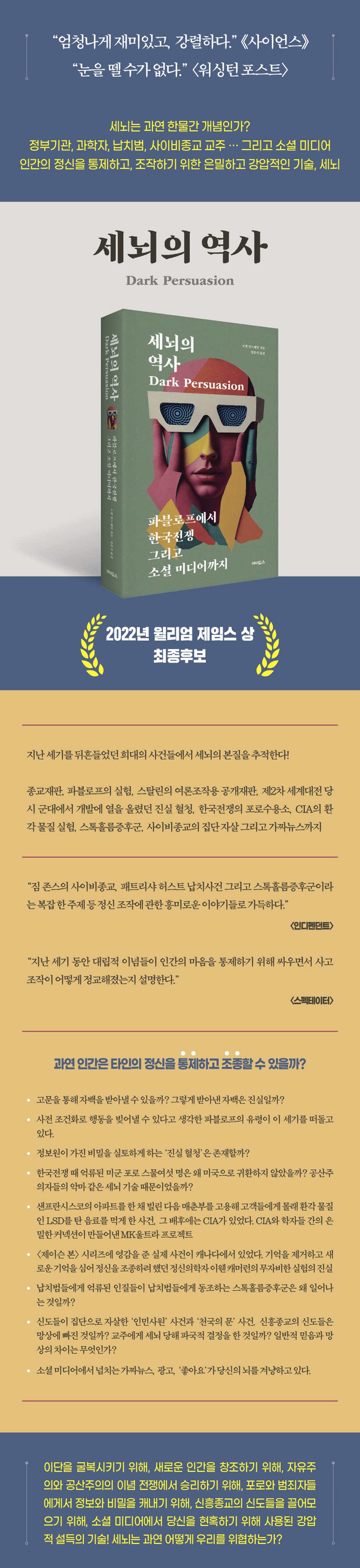
The author, a renowned American psychiatrist, traces the history of brainwashing, which has haunted us like a ghost, from the Inquisition in the Middle Ages to Pavlov's attempt to condition behavior through scientific experiments, through the Korean War, and up to the present day.
This book delves into the techniques of coercive persuasion used to subdue heresy, create a new humanity, win the ideological war between liberalism and communism, extract information and secrets from prisoners and criminals, and sometimes even gather followers for new religions, focusing on major historical events that shook the world.
It makes us reconsider what "brainwashing," once considered an outdated, unscientific concept, means in the modern world, with its unimaginable tales of government agencies, scientists, criminals, and cult leaders trying to dominate, control, and manipulate the human mind.
This book delves into the techniques of coercive persuasion used to subdue heresy, create a new humanity, win the ideological war between liberalism and communism, extract information and secrets from prisoners and criminals, and sometimes even gather followers for new religions, focusing on major historical events that shook the world.
It makes us reconsider what "brainwashing," once considered an outdated, unscientific concept, means in the modern world, with its unimaginable tales of government agencies, scientists, criminals, and cult leaders trying to dominate, control, and manipulate the human mind.
- You can preview some of the book's contents.
Preview
index
Preface 006
Chapter 1: Before Pavlov: Torture and Conversion or Conversion 017
Part 1: The War Over the Mind
Chapter 2: Pavlov's Dog and the Soviet Public Opinion Manipulation Show Trial 038
Chapter 3: Drug-Based Information Extraction: World War II and the Military 068
Chapter 4: Korea, the Prelude to the Cold War 099
Chapter 5: The Korean War and the Birth of Brainwashing 116
Chapter 6: The CIA's Counterattack: Corpses 151
Chapter 7: Dead Memories 187
Part 2 Criminals and Religious Groups
Chapter 8: The Sudden Conversion of Hostages: Stockholm Syndrome and Its Variants 220
Chapter 9: Brainwashing or Belief Change 239
Chapter 10: Mass Suicide at the People's Temple 283
Chapter 11: Faith or Delusion: The Gates of Heaven Incident 326
Part 3: Brainwashing in the 21st Century
Chapter 12: Does Brainwashing Exist? 358
Chapter 13: The Future of Brainwashing: Neuroscience and Social Media 369
Review 394
Acknowledgments 396
Americas 402
Search 447
Chapter 1: Before Pavlov: Torture and Conversion or Conversion 017
Part 1: The War Over the Mind
Chapter 2: Pavlov's Dog and the Soviet Public Opinion Manipulation Show Trial 038
Chapter 3: Drug-Based Information Extraction: World War II and the Military 068
Chapter 4: Korea, the Prelude to the Cold War 099
Chapter 5: The Korean War and the Birth of Brainwashing 116
Chapter 6: The CIA's Counterattack: Corpses 151
Chapter 7: Dead Memories 187
Part 2 Criminals and Religious Groups
Chapter 8: The Sudden Conversion of Hostages: Stockholm Syndrome and Its Variants 220
Chapter 9: Brainwashing or Belief Change 239
Chapter 10: Mass Suicide at the People's Temple 283
Chapter 11: Faith or Delusion: The Gates of Heaven Incident 326
Part 3: Brainwashing in the 21st Century
Chapter 12: Does Brainwashing Exist? 358
Chapter 13: The Future of Brainwashing: Neuroscience and Social Media 369
Review 394
Acknowledgments 396
Americas 402
Search 447
Detailed image
Into the book
The CIA was also very enthusiastic about the use of LSD and had no qualms about testing it on humans.
I'd like to say the CIA "tested LSD on volunteers," but those tests rarely "voluntarily" occurred, and the results were sometimes fatal. The CIA was keen to test LSD to determine exactly how effective it was as a motor-suppressant for subduing large groups, and crucially, as an interrogation tool.
Could this drug disrupt a person's mind enough to force them to reveal their true feelings? The CIA also had other concerns. Could LSD so profoundly alter a person's thinking that it could lead to a change of heart? Could secretly administering LSD to a foreign leader before a public appearance be used to embarrass or undermine their credibility? These questions were important for both offensive and defensive reasons.
--- p.179
Brainwashing is known to use covert, harmful manipulation.
Unfortunately, social media, a powerful tool for communication and support, can also lead directly to coercion.
During the 2016 US presidential campaign, rumors circulated on social media that Democratic Party officials were involved in a child sex trafficking ring based out of the Comet Ping Pong pizza parlor in Washington, D.C.
The pizza shop received hundreds of threats, and a 28-year-old man from North Carolina even came to Washington, D.C., armed with a rifle, and opened fire on the shop.
Two weeks later, a poll of American adults asked whether they believed social media posts implicating Hillary Clinton campaign officials in a satanic cult involving child molestation and abuse.
Forty-six percent of Trump supporters and even 17 percent of Clinton supporters said they believed it.
I'd like to say the CIA "tested LSD on volunteers," but those tests rarely "voluntarily" occurred, and the results were sometimes fatal. The CIA was keen to test LSD to determine exactly how effective it was as a motor-suppressant for subduing large groups, and crucially, as an interrogation tool.
Could this drug disrupt a person's mind enough to force them to reveal their true feelings? The CIA also had other concerns. Could LSD so profoundly alter a person's thinking that it could lead to a change of heart? Could secretly administering LSD to a foreign leader before a public appearance be used to embarrass or undermine their credibility? These questions were important for both offensive and defensive reasons.
--- p.179
Brainwashing is known to use covert, harmful manipulation.
Unfortunately, social media, a powerful tool for communication and support, can also lead directly to coercion.
During the 2016 US presidential campaign, rumors circulated on social media that Democratic Party officials were involved in a child sex trafficking ring based out of the Comet Ping Pong pizza parlor in Washington, D.C.
The pizza shop received hundreds of threats, and a 28-year-old man from North Carolina even came to Washington, D.C., armed with a rifle, and opened fire on the shop.
Two weeks later, a poll of American adults asked whether they believed social media posts implicating Hillary Clinton campaign officials in a satanic cult involving child molestation and abuse.
Forty-six percent of Trump supporters and even 17 percent of Clinton supporters said they believed it.
--- p.389
Publisher's Review
Brainwashing, the art of coercive persuasion to control and manipulate the human mind
Can a person be forced to think differently against their freedom and will? Is brainwashing truly possible? The author, a renowned American psychiatrist, traces the history of brainwashing, a phenomenon that has haunted us like a ghost, from the Inquisition in the Middle Ages, to Pavlov's attempts to condition behavior through scientific experiments, to the Korean War, and on to the present day.
This book delves into the techniques of coercive persuasion used to subdue heresy, create a new humanity (Soviet humanity), win the ideological war between liberalism and communism, extract the secrets of prisoners and criminals, and sometimes even gather followers of new religions, focusing on major historical events that shook the world.
It makes us reconsider what "brainwashing," once considered an outdated, unscientific concept, means in the modern world, with its unimaginable tales of government agencies, scientists, criminals, and cult leaders trying to dominate, control, and manipulate the human mind.
From Pavlov's scientific experiments to Stalin's public opinion-manipulating show trials, the Korean War, Stockholm syndrome, cults, and even fake news and social media.
Brutal torture and interrogation, sleep deprivation, behavioral conditioning, ideological indoctrination, truth drugs, memory erasure and restoration, kidnappings and hostages, mass suicides in cults, fake news and social media…
If we look into the history of brainwashing, all kinds of dark stories about humanity emerge.
Behind the scenes, government officials, the military, behavioral scientists, psychiatrists, neuroscientists, criminals, and cult leaders appear.
Among the so-called MK Ultra projects that took place in the 1950s and 1960s was an experiment in which prostitutes were hired to rent an apartment and secretly inject drinks laced with LSD for clients or spray LSD in the air in aerosol form (pp. 168-169).
It was an experiment to see if the hallucinogenic drug LSD was effective in extracting the desired information.
The mastermind, surprisingly, was the CIA.
When the US military prisoners of war held in China and North Korea during the Korean War did not return to the free world, the US government, believing that the communist bloc's brainwashing efforts were effective, secretly poured large amounts of money into academia and carried out a project.
The author explores classic brainwashing techniques like brutal torture, sleep deprivation, show trials, and mind-bending, as well as more outlandish cases like the CIA's LSD experiments, psychiatrist Ewen Cameron's mind control projects, and mass suicides by cults. He examines how the subtle and coercive art of persuasion has been refined to the point where it extends into modern neuroscience, fake news, and social media.
“The Internet is the new LSD”
Increasingly sophisticated and covert techniques of coercive persuasion threaten society.
Edward Hunter, a journalist who worked as a psychological warfare expert for the OSS during World War II, first used the term "brainwashing" to describe the ideological reform programs taking place in Chinese and North Korean prisoner-of-war camps during the Korean War, calling it "a terrifying new communist strategy to conquer the free world by destroying its spirit" (p. 117).
Despite being criticized as an outdated and unscientific term, the author says that the metaphor of the term brainwashing still has a powerful force, and points out that the influence of brainwashing is increasing due to more advanced technologies in the 21st century.
During the 2016 U.S. presidential campaign, rumors circulated on social media that Democratic Party officials were involved in a child sex trafficking ring based out of the Comet Ping Pong pizza parlor in Washington, D.C.
The pizza shop received hundreds of threats, and a 28-year-old man from North Carolina even came to Washington, D.C., armed with a rifle, and opened fire on the shop.
Two weeks later, a poll of American adults asked whether they believed social media posts implicating Hillary Clinton campaign officials in a satanic cult involving child molestation and abuse.
“Forty-six percent of Trump supporters and even 17 percent of Clinton supporters said they believed it.” (p. 389)
If the brainwashing and coercive persuasion of the last century involved primitive and visibly evil methods such as torture, interrogation, mind-altering, truth drugs, and trials, the coercive persuasion of the present age employs covert, deceptive, and sophisticated techniques.
The author points out that the Internet, social media, and advances in neuroscience have made coercive persuasion more covert, sophisticated, and powerful.
Fake news spreads faster and more widely on social media than real news, and governments are dividing societies by creating armies of trolls to manipulate public opinion and attack other countries by spreading misinformation.
The author, who argues that limited communication on the Internet literally facilitates brainwashing, warns that “the Internet now allows us to ‘deafen our ears with false reports’ much more quickly” (p. 393).
In the 17th century, Spinoza said, “No man’s mind can be entirely at the mercy of another.”
The author admits that extracting confessions through torture (let alone the legal validity of confessions) is unclear, that conversions to new religions or cults are short-lived, that the "truth serum" (to extract secrets from enemies) sought in the 1950s and 1960s does not exist, that erasing memories and transplanting new ones is impossible, and that so-called brainwashing is a crude and unscientific term.
However, the author says that humans are too easily swayed by torture and interrogation, fall into delusional pseudo-religions and engage in irreversible self-destructive behavior, and are easily fooled by fake news that blinds and deafens them, and that modern cognitive science, neuroscience, and behavioral science are becoming increasingly sophisticated by the day to manipulate these vulnerable human minds.
“It’s incredibly fun and intense.
This book urges reflection on the reality that coercive persuasion receives insufficient attention in society and the ongoing threat it poses to individuals and society as a whole.
The author warns that the threat of coercive persuasion is increasingly amplified by new technologies and mass media.”
- 〈Science〉
“I can’t take my eyes off it.
In clear, vibrant writing, the author shows how dark techniques of persuasion have led to today's fake news, cyberbullying, and cult-like behavior on the Internet.”
- The Washington Post
“It’s full of fascinating stories about mind control, including the Jim Jones cult, the Patricia Hearst kidnapping, and the complex subject of Stockholm syndrome.”
- The Independent
“It explains how thought manipulation has become more sophisticated over the past century as opposing ideologies have fought for control of the human mind.”
- The Spectator
Can a person be forced to think differently against their freedom and will? Is brainwashing truly possible? The author, a renowned American psychiatrist, traces the history of brainwashing, a phenomenon that has haunted us like a ghost, from the Inquisition in the Middle Ages, to Pavlov's attempts to condition behavior through scientific experiments, to the Korean War, and on to the present day.
This book delves into the techniques of coercive persuasion used to subdue heresy, create a new humanity (Soviet humanity), win the ideological war between liberalism and communism, extract the secrets of prisoners and criminals, and sometimes even gather followers of new religions, focusing on major historical events that shook the world.
It makes us reconsider what "brainwashing," once considered an outdated, unscientific concept, means in the modern world, with its unimaginable tales of government agencies, scientists, criminals, and cult leaders trying to dominate, control, and manipulate the human mind.
From Pavlov's scientific experiments to Stalin's public opinion-manipulating show trials, the Korean War, Stockholm syndrome, cults, and even fake news and social media.
Brutal torture and interrogation, sleep deprivation, behavioral conditioning, ideological indoctrination, truth drugs, memory erasure and restoration, kidnappings and hostages, mass suicides in cults, fake news and social media…
If we look into the history of brainwashing, all kinds of dark stories about humanity emerge.
Behind the scenes, government officials, the military, behavioral scientists, psychiatrists, neuroscientists, criminals, and cult leaders appear.
Among the so-called MK Ultra projects that took place in the 1950s and 1960s was an experiment in which prostitutes were hired to rent an apartment and secretly inject drinks laced with LSD for clients or spray LSD in the air in aerosol form (pp. 168-169).
It was an experiment to see if the hallucinogenic drug LSD was effective in extracting the desired information.
The mastermind, surprisingly, was the CIA.
When the US military prisoners of war held in China and North Korea during the Korean War did not return to the free world, the US government, believing that the communist bloc's brainwashing efforts were effective, secretly poured large amounts of money into academia and carried out a project.
The author explores classic brainwashing techniques like brutal torture, sleep deprivation, show trials, and mind-bending, as well as more outlandish cases like the CIA's LSD experiments, psychiatrist Ewen Cameron's mind control projects, and mass suicides by cults. He examines how the subtle and coercive art of persuasion has been refined to the point where it extends into modern neuroscience, fake news, and social media.
“The Internet is the new LSD”
Increasingly sophisticated and covert techniques of coercive persuasion threaten society.
Edward Hunter, a journalist who worked as a psychological warfare expert for the OSS during World War II, first used the term "brainwashing" to describe the ideological reform programs taking place in Chinese and North Korean prisoner-of-war camps during the Korean War, calling it "a terrifying new communist strategy to conquer the free world by destroying its spirit" (p. 117).
Despite being criticized as an outdated and unscientific term, the author says that the metaphor of the term brainwashing still has a powerful force, and points out that the influence of brainwashing is increasing due to more advanced technologies in the 21st century.
During the 2016 U.S. presidential campaign, rumors circulated on social media that Democratic Party officials were involved in a child sex trafficking ring based out of the Comet Ping Pong pizza parlor in Washington, D.C.
The pizza shop received hundreds of threats, and a 28-year-old man from North Carolina even came to Washington, D.C., armed with a rifle, and opened fire on the shop.
Two weeks later, a poll of American adults asked whether they believed social media posts implicating Hillary Clinton campaign officials in a satanic cult involving child molestation and abuse.
“Forty-six percent of Trump supporters and even 17 percent of Clinton supporters said they believed it.” (p. 389)
If the brainwashing and coercive persuasion of the last century involved primitive and visibly evil methods such as torture, interrogation, mind-altering, truth drugs, and trials, the coercive persuasion of the present age employs covert, deceptive, and sophisticated techniques.
The author points out that the Internet, social media, and advances in neuroscience have made coercive persuasion more covert, sophisticated, and powerful.
Fake news spreads faster and more widely on social media than real news, and governments are dividing societies by creating armies of trolls to manipulate public opinion and attack other countries by spreading misinformation.
The author, who argues that limited communication on the Internet literally facilitates brainwashing, warns that “the Internet now allows us to ‘deafen our ears with false reports’ much more quickly” (p. 393).
In the 17th century, Spinoza said, “No man’s mind can be entirely at the mercy of another.”
The author admits that extracting confessions through torture (let alone the legal validity of confessions) is unclear, that conversions to new religions or cults are short-lived, that the "truth serum" (to extract secrets from enemies) sought in the 1950s and 1960s does not exist, that erasing memories and transplanting new ones is impossible, and that so-called brainwashing is a crude and unscientific term.
However, the author says that humans are too easily swayed by torture and interrogation, fall into delusional pseudo-religions and engage in irreversible self-destructive behavior, and are easily fooled by fake news that blinds and deafens them, and that modern cognitive science, neuroscience, and behavioral science are becoming increasingly sophisticated by the day to manipulate these vulnerable human minds.
“It’s incredibly fun and intense.
This book urges reflection on the reality that coercive persuasion receives insufficient attention in society and the ongoing threat it poses to individuals and society as a whole.
The author warns that the threat of coercive persuasion is increasingly amplified by new technologies and mass media.”
- 〈Science〉
“I can’t take my eyes off it.
In clear, vibrant writing, the author shows how dark techniques of persuasion have led to today's fake news, cyberbullying, and cult-like behavior on the Internet.”
- The Washington Post
“It’s full of fascinating stories about mind control, including the Jim Jones cult, the Patricia Hearst kidnapping, and the complex subject of Stockholm syndrome.”
- The Independent
“It explains how thought manipulation has become more sophisticated over the past century as opposing ideologies have fought for control of the human mind.”
- The Spectator
GOODS SPECIFICS
- Date of issue: August 18, 2024
- Format: Paperback book binding method guide
- Page count, weight, size: 452 pages | 596g | 137*217*28mm
- ISBN13: 9791185415727
- ISBN10: 1185415726
You may also like
카테고리
korean


korean

![GQ KOREA Mark (Monthly): December [2025]](http://librairie.coreenne.fr/cdn/shop/files/8ef265dbbfbf186523ed75ba7319009d.jpg?v=1765340328&width=3840)


