

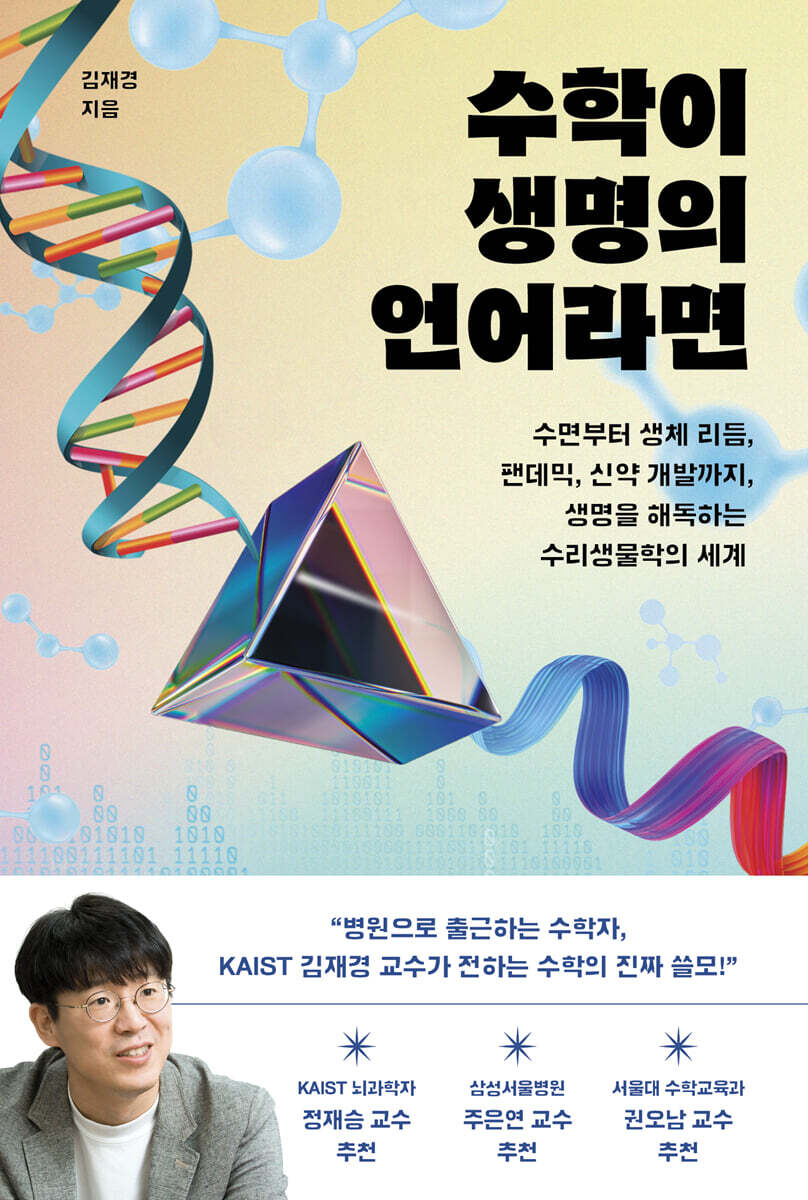
If mathematics is the language of life
 |
Description
Book Introduction
- A word from MD
-
Math that will save your lifeWhat comes to mind when you hear the Pythagorean theorem, the formula for roots, and calculus? Unlike life itself, which cycles through birth and death, I think of eternal, immutable laws that transcend time and space.
But what if mathematics is the language of life? This book, with its beautiful title, reminds us of how mathematics can help us understand and navigate life.
September 6, 2024. Natural Science PD Son Min-gyu
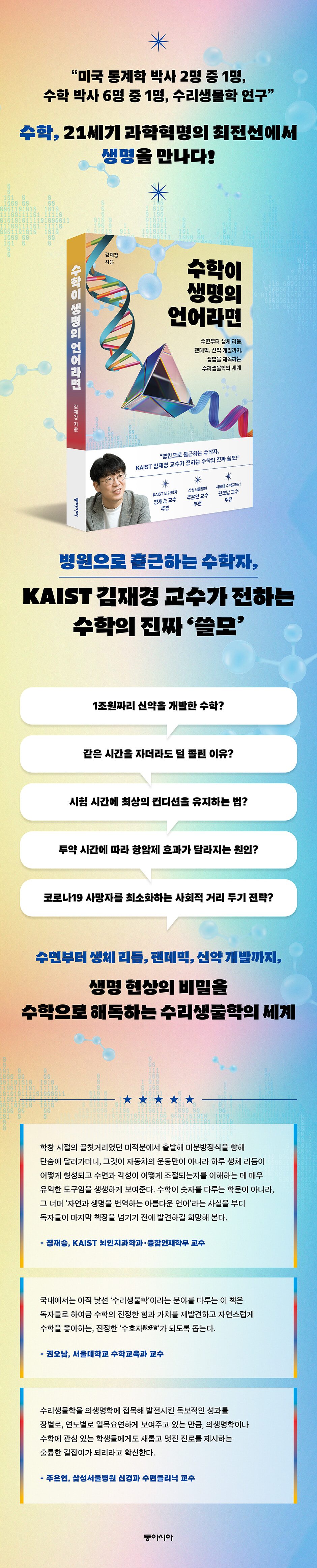
“One in two American statistics Ph.D.s,
One in six math PhDs goes into biomedical science research.
Mathematics, meeting life at the forefront of the 21st century scientific revolution!
★ Recommended by KAIST Neuroscientist Professor Jaeseung Jeong ★
★ Recommended by Professor Kwon Oh-nam of the Department of Mathematics Education at Seoul National University ★
★ Recommended by Professor Eun-Yeon Joo, Department of Neurology, Samsung Seoul Hospital ★
A mathematician going to work at a hospital,
KAIST Professor Jae-Kyung Kim shares the true "usefulness" of mathematics.
Mathematics, which was active in physics in the 19th century and chemistry in the 20th century, is leading the scientific revolution in life sciences in the 21st century.
In the United States, one in two statistics PhDs and one in six mathematics PhDs already earn degrees through biomedical research, and to join this trend, the National Science Foundation recently established mathematical biology research centers in the eastern, central, western, and southern United States.
However, despite the rapid growth of mathematical biology, which integrates mathematics into medicine and life sciences, there have been virtually no books introducing how mathematics is actually used to understand life phenomena, and even most students and readers who enjoy mathematics or biology have no idea what mathematical biology is.
The author, a professor of mathematical sciences at KAIST and a mathematician who explores life phenomena using mathematical models at the forefront of mathematical biology, explains in this book how mathematics is actually being applied to various problems related to biological rhythms, new drug development, sleep patterns, and pandemics.
As an educator who majored in mathematics education, he vividly demonstrates to students interested in medicine, life sciences, and mathematics the competencies and qualities required by today's times, as well as the true utility and beauty of mathematics, through his own experiences.
One in six math PhDs goes into biomedical science research.
Mathematics, meeting life at the forefront of the 21st century scientific revolution!
★ Recommended by KAIST Neuroscientist Professor Jaeseung Jeong ★
★ Recommended by Professor Kwon Oh-nam of the Department of Mathematics Education at Seoul National University ★
★ Recommended by Professor Eun-Yeon Joo, Department of Neurology, Samsung Seoul Hospital ★
A mathematician going to work at a hospital,
KAIST Professor Jae-Kyung Kim shares the true "usefulness" of mathematics.
Mathematics, which was active in physics in the 19th century and chemistry in the 20th century, is leading the scientific revolution in life sciences in the 21st century.
In the United States, one in two statistics PhDs and one in six mathematics PhDs already earn degrees through biomedical research, and to join this trend, the National Science Foundation recently established mathematical biology research centers in the eastern, central, western, and southern United States.
However, despite the rapid growth of mathematical biology, which integrates mathematics into medicine and life sciences, there have been virtually no books introducing how mathematics is actually used to understand life phenomena, and even most students and readers who enjoy mathematics or biology have no idea what mathematical biology is.
The author, a professor of mathematical sciences at KAIST and a mathematician who explores life phenomena using mathematical models at the forefront of mathematical biology, explains in this book how mathematics is actually being applied to various problems related to biological rhythms, new drug development, sleep patterns, and pandemics.
As an educator who majored in mathematics education, he vividly demonstrates to students interested in medicine, life sciences, and mathematics the competencies and qualities required by today's times, as well as the true utility and beauty of mathematics, through his own experiences.
- You can preview some of the book's contents.
Preview
index
Entering
Chapter 1: Calculus for Predicting the Future
A Beautiful Intersection of Biomedical Science and Mathematics
Differentiation and Integration in 10 Minutes
The real use of calculus
Chapter 2: A Computer-Readable Translator of Life Phenomena, Mathematics
A question that no one could answer correctly
Cell proliferation translated into mathematics
Cell infection translated into mathematics
Human Intuition vs.
Computer predictions
Chapter 3: The Mysterious World Inside Our Bodies: The Biological Clock
Doubts about Nobel Prize research
Time in our bodies, circadian rhythm
How the biological clock works, as revealed by Nobel laureates
Another face of the biological clock revealed by mathematics
A 60-year-old puzzle that Nobel laureates have been unable to solve
How does the biological clock handle intracellular traffic congestion?
Chapter 4: A Mathematician Goes to Work at the Hospital
My first research started due to financial difficulties
Why can't I adjust to jet lag?
Mathematics that developed a new drug worth 1 trillion won
If the effect of anticancer drugs varies depending on the time of administration
The idea behind Picasso's "The Bull"
Chapter 5: The Optimal Sleep Pattern Discovered by Mathematics
Asan Hospital, which is not in Asan
If I sleep a lot, will I feel less sleepy?
Why You Feel Less Sleepy Even When You Sleep the Same Hours
Anticipate and manage your test-time conditions
Diagnosing Sleep Disorders with 9 Questions
Chapter 6: The Mathematics of Pandemics and Social Distancing
Unexpectedly hot interest
The beginning of research to end COVID-19
The Paradoxical Future of COVID-19 Revealed by Mathematics
Was social distancing necessary?
Chapter 7: The K-Formula That Corrected 100 Years of Errors
The most famous formula in life sciences
A diet that has been used for 100 years is wrong?
The quadratic equation "root formula" that corrects errors in FDA formulas
Two Qualities of a Convergence Researcher
Going out
supplement
One step closer to calculus
How to make complex things simple
main
Image source
Chapter 1: Calculus for Predicting the Future
A Beautiful Intersection of Biomedical Science and Mathematics
Differentiation and Integration in 10 Minutes
The real use of calculus
Chapter 2: A Computer-Readable Translator of Life Phenomena, Mathematics
A question that no one could answer correctly
Cell proliferation translated into mathematics
Cell infection translated into mathematics
Human Intuition vs.
Computer predictions
Chapter 3: The Mysterious World Inside Our Bodies: The Biological Clock
Doubts about Nobel Prize research
Time in our bodies, circadian rhythm
How the biological clock works, as revealed by Nobel laureates
Another face of the biological clock revealed by mathematics
A 60-year-old puzzle that Nobel laureates have been unable to solve
How does the biological clock handle intracellular traffic congestion?
Chapter 4: A Mathematician Goes to Work at the Hospital
My first research started due to financial difficulties
Why can't I adjust to jet lag?
Mathematics that developed a new drug worth 1 trillion won
If the effect of anticancer drugs varies depending on the time of administration
The idea behind Picasso's "The Bull"
Chapter 5: The Optimal Sleep Pattern Discovered by Mathematics
Asan Hospital, which is not in Asan
If I sleep a lot, will I feel less sleepy?
Why You Feel Less Sleepy Even When You Sleep the Same Hours
Anticipate and manage your test-time conditions
Diagnosing Sleep Disorders with 9 Questions
Chapter 6: The Mathematics of Pandemics and Social Distancing
Unexpectedly hot interest
The beginning of research to end COVID-19
The Paradoxical Future of COVID-19 Revealed by Mathematics
Was social distancing necessary?
Chapter 7: The K-Formula That Corrected 100 Years of Errors
The most famous formula in life sciences
A diet that has been used for 100 years is wrong?
The quadratic equation "root formula" that corrects errors in FDA formulas
Two Qualities of a Convergence Researcher
Going out
supplement
One step closer to calculus
How to make complex things simple
main
Image source
Detailed image
Into the book
Calculus, a core mathematical theory for understanding and predicting the constantly changing life system, is learned only after overcoming numerous hurdles and studying mathematics for over ten years from elementary school to high school.
However, there are so many students who suffer from calculus that there are claims every year that calculus should be eliminated to reduce the number of students who give up on math, the so-called "math dropouts."
This is because, to learn calculus rigorously, you need to know various mathematical concepts such as sequences, limits, and series.
However, even without knowing this complex mathematics, it is not difficult to understand the essence of calculus, and even go one step further and use it to solve problems in the life sciences.
--- p.25~26
In this chapter, we will approach this problem in two ways.
One way is to use our intuition, and the other is to use computers.
Describing a phenomenon mathematically so that a computer can understand it is called 'mathematical modeling'.
From now on, I'd like to introduce a method for mathematical modeling based on calculus, that is, a method for translating the language of life sciences into mathematics so that computers can understand it.
This chapter contains the most mathematical formulas in the book, so it may be somewhat difficult. However, if you understand the mathematical content of this chapter, you will be able to approach and solve various biomedical science problems covered in the following chapters in new ways.
--- p.38~39
Almost all living things, from bacteria to insects, plants and animals, have these circadian rhythms, not just humans.
So how on earth do living things know the time and maintain their circadian rhythms? At first, I thought they simply followed the cycle of day and night created by the Earth's rotation, but that turned out to be half right and half wrong.
Because we can confirm that circadian rhythms are maintained for several weeks even when living things are placed in a dark environment with no day or night.
For example, many plants raise their leaves during the day to receive more energy from sunlight, and this periodic movement of leaves occurs even in a dark room.
And even in a dark environment, rats wake up and fall asleep approximately every 23.7 hours, and humans wake up and fall asleep approximately every 24.2 hours.
These research results suggest that living systems possess a mechanism that allows them to tell time independently of their surroundings, and the 2017 Nobel Prize in Physiology or Medicine was awarded for the discovery of this mechanism and its molecular mechanisms.
--- p.63~65
In 2007, Pfizer discovered PF-670462, a new drug candidate that regulates the body's biological clock.
Eating this will flip the dial on your body clock, causing it to be delayed by a few hours.
But this medicine had unique properties.
The effect was found to differ by more than three times depending on when you took it during the day.
If you take it at 6am, the effect is weakest and the clock is set back about an hour. If you take it at 6pm, the effect is strongest and the clock is set back about 3 hours.
Because the biological clock that this drug targets changes throughout the day, its effectiveness varies depending on when you take it.
Additionally, the efficacy was lower in a real environment with day and night than in a dark environment.
The biological clock, which has been adjusted by drugs, tries to return to its original state when it receives light information from the surrounding environment.
Therefore, even if you adjust your biological clock with this drug, if you do not take it consistently, your biological clock will return to its original state.
It's really fascinating that there is a medicine whose effects change depending on light.
Naturally, it could be expected that the effects of the medicine would differ depending on whether it was taken in the long summer or short winter days.
It was also expected that the drug's effectiveness would vary depending on how much light the person taking the drug was normally exposed to (and how much they spent looking at their smartphone late at night).
In short, it was expected that the effect would vary depending on when the drug was taken during the day and how much light the person was exposed to.
However, testing the effectiveness of drugs under all these complex conditions required astronomical costs, so Pfizer was having difficulty developing new drugs.
The reason Pfizer asked Professor Daniel Forger to collaborate was to use a mathematical model to overcome this situation.
Because testing the effects of drugs using mathematical models only costs money for computer electricity.
--- p.119~120
Professors Eun-Yeon Joo and Soo-Jeong Choi have been researching this issue for a long time, and the reason Professor Eun-Yeon Joo first contacted me in the summer of 2018 was because of daytime sleepiness.
We tracked the sleep of nurses working shifts at Samsung Medical Center using smartwatches for several weeks, and the results were different from what we expected.
We expected that as average sleep time increased and various sleep indicators, such as sleep efficiency, improved, sleepiness during shift work would naturally disappear, but this was not the case at all.
For example, when plotting the average sleep time and daytime sleepiness of shift-working nurses at Samsung Medical Center, as shown in Figure 5.1, it could not be said that the longer the average sleep time, the lower the sleepiness level.
Further research revealed that overseas studies have attempted to predict shift workers' daytime sleepiness using dozens of sleep indicators, but all have failed.
When you know that a problem has not been solved before, you become interested.
My heart raced at the thought that math might hold the key to the mystery.
--- p.149~150
According to the prediction, if the relaxed social distancing measures in place at the time could not be maintained by upgrading them to strong social distancing measures, it would be better to lift them immediately.
The results were announced in February 2022, and I was very scared until the day before the results were announced.
It's easy to argue for maintaining social distancing, but it takes courage to argue for lifting it.
I was anxious that the predictions would be wrong and that the lifting of social distancing measures would lead to disaster.
Even during interviews with reporters after the announcement, he repeatedly said that he was cautious.
However, contrary to concerns, the response to the announcement was lukewarm.
The entire nation was still focused on preventing the spread of COVID-19, and lifting social distancing was completely out of the question.
However, as I mentioned at the beginning of this chapter, the paper spread rapidly through Twitter and received a lot of attention overseas.
Fortunately, the predictions seem to have been quite accurate, as evidenced by data published in Japan in 2023, two years after the study was published.
As shown in the graph in Figure 6.4, the number of confirmed cases increased rapidly after social distancing measures were lifted, while the proportion of severely ill patients decreased significantly to almost zero, leading to a decrease in the number of severely ill patients.
The calculus prediction that lifting social distancing would actually reduce the number of critically ill patients, which contradicts our intuition, turned out to be correct.
These results are expected to be helpful in designing quarantine policies for emerging infectious diseases in the future.
Another useful use of calculus.
However, there are so many students who suffer from calculus that there are claims every year that calculus should be eliminated to reduce the number of students who give up on math, the so-called "math dropouts."
This is because, to learn calculus rigorously, you need to know various mathematical concepts such as sequences, limits, and series.
However, even without knowing this complex mathematics, it is not difficult to understand the essence of calculus, and even go one step further and use it to solve problems in the life sciences.
--- p.25~26
In this chapter, we will approach this problem in two ways.
One way is to use our intuition, and the other is to use computers.
Describing a phenomenon mathematically so that a computer can understand it is called 'mathematical modeling'.
From now on, I'd like to introduce a method for mathematical modeling based on calculus, that is, a method for translating the language of life sciences into mathematics so that computers can understand it.
This chapter contains the most mathematical formulas in the book, so it may be somewhat difficult. However, if you understand the mathematical content of this chapter, you will be able to approach and solve various biomedical science problems covered in the following chapters in new ways.
--- p.38~39
Almost all living things, from bacteria to insects, plants and animals, have these circadian rhythms, not just humans.
So how on earth do living things know the time and maintain their circadian rhythms? At first, I thought they simply followed the cycle of day and night created by the Earth's rotation, but that turned out to be half right and half wrong.
Because we can confirm that circadian rhythms are maintained for several weeks even when living things are placed in a dark environment with no day or night.
For example, many plants raise their leaves during the day to receive more energy from sunlight, and this periodic movement of leaves occurs even in a dark room.
And even in a dark environment, rats wake up and fall asleep approximately every 23.7 hours, and humans wake up and fall asleep approximately every 24.2 hours.
These research results suggest that living systems possess a mechanism that allows them to tell time independently of their surroundings, and the 2017 Nobel Prize in Physiology or Medicine was awarded for the discovery of this mechanism and its molecular mechanisms.
--- p.63~65
In 2007, Pfizer discovered PF-670462, a new drug candidate that regulates the body's biological clock.
Eating this will flip the dial on your body clock, causing it to be delayed by a few hours.
But this medicine had unique properties.
The effect was found to differ by more than three times depending on when you took it during the day.
If you take it at 6am, the effect is weakest and the clock is set back about an hour. If you take it at 6pm, the effect is strongest and the clock is set back about 3 hours.
Because the biological clock that this drug targets changes throughout the day, its effectiveness varies depending on when you take it.
Additionally, the efficacy was lower in a real environment with day and night than in a dark environment.
The biological clock, which has been adjusted by drugs, tries to return to its original state when it receives light information from the surrounding environment.
Therefore, even if you adjust your biological clock with this drug, if you do not take it consistently, your biological clock will return to its original state.
It's really fascinating that there is a medicine whose effects change depending on light.
Naturally, it could be expected that the effects of the medicine would differ depending on whether it was taken in the long summer or short winter days.
It was also expected that the drug's effectiveness would vary depending on how much light the person taking the drug was normally exposed to (and how much they spent looking at their smartphone late at night).
In short, it was expected that the effect would vary depending on when the drug was taken during the day and how much light the person was exposed to.
However, testing the effectiveness of drugs under all these complex conditions required astronomical costs, so Pfizer was having difficulty developing new drugs.
The reason Pfizer asked Professor Daniel Forger to collaborate was to use a mathematical model to overcome this situation.
Because testing the effects of drugs using mathematical models only costs money for computer electricity.
--- p.119~120
Professors Eun-Yeon Joo and Soo-Jeong Choi have been researching this issue for a long time, and the reason Professor Eun-Yeon Joo first contacted me in the summer of 2018 was because of daytime sleepiness.
We tracked the sleep of nurses working shifts at Samsung Medical Center using smartwatches for several weeks, and the results were different from what we expected.
We expected that as average sleep time increased and various sleep indicators, such as sleep efficiency, improved, sleepiness during shift work would naturally disappear, but this was not the case at all.
For example, when plotting the average sleep time and daytime sleepiness of shift-working nurses at Samsung Medical Center, as shown in Figure 5.1, it could not be said that the longer the average sleep time, the lower the sleepiness level.
Further research revealed that overseas studies have attempted to predict shift workers' daytime sleepiness using dozens of sleep indicators, but all have failed.
When you know that a problem has not been solved before, you become interested.
My heart raced at the thought that math might hold the key to the mystery.
--- p.149~150
According to the prediction, if the relaxed social distancing measures in place at the time could not be maintained by upgrading them to strong social distancing measures, it would be better to lift them immediately.
The results were announced in February 2022, and I was very scared until the day before the results were announced.
It's easy to argue for maintaining social distancing, but it takes courage to argue for lifting it.
I was anxious that the predictions would be wrong and that the lifting of social distancing measures would lead to disaster.
Even during interviews with reporters after the announcement, he repeatedly said that he was cautious.
However, contrary to concerns, the response to the announcement was lukewarm.
The entire nation was still focused on preventing the spread of COVID-19, and lifting social distancing was completely out of the question.
However, as I mentioned at the beginning of this chapter, the paper spread rapidly through Twitter and received a lot of attention overseas.
Fortunately, the predictions seem to have been quite accurate, as evidenced by data published in Japan in 2023, two years after the study was published.
As shown in the graph in Figure 6.4, the number of confirmed cases increased rapidly after social distancing measures were lifted, while the proportion of severely ill patients decreased significantly to almost zero, leading to a decrease in the number of severely ill patients.
The calculus prediction that lifting social distancing would actually reduce the number of critically ill patients, which contradicts our intuition, turned out to be correct.
These results are expected to be helpful in designing quarantine policies for emerging infectious diseases in the future.
Another useful use of calculus.
--- p.191~192
Publisher's Review
Why do I feel less sleepy even though I sleep the same amount of time?
How to stay in top condition during exam time?
Why do anticancer drug effects vary depending on the time of administration?
Social distancing strategies to minimize COVID-19 deaths?
From sleep to circadian rhythms, pandemics, and new drug development,
The world of mathematical biology: deciphering life
How can mathematical formulas, composed of symbols, help solve problems in medicine and life sciences? This is because mathematics is a "language" that describes complex biological phenomena in a way that computers can easily understand. This book focuses on calculus, the most widely used of these disciplines as a "tool for predicting the future."
First, Chapter 1 revisits the core of calculus, focusing on its true 'usefulness' from a different perspective than what is taught in high school.
Chapter 2 details how to translate real-world biological phenomena like cell proliferation and infection into differential equations using the calculus learned in Chapter 1, and discusses how computers can use differential equations to make predictions that surpass human intuition.
Chapters 3 through 7 demonstrate how this method of translating biological phenomena into differential equations and predicting the future using computers has addressed modern biomedical problems such as biological rhythms, drug development, sleep patterns, and pandemics.
In particular, among the problems the author personally researched, he deals with issues that are closely related to our daily lives and health while still being easily understandable to readers, so that readers can fully experience the usefulness of mathematics.
Specifically, Chapter 3 introduces research that has unraveled the secrets of the biological clock that governs our body's circadian rhythm, and explains how this research has explained the temperature compensation mechanism, which has been called the "greatest puzzle" in the field of mathematical biology because it has remained unsolved for a long time.
Chapter 4 introduces how mathematical biology contributes to the development of new drugs and cancer treatment, based on a case study of developing a new drug jointly with Pfizer, a global pharmaceutical company, and a study conducted with Professor Young-il Koh of Seoul National University Hospital that revealed that the mortality rate of female patients differed by more than 12 times depending on the time of administration of anticancer drugs.
Chapter 5 explains how mathematics, in a study of daytime sleepiness in shift workers, revealed why people feel less sleepy despite sleeping the same amount of time and how to maintain high alertness during specific time periods, and how these findings led to the development of an artificial intelligence algorithm that can diagnose sleep disorders with just a few questions.
Chapter 6 prepares for new pandemics by using mathematical models of infection and immunity to determine when strengthening or lifting social distancing measures can be a strategy to minimize severe cases and deaths.
Finally, Chapter 7 emphasizes the universality of mathematical biology by introducing a case in which mathematical biology corrected a huge error in the Michaelis-Menten equation, which had been recommended and used for over 100 years to predict the effects of drugs, using middle school-level mathematics.
How to stay in top condition during exam time?
Why do anticancer drug effects vary depending on the time of administration?
Social distancing strategies to minimize COVID-19 deaths?
From sleep to circadian rhythms, pandemics, and new drug development,
The world of mathematical biology: deciphering life
How can mathematical formulas, composed of symbols, help solve problems in medicine and life sciences? This is because mathematics is a "language" that describes complex biological phenomena in a way that computers can easily understand. This book focuses on calculus, the most widely used of these disciplines as a "tool for predicting the future."
First, Chapter 1 revisits the core of calculus, focusing on its true 'usefulness' from a different perspective than what is taught in high school.
Chapter 2 details how to translate real-world biological phenomena like cell proliferation and infection into differential equations using the calculus learned in Chapter 1, and discusses how computers can use differential equations to make predictions that surpass human intuition.
Chapters 3 through 7 demonstrate how this method of translating biological phenomena into differential equations and predicting the future using computers has addressed modern biomedical problems such as biological rhythms, drug development, sleep patterns, and pandemics.
In particular, among the problems the author personally researched, he deals with issues that are closely related to our daily lives and health while still being easily understandable to readers, so that readers can fully experience the usefulness of mathematics.
Specifically, Chapter 3 introduces research that has unraveled the secrets of the biological clock that governs our body's circadian rhythm, and explains how this research has explained the temperature compensation mechanism, which has been called the "greatest puzzle" in the field of mathematical biology because it has remained unsolved for a long time.
Chapter 4 introduces how mathematical biology contributes to the development of new drugs and cancer treatment, based on a case study of developing a new drug jointly with Pfizer, a global pharmaceutical company, and a study conducted with Professor Young-il Koh of Seoul National University Hospital that revealed that the mortality rate of female patients differed by more than 12 times depending on the time of administration of anticancer drugs.
Chapter 5 explains how mathematics, in a study of daytime sleepiness in shift workers, revealed why people feel less sleepy despite sleeping the same amount of time and how to maintain high alertness during specific time periods, and how these findings led to the development of an artificial intelligence algorithm that can diagnose sleep disorders with just a few questions.
Chapter 6 prepares for new pandemics by using mathematical models of infection and immunity to determine when strengthening or lifting social distancing measures can be a strategy to minimize severe cases and deaths.
Finally, Chapter 7 emphasizes the universality of mathematical biology by introducing a case in which mathematical biology corrected a huge error in the Michaelis-Menten equation, which had been recommended and used for over 100 years to predict the effects of drugs, using middle school-level mathematics.
GOODS SPECIFICS
- Date of issue: September 5, 2024
- Page count, weight, size: 244 pages | 333g | 128*190*20mm
- ISBN13: 9788962624953
- ISBN10: 8962624958
You may also like
카테고리
korean


korean

![GQ KOREA Mark (Monthly): December [2025]](http://librairie.coreenne.fr/cdn/shop/files/8ef265dbbfbf186523ed75ba7319009d.jpg?v=1765340328&width=3840)


