

Whitehall
 |
Description
Book Introduction
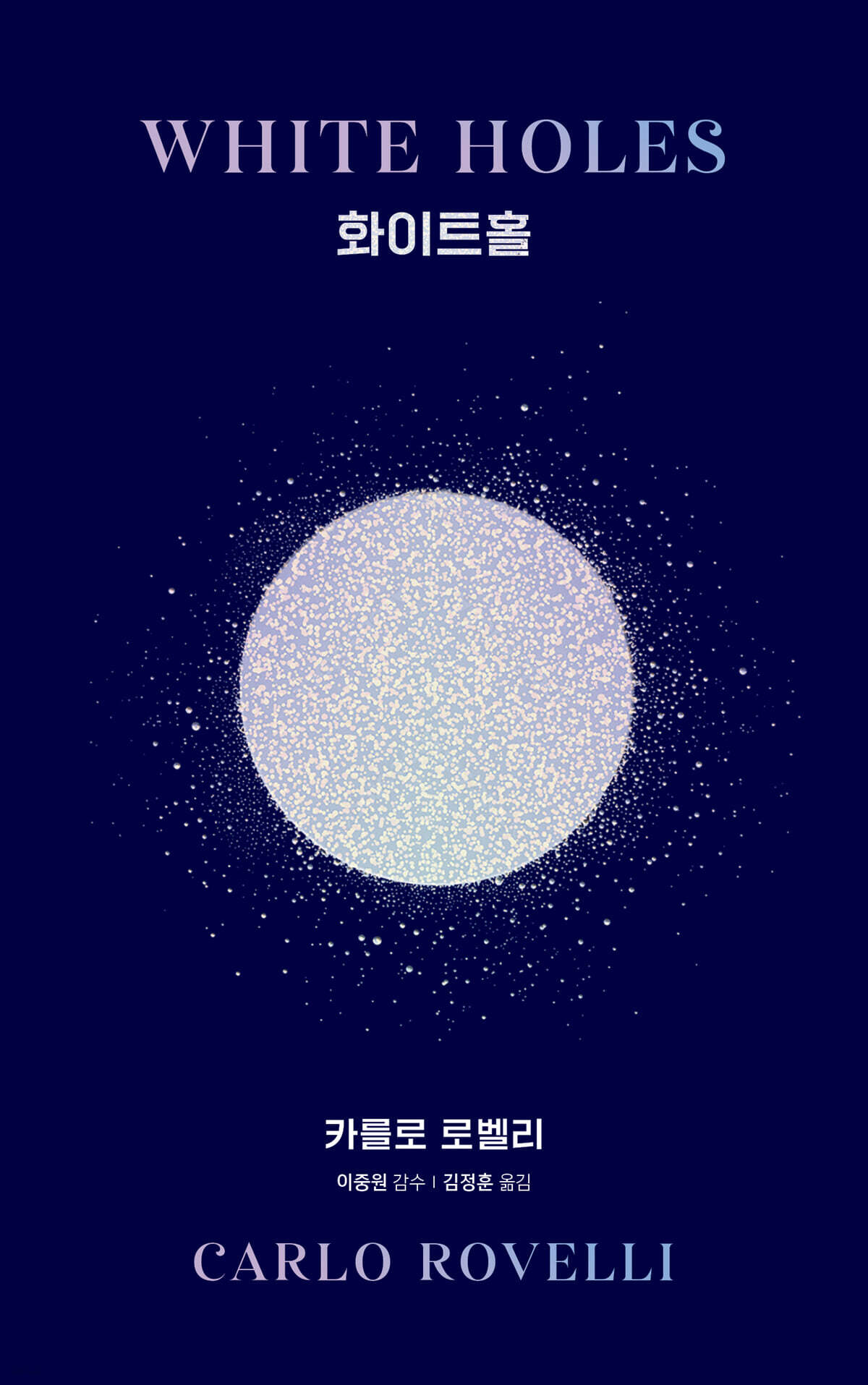
Carlo Rovelli, a world-renowned physicist, Guide us into a black hole where 'time is reversed' The latest work by Carlo Rovelli, a world-renowned physicist and considered the 'next Stephen Hawking.' Carlo Rovelli explores the unknown world of 'white holes' and the reality of persistent uncertainty, drawing on cutting-edge research. What happens at the very edge of reality, where human equations fail? He begins by explaining how black holes are created. It shows in detail what happens at the edge of reality, at the end of the world where time slows down and stops. And it takes us deep inside, to the very depths, where time and space seem to melt away and even bounce back up. That's where White Hole is born. In 2014, Carlo Rovelli's book, Physics of Every Moment, set an unprecedented record for a physics book, being translated and sold over 2 million copies worldwide. Over the next decade, Carlo Rovelli did his greatest work in popularizing physics, straddling science, philosophy, and art as a storyteller of time and quantum theory. The physics he wrote about has given us a new perspective on our world and a clear way to understand our place in the universe. In 2024, he once again takes us on a breathtakingly beautiful journey. With rave reviews from the world's media, including "There's never been a better guide to black holes!", let's delve into this fascinating book that explores ideas beyond the reach of human intuition. |
- You can preview some of the book's contents.
Preview
index
Part 1 This is a story about an adventure that is currently in progress.
Part 2: Turning Back Time in a Black Hole
Part 3 When You Call the Universe 'You'
Part 2: Turning Back Time in a Black Hole
Part 3 When You Call the Universe 'You'
Detailed image

Into the book
In this book, we will have a close and complex relationship with these equations.
These equations summarize our best understanding of space, time, and gravity.
It will tell us what to expect at the edge of a black hole, and inside it.
I'll also tell you what a white hole is.
It will show you the way through the territory of strange landscapes.
But really, the point I'm going to make from now on is to go to a place where these equations no longer work and see what happens.
We have to throw those equations away there.
That's what science is.
--- p.22
If our father were to watch us as we approached the event horizon, he would see our clocks slowly slowing down.
Because the closer we get to the horizon, the longer it takes for light to reach the Father.
Light is held by gravity and stays near the horizon before leaving.
If our Father continues to watch over us, we will see moments in our lives slowing down near the horizon, until they finally stop at the last moment before crossing the horizon.
Inside the horizon of a desert or a black hole, we continue to live normally, but no matter how long our Father waits, he will no longer receive anything from us.
In short, time does not stop for those who are inside beyond the horizon.
Only to someone observing them from a distance would events near the horizon appear to slow down tremendously.
--- p.42~43
We are now inside a black hole, "into the secrets." If we had a good star map, we would know that we have already crossed the threshold, and it is too late to send word home.
It's too late to stop here and turn back.
Beyond the horizon, not even light can escape, so we cannot go back.
No matter how powerful the rocket is, there is now no way to avoid falling towards the center.
To get back out, we'll have to "take a different route." If we pay even a little attention, we can tell just by looking around that we're inside a black hole.
Here too, space is spherical, just as it is outside the horizon.
However, outside, with a sufficiently powerful rocket, you can move (upwards) towards a larger spherical space.
Meanwhile, inside here, no matter what we do, we will be in a smaller and smaller sphere.
The gravity pulling us downward is so strong that there is no way to stop our descent.
--- p.58
How does a bounced ball move? Think about it for a moment.
It moves in the opposite direction of the falling motion, as if the film was run backwards.
A bouncing ball is like a falling ball viewed upside down from the end of its fall.
It's like watching the ball drop backwards.
We have seen before that the singularity region of a black hole is not at the 'center', but at the bottom of the fall.
If a black hole reaches the bottom of its descent, the area highlighted in bold in the preceding image, wouldn't it bounce back like a ball? As if time were running backwards.
Imagine filming the life of a black hole and playing the video backwards. What would we see? We would see a white hole.
--- p.86~87
How is the outside of a white hole different from the outside of a black hole? If we were outside, how could we distinguish between a black hole and a white hole? The answer is: "Indistinguishable."
From the outside, a white hole is indistinguishable from a black hole.
Black holes attract all objects with mass.
The same goes for Whitehall.
There may be planets orbiting around black holes.
The area around Whitehall is also like that… .
We could fall into a black hole, or we could fall into a white hole.
This is a bit confusing.
A white hole is like an upside-down black hole, but that doesn't mean its gravitational pull is repulsive.
Just because the direction of time is reversed doesn't mean gravity becomes repulsion.
From the outside, black holes and white holes behave in exactly the same way.
Both masses are attracted by the force of gravity.
--- p.109~110
The reconstruction of the life cycle of a black hole that I have described so far is too simplistic.
An explanation that ignores everything that distinguishes between past and future.
To complete the story, we must also consider the "irreversible" aspect of a black hole's life: phenomena that cannot be reversed in time.
This again leads to the question of time.
Why are the past and the future so different? Why do we remember the past but not the future? Why can we decide what we do tomorrow but not what we did yesterday? I've been obsessed with these questions and have been researching them for the past several years.
The answer is subtle and ultimately has everything to do with us.
--- p.126
The world is the same.
Studying space and time, black holes and white holes, is one of the ways we relate to reality.
Reality is not 'it', it is 'you'.
As lyric poets talk to the moon.
In The Jungle Book, all the animals exchange cries of recognition.
“You and I, we share the same blood.” I believe that in order to understand the universe and ourselves, we must always refer to the universe as “you.”
A 'you' who acknowledges that we are one with things.
You and I, we share the same blood.
These equations summarize our best understanding of space, time, and gravity.
It will tell us what to expect at the edge of a black hole, and inside it.
I'll also tell you what a white hole is.
It will show you the way through the territory of strange landscapes.
But really, the point I'm going to make from now on is to go to a place where these equations no longer work and see what happens.
We have to throw those equations away there.
That's what science is.
--- p.22
If our father were to watch us as we approached the event horizon, he would see our clocks slowly slowing down.
Because the closer we get to the horizon, the longer it takes for light to reach the Father.
Light is held by gravity and stays near the horizon before leaving.
If our Father continues to watch over us, we will see moments in our lives slowing down near the horizon, until they finally stop at the last moment before crossing the horizon.
Inside the horizon of a desert or a black hole, we continue to live normally, but no matter how long our Father waits, he will no longer receive anything from us.
In short, time does not stop for those who are inside beyond the horizon.
Only to someone observing them from a distance would events near the horizon appear to slow down tremendously.
--- p.42~43
We are now inside a black hole, "into the secrets." If we had a good star map, we would know that we have already crossed the threshold, and it is too late to send word home.
It's too late to stop here and turn back.
Beyond the horizon, not even light can escape, so we cannot go back.
No matter how powerful the rocket is, there is now no way to avoid falling towards the center.
To get back out, we'll have to "take a different route." If we pay even a little attention, we can tell just by looking around that we're inside a black hole.
Here too, space is spherical, just as it is outside the horizon.
However, outside, with a sufficiently powerful rocket, you can move (upwards) towards a larger spherical space.
Meanwhile, inside here, no matter what we do, we will be in a smaller and smaller sphere.
The gravity pulling us downward is so strong that there is no way to stop our descent.
--- p.58
How does a bounced ball move? Think about it for a moment.
It moves in the opposite direction of the falling motion, as if the film was run backwards.
A bouncing ball is like a falling ball viewed upside down from the end of its fall.
It's like watching the ball drop backwards.
We have seen before that the singularity region of a black hole is not at the 'center', but at the bottom of the fall.
If a black hole reaches the bottom of its descent, the area highlighted in bold in the preceding image, wouldn't it bounce back like a ball? As if time were running backwards.
Imagine filming the life of a black hole and playing the video backwards. What would we see? We would see a white hole.
--- p.86~87
How is the outside of a white hole different from the outside of a black hole? If we were outside, how could we distinguish between a black hole and a white hole? The answer is: "Indistinguishable."
From the outside, a white hole is indistinguishable from a black hole.
Black holes attract all objects with mass.
The same goes for Whitehall.
There may be planets orbiting around black holes.
The area around Whitehall is also like that… .
We could fall into a black hole, or we could fall into a white hole.
This is a bit confusing.
A white hole is like an upside-down black hole, but that doesn't mean its gravitational pull is repulsive.
Just because the direction of time is reversed doesn't mean gravity becomes repulsion.
From the outside, black holes and white holes behave in exactly the same way.
Both masses are attracted by the force of gravity.
--- p.109~110
The reconstruction of the life cycle of a black hole that I have described so far is too simplistic.
An explanation that ignores everything that distinguishes between past and future.
To complete the story, we must also consider the "irreversible" aspect of a black hole's life: phenomena that cannot be reversed in time.
This again leads to the question of time.
Why are the past and the future so different? Why do we remember the past but not the future? Why can we decide what we do tomorrow but not what we did yesterday? I've been obsessed with these questions and have been researching them for the past several years.
The answer is subtle and ultimately has everything to do with us.
--- p.126
The world is the same.
Studying space and time, black holes and white holes, is one of the ways we relate to reality.
Reality is not 'it', it is 'you'.
As lyric poets talk to the moon.
In The Jungle Book, all the animals exchange cries of recognition.
“You and I, we share the same blood.” I believe that in order to understand the universe and ourselves, we must always refer to the universe as “you.”
A 'you' who acknowledges that we are one with things.
You and I, we share the same blood.
--- p.173~174
Publisher's Review
Where science comes to life
Meet the new Stephen Hawking
In 1915, Einstein presented the gravitational field equations in his general theory of relativity, which describe the close relationship between the gravity of a star and the structure of spacetime around it.
Since then, numerous astrophysicists have used this equation to partially or fragmentarily explain the motion and evolution of stars, from the Big Bang in the early universe to black holes.
Carlo Rovelli, a world-renowned physicist who is called the next Stephen Hawking, has pieced together these fragmentary puzzle pieces to create a coherent big picture of black holes, a gigantic patchwork quilt.
The last piece of this picture, the last puzzle in the jigsaw puzzle, is the White Hall.
And this book, "White Hole," is about him.
"White Hole" became a bestseller immediately after its release in Italy in March 2023, maintaining the top spot for 10 weeks.
This book has been translated and published in over 40 countries around the world, including English-speaking countries, and has been highly praised by major media outlets such as The Times, The Washington Post, and New Scientist, selecting it as the “Book of the Year.”
Carlo Rovelli, a physicist, once again demonstrated his "Rovelli power" by attracting unusual public and media attention.
The moment we open the book, we are instantly transported to outer space.
It feels like you're on a spaceship, like you're near the horizon of a black hole.
Through his unique "Robelian" language and storytelling that crosses literature and philosophy, he vividly describes how black and white holes are created and what happens at the edges of strange stars where "time seems to slow down and then stop, and space seems to be torn apart."
The end of the world where time stops,
What will happen there?
After the Big Bang, a huge cloud of hydrogen floating in space becomes denser and contracts under its own gravity.
As it does so, it heats up and ignites to become a star like our sun, which lasts for billions of years until all the hydrogen has been converted to helium and ash.
When all the hydrogen is burned, the star cannot withstand its own gravity and collapses, creating a massive void called a black hole.
And the star's matter is sucked into the black hole and sinks.
At this time, the energy the star had gradually disappeared due to Hawking radiation.
The matter of the star inside the black hole continues to lose energy through Hawking radiation, and at the same time, it is compressed further and further, constantly shrinking, distorting the space and time of the black hole into a funnel shape.
Many people believed that this process would continue indefinitely, and that eventually, the matter of the stars, the black holes, space and time would all be destroyed and disappear.
The end of the black hole was predicted.
But Carlo Rovelli insists that this is not the end.
Matter, which seemed to be endlessly compressed and shrinking until it disappeared, stops being compressed when it reaches the minimum size of space where it can no longer shrink due to the quantum structure of space and time.
The matter of the star also remains at a minimum size, which is called a Planck star.
This point is the singularity of the black hole.
Planck stars have quantum properties and can quantum-transfer to another world through a quantum tunnel, and that other world is a white hole.
Matter that has sunk to the bottom of a black hole bounces back up to the bottom of a white hole.
At the same time, the fabric of space and time expands again.
It's as if time inside a black hole has been turned back.
In this way, a black hole does not disappear into ‘nothingness’, but rather transitions into a white hole.
Anything that enters a black hole bounces all the way to the white hole's horizon and then completely escapes, returning to where the sun and other stars are.
With this, the black hole was reincarnated as a white hole.
When you call the universe 'you',
Only then can we understand the universe.
This is Carlo Rovelli's big picture of the life of the universe, and more specifically, the fate of black holes.
Here, black holes and white holes can be explained by Einstein's gravitational field equations, and quantum transitions at singularities can be explained by quantum theory.
Based on this, he comes to the idea that the Big Bang may not have been the beginning of the universe, but rather a 'big bounce' of a white hole created by the collapse of the previous universe.
It also cautiously suggests that some of the dark matter that fills the universe may also be made up of billions of tiny, delicate white holes.
The idea that the universe might not begin (birth) with the Big Bang and end (death) with a black hole, but might be reincarnated as a white hole and continue to cycle endlessly seems somehow connected to human life and death.
Although humans are insignificant beings in the universe, they are still a part of the universe.
So, our lives do not end with birth and death, but, like the universe, they can continue on, perhaps even extending beyond.
Carlo Rovelli also emphasizes that studying space and time, black holes and white holes, is one way we relate to reality.
We always think that we are different from the world around us, but that is because we are just like any other thing.
We are “not only social beings living with other humans, but also biochemical organisms that sing in chorus with the rest of the biosphere and burn free energy from the sun.”
And he says:
“In order to understand the universe and ourselves, we must always call the universe ‘you.’”
It is a definite stroke of luck to have encountered this book and Carlo Rovelli.
The Big Bang, white holes, black holes, space and time… Through the study of these vast realities, we will have a rare opportunity to contemplate the implications the universe holds for humanity, messages we have overlooked, buried within our own lives.
Meet the new Stephen Hawking
In 1915, Einstein presented the gravitational field equations in his general theory of relativity, which describe the close relationship between the gravity of a star and the structure of spacetime around it.
Since then, numerous astrophysicists have used this equation to partially or fragmentarily explain the motion and evolution of stars, from the Big Bang in the early universe to black holes.
Carlo Rovelli, a world-renowned physicist who is called the next Stephen Hawking, has pieced together these fragmentary puzzle pieces to create a coherent big picture of black holes, a gigantic patchwork quilt.
The last piece of this picture, the last puzzle in the jigsaw puzzle, is the White Hall.
And this book, "White Hole," is about him.
"White Hole" became a bestseller immediately after its release in Italy in March 2023, maintaining the top spot for 10 weeks.
This book has been translated and published in over 40 countries around the world, including English-speaking countries, and has been highly praised by major media outlets such as The Times, The Washington Post, and New Scientist, selecting it as the “Book of the Year.”
Carlo Rovelli, a physicist, once again demonstrated his "Rovelli power" by attracting unusual public and media attention.
The moment we open the book, we are instantly transported to outer space.
It feels like you're on a spaceship, like you're near the horizon of a black hole.
Through his unique "Robelian" language and storytelling that crosses literature and philosophy, he vividly describes how black and white holes are created and what happens at the edges of strange stars where "time seems to slow down and then stop, and space seems to be torn apart."
The end of the world where time stops,
What will happen there?
After the Big Bang, a huge cloud of hydrogen floating in space becomes denser and contracts under its own gravity.
As it does so, it heats up and ignites to become a star like our sun, which lasts for billions of years until all the hydrogen has been converted to helium and ash.
When all the hydrogen is burned, the star cannot withstand its own gravity and collapses, creating a massive void called a black hole.
And the star's matter is sucked into the black hole and sinks.
At this time, the energy the star had gradually disappeared due to Hawking radiation.
The matter of the star inside the black hole continues to lose energy through Hawking radiation, and at the same time, it is compressed further and further, constantly shrinking, distorting the space and time of the black hole into a funnel shape.
Many people believed that this process would continue indefinitely, and that eventually, the matter of the stars, the black holes, space and time would all be destroyed and disappear.
The end of the black hole was predicted.
But Carlo Rovelli insists that this is not the end.
Matter, which seemed to be endlessly compressed and shrinking until it disappeared, stops being compressed when it reaches the minimum size of space where it can no longer shrink due to the quantum structure of space and time.
The matter of the star also remains at a minimum size, which is called a Planck star.
This point is the singularity of the black hole.
Planck stars have quantum properties and can quantum-transfer to another world through a quantum tunnel, and that other world is a white hole.
Matter that has sunk to the bottom of a black hole bounces back up to the bottom of a white hole.
At the same time, the fabric of space and time expands again.
It's as if time inside a black hole has been turned back.
In this way, a black hole does not disappear into ‘nothingness’, but rather transitions into a white hole.
Anything that enters a black hole bounces all the way to the white hole's horizon and then completely escapes, returning to where the sun and other stars are.
With this, the black hole was reincarnated as a white hole.
When you call the universe 'you',
Only then can we understand the universe.
This is Carlo Rovelli's big picture of the life of the universe, and more specifically, the fate of black holes.
Here, black holes and white holes can be explained by Einstein's gravitational field equations, and quantum transitions at singularities can be explained by quantum theory.
Based on this, he comes to the idea that the Big Bang may not have been the beginning of the universe, but rather a 'big bounce' of a white hole created by the collapse of the previous universe.
It also cautiously suggests that some of the dark matter that fills the universe may also be made up of billions of tiny, delicate white holes.
The idea that the universe might not begin (birth) with the Big Bang and end (death) with a black hole, but might be reincarnated as a white hole and continue to cycle endlessly seems somehow connected to human life and death.
Although humans are insignificant beings in the universe, they are still a part of the universe.
So, our lives do not end with birth and death, but, like the universe, they can continue on, perhaps even extending beyond.
Carlo Rovelli also emphasizes that studying space and time, black holes and white holes, is one way we relate to reality.
We always think that we are different from the world around us, but that is because we are just like any other thing.
We are “not only social beings living with other humans, but also biochemical organisms that sing in chorus with the rest of the biosphere and burn free energy from the sun.”
And he says:
“In order to understand the universe and ourselves, we must always call the universe ‘you.’”
It is a definite stroke of luck to have encountered this book and Carlo Rovelli.
The Big Bang, white holes, black holes, space and time… Through the study of these vast realities, we will have a rare opportunity to contemplate the implications the universe holds for humanity, messages we have overlooked, buried within our own lives.
GOODS SPECIFICS
- Date of issue: September 1, 2024
- Format: Hardcover book binding method guide
- Page count, weight, size: 196 pages | 420g | 130*209*20mm
- ISBN13: 9791165349936
- ISBN10: 1165349930
You may also like
카테고리
korean


korean

![GQ KOREA Mark (Monthly): December [2025]](http://librairie.coreenne.fr/cdn/shop/files/8ef265dbbfbf186523ed75ba7319009d.jpg?v=1765340328&width=3840)


