

Anxious Generation
 |
Description
Book Introduction
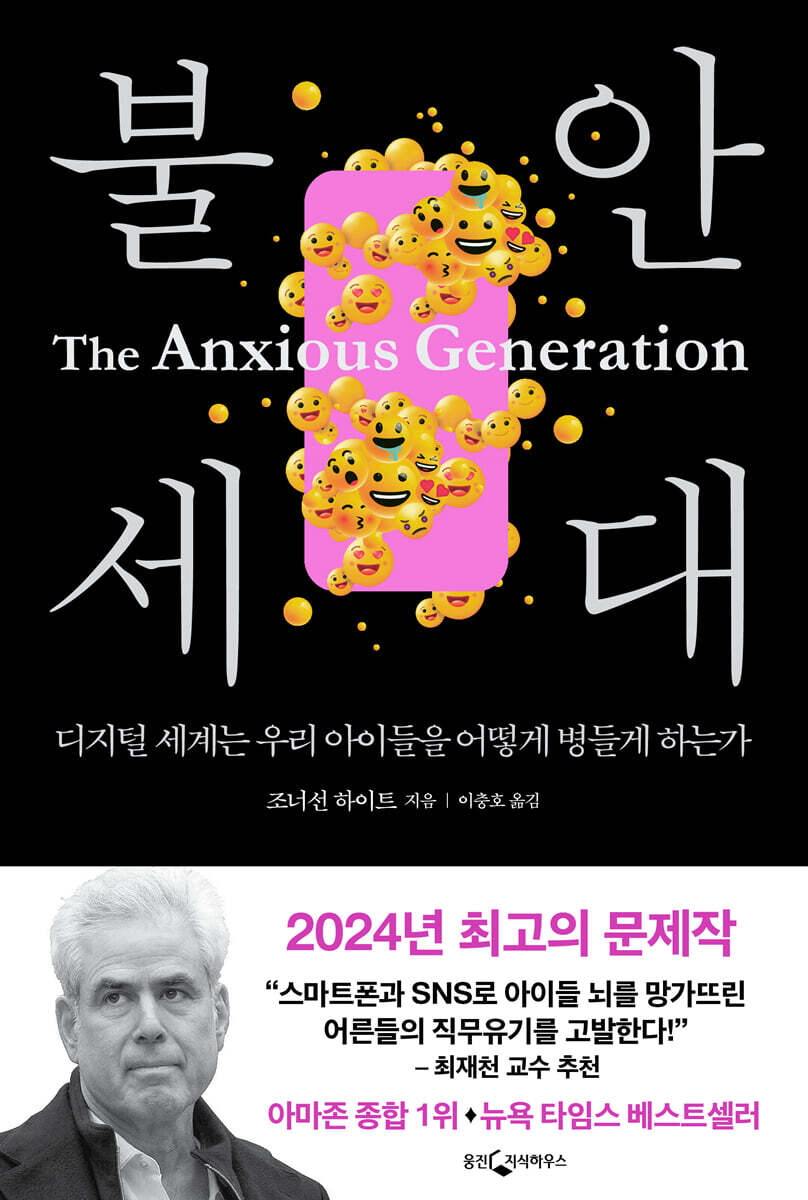
The best problem novel of 2024 that shocked the world Why should we limit teens' use of social media? * #1 in Amazon's overall nonfiction rankings * New York Times (USA) and Sunday Times (UK) bestseller immediately after publication * Highly recommended by Professor Jae-Cheon Choi of Ewha Womans University World-renowned social psychologist Jonathan Haidt's new book, "Generation Anxiety," is taking the world by storm. Having emerged as "the most controversial scholar in the English-speaking world" with his bestseller "The Righteous Mind," he makes the shocking claim that smartphones, social media, and the internet are causing a youth mental health crisis. The book immediately became #1 on Amazon's overall charts, a New York Times bestseller, and a Sunday Times bestseller, sparking a global debate about teenagers' smartphone and social media regulations. How do social media, online pornography, addictive games, and stimulating content rewire the sensitive and vulnerable brains of children? How do overprotective parenting and helicopter parenting amplify the harm caused by smartphones? Drawing on extensive data and research, Hait reveals the mechanisms by which "overprotection in the real world and underprotection in the virtual world" harm children's brains. And it clearly sets out the path our society must take to restore healthier and happier childhoods. “The best gift you can give your children is a childhood grounded in real reality.” _Jonathan Haidt |
- You can preview some of the book's contents.
Preview
index
Recommendation
Preface: “Would You Send Your Children to Mars?”
Part 1: The Rising Tidal Wave
Chapter 1: The Rise of Pain
The tsunami begins to surge
The root cause of the surge
What is anxiety
Is that really a real phenomenon?
The birth of smartphones and Generation Z
Isn't it natural to suffer from anxiety and depression?
In all English-speaking countries
The rest of the world
Part 2 Background: The Decline of Play-Based Childhood
Chapter 2: What Children Should Do During Childhood
The long childhood of slow-growing humans
Free play
tuning
social learning
The brain and sensitive organs that expect
Chapter 3: Discovery Mode and the Need for Risky Play
Discovery Mode vs. Defense Mode
Students living in defensive mode
Children are born with antifragility.
Antifragile children need risky play to stay in discovery mode.
The End of Play-Based Childhood
Fear-driven parenting
Safety first and concept expansion
Antifragility and the Attachment System
Chapter 4 Puberty and the Blocked Transition to Adulthood
Plasticity and vulnerability of adolescence
Experience Blockers: Safety First and Smartphones
rite of passage
Why We Block the Transition to Adulthood
Building a Ladder Between Childhood and Adulthood
Part 3: The Great Reshaping of Childhood: The Rise of Smartphone-Based Childhood
Chapter 5: The Four Fundamental Harms: Social Deprivation, Sleep Deprivation, Distraction, and Addiction
The emergence of smartphone-based childhood
Social Media and Its Transformation
The Opportunity Cost of Smartphone-Based Childhood
Harm 1: Social Deprivation
Harm #2: Sleep Deprivation
Harm #3: Distraction
Harm 4: Addiction
Regarding the claim that social media benefits teenagers
Chapter 6: Why Social Media Is More Harmful to Girls Than Boys
Evidence that social media is harmful to girls
Girls use social media more than boys.
Subjectivity and compatibility
Four Reasons Why Girls Are Especially Vulnerable
Quantity overwhelms quality
Chapter 7: What's Happening to the Boys?
The long-standing decline of men
Boys who fail to take off
A boy's childhood free from the dangers of the real world
A virtual world welcoming boys
A virtual world that devours boys
porn
video games
If you live your life immersed in the screen and never engage in real-world play,
Technology, freedom, and meaninglessness
Chapter 8: Spiritual Elevation and Degeneration
spiritual practice
A hole in the shape of a god
Part 4: Collective Action for Healthier Childhood
Chapter 9: Preparing for Collective Action
collective action problem
A few notes
Chapter 10: What Governments and Tech Companies Can Do Now
Race to the bottom of the brainstem
What governments and tech companies can do to end the race to the bottom of the brain stem
What governments can do to encourage more and better real-world experiences
Chapter 11: What Schools Can Do Now
School without cell phones
A school with lots of play
Letgro Project
Better breaks and playgrounds
Bring the boys back to the real world
The educational experiment we need most
Chapter 12 What Parents Can Do Now
Suggestions for parents of young children aged 0-5
Suggestions for parents of elementary and middle school children aged 6 to 13
Suggestions for parents of middle and high school students aged 13 to 18
Conclusion: Let's return the children to Earth.
Acknowledgements
main
References
Search
Preface: “Would You Send Your Children to Mars?”
Part 1: The Rising Tidal Wave
Chapter 1: The Rise of Pain
The tsunami begins to surge
The root cause of the surge
What is anxiety
Is that really a real phenomenon?
The birth of smartphones and Generation Z
Isn't it natural to suffer from anxiety and depression?
In all English-speaking countries
The rest of the world
Part 2 Background: The Decline of Play-Based Childhood
Chapter 2: What Children Should Do During Childhood
The long childhood of slow-growing humans
Free play
tuning
social learning
The brain and sensitive organs that expect
Chapter 3: Discovery Mode and the Need for Risky Play
Discovery Mode vs. Defense Mode
Students living in defensive mode
Children are born with antifragility.
Antifragile children need risky play to stay in discovery mode.
The End of Play-Based Childhood
Fear-driven parenting
Safety first and concept expansion
Antifragility and the Attachment System
Chapter 4 Puberty and the Blocked Transition to Adulthood
Plasticity and vulnerability of adolescence
Experience Blockers: Safety First and Smartphones
rite of passage
Why We Block the Transition to Adulthood
Building a Ladder Between Childhood and Adulthood
Part 3: The Great Reshaping of Childhood: The Rise of Smartphone-Based Childhood
Chapter 5: The Four Fundamental Harms: Social Deprivation, Sleep Deprivation, Distraction, and Addiction
The emergence of smartphone-based childhood
Social Media and Its Transformation
The Opportunity Cost of Smartphone-Based Childhood
Harm 1: Social Deprivation
Harm #2: Sleep Deprivation
Harm #3: Distraction
Harm 4: Addiction
Regarding the claim that social media benefits teenagers
Chapter 6: Why Social Media Is More Harmful to Girls Than Boys
Evidence that social media is harmful to girls
Girls use social media more than boys.
Subjectivity and compatibility
Four Reasons Why Girls Are Especially Vulnerable
Quantity overwhelms quality
Chapter 7: What's Happening to the Boys?
The long-standing decline of men
Boys who fail to take off
A boy's childhood free from the dangers of the real world
A virtual world welcoming boys
A virtual world that devours boys
porn
video games
If you live your life immersed in the screen and never engage in real-world play,
Technology, freedom, and meaninglessness
Chapter 8: Spiritual Elevation and Degeneration
spiritual practice
A hole in the shape of a god
Part 4: Collective Action for Healthier Childhood
Chapter 9: Preparing for Collective Action
collective action problem
A few notes
Chapter 10: What Governments and Tech Companies Can Do Now
Race to the bottom of the brainstem
What governments and tech companies can do to end the race to the bottom of the brain stem
What governments can do to encourage more and better real-world experiences
Chapter 11: What Schools Can Do Now
School without cell phones
A school with lots of play
Letgro Project
Better breaks and playgrounds
Bring the boys back to the real world
The educational experiment we need most
Chapter 12 What Parents Can Do Now
Suggestions for parents of young children aged 0-5
Suggestions for parents of elementary and middle school children aged 6 to 13
Suggestions for parents of middle and high school students aged 13 to 18
Conclusion: Let's return the children to Earth.
Acknowledgements
main
References
Search
Detailed image

Into the book
Generation Z is a testbed for a radical new way of growing up: one entirely removed from the real-world interactions of the small communities in which humanity evolved.
Let's call this the 'Great Rewiring of Childhood'.
It's almost as if they were the first generation to grow up on Mars.
--- From "Preface: "Would You Send Children to Mars?"
One in four teens said they are online “almost always.”
By 2022, that figure had nearly doubled to 46%.
This unusually high percentage suggests that even when Gen Z youth appear to be away from their devices or engaged in other real-world activities, they devote a significant portion of their attention to watching or worrying (or perhaps even anxiously) about events unfolding in the social metaverse. As MIT professor Sherry Turkle wrote about life with smartphones in 2015, “We are forever somewhere else.”
--- From "Chapter 1: The Surge of Pain"
Adult-led classes can provide useful information, but the information doesn't play a significant role in shaping the developing brain.
On the other hand, play plays a big role.
This ties into a core insight of cognitive behavioral therapy: that the key to emotional development lies in experiences, not information.
The best way for children to learn to tolerate hurt feelings, regulate their emotions, read other children's emotions, take turns, resolve conflicts, and compete fairly is through unsupervised, child-directed play.
--- From "Chapter 2: What Children Should Do During Childhood"
Could it be that children can also grow up antifragile online? Don't they experience frustration, stress, and challenges online too? I've seen little evidence to suggest that smartphone-based childhoods foster antifragility.
Human childhood evolved in the real world, and the child's mind 'anticipates' real-world challenges, (…) whereas the virtual combat of video games offers little or no physical advantage.
For social development, it is necessary to learn friendship skills in an embodied way.
--- From "Chapter 3: Discovery Mode and the Need for Risky Play"
Smartphones are like cuckoos laying eggs in other birds' nests.
Cuckoo eggs hatch before those of other birds.
Just as a hatchling cuckoo immediately pushes all the other eggs out of the nest to monopolize the food, (…) similarly, when a smartphone, tablet, or video game console infiltrates a child's life, it crowds out most, or at least some, of the rest of their activities.
Children spend countless hours each day glued to a screen, motionless (except for one finger), ignoring everything outside the screen.
--- From "Chapter 4 Puberty and the Blocked Transition to Adulthood"
The endless stream of distractions (constant distraction) eats away at a teenager's thinking skills, leaving permanent marks on their rapidly rewiring brain.
Students who have access to cell phones are significantly less likely to pay attention to their teachers while using them in class, a fact confirmed by numerous studies.
People can't actually multitask.
The best we can do is switch our attention back and forth between tasks, but each time we switch back and forth, we waste a lot of attention.
--- From "Chapter 5 Four Basic Harms"
For girls, the correlations were larger and more consistent.
The more time you spend on social media, the higher your risk of depression.
Girls who report spending more than five hours on social media on a weekday are three times more likely to be depressed than those who report not spending any time on social media.
--- From "Chapter 6: Why Social Media Is More Harmful to Girls Than Boys"
Since the dawn of the digital age, the tech industry has found increasingly powerful ways to help boys do what they want, even without taking the social and physical risks that once were necessary to fulfill those desires.
As what were traditionally considered "masculine" skills and attributes became less valuable economically and culturally, and a culture of safety-first masculinity grew, virtual worlds stepped in to directly satisfy those needs, but not in a way that facilitated the skills needed for the transition to adulthood.
--- From "Chapter 7: What's Happening to the Boys"
To address the anxiety that plagues this generation, there are two whales we must confront.
It involves banning cell phone use in schools and encouraging more free play.
I believe that implementing these two measures together will be far more effective in improving students' mental health than all the other measures schools are currently taking combined.
--- From Chapter 11, “What Schools Can Do Now”
In this book, I argue that we have unnecessarily overprotected children in the real world.
To borrow Gopnik's expression, many people have adopted a carpenter's mindset of trying to be too controlling, which actually hinders their children's growth.
At the same time, we underprotect our children in the virtual world, leaving them to play with their electronic devices alone and neglecting to pull weeds.
We've allowed the internet and social media to take over our gardens.
We have allowed young people to grow up on digital social networks instead of in communities where they can put down roots.
Then we are surprised to find that children feel lonely and starve for real human connection.
--- From "Chapter 12: What Parents Can Do Now"
Humanity evolved on Earth.
Childhood evolved to pursue physical play and exploration.
Children thrive when they are rooted in real-world communities, not in disembodied virtual networks.
Growing up in a virtual world promotes anxiety, anomie, and loneliness.
The great restructuring of childhood, from a play-based childhood to a smartphone-based childhood, was a near-catastrophic failure.
Let's call this the 'Great Rewiring of Childhood'.
It's almost as if they were the first generation to grow up on Mars.
--- From "Preface: "Would You Send Children to Mars?"
One in four teens said they are online “almost always.”
By 2022, that figure had nearly doubled to 46%.
This unusually high percentage suggests that even when Gen Z youth appear to be away from their devices or engaged in other real-world activities, they devote a significant portion of their attention to watching or worrying (or perhaps even anxiously) about events unfolding in the social metaverse. As MIT professor Sherry Turkle wrote about life with smartphones in 2015, “We are forever somewhere else.”
--- From "Chapter 1: The Surge of Pain"
Adult-led classes can provide useful information, but the information doesn't play a significant role in shaping the developing brain.
On the other hand, play plays a big role.
This ties into a core insight of cognitive behavioral therapy: that the key to emotional development lies in experiences, not information.
The best way for children to learn to tolerate hurt feelings, regulate their emotions, read other children's emotions, take turns, resolve conflicts, and compete fairly is through unsupervised, child-directed play.
--- From "Chapter 2: What Children Should Do During Childhood"
Could it be that children can also grow up antifragile online? Don't they experience frustration, stress, and challenges online too? I've seen little evidence to suggest that smartphone-based childhoods foster antifragility.
Human childhood evolved in the real world, and the child's mind 'anticipates' real-world challenges, (…) whereas the virtual combat of video games offers little or no physical advantage.
For social development, it is necessary to learn friendship skills in an embodied way.
--- From "Chapter 3: Discovery Mode and the Need for Risky Play"
Smartphones are like cuckoos laying eggs in other birds' nests.
Cuckoo eggs hatch before those of other birds.
Just as a hatchling cuckoo immediately pushes all the other eggs out of the nest to monopolize the food, (…) similarly, when a smartphone, tablet, or video game console infiltrates a child's life, it crowds out most, or at least some, of the rest of their activities.
Children spend countless hours each day glued to a screen, motionless (except for one finger), ignoring everything outside the screen.
--- From "Chapter 4 Puberty and the Blocked Transition to Adulthood"
The endless stream of distractions (constant distraction) eats away at a teenager's thinking skills, leaving permanent marks on their rapidly rewiring brain.
Students who have access to cell phones are significantly less likely to pay attention to their teachers while using them in class, a fact confirmed by numerous studies.
People can't actually multitask.
The best we can do is switch our attention back and forth between tasks, but each time we switch back and forth, we waste a lot of attention.
--- From "Chapter 5 Four Basic Harms"
For girls, the correlations were larger and more consistent.
The more time you spend on social media, the higher your risk of depression.
Girls who report spending more than five hours on social media on a weekday are three times more likely to be depressed than those who report not spending any time on social media.
--- From "Chapter 6: Why Social Media Is More Harmful to Girls Than Boys"
Since the dawn of the digital age, the tech industry has found increasingly powerful ways to help boys do what they want, even without taking the social and physical risks that once were necessary to fulfill those desires.
As what were traditionally considered "masculine" skills and attributes became less valuable economically and culturally, and a culture of safety-first masculinity grew, virtual worlds stepped in to directly satisfy those needs, but not in a way that facilitated the skills needed for the transition to adulthood.
--- From "Chapter 7: What's Happening to the Boys"
To address the anxiety that plagues this generation, there are two whales we must confront.
It involves banning cell phone use in schools and encouraging more free play.
I believe that implementing these two measures together will be far more effective in improving students' mental health than all the other measures schools are currently taking combined.
--- From Chapter 11, “What Schools Can Do Now”
In this book, I argue that we have unnecessarily overprotected children in the real world.
To borrow Gopnik's expression, many people have adopted a carpenter's mindset of trying to be too controlling, which actually hinders their children's growth.
At the same time, we underprotect our children in the virtual world, leaving them to play with their electronic devices alone and neglecting to pull weeds.
We've allowed the internet and social media to take over our gardens.
We have allowed young people to grow up on digital social networks instead of in communities where they can put down roots.
Then we are surprised to find that children feel lonely and starve for real human connection.
--- From "Chapter 12: What Parents Can Do Now"
Humanity evolved on Earth.
Childhood evolved to pursue physical play and exploration.
Children thrive when they are rooted in real-world communities, not in disembodied virtual networks.
Growing up in a virtual world promotes anxiety, anomie, and loneliness.
The great restructuring of childhood, from a play-based childhood to a smartphone-based childhood, was a near-catastrophic failure.
--- From "Conclusion: Let's Return the Children to Earth"
Publisher's Review
Teen depression rates double, and female suicide rates rise 167%.
What the heck is going on with 'kids these days'?
Youth mental illness is hitting multiple countries at once like an epidemic.
Various data and graphs clearly show that the mental health of teenagers, which had been stable or improving, has been rapidly deteriorating since the early 2010s.
In particular, the number of indicators such as anxiety, depression, self-harm, and suicidal thoughts more than doubled sharply.
What on earth is happening to our children?
Hite accuses "The Great Rewiring of Childhood," where "play-based childhood" has been replaced by "smartphone-based childhood," as the main culprit in worsening youth mental health.
Electronic devices that provide 24/7 internet access have completely changed the lives of not only adults but also children.
The result is the birth of the "anxious generation," plagued by loneliness, depression, fear of the real world, and low self-efficacy.
“Generation Z has become the first generation in history to spend their adolescence carrying around in their pockets a ‘portal’ that beckons them to an alternate universe that is exciting, addictive, unsettling, and (…) inappropriate.” (p. 22)
Ruined by smartphones and social media
A shocking diagnosis of children's brains
Because children and adolescents have flexible brains for learning and growth, experiences and activities during this period have a lasting impact on brain structure.
So what happens in the brains of children who navigate the smartphone world, constantly bombarded by social comparison, distraction, and stimulation? "Generation Anxiety" scientifically supports the finding that social media and algorithms are destroying girls' mental health and devastating their social lives.
It also details how boys addicted to online pornography and games fail to develop into competent, responsible adults.
“Six months after launching her account, the content Instagram’s algorithm was selecting for Alexis had shifted from her initial interest in fitness to photos of models, then diet advice, and then pro-ana content.
In eighth grade, Alexis was hospitalized for treatment of anorexia and depression.
And I spent the rest of my teenage years battling eating disorders and depression.” (p. 214)
Overprotective parenting amplifies
The Harmful Effects of Smartphone-Based Childhood
As social cohesion and cohesion weakened and trust in others diminished, families and schools began to overprotect and control children.
This type of overprotective parenting has amplified the harmful effects of smartphones by depriving children of the real-world stimulation and experiences they need.
Children who have not had enough free physical play, thrilling adventures, mistakes, failures, frustrations, conflicts and stresses in relationships become insecure and vulnerable.
And, fearing the outside world, I became more and more comfortable in the virtual world.
Hite diagnoses that Generation Z children have a weaker ability to establish roots in real-world communities than any other generation in history.
This is why so many young people struggle to find meaning in life, suffering from anxiety, depression, loneliness and emptiness.
The confessions of a Generation Z youth who was once addicted to video games and pornography encapsulate the severity of the problems facing children.
“I have lost a lot in my life.
We lost a lot during the socialization process.
I'm feeling the impact of it keenly now.
I feel it deeply when I meet new people and talk to them.
I feel like the interactions aren't as smooth and seamless as I'd like.
I also lack knowledge about the world (geography, politics, etc.).
I didn't spend much time talking or learning about sports.
“I often feel like I’m an empty operating system.” (pp. 258-259)
A provocative proposal from a world-renowned psychology scholar.
“Restrict teenagers’ smartphone and social media use right now, and throw them out of helicopters.”
Can we end the global epidemic of youth mental illness? Hait argues that if we implement all four of the following reforms, substantial improvements could be achieved within two years.
1.
Smartphones are prohibited for those before high school.
2.
Do not use social media before the age of 16.
3.
Cell phones are banned in schools.
4.
Expand unsupervised play and independent behavior.
Of course, there is considerable opposition to this.
Bystanders make excuses, saying there's nothing they can do, while tech companies fight back, saying regulation isn't the answer.
Some criticize that the causal relationship has been exaggerated.
But with signs of illness emerging everywhere, it would be irresponsible and reckless to delay action until more definitive evidence emerges.
Just as smartphones and social media have no borders, we are by no means immune from the current youth mental illness crisis that has gripped the English-speaking world.
The damage caused by online sexual exploitation, ‘crazy challenges’ and cyberbullying is also increasing.
"Generation Anxiety" is a powerful "hammer" that makes us realize that children who are overly sensitive, chronically anxious, and suffering from apathy are the result of the dereliction of duty on the part of adults and parents.
My liver and gallbladder feel cold.
A glimpse into the true horror of what has happened in our world.
_The Wall Street Journal
A scholarly, engaging, combative book that powerfully calls for action for change.
_The New York Times
It's compelling, readable, and surprisingly creepy.
_The Telegraph
A must-read book you must read right now.
We support movements to ban smartphones from schools and keep children away from social media.
_《The Guardian》
A clear demonstration that smartphones are fueling an epidemic of anxiety among young people, and a book that could change the landscape of society.
_The Irish Independent
If this important book can lead to practical action, many parents and young people will undoubtedly be happier.
_"times"
What the heck is going on with 'kids these days'?
Youth mental illness is hitting multiple countries at once like an epidemic.
Various data and graphs clearly show that the mental health of teenagers, which had been stable or improving, has been rapidly deteriorating since the early 2010s.
In particular, the number of indicators such as anxiety, depression, self-harm, and suicidal thoughts more than doubled sharply.
What on earth is happening to our children?
Hite accuses "The Great Rewiring of Childhood," where "play-based childhood" has been replaced by "smartphone-based childhood," as the main culprit in worsening youth mental health.
Electronic devices that provide 24/7 internet access have completely changed the lives of not only adults but also children.
The result is the birth of the "anxious generation," plagued by loneliness, depression, fear of the real world, and low self-efficacy.
“Generation Z has become the first generation in history to spend their adolescence carrying around in their pockets a ‘portal’ that beckons them to an alternate universe that is exciting, addictive, unsettling, and (…) inappropriate.” (p. 22)
Ruined by smartphones and social media
A shocking diagnosis of children's brains
Because children and adolescents have flexible brains for learning and growth, experiences and activities during this period have a lasting impact on brain structure.
So what happens in the brains of children who navigate the smartphone world, constantly bombarded by social comparison, distraction, and stimulation? "Generation Anxiety" scientifically supports the finding that social media and algorithms are destroying girls' mental health and devastating their social lives.
It also details how boys addicted to online pornography and games fail to develop into competent, responsible adults.
“Six months after launching her account, the content Instagram’s algorithm was selecting for Alexis had shifted from her initial interest in fitness to photos of models, then diet advice, and then pro-ana content.
In eighth grade, Alexis was hospitalized for treatment of anorexia and depression.
And I spent the rest of my teenage years battling eating disorders and depression.” (p. 214)
Overprotective parenting amplifies
The Harmful Effects of Smartphone-Based Childhood
As social cohesion and cohesion weakened and trust in others diminished, families and schools began to overprotect and control children.
This type of overprotective parenting has amplified the harmful effects of smartphones by depriving children of the real-world stimulation and experiences they need.
Children who have not had enough free physical play, thrilling adventures, mistakes, failures, frustrations, conflicts and stresses in relationships become insecure and vulnerable.
And, fearing the outside world, I became more and more comfortable in the virtual world.
Hite diagnoses that Generation Z children have a weaker ability to establish roots in real-world communities than any other generation in history.
This is why so many young people struggle to find meaning in life, suffering from anxiety, depression, loneliness and emptiness.
The confessions of a Generation Z youth who was once addicted to video games and pornography encapsulate the severity of the problems facing children.
“I have lost a lot in my life.
We lost a lot during the socialization process.
I'm feeling the impact of it keenly now.
I feel it deeply when I meet new people and talk to them.
I feel like the interactions aren't as smooth and seamless as I'd like.
I also lack knowledge about the world (geography, politics, etc.).
I didn't spend much time talking or learning about sports.
“I often feel like I’m an empty operating system.” (pp. 258-259)
A provocative proposal from a world-renowned psychology scholar.
“Restrict teenagers’ smartphone and social media use right now, and throw them out of helicopters.”
Can we end the global epidemic of youth mental illness? Hait argues that if we implement all four of the following reforms, substantial improvements could be achieved within two years.
1.
Smartphones are prohibited for those before high school.
2.
Do not use social media before the age of 16.
3.
Cell phones are banned in schools.
4.
Expand unsupervised play and independent behavior.
Of course, there is considerable opposition to this.
Bystanders make excuses, saying there's nothing they can do, while tech companies fight back, saying regulation isn't the answer.
Some criticize that the causal relationship has been exaggerated.
But with signs of illness emerging everywhere, it would be irresponsible and reckless to delay action until more definitive evidence emerges.
Just as smartphones and social media have no borders, we are by no means immune from the current youth mental illness crisis that has gripped the English-speaking world.
The damage caused by online sexual exploitation, ‘crazy challenges’ and cyberbullying is also increasing.
"Generation Anxiety" is a powerful "hammer" that makes us realize that children who are overly sensitive, chronically anxious, and suffering from apathy are the result of the dereliction of duty on the part of adults and parents.
My liver and gallbladder feel cold.
A glimpse into the true horror of what has happened in our world.
_The Wall Street Journal
A scholarly, engaging, combative book that powerfully calls for action for change.
_The New York Times
It's compelling, readable, and surprisingly creepy.
_The Telegraph
A must-read book you must read right now.
We support movements to ban smartphones from schools and keep children away from social media.
_《The Guardian》
A clear demonstration that smartphones are fueling an epidemic of anxiety among young people, and a book that could change the landscape of society.
_The Irish Independent
If this important book can lead to practical action, many parents and young people will undoubtedly be happier.
_"times"
GOODS SPECIFICS
- Date of issue: July 31, 2024
- Page count, weight, size: 528 pages | 788g | 152*225*25mm
- ISBN13: 9788901285894
- ISBN10: 8901285894
You may also like
카테고리
korean


korean

![ELLE 엘르 스페셜 에디션 A형 : 12월 [2025]](http://librairie.coreenne.fr/cdn/shop/files/b8e27a3de6c9538896439686c6b0e8fb.jpg?v=1766436872&width=3840)


