

SOULSCAPE
 |
Description
Book Introduction
- A word from MD
-
The recovery of thought and reflection and the meaning of spaceArchitect Seung Hyo-sang's final task was the architectural vocabulary 'Soulscape', which he called 'the aesthetics of poverty'.
The landscape of spirituality asks what it means to have a space for thinking and reflecting in a fragmented modern society.
Since the space for exploring the inner self is the essence of architecture, his journey on how to cultivate oneself and live resonates with a calm resonance.
October 4, 2024. Art PD Ahn Hyun-jae
“Good architecture makes us reflect on any street or space.”
Light and darkness are varied,
A space that fills, empties, and breathes life into.
A place to let go of the emotions of the world and find the strength to go back to everyday life.
A place where modern people can recover the reasoning and reflection they have lost.
Architect Seung Hyo-sang's architectural landscape of encounters with spirituality
The architectural vocabulary 'Soulscape' that Seunghyosang took on as his final task,
A 400-kilometer journey in search of the essence of architecture and the meaning of spirituality.
Representative architect of the Republic of Korea, the first chief architect of Seoul Metropolitan Government, the first architect to be selected as the 'Artist of the Year' by the National Museum of Modern and Contemporary Art, recipient of the Silver Crown Order of Cultural Merit, honorary award from the American Institute of Architects, the first Asian architect to receive the Austrian Cross of Academic Arts, First Class...
The language used to describe Seunghyo Sang in the media is colorful.
However, as the head of the architectural firm Irojae, he has been in the field for over 50 years, and is an architect who still builds houses and writes while worrying and contemplating.
‘Aesthetics of the poor’, ‘Landscript’, ‘Landscape of those who exiled themselves’… .
He is a rare architect who has a clear architectural language to describe his architecture and has published a relatively large number of books.
The architectural vocabulary he took up as his final task was ‘Soulscape’, a landscape of spirituality.
Readers who have been watching Seunghyosang for a long time will guess.
From the beginning, the question of ‘spirituality’ was at the foundation of his architectural language, starting with ‘The Aesthetics of Poverty.’
How to live while cultivating yourself.
The exploration of spirituality became clearer and deeper in the previous work, Meditation.
He believed that it was important to recover lost spirituality in order to fight against materialism.
So, I set out on a journey and visited places of spirituality, such as monasteries and cemeteries.
When building a building, I put a lot of effort into making it a place for thinking and reflecting, even if it's just a part of it.
So, we wanted to restore our welcoming daily life and healing community.
And now, after half a century as an architect, I have come to the point where I want to build a spiritual architecture with the theme of ‘Soulscape.’
"Soulscape: On the Architectural Landscape of Thinking and Reflection" is an architectural essay written by Seung Hyo-sang and records the architectural landscape of spirituality he encountered.
From Gunwi Arboretum to Hayang Muhakro Church, Gyeongju Dokrakdang, Yangsan Tongdosa Temple and Manchuheon, Busan Gudeok Church, Gimhae Bongha Village, Miryang Myeongrye Shrine, and Chilgok Benedictine Waegwan Monastery.
A journey of approximately 400 kilometers, asking questions about the essence of architecture and the meaning of spirituality and finding answers, is presented with over 150 beautiful black-and-white illustrations.
This book is a travelogue of Seung Hyo-sang's architectural pilgrimage in search of the architectural landscape of spirituality, and a humanistic architectural essay that illuminates the foundation of his identity as an architect and the architectural theory he has long contemplated.
For readers seeking to escape the tedious and habitual lifestyle and find new strength, this book will be an original travel guide. For those seeking to replace their journey with a book, this book will be a guide that offers a time of deep contemplation and reflection, as if they were stepping out of their daily routine.
Good architecture makes us reflect on any road or space.
『Soulscape』 seeks to convey the meaning and value of architectural landscapes that foster reflection and contemplation in a fragmented modern society that conforms to materialism.
Light and darkness are varied,
A space that fills, empties, and breathes life into.
A place to let go of the emotions of the world and find the strength to go back to everyday life.
A place where modern people can recover the reasoning and reflection they have lost.
Architect Seung Hyo-sang's architectural landscape of encounters with spirituality
The architectural vocabulary 'Soulscape' that Seunghyosang took on as his final task,
A 400-kilometer journey in search of the essence of architecture and the meaning of spirituality.
Representative architect of the Republic of Korea, the first chief architect of Seoul Metropolitan Government, the first architect to be selected as the 'Artist of the Year' by the National Museum of Modern and Contemporary Art, recipient of the Silver Crown Order of Cultural Merit, honorary award from the American Institute of Architects, the first Asian architect to receive the Austrian Cross of Academic Arts, First Class...
The language used to describe Seunghyo Sang in the media is colorful.
However, as the head of the architectural firm Irojae, he has been in the field for over 50 years, and is an architect who still builds houses and writes while worrying and contemplating.
‘Aesthetics of the poor’, ‘Landscript’, ‘Landscape of those who exiled themselves’… .
He is a rare architect who has a clear architectural language to describe his architecture and has published a relatively large number of books.
The architectural vocabulary he took up as his final task was ‘Soulscape’, a landscape of spirituality.
Readers who have been watching Seunghyosang for a long time will guess.
From the beginning, the question of ‘spirituality’ was at the foundation of his architectural language, starting with ‘The Aesthetics of Poverty.’
How to live while cultivating yourself.
The exploration of spirituality became clearer and deeper in the previous work, Meditation.
He believed that it was important to recover lost spirituality in order to fight against materialism.
So, I set out on a journey and visited places of spirituality, such as monasteries and cemeteries.
When building a building, I put a lot of effort into making it a place for thinking and reflecting, even if it's just a part of it.
So, we wanted to restore our welcoming daily life and healing community.
And now, after half a century as an architect, I have come to the point where I want to build a spiritual architecture with the theme of ‘Soulscape.’
"Soulscape: On the Architectural Landscape of Thinking and Reflection" is an architectural essay written by Seung Hyo-sang and records the architectural landscape of spirituality he encountered.
From Gunwi Arboretum to Hayang Muhakro Church, Gyeongju Dokrakdang, Yangsan Tongdosa Temple and Manchuheon, Busan Gudeok Church, Gimhae Bongha Village, Miryang Myeongrye Shrine, and Chilgok Benedictine Waegwan Monastery.
A journey of approximately 400 kilometers, asking questions about the essence of architecture and the meaning of spirituality and finding answers, is presented with over 150 beautiful black-and-white illustrations.
This book is a travelogue of Seung Hyo-sang's architectural pilgrimage in search of the architectural landscape of spirituality, and a humanistic architectural essay that illuminates the foundation of his identity as an architect and the architectural theory he has long contemplated.
For readers seeking to escape the tedious and habitual lifestyle and find new strength, this book will be an original travel guide. For those seeking to replace their journey with a book, this book will be a guide that offers a time of deep contemplation and reflection, as if they were stepping out of their daily routine.
Good architecture makes us reflect on any road or space.
『Soulscape』 seeks to convey the meaning and value of architectural landscapes that foster reflection and contemplation in a fragmented modern society that conforms to materialism.
- You can preview some of the book's contents.
Preview
index
Introduction Donna Nobis Patcham 6
ㆍThe human being lives poetically 27
Tour of the garden 42
Hyeonam - A shabby, black house 50
Saddam - Wall of Memory 62
Myeongjeong - Invisible Observatory 70
Cutting Edge - Level 82: Climbing to the Stars
Wasa - Ruined Monastery 92
Investigation - Bird Monastery 104
Gochimjeongsa - A Place for Those on the Border 112
Soyoheon - A House Without Boundaries 120
Mukhyeon and the Inner Paradise ─ On the Hill of Silence, Peace of Mind 128
Platoon - Gesture of Existence 134
GaGaBinBin ─ House with Flowing Scenery 138
Other facilities 144
Hayang Muhakro Church, a place for those who are free in truth 151
Teahouse Water Sunshine - Sunlight on Water 164
ㆍDokrakdang: A House of Solitude for Enjoying Being Alone 169
City 183 for Tongdosa practitioners
ㆍManchuiheon, The House That Stays Green Until Late 197
ㆍThe Miracle of the Calling and the Grace of Response at Gudeok Church 211
ㆍBongha Village's history exists through interruption 227
The President's House - Low-Roofed House 238
President Roh Moo-hyun's Graveyard - A Landscape of Self-Exile 246
President Roh Moo-hyun Memorial Hall - Rising Land 260
ㆍBiblical Landscape of Myeongrye Holy Land 275
ㆍSt. Benedictine Waegwan Abbey You are now at peace 291
Retreat Center - House on the Edge 302
Maoro Hall - Modern Relics 328
Monks' Shelter - A Space of Hospitality 338
Later we are his house 348
ㆍThe human being lives poetically 27
Tour of the garden 42
Hyeonam - A shabby, black house 50
Saddam - Wall of Memory 62
Myeongjeong - Invisible Observatory 70
Cutting Edge - Level 82: Climbing to the Stars
Wasa - Ruined Monastery 92
Investigation - Bird Monastery 104
Gochimjeongsa - A Place for Those on the Border 112
Soyoheon - A House Without Boundaries 120
Mukhyeon and the Inner Paradise ─ On the Hill of Silence, Peace of Mind 128
Platoon - Gesture of Existence 134
GaGaBinBin ─ House with Flowing Scenery 138
Other facilities 144
Hayang Muhakro Church, a place for those who are free in truth 151
Teahouse Water Sunshine - Sunlight on Water 164
ㆍDokrakdang: A House of Solitude for Enjoying Being Alone 169
City 183 for Tongdosa practitioners
ㆍManchuiheon, The House That Stays Green Until Late 197
ㆍThe Miracle of the Calling and the Grace of Response at Gudeok Church 211
ㆍBongha Village's history exists through interruption 227
The President's House - Low-Roofed House 238
President Roh Moo-hyun's Graveyard - A Landscape of Self-Exile 246
President Roh Moo-hyun Memorial Hall - Rising Land 260
ㆍBiblical Landscape of Myeongrye Holy Land 275
ㆍSt. Benedictine Waegwan Abbey You are now at peace 291
Retreat Center - House on the Edge 302
Maoro Hall - Modern Relics 328
Monks' Shelter - A Space of Hospitality 338
Later we are his house 348
Into the book
I thought it was important to recover the lost spirituality in our daily lives.
So, even in single-family homes, some suggest keeping a study room where ancestors practiced their spirituality, creating a space of solitude. Some even make a part of the living room feel special, and some even raise the ceiling of the bathroom to provide a brief experience of the unfamiliar in everyday life.
(…) Even in the design of small neighborhood living facilities, he persuaded people to include small sanctuaries.
When the opportunity arose to design a cemetery, I focused on making it not a facility for ghosts, but a park where we could cultivate and reflect on ourselves, and thus a place that third parties would also enjoy visiting.
We criticized religious institutions that seemed to have become slaves to materialism and obsessed with designing even small-scale churches to restore religious essence and comfort our community.
--- From the "Preface"
I feel that the tree, which rises above the ground and shapes itself with the help of the sky, is a being that is settled and builds, and even seems to think.
And the work of nurturing such trees to live well seems like the work of an immortal being, so arboretums have always been a place of awe for me.
I suggested that this arboretum be made not just a place to show off beautiful plants, but a place to recover the thoughts and meditation that modern people seem to have lost, and he ended up naming the arboretum "Sayuwon" on the spot.
--- From "Sayuwon"
The truth and goal of church architecture should be not a secular and decorative space, but a simple form filled with sincerity.
French poet Paul Valéry said that nothing is more mysterious than clarity.
A clear and simple space, a home for those who seek freedom in truth – this is what I consider the essence of the church and church architecture.
--- From "Hayang Muhakro Church"
If we live in an age of democracy, wouldn't it be right for both the architecture and the cities we inhabit to be structured around this kind of multi-centered space?
(…) This house, built by Hoejae Yi Eon-jeok, a leading figure in Neo-Confucianism during the reign of King Jungjong of the Joseon Dynasty, after he was driven out of political strife and returned to his hometown, is a building built on this land at about the same time as Villa Rotunda.
(…) The architecture of Dokrakdang here did not exist as a building.
A building is merely a tool that forms a yard, and each yard is an independent world.
--- From "Dokrakdang"
The house site was on a slightly elevated hill at the end of Pyeongsan Village, beyond the mountain to the north of Tongdosa Temple.
For an architect, visiting a piece of land for the first time to design is an incredibly exciting experience.
This is especially true for me, who believes that the answer to all architecture lies in the land.
The moment you first encounter a given piece of land, it is a critical moment to discover the clues to architectural design from that land and to listen to the detailed story of the land so that those clues do not become fragmented.
So, I developed the habit of washing my body thoroughly before going to a new land.
--- From "Manchuiheon"
Mr. Jeong Gi-yong broadened his horizons while maintaining the proper attitude of an architect in a land with a harsh architectural environment.
He was a typical example of a so-called humanistic architect, a rarity in our society.
He was also a social architect who was more dedicated than anyone else to creating happiness for those living in difficult and lowly places and the marginalized. To us who are content with vested interests and are content with the world around us, his entire life was that of a thorough outsider.
So, it would have been a good fit for President Roh, who also had a lot of outsider tendencies.
Jeong Gi-yong was pleased to learn that while the president actively expressed his opinions during the design process, he ultimately followed the architect's decision.
Good architecture is made by good architects, but good architects are made by good clients.
--- From "The President's House"
The true and essential function of a grave is to remember the dead and reflect on us, the survivors.
In other words, the tomb is ultimately a facility for us, the living, and I thought it was right to create it that way.
(…) In other words, the space where life and death meet, the space of the square that is always empty to mediate between them.
The square of that moon had to be built here.
(…) It is undoubtedly a scene of self-consolation and reflection, where one reads the inscriptions on the ground while walking or stopping along the road, gazes at Owl Rock while crossing the waterway, or stands alone in the rough field in a daze.
--- From "President Roh Moo-hyun's Grave"
This monastery, located near Waegwan Station, has had much of its land cut off by several urban planning projects, but even now, on a land of over 20,000 pyeong, it is fully equipped with all the facilities required for an orthodox monastery. It is a village for those who have so-called self-exiled themselves, and is a place full of peace.
When I first visited the retreat center after being commissioned to design it, I was deeply moved, as if I were seeing the Cluny Abbey in France, the most powerful monastery in Europe during the Middle Ages, or the actual drawings of the monastery discovered in the library of the Abbey of St. Gall.
There are facilities like this in this land too….
Above all, I was grateful and thankful for the nearly 100 monks who, by their calling, exiled themselves here and devoted themselves to their lives of obedience.
There is still hope in this world….
So, even in single-family homes, some suggest keeping a study room where ancestors practiced their spirituality, creating a space of solitude. Some even make a part of the living room feel special, and some even raise the ceiling of the bathroom to provide a brief experience of the unfamiliar in everyday life.
(…) Even in the design of small neighborhood living facilities, he persuaded people to include small sanctuaries.
When the opportunity arose to design a cemetery, I focused on making it not a facility for ghosts, but a park where we could cultivate and reflect on ourselves, and thus a place that third parties would also enjoy visiting.
We criticized religious institutions that seemed to have become slaves to materialism and obsessed with designing even small-scale churches to restore religious essence and comfort our community.
--- From the "Preface"
I feel that the tree, which rises above the ground and shapes itself with the help of the sky, is a being that is settled and builds, and even seems to think.
And the work of nurturing such trees to live well seems like the work of an immortal being, so arboretums have always been a place of awe for me.
I suggested that this arboretum be made not just a place to show off beautiful plants, but a place to recover the thoughts and meditation that modern people seem to have lost, and he ended up naming the arboretum "Sayuwon" on the spot.
--- From "Sayuwon"
The truth and goal of church architecture should be not a secular and decorative space, but a simple form filled with sincerity.
French poet Paul Valéry said that nothing is more mysterious than clarity.
A clear and simple space, a home for those who seek freedom in truth – this is what I consider the essence of the church and church architecture.
--- From "Hayang Muhakro Church"
If we live in an age of democracy, wouldn't it be right for both the architecture and the cities we inhabit to be structured around this kind of multi-centered space?
(…) This house, built by Hoejae Yi Eon-jeok, a leading figure in Neo-Confucianism during the reign of King Jungjong of the Joseon Dynasty, after he was driven out of political strife and returned to his hometown, is a building built on this land at about the same time as Villa Rotunda.
(…) The architecture of Dokrakdang here did not exist as a building.
A building is merely a tool that forms a yard, and each yard is an independent world.
--- From "Dokrakdang"
The house site was on a slightly elevated hill at the end of Pyeongsan Village, beyond the mountain to the north of Tongdosa Temple.
For an architect, visiting a piece of land for the first time to design is an incredibly exciting experience.
This is especially true for me, who believes that the answer to all architecture lies in the land.
The moment you first encounter a given piece of land, it is a critical moment to discover the clues to architectural design from that land and to listen to the detailed story of the land so that those clues do not become fragmented.
So, I developed the habit of washing my body thoroughly before going to a new land.
--- From "Manchuiheon"
Mr. Jeong Gi-yong broadened his horizons while maintaining the proper attitude of an architect in a land with a harsh architectural environment.
He was a typical example of a so-called humanistic architect, a rarity in our society.
He was also a social architect who was more dedicated than anyone else to creating happiness for those living in difficult and lowly places and the marginalized. To us who are content with vested interests and are content with the world around us, his entire life was that of a thorough outsider.
So, it would have been a good fit for President Roh, who also had a lot of outsider tendencies.
Jeong Gi-yong was pleased to learn that while the president actively expressed his opinions during the design process, he ultimately followed the architect's decision.
Good architecture is made by good architects, but good architects are made by good clients.
--- From "The President's House"
The true and essential function of a grave is to remember the dead and reflect on us, the survivors.
In other words, the tomb is ultimately a facility for us, the living, and I thought it was right to create it that way.
(…) In other words, the space where life and death meet, the space of the square that is always empty to mediate between them.
The square of that moon had to be built here.
(…) It is undoubtedly a scene of self-consolation and reflection, where one reads the inscriptions on the ground while walking or stopping along the road, gazes at Owl Rock while crossing the waterway, or stands alone in the rough field in a daze.
--- From "President Roh Moo-hyun's Grave"
This monastery, located near Waegwan Station, has had much of its land cut off by several urban planning projects, but even now, on a land of over 20,000 pyeong, it is fully equipped with all the facilities required for an orthodox monastery. It is a village for those who have so-called self-exiled themselves, and is a place full of peace.
When I first visited the retreat center after being commissioned to design it, I was deeply moved, as if I were seeing the Cluny Abbey in France, the most powerful monastery in Europe during the Middle Ages, or the actual drawings of the monastery discovered in the library of the Abbey of St. Gall.
There are facilities like this in this land too….
Above all, I was grateful and thankful for the nearly 100 monks who, by their calling, exiled themselves here and devoted themselves to their lives of obedience.
There is still hope in this world….
--- From "St. Benedict's Waegwan Abbey"
Publisher's Review
A true space that relieves the pain of everyday life and infuses vitality.
The power of thoughtful and reflective architecture
When we say ‘spirituality,’ some people might first think of religion.
However, Seunghyosang wants to speak of the beauty of spirituality that encompasses silence and meditation, thought and reflection, peace and solidarity, not only in the religious sense of spirituality, but also in the sense of protesting against an unethical society and shallow capitalism.
The reason Seunghyo Sang seeks spiritual values and seeks to create a spiritual landscape is not because he himself possesses a clear spirituality.
Instead, he confesses that he suffers and is tormented by his own mistakes, such as greed, hypocrisy, laziness, pride, and anger.
He says that because we are constantly going through worries and reflections, we have no choice but to search for spirituality more desperately.
This is why we can empathize with Seunghyosang's journey toward spirituality.
Modern people often live with anxiety and hatred due to the worries and concerns that come to them like fate.
If this pain could be alleviated, wouldn't it be worth taking the time to dwell in a place of spirituality, an architectural landscape that allows for reflection and contemplation?
All of the major locations covered by Seunghyo Sang in ‘Soulscape’ are domestic.
In addition, the locations of the buildings for which Seunghyosang was commissioned to design are mostly places where the path can be connected without difficulty, making it easy and realistic to plan the route.
Moreover, the author guides you to freely decide your route and accommodations, so you can set out according to your own circumstances when you want to escape from everyday life for a while and settle down.
Additionally, the places covered in the book are diverse, including arboretums, old houses, cemeteries, and houses, as well as religious buildings such as holy places, sanctuaries, churches, cathedrals, monasteries, and temples.
Seunghyo Sang presents a variety of places that we can easily find when we are tired of everyday life, and shows that meditation and contemplation are possible anywhere, if we put our minds to it.
The places introduced in the book are each unique and special, but they fall into the same category as reflective landscapes that provide the strength to move back into everyday life through experiences that escape the everyday.
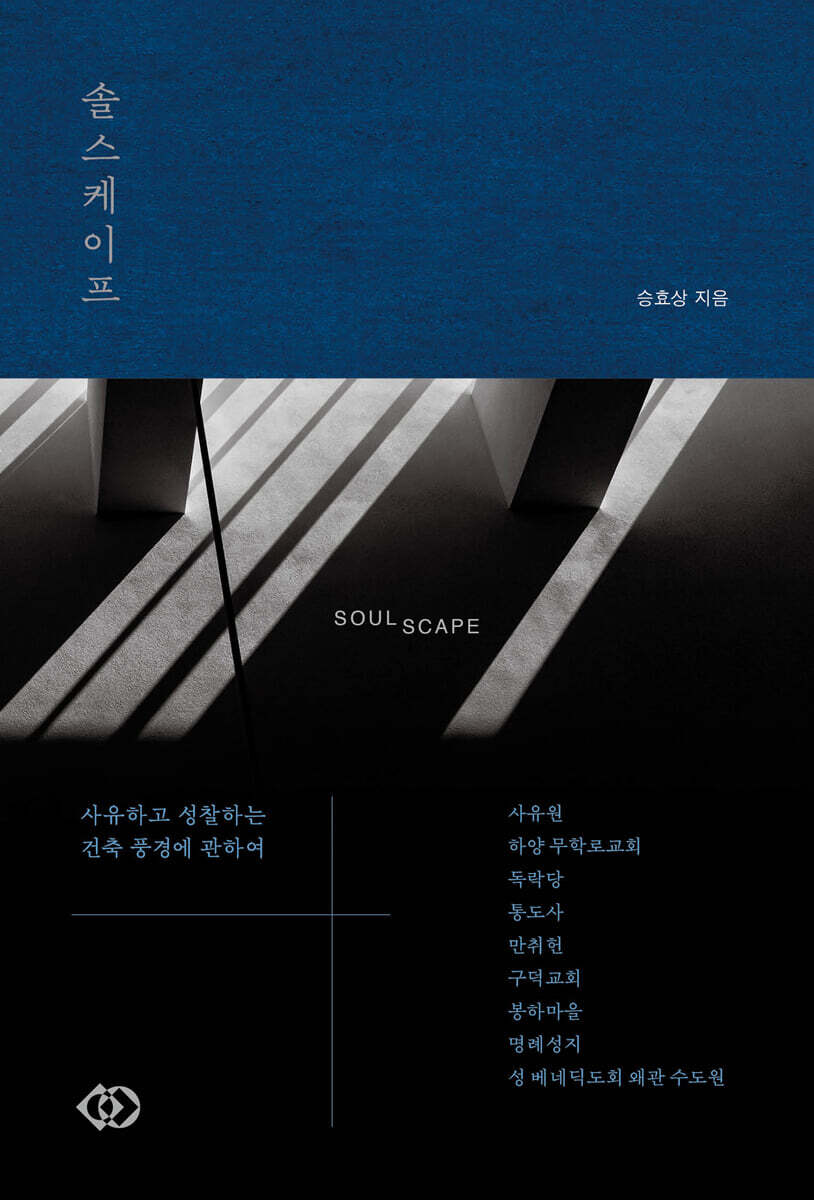
"Soulscape" shows that architecture that evokes meditation through the mere play of light and darkness can be more energizing than architecture that creates spectacular scenes.
By following the profound narrative of the architectural landscape that inspires thought and reflection, you can escape the hustle and bustle and encounter a mind that focuses on inner calm and solidity.
“Architecture is a means, not an end.
“We must keep it simple and silent so that it becomes the background of our lives.” Even in an era where architecture is being replaced by real estate and converted into money, Seung Hyo-sang believes in the power of architecture and the power of thought that permeates architecture.
Because good architecture creates a good life.
As you walk along the journey engraved in 『Soulscape』, you will come to have the same faith as the author.
Of course, Seunghyosang's architecture and words are not flashy enough to dazzle others.
Rather, it is so honest and clear that it can be readily explained with just light, darkness, and exposed concrete.
Is it because authenticity lies in its simplest form?
The concise space gives us a more powerful sense of persuasion and emotion.
It is also in this context that the text of this book, which includes over 150 illustrations, is composed solely of black and white.
The architectural landscapes we encounter in books appear as more realistic spaces because they are in black and white.
The meaning of the place also becomes deeper.
If you follow the architectural landscape conveyed by Seunghyosang, you will soon find yourself with the same mindset as an architect.
This book is the basis of Seunghyosang's thinking and proof of his faith.
The architectural landscape of spirituality that led architects,
A spiritual map that readers can carve themselves through their own footsteps.
Gunwi Sayuwon, Hayang Muhakro Church, Gyeongju Dokrakdang, Yangsan Tongdosa Temple and Manchuheon, Busan Gudeok Church, Gimhae Bongha Village, Miryang Myeongrye Shrine, Chilgok Benedictine Waegwan Monastery.
All together, it's a journey of nearly 400 kilometers.
Seunghyo Sang calls this path, which can be taken as if on a pilgrimage, the ‘map of spirituality.’
『Soulscape』 introduces thirty architectural sites in detail, which can be broadly divided into nine locations.
ㆍSayuwon: An arboretum located in Gunwi, Daegu.
This space, built by architects Seung Hyo-sang, Alvaro Siza, and Choi Wook, and decorated by landscape architects Jeong Yeong-seon and Kawagishi Matsunobu, is already a place that many people are interested in and visiting.
It received renewed attention after appearing in the drama "Queen of Tears" starring actors Kim Ji-won and Kim Soo-hyun.
It is a place where one can reflect on the harmony between nature and architecture, as well as the meaning of thought and reflection that a place provides.
'Hyeonam' where you can have an unfamiliar experience of becoming a piece of nature in silence; 'Sadam' built like a hypothetical stage set; 'Myeongjeong', an invisible observatory; 'Cheomdan' built like a water tank but a place to look at stars; 'Wasa', a ruined monastery; 'Josa', a monastery for birds; 'Gochimjeongsa', a place for border guards; 'Gagabinbin' built by Choi Wook; 'Soyoheon', 'Naesimnagwon', and 'Sodae' built by Alvaro Siza are all buildings in Sayuwon.
ㆍHayang Muhakro Church: A small church in the Hayang area.
It is a home for those who seek freedom in the truth, and a place where one can glimpse the essence of church architecture.
ㆍDokrakdang: Located in Gyeongju, it is the old house where Lee Eon-jeok of Hoejae lived.
Although it is a Joseon Dynasty building, it has a multi-centered spatial structure centered around a courtyard, making it a place that is even more meaningful in the democratic era.
ㆍTongdosa Temple: Tongdosa Temple in Yangsan is one of the Three Jewel Temples and is registered as a UNESCO World Heritage Site under the name of ‘Sansa.’
It is an architectural structure that resembles a special urban organization, and its size and composition are exquisite spaces.
ㆍManchuiheon: Also located in Yangsan, it is the private residence of the 19th President Moon Jae-in.
The name of the building, which means 'A pine tree by the stream that grows slowly, retains its lush greenness until late in life,' contains the architect's wish to live a peaceful life after retirement.
ㆍGudeok Church: Located in Busan.
This is the place where the author spent his childhood, and a place to look back on the architectural experiences that laid the foundation for his career as an architect.
ㆍBongha Village: Located in Gimhae, this area is well known as the site of President Roh Moo-hyun's tomb, which is visited by 1 million people annually.
The former President Roh Moo-hyun's private residence, known as the 'low-roofed house,' was built by the late architect Jeong Gi-yong.
This is a place that makes you ponder the saying that a good architect makes a good client.
The Roh Moo-hyun Memorial Hall, rather than overwhelming its surroundings, was designed to embody the spirit and values of Roh Moo-hyun through architecture by expressing the "rising land" as a landscape of a sloping square.
The grave of President Roh Moo-hyun is covered with stone tablets inscribed with citizens' memorial messages like fingerprints, creating a reflective landscape where the dead and the living face each other, much like the Woldae of Jongmyo Shrine.
ㆍMyeongrye Holy Land: Located in Miryang.
This place commemorates the martyr Shin Seok-bok Marco, and the old Hanok cathedral and the newly built memorial cathedral harmonize to celebrate peace.
ㆍBenedictine Waegwan Abbey: Located in Chilgok, it is a beautiful place with a historic cathedral and a recently completed Seunghyosang building.
Up to 100 monks live in a community with a spirit of martyrdom and devotion.
The 'Retreat Center', a facility where guests can stay overnight at the monastery, was designed as a place of retreat for those who long for a life outside the boundaries and want to escape from their daily lives, even if only for a moment.
It is called 'House on the Border' and is a place where one can stay and meditate alone in a solitary cell surrounded by silence.
The 'Maoro Hall' was built in 1957, and the urgent task of remodeling it was to restore its original form by revealing the passage of time rather than hiding it.
The 'Monk's Shelter' was built as a so-called 'place-made architecture' that integrates with the bamboo forest of the existing roadside wall.
The power of thoughtful and reflective architecture
When we say ‘spirituality,’ some people might first think of religion.
However, Seunghyosang wants to speak of the beauty of spirituality that encompasses silence and meditation, thought and reflection, peace and solidarity, not only in the religious sense of spirituality, but also in the sense of protesting against an unethical society and shallow capitalism.
The reason Seunghyo Sang seeks spiritual values and seeks to create a spiritual landscape is not because he himself possesses a clear spirituality.
Instead, he confesses that he suffers and is tormented by his own mistakes, such as greed, hypocrisy, laziness, pride, and anger.
He says that because we are constantly going through worries and reflections, we have no choice but to search for spirituality more desperately.
This is why we can empathize with Seunghyosang's journey toward spirituality.
Modern people often live with anxiety and hatred due to the worries and concerns that come to them like fate.
If this pain could be alleviated, wouldn't it be worth taking the time to dwell in a place of spirituality, an architectural landscape that allows for reflection and contemplation?
All of the major locations covered by Seunghyo Sang in ‘Soulscape’ are domestic.
In addition, the locations of the buildings for which Seunghyosang was commissioned to design are mostly places where the path can be connected without difficulty, making it easy and realistic to plan the route.
Moreover, the author guides you to freely decide your route and accommodations, so you can set out according to your own circumstances when you want to escape from everyday life for a while and settle down.
Additionally, the places covered in the book are diverse, including arboretums, old houses, cemeteries, and houses, as well as religious buildings such as holy places, sanctuaries, churches, cathedrals, monasteries, and temples.
Seunghyo Sang presents a variety of places that we can easily find when we are tired of everyday life, and shows that meditation and contemplation are possible anywhere, if we put our minds to it.
The places introduced in the book are each unique and special, but they fall into the same category as reflective landscapes that provide the strength to move back into everyday life through experiences that escape the everyday.
"Soulscape" shows that architecture that evokes meditation through the mere play of light and darkness can be more energizing than architecture that creates spectacular scenes.
By following the profound narrative of the architectural landscape that inspires thought and reflection, you can escape the hustle and bustle and encounter a mind that focuses on inner calm and solidity.
“Architecture is a means, not an end.
“We must keep it simple and silent so that it becomes the background of our lives.” Even in an era where architecture is being replaced by real estate and converted into money, Seung Hyo-sang believes in the power of architecture and the power of thought that permeates architecture.
Because good architecture creates a good life.
As you walk along the journey engraved in 『Soulscape』, you will come to have the same faith as the author.
Of course, Seunghyosang's architecture and words are not flashy enough to dazzle others.
Rather, it is so honest and clear that it can be readily explained with just light, darkness, and exposed concrete.
Is it because authenticity lies in its simplest form?
The concise space gives us a more powerful sense of persuasion and emotion.
It is also in this context that the text of this book, which includes over 150 illustrations, is composed solely of black and white.
The architectural landscapes we encounter in books appear as more realistic spaces because they are in black and white.
The meaning of the place also becomes deeper.
If you follow the architectural landscape conveyed by Seunghyosang, you will soon find yourself with the same mindset as an architect.
This book is the basis of Seunghyosang's thinking and proof of his faith.
The architectural landscape of spirituality that led architects,
A spiritual map that readers can carve themselves through their own footsteps.
Gunwi Sayuwon, Hayang Muhakro Church, Gyeongju Dokrakdang, Yangsan Tongdosa Temple and Manchuheon, Busan Gudeok Church, Gimhae Bongha Village, Miryang Myeongrye Shrine, Chilgok Benedictine Waegwan Monastery.
All together, it's a journey of nearly 400 kilometers.
Seunghyo Sang calls this path, which can be taken as if on a pilgrimage, the ‘map of spirituality.’
『Soulscape』 introduces thirty architectural sites in detail, which can be broadly divided into nine locations.
ㆍSayuwon: An arboretum located in Gunwi, Daegu.
This space, built by architects Seung Hyo-sang, Alvaro Siza, and Choi Wook, and decorated by landscape architects Jeong Yeong-seon and Kawagishi Matsunobu, is already a place that many people are interested in and visiting.
It received renewed attention after appearing in the drama "Queen of Tears" starring actors Kim Ji-won and Kim Soo-hyun.
It is a place where one can reflect on the harmony between nature and architecture, as well as the meaning of thought and reflection that a place provides.
'Hyeonam' where you can have an unfamiliar experience of becoming a piece of nature in silence; 'Sadam' built like a hypothetical stage set; 'Myeongjeong', an invisible observatory; 'Cheomdan' built like a water tank but a place to look at stars; 'Wasa', a ruined monastery; 'Josa', a monastery for birds; 'Gochimjeongsa', a place for border guards; 'Gagabinbin' built by Choi Wook; 'Soyoheon', 'Naesimnagwon', and 'Sodae' built by Alvaro Siza are all buildings in Sayuwon.
ㆍHayang Muhakro Church: A small church in the Hayang area.
It is a home for those who seek freedom in the truth, and a place where one can glimpse the essence of church architecture.
ㆍDokrakdang: Located in Gyeongju, it is the old house where Lee Eon-jeok of Hoejae lived.
Although it is a Joseon Dynasty building, it has a multi-centered spatial structure centered around a courtyard, making it a place that is even more meaningful in the democratic era.
ㆍTongdosa Temple: Tongdosa Temple in Yangsan is one of the Three Jewel Temples and is registered as a UNESCO World Heritage Site under the name of ‘Sansa.’
It is an architectural structure that resembles a special urban organization, and its size and composition are exquisite spaces.
ㆍManchuiheon: Also located in Yangsan, it is the private residence of the 19th President Moon Jae-in.
The name of the building, which means 'A pine tree by the stream that grows slowly, retains its lush greenness until late in life,' contains the architect's wish to live a peaceful life after retirement.
ㆍGudeok Church: Located in Busan.
This is the place where the author spent his childhood, and a place to look back on the architectural experiences that laid the foundation for his career as an architect.
ㆍBongha Village: Located in Gimhae, this area is well known as the site of President Roh Moo-hyun's tomb, which is visited by 1 million people annually.
The former President Roh Moo-hyun's private residence, known as the 'low-roofed house,' was built by the late architect Jeong Gi-yong.
This is a place that makes you ponder the saying that a good architect makes a good client.
The Roh Moo-hyun Memorial Hall, rather than overwhelming its surroundings, was designed to embody the spirit and values of Roh Moo-hyun through architecture by expressing the "rising land" as a landscape of a sloping square.
The grave of President Roh Moo-hyun is covered with stone tablets inscribed with citizens' memorial messages like fingerprints, creating a reflective landscape where the dead and the living face each other, much like the Woldae of Jongmyo Shrine.
ㆍMyeongrye Holy Land: Located in Miryang.
This place commemorates the martyr Shin Seok-bok Marco, and the old Hanok cathedral and the newly built memorial cathedral harmonize to celebrate peace.
ㆍBenedictine Waegwan Abbey: Located in Chilgok, it is a beautiful place with a historic cathedral and a recently completed Seunghyosang building.
Up to 100 monks live in a community with a spirit of martyrdom and devotion.
The 'Retreat Center', a facility where guests can stay overnight at the monastery, was designed as a place of retreat for those who long for a life outside the boundaries and want to escape from their daily lives, even if only for a moment.
It is called 'House on the Border' and is a place where one can stay and meditate alone in a solitary cell surrounded by silence.
The 'Maoro Hall' was built in 1957, and the urgent task of remodeling it was to restore its original form by revealing the passage of time rather than hiding it.
The 'Monk's Shelter' was built as a so-called 'place-made architecture' that integrates with the bamboo forest of the existing roadside wall.
GOODS SPECIFICS
- Date of issue: September 24, 2024
- Format: Hardcover book binding method guide
- Page count, weight, size: 356 pages | 514g | 133*192*24mm
- ISBN13: 9791198043313
- ISBN10: 1198043318
You may also like
카테고리
korean


korean

![GQ KOREA Mark (Monthly): December [2025]](http://librairie.coreenne.fr/cdn/shop/files/8ef265dbbfbf186523ed75ba7319009d.jpg?v=1765340328&width=3840)


