

Brilliant Extinction
 |
Description
Book Introduction
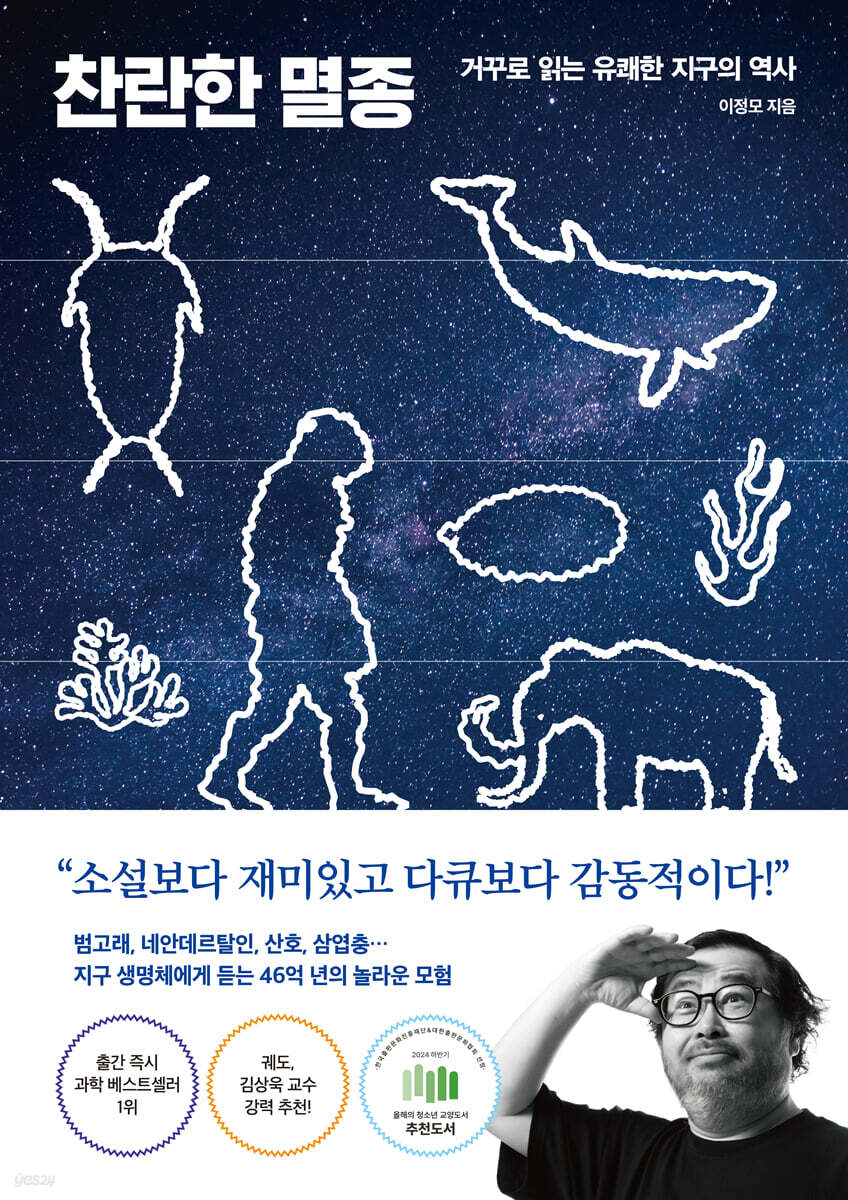
★ The latest work from Korea's top science storyteller, Director Furbo! ★ ★ Popular lectures from JTBC's "China Class" and tvN's "Unexpected Adults" ★ ★ Orbit, highly recommended by Professor Kim Sang-wook! ★ ★ Recommended as a 2024 Youth Education Book of the Year ★ “More interesting than a novel and more moving than a documentary!” Orcas, Neanderthals, coral, trilobites… A 4.6 Billion-Year-Old Adventure: Hear from Life on Earth Korea's top science storyteller, "Director Furbo," has returned with a new work after three years. Author Lee Jeong-mo, who has garnered over 11 million cumulative views for his lectures on "Earth's History" and "Human Extinction" on programs like JTBC's "Different Class" and tvN's "Unexpected Adults" as well as on his YouTube channel, is now taking a closer look at the 4.6 billion-year history of Earth as seen through extinction through "Splendid Extinction." This book departs from the usual chronological Big History narrative and begins with a story told by an artificial intelligence in the year 2150, after humanity has been destroyed. From the year 2100, when terraforming Mars was implemented, to the year 2024, when ice still remains on Earth, to the birth of Earth 4.6 billion years ago, the book weaves together a vast history with vivid illustrations. Not only that, but life on Earth, including killer whales, Neanderthals, corals, and trilobites, unfold their own stories, overturning all human perspectives on the Earth. Lee Jeong-mo's unique humor, which unfolds the story in a witty manner, befitting the 'Bill Bryson of Korea', makes readers laugh throughout. If you read it with such enjoyment, like a novel, you will understand the 4.6 billion years of Earth's history in one breath. This is why physicist Professor Kim Sang-wook praised the book, saying, “Only Lee Jeong-mo can write about such a timely topic so deliciously,” and science communicator Orbit strongly recommended the book, saying, “It makes us imagine our bright future after overcoming extreme situations.” Earth has experienced five mass extinctions, but each time it has evolved more miraculously. Readers will have the wonderful experience of imagining the future with excitement rather than fear through 『Splendid Extinction』. Discover a new educational book for Earthlings facing the sixth mass extinction. |
- You can preview some of the book's contents.
Preview
index
Recommendation
Prologue - Can we survive on Earth?
geologic time scale
geological clock
PART 1.
Mass extinction is underway: The climate crisis is upon us.
Extinction is the beginning of new life.
- Human extinction predicted by artificial intelligence in 2150
The Last of the Humans Who Migrated to Mars
- Terraforming as told by a Martian robot in 2100
The lie that the Arctic icebergs are melting and submerging islands
- Global warming as predicted by killer whales in 2024
Global warming is unstoppable?
- Charles Darwin and the Extinction of Corals as Spoken by Corals
The sixth mass extinction has begun.
- The Anthropocene as told by the Earth
PART 2.
The Apex Predator: The Time of Homo Sapiens
A world where you can't wander around
- The Paleolithic man confesses his own extinction 10,000 years ago
Why Only Homo Sapiens Survived
- Neanderthals confess their own extinction 40,000 years ago
The giant cat disappeared because it was hungry
- Smilodon speaks of its own extinction 12,000 years ago
A hunter I've never seen before has appeared.
The extinction of large herbivorous mammals, as described by the woolly mammoth 12,000 years ago
A fireball that destroyed almost everything
The Fifth Mass Extinction, 66 Million Years Ago, as Spoke Dinosaurs
PART 3.
The Grand Beginning of Evolution and Symbiosis: The Birth of Life
Dinosaurs that survived a volcanic eruption
The Fourth Mass Extinction, 210 Million Years Ago, as Spoke Postosuchus
95 percent of life disappears
- The third mass extinction, 251 million years ago, as told by Dimetrodon.
The Birth of Coal, the Creation of the Climate Crisis
- Meganeura speaks of its own extinction 300 million years ago
The only animal to have survived four mass extinctions
- The secret of 400 million years of survival, as told by a modern great white shark.
Finally, snow appears
The beginning of evolution, as told by trilobites 541 million years ago
Do you know the beginning of sex?
- The beginning of evolution, as told by mitochondria 1 billion years ago
The beginning and end of every story
The birth of life, spoken of by the moon and the sea 4.5 billion years ago
References
Source of the illustration
Prologue - Can we survive on Earth?
geologic time scale
geological clock
PART 1.
Mass extinction is underway: The climate crisis is upon us.
Extinction is the beginning of new life.
- Human extinction predicted by artificial intelligence in 2150
The Last of the Humans Who Migrated to Mars
- Terraforming as told by a Martian robot in 2100
The lie that the Arctic icebergs are melting and submerging islands
- Global warming as predicted by killer whales in 2024
Global warming is unstoppable?
- Charles Darwin and the Extinction of Corals as Spoken by Corals
The sixth mass extinction has begun.
- The Anthropocene as told by the Earth
PART 2.
The Apex Predator: The Time of Homo Sapiens
A world where you can't wander around
- The Paleolithic man confesses his own extinction 10,000 years ago
Why Only Homo Sapiens Survived
- Neanderthals confess their own extinction 40,000 years ago
The giant cat disappeared because it was hungry
- Smilodon speaks of its own extinction 12,000 years ago
A hunter I've never seen before has appeared.
The extinction of large herbivorous mammals, as described by the woolly mammoth 12,000 years ago
A fireball that destroyed almost everything
The Fifth Mass Extinction, 66 Million Years Ago, as Spoke Dinosaurs
PART 3.
The Grand Beginning of Evolution and Symbiosis: The Birth of Life
Dinosaurs that survived a volcanic eruption
The Fourth Mass Extinction, 210 Million Years Ago, as Spoke Postosuchus
95 percent of life disappears
- The third mass extinction, 251 million years ago, as told by Dimetrodon.
The Birth of Coal, the Creation of the Climate Crisis
- Meganeura speaks of its own extinction 300 million years ago
The only animal to have survived four mass extinctions
- The secret of 400 million years of survival, as told by a modern great white shark.
Finally, snow appears
The beginning of evolution, as told by trilobites 541 million years ago
Do you know the beginning of sex?
- The beginning of evolution, as told by mitochondria 1 billion years ago
The beginning and end of every story
The birth of life, spoken of by the moon and the sea 4.5 billion years ago
References
Source of the illustration
Detailed image
.jpg)
Into the book
Will humanity still be alive in 2150? Of course, I hope humanity will still be alive then.
I guess that might be the case.
Because most of the technologies needed to overcome the climate crisis already exist.
But if we don't change and continue to live as we do now, and the Earth continues to warm, there will likely be no humans on Earth in 2150.
The sixth mass extinction is already underway.
--- From "Can We Survive on Earth?"
Oddly enough, humans, especially young humans, loved dinosaurs.
The reason they loved dinosaurs was actually simple.
It was all love based on misunderstanding.
There are three main reasons why children love dinosaurs.
First, it's big.
Second, it looks weird.
Third, it disappeared.
It's a misconception that dinosaurs are big.
Humans have unearthed nearly 2,000 species of dinosaurs that lived long before their appearance.
It's a great ability.
But half of them were shorter than an adult's knee height.
--- From "Extinction is the beginning of the birth of new life: The extinction of humanity in 2150 as predicted by artificial intelligence"
In the end, Earthlings failed to colonize Mars.
Life on Earth is miserable these days.
Desertification and global warming are completely destroying their lives.
Dr. Stephen Hawking's will to colonize Mars was not fulfilled.
It wasn't going to happen fundamentally.
If even one ten-thousandth of the effort to terraform Mars had been poured into Earth, the fate of the human species would be very different.
--- From "The Last of Humanity on Mars: Terraforming as Told by a Martian Robot in 2100"
It's the Ice Age now, and we are the famous Neanderthals.
And finally, the remaining family.
There are no Neanderthals on Earth except us.
In a wide open space covered in flurries of snow, a herd of aurochs (an extinct European bison) forage for food.
Our family is watching the aurochs from a riverbank lined with dense pine trees.
You have to hunt it down.
It's not an easy task.
Our group is small, we haven't eaten properly for days, and it's so cold that we can barely keep our bodies warm.
A group of Cro-Magnon men appeared just a few dozen meters away.
(Omitted) The Cro-Magnon boy must have been scared by our thick eyelashes, hunched body, and hairy face, but it was us who were truly afraid.
Rumors of being attacked by Cro-Magnon people were often heard among us Neanderthals.
The Cro-Magnon man waved his spear at us, shrugged his shoulders, and continued on his way, leading his family.
Phew, thank goodness.
Why are we Neanderthals disappearing? How much longer can we live?
--- From "Why Only Homo Sapiens Survived: Neanderthals Confess Their Extinction 40,000 Years Ago"
hungry.
It's an absurd situation.
My [Smilodon] is hungry… .
I don't understand this situation.
Before your eyes, a dense, pristine forest connects with a wide grassland.
In the forests and meadows, delicious herbivores leisurely graze on grass and trees.
We have to catch and eat those animals.
The basics of hunting are ambush! But I don't bother hiding.
They cannot see me because the canopy of towering trees, their thick branches and lush foliage, filters the sunlight, casting a mosaic of light and shadow on the forest floor and permeating it.
The forest air is filled with the scent of trees and damp earth, so herbivores don't notice my scent.
Even if I walk briskly through the forest, they don't hear me.
Because it is filled with the sound of a gently trickling stream between rocks covered with ferns and moss, the rustling of leaves, and the distant calls of birds.
Nature is abundant.
Except my stomach.
--- From "The Hungry Giant Cat Disappears: Smilodon Told of Its Extinction 12,000 Years Ago"
A dromaeosaurus that was always lurking also appeared.
Dromaeosaurus is smart and agile.
The reason I [Tyrannosaurus rex] hold Dromaeosaurus in such high regard is because of the important role it plays in the complex web of life in our ecosystem.
He's a corpse cleaner.
I eat a lot, but I can't eat an entire dinosaur as big as a Triceratops.
In the end, we have no choice but to leave it, but if we leave it as it is, our plains will be filled with unpleasant smells and the noise of annoying insects swarming around the corpses.
As corpses pile up, the number of animals that become sick and die also increases.
Dromaeosaurus thankfully prevents disease and maintains the health of the ecosystem by scavenging for carcasses that are not discarded.
Still, I sometimes catch and eat dromaeosaurus.
Because even the cleaners have a suitable garden.
The beautiful symphony of the ecosystem unfolds with new variations every day under my direction.
Our days are filled with the rhythm of life: hunting, migration, mating.
I am the conductor of the Cretaceous Symphony.
--- From "The Fireball That Destroyed Almost Everything: The Fifth Mass Extinction 66 Million Years Ago According to Dinosaurs"
Among the extinction events that have occurred on Earth, none have been as catastrophic as the third mass extinction.
At this time, 95 percent of life became extinct.
95 percent extinction does not mean that 95 out of 100 species are gone.
If there were 100 species of life, 95 of them would not have survived at all and would have died out completely, while the remaining 5 species would have survived, but this does not mean that they survived well; it means that only a few individuals survived.
If there are 100 classes in a school, 95 of them will transfer, leaving only 5 classes, but not all of them. Only two or three students will remain in each class.
I [Lystrosaurus] experienced and witnessed the horrific spectacle of the third mass extinction.
Our Lystrosaurus has also almost disappeared.
Only a few individuals, including me, survived.
What do you think? That's fine.
Now the gates of heaven are open to me.
I lived a humble herbivorous life during the Permian period, barely the size of a wild boar.
It's sickening to think about living my life being chased by things like Dimetrodon.
Now I decide what status I will enjoy and live in.
--- From "95% of Life Disappeared: The Third Mass Extinction 251 Million Years Ago, as Told by Dimetrodon"
I [Meganeura] am big.
But it's not just me who's big.
The rich vegetation of the Carboniferous period provided food and habitat for a variety of animals, including early amphibians, insects, and the first reptiles.
The high oxygen concentration allowed them to grow to enormous sizes.
The scorpion Pulmonoscorpius was 70 centimeters long and weighed 25 kilograms, while the spider had legs that were 50 centimeters long.
Arthropleura, a type of songbird, was 2.6 meters long, 55 centimeters wide, and weighed 50 kilograms.
It was the largest of all invertebrates that ever lived on Earth.
How did we grow so large? It's thanks to the forest.
The enormous oxygen concentration created by the forest made our arthropods large.
Insects and other mammals depend almost entirely on diffusion for their internal oxygen supply.
Therefore, once they grow to a certain size, there is a limit to their growth because they cannot be supplied with oxygen.
However, as the oxygen concentration increased, the oxygen supply was no longer a limit to the growth of the size.
It was able to grow to the maximum size that its exoskeleton could support.
--- From "The Birth of Coal, Which Created the Climate Crisis: Meganeura's Own Extinction 300 Million Years Ago"
Even the fifth mass extinction, which wiped out the terrestrial dinosaurs 66 million years ago, did not wipe out sharks.
Our sharks' survival is not just luck.
However, it is not the result of an indomitable will to survive in the face of a great upheaval.
He survived because of his 'opportunistic' nature, which people criticize.
Opportunism is when you act in a way that benefits you depending on the situation without a consistent position.
In human history, an opportunist is someone who clings to the advantageous side regardless of their beliefs.
But in natural history, opportunism is a key competency for survival.
We have survived four mass extinctions solely because of the evolutionary strength that has defined us since the beginning: opportunistic adaptability.
--- From "The Only Animal to Survive Four Mass Extinctions: The Secret of 400 Million Years of Survival Told by Modern Great White Sharks"
I [Mitochondria] also changed major laws in the Republic of Korea.
The household system is a system in which the center of the family group is the male lineage, passed down from father to son.
I was at the center of the debate over the Australian system, which had been going on for years.
Professor Choi Jae-cheon introduced the fact that mitochondria have their own genes and that mitochondria are passed on to offspring only through eggs to the legal debate.
That is, it became widely known that offspring receive more genes from females than from males.
From this time on, public opinion changed, and the household system was abolished on January 1, 2008 through a ruling by the Constitutional Court.
I guess that might be the case.
Because most of the technologies needed to overcome the climate crisis already exist.
But if we don't change and continue to live as we do now, and the Earth continues to warm, there will likely be no humans on Earth in 2150.
The sixth mass extinction is already underway.
--- From "Can We Survive on Earth?"
Oddly enough, humans, especially young humans, loved dinosaurs.
The reason they loved dinosaurs was actually simple.
It was all love based on misunderstanding.
There are three main reasons why children love dinosaurs.
First, it's big.
Second, it looks weird.
Third, it disappeared.
It's a misconception that dinosaurs are big.
Humans have unearthed nearly 2,000 species of dinosaurs that lived long before their appearance.
It's a great ability.
But half of them were shorter than an adult's knee height.
--- From "Extinction is the beginning of the birth of new life: The extinction of humanity in 2150 as predicted by artificial intelligence"
In the end, Earthlings failed to colonize Mars.
Life on Earth is miserable these days.
Desertification and global warming are completely destroying their lives.
Dr. Stephen Hawking's will to colonize Mars was not fulfilled.
It wasn't going to happen fundamentally.
If even one ten-thousandth of the effort to terraform Mars had been poured into Earth, the fate of the human species would be very different.
--- From "The Last of Humanity on Mars: Terraforming as Told by a Martian Robot in 2100"
It's the Ice Age now, and we are the famous Neanderthals.
And finally, the remaining family.
There are no Neanderthals on Earth except us.
In a wide open space covered in flurries of snow, a herd of aurochs (an extinct European bison) forage for food.
Our family is watching the aurochs from a riverbank lined with dense pine trees.
You have to hunt it down.
It's not an easy task.
Our group is small, we haven't eaten properly for days, and it's so cold that we can barely keep our bodies warm.
A group of Cro-Magnon men appeared just a few dozen meters away.
(Omitted) The Cro-Magnon boy must have been scared by our thick eyelashes, hunched body, and hairy face, but it was us who were truly afraid.
Rumors of being attacked by Cro-Magnon people were often heard among us Neanderthals.
The Cro-Magnon man waved his spear at us, shrugged his shoulders, and continued on his way, leading his family.
Phew, thank goodness.
Why are we Neanderthals disappearing? How much longer can we live?
--- From "Why Only Homo Sapiens Survived: Neanderthals Confess Their Extinction 40,000 Years Ago"
hungry.
It's an absurd situation.
My [Smilodon] is hungry… .
I don't understand this situation.
Before your eyes, a dense, pristine forest connects with a wide grassland.
In the forests and meadows, delicious herbivores leisurely graze on grass and trees.
We have to catch and eat those animals.
The basics of hunting are ambush! But I don't bother hiding.
They cannot see me because the canopy of towering trees, their thick branches and lush foliage, filters the sunlight, casting a mosaic of light and shadow on the forest floor and permeating it.
The forest air is filled with the scent of trees and damp earth, so herbivores don't notice my scent.
Even if I walk briskly through the forest, they don't hear me.
Because it is filled with the sound of a gently trickling stream between rocks covered with ferns and moss, the rustling of leaves, and the distant calls of birds.
Nature is abundant.
Except my stomach.
--- From "The Hungry Giant Cat Disappears: Smilodon Told of Its Extinction 12,000 Years Ago"
A dromaeosaurus that was always lurking also appeared.
Dromaeosaurus is smart and agile.
The reason I [Tyrannosaurus rex] hold Dromaeosaurus in such high regard is because of the important role it plays in the complex web of life in our ecosystem.
He's a corpse cleaner.
I eat a lot, but I can't eat an entire dinosaur as big as a Triceratops.
In the end, we have no choice but to leave it, but if we leave it as it is, our plains will be filled with unpleasant smells and the noise of annoying insects swarming around the corpses.
As corpses pile up, the number of animals that become sick and die also increases.
Dromaeosaurus thankfully prevents disease and maintains the health of the ecosystem by scavenging for carcasses that are not discarded.
Still, I sometimes catch and eat dromaeosaurus.
Because even the cleaners have a suitable garden.
The beautiful symphony of the ecosystem unfolds with new variations every day under my direction.
Our days are filled with the rhythm of life: hunting, migration, mating.
I am the conductor of the Cretaceous Symphony.
--- From "The Fireball That Destroyed Almost Everything: The Fifth Mass Extinction 66 Million Years Ago According to Dinosaurs"
Among the extinction events that have occurred on Earth, none have been as catastrophic as the third mass extinction.
At this time, 95 percent of life became extinct.
95 percent extinction does not mean that 95 out of 100 species are gone.
If there were 100 species of life, 95 of them would not have survived at all and would have died out completely, while the remaining 5 species would have survived, but this does not mean that they survived well; it means that only a few individuals survived.
If there are 100 classes in a school, 95 of them will transfer, leaving only 5 classes, but not all of them. Only two or three students will remain in each class.
I [Lystrosaurus] experienced and witnessed the horrific spectacle of the third mass extinction.
Our Lystrosaurus has also almost disappeared.
Only a few individuals, including me, survived.
What do you think? That's fine.
Now the gates of heaven are open to me.
I lived a humble herbivorous life during the Permian period, barely the size of a wild boar.
It's sickening to think about living my life being chased by things like Dimetrodon.
Now I decide what status I will enjoy and live in.
--- From "95% of Life Disappeared: The Third Mass Extinction 251 Million Years Ago, as Told by Dimetrodon"
I [Meganeura] am big.
But it's not just me who's big.
The rich vegetation of the Carboniferous period provided food and habitat for a variety of animals, including early amphibians, insects, and the first reptiles.
The high oxygen concentration allowed them to grow to enormous sizes.
The scorpion Pulmonoscorpius was 70 centimeters long and weighed 25 kilograms, while the spider had legs that were 50 centimeters long.
Arthropleura, a type of songbird, was 2.6 meters long, 55 centimeters wide, and weighed 50 kilograms.
It was the largest of all invertebrates that ever lived on Earth.
How did we grow so large? It's thanks to the forest.
The enormous oxygen concentration created by the forest made our arthropods large.
Insects and other mammals depend almost entirely on diffusion for their internal oxygen supply.
Therefore, once they grow to a certain size, there is a limit to their growth because they cannot be supplied with oxygen.
However, as the oxygen concentration increased, the oxygen supply was no longer a limit to the growth of the size.
It was able to grow to the maximum size that its exoskeleton could support.
--- From "The Birth of Coal, Which Created the Climate Crisis: Meganeura's Own Extinction 300 Million Years Ago"
Even the fifth mass extinction, which wiped out the terrestrial dinosaurs 66 million years ago, did not wipe out sharks.
Our sharks' survival is not just luck.
However, it is not the result of an indomitable will to survive in the face of a great upheaval.
He survived because of his 'opportunistic' nature, which people criticize.
Opportunism is when you act in a way that benefits you depending on the situation without a consistent position.
In human history, an opportunist is someone who clings to the advantageous side regardless of their beliefs.
But in natural history, opportunism is a key competency for survival.
We have survived four mass extinctions solely because of the evolutionary strength that has defined us since the beginning: opportunistic adaptability.
--- From "The Only Animal to Survive Four Mass Extinctions: The Secret of 400 Million Years of Survival Told by Modern Great White Sharks"
I [Mitochondria] also changed major laws in the Republic of Korea.
The household system is a system in which the center of the family group is the male lineage, passed down from father to son.
I was at the center of the debate over the Australian system, which had been going on for years.
Professor Choi Jae-cheon introduced the fact that mitochondria have their own genes and that mitochondria are passed on to offspring only through eggs to the legal debate.
That is, it became widely known that offspring receive more genes from females than from males.
From this time on, public opinion changed, and the household system was abolished on January 1, 2008 through a ruling by the Constitutional Court.
--- From "Do You Know the Beginning of Sex?: The Beginning of Evolution as Told by Mitochondria 1 Billion Years Ago"
Publisher's Review
“The Earth has experienced five mass extinctions,
“Each time it evolved more wonderfully!”
Director Lee Jeong-mo, known as the ‘Bill Bryson of Korea’
Earth's history through whimsical imagination
When we talk about extinction, we often think of negative images.
But extinction is also the beginning of the birth of new life.
Because for new life to emerge, someone has to make way for it.
The history of life is also the history of extinction.
Author Lee Jeong-mo, who has been introducing science stories to the general public in a fun way for 12 years as the "hairy director" - 5 years as the director of the Seodaemun Museum of Natural History, 4 years as the director of the Seoul Metropolitan Science Museum, and 3 years as the director of the National Gwacheon Science Museum - looks into the wondrous 4.6 billion-year history of the Earth through extinction in this new work.
This is an exploration of Earth's splendidly evolved vitality, even after experiencing five mass extinctions. Director Lee Jeong-mo's tale of mass extinctions, which has garnered over 11 million cumulative views on programs like JTBC's "Different Class" and tvN's "Unexpected Adults" and YouTube, has been brought to life in "Splendid Extinction," with a captivating imagination.
As befitting the 'Bill Bryson of Korea,' author Lee Jeong-mo does not simply list the history of the Earth in this book.
From the year 2150, when humanity is assumed to have perished, to 4.6 billion years ago, when Earth was born, the film travels backwards through 17 key scenes from the perspective of life forms that brought about amazing changes on Earth.
From the mass extinction of humanity, the terraforming of Mars, the competition between Neanderthals and Homo sapiens, the emergence of sex and death, and the dawn of the age of life on the moon and the ocean, it's filled with stories of Earth encountered for the first time.
This book, which was also selected as a recommended book for the 2024 Youth Culture Book of the Year for adding amazing imagination to the latest science, was highly praised by physicist Professor Kim Sang-wook, saying, “As far as I know, Lee Jeong-mo is the only one who can write about such a timely topic in such a style and so deliciously.” Science communicator Orbit strongly recommended this book to culture readers who are concerned about the future of the Earth and humanity, saying, “The fact that it makes us imagine a bright future for us after overcoming extreme situations is enough reason to read it.”
Through this book, readers will encounter 'Splendid Extinction' and feel the wondrous emotion of the irony of life.
“I just read it with interest, like a novel.
“4.6 billion years of history can be understood in an instant!”
Orcas, Neanderthals, corals, trilobites, etc.
A history of twists and turns, first heard by life on Earth
『Splendid Extinction』 contains a special kind of fun that cannot be found in any other book.
Unlike books on Earth's history that distance themselves from the human perspective and describe knowledge, this book features over 20 species of life forms that have had a significant impact on the planet, including killer whales, Neanderthals, coral, and trilobites, telling their own stories.
The story begins with an artificial intelligence in 2150 and a robot on Mars in 2100 uncovering the process and cause of the mass extinction of mankind.
And then there are the fascinating scientific knowledge from the perspective of life on Earth, such as global warming as told by killer whales in 2024, their extinction as told by Neanderthals 40,000 years ago, the secret of survival for 400 million years as told by great white sharks, the only survivors of four mass extinctions, and the grand beginning of the birth of Earth and life as told by the moon and oceans 4.5 billion years ago.
As befitting the best storyteller in the country, the writing style of 'Turtle Manager' Lee Jeong-mo, who tells stories in a playful and witty manner, and his unique, bland humor make readers laugh throughout.
If you read it with such enjoyment, like a novel, you will understand the 4.6 billion years of Earth's history in one breath.
Author Lee Jeong-mo does not miss even the most moving moments.
If you empathize with the story as if you were the main character of each story, you will feel a different emotion than when you look at it from a human-centered perspective.
Becoming another being on Earth allows us to understand the history of life more deeply.
The emergence of Homo sapiens and the rise of civilization, the extinction of dinosaurs by an asteroid impact, and the creation of life by the ocean through the production of oxygen are all presented as entirely new stories.
The reason for looking at the history of the Earth in this way, turning it upside down, is clear.
It is to see the Earth, which we take for granted, in a strange way.
This amazing book makes us experience the earth beneath our feet, the smell of grass brushing our noses, and even the sounds of insects filling our summer nights. It makes us realize the wonder of the beauty of the Earth we live on.
“Will humans still be living on Earth in 2150?”
In an era of extreme climate crisis,
Minimum scientific knowledge for Earthlings
Today, the Earth's climate is changing rapidly every day.
Fish are dying in droves due to rising water temperatures, and vegetable prices are skyrocketing due to rainfall problems, causing grocery shopping prices to skyrocket.
Incidents of people being injured or killed by sudden heavy rain have now become all too common.
Is the climate crisis truly an unstoppable force? How long can we survive on Earth?
To find the answer, 『Splendid Extinction』 presents the history of the Earth in three chapters.
It is a vast history narrated in three parts: 'The Time of Climate Crisis', which contains the extinction crisis of mankind today; 'The Time of Homo Sapiens', which contains the process of dinosaurs disappearing due to mass extinction and Homo sapiens rising to become the top predator on Earth; and 'The Time of Birth of Life', which contains the wondrous moments when the Earth and life were born.
Here, illustrations that help readers understand the text, a geologic timeline that shows the history of the Earth at a glance, a geologic clock that turns 4.6 billion years of Earth's history into a 24-hour day, and illustrations that bring extinct life forms to life add fun and emotion to author Lee Jeong-mo's delicious writing, making it an interesting read for readers of all ages, from adults to children.
The Earth has experienced five mass extinctions over 4.6 billion years.
And now we are going through the sixth mass extinction.
The last five mass extinctions were ultimately caused by climate change.
At the time of extinction, life forms were helpless against climate change.
We couldn't stop volcanoes from erupting, continents from moving, or meteors from impacting.
But the sixth mass extinction we are experiencing is different.
Because the current climate change is not a natural phenomenon but a result of human activity.
Author Lee Jeong-mo offers hope that we can overcome the sixth mass extinction if we have the will, as most of the technologies needed to overcome the climate crisis already exist.
Earth has experienced five mass extinctions, but each time it has evolved in a more miraculous way.
Through this book, readers will encounter the vast history of the Earth, life, and humanity, and will have the enjoyable experience of imagining the future with excitement rather than fear.
“Each time it evolved more wonderfully!”
Director Lee Jeong-mo, known as the ‘Bill Bryson of Korea’
Earth's history through whimsical imagination
When we talk about extinction, we often think of negative images.
But extinction is also the beginning of the birth of new life.
Because for new life to emerge, someone has to make way for it.
The history of life is also the history of extinction.
Author Lee Jeong-mo, who has been introducing science stories to the general public in a fun way for 12 years as the "hairy director" - 5 years as the director of the Seodaemun Museum of Natural History, 4 years as the director of the Seoul Metropolitan Science Museum, and 3 years as the director of the National Gwacheon Science Museum - looks into the wondrous 4.6 billion-year history of the Earth through extinction in this new work.
This is an exploration of Earth's splendidly evolved vitality, even after experiencing five mass extinctions. Director Lee Jeong-mo's tale of mass extinctions, which has garnered over 11 million cumulative views on programs like JTBC's "Different Class" and tvN's "Unexpected Adults" and YouTube, has been brought to life in "Splendid Extinction," with a captivating imagination.
As befitting the 'Bill Bryson of Korea,' author Lee Jeong-mo does not simply list the history of the Earth in this book.
From the year 2150, when humanity is assumed to have perished, to 4.6 billion years ago, when Earth was born, the film travels backwards through 17 key scenes from the perspective of life forms that brought about amazing changes on Earth.
From the mass extinction of humanity, the terraforming of Mars, the competition between Neanderthals and Homo sapiens, the emergence of sex and death, and the dawn of the age of life on the moon and the ocean, it's filled with stories of Earth encountered for the first time.
This book, which was also selected as a recommended book for the 2024 Youth Culture Book of the Year for adding amazing imagination to the latest science, was highly praised by physicist Professor Kim Sang-wook, saying, “As far as I know, Lee Jeong-mo is the only one who can write about such a timely topic in such a style and so deliciously.” Science communicator Orbit strongly recommended this book to culture readers who are concerned about the future of the Earth and humanity, saying, “The fact that it makes us imagine a bright future for us after overcoming extreme situations is enough reason to read it.”
Through this book, readers will encounter 'Splendid Extinction' and feel the wondrous emotion of the irony of life.
“I just read it with interest, like a novel.
“4.6 billion years of history can be understood in an instant!”
Orcas, Neanderthals, corals, trilobites, etc.
A history of twists and turns, first heard by life on Earth
『Splendid Extinction』 contains a special kind of fun that cannot be found in any other book.
Unlike books on Earth's history that distance themselves from the human perspective and describe knowledge, this book features over 20 species of life forms that have had a significant impact on the planet, including killer whales, Neanderthals, coral, and trilobites, telling their own stories.
The story begins with an artificial intelligence in 2150 and a robot on Mars in 2100 uncovering the process and cause of the mass extinction of mankind.
And then there are the fascinating scientific knowledge from the perspective of life on Earth, such as global warming as told by killer whales in 2024, their extinction as told by Neanderthals 40,000 years ago, the secret of survival for 400 million years as told by great white sharks, the only survivors of four mass extinctions, and the grand beginning of the birth of Earth and life as told by the moon and oceans 4.5 billion years ago.
As befitting the best storyteller in the country, the writing style of 'Turtle Manager' Lee Jeong-mo, who tells stories in a playful and witty manner, and his unique, bland humor make readers laugh throughout.
If you read it with such enjoyment, like a novel, you will understand the 4.6 billion years of Earth's history in one breath.
Author Lee Jeong-mo does not miss even the most moving moments.
If you empathize with the story as if you were the main character of each story, you will feel a different emotion than when you look at it from a human-centered perspective.
Becoming another being on Earth allows us to understand the history of life more deeply.
The emergence of Homo sapiens and the rise of civilization, the extinction of dinosaurs by an asteroid impact, and the creation of life by the ocean through the production of oxygen are all presented as entirely new stories.
The reason for looking at the history of the Earth in this way, turning it upside down, is clear.
It is to see the Earth, which we take for granted, in a strange way.
This amazing book makes us experience the earth beneath our feet, the smell of grass brushing our noses, and even the sounds of insects filling our summer nights. It makes us realize the wonder of the beauty of the Earth we live on.
“Will humans still be living on Earth in 2150?”
In an era of extreme climate crisis,
Minimum scientific knowledge for Earthlings
Today, the Earth's climate is changing rapidly every day.
Fish are dying in droves due to rising water temperatures, and vegetable prices are skyrocketing due to rainfall problems, causing grocery shopping prices to skyrocket.
Incidents of people being injured or killed by sudden heavy rain have now become all too common.
Is the climate crisis truly an unstoppable force? How long can we survive on Earth?
To find the answer, 『Splendid Extinction』 presents the history of the Earth in three chapters.
It is a vast history narrated in three parts: 'The Time of Climate Crisis', which contains the extinction crisis of mankind today; 'The Time of Homo Sapiens', which contains the process of dinosaurs disappearing due to mass extinction and Homo sapiens rising to become the top predator on Earth; and 'The Time of Birth of Life', which contains the wondrous moments when the Earth and life were born.
Here, illustrations that help readers understand the text, a geologic timeline that shows the history of the Earth at a glance, a geologic clock that turns 4.6 billion years of Earth's history into a 24-hour day, and illustrations that bring extinct life forms to life add fun and emotion to author Lee Jeong-mo's delicious writing, making it an interesting read for readers of all ages, from adults to children.
The Earth has experienced five mass extinctions over 4.6 billion years.
And now we are going through the sixth mass extinction.
The last five mass extinctions were ultimately caused by climate change.
At the time of extinction, life forms were helpless against climate change.
We couldn't stop volcanoes from erupting, continents from moving, or meteors from impacting.
But the sixth mass extinction we are experiencing is different.
Because the current climate change is not a natural phenomenon but a result of human activity.
Author Lee Jeong-mo offers hope that we can overcome the sixth mass extinction if we have the will, as most of the technologies needed to overcome the climate crisis already exist.
Earth has experienced five mass extinctions, but each time it has evolved in a more miraculous way.
Through this book, readers will encounter the vast history of the Earth, life, and humanity, and will have the enjoyable experience of imagining the future with excitement rather than fear.
GOODS SPECIFICS
- Date of issue: August 7, 2024
- Page count, weight, size: 352 pages | 596g | 152*215*20mm
- ISBN13: 9791130655017
- ISBN10: 1130655016
You may also like
카테고리
korean


korean

![GQ KOREA Mark (Monthly): December [2025]](http://librairie.coreenne.fr/cdn/shop/files/8ef265dbbfbf186523ed75ba7319009d.jpg?v=1765340328&width=3840)


