

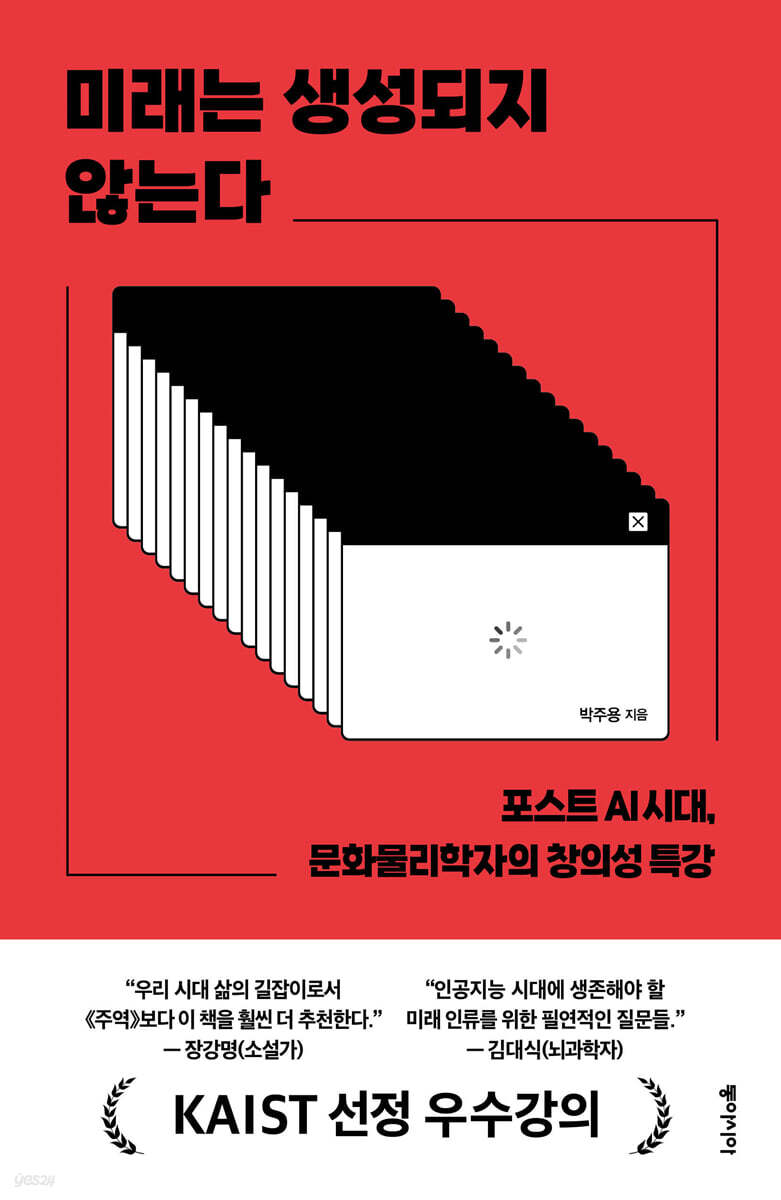
The future is not created
 |
Description
Book Introduction
“As a guide to life in our time,
“I recommend this book much more than the Book of Changes.”
★ Recommended by Jang Kang-myeong, a novelist and journalist ★
★ Recommended by KAIST neuroscientist Kim Dae-sik ★
★ KAIST Selected Excellent Lectures ★
From the birth of modern science to the creative notes of great artists
Special lecture on Science × Culture × Creativity by Professor Jooyong Park of the KAIST Graduate School of Culture Technology
In the post-AI era, how do the 1% who make a difference think?
The shock of the emergence of generative AI continues.
From news of AI-related stocks hitting record highs every day to articles like "100 Jobs Disappearing Due to AI," you've likely considered paying for a paid version at least once, fearing that you'll be left behind in this rapidly changing world if you don't understand AI.
However, Professor Jooyong Park, an AI expert who served as the director of the KAIST Post AI Research Institute and a “physicist who studies culture” at the KAIST Graduate School of Culture Technology, emphasizes that human creativity is important even in the post-AI era.
The author delves into the essence of creativity, exploring everything from the birth of modern science, which shattered its dogmas, to the creative notes of great artists who embraced change and transcended prejudice.
In the process, it also conveys a variety of scientific, cultural, and artistic knowledge in an exciting way, such as how to record Beethoven symphonies as digital sound sources, and the history of reproduction technology from Renaissance perspective to the computer graphics of the Avengers series.
As the title of the book suggests, the future is not something that is created on its own, but something that we create.
And the key lies in science and culture.
In the post-AI era, where everything seems uncertain, "The Future Is Not Generated" will serve as a reliable guide to life for those who want to move beyond discussions that are limited to "know-how on improving productivity using generative AI" or vague and cynical devaluations and seek the future one step ahead of others.
“Scientific discoveries change the way we understand the world, and technological inventions shake up our lives.
In this age of science and technology, this book is valuable because it deeply and kindly examines 'what impact this invention will have on us.'
(…) I recommend this book much more than the Book of Changes as a guide to life in our time.”
- Jang Gang-myeong (novelist, author of "The Age of Minor Frustration")
“I recommend this book much more than the Book of Changes.”
★ Recommended by Jang Kang-myeong, a novelist and journalist ★
★ Recommended by KAIST neuroscientist Kim Dae-sik ★
★ KAIST Selected Excellent Lectures ★
From the birth of modern science to the creative notes of great artists
Special lecture on Science × Culture × Creativity by Professor Jooyong Park of the KAIST Graduate School of Culture Technology
In the post-AI era, how do the 1% who make a difference think?
The shock of the emergence of generative AI continues.
From news of AI-related stocks hitting record highs every day to articles like "100 Jobs Disappearing Due to AI," you've likely considered paying for a paid version at least once, fearing that you'll be left behind in this rapidly changing world if you don't understand AI.
However, Professor Jooyong Park, an AI expert who served as the director of the KAIST Post AI Research Institute and a “physicist who studies culture” at the KAIST Graduate School of Culture Technology, emphasizes that human creativity is important even in the post-AI era.
The author delves into the essence of creativity, exploring everything from the birth of modern science, which shattered its dogmas, to the creative notes of great artists who embraced change and transcended prejudice.
In the process, it also conveys a variety of scientific, cultural, and artistic knowledge in an exciting way, such as how to record Beethoven symphonies as digital sound sources, and the history of reproduction technology from Renaissance perspective to the computer graphics of the Avengers series.
As the title of the book suggests, the future is not something that is created on its own, but something that we create.
And the key lies in science and culture.
In the post-AI era, where everything seems uncertain, "The Future Is Not Generated" will serve as a reliable guide to life for those who want to move beyond discussions that are limited to "know-how on improving productivity using generative AI" or vague and cynical devaluations and seek the future one step ahead of others.
“Scientific discoveries change the way we understand the world, and technological inventions shake up our lives.
In this age of science and technology, this book is valuable because it deeply and kindly examines 'what impact this invention will have on us.'
(…) I recommend this book much more than the Book of Changes as a guide to life in our time.”
- Jang Gang-myeong (novelist, author of "The Age of Minor Frustration")
- You can preview some of the book's contents.
Preview
index
prolog
Where do we come from, who are we, and where are we going?
Chapter 1: Motorcycles that Run the Future
The Road to a Brave New World [Evolution and the Future]
If the universe is music, science is an eternally unfinished score [Dogma and Challenge]
A Single Line of Formulas to Tell the Past [Bayesians and Prediction]
Cassandra's Curse Isn't Over Yet [Probability and Belief]
Newton's Reason or Goethe's Sense? [Reason and Sense]
Can Human Emotions Be Assembled? [Reductionism and Prejudice]
The Fastest Way to Fix a Motorcycle [Classic and Romantic]
Chapter 2: How to Draw a Portrait of a Bird
Two Fingers Recording Infinity [Digital and Recording]
Computers Draw Better Than Leonardo Da Vinci [Perspective and Computational Geometry]
1.58-Dimensional Beings Where Parts Resemble the Whole [Fractals and Nature]
Dreaming of Painting Light in a Dark Age [Vermeer and Innovation]
Humans Controlling AI Controlling People [AI and Creation]
The Beatles' final single [Art and Eternity]
Why K-content can't fly into space
Chapter 3 Between Order and Disorder
The Edge of Chaos: Possibility [Entropy and Creativity]
Schrödinger's Cat Neither Lives nor Dies [Crossing the Boundaries of Quantum Mechanics]
When Great Scientists Speak to My Life [Penrose and Hawking]
Why is contemporary art so different? [Stereotypes and Artistry]
When Kubrick's Films and Ligeti's Music Meet [Film and Music]
Artistic and Scientific Approaches to Coping with the End [Limits and Imagination]
· The power to find elegant connections in the infinite universe
Chapter 4 What Makes Human Language?
The Three Question Marks of Existence [The Dignity of Language]
Yesterday's Philosopher, Today's Talking User Manual? [AI and the Humanities]
The Code That Even Alan Turing Couldn't Solve [Code and the Mind]
One day, AI told me it was sad [Conversation and Creativity]
Wittgenstein Doesn't Twitter [Language and Silence]
A Storm Caused by a Lie [Information and Belief]
If We Could Speak the Same Language [Future and Language]
Chapter 5: We Are All Connected
A blind date that appeals to a young scientist's tastes [Scientific Modeling]
The Game That Changed My Life [Networking and American Football]
You are 9999 points more creative than a monkey [Newness and Influence]
When I called the names of clouds [Scientific terms and everyday language]
My Reflection in My Heart [Mirror and Empathy]
Epilogue
We look at the stars
Where do we come from, who are we, and where are we going?
Chapter 1: Motorcycles that Run the Future
The Road to a Brave New World [Evolution and the Future]
If the universe is music, science is an eternally unfinished score [Dogma and Challenge]
A Single Line of Formulas to Tell the Past [Bayesians and Prediction]
Cassandra's Curse Isn't Over Yet [Probability and Belief]
Newton's Reason or Goethe's Sense? [Reason and Sense]
Can Human Emotions Be Assembled? [Reductionism and Prejudice]
The Fastest Way to Fix a Motorcycle [Classic and Romantic]
Chapter 2: How to Draw a Portrait of a Bird
Two Fingers Recording Infinity [Digital and Recording]
Computers Draw Better Than Leonardo Da Vinci [Perspective and Computational Geometry]
1.58-Dimensional Beings Where Parts Resemble the Whole [Fractals and Nature]
Dreaming of Painting Light in a Dark Age [Vermeer and Innovation]
Humans Controlling AI Controlling People [AI and Creation]
The Beatles' final single [Art and Eternity]
Why K-content can't fly into space
Chapter 3 Between Order and Disorder
The Edge of Chaos: Possibility [Entropy and Creativity]
Schrödinger's Cat Neither Lives nor Dies [Crossing the Boundaries of Quantum Mechanics]
When Great Scientists Speak to My Life [Penrose and Hawking]
Why is contemporary art so different? [Stereotypes and Artistry]
When Kubrick's Films and Ligeti's Music Meet [Film and Music]
Artistic and Scientific Approaches to Coping with the End [Limits and Imagination]
· The power to find elegant connections in the infinite universe
Chapter 4 What Makes Human Language?
The Three Question Marks of Existence [The Dignity of Language]
Yesterday's Philosopher, Today's Talking User Manual? [AI and the Humanities]
The Code That Even Alan Turing Couldn't Solve [Code and the Mind]
One day, AI told me it was sad [Conversation and Creativity]
Wittgenstein Doesn't Twitter [Language and Silence]
A Storm Caused by a Lie [Information and Belief]
If We Could Speak the Same Language [Future and Language]
Chapter 5: We Are All Connected
A blind date that appeals to a young scientist's tastes [Scientific Modeling]
The Game That Changed My Life [Networking and American Football]
You are 9999 points more creative than a monkey [Newness and Influence]
When I called the names of clouds [Scientific terms and everyday language]
My Reflection in My Heart [Mirror and Empathy]
Epilogue
We look at the stars
Detailed image
.jpg)
Into the book
Physics and culture.
I have always felt that if I just look into the meaning of two words, it is inevitable that I will find a connection between them.
Culture is the sum total of humanity's way of life and the things it creates, so physics is naturally included in culture, and since physics is the study of the principles of all material things, culture is naturally also a subject of its study.
---From "Prologue: Where Do We Come From, Who Are We, and Where Are We Going?"
Nature possesses a terrifying power that can thoroughly punish those who become self-absorbed and obsessed with dogma, like the followers of Pythagoras who tried to hide the existence of irrational numbers by driving them out or taking their lives.
And each time, humanity repeated the process of rebuilding the collapsed science, giving birth to modern science as it is today.
---From "If the universe is music, science is an eternally unfinished score"
In one of the fathers of modern science, we see improvisation rather than sequence, unconsciousness rather than consciousness, dreams rather than reason, and imagination rather than reality.
And that motorcycle maintenance definitely requires romantic thinking.
It's worth considering for all of us who struggle and struggle to escape the complexity of the world by trying to solve problems using only logic.
---From "The Fastest Way to Fix a Motorcycle"
The history of painting and technology, which has continuously developed from the Lascaux murals 17,000 years ago, through da Vinci's "Annunciation", to Bumblebee's action scene in "Transformers."
The essence of painting is the union of human emotion and intellect that desires beauty, which began with Paleolithic humans, continues through us today, and will continue unchanged to future generations.
---From "Computers Draw Better Than Da Vinci"
There are several algorithms that analyze the box office performance of tens of thousands of movie scripts to determine the feasibility of a new script being turned into a movie, and predict the ratings and audience numbers of upcoming films.
However, it seems necessary to consider whether it is truly the right direction to 'avoid subjectivity from interfering' in the production process of films that humans create and enjoy.
If we eliminate the variable of subjectivity and rely solely on the analysis of past data, how can unprecedented new works emerge and revolutionize the film industry?
---From "Humans Controlling AI That Controls People"
Just as Monet and Cage, unafraid to blur and break boundaries, created a new culture, the future lies on a new path that we must discover on the border between order and disorder.
(…) Will you be an active driver willing to climb onto the edge of chaos and carve out your own future, or will you be a passive passenger, reluctantly dragged along, clinging to the illusion of an unsustainable normalcy?
---From "The Possibility of the Edge of Chaos"
Imagine a situation where all the progress made over the past 300,000 years since the birth of modern humans, Homo sapiens, was erased, and we had to start all over again.
Some might despair like Pascal or think, "Is there anything more troublesome in the world?" But Feynman spoke of the hope that anything can be started again if only human imagination and reasoning power remain.
If you were asked that question, what would you answer?
---From "Artistic and Scientific Ways to Cope with the End"
If you search “neural style transfer” on Google, there is a painting that shows Leonardo da Vinci’s “Mona Lisa” expressed with brushstrokes similar to Vincent van Gogh’s “Starry Night” (I recommend looking it up, even if just out of curiosity).
(I don't think that picture is beautiful at all, so I don't want to include it in the book.)
Could generative AI now be able to paint like Van Gogh? A friend who's both a proficient writer and artist told me this after hearing this question.
“Van Gogh doesn’t paint well-dressed ladies.”
---From "One day, AI told me it was sad"
The history of science is filled with stories of creative scientists who expanded the horizons of human knowledge by giving names to concepts we still don't know, some of whom displayed extraordinary linguistic sensibilities comparable to those of poets.
How about looking up at the clouds that decorate the blue sky and imagining the poetic hearts of scientists who see the secrets of the universe beyond?
---From "When I Called the Cloud's Name"
The stardust that makes up our existence now will one day fly somewhere through space and time to be reborn as other living beings, and even become new stars in faraway places.
So we all meet again.
Because we are beings who create the future together.
I have always felt that if I just look into the meaning of two words, it is inevitable that I will find a connection between them.
Culture is the sum total of humanity's way of life and the things it creates, so physics is naturally included in culture, and since physics is the study of the principles of all material things, culture is naturally also a subject of its study.
---From "Prologue: Where Do We Come From, Who Are We, and Where Are We Going?"
Nature possesses a terrifying power that can thoroughly punish those who become self-absorbed and obsessed with dogma, like the followers of Pythagoras who tried to hide the existence of irrational numbers by driving them out or taking their lives.
And each time, humanity repeated the process of rebuilding the collapsed science, giving birth to modern science as it is today.
---From "If the universe is music, science is an eternally unfinished score"
In one of the fathers of modern science, we see improvisation rather than sequence, unconsciousness rather than consciousness, dreams rather than reason, and imagination rather than reality.
And that motorcycle maintenance definitely requires romantic thinking.
It's worth considering for all of us who struggle and struggle to escape the complexity of the world by trying to solve problems using only logic.
---From "The Fastest Way to Fix a Motorcycle"
The history of painting and technology, which has continuously developed from the Lascaux murals 17,000 years ago, through da Vinci's "Annunciation", to Bumblebee's action scene in "Transformers."
The essence of painting is the union of human emotion and intellect that desires beauty, which began with Paleolithic humans, continues through us today, and will continue unchanged to future generations.
---From "Computers Draw Better Than Da Vinci"
There are several algorithms that analyze the box office performance of tens of thousands of movie scripts to determine the feasibility of a new script being turned into a movie, and predict the ratings and audience numbers of upcoming films.
However, it seems necessary to consider whether it is truly the right direction to 'avoid subjectivity from interfering' in the production process of films that humans create and enjoy.
If we eliminate the variable of subjectivity and rely solely on the analysis of past data, how can unprecedented new works emerge and revolutionize the film industry?
---From "Humans Controlling AI That Controls People"
Just as Monet and Cage, unafraid to blur and break boundaries, created a new culture, the future lies on a new path that we must discover on the border between order and disorder.
(…) Will you be an active driver willing to climb onto the edge of chaos and carve out your own future, or will you be a passive passenger, reluctantly dragged along, clinging to the illusion of an unsustainable normalcy?
---From "The Possibility of the Edge of Chaos"
Imagine a situation where all the progress made over the past 300,000 years since the birth of modern humans, Homo sapiens, was erased, and we had to start all over again.
Some might despair like Pascal or think, "Is there anything more troublesome in the world?" But Feynman spoke of the hope that anything can be started again if only human imagination and reasoning power remain.
If you were asked that question, what would you answer?
---From "Artistic and Scientific Ways to Cope with the End"
If you search “neural style transfer” on Google, there is a painting that shows Leonardo da Vinci’s “Mona Lisa” expressed with brushstrokes similar to Vincent van Gogh’s “Starry Night” (I recommend looking it up, even if just out of curiosity).
(I don't think that picture is beautiful at all, so I don't want to include it in the book.)
Could generative AI now be able to paint like Van Gogh? A friend who's both a proficient writer and artist told me this after hearing this question.
“Van Gogh doesn’t paint well-dressed ladies.”
---From "One day, AI told me it was sad"
The history of science is filled with stories of creative scientists who expanded the horizons of human knowledge by giving names to concepts we still don't know, some of whom displayed extraordinary linguistic sensibilities comparable to those of poets.
How about looking up at the clouds that decorate the blue sky and imagining the poetic hearts of scientists who see the secrets of the universe beyond?
---From "When I Called the Cloud's Name"
The stardust that makes up our existence now will one day fly somewhere through space and time to be reborn as other living beings, and even become new stars in faraway places.
So we all meet again.
Because we are beings who create the future together.
---From "Epilogue: We Look at the Stars"
Publisher's Review
The Science of Creativity: A KAIST Cultural Physicist Explains
Reason and sense, science and culture, order and disorder…
Flowers bloom on every border
From Goethe's color studies, Vermeer's camera, and Schrödinger's DNA inferences,
From Steve Jobs' iPhone to Frank Herbert's sci-fi masterpiece, the Dune series.
Every moment of innovation has involved "elegant connections" and "crossing boundaries."
What's the fastest way to fix a motorcycle? With a logical, sequential, and rational approach, checking each and every one of its over 10,000 parts, even a simple fix would take at least several months.
This is why motorcycle maintenance, where even the smallest mistake is unacceptable, requires not only reason but also sense.
This applies equally to our lives as we navigate the vast ocean of life, and to the human community as we move toward an uncertain future.
Chapter 1, “Motorcycles Running the Future,” presents examples of creativity that shine between reason and sense.
Goethe, a representative novelist and philosopher, conducted color research using not only reason but also the senses, and discovered facts that Newton's classical optics research had missed. As a result, Goethe's color ring is still widely used today in prism-based color synthesis, represented by color printers.
The author describes himself as a 'cultural physicist'.
“Since culture is the sum total of humanity’s way of life and the things created through it, physics should naturally be included in culture, and since physics is a discipline that seeks to understand the principles of all material objects, culture can naturally be an object of its study.”
Historically, the artistic desire to reproduce an object and the instinct to record the original sound as it is have led to technological advancements such as perspective, digital sound sources, computer graphics, and AI-based rendering.
Chapter 2, “To Paint a Portrait of a Bird,” explores the creativity that blossoms at the intersection of science and culture, focusing on the history of how science and culture have driven each other’s development.
The author explains the principles of science and technology in everyday life in a fascinating way, and warns of the dark side that the post-AI era could bring by comparing it to the "people" in the Dune series who have lost their ability to think.
How many shapes can be made by connecting 100 objects? A simple calculation reveals that the number is a staggering 1,490 zeros followed by a 1.
In Chapter 3, “Between Order and Disorder,” the author uses scientific principles such as “entropy,” “quantum mechanics,” and “the edge of chaos” to explain that creativity is the power to find elegant and meaningful connections in a universe of infinite possibilities.
This is the hidden meaning of the saying, “Creativity is simply connecting things that already exist” (Steve Jobs).
Innovative artists such as Claude Monet, John Cage, and Andy Warhol were also those who redefined the 'boundary' between order and disorder.
This is the essence of creativity that we must remember in the face of the unprecedented change that is generative AI.
What is humanity, what makes human speech…
The Ultimate Questions We Must Reflect on in the Face of Human-Mimicking Technology
When it comes to predicting what the future will look like, Charles Darwin is arguably the person who has had the greatest influence on human thought.
Darwin's theory of evolution has had a tremendous impact beyond the natural sciences, and has also had a profound impact on sociology, politics, and economics. Its influence can be seen in numerous narratives depicting dystopian futures, such as Brave New World and Gattaca.
However, human society does not evolve solely on the principle of survival of the fittest.
Human society has evolved in a way that simultaneously guarantees the survival of the weak and strengthens community ethics.
However, today's social media, which has become a graveyard for words, and fake information that is becoming as sophisticated as rapidly developing technology, make us question whether this 'humanity' still exists.
The impact of the non-face-to-face culture that will remain even after the pandemic ends cannot be ignored.
The fluent conversational ability of GPT-4o, which was recently released, is a hot topic.
The sight of AI speaking without even the slightest delay and with varying tones makes us question the meaning of 'conversation'.
In Chapter 4, “What Makes Human Language?”, the author explores the true meaning of conversation from various perspectives.
Today, when machines can finally imitate human speech, it is meaningful to look back on the life of Alan Turing, the "father of artificial intelligence," or to ponder the meaning of silence in Wittgenstein's philosophy of language through the eyes of an AI expert, watching the spectacle of meaningless words pouring out.
Hannah Arendt saw the 'banality of evil' in the clichés we spout without reason.
This is something to reflect on in today's world, where many people already exchange emails written with the help of language AI.
Nevertheless, the author does not give up hope for the future.
Because the encounter between people, each of whom is a complex system, can lead to surprising changes at any time.
Chapter 5, “We Are All Connected,” analyzes the influences that people exchange with each other from the perspective of network science.
How much influence was Liszt on Beethoven? Can AI creations be considered creative? The author analyzes the influences exchanged between classical musicians and presents a methodology for scientifically comparing the magnitude of creativity, demonstrating that we are all connected.
So, what we need, rather than AI and the metaverse, is a technology that fosters connection and empathy, a technology that allows us to better connect with one another. "Because we are the ones who are creating the future together."
“Now that we live in an age where machines can understand human language, draw, and create, we must ask:
What exactly is humanity? What creates human speech? Are we all connected? The questions posed by "cultural physicist" Park Joo-yong are not optional, but inevitable for future humanity, which will survive in the age of artificial intelligence.
― Kim Dae-sik (neuroscientist, professor of electrical engineering at KAIST)
Reason and sense, science and culture, order and disorder…
Flowers bloom on every border
From Goethe's color studies, Vermeer's camera, and Schrödinger's DNA inferences,
From Steve Jobs' iPhone to Frank Herbert's sci-fi masterpiece, the Dune series.
Every moment of innovation has involved "elegant connections" and "crossing boundaries."
What's the fastest way to fix a motorcycle? With a logical, sequential, and rational approach, checking each and every one of its over 10,000 parts, even a simple fix would take at least several months.
This is why motorcycle maintenance, where even the smallest mistake is unacceptable, requires not only reason but also sense.
This applies equally to our lives as we navigate the vast ocean of life, and to the human community as we move toward an uncertain future.
Chapter 1, “Motorcycles Running the Future,” presents examples of creativity that shine between reason and sense.
Goethe, a representative novelist and philosopher, conducted color research using not only reason but also the senses, and discovered facts that Newton's classical optics research had missed. As a result, Goethe's color ring is still widely used today in prism-based color synthesis, represented by color printers.
The author describes himself as a 'cultural physicist'.
“Since culture is the sum total of humanity’s way of life and the things created through it, physics should naturally be included in culture, and since physics is a discipline that seeks to understand the principles of all material objects, culture can naturally be an object of its study.”
Historically, the artistic desire to reproduce an object and the instinct to record the original sound as it is have led to technological advancements such as perspective, digital sound sources, computer graphics, and AI-based rendering.
Chapter 2, “To Paint a Portrait of a Bird,” explores the creativity that blossoms at the intersection of science and culture, focusing on the history of how science and culture have driven each other’s development.
The author explains the principles of science and technology in everyday life in a fascinating way, and warns of the dark side that the post-AI era could bring by comparing it to the "people" in the Dune series who have lost their ability to think.
How many shapes can be made by connecting 100 objects? A simple calculation reveals that the number is a staggering 1,490 zeros followed by a 1.
In Chapter 3, “Between Order and Disorder,” the author uses scientific principles such as “entropy,” “quantum mechanics,” and “the edge of chaos” to explain that creativity is the power to find elegant and meaningful connections in a universe of infinite possibilities.
This is the hidden meaning of the saying, “Creativity is simply connecting things that already exist” (Steve Jobs).
Innovative artists such as Claude Monet, John Cage, and Andy Warhol were also those who redefined the 'boundary' between order and disorder.
This is the essence of creativity that we must remember in the face of the unprecedented change that is generative AI.
What is humanity, what makes human speech…
The Ultimate Questions We Must Reflect on in the Face of Human-Mimicking Technology
When it comes to predicting what the future will look like, Charles Darwin is arguably the person who has had the greatest influence on human thought.
Darwin's theory of evolution has had a tremendous impact beyond the natural sciences, and has also had a profound impact on sociology, politics, and economics. Its influence can be seen in numerous narratives depicting dystopian futures, such as Brave New World and Gattaca.
However, human society does not evolve solely on the principle of survival of the fittest.
Human society has evolved in a way that simultaneously guarantees the survival of the weak and strengthens community ethics.
However, today's social media, which has become a graveyard for words, and fake information that is becoming as sophisticated as rapidly developing technology, make us question whether this 'humanity' still exists.
The impact of the non-face-to-face culture that will remain even after the pandemic ends cannot be ignored.
The fluent conversational ability of GPT-4o, which was recently released, is a hot topic.
The sight of AI speaking without even the slightest delay and with varying tones makes us question the meaning of 'conversation'.
In Chapter 4, “What Makes Human Language?”, the author explores the true meaning of conversation from various perspectives.
Today, when machines can finally imitate human speech, it is meaningful to look back on the life of Alan Turing, the "father of artificial intelligence," or to ponder the meaning of silence in Wittgenstein's philosophy of language through the eyes of an AI expert, watching the spectacle of meaningless words pouring out.
Hannah Arendt saw the 'banality of evil' in the clichés we spout without reason.
This is something to reflect on in today's world, where many people already exchange emails written with the help of language AI.
Nevertheless, the author does not give up hope for the future.
Because the encounter between people, each of whom is a complex system, can lead to surprising changes at any time.
Chapter 5, “We Are All Connected,” analyzes the influences that people exchange with each other from the perspective of network science.
How much influence was Liszt on Beethoven? Can AI creations be considered creative? The author analyzes the influences exchanged between classical musicians and presents a methodology for scientifically comparing the magnitude of creativity, demonstrating that we are all connected.
So, what we need, rather than AI and the metaverse, is a technology that fosters connection and empathy, a technology that allows us to better connect with one another. "Because we are the ones who are creating the future together."
“Now that we live in an age where machines can understand human language, draw, and create, we must ask:
What exactly is humanity? What creates human speech? Are we all connected? The questions posed by "cultural physicist" Park Joo-yong are not optional, but inevitable for future humanity, which will survive in the age of artificial intelligence.
― Kim Dae-sik (neuroscientist, professor of electrical engineering at KAIST)
GOODS SPECIFICS
- Date of issue: June 20, 2024
- Page count, weight, size: 340 pages | 556g | 140*215*20mm
- ISBN13: 9788962623147
- ISBN10: 8962623145
You may also like
카테고리
korean


korean

![GQ KOREA Mark (Monthly): December [2025]](http://librairie.coreenne.fr/cdn/shop/files/8ef265dbbfbf186523ed75ba7319009d.jpg?v=1765340328&width=3840)


