

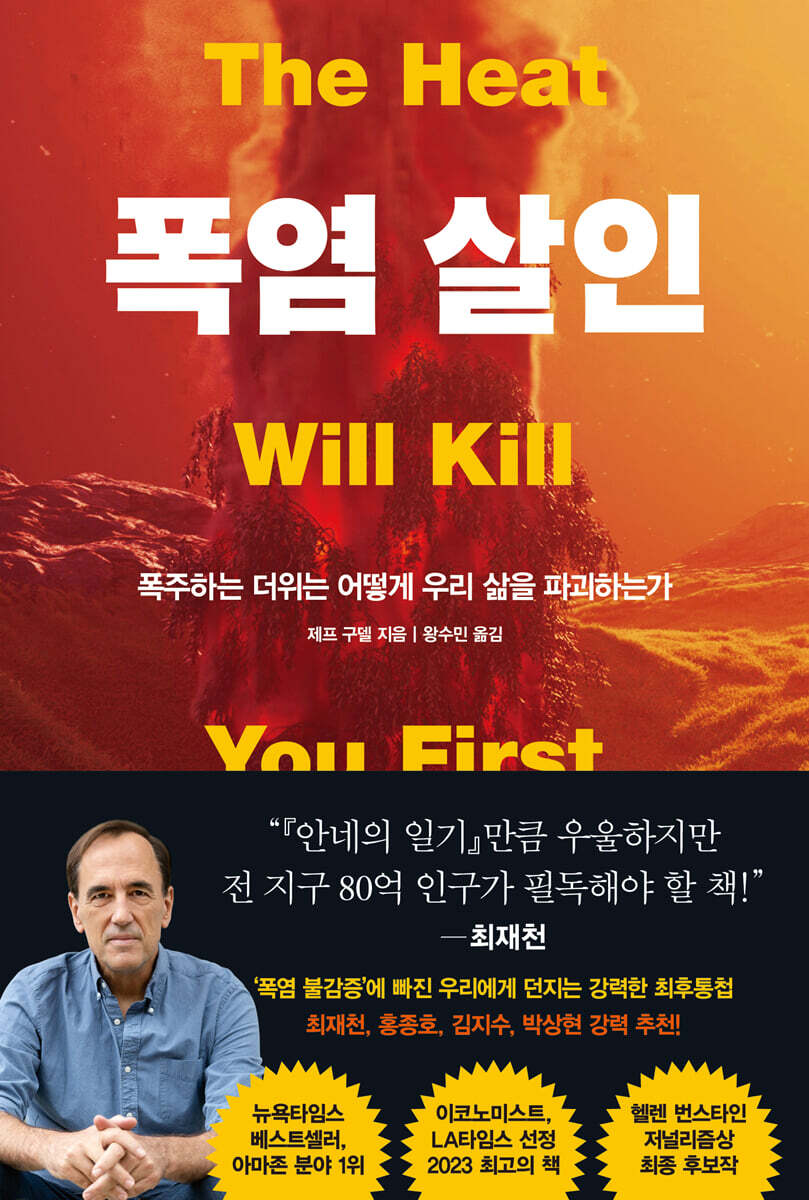
Heat wave murder
 |
Description
Book Introduction
- A word from MD
-
The cruel reality of dying from the heatWhen the heat is intense, you may have used the exaggerated expression, "I'm dying of heat."
It's no exaggeration anymore.
There are people who actually die from the heat.
It's getting hotter and hotter, and more lives are being lost.
The scene shown in the book is chilling, but it is a fact that cannot be ignored.
A must-read for all Earthlings.
June 11, 2024. Natural Science PD Son Min-gyu
Highly recommended by Choi Jae-cheon, Hong Jong-ho, Kim Ji-soo, and Park Sang-hyun!
The Economist and LA Times' Best Books of 2023
New York Times bestseller, #1 on Amazon
"What we welcomed early was not summer, but death."
The era of 500,000 heatwave deaths, power shortages, skyrocketing prices, super wildfires, and epidemics.
Jeff Goodell's heatwave reportage delves into the devastation of global warming.
· As temperatures rise, suicide and rape cases increase?
· How Air Conditioning Changed the US Election
· If cherry blossom mosquitoes run rampant, a simultaneous pandemic will occur!
How Cool Indoor Temperatures Divide Class and Housing Values
· The food panic, the green onion and cabbage wave are just the beginning!
· The tragedy brought about by desertification of the ocean
In the age of extreme heat, with record-breaking heat waves breaking every year, the Earth is heading towards an increasingly faster and hotter extinction.
From power shortages and skyrocketing prices to wildfires and epidemics, the heat wave will crush our lives on all fronts, leaving nothing but death in its wake.
"Heat Wave Murder" is a heat wave reportage by frontline climate journalist Jeff Goodell, who takes a ride on the "nation train" to see the scorching Earth.
This book predicted that 2023 would be the hottest year since the Industrial Revolution, and it became a bestseller immediately after its publication, creating a huge buzz in American society.
From Pakistan, where average temperatures exceed 45 degrees Celsius, to Chicago, and from the vanishing Antarctica to Paris, the author chronicles in detail the devastation of heat waves that push our daily lives, bodies, and social systems to the limit.
How long can the cool air of air conditioning protect us from the heat that is running wild beyond the speed of evolution and the unpredictable disasters it will bring?
What is clear is that no one is free from the chain reaction of death that extreme heat will bring.
The Economist and LA Times' Best Books of 2023
New York Times bestseller, #1 on Amazon
"What we welcomed early was not summer, but death."
The era of 500,000 heatwave deaths, power shortages, skyrocketing prices, super wildfires, and epidemics.
Jeff Goodell's heatwave reportage delves into the devastation of global warming.
· As temperatures rise, suicide and rape cases increase?
· How Air Conditioning Changed the US Election
· If cherry blossom mosquitoes run rampant, a simultaneous pandemic will occur!
How Cool Indoor Temperatures Divide Class and Housing Values
· The food panic, the green onion and cabbage wave are just the beginning!
· The tragedy brought about by desertification of the ocean
In the age of extreme heat, with record-breaking heat waves breaking every year, the Earth is heading towards an increasingly faster and hotter extinction.
From power shortages and skyrocketing prices to wildfires and epidemics, the heat wave will crush our lives on all fronts, leaving nothing but death in its wake.
"Heat Wave Murder" is a heat wave reportage by frontline climate journalist Jeff Goodell, who takes a ride on the "nation train" to see the scorching Earth.
This book predicted that 2023 would be the hottest year since the Industrial Revolution, and it became a bestseller immediately after its publication, creating a huge buzz in American society.
From Pakistan, where average temperatures exceed 45 degrees Celsius, to Chicago, and from the vanishing Antarctica to Paris, the author chronicles in detail the devastation of heat waves that push our daily lives, bodies, and social systems to the limit.
How long can the cool air of air conditioning protect us from the heat that is running wild beyond the speed of evolution and the unpredictable disasters it will bring?
What is clear is that no one is free from the chain reaction of death that extreme heat will bring.
- You can preview some of the book's contents.
Preview
index
Prologue: Romance is over
Suffocating Everything│A World Finally Equalized in the Face of a Heat Wave│Summer's Romance Is Over│More Frequent Wars and More Deaths│Outpacing the Speed of Evolution
Chapter 1: A Family Tragedy
Family Death Scene│7:44 a.m., 21 degrees Celsius: Start Hiking│10:29 a.m., 38 degrees Celsius│What to Do When Heat Exhaustion Approaches│11:56 a.m., 41.6 degrees Celsius: Call for Rescue│Heatstroke, a Chain Reaction to Death│The Heat Leaves No Trace
Chapter 2: Heat and Evolution
Mammalian Heat Management Strategies│What Made Lucy, the First Human, Walk│The Power of Evolution│Saving Chimpanzees on the Savannah│He Who Sweats Rules
Chapter 3 Heat Island
Empire of Asphalt, Concrete, and Steel│Chennai, the Tragedy of a Heatwave-Caught City│Heat Shelters│Low-Income Apartments Trapped in the Heatwave│Temperature: A Barometer of Class and Race
Chapter 4: Climate Migration
Hurricane Survivors | Heat-Driven Mass Migration and Ecosystem Disruption | The Illusion of Adaptability | Global Climate Migration | A Wall Stronger Than a Border
Chapter 5: Crime Scene
Extreme Heat Waves | Understanding Heat | Rumford's Discoveries and the Laws of Thermodynamics | History of Climate Science | The Science of Identifying the Causes of Extreme Events
Chapter 6: The Valley of Magic
When Corn Disappears│Food Panic Begins│The Magic Valley│The Longer Off-Season│The Collapsing Corn Republic│No More Crops to Plant│Genetically Modified Foods That Beat the Heat
Chapter 7 Marine Heat Waves
The Blob That Brings Disaster | The Ocean That Drives the Climate System | Marine Desertification | Coral Reef Bleaching
Chapter 8: The Sweat Economy
The Death of a Migrant Worker | Heat-related Illnesses and Death Prevention | No Rest, Even in the Heat | Are Black People Heat-Resistant? | Just Shade, Water, and 10 Minutes of Rest
Chapter 9: Ice at the End of the World
Day 1 of Antarctica: Ice Shelf Collapses | Sleeping Elephants | Entering Drake Passage | A 5-Meter Disaster | Mother Nature's Wrath | A Great Research Assistant | Heat Touches Everything
Chapter 10: Mosquitoes as a Vector
Mosquito-borne diseases│Unprecedented pandemic explosion 302│The great escape of the wild and the cross-species spread of viruses│Hotbeds of infectious diseases│Evolving mosquitoes│Killer ticks
Chapter 11: Cheap Refrigerant
The King of Cool | The Invention of Air Conditioning | The Air Conditioning Economy and Marilyn Monroe | Air Conditioning: How It Changed American Politics | The Vicious Cycle of Air Conditioning Dependence | A Blackout Is Death | The Technology That Forgets Great Wisdom | A World Addicted to the Comfort of Air Conditioning
Chapter 12 Heat Wave Warning
A Photo That Changed My Destiny│Finding Images of the Heat Wave│How to Find the Invisible Killer│Naming the Heat Wave│Reporting and Re-informing Isn't Enough 37
Chapter 13 Code of Conduct
That year, summer in Paris│Cities under remodeling│A city that is no longer beautiful│More, more trees│There are no trees in poor areas│Work to improve urban metabolism
Chapter 14 Polar Bear
Encountering a polar bear│Image of a hungry bear│Worst-case scenario│Technology for manipulating the Earth's climate│A perilous journey│At the end of the world that will soon melt away
Epilogue: A Great Story
Beyond the Goldilocks Zone│On a very old future
Acknowledgements
Glossary of Terms
main
Suffocating Everything│A World Finally Equalized in the Face of a Heat Wave│Summer's Romance Is Over│More Frequent Wars and More Deaths│Outpacing the Speed of Evolution
Chapter 1: A Family Tragedy
Family Death Scene│7:44 a.m., 21 degrees Celsius: Start Hiking│10:29 a.m., 38 degrees Celsius│What to Do When Heat Exhaustion Approaches│11:56 a.m., 41.6 degrees Celsius: Call for Rescue│Heatstroke, a Chain Reaction to Death│The Heat Leaves No Trace
Chapter 2: Heat and Evolution
Mammalian Heat Management Strategies│What Made Lucy, the First Human, Walk│The Power of Evolution│Saving Chimpanzees on the Savannah│He Who Sweats Rules
Chapter 3 Heat Island
Empire of Asphalt, Concrete, and Steel│Chennai, the Tragedy of a Heatwave-Caught City│Heat Shelters│Low-Income Apartments Trapped in the Heatwave│Temperature: A Barometer of Class and Race
Chapter 4: Climate Migration
Hurricane Survivors | Heat-Driven Mass Migration and Ecosystem Disruption | The Illusion of Adaptability | Global Climate Migration | A Wall Stronger Than a Border
Chapter 5: Crime Scene
Extreme Heat Waves | Understanding Heat | Rumford's Discoveries and the Laws of Thermodynamics | History of Climate Science | The Science of Identifying the Causes of Extreme Events
Chapter 6: The Valley of Magic
When Corn Disappears│Food Panic Begins│The Magic Valley│The Longer Off-Season│The Collapsing Corn Republic│No More Crops to Plant│Genetically Modified Foods That Beat the Heat
Chapter 7 Marine Heat Waves
The Blob That Brings Disaster | The Ocean That Drives the Climate System | Marine Desertification | Coral Reef Bleaching
Chapter 8: The Sweat Economy
The Death of a Migrant Worker | Heat-related Illnesses and Death Prevention | No Rest, Even in the Heat | Are Black People Heat-Resistant? | Just Shade, Water, and 10 Minutes of Rest
Chapter 9: Ice at the End of the World
Day 1 of Antarctica: Ice Shelf Collapses | Sleeping Elephants | Entering Drake Passage | A 5-Meter Disaster | Mother Nature's Wrath | A Great Research Assistant | Heat Touches Everything
Chapter 10: Mosquitoes as a Vector
Mosquito-borne diseases│Unprecedented pandemic explosion 302│The great escape of the wild and the cross-species spread of viruses│Hotbeds of infectious diseases│Evolving mosquitoes│Killer ticks
Chapter 11: Cheap Refrigerant
The King of Cool | The Invention of Air Conditioning | The Air Conditioning Economy and Marilyn Monroe | Air Conditioning: How It Changed American Politics | The Vicious Cycle of Air Conditioning Dependence | A Blackout Is Death | The Technology That Forgets Great Wisdom | A World Addicted to the Comfort of Air Conditioning
Chapter 12 Heat Wave Warning
A Photo That Changed My Destiny│Finding Images of the Heat Wave│How to Find the Invisible Killer│Naming the Heat Wave│Reporting and Re-informing Isn't Enough 37
Chapter 13 Code of Conduct
That year, summer in Paris│Cities under remodeling│A city that is no longer beautiful│More, more trees│There are no trees in poor areas│Work to improve urban metabolism
Chapter 14 Polar Bear
Encountering a polar bear│Image of a hungry bear│Worst-case scenario│Technology for manipulating the Earth's climate│A perilous journey│At the end of the world that will soon melt away
Epilogue: A Great Story
Beyond the Goldilocks Zone│On a very old future
Acknowledgements
Glossary of Terms
main
Detailed image

Into the book
The tragedy that befell Gerish, Jeong, Miju, and Oski cannot simply be attributed to bad luck and poor decisions made in the wild that day.
This incident is nothing less than a tragedy, a reminder of the dangers of living in a rapidly warming world, and of our collective failure to grasp the very nature of heat.
We cannot accept this kind of death.
No one thinks they will die this way.
Because we live in a world of advanced technology, we think we have already tamed the wild forces of nature.
---From "Chapter 1 - A Family Tragedy"
The loss of hair and the development of eccrine glands on our bodies are significant events in the history of evolution.
Its importance is comparable to that of extension and use of fire.
(Omitted) However, human heat management strategies, like those of all living things, are optimized for the so-called Goldilocks zone environment in which we have lived for the past ten thousand years or so.
In a world that changes so rapidly—so rapidly that evolutionary selection struggles to keep up—these strategies are now little more than outdated relics.
---From "Chapter 2 - Heat and Evolution"
In Phoenix, temperature becomes an indicator of class, wealth, and often race.
Being rich in Phoenix means living in a big house, cranking the air conditioning to the max, and drinking ice-cold martinis.
But being in a situation as destitute as Leono Juárez, a 46-year-old single mother of four whom I met on a July afternoon when the temperature reached a staggering 46 degrees Celsius, means living in south Phoenix, where trees are rare, and hoping to split your meager wages to afford an hour or two of air conditioning on a sweltering summer night.
---From "Chapter 3 - Heat Island"
Researchers, including Foote, knew only that certain types of gases, such as carbon dioxide, were good at trapping heat.
Still, it is clear that they were not overly concerned about the heat wave.
Those who thought there would be any impact believed that a little warming would actually be positive.
(Omitted) At the time, most people assumed that a disaster caused by global warming would be impossible thanks to the ‘balance of nature’, and that even if any changes occurred due to ‘progress’ in human industry, they would all be good for humans.
---From "Chapter 5 - Crime Scene"
Corn is an essential food source that must be industrially stored to sustain American life.
First of all, corn syrup is needed to make processed foods, from the cereal we eat in the morning to ice cream.
Corn is also the most important feed ingredient.
In other words, animals must eat massive amounts of corn to produce animal protein.
A McDonald's hamburger is essentially a McDonald's corn burger.
Corn is also the fuel that gets you to McDonald's.
More than half of the corn grown in Iowa ends up being converted into ethanol, which is then used as fuel alongside gasoline.
---From "Chapter 6 - The Valley of Magic"
More and more people work indoors with purified air and less sunlight.
But not everyone is like that.
Because even in this situation, there are still people who need to fix houses and bridges and deliver packages.
In the United States, there are 15 million people who have to work outside the home at least some of the time.
---From "Chapter 8 - The Sweat Economy"
In Texas, a temperature increase of 0.5 to 1℃ is not felt much.
But in Antarctica, a change of 0.5 to 1℃ determines whether water or ice is formed, and whether glaciers remain stable or collapse.
For millions of people in coastal cities around the world, a difference of 0.5 to 1°C can mean the difference between a beautiful beach scene and a meter of water rising in their living room.
Nowhere on Earth does heat exert such a powerful influence on our future as in Antarctica.
---From "Chapter 9 - Ice at the End of the World"
The global demand for air conditioners shows no signs of cooling down.
There are currently over 1 billion single-person air conditioners installed worldwide.
At this rate, one in seven people has an air conditioner.
By 2050, the number of air conditioners is expected to exceed 4.5 billion.
It is becoming as common as cell phones today.
---From "Chapter 11 - Cheap Cooling"
In less than two weeks in 2003, 15,000 people died in France as a direct result of the heatwave.
Among them, nearly 1,000 people lived in downtown Paris.
Many of the victims were people who lived alone or in attics or loft-style apartments on the top floor.
In these houses, heat builds up under the thatched roof, literally roasting people whole as if they were in an oven.
It took weeks to find all the bodies of those who had died in the heatwave.
The apartment where the body was found had to be emptied for a while to get rid of the corpse smell that had permeated every corner.
This incident is nothing less than a tragedy, a reminder of the dangers of living in a rapidly warming world, and of our collective failure to grasp the very nature of heat.
We cannot accept this kind of death.
No one thinks they will die this way.
Because we live in a world of advanced technology, we think we have already tamed the wild forces of nature.
---From "Chapter 1 - A Family Tragedy"
The loss of hair and the development of eccrine glands on our bodies are significant events in the history of evolution.
Its importance is comparable to that of extension and use of fire.
(Omitted) However, human heat management strategies, like those of all living things, are optimized for the so-called Goldilocks zone environment in which we have lived for the past ten thousand years or so.
In a world that changes so rapidly—so rapidly that evolutionary selection struggles to keep up—these strategies are now little more than outdated relics.
---From "Chapter 2 - Heat and Evolution"
In Phoenix, temperature becomes an indicator of class, wealth, and often race.
Being rich in Phoenix means living in a big house, cranking the air conditioning to the max, and drinking ice-cold martinis.
But being in a situation as destitute as Leono Juárez, a 46-year-old single mother of four whom I met on a July afternoon when the temperature reached a staggering 46 degrees Celsius, means living in south Phoenix, where trees are rare, and hoping to split your meager wages to afford an hour or two of air conditioning on a sweltering summer night.
---From "Chapter 3 - Heat Island"
Researchers, including Foote, knew only that certain types of gases, such as carbon dioxide, were good at trapping heat.
Still, it is clear that they were not overly concerned about the heat wave.
Those who thought there would be any impact believed that a little warming would actually be positive.
(Omitted) At the time, most people assumed that a disaster caused by global warming would be impossible thanks to the ‘balance of nature’, and that even if any changes occurred due to ‘progress’ in human industry, they would all be good for humans.
---From "Chapter 5 - Crime Scene"
Corn is an essential food source that must be industrially stored to sustain American life.
First of all, corn syrup is needed to make processed foods, from the cereal we eat in the morning to ice cream.
Corn is also the most important feed ingredient.
In other words, animals must eat massive amounts of corn to produce animal protein.
A McDonald's hamburger is essentially a McDonald's corn burger.
Corn is also the fuel that gets you to McDonald's.
More than half of the corn grown in Iowa ends up being converted into ethanol, which is then used as fuel alongside gasoline.
---From "Chapter 6 - The Valley of Magic"
More and more people work indoors with purified air and less sunlight.
But not everyone is like that.
Because even in this situation, there are still people who need to fix houses and bridges and deliver packages.
In the United States, there are 15 million people who have to work outside the home at least some of the time.
---From "Chapter 8 - The Sweat Economy"
In Texas, a temperature increase of 0.5 to 1℃ is not felt much.
But in Antarctica, a change of 0.5 to 1℃ determines whether water or ice is formed, and whether glaciers remain stable or collapse.
For millions of people in coastal cities around the world, a difference of 0.5 to 1°C can mean the difference between a beautiful beach scene and a meter of water rising in their living room.
Nowhere on Earth does heat exert such a powerful influence on our future as in Antarctica.
---From "Chapter 9 - Ice at the End of the World"
The global demand for air conditioners shows no signs of cooling down.
There are currently over 1 billion single-person air conditioners installed worldwide.
At this rate, one in seven people has an air conditioner.
By 2050, the number of air conditioners is expected to exceed 4.5 billion.
It is becoming as common as cell phones today.
---From "Chapter 11 - Cheap Cooling"
In less than two weeks in 2003, 15,000 people died in France as a direct result of the heatwave.
Among them, nearly 1,000 people lived in downtown Paris.
Many of the victims were people who lived alone or in attics or loft-style apartments on the top floor.
In these houses, heat builds up under the thatched roof, literally roasting people whole as if they were in an oven.
It took weeks to find all the bodies of those who had died in the heatwave.
The apartment where the body was found had to be emptied for a while to get rid of the corpse smell that had permeated every corner.
---From "Chapter 13 - Code of Conduct"
Publisher's Review
"From Antarctica to Pakistan, it's like riding a train across the globe, a shocking sight."
A climate journalist's expedition into the heatwave, witnessing the devastation of the heatwave in advance.
In May 2024, 83 Yucatan black howler monkeys were found dead off the southern coast of Mexico, having fallen from tall trees like apples.
The cause of death was severe dehydration and high fever.
In 2021, dozens of eagles, still unable to fly, jumped from nests that were as hot as a sweltering pit in the Pacific Northwest of the United States.
Death, like a scene from the Apocalypse, was something that even humans could not avoid.
In 2019, the number of deaths from heat waves worldwide approached 500,000.
How many of them imagined that they would die from 'the heat'?
Jeff Goodell, a journalist who has covered climate issues for 20 years, says heat waves are killing us more easily and faster than we expected.
The book "The Heat Will Kill You First" became a hot topic in the United States when it was published as if it predicted the runaway heat that would go beyond the predictions of climate scientists in 2023, the hottest year in recorded history.
The author has been covering the vivid scenes of heat waves for years, traveling from Antarctica to Chicago, Pakistan to Paris, and elsewhere.
It vividly tells the harrowing stories of Pakistani citizens living in a zone where the average temperature is 45 degrees Celsius, Mexican workers who died while working outdoors, farmers on American corn farms, and dozens of climate scientists, as well as polar bears who have lost their habitat.
This book is a heat wave reportage that depicts, in a sophisticated manner, the origins and reality of the heat wave that is pushing our daily lives, politics, economy, and social systems to the limit.
The vivid descriptions of “falling birds, struggling fish, withered crops, collapsing workers, and fainting city walkers” will give us, who are still “insensitive to heat waves,” “a shock like riding a ‘train of nations’ over a heated Earth, just like the movie ‘Snowpiercer’ orbits over a frozen Earth” (Kim Ji-soo).
Deaths from heat waves have surpassed the combined death toll from all natural disasters worldwide.
With heatwave deaths reaching 500,000, a powerful ultimatum is being issued to those suffering from heatwave insensitivity.
Just as heatstroke can occur when heat cannot escape from the human body, the Earth is also suffering from heatstroke.
A heat wave, which refers to extreme heat, is a climate disaster in which temperatures rise as the jet stream, which circulates cold air, becomes unpredictably distorted due to global warming.
As global warming accelerates, surprise heat waves will become more frequent and difficult to predict.
A recent study found that the likelihood of heat waves today is 150 times higher than in the early industrial era, and ocean temperatures, soaring like wildfires, are breaking new records every year (Prologue).
As of 2019, the global heatwave death toll, at 489,000, far exceeds the combined death toll from all natural disasters, including hurricanes, typhoons, and floods.
If you still think you might die from the heat, you are still suffering from heat insensitivity.
The Korea Disease Control and Prevention Agency (KDCA) announced that the number of patients with heat-related illnesses in Korea increased 3.5 times in 2023, and the number of deaths reached 32.
Considering the indirect effects, it is estimated that the number would have been higher.
The author notes that the 'heat' we are experiencing now is not the romance of summer, but the 'heat' itself that is boiling the earth.
All life on Earth, including humans, as well as the atmosphere and ocean currents, is a kind of 'heat management system', and according to the principles of thermodynamics, heat does not disappear but is transformed into other forms.
Just as a family on a hike died in just four hours during the 2022 Pacific Northwest heatwave, the human body, as a heat-generating organism, experiences hyperthermia when the wet-bulb temperature exceeds its threshold of 35 degrees Celsius, quickly progressing to heat cramps and heatstroke (Chapter 1).
The heat is even destroying our social systems.
Statistics show that for every 1 degree Celsius rise in global temperatures, suicides and abortions increase.
The frequency of violent crimes, including hate speech and rape, is increasing.
The author sounds the alarm about our insensitivity to heat waves, emphasizing that not only the survival of all beings on Earth, but also the political and economic problems of our society have stepped outside the Goldilocks zone, the area where survival is possible.
“Let go of the illusion that air conditioning will protect us.”
Air conditioning changed the US presidential election landscape. Cool temperatures are a new indicator of class and housing prices.
The saying, “If it’s hot, why don’t you just turn on the air conditioner?” makes it even harder for us to escape from heat wave insensitivity.
According to the energy efficiency non-profit RMI, there are more than 1 billion air conditioners installed worldwide, benefiting one in seven people, and by 2050, air conditioners will be more common than smartphones.
The popularity of air conditioning was enough to cause a large-scale migration of northern populations to the American South, which had been shunned by the hot climate, and the author reveals that between the 1940s and 1980s, the Sun Belt region, a Democratic stronghold, was flooded with conservative retirees, who turned the tide of presidential elections (Chapter 11).
The problem is that the explosive increase in electricity demand due to the popularity of air conditioners is causing large-scale power outages, while the carbon dioxide produced during the power generation process is accelerating heat waves.
Just as air conditioning changed the landscape of the U.S. presidential election, cool indoor temperatures are becoming a new indicator of class, housing affordability, and race in this heat wave era.
According to the author's testimony, when the temperature in Lenz, Portland's worst slum, reached 122 degrees Fahrenheit (51.1 degrees Celsius), the temperature in the surrounding affluent residential areas, where the trees are thick and the average home value is over $1 million, was only 100 degrees Fahrenheit (37.2 degrees Celsius).
Many of the 15,000 people who died during the two-week heatwave that gripped Paris in August 2003 were living alone in attics, where the heat from the thatched roofs was transmitted directly to them.
At the time, city authorities were unable to find a place to store the overflowing corpses, and even had to forcibly requisition food warehouses and refrigerated trucks (Chapter 8).
People forced to do poor outdoor work in extreme heat also bring to mind the class theory of the heat wave era.
The story of Chennai, an Indian city gripped by a 50-degree heatwave, where worrying about the survival of families working on construction sites has become a daily occurrence, makes us reflect on the situation in Korea (Chapter 3).
"The green onion wave is just the beginning. Everything on the table is drying up."
From skyrocketing food prices to GDP evaporation, the cruel butterfly effect of the heat wave era.
The president's remarks on the 875 won price hike, which determined the outcome of the 22nd general election, led to a heated debate over who was to blame for the soaring prices and the difficulties facing the people's economy.
The prices of apples, cabbage, and radishes, which are approaching 10,000 won, make us realize the soaring cost of living.
Livestock products such as cows, pigs, and chickens, which are major contributors to carbon emissions and vulnerable to heat, will be the first to disappear from our tables.
According to research, the number of people experiencing food insecurity will reach 345 million by 2023, and half the world's population will go hungry by 2050 (Chapter 6).
The author vividly conveys the despair of farmers by visiting the "Magic Valley," once a land of abundance but now a land of death, the Rio Grande Valley, and the Texas cornfields where yields have been halved.
Corn is used as animal feed and as a raw material for gasoline, so a decrease in corn production means the paralysis of energy production facilities and distribution networks, which will soon lead to the collapse of the social system.
Considering that food shortages of not only corn but also wheat, barley, and rice have led to wars, civil wars, and revolutions throughout history, it's likely that the extreme butterfly effect of heat waves will not only change the appearance of our dining tables.
There is no mercy in the bill we have received for the heat wave.
According to the book, for every 1 degree rise in average temperature, about 300 billion dollars (about 4 trillion won), or about 1 percent of the U.S. GDP, evaporates.
Outdoor work is impossible under extreme heat, and equipment breakdowns also increase.
In 2020, extreme heat-related worker productivity losses in the United States were estimated at $100 billion, and this figure is projected to rise to $500 billion by 2050.
What we are faced with after this continuous decline in production facilities and labor productivity is the 'price tag' of the supermarket that threatens our very survival.
"The beginning of climate migration to escape the heatwave, COVID-19 was just a mild taste."
A Wild Exodus: A New Disease Algorithm, From Cherry Blossom Mosquitoes to Ticks
A wild exodus to escape the heat is also taking place.
Terrestrial animals are currently moving north at a rate of about 20 kilometers per decade, Atlantic cod at 160 kilometers per decade, and even corals at about 32 kilometers per year.
As warmer ocean currents cause sea levels to rise, residents of coastal cities are forced to abandon their homes and migrate.
John Mercer, the climatologist who first identified the collapse of Antarctica, has already warned that if the West Antarctic ice sheet melts and sea levels rise by 5 meters, Florida and the Netherlands will disappear from the map (Chapter 9).
South Korea's coastal cities, such as Incheon and Busan, are not immune to the global climate migration.
COVID-19 is just the beginning of a pandemic, and heat waves are rewriting the disease algorithm.
This is because the habitats of infectious disease vectors are moving northward and closer to human habitats.
Biologist Colin Carlson calls it a "fascinating first encounter." The World Health Organization (WHO) projects that by 2080, 60 percent of the world's population will be infected with dengue fever, a leading mosquito-borne disease.
Ticks are also moving northward by 48 kilometers each year, and cases of Lyme disease, carried by deer ticks, have tripled since the late 1990s, according to the Centers for Disease Control and Prevention.
Bats, which transmit Ebola and rabies, as well as COVID-19, are also increasingly likely to encounter humans.
Looking at these trends, we cannot help but say that the COVID-19 pandemic has actually been a stroke of luck for humanity.
Because COVID-19 does not have a 75 percent mortality rate or cause bleeding from the eyes or organs (Chapter 10).
“Bake, run, or act.”
Heatwave Branding, Urban Remodeling, and Climate Action to Avoid Being Complicit in Heatwave Murder
Contrary to the claims of climate crisis conspiracy theorists, numerous climate scientists the author met unanimously agreed that the cause of the Earth's heating up is the use of fossil fuels.
Stopping fossil fuel-based power generation could change the climate 30 years from now, but global fossil fuel use is still growing, reaching 82% in 2024.
The fact that US primary oil and gas production is projected to hit a record high in 2023 is discouraging enough.
Oil giant BP has backed out of its pledge to cut carbon emissions by 35%, and ExxonMobil has stopped supporting biofuel production.
What about South Korea? It ranks among the highest in fossil fuel consumption among OECD countries and is the world's second-largest investor in fossil fuels.
South Korea will pay an additional 430,000 won per person (IEEA) due to rising energy costs, but the bill for the heat wave doesn't end there.
Myles Allen, a geophysicist who founded the science of "extreme anomaly explanation," says:
“As climate science advances and we are able to identify the direct causes of heatwave deaths, we will be able to hold those responsible legally accountable.” (Chapter 5)
The author explores the scientific basis and solutions for dealing with the deadly heat wave, covering everything from evolutionary history to industrial structure, disease algorithms, and climate science.
In particular, if heat waves cannot be avoided, it is worth listening to the argument that we need 'branding' to actively publicize the dangers of heat waves by giving them a name and image, like Hurricane Katrina.
Seville, Spain, was able to prevent heatwave deaths, which had previously reached 14 to 15 people a day, thanks to actively promoting the heatwave and naming it "Zoe."
Even the cities that will house 70% of the world's population in just 20 years need remodeling.
Cities, filled with asphalt, concrete, steel and outdoor units, are sweltering heat traps.
New York City has planted a million trees to shade the city, and Seville has used groundwater technology to cool the city.
As countries around the world adapt their urban landscapes to cope with heat waves, what about Seoul, a city of ten million people? It's time to ask ourselves whether we're adequately prepared for "heat wave murder."
The author, who went on a ski trip to the Arctic, recalls that the moment he came face to face with a polar bear that had come into human habitation in search of food, he "felt like a criminal whose execution had been postponed just before death."
We could not deny that we were all accomplices in this heat wave murder.
However, the author says that despair is premature, despite the gloomy apocalypse of Anne Frank.
When it was published in 2023, the question the author heard most often was, “Are we finished?”
He answered like this every time.
"Do you want Earth to be a habitable planet? Then roll up your sleeves and fight."
Over 14 chapters, it traces the impact of heat from the Arctic to the tropics and back again, melting ice and coral, and even covering the rampant heat-loving mosquitoes.
He points out that the scariest thing about a future dominated by heat waves is that we do not treat it with the respect and care it deserves.
- Washington Post
A startling exploration of the deadly consequences of rising temperatures.
The harm caused by heat falls unfairly on those who cannot protect themselves.
Unlike climate science books that are overflowing with data, this book is full of colorful stories.
- The Economist
“Prescient” and “exciting” are two words that come to mind when describing Goodell’s book.
It guides us on a clear path through clear scientific evidence and great storytelling.
- LA Times
A climate journalist's expedition into the heatwave, witnessing the devastation of the heatwave in advance.
In May 2024, 83 Yucatan black howler monkeys were found dead off the southern coast of Mexico, having fallen from tall trees like apples.
The cause of death was severe dehydration and high fever.
In 2021, dozens of eagles, still unable to fly, jumped from nests that were as hot as a sweltering pit in the Pacific Northwest of the United States.
Death, like a scene from the Apocalypse, was something that even humans could not avoid.
In 2019, the number of deaths from heat waves worldwide approached 500,000.
How many of them imagined that they would die from 'the heat'?
Jeff Goodell, a journalist who has covered climate issues for 20 years, says heat waves are killing us more easily and faster than we expected.
The book "The Heat Will Kill You First" became a hot topic in the United States when it was published as if it predicted the runaway heat that would go beyond the predictions of climate scientists in 2023, the hottest year in recorded history.
The author has been covering the vivid scenes of heat waves for years, traveling from Antarctica to Chicago, Pakistan to Paris, and elsewhere.
It vividly tells the harrowing stories of Pakistani citizens living in a zone where the average temperature is 45 degrees Celsius, Mexican workers who died while working outdoors, farmers on American corn farms, and dozens of climate scientists, as well as polar bears who have lost their habitat.
This book is a heat wave reportage that depicts, in a sophisticated manner, the origins and reality of the heat wave that is pushing our daily lives, politics, economy, and social systems to the limit.
The vivid descriptions of “falling birds, struggling fish, withered crops, collapsing workers, and fainting city walkers” will give us, who are still “insensitive to heat waves,” “a shock like riding a ‘train of nations’ over a heated Earth, just like the movie ‘Snowpiercer’ orbits over a frozen Earth” (Kim Ji-soo).
Deaths from heat waves have surpassed the combined death toll from all natural disasters worldwide.
With heatwave deaths reaching 500,000, a powerful ultimatum is being issued to those suffering from heatwave insensitivity.
Just as heatstroke can occur when heat cannot escape from the human body, the Earth is also suffering from heatstroke.
A heat wave, which refers to extreme heat, is a climate disaster in which temperatures rise as the jet stream, which circulates cold air, becomes unpredictably distorted due to global warming.
As global warming accelerates, surprise heat waves will become more frequent and difficult to predict.
A recent study found that the likelihood of heat waves today is 150 times higher than in the early industrial era, and ocean temperatures, soaring like wildfires, are breaking new records every year (Prologue).
As of 2019, the global heatwave death toll, at 489,000, far exceeds the combined death toll from all natural disasters, including hurricanes, typhoons, and floods.
If you still think you might die from the heat, you are still suffering from heat insensitivity.
The Korea Disease Control and Prevention Agency (KDCA) announced that the number of patients with heat-related illnesses in Korea increased 3.5 times in 2023, and the number of deaths reached 32.
Considering the indirect effects, it is estimated that the number would have been higher.
The author notes that the 'heat' we are experiencing now is not the romance of summer, but the 'heat' itself that is boiling the earth.
All life on Earth, including humans, as well as the atmosphere and ocean currents, is a kind of 'heat management system', and according to the principles of thermodynamics, heat does not disappear but is transformed into other forms.
Just as a family on a hike died in just four hours during the 2022 Pacific Northwest heatwave, the human body, as a heat-generating organism, experiences hyperthermia when the wet-bulb temperature exceeds its threshold of 35 degrees Celsius, quickly progressing to heat cramps and heatstroke (Chapter 1).
The heat is even destroying our social systems.
Statistics show that for every 1 degree Celsius rise in global temperatures, suicides and abortions increase.
The frequency of violent crimes, including hate speech and rape, is increasing.
The author sounds the alarm about our insensitivity to heat waves, emphasizing that not only the survival of all beings on Earth, but also the political and economic problems of our society have stepped outside the Goldilocks zone, the area where survival is possible.
“Let go of the illusion that air conditioning will protect us.”
Air conditioning changed the US presidential election landscape. Cool temperatures are a new indicator of class and housing prices.
The saying, “If it’s hot, why don’t you just turn on the air conditioner?” makes it even harder for us to escape from heat wave insensitivity.
According to the energy efficiency non-profit RMI, there are more than 1 billion air conditioners installed worldwide, benefiting one in seven people, and by 2050, air conditioners will be more common than smartphones.
The popularity of air conditioning was enough to cause a large-scale migration of northern populations to the American South, which had been shunned by the hot climate, and the author reveals that between the 1940s and 1980s, the Sun Belt region, a Democratic stronghold, was flooded with conservative retirees, who turned the tide of presidential elections (Chapter 11).
The problem is that the explosive increase in electricity demand due to the popularity of air conditioners is causing large-scale power outages, while the carbon dioxide produced during the power generation process is accelerating heat waves.
Just as air conditioning changed the landscape of the U.S. presidential election, cool indoor temperatures are becoming a new indicator of class, housing affordability, and race in this heat wave era.
According to the author's testimony, when the temperature in Lenz, Portland's worst slum, reached 122 degrees Fahrenheit (51.1 degrees Celsius), the temperature in the surrounding affluent residential areas, where the trees are thick and the average home value is over $1 million, was only 100 degrees Fahrenheit (37.2 degrees Celsius).
Many of the 15,000 people who died during the two-week heatwave that gripped Paris in August 2003 were living alone in attics, where the heat from the thatched roofs was transmitted directly to them.
At the time, city authorities were unable to find a place to store the overflowing corpses, and even had to forcibly requisition food warehouses and refrigerated trucks (Chapter 8).
People forced to do poor outdoor work in extreme heat also bring to mind the class theory of the heat wave era.
The story of Chennai, an Indian city gripped by a 50-degree heatwave, where worrying about the survival of families working on construction sites has become a daily occurrence, makes us reflect on the situation in Korea (Chapter 3).
"The green onion wave is just the beginning. Everything on the table is drying up."
From skyrocketing food prices to GDP evaporation, the cruel butterfly effect of the heat wave era.
The president's remarks on the 875 won price hike, which determined the outcome of the 22nd general election, led to a heated debate over who was to blame for the soaring prices and the difficulties facing the people's economy.
The prices of apples, cabbage, and radishes, which are approaching 10,000 won, make us realize the soaring cost of living.
Livestock products such as cows, pigs, and chickens, which are major contributors to carbon emissions and vulnerable to heat, will be the first to disappear from our tables.
According to research, the number of people experiencing food insecurity will reach 345 million by 2023, and half the world's population will go hungry by 2050 (Chapter 6).
The author vividly conveys the despair of farmers by visiting the "Magic Valley," once a land of abundance but now a land of death, the Rio Grande Valley, and the Texas cornfields where yields have been halved.
Corn is used as animal feed and as a raw material for gasoline, so a decrease in corn production means the paralysis of energy production facilities and distribution networks, which will soon lead to the collapse of the social system.
Considering that food shortages of not only corn but also wheat, barley, and rice have led to wars, civil wars, and revolutions throughout history, it's likely that the extreme butterfly effect of heat waves will not only change the appearance of our dining tables.
There is no mercy in the bill we have received for the heat wave.
According to the book, for every 1 degree rise in average temperature, about 300 billion dollars (about 4 trillion won), or about 1 percent of the U.S. GDP, evaporates.
Outdoor work is impossible under extreme heat, and equipment breakdowns also increase.
In 2020, extreme heat-related worker productivity losses in the United States were estimated at $100 billion, and this figure is projected to rise to $500 billion by 2050.
What we are faced with after this continuous decline in production facilities and labor productivity is the 'price tag' of the supermarket that threatens our very survival.
"The beginning of climate migration to escape the heatwave, COVID-19 was just a mild taste."
A Wild Exodus: A New Disease Algorithm, From Cherry Blossom Mosquitoes to Ticks
A wild exodus to escape the heat is also taking place.
Terrestrial animals are currently moving north at a rate of about 20 kilometers per decade, Atlantic cod at 160 kilometers per decade, and even corals at about 32 kilometers per year.
As warmer ocean currents cause sea levels to rise, residents of coastal cities are forced to abandon their homes and migrate.
John Mercer, the climatologist who first identified the collapse of Antarctica, has already warned that if the West Antarctic ice sheet melts and sea levels rise by 5 meters, Florida and the Netherlands will disappear from the map (Chapter 9).
South Korea's coastal cities, such as Incheon and Busan, are not immune to the global climate migration.
COVID-19 is just the beginning of a pandemic, and heat waves are rewriting the disease algorithm.
This is because the habitats of infectious disease vectors are moving northward and closer to human habitats.
Biologist Colin Carlson calls it a "fascinating first encounter." The World Health Organization (WHO) projects that by 2080, 60 percent of the world's population will be infected with dengue fever, a leading mosquito-borne disease.
Ticks are also moving northward by 48 kilometers each year, and cases of Lyme disease, carried by deer ticks, have tripled since the late 1990s, according to the Centers for Disease Control and Prevention.
Bats, which transmit Ebola and rabies, as well as COVID-19, are also increasingly likely to encounter humans.
Looking at these trends, we cannot help but say that the COVID-19 pandemic has actually been a stroke of luck for humanity.
Because COVID-19 does not have a 75 percent mortality rate or cause bleeding from the eyes or organs (Chapter 10).
“Bake, run, or act.”
Heatwave Branding, Urban Remodeling, and Climate Action to Avoid Being Complicit in Heatwave Murder
Contrary to the claims of climate crisis conspiracy theorists, numerous climate scientists the author met unanimously agreed that the cause of the Earth's heating up is the use of fossil fuels.
Stopping fossil fuel-based power generation could change the climate 30 years from now, but global fossil fuel use is still growing, reaching 82% in 2024.
The fact that US primary oil and gas production is projected to hit a record high in 2023 is discouraging enough.
Oil giant BP has backed out of its pledge to cut carbon emissions by 35%, and ExxonMobil has stopped supporting biofuel production.
What about South Korea? It ranks among the highest in fossil fuel consumption among OECD countries and is the world's second-largest investor in fossil fuels.
South Korea will pay an additional 430,000 won per person (IEEA) due to rising energy costs, but the bill for the heat wave doesn't end there.
Myles Allen, a geophysicist who founded the science of "extreme anomaly explanation," says:
“As climate science advances and we are able to identify the direct causes of heatwave deaths, we will be able to hold those responsible legally accountable.” (Chapter 5)
The author explores the scientific basis and solutions for dealing with the deadly heat wave, covering everything from evolutionary history to industrial structure, disease algorithms, and climate science.
In particular, if heat waves cannot be avoided, it is worth listening to the argument that we need 'branding' to actively publicize the dangers of heat waves by giving them a name and image, like Hurricane Katrina.
Seville, Spain, was able to prevent heatwave deaths, which had previously reached 14 to 15 people a day, thanks to actively promoting the heatwave and naming it "Zoe."
Even the cities that will house 70% of the world's population in just 20 years need remodeling.
Cities, filled with asphalt, concrete, steel and outdoor units, are sweltering heat traps.
New York City has planted a million trees to shade the city, and Seville has used groundwater technology to cool the city.
As countries around the world adapt their urban landscapes to cope with heat waves, what about Seoul, a city of ten million people? It's time to ask ourselves whether we're adequately prepared for "heat wave murder."
The author, who went on a ski trip to the Arctic, recalls that the moment he came face to face with a polar bear that had come into human habitation in search of food, he "felt like a criminal whose execution had been postponed just before death."
We could not deny that we were all accomplices in this heat wave murder.
However, the author says that despair is premature, despite the gloomy apocalypse of Anne Frank.
When it was published in 2023, the question the author heard most often was, “Are we finished?”
He answered like this every time.
"Do you want Earth to be a habitable planet? Then roll up your sleeves and fight."
Over 14 chapters, it traces the impact of heat from the Arctic to the tropics and back again, melting ice and coral, and even covering the rampant heat-loving mosquitoes.
He points out that the scariest thing about a future dominated by heat waves is that we do not treat it with the respect and care it deserves.
- Washington Post
A startling exploration of the deadly consequences of rising temperatures.
The harm caused by heat falls unfairly on those who cannot protect themselves.
Unlike climate science books that are overflowing with data, this book is full of colorful stories.
- The Economist
“Prescient” and “exciting” are two words that come to mind when describing Goodell’s book.
It guides us on a clear path through clear scientific evidence and great storytelling.
- LA Times
GOODS SPECIFICS
- Date of issue: June 3, 2024
- Page count, weight, size: 508 pages | 692g | 145*215*25mm
- ISBN13: 9788901283470
- ISBN10: 8901283476
You may also like
카테고리
korean


korean

![GQ KOREA Mark (Monthly): December [2025]](http://librairie.coreenne.fr/cdn/shop/files/8ef265dbbfbf186523ed75ba7319009d.jpg?v=1765340328&width=3840)


