

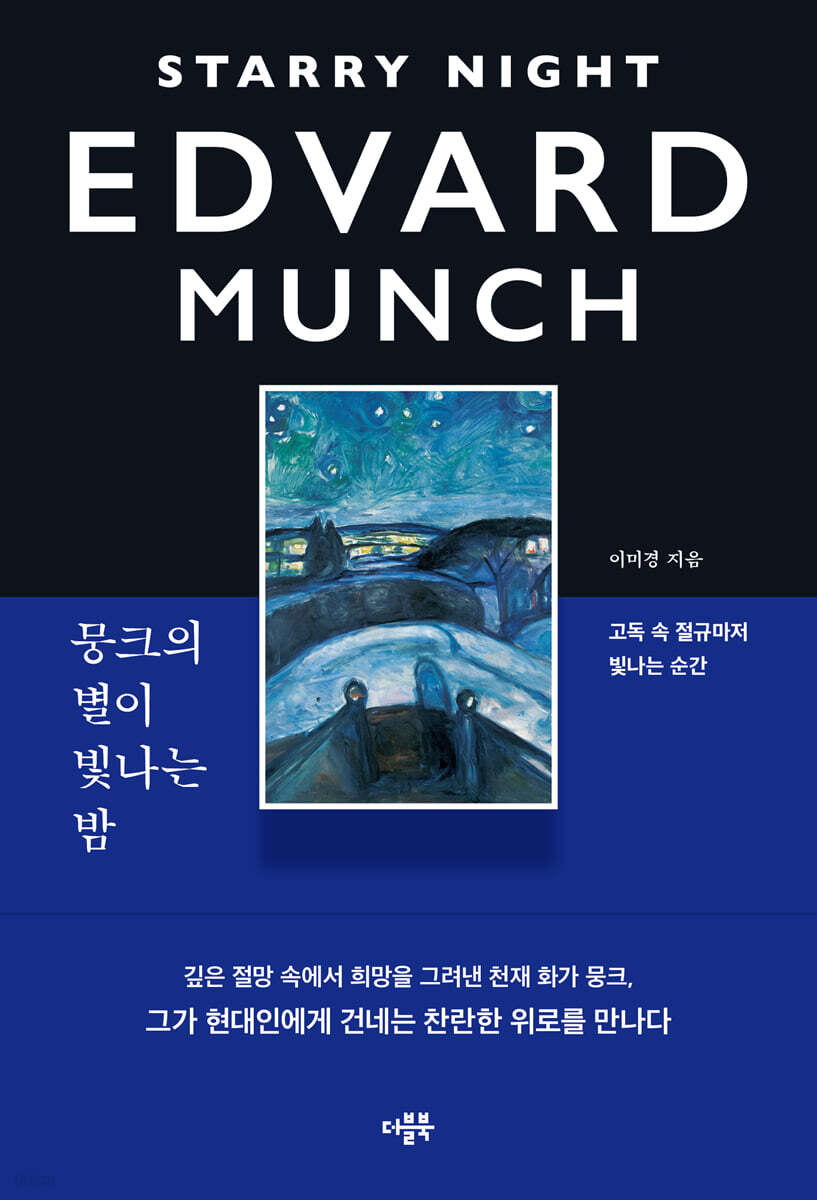
Munch's Starry Night
 |
Description
Book Introduction
- A word from MD
-
Step into Munch's TimeEdvard Munch's masterpiece = The Scream.
Professor Lee Mi-kyung, a Munch expert, breaks this formula.
By examining each of the records Munch left behind, we can see that his life and works were a journey from pain and despair to hope.
Moments from Edvard Munch's life that shine even brighter in despair are vividly depicted.
August 16, 2024. Art PD Ahn Hyun-jae
KBS 1TV 'Issue Pick with Teacher' Professor Lee Mi-kyung's
A deep understanding of Munch's life and works
A Munch guide that shines with kind and warm storytelling!
Edvard Munch (1863–1944), considered one of the most influential painters on modern art at the turn of the century.
This year marks the 80th anniversary of Munch's death.
"Munch's Starry Night" invites us into the life of Munch, the master of expressionism, whom we never knew about.
The author of this book, Professor Lee Mi-kyung (Yonsei University), is a Munch expert who served as exhibition advisor for the special retrospective exhibition “Edvard Munch: Beyond the Scream” currently being held at the Seoul Arts Center.
Prior to the publication of the book, the author spoke about the life, death, and art of Edvard Munch, who overcame the pain and anxiety that had plagued him his entire life and sublimated the darkness of the Scream into a brilliant sun, on KBS 1TV's [Issue Pick with Teacher] (June 30, 2024) under the theme, "The Brilliant Scream - Munch's Instruction Manual for Life."
The author spared no effort in understanding Munch's life and work by searching for and reading the diaries, notes, sketches, and letters left behind by the record-keeping fanatic Munch.
As a result, 『Munch's Starry Night』 vividly depicts every moment of his life, including his tragic childhood, his relationships with various artists who had a great influence on his early art, his love affair with three women marred by infidelity, unrequited love, and stalking, and his lifelong struggles with mental illnesses such as depression, claustrophobia, alcoholism, and insomnia, as if we were meeting him in 19th-century Oslo, Paris, and Germany.
It is often said that to understand a painting, you must know the artist's life.
This is especially true of Munch's work.
For example, to fully understand "Dance of Life," one must know about the seaside dance festival Munch experienced as a child, his painful memories of his first love, Millie, and the accidental pistol discharge by Toula, who was stalking him.
Munch created this work by complexly connecting several memories.
This is why 『Munch's Starry Night』 is a must-read before visiting the exhibition 『Edvard Munch: Beyond the Scream』.
Through this book, readers will gain new perspectives on Munch's work.
A deep understanding of Munch's life and works
A Munch guide that shines with kind and warm storytelling!
Edvard Munch (1863–1944), considered one of the most influential painters on modern art at the turn of the century.
This year marks the 80th anniversary of Munch's death.
"Munch's Starry Night" invites us into the life of Munch, the master of expressionism, whom we never knew about.
The author of this book, Professor Lee Mi-kyung (Yonsei University), is a Munch expert who served as exhibition advisor for the special retrospective exhibition “Edvard Munch: Beyond the Scream” currently being held at the Seoul Arts Center.
Prior to the publication of the book, the author spoke about the life, death, and art of Edvard Munch, who overcame the pain and anxiety that had plagued him his entire life and sublimated the darkness of the Scream into a brilliant sun, on KBS 1TV's [Issue Pick with Teacher] (June 30, 2024) under the theme, "The Brilliant Scream - Munch's Instruction Manual for Life."
The author spared no effort in understanding Munch's life and work by searching for and reading the diaries, notes, sketches, and letters left behind by the record-keeping fanatic Munch.
As a result, 『Munch's Starry Night』 vividly depicts every moment of his life, including his tragic childhood, his relationships with various artists who had a great influence on his early art, his love affair with three women marred by infidelity, unrequited love, and stalking, and his lifelong struggles with mental illnesses such as depression, claustrophobia, alcoholism, and insomnia, as if we were meeting him in 19th-century Oslo, Paris, and Germany.
It is often said that to understand a painting, you must know the artist's life.
This is especially true of Munch's work.
For example, to fully understand "Dance of Life," one must know about the seaside dance festival Munch experienced as a child, his painful memories of his first love, Millie, and the accidental pistol discharge by Toula, who was stalking him.
Munch created this work by complexly connecting several memories.
This is why 『Munch's Starry Night』 is a must-read before visiting the exhibition 『Edvard Munch: Beyond the Scream』.
Through this book, readers will gain new perspectives on Munch's work.
- You can preview some of the book's contents.
Preview
index
prolog
I.
Disease, death, madness
Childhood with Death
A Bachelor's Late Marriage | The Prelude to Tragedy | The Demon of Death Visits Munch | Guilt Becomes a Debt of the Heart | Painting "The Sick Child"
Ah! Father, Father
Embarking on the path of an artist | Father's final farewell | Father's death | Two people who were endlessly at odds | Munch's final gift to his son
Family who has been my support
Shaking Under the Weight of Life | Unfinished Tragedy | Families Left Behind
II.
Wandering Youth
Benefactors of Oslo
Oslo: Christiania Bohemian Group
Krog, From Benefactor to Villain | Describe Your Life | The Destroyer from the Underworld | The Shabby Death of Yeager
Paris: Declaration of Saint-Cloud
Munch encounters Impressionism | The Saint-Cloud Declaration | A relapse of rheumatism and a studio fire | A gambling addiction
Berlin: Black Piglet Group 98
The Munch Scandal | The Missing 'R' Mistake | The Black Piglet's Lover | And Jens Thies
Back to Norway
Building a Home on the Beach of the Gods | Finally Finding Small Happiness
III.
Munch's Women
Millie Thewlov: A First Love That Left Only Shame
Suffering from Love Fever | Elusive but Evident | The Emergence of the Femme Fatale
Dagny Yul: You Who Cannot Be Approached
A Woman of Mysterious Allure | Dagny, Munch's Model | Dagny's Marriage and Fall | The Murdered Madonna | Portraits of Munch and Dagny
Tula Larsen: A Stalker's Daily Life
Love Turns to Stalking | Munch's Growing Anxiety | The Worst Gun Accident of His Life | Trapped in the Hell of Toula | Munch, the Incarnation of Revenge | Another Gun Accident
Eva Mudoch: A Love That Just Ended Like That
Ideal Love, But | Women Who Vanished from Records
IV.
Freeze of Life
Symphony of Life | Reading Order for "The Frieze of Life"
Seeds of Love
Love began with a voice | In the dark, in the forest, under the moonlight | Such a provocative Madonna
The Flowering and Ending of Love
Love Leaves Only Ashes | Vampires, the Reality of Fear | Adding First Love to Childhood Memories | Ibsen and Munch Meet | Back to Paris! | Munch, Feeling a Sympathy
unrest
Munch's First Scream: "Despair" | "The Scream," a Modern Mona Lisa | Graffiti: Munch's Timid Revenge | The World as Seen by Munch, Suffering from Agoraphobia
death
Death Hovering Around Munch | Longing Sublimated into Art
V Life of a Hermit
Thank you to our generous supporters
Max Linde, who predicted Munch's era | Munch's children | Munch's lifelong supporters | The wardrobe of a successful man
Munch admitted to a mental hospital
Munch's Long-Lasting End | The Seeds of Madness Sprouting | Self-Enrollment in a Mental Asylum
The Sun mural in the Aula Grand Hall
Munch Becomes a Natural Man | The New Sun of the 20th Century
The Decadent Art Exhibition and the Reclusive Life
Grim news | The painters who painted "Starry Night" | Munch, painting the essence of night | Munch, who gained the artist's eye | The stigma of decadent art | A great legacy
Epilogue
Appendix 1 / Munch's Chronicles
Appendix 2 / Munch's Footsteps
References
I.
Disease, death, madness
Childhood with Death
A Bachelor's Late Marriage | The Prelude to Tragedy | The Demon of Death Visits Munch | Guilt Becomes a Debt of the Heart | Painting "The Sick Child"
Ah! Father, Father
Embarking on the path of an artist | Father's final farewell | Father's death | Two people who were endlessly at odds | Munch's final gift to his son
Family who has been my support
Shaking Under the Weight of Life | Unfinished Tragedy | Families Left Behind
II.
Wandering Youth
Benefactors of Oslo
Oslo: Christiania Bohemian Group
Krog, From Benefactor to Villain | Describe Your Life | The Destroyer from the Underworld | The Shabby Death of Yeager
Paris: Declaration of Saint-Cloud
Munch encounters Impressionism | The Saint-Cloud Declaration | A relapse of rheumatism and a studio fire | A gambling addiction
Berlin: Black Piglet Group 98
The Munch Scandal | The Missing 'R' Mistake | The Black Piglet's Lover | And Jens Thies
Back to Norway
Building a Home on the Beach of the Gods | Finally Finding Small Happiness
III.
Munch's Women
Millie Thewlov: A First Love That Left Only Shame
Suffering from Love Fever | Elusive but Evident | The Emergence of the Femme Fatale
Dagny Yul: You Who Cannot Be Approached
A Woman of Mysterious Allure | Dagny, Munch's Model | Dagny's Marriage and Fall | The Murdered Madonna | Portraits of Munch and Dagny
Tula Larsen: A Stalker's Daily Life
Love Turns to Stalking | Munch's Growing Anxiety | The Worst Gun Accident of His Life | Trapped in the Hell of Toula | Munch, the Incarnation of Revenge | Another Gun Accident
Eva Mudoch: A Love That Just Ended Like That
Ideal Love, But | Women Who Vanished from Records
IV.
Freeze of Life
Symphony of Life | Reading Order for "The Frieze of Life"
Seeds of Love
Love began with a voice | In the dark, in the forest, under the moonlight | Such a provocative Madonna
The Flowering and Ending of Love
Love Leaves Only Ashes | Vampires, the Reality of Fear | Adding First Love to Childhood Memories | Ibsen and Munch Meet | Back to Paris! | Munch, Feeling a Sympathy
unrest
Munch's First Scream: "Despair" | "The Scream," a Modern Mona Lisa | Graffiti: Munch's Timid Revenge | The World as Seen by Munch, Suffering from Agoraphobia
death
Death Hovering Around Munch | Longing Sublimated into Art
V Life of a Hermit
Thank you to our generous supporters
Max Linde, who predicted Munch's era | Munch's children | Munch's lifelong supporters | The wardrobe of a successful man
Munch admitted to a mental hospital
Munch's Long-Lasting End | The Seeds of Madness Sprouting | Self-Enrollment in a Mental Asylum
The Sun mural in the Aula Grand Hall
Munch Becomes a Natural Man | The New Sun of the 20th Century
The Decadent Art Exhibition and the Reclusive Life
Grim news | The painters who painted "Starry Night" | Munch, painting the essence of night | Munch, who gained the artist's eye | The stigma of decadent art | A great legacy
Epilogue
Appendix 1 / Munch's Chronicles
Appendix 2 / Munch's Footsteps
References
Detailed image

Into the book
Munch felt a maternal affection for his caring older sister Sophie, who took the place of his mother, whom he lost when he was five years old.
His sister's death came as a tremendous shock to Munch as he was entering puberty.
At the age of fourteen, Munch's emotions and feelings became increasingly unstable.
He was gripped by the fear that he could die at any moment, and was consumed by fear, anxiety, and guilt.
The young Munch blamed himself for infecting Sophie with his illness and felt intense guilt that his sister had died in his place.
This burden on the mind was born as “Sick Child” nine years later.
Munch never recovered from the psychological shock of losing his older sister, Sophie, on whom he had relied.
--- p.21
A look into Munch's tragic family history reveals a series of illnesses, deaths, and madness.
But Munch did not give in to this.
He chose to face the illness, death, and madness that had followed him throughout his life head-on, rather than covering it up or ignoring it.
Looking at Munch's diary, we can see that he accepted this suffering as a part of his life.
My suffering is part of myself and my art.
Pain is one with me, so if it is destroyed, both I and art will be destroyed.
―MM T 2748, Sketchbook, 1927–1934 (2024-6-14)
As Munch recorded, his art was a continuation of suffering.
And Munch's life, which did not turn away from pain, was a solution to pain and a user manual for life.
The greatness of Munch's art lies in the fact that he accepted suffering as part of his life and sublimated it into art.
--- p.65~66
Munch painted full-length portraits of those who supported him, like Thies, and placed them in his outdoor studio like a guard of honor.
Those full-length portraits stayed with Munch until the moment of his death.
The portraits were exposed to heavy rain, wind, and snow in an outdoor studio, and the marks of these exposures remain on the canvas.
They also buried the droppings of all kinds of animals, including birds, dogs, and horses.
The portrait of Tiss was no exception.
The snow had piled up after the rain, and the melted stains remained.
Someone once asked Munch why he worked so hard on his works.
Munch said that layers of time are accumulated on the canvas.
The full-length portraits of his friends bear the marks of time spent with Munch.
--- p.110
Munch expressed the heartbreaking pain he felt after parting with Millie in “The Parting.”
Millie, dressed in white, walks towards the beach, feeling the sea breeze.
Millie's hair fluttered in the wind, wrapped around Munch's neck, and flowed down close to his heart.
Unable to catch Millie as she leaves, Munch clutches her heart as if it were in pain.
Millie Munch's first love was his heart.
Munch clearly felt from his own experience that a person's heart hurts when they break up.
Before painting “The Parting,” Munch visited a slaughterhouse to observe the slaughtering process of a cow in order to see the torn heart firsthand.
A large bull yowled as it fell into the hands of a ruthless slaughterer.
The slaughterman mercilessly stabbed the bull's heart with a dagger.
After a while, the cow's heart also stopped beating.
Like a merciless butcher, he cut out Munch's heart.
Munch's love also stopped.
--- p.125~126
There are three people in “Jealousy.”
Adam and Eve, and the mysterious man.
This work is a story of a love triangle between Munch, Dagny, and Przybyszewski.
Munch portrayed himself and Dagny as Adam and Eve, and Dagny's husband, Przybyszewski, as a jealous man, creating an absurd love triangle.
After Dagny got married, Munch could only watch her from afar.
There is another painting that represents his longing for Dagny.
In another painting, "Jealousy," Munch captured the indifferent appearance of Przybyshevsky.
The face of Przybyshevsky, painted large on the front, is painted green.
In German, 'green' means 'young, fledgling', so we can read Munch's mind mocking Przybyszewski for not recognizing Dagny's value.
--- p.137
One day, when I gathered all my works together, I felt that each painting was connected to each other.
When the pieces were placed side by side, they immediately became notes and blended together to form a symphony.
Then I started drawing friezes.
―MM N 46, Memo 1930–1934 (2024-6-10)
Munch believed that showing his works together rather than one by one would help the public understand his work better.
Munch thought of each work as a single musical note.
So, it was believed that many notes came together to form a great harmony and finally completed as a symphony.
《Frieze of Life》 is Munch's life symphony that was born in this way.
--- p.185~186
If you look closely at the bloody clouds in “The Scream,” you’ll find a small doodle that reads, “Only a madman could draw this.”
The graffiti was first discovered in 1904, eleven years after the work was created.
The museum suspected that the graffiti was created by a visitor who was dissatisfied with the artwork.
However, in 2021, the National Gallery of Norway concluded through handwriting analysis during the restoration process that this graffiti was done by Munch himself.
His sister's death came as a tremendous shock to Munch as he was entering puberty.
At the age of fourteen, Munch's emotions and feelings became increasingly unstable.
He was gripped by the fear that he could die at any moment, and was consumed by fear, anxiety, and guilt.
The young Munch blamed himself for infecting Sophie with his illness and felt intense guilt that his sister had died in his place.
This burden on the mind was born as “Sick Child” nine years later.
Munch never recovered from the psychological shock of losing his older sister, Sophie, on whom he had relied.
--- p.21
A look into Munch's tragic family history reveals a series of illnesses, deaths, and madness.
But Munch did not give in to this.
He chose to face the illness, death, and madness that had followed him throughout his life head-on, rather than covering it up or ignoring it.
Looking at Munch's diary, we can see that he accepted this suffering as a part of his life.
My suffering is part of myself and my art.
Pain is one with me, so if it is destroyed, both I and art will be destroyed.
―MM T 2748, Sketchbook, 1927–1934 (2024-6-14)
As Munch recorded, his art was a continuation of suffering.
And Munch's life, which did not turn away from pain, was a solution to pain and a user manual for life.
The greatness of Munch's art lies in the fact that he accepted suffering as part of his life and sublimated it into art.
--- p.65~66
Munch painted full-length portraits of those who supported him, like Thies, and placed them in his outdoor studio like a guard of honor.
Those full-length portraits stayed with Munch until the moment of his death.
The portraits were exposed to heavy rain, wind, and snow in an outdoor studio, and the marks of these exposures remain on the canvas.
They also buried the droppings of all kinds of animals, including birds, dogs, and horses.
The portrait of Tiss was no exception.
The snow had piled up after the rain, and the melted stains remained.
Someone once asked Munch why he worked so hard on his works.
Munch said that layers of time are accumulated on the canvas.
The full-length portraits of his friends bear the marks of time spent with Munch.
--- p.110
Munch expressed the heartbreaking pain he felt after parting with Millie in “The Parting.”
Millie, dressed in white, walks towards the beach, feeling the sea breeze.
Millie's hair fluttered in the wind, wrapped around Munch's neck, and flowed down close to his heart.
Unable to catch Millie as she leaves, Munch clutches her heart as if it were in pain.
Millie Munch's first love was his heart.
Munch clearly felt from his own experience that a person's heart hurts when they break up.
Before painting “The Parting,” Munch visited a slaughterhouse to observe the slaughtering process of a cow in order to see the torn heart firsthand.
A large bull yowled as it fell into the hands of a ruthless slaughterer.
The slaughterman mercilessly stabbed the bull's heart with a dagger.
After a while, the cow's heart also stopped beating.
Like a merciless butcher, he cut out Munch's heart.
Munch's love also stopped.
--- p.125~126
There are three people in “Jealousy.”
Adam and Eve, and the mysterious man.
This work is a story of a love triangle between Munch, Dagny, and Przybyszewski.
Munch portrayed himself and Dagny as Adam and Eve, and Dagny's husband, Przybyszewski, as a jealous man, creating an absurd love triangle.
After Dagny got married, Munch could only watch her from afar.
There is another painting that represents his longing for Dagny.
In another painting, "Jealousy," Munch captured the indifferent appearance of Przybyshevsky.
The face of Przybyshevsky, painted large on the front, is painted green.
In German, 'green' means 'young, fledgling', so we can read Munch's mind mocking Przybyszewski for not recognizing Dagny's value.
--- p.137
One day, when I gathered all my works together, I felt that each painting was connected to each other.
When the pieces were placed side by side, they immediately became notes and blended together to form a symphony.
Then I started drawing friezes.
―MM N 46, Memo 1930–1934 (2024-6-10)
Munch believed that showing his works together rather than one by one would help the public understand his work better.
Munch thought of each work as a single musical note.
So, it was believed that many notes came together to form a great harmony and finally completed as a symphony.
《Frieze of Life》 is Munch's life symphony that was born in this way.
--- p.185~186
If you look closely at the bloody clouds in “The Scream,” you’ll find a small doodle that reads, “Only a madman could draw this.”
The graffiti was first discovered in 1904, eleven years after the work was created.
The museum suspected that the graffiti was created by a visitor who was dissatisfied with the artwork.
However, in 2021, the National Gallery of Norway concluded through handwriting analysis during the restoration process that this graffiti was done by Munch himself.
--- p.221
Publisher's Review
Breaking the formula of “Munch = Scream”
A glimpse into Munch's brilliant hope that transcends anxiety
If you ask people about Munch, 100 out of 100 will think of “The Scream.”
And perhaps because of that masterpiece, I think he is a painter of madness, a painter of loneliness and despair.
He is remembered as a painter who was obsessed with madness and lived an anxious life, always close to death and alcohol.
Is this really true?
It is true that Munch lived his entire life in anxiety and pain due to numerous mental illnesses, including depression, claustrophobia, alcoholism, and insomnia.
But that's not all.
“My suffering is a part of myself and of my art.
“Pain is one with me, so if it is destroyed, I and art will be destroyed,” said Munch.
He accepted the pain as his life and sublimated it into art.
Munch is recognized as a living master, leaving behind over 20,000 works of art and living until the age of 81.
The author says that “The Scream” is not the only masterpiece left by Munch.
In particular, he mentions “The Sun,” “Nurse Holding a Sheet,” and “Starry Night,” emphasizing that he is a painter who depicts not only anxiety and despair, but also comfort and hope.
Among them, “The Sun,” full of brilliant colors, radiates the most brilliant and powerful life energy of Munch’s life.
Perhaps that is why this work is so beloved by Norwegians that it is even featured on their currency.
Surprisingly, however, "The Sun" was painted after Munch was discharged from the mental hospital, and through "The Sun" he shows us the brilliant hope he found at the end of depression and pain.
Engraved in Oslo, Paris, and Germany in the 19th century
Interesting moments from Munch's life are vividly revealed.
Munch spent his childhood and later years in Oslo, and spent his youth wandering around Paris and Nice in France and various cities in Germany.
This book contains a detailed account of the important moments Munch experienced in the various European cities he traveled to.
The moment he sent his mother and sister away, the time he was suffering from conflict with his father, the moment he left for France for the first time while being seen off by his family, the moment he heard the news of his father's death in Saint-Cloud, the night he blew his remaining scholarship money in a gambling den in Monte Carlo, the days he secretly enjoyed the Munch scandal in Germany, the moment he could only look at Dagny in The Black Piglet, and even the moment he was shot in his left hand during a physical fight with Toula - these moments unfold so that it makes you feel as if you were right by Munch's side and watching him.
These are moments where the author's kind, warm, and delicate storytelling shines.
This is possible because the author spent a lot of time trying to understand Munch's life by reading not only his works but also his diaries, notes, sketches, and letters.
The author did not lose interest in Munch even while creating 'Munch's Starry Night'.
I set out on a journey to Oslo to find traces of Munch.
She personally visited the houses where Munch spent his childhood, the house where he painted “The Sick Child,” which marked the beginning of his art, his first studio, the café he often visited, the Munch Museum, Ekeberg Hill, the setting for “The Scream,” the house in Ekely where he spent his old age, and Our Savior Cemetery, and included the photos in this book.
In particular, during this trip, she discovered new facts about Munch's neglected urn, which she included in this book.
Special retrospective exhibition “Edvard Munch: Beyond the Scream”
A must-read before you go and after you return!
The special retrospective exhibition "Edvard Munch: Beyond the Scream," currently being held at the Hangaram Art Museum in the Seoul Arts Center, has been viewed by over 150,000 people as of mid-August.
There is a lot of interest in Munch.
So, what did they think and understand when they looked at Munch's works?
In fact, Munch's works number over 20,000 and the meanings contained in them are so complex that it is not easy to understand them.
Therefore, it is nearly impossible to fully understand his work without understanding his life.
The author, who served as exhibition advisor for "Edvard Munch: Beyond the Scream," knows this fact all too well, and so, as a "Munch expert," he poured his skills into writing this book, "Munch's Starry Night."
The author devotes a great deal of space to the Frieze of Life, a particularly important section of this exhibition.
Contains everything you need to understand The Freeze of Life, including how it came to be, how to read it, and interpretations of its major works.
If you visit the Edvard Munch: Beyond the Scream exhibition with this book in hand, you will be able to hear the stories whispered by Munch's works more clearly.
It's okay since I've already been there.
If you read this book while recalling the works you saw at the exhibition, the emotions you felt at that time will come back vividly.
A glimpse into Munch's brilliant hope that transcends anxiety
If you ask people about Munch, 100 out of 100 will think of “The Scream.”
And perhaps because of that masterpiece, I think he is a painter of madness, a painter of loneliness and despair.
He is remembered as a painter who was obsessed with madness and lived an anxious life, always close to death and alcohol.
Is this really true?
It is true that Munch lived his entire life in anxiety and pain due to numerous mental illnesses, including depression, claustrophobia, alcoholism, and insomnia.
But that's not all.
“My suffering is a part of myself and of my art.
“Pain is one with me, so if it is destroyed, I and art will be destroyed,” said Munch.
He accepted the pain as his life and sublimated it into art.
Munch is recognized as a living master, leaving behind over 20,000 works of art and living until the age of 81.
The author says that “The Scream” is not the only masterpiece left by Munch.
In particular, he mentions “The Sun,” “Nurse Holding a Sheet,” and “Starry Night,” emphasizing that he is a painter who depicts not only anxiety and despair, but also comfort and hope.
Among them, “The Sun,” full of brilliant colors, radiates the most brilliant and powerful life energy of Munch’s life.
Perhaps that is why this work is so beloved by Norwegians that it is even featured on their currency.
Surprisingly, however, "The Sun" was painted after Munch was discharged from the mental hospital, and through "The Sun" he shows us the brilliant hope he found at the end of depression and pain.
Engraved in Oslo, Paris, and Germany in the 19th century
Interesting moments from Munch's life are vividly revealed.
Munch spent his childhood and later years in Oslo, and spent his youth wandering around Paris and Nice in France and various cities in Germany.
This book contains a detailed account of the important moments Munch experienced in the various European cities he traveled to.
The moment he sent his mother and sister away, the time he was suffering from conflict with his father, the moment he left for France for the first time while being seen off by his family, the moment he heard the news of his father's death in Saint-Cloud, the night he blew his remaining scholarship money in a gambling den in Monte Carlo, the days he secretly enjoyed the Munch scandal in Germany, the moment he could only look at Dagny in The Black Piglet, and even the moment he was shot in his left hand during a physical fight with Toula - these moments unfold so that it makes you feel as if you were right by Munch's side and watching him.
These are moments where the author's kind, warm, and delicate storytelling shines.
This is possible because the author spent a lot of time trying to understand Munch's life by reading not only his works but also his diaries, notes, sketches, and letters.
The author did not lose interest in Munch even while creating 'Munch's Starry Night'.
I set out on a journey to Oslo to find traces of Munch.
She personally visited the houses where Munch spent his childhood, the house where he painted “The Sick Child,” which marked the beginning of his art, his first studio, the café he often visited, the Munch Museum, Ekeberg Hill, the setting for “The Scream,” the house in Ekely where he spent his old age, and Our Savior Cemetery, and included the photos in this book.
In particular, during this trip, she discovered new facts about Munch's neglected urn, which she included in this book.
Special retrospective exhibition “Edvard Munch: Beyond the Scream”
A must-read before you go and after you return!
The special retrospective exhibition "Edvard Munch: Beyond the Scream," currently being held at the Hangaram Art Museum in the Seoul Arts Center, has been viewed by over 150,000 people as of mid-August.
There is a lot of interest in Munch.
So, what did they think and understand when they looked at Munch's works?
In fact, Munch's works number over 20,000 and the meanings contained in them are so complex that it is not easy to understand them.
Therefore, it is nearly impossible to fully understand his work without understanding his life.
The author, who served as exhibition advisor for "Edvard Munch: Beyond the Scream," knows this fact all too well, and so, as a "Munch expert," he poured his skills into writing this book, "Munch's Starry Night."
The author devotes a great deal of space to the Frieze of Life, a particularly important section of this exhibition.
Contains everything you need to understand The Freeze of Life, including how it came to be, how to read it, and interpretations of its major works.
If you visit the Edvard Munch: Beyond the Scream exhibition with this book in hand, you will be able to hear the stories whispered by Munch's works more clearly.
It's okay since I've already been there.
If you read this book while recalling the works you saw at the exhibition, the emotions you felt at that time will come back vividly.
GOODS SPECIFICS
- Date of issue: August 8, 2024
- Page count, weight, size: 316 pages | 534g | 143*210*19mm
- ISBN13: 9791193153307
You may also like
카테고리
korean


korean

![GQ KOREA Mark (Monthly): December [2025]](http://librairie.coreenne.fr/cdn/shop/files/8ef265dbbfbf186523ed75ba7319009d.jpg?v=1765340328&width=3840)


