

Misconceptions about plants
 |
Description
Book Introduction
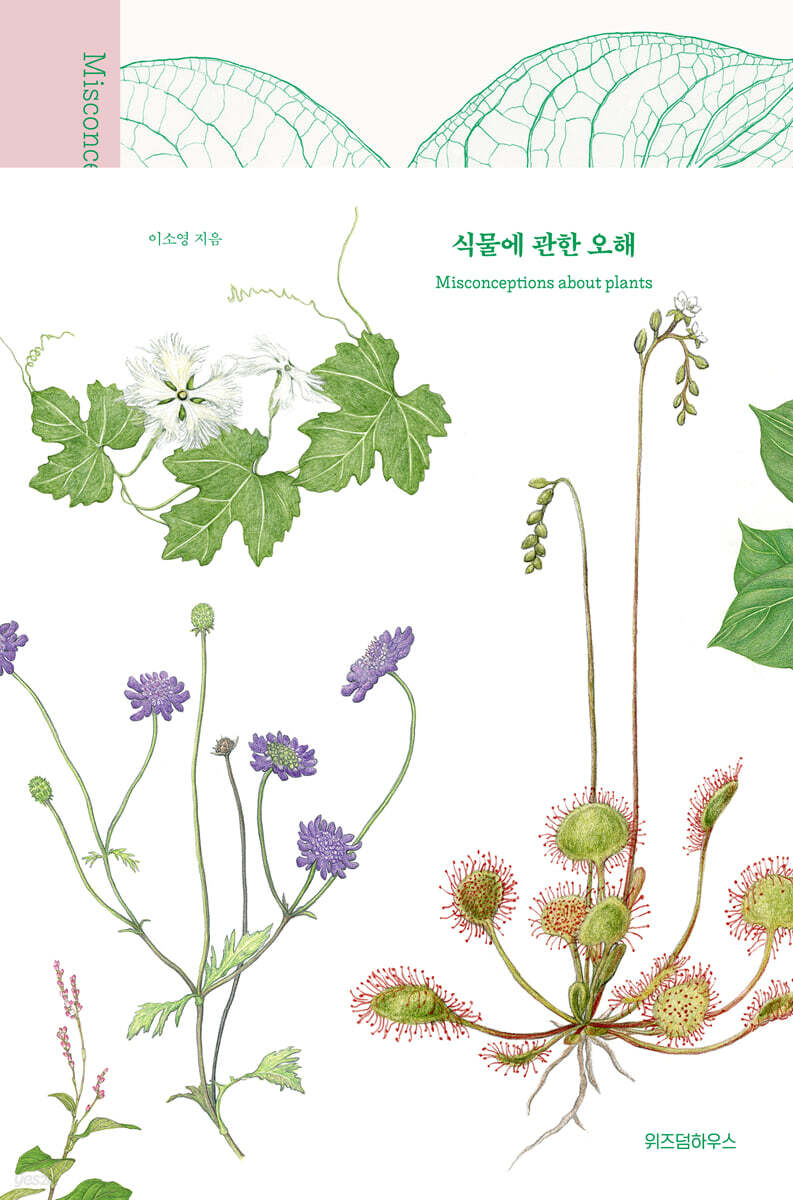
The true nature of the plants we see, eat, and enjoy Looking at it from a new perspective A combative and strategic world of plants A new book by author Lee So-young of "The Book of Plants"! Author So-Young Lee, a botanical artist and horticultural researcher who has meticulously examined the world of plants and our relationships with them through her previous works, including “The Book of Plants” and “Plants and Me,” now talks about the correct way to view plants. "Misconceptions About Plants" is a book that collects the large and small misconceptions and prejudices about plants that the author encountered during 16 years of observing and recording plants. Based on this, it encourages people to break away from their conventional perspectives toward plants and truly see their diverse appearances and strong survival skills. Beautiful and detailed plant illustrations included in each chapter aid understanding. This book looks back on the misunderstandings and prejudices that people have about plants, such as prejudices about niche plants that can be easily found around us, the misconception that figs do not bloom, the misunderstanding about daffodil pollen, the understanding of rice, vegetables, and fruits that are on our daily tables, the strategies of plants that open and close their leaves and flowers for survival, and the migratory power of goblin needles that use animals. It also talks about the tenacity of plants that live more fiercely than anyone else to reproduce, and makes us think about what attitude we should take in terms of using and living with plants. |
- You can preview some of the book's contents.
Preview
index
Entering
Part 1: Misconceptions About Plants
Selection of urban niche plants│Lilacs that bring spring to the heart of the city│Misunderstandings surrounding the name 'Bodhi tree'│Cherry blossoms blooming in autumn, is it because of the climate crisis│Peonies in Alaska, roses in Kenya│From dung trees to money trees│A season when the presence of the Rose of Sharon shines│The prejudice that quince is a useless fruit│Two perspectives on Jeju bamboo│The misconception that figs do not bloom│Carrots were not originally orange│Color names that originated from plants│Trees grow at their own pace│Fir trees that become Christmas trees
Part 2: Looking at Plants Directly
The violets at your feet now│Plum blossoms that call us every early spring│Calling out the name of the magnolia│Memories of 'Under the Poplar Tree'│The season of water lilies│The forest where tulips and anemones live│Flowers that bloom in the morning, flowers that bloom at night│Cauliflowers that brighten the winter flower beds│The horse chestnut trees of Marronnier Park│Inquiring about the well-being of rice│Weaving together the beauty of nature│The opportunity given by the leaves of plants
Part 3: The Power of Plants
Plants also have warmth│Living with plant poison│There is a reason for the unpleasant smell│The identity of the sticky liquid│It may tilt, but it does not break│The survival method of vines│Tiny pollen spread by the wind│The plant that travels farther than anyone else│Plants can make sounds too│Plants that are sensitive to touch
Part 4: Living with Plants
Edited Carnations│The Role of Greenery in the Age of Heavy Rain│Two Feelings About Street Trees│Between Colorful Flowerbeds and Barren Land│School Plants for Children│Will Palm Oil Be Available in the Future│Surprising Spring Greens│The Relationship Between Hazelnuts and Hazelnuts│The Identity of the Christmas Cactus│Why Do We Scribble on Plants│How Humans Move Plants│The Status of the Pineapple, the King of Fruits│Being Happy with Plants
Index
References
Part 1: Misconceptions About Plants
Selection of urban niche plants│Lilacs that bring spring to the heart of the city│Misunderstandings surrounding the name 'Bodhi tree'│Cherry blossoms blooming in autumn, is it because of the climate crisis│Peonies in Alaska, roses in Kenya│From dung trees to money trees│A season when the presence of the Rose of Sharon shines│The prejudice that quince is a useless fruit│Two perspectives on Jeju bamboo│The misconception that figs do not bloom│Carrots were not originally orange│Color names that originated from plants│Trees grow at their own pace│Fir trees that become Christmas trees
Part 2: Looking at Plants Directly
The violets at your feet now│Plum blossoms that call us every early spring│Calling out the name of the magnolia│Memories of 'Under the Poplar Tree'│The season of water lilies│The forest where tulips and anemones live│Flowers that bloom in the morning, flowers that bloom at night│Cauliflowers that brighten the winter flower beds│The horse chestnut trees of Marronnier Park│Inquiring about the well-being of rice│Weaving together the beauty of nature│The opportunity given by the leaves of plants
Part 3: The Power of Plants
Plants also have warmth│Living with plant poison│There is a reason for the unpleasant smell│The identity of the sticky liquid│It may tilt, but it does not break│The survival method of vines│Tiny pollen spread by the wind│The plant that travels farther than anyone else│Plants can make sounds too│Plants that are sensitive to touch
Part 4: Living with Plants
Edited Carnations│The Role of Greenery in the Age of Heavy Rain│Two Feelings About Street Trees│Between Colorful Flowerbeds and Barren Land│School Plants for Children│Will Palm Oil Be Available in the Future│Surprising Spring Greens│The Relationship Between Hazelnuts and Hazelnuts│The Identity of the Christmas Cactus│Why Do We Scribble on Plants│How Humans Move Plants│The Status of the Pineapple, the King of Fruits│Being Happy with Plants
Index
References
Detailed image

Into the book
These niche plants catch people's attention as they freely photosynthesize, spread their roots as far as they want, absorb water and nutrients as they want, and bloom.
It would have been the best form of life for plants that could no longer avoid city life.
Perhaps our indoor potted plants, brought from the distant rainforests to Korea and living in dry indoor spaces without sufficient sunlight and water, are actually more unfortunate.
We are confident in the happiness of existence within our own sphere, and we presume upon the misfortune of unfamiliar and distant beings.
---From "A Selection of Urban Niche Plants"
Even if I see something and feel that it is different from usual, I must first reflect on myself.
The same applies when encountering natural phenomena that go beyond common sense.
Maybe my common sense is wrong or my experience data on the target plant is insufficient.
The reason it seemed strange that the spring and autumn cherry trees and roses bloomed in the fall was because I didn't know that roses and cherry trees that bloom in the fall existed.
Before questioning the climate crisis, we must first reflect on our own indifference.
---From "Cherry Blossoms in Autumn, Is It Because of the Climate Crisis?"
A research team led by Dr. Kingsley Dixon at Curtin University in Australia investigated the criteria by which plant researchers in their fields select plants to study.
This study analyzed the relationship between the color, shape, and conspicuous characteristics of the plant species selected as the research topic, based on 280 papers on Alpine native plants published from 1975 to 2020.
The analysis found that researchers studied larger flowers much more often than smaller ones, and brightly colored flowers like pink and white much more often than inconspicuous colors like green and black.
The rarity of the object had no relevance.
Above all, blue flowers, which are rare in nature, have been studied the most.
Dr. Dixon's message through this study is that researchers may unknowingly miss plants that are important to the ecosystem or in urgent need of conservation.
Because the appearance of a plant is not proportional to its value or utility.
---From "The Prejudice That Apples Are Useless Fruits"
Fig means 'fruit without flowers' in Chinese characters.
But this is an error that arises from human error.
Those who first discovered figs thought that they did not bloom because they could not see flowers no matter how long they looked at them, but in fact, figs do have flowers.
Even countless flowers bloom.
These flowers bloom in small, inconspicuous clusters within the flower sac before the fruit is produced.
When we eat a fig, the numerous seeds we chew prove the presence of the flower, so we can feel the flower through texture.
Additionally, there is a small hole at the end of the fig fruit.
This is also called fig eye.
Fig wasps, which help pollinate fig trees, move in and out of the flower sacs through these holes, transferring pollen.
---From "The Misconception That Figs Don't Bloom"
A few years ago, I was asked by a carrot farm association to draw a picture to use for the design of the box packaging they use to distribute their carrots.
To draw a carrot, you need to know about the wild carrot species, so I looked for carrot specimen information through digital data at the Royal Botanic Gardens, Kew, in the UK.
However, the paper that was presumed to be the original was not the orange color I had thought, but a white color closer to purple.
Moreover, the color of carrot roots recorded in drawings, specimens, and photographs throughout history has varied greatly.
White, purple, red, yellow and orange.
After seeing this data with my own eyes, I could no longer call carrots carrots.
This is because carrots have changed into various colors over time.
---From "Carrots weren't originally orange"
When observing plants, you encounter a variety of colors with a tight margin of error that is not found on a paint palette.
We call the flower colors of the common primrose, the common chrysanthemum, the common pine, and the common chive purple, but when we actually encounter them, we realize that purple comes in many different colors.
Looking at plants is also an opportunity to realize the diversity of colors that exist in this world.
---From "Color Names Originating from Plants"
Our forest also has the ranunculus family, which can be easily found in flower shops these days.
Plum blossoms, frog's cap, frog's nest, and chopstick plants are all in the same family as ranunculus.
All of these have petals that sparkle and shine under the sunlight.
This glow is a survival strategy of the plant to attract the attention of pollinators and attract pollinators.
These days, among the ranunculus varieties, the butterfly type with shiny petals is popular in the flower market, and these petals shine for the same reason.
Knowing the genealogy of plants also allows us to understand that the plants in our flower shops and flower gardens are not separate from those in the forest.
---From "The Forest Where Tulips and Anemones Live"
That's why I had to leave home late in the afternoon to observe the sky.
The sky-tari flower, which seemed to be spewing white petals from the darkness, was so strange that it was difficult to tell whether it was a plant or a small animal.
The next day, when I looked for the sky tari again, the petals were drooping as if nothing had happened the night before.
So why do these plants bloom in the dark of night? The most likely reason is that the insects that help pollinate them are nocturnal.
The reason for seeking the help of nocturnal insects may have been that it was judged that it would be more advantageous to be chosen by insects that are active at night than to participate in the competition to be chosen by insects that are active during the day.
The same reason is why we choose winter flowers like forsythia and snowdrops, which bloom during the cold winter rather than the warm spring and summer.
---From "Flowers that Bloom in the Morning, Flowers that Bloom at Night"
To date, research has shown that a total of fourteen families of plants are known to emit heat.
Among them are some plants that are very familiar to us.
The organ called the flower of the Selloom Philodendron is a long inflorescence surrounded by white bracts (small leaves that are modified leaves and surround the flower or sepals), and it is this inflorescence that radiates heat.
The heat given off not only helps the flowers mature, but also attracts beetles, which are pollinators.
Beetles crawl into the philodendron flowers to find warmth and help pollinate them.
While many thermogenic plants produce heat by burning carbohydrates and sugars stored in their cells, philodendrons are unique in that they produce heat by burning fat.
---From “Plants also have warmth”
The smell from plants is due to volatile organic compounds.
Volatile substances disperse into the air and evaporate, attracting pollinators and repelling harmful animals.
Plants communicate with animals through smell.
Even if a scent is unpleasant to humans, it may be interesting or tempting to some animals.
The scents of the fishy-smelling buckwheat, the pungent-smelling dandelion, and the dandelion are also optimized for their respective pollinators.
---From "Even a bad smell has a reason"
When I was young, I often heard advice from adults about daffodil pollen.
The advice was to be careful not to rub your eyes with your hands near a daffodil flower, as the pollen could get into your eyes and, in severe cases, even lead to blindness.
The pollen of the daffodil flower is hook-shaped, so once it sticks to the skin or clothes, it does not come off easily, and contains toxic substances that can cause inflammation and even blindness.
This rumor has persisted in our country for decades, and some even claim that we should no longer plant chrysanthemums.
However, recent research suggests that this is an exaggeration.
The thing that cleared the false accusation against Nungsohwa was also an electron microscope.
The pollen grains of the daffodil flower, magnified under a microscope, were not shaped like hooks, but rather just ordinary net-shaped pollen grains.
---From "Tiny Pollen Spreading in the Wind"
The colors and shapes of carnations that we know are the result of industrialization that has occurred over 200 years of breeding and cultivation.
Unlike the forest daisy family, which blooms for a moment and then dies, carnations bloom all year round.
The stem is long and straight, and the petals are large and showy.
When comparing the original and cultivated carnation species, the stem lengths are clearly different.
Plants in the genus Carnation are characterized by short, thin stems, while carnations have straight, long stems.
Since short stems cannot be used as cut flowers in a vase, the tallest species among the genus Perilla were selected and the stems were bred to be straighter.
Recently, carnations that have been bred to have smooth edges and erase the pinking on the petal edges that is characteristic of the genus Carnation have also been distributed.
---From "Edited Carnations"
Pineapples enjoyed a boom as a valuable plant for over 200 years before greenhouse cultivation was successful.
Those in power would pay up to 8 million won (approximately $8,000 USD) for a single pineapple, and they would even feel bad about eating it, so they would just display it on the dining table or carry it on their arm like a bag when going out.
It has become a decoration for show, going beyond being an ornamental plant.
Even pineapple rental shops, like modern luxury rental shops, were popular and became a symbol of power.
Because the shape of the pineapple resembles a crown, it seemed like it could make the person who owned it a king.
It would have been the best form of life for plants that could no longer avoid city life.
Perhaps our indoor potted plants, brought from the distant rainforests to Korea and living in dry indoor spaces without sufficient sunlight and water, are actually more unfortunate.
We are confident in the happiness of existence within our own sphere, and we presume upon the misfortune of unfamiliar and distant beings.
---From "A Selection of Urban Niche Plants"
Even if I see something and feel that it is different from usual, I must first reflect on myself.
The same applies when encountering natural phenomena that go beyond common sense.
Maybe my common sense is wrong or my experience data on the target plant is insufficient.
The reason it seemed strange that the spring and autumn cherry trees and roses bloomed in the fall was because I didn't know that roses and cherry trees that bloom in the fall existed.
Before questioning the climate crisis, we must first reflect on our own indifference.
---From "Cherry Blossoms in Autumn, Is It Because of the Climate Crisis?"
A research team led by Dr. Kingsley Dixon at Curtin University in Australia investigated the criteria by which plant researchers in their fields select plants to study.
This study analyzed the relationship between the color, shape, and conspicuous characteristics of the plant species selected as the research topic, based on 280 papers on Alpine native plants published from 1975 to 2020.
The analysis found that researchers studied larger flowers much more often than smaller ones, and brightly colored flowers like pink and white much more often than inconspicuous colors like green and black.
The rarity of the object had no relevance.
Above all, blue flowers, which are rare in nature, have been studied the most.
Dr. Dixon's message through this study is that researchers may unknowingly miss plants that are important to the ecosystem or in urgent need of conservation.
Because the appearance of a plant is not proportional to its value or utility.
---From "The Prejudice That Apples Are Useless Fruits"
Fig means 'fruit without flowers' in Chinese characters.
But this is an error that arises from human error.
Those who first discovered figs thought that they did not bloom because they could not see flowers no matter how long they looked at them, but in fact, figs do have flowers.
Even countless flowers bloom.
These flowers bloom in small, inconspicuous clusters within the flower sac before the fruit is produced.
When we eat a fig, the numerous seeds we chew prove the presence of the flower, so we can feel the flower through texture.
Additionally, there is a small hole at the end of the fig fruit.
This is also called fig eye.
Fig wasps, which help pollinate fig trees, move in and out of the flower sacs through these holes, transferring pollen.
---From "The Misconception That Figs Don't Bloom"
A few years ago, I was asked by a carrot farm association to draw a picture to use for the design of the box packaging they use to distribute their carrots.
To draw a carrot, you need to know about the wild carrot species, so I looked for carrot specimen information through digital data at the Royal Botanic Gardens, Kew, in the UK.
However, the paper that was presumed to be the original was not the orange color I had thought, but a white color closer to purple.
Moreover, the color of carrot roots recorded in drawings, specimens, and photographs throughout history has varied greatly.
White, purple, red, yellow and orange.
After seeing this data with my own eyes, I could no longer call carrots carrots.
This is because carrots have changed into various colors over time.
---From "Carrots weren't originally orange"
When observing plants, you encounter a variety of colors with a tight margin of error that is not found on a paint palette.
We call the flower colors of the common primrose, the common chrysanthemum, the common pine, and the common chive purple, but when we actually encounter them, we realize that purple comes in many different colors.
Looking at plants is also an opportunity to realize the diversity of colors that exist in this world.
---From "Color Names Originating from Plants"
Our forest also has the ranunculus family, which can be easily found in flower shops these days.
Plum blossoms, frog's cap, frog's nest, and chopstick plants are all in the same family as ranunculus.
All of these have petals that sparkle and shine under the sunlight.
This glow is a survival strategy of the plant to attract the attention of pollinators and attract pollinators.
These days, among the ranunculus varieties, the butterfly type with shiny petals is popular in the flower market, and these petals shine for the same reason.
Knowing the genealogy of plants also allows us to understand that the plants in our flower shops and flower gardens are not separate from those in the forest.
---From "The Forest Where Tulips and Anemones Live"
That's why I had to leave home late in the afternoon to observe the sky.
The sky-tari flower, which seemed to be spewing white petals from the darkness, was so strange that it was difficult to tell whether it was a plant or a small animal.
The next day, when I looked for the sky tari again, the petals were drooping as if nothing had happened the night before.
So why do these plants bloom in the dark of night? The most likely reason is that the insects that help pollinate them are nocturnal.
The reason for seeking the help of nocturnal insects may have been that it was judged that it would be more advantageous to be chosen by insects that are active at night than to participate in the competition to be chosen by insects that are active during the day.
The same reason is why we choose winter flowers like forsythia and snowdrops, which bloom during the cold winter rather than the warm spring and summer.
---From "Flowers that Bloom in the Morning, Flowers that Bloom at Night"
To date, research has shown that a total of fourteen families of plants are known to emit heat.
Among them are some plants that are very familiar to us.
The organ called the flower of the Selloom Philodendron is a long inflorescence surrounded by white bracts (small leaves that are modified leaves and surround the flower or sepals), and it is this inflorescence that radiates heat.
The heat given off not only helps the flowers mature, but also attracts beetles, which are pollinators.
Beetles crawl into the philodendron flowers to find warmth and help pollinate them.
While many thermogenic plants produce heat by burning carbohydrates and sugars stored in their cells, philodendrons are unique in that they produce heat by burning fat.
---From “Plants also have warmth”
The smell from plants is due to volatile organic compounds.
Volatile substances disperse into the air and evaporate, attracting pollinators and repelling harmful animals.
Plants communicate with animals through smell.
Even if a scent is unpleasant to humans, it may be interesting or tempting to some animals.
The scents of the fishy-smelling buckwheat, the pungent-smelling dandelion, and the dandelion are also optimized for their respective pollinators.
---From "Even a bad smell has a reason"
When I was young, I often heard advice from adults about daffodil pollen.
The advice was to be careful not to rub your eyes with your hands near a daffodil flower, as the pollen could get into your eyes and, in severe cases, even lead to blindness.
The pollen of the daffodil flower is hook-shaped, so once it sticks to the skin or clothes, it does not come off easily, and contains toxic substances that can cause inflammation and even blindness.
This rumor has persisted in our country for decades, and some even claim that we should no longer plant chrysanthemums.
However, recent research suggests that this is an exaggeration.
The thing that cleared the false accusation against Nungsohwa was also an electron microscope.
The pollen grains of the daffodil flower, magnified under a microscope, were not shaped like hooks, but rather just ordinary net-shaped pollen grains.
---From "Tiny Pollen Spreading in the Wind"
The colors and shapes of carnations that we know are the result of industrialization that has occurred over 200 years of breeding and cultivation.
Unlike the forest daisy family, which blooms for a moment and then dies, carnations bloom all year round.
The stem is long and straight, and the petals are large and showy.
When comparing the original and cultivated carnation species, the stem lengths are clearly different.
Plants in the genus Carnation are characterized by short, thin stems, while carnations have straight, long stems.
Since short stems cannot be used as cut flowers in a vase, the tallest species among the genus Perilla were selected and the stems were bred to be straighter.
Recently, carnations that have been bred to have smooth edges and erase the pinking on the petal edges that is characteristic of the genus Carnation have also been distributed.
---From "Edited Carnations"
Pineapples enjoyed a boom as a valuable plant for over 200 years before greenhouse cultivation was successful.
Those in power would pay up to 8 million won (approximately $8,000 USD) for a single pineapple, and they would even feel bad about eating it, so they would just display it on the dining table or carry it on their arm like a bag when going out.
It has become a decoration for show, going beyond being an ornamental plant.
Even pineapple rental shops, like modern luxury rental shops, were popular and became a symbol of power.
Because the shape of the pineapple resembles a crown, it seemed like it could make the person who owned it a king.
---From "The Status of Pineapple, the King of Fruits"
Publisher's Review
Attitudes for building a proper relationship with plants
When people walk down the street and find violets or dandelions blooming between the cracks in the sidewalk, they feel sorry for them or are proud of them for blooming in such a harsh environment.
But is the land truly so barren for niche plants? Author Lee So-young urges us to reexamine the space called niche.
Although it may look cramped when viewed from above, there is dirt and sand underneath the concrete or asphalt, making it easy for plants to take root.
And since there are no competing plants around, it receives more sunlight than any other flower bed in the city.
It is the best form of life for plants that cannot avoid city life.
Rather than guessing at the lives of other beings from my perspective, I look at them from the same eye level.
It is the most basic attitude to have in order to have a proper relationship, but people are particularly quick to judge and act towards plants.
For us, author So-Young Lee, who has been observing plants and recording them in writing and detailed drawings for over 16 years as a horticultural researcher, encourages us to reconsider our relationship with plants by looking back on the misunderstandings and prejudices about plants through “Misunderstandings About Plants.”
Part 1, 'Misunderstandings about Plants' and Part 2, 'Looking at Plants Correctly' look at misunderstandings surrounding plant names, such as the bodhi tree, which is clearly a plant with a different scientific name but is often mistaken for a common name in Korea, and the story of how a plant that was originally called 'ddongnamu' because its fruit often attracted dung flies, has now become called 'moneynamu' and is popular as a celebratory gift. They also point out people's prejudices about Jeju bamboo, quince, and the national flower, the Rose of Sharon, and make us look back on our subjective standards for judging usefulness.
To avoid misunderstandings or prejudices about plants, it is important to first learn the correct names (scientific names) of plants, and also to have the will to properly understand the characteristics of plant species.
As an example, the author introduces an episode when he encountered a cherry tree in full bloom with light pink blossoms in an arboretum in late autumn.
Visitors who saw the cherry blossoms were all concerned about the climate crisis, saying that it seemed to be due to abnormal weather, but in fact, the plant was a spring cherry tree called 'Autumnalis' that blooms even in the fall.
Since my common sense about the target plant may be wrong, it is better to first build up accurate knowledge about the plant rather than making hasty judgments.
The resilience and strategies of plants for survival
The author asks:
If plants could make sounds like animals or move on their own, wouldn't people realize that they are living creatures and treat them carelessly?
But in fact, plants are much more resilient than we think.
Not only trees like zelkova and willow trees that can easily live in one place for hundreds of years, but even plants in the genus Syringa, which are loved as garden trees, can survive in temperatures as low as -60 degrees Celsius and live for over 100 years.
In other words, the tree is more likely to survive longer than the humans who plant and care for the lilac in the garden.
Part 3, 'The Power of Plants', talks about the resilient survival abilities of plants and how they do it.
In 2019, a team of botany researchers at Tel Aviv University in Israel demonstrated that when plants are stressed, they emit subtle sounds that are undetectable to humans (p. 235). The team induced water stress in tomato and tobacco plants by cutting the stems or stopping watering, and discovered that when the plants are stressed, they emit subtle sounds that can be heard by animals such as mice and bats.
It is thought to be a sound made by the formation of bubbles as water moves through the tubes. It is unknown whether this is something that plants do instinctively or whether they do it to convey information to other living things, but it confirms that plants are also 'living things' just like us.
When faced with threats to their survival, plants try to defend and protect themselves in various ways.
Rubber trees, a common houseplant, release a sticky, white liquid when their leaves or stems are cut. This liquid contains toxic latex, which helps the plant heal the cut surface and protect itself from external viruses.
It is for the same reason that mimosa quickly closes its leaves when stimulated.
When a leaf is stimulated, various chemicals and sap diffuse inside the leaf, causing the cells to collapse, which makes the leaf appear to be curled to our eyes.
Meanwhile, the reason why the Venus flytrap closes or folds its leaves when stimulated is to catch insects and obtain nutrients.
Plants evolve to survive.
Although violets may be a common niche plant for many people, the author says that for him, who has to capture the characteristics of the plant species and draw them, violets are rather difficult plants to handle (p. 105). Because hybridization is frequent, it is difficult to identify the species, and because environmental variations are very diverse, even more careful observation is required.
Both hybridization and mutation are strategies of violets for reproduction and survival.
The stench emitted by the titan arum, also known as the corpse flower, and the vine-like evolution of plants such as the round-leafed rhododendron and the rhododendron are also survival strategies.
Envisioning a society with a truly developed plant culture
Plants cannot move on their own, but they use animals as a means of transportation to reproduce and survive.
They travel long distances as food for animals and by attaching fruits and seeds to animal fur or feathers.
Plants such as goblin needles, ox knee, burdock, and cod have evolved seeds with thorns or hooks to better adhere to animal fur.
And this is where humans get ideas for invention.
In 1941, Swiss engineer Georges de Mestrill was inspired by a burr he found while walking his dog and developed a protruding fastener, Velcro, which is now widely used in everything from sneakers to equipment on the International Space Station.
In this way, plants and animals have always lived together on Earth, and the story of our appearance and attitude towards them is discussed in Chapter 4, 'Life with Plants.'
Humans have long used plants for food and as cut flowers for appreciation.
The roots, stems, leaves, and fruits are used in a variety of dishes, and oils are also obtained from the fruits and seeds, such as palm oil, castor oil, and sunflower oil.
However, human greed often ruins our relationship with plants.
Carnations, a popular flower in May when there are many events, are a hybrid of the Caryophyllus species in the genus Caryophyllus.
However, to become the carnation we know today, the carnation had to give up much of its original nature over 200 years.
People first removed the clove scent because it was divisive when grown, and selected and improved the tallest species in the genus Perilla for use as cut flowers.
Recently, carnations that have been grown with even the characteristic pinking of the petals smoothed out have also been distributed.
For the sole purpose of human satisfaction, the shape of the stem, leaves, petals, and even the scent have been flattened, and the value of the plant's existence has been erased.
There is much talk that Korea's plant culture has developed compared to the past, with the number of plant enthusiasts increasing and botanical gardens and large gardens being built in large numbers. However, after reading the various examples pointed out in this book, "Misconceptions about Plants," it is difficult to completely agree with this.
The following sentence from the book makes us think about what attitude we should take and what kind of relationship we should have with plants as we live with them.
"Does the rise in plant consumption, the growth of industry, and the proliferation of gardens alone mean that plant culture has developed? I don't think so.
“I think a society with a developed plant culture is one in which its members have a basic understanding of plants to the extent that incorrect information about plants does not circulate, and in which more accurate information about plants is shared.” (p. 29)
When people walk down the street and find violets or dandelions blooming between the cracks in the sidewalk, they feel sorry for them or are proud of them for blooming in such a harsh environment.
But is the land truly so barren for niche plants? Author Lee So-young urges us to reexamine the space called niche.
Although it may look cramped when viewed from above, there is dirt and sand underneath the concrete or asphalt, making it easy for plants to take root.
And since there are no competing plants around, it receives more sunlight than any other flower bed in the city.
It is the best form of life for plants that cannot avoid city life.
Rather than guessing at the lives of other beings from my perspective, I look at them from the same eye level.
It is the most basic attitude to have in order to have a proper relationship, but people are particularly quick to judge and act towards plants.
For us, author So-Young Lee, who has been observing plants and recording them in writing and detailed drawings for over 16 years as a horticultural researcher, encourages us to reconsider our relationship with plants by looking back on the misunderstandings and prejudices about plants through “Misunderstandings About Plants.”
Part 1, 'Misunderstandings about Plants' and Part 2, 'Looking at Plants Correctly' look at misunderstandings surrounding plant names, such as the bodhi tree, which is clearly a plant with a different scientific name but is often mistaken for a common name in Korea, and the story of how a plant that was originally called 'ddongnamu' because its fruit often attracted dung flies, has now become called 'moneynamu' and is popular as a celebratory gift. They also point out people's prejudices about Jeju bamboo, quince, and the national flower, the Rose of Sharon, and make us look back on our subjective standards for judging usefulness.
To avoid misunderstandings or prejudices about plants, it is important to first learn the correct names (scientific names) of plants, and also to have the will to properly understand the characteristics of plant species.
As an example, the author introduces an episode when he encountered a cherry tree in full bloom with light pink blossoms in an arboretum in late autumn.
Visitors who saw the cherry blossoms were all concerned about the climate crisis, saying that it seemed to be due to abnormal weather, but in fact, the plant was a spring cherry tree called 'Autumnalis' that blooms even in the fall.
Since my common sense about the target plant may be wrong, it is better to first build up accurate knowledge about the plant rather than making hasty judgments.
The resilience and strategies of plants for survival
The author asks:
If plants could make sounds like animals or move on their own, wouldn't people realize that they are living creatures and treat them carelessly?
But in fact, plants are much more resilient than we think.
Not only trees like zelkova and willow trees that can easily live in one place for hundreds of years, but even plants in the genus Syringa, which are loved as garden trees, can survive in temperatures as low as -60 degrees Celsius and live for over 100 years.
In other words, the tree is more likely to survive longer than the humans who plant and care for the lilac in the garden.
Part 3, 'The Power of Plants', talks about the resilient survival abilities of plants and how they do it.
In 2019, a team of botany researchers at Tel Aviv University in Israel demonstrated that when plants are stressed, they emit subtle sounds that are undetectable to humans (p. 235). The team induced water stress in tomato and tobacco plants by cutting the stems or stopping watering, and discovered that when the plants are stressed, they emit subtle sounds that can be heard by animals such as mice and bats.
It is thought to be a sound made by the formation of bubbles as water moves through the tubes. It is unknown whether this is something that plants do instinctively or whether they do it to convey information to other living things, but it confirms that plants are also 'living things' just like us.
When faced with threats to their survival, plants try to defend and protect themselves in various ways.
Rubber trees, a common houseplant, release a sticky, white liquid when their leaves or stems are cut. This liquid contains toxic latex, which helps the plant heal the cut surface and protect itself from external viruses.
It is for the same reason that mimosa quickly closes its leaves when stimulated.
When a leaf is stimulated, various chemicals and sap diffuse inside the leaf, causing the cells to collapse, which makes the leaf appear to be curled to our eyes.
Meanwhile, the reason why the Venus flytrap closes or folds its leaves when stimulated is to catch insects and obtain nutrients.
Plants evolve to survive.
Although violets may be a common niche plant for many people, the author says that for him, who has to capture the characteristics of the plant species and draw them, violets are rather difficult plants to handle (p. 105). Because hybridization is frequent, it is difficult to identify the species, and because environmental variations are very diverse, even more careful observation is required.
Both hybridization and mutation are strategies of violets for reproduction and survival.
The stench emitted by the titan arum, also known as the corpse flower, and the vine-like evolution of plants such as the round-leafed rhododendron and the rhododendron are also survival strategies.
Envisioning a society with a truly developed plant culture
Plants cannot move on their own, but they use animals as a means of transportation to reproduce and survive.
They travel long distances as food for animals and by attaching fruits and seeds to animal fur or feathers.
Plants such as goblin needles, ox knee, burdock, and cod have evolved seeds with thorns or hooks to better adhere to animal fur.
And this is where humans get ideas for invention.
In 1941, Swiss engineer Georges de Mestrill was inspired by a burr he found while walking his dog and developed a protruding fastener, Velcro, which is now widely used in everything from sneakers to equipment on the International Space Station.
In this way, plants and animals have always lived together on Earth, and the story of our appearance and attitude towards them is discussed in Chapter 4, 'Life with Plants.'
Humans have long used plants for food and as cut flowers for appreciation.
The roots, stems, leaves, and fruits are used in a variety of dishes, and oils are also obtained from the fruits and seeds, such as palm oil, castor oil, and sunflower oil.
However, human greed often ruins our relationship with plants.
Carnations, a popular flower in May when there are many events, are a hybrid of the Caryophyllus species in the genus Caryophyllus.
However, to become the carnation we know today, the carnation had to give up much of its original nature over 200 years.
People first removed the clove scent because it was divisive when grown, and selected and improved the tallest species in the genus Perilla for use as cut flowers.
Recently, carnations that have been grown with even the characteristic pinking of the petals smoothed out have also been distributed.
For the sole purpose of human satisfaction, the shape of the stem, leaves, petals, and even the scent have been flattened, and the value of the plant's existence has been erased.
There is much talk that Korea's plant culture has developed compared to the past, with the number of plant enthusiasts increasing and botanical gardens and large gardens being built in large numbers. However, after reading the various examples pointed out in this book, "Misconceptions about Plants," it is difficult to completely agree with this.
The following sentence from the book makes us think about what attitude we should take and what kind of relationship we should have with plants as we live with them.
"Does the rise in plant consumption, the growth of industry, and the proliferation of gardens alone mean that plant culture has developed? I don't think so.
“I think a society with a developed plant culture is one in which its members have a basic understanding of plants to the extent that incorrect information about plants does not circulate, and in which more accurate information about plants is shared.” (p. 29)
GOODS SPECIFICS
- Date of issue: May 22, 2024
- Format: Hardcover book binding method guide
- Page count, weight, size: 336 pages | 698g | 145*220*22mm
- ISBN13: 9791171711994
- ISBN10: 1171711999
You may also like
카테고리
korean


korean

![GQ KOREA Mark (Monthly): December [2025]](http://librairie.coreenne.fr/cdn/shop/files/8ef265dbbfbf186523ed75ba7319009d.jpg?v=1765340328&width=3840)


