

Myunghwajapsa
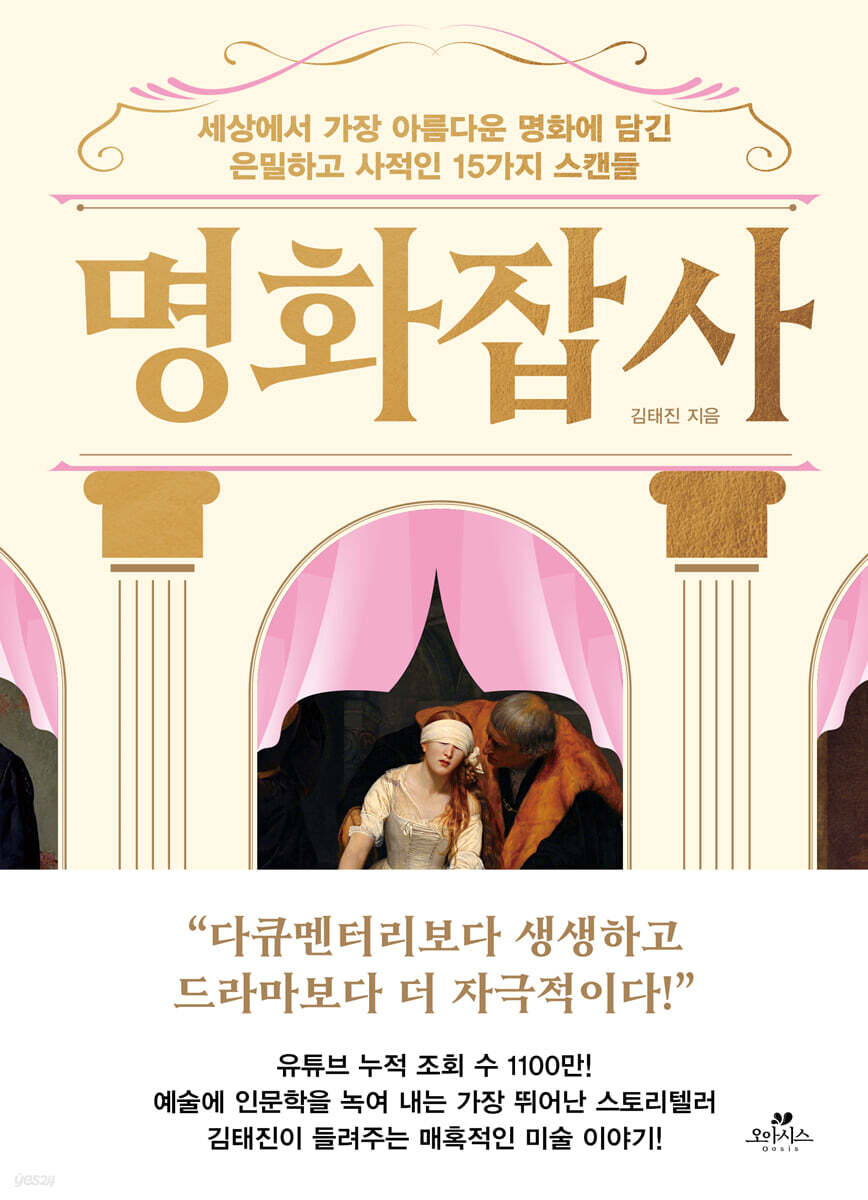 |
Description
Book Introduction
“More vivid than a documentary and more stimulating than a drama!” The one and only book for you, the 'perennial art museum beginner' YouTube's 'Art and Humanities' has accumulated 11 million views. Kim Tae-jin's very special and new way of appreciating art Artist Taejin Kim, who created a sensation in the art world by coining the term "art humanities" with his captivating storytelling that blends humanities with art, has returned with a new work after three years. The author, who has been conveying the charm of art to the public through his YouTube channel 'Art Humanities' with 11 million cumulative views and offline lectures, unravels the miscellaneous and personal stories contained in 15 famous paintings one by one through 'Miscellaneous History of Famous Paintings'. The trivial and personal stories surrounding famous paintings are none other than the lives of the people in the paintings. This book is full of fascinating behind-the-scenes stories of famous paintings, from the saucy rumors surrounding Raphael's death, to the story of a girl who was dethroned after just nine days, to the 'diamond necklace fraud' that implicated Marie Antoinette. It's so captivating that you'll want to sneak away and read it alone. The themes of the story are mostly not the noble and elegant records that befit the word 'masterpiece', but rather twisted desires or foolish choices that do not know what will happen next. The reason why we must know the 'miscellaneous stories' in order to properly appreciate a masterpiece is because the joys and sorrows of our lives are contained therein. As you flip through the pages, you will find yourself naturally feeling empathy and compassion for the life of a person depicted in the painting. To fully enjoy the intricate stories within beautiful masterpieces, the author presents a special way of appreciating them in "Miscellaneous History of Masterpieces." That's right 1. Appreciating famous paintings without any information, 2. After reading the story behind the famous painting, 3. It's like looking at a masterpiece again. Through this process, readers can feel the vividness of the figures from hundreds of years ago who were frozen in the picture, as if they were moving and coming to life. Additionally, through the 'Humanities Café' provided in each chapter, you can also see what trends of the times the lives of the protagonists in famous paintings fiercely lived belonged to. If you're curious about the stories contained in great masterpieces, more vivid than documentaries and more stimulating than dramas, open this book right now. As you follow the author's characteristically witty banter, you will feel an 'inner intimacy' with the characters in famous paintings that once seemed distant and aloof. And you will find yourself visiting the art museum again. |
- You can preview some of the book's contents.
Preview
index
prolog
What you believe in your head cannot overcome what you see with your eyes.
Before reading: A special way to appreciate paintings from "Famous Paintings"
The magic that makes time flow again
Chapter 1: The World of God Begins to Decline
* Rome's top star painter who fell in love with a baker's daughter
Dominique Ingres, [Raphael and La Fornarina]
* A polite and elegant rejection depicted in the picture
Hans Holbein, The Ambassadors
* A girl who was kicked out after only nine days as queen
Paul Delaroche, The Execution of Jane Grey
* A lover who stole the heart of a princess who only followed her older brother
Michiel Jansson van Merevelt, [Elizabeth Stuart, Queen of Bohemia]
[Humanities Cafe] - From the Reformation to the Religious Wars
Chapter 2: The Flow of Wealth from Land to Sea
* The woman who protected Rembrandt even while being pointed at
Rembrandt van Rijn, Bathsheba with David's Letter
* A bird that has finally become free after entering a cage
Louise Desnos, [Encounters at the Royal Court]
* The emperor who respected his mother's sworn enemy
Adolf Menzel, [Meeting between Frederick II and Joseph II at Neisse, 1769]
* The butterfly effect caused by the necklace scam?
Elisabeth Vigée-Lebrun, [Marie Antoinette and Children]
[Humanities Cafe] - From Absolute Monarchy to Enlightenment
Chapter 3: Romance and Reality after the Revolution
* The beautiful woman who killed the monster of revolution
Paul-Jacques Aimé Baudry, The Assassination of Marat
* The reason why I appeared as a nude model in front of my lover's friend
Gustave Courbet, [Lady with Parrot]
* The Habsburg fool fooled by Napoleon III
Jean-Paul Laurent, Emperor Maximilian on the Way to Execution
* The artist's eternal muse, left behind in paintings
James Tissot, [Garden Bench]
[Humanities Cafe] - From Political Revolution to Industrial Revolution
Chapter 4: An Age of Optimism and War, Lovers Who Cry and Laugh
* A sleepless man above a blue storm cloud
Oskar Kokoschka, [The Bride of the Wind]
* A girl desperately embracing death
Egon Schiele, [Death and the Maiden]
* A shattered body, a cruel and harsh love
Frida Kahlo, [Self-Portrait with Thorn Necklace]
[Humanities Cafe] - From the Illusion of Prosperity to Ruins
Epilogue
Something that sparkles endlessly on the mighty river
Detailed image

Into the book
It has already been ten years since Art Humanities was first introduced to the world.
I've introduced many famous paintings, and a significant portion of the conversations I've had have been about history.
Because famous paintings are history books in themselves.
What better textbook on absolute monarchy could there be than a portrait of Louis XIV? In this way, art transports us to a moment in history.
---From the "Prologue"
So, what should we do to truly appreciate a masterpiece? While there's no right answer, I'd like to suggest a new and effective method.
That is to become completely immersed in the work.
To immerse oneself in a work of art means to use one's imagination and feel as if one has entered the scene in the painting.
Anyone who hears it for the first time will probably think, 'What is that?' and find it difficult.
But if you actually try it, it's not that difficult.
What is absolutely necessary for imagination to be exercised at this time is a story.
I'm talking about the kinds of stories we encounter through novels and movies.
The more exciting the story, the easier it is for us to experience the world within the canvas.
---「Before reading: A special way to appreciate paintings from 《Famous Paintings》」
Raphael, who arrived in Rome in 1508 at the age of 25, immediately captivated the city.
He was a rather handsome man, and yet his manners were very elegant.
He possessed outstanding drawing skills and a high level of culture, and because he always considered the other person's position before acting, everyone who met Raphael praised him.
Wherever he went, people flocked to him and everyone wanted to see him, so Raphael had to manage a very busy schedule.
Moreover, he became successful as an artist and became a wealthy man in a short period of time.
A phenomenon that could be called the Raphael Syndrome hit Rome hard.
---From "The greatest star painter in Rome who fell in love with a baker's daughter"
But Anne Boleyn treated both ambassadors respectfully.
It was she who commissioned the court painter Holbein to paint portraits of the two ambassadors as farewell gifts.
However, there is more meaning hidden behind this painting commissioned by Anne Boleyn than you might think.
It wasn't just a simple portrait.
Each object depicted contains symbols that strangely intertwine with the situation at the time, and as these symbols are connected, a meaningful message is revealed throughout the painting.
Let's take a look at some of the important ones.
---From "Polite and Elegant Refusal in Painting"
If we've looked through a magnifying glass to identify important figures and events, let's put the glass aside and take a few steps back to take a broader look at the era of the Reformation and the religious wars.
You will see the larger trends of the times.
So, the answer to the same question, 'Why did the Reformation break out?' changes like this.
Well… it was time for the long Middle Ages to end.
---From "Humanities Cafe - From the Reformation to the Religious Wars"
Montespan, who had the opportunity to meet Louise on the queen's errand, treated Louise with the utmost respect, unlike the queen's other maids of honor.
Then, he made full use of his talents and entertained Louise with interesting stories.
Since there was always something to laugh about when she came, Louise naturally started calling her over and talking to her more often.
He came to trust Montespan as if he were his own person.
But Louise's maids all spoke ill of her.
He said that we must be careful because we cannot know what is inside.
But Louise instead scolded the maids.
And then, after a while, he makes a critical mistake.
---From "The Bird That Entered the Cage and Finally Became Free"
Marie Antoinette was easily distracted and had difficulty concentrating, which made her hate studying.
I also had difficulty with foreign languages, so I wasn't even good at French, which was the most basic language I had to speak.
Moreover, he was a bit reckless and reckless, so he treated people he didn't like with arrogance and coldness.
So, Maria Theresa was also worried about whether her daughter would be able to handle the complicated court life, let alone perform her duties well for her mother.
But in reality, it is difficult to see this as a major disqualification for royalty.
In short, she was an ordinary princess, neither particularly wise nor particularly foolish.
If such a drastic event as the Great Revolution had not occurred, she would have been remembered simply as a beautiful and sophisticated queen from Vienna.
---From "The Butterfly Effect Caused by the Necklace Fraud?"
At the time, Hiffernan was living on the beaches of Normandy.
After Whistler left, she continued to paint and hang out with artists she had become close with.
At this time, I also met Courbet frequently, and one day, Courbet made a serious proposal.
It was a request to be a model for a nude painting.
He added that the exposure would be more severe than expected.
Hippernan knew well.
That his offer included not only modeling but also dating him.
She also knew very well that Courbet had liked her for a long time.
---From "The Reason I Appeared as a Nude Model in Front of My Lover's Friend"
In the spring of 1911, the twenty-year-old painter Egon Schiele was contemplating his future.
Painting was his everything, but he was not sure if he had talent as an artist or if his paintings, which were driven by impulse, would be successful.
At that time, a 17-year-old girl, Bali Noizil, appeared in front of him.
Bali was originally Klimt's model.
At the time, Klimt was Schiele's idol, and Klimt, who presented very classic yet unconventional paintings, was extremely popular at the time.
Sille went to see him and asked for advice and received a lot of advice.
Klimt encouraged Schiele, saying that he had a more primitive sensibility and boldness that he did not have, and introduced him to Bali, saying that it would fit well with his painting style.
---From "The Girl Who Desperately Embraces Death"
In this book, we encounter 15 famous paintings and the dramas that unfold within them.
And I placed them on the mighty waves of history.
Then they all became Yunseul and shone brightly.
This sparkle of Yunseul leaves a long aftertaste in our hearts.
What evokes this lingering feeling is, of course, the emotion felt from the life of the protagonist in the famous painting.
This kind of emotion does not arise because he is a historical figure.
It's not like I left behind any great achievements.
Regardless of their status or position, they simply lived a messy reality.
But there was something special about their reality.
In other words, a certain mindset, a fierce struggle, etc. breathed life into the drama, and through some opportunity, it became a masterpiece.
That is how a single grain of Yunseul was born.
---From the "Epilogue"
Publisher's Review
Just knowing the story behind a painting makes it easier to appreciate famous paintings!
11 million cumulative YouTube views
The story of Taejin Kim, an outstanding art storyteller of 'Art Humanities'
15 "miscellaneous" and "historical" stories from "Famous Paintings"
Have you ever stopped by an art museum while traveling? You're probably hoping to admire the ancient and beautiful paintings and feel like a cultured person, but you're overwhelmed by the complex historical context and unfamiliar scenery, and you end up thinking, "That's a pretty dress..." or "They all look the same..." And then you realize, "Art just isn't for me."
Right now, if you're feeling a pang of remorse for this story, there's an art textbook you need to read.
Even those who only went to art museums with a 2% sense of regret can enjoy this book, “Miscellaneous History of Famous Paintings,” by 200%.
《Masterpieces of Fine Art》 is an art textbook presented by author Taejin Kim, who is renowned for his captivating storytelling that blends humanities with art stories, after three years.
The author, who coined the term "Art Humanities," which is now widely used as a common noun, and published a series of the same name, delivers stories of art that cross fields such as history and philosophy in a way that is easy and fun for anyone to access through the YouTube channel "Art Humanities," which has accumulated 11 million views, and through offline lectures.
In this book, "A History of Famous Paintings," the author has collected 15 interesting behind-the-scenes stories of famous paintings that will make even "perennial art museum beginners" who find art unfamiliar lose track of time.
The reason why we must know the 'miscellaneous stories' in order to properly appreciate a masterpiece is because the joys and sorrows of our lives are contained therein.
As you flip through the pages, you will find yourself naturally feeling empathy and compassion for the human life captured in the picture.
Raphael, Rome's greatest star painter, met a mysterious death.
Jane Grey was deposed from the throne after only 9 days… .
The masterpieces that I only thought were noble
Meet human life, desires, beliefs and struggles!
Dominique Ingres' painting, [Raphael and La Fornarina], depicts two lovers in love.
It was the golden age of the Renaissance, and it was Raphael who was famous as a star painter in Rome, and his fateful lover, Margherita Luti.
Because of Margherita's low social status, many people were displeased with their relationship, but their love burned for a long time, overcoming the opposition of those around them.
Then one day, on his 37th birthday, Raphael suddenly collapsed and died five days later.
And from that day on, secret rumors surrounding Raphael's death began to spread throughout Rome.
The rumor was none other than that Raphael had died while spending the night with Margherita.
Was this rumor true? And how did Margherita, who was left behind, live on?
Meanwhile, in Paul Delaroche's [The Execution of Jane Grey], a girl who appears young at first glance is sitting in front of the scaffold with her eyes covered.
She is Jane Grey, the shortest-lived queen in English history.
The whole story was like this.
At that time, in England, a political battle broke out over the succession to the throne as King Edward VI became critically ill.
Pushed by nobles who wanted to block Mary I, the first in line for succession, and by her power-hungry parents, Jane Grey ascended to the throne at the age of 16.
And after becoming a sacrifice to the greed of the adults, she is driven out after only 9 days as queen and put on the gallows.
Why did the nobles choose Jane Grey as queen instead of Mary? And why was Jane Grey condemned to death?
Like this, the 15 famous paintings in “Famous Paintings” are full of dopamine-inducing stories that make you want to read them secretly.
The author skillfully summons figures from Western history from hundreds of years ago, captured in the paintings, to the readers of this book in the 21st century.
As you follow the author's captivating sentences, you will soon have the illusion that the characters in the famous painting are coming to life.
And that's not all.
For readers who feel overwhelmed when standing before famous paintings, the author introduces a new, never-before-seen method of art appreciation.
To provide a more vivid look into famous paintings, this book goes beyond simply listing interesting stories, and is structured so that readers can compare their impressions before and after learning about the drama behind the paintings.
* A special way to appreciate paintings unique to 《Famous Paintings》
1.
Seeing a famous painting without any prior knowledge.
On the right side is a brief introduction to the painting.
This introduction serves to arouse curiosity about the painting before delving into the story in earnest.
2.
Turn the pages and read the exciting stories hidden in the famous paintings.
After reading the story, I go back and look at the famous painting I first saw.
Unlike the first time, the main character in the famous painting will appear more vividly.
3.
Finally, through the 'Humanities Café', we step away from the paintings and look into the times in which the characters in the paintings lived.
Through this, readers can understand and accept famous paintings and people, and famous paintings and history in a three-dimensional way.
Humanities Cafe: Where Miscellaneous Stories and History Meet
A fresh look at my life through famous paintings from hundreds of years ago.
《Myeonghwa Miscellaneous》 is composed of a total of four chapters.
Chapter 1 covers the period from the beginning of the Reformation to the religious wars; Chapter 2 covers the period from the end of absolute monarchy to the rise of the Enlightenment; Chapter 3 covers the period from the political revolution to the industrial revolution; and Chapter 4 covers the period from the industrial revolution to the optimistic world ending in war.
The reason why the four chapters are divided by era is because they serve to tie together and organize the miscellaneous stories that history encounters in famous paintings.
When we look back at history after learning the dramatic stories of the main characters in famous paintings, the history we knew appears in a new light.
And I think about the joys and sorrows of human life, which sparkle like a grain of dew in the winding flow of history.
“Regardless of their status or position, they simply lived a messy reality.
But there was something special about their reality.
In other words, a certain mindset, a fierce struggle, etc. breathed life into the drama, and through some opportunity, it became a masterpiece.
That is how a single grain of Yunseul was born.” _337,338p
When we delve deep into the lives of people from hundreds of years ago, we are finally left asking this question:
Can our lives also become masterpieces? Can we, even if fleeting, experience a sparkling moment worthy of being remembered in the waves of history? Addressing these questions, the author suggests living with a "long breath," rather than being caught up in a "memory scene" or swayed by impatience.
Instead of worrying that our lives will remain as mere mediocrity, only when we live in the present as ourselves can we truly write a "drama of growth" and live in the present.
And I realize that this 'now' is the masterpiece of my life.
“We can only live in the present and do something only in the present.
…let’s say someone took a picture of me looking so lively.
I am truly alive in the photo.
If I ever see such a wonderful picture, I will finally realize it.
This is what a masterpiece is.
And that my present moment is shining brightly like Yunseul.” _342p
If you're curious about the 15 masterpieces and the dramas they portray, open this book.
Just like a drama that's so entertaining you watch it all night, if you read each story in a single sitting, you'll soon feel an 'inner intimacy' with the characters in the famous paintings that once seemed distant and distant.
And you will experience the fulfillment of gaining a new perspective on history, and a new perspective on your own life.
As a bonus, you'll find yourself heading to the art museum again with a fluttering heart.
GOODS SPECIFICS
- Date of issue: July 9, 2024
- Page count, weight, size: 352 pages | 152*210*30mm
- ISBN13: 9791168272040
- ISBN10: 1168272041
You may also like
카테고리
korean


korean


