

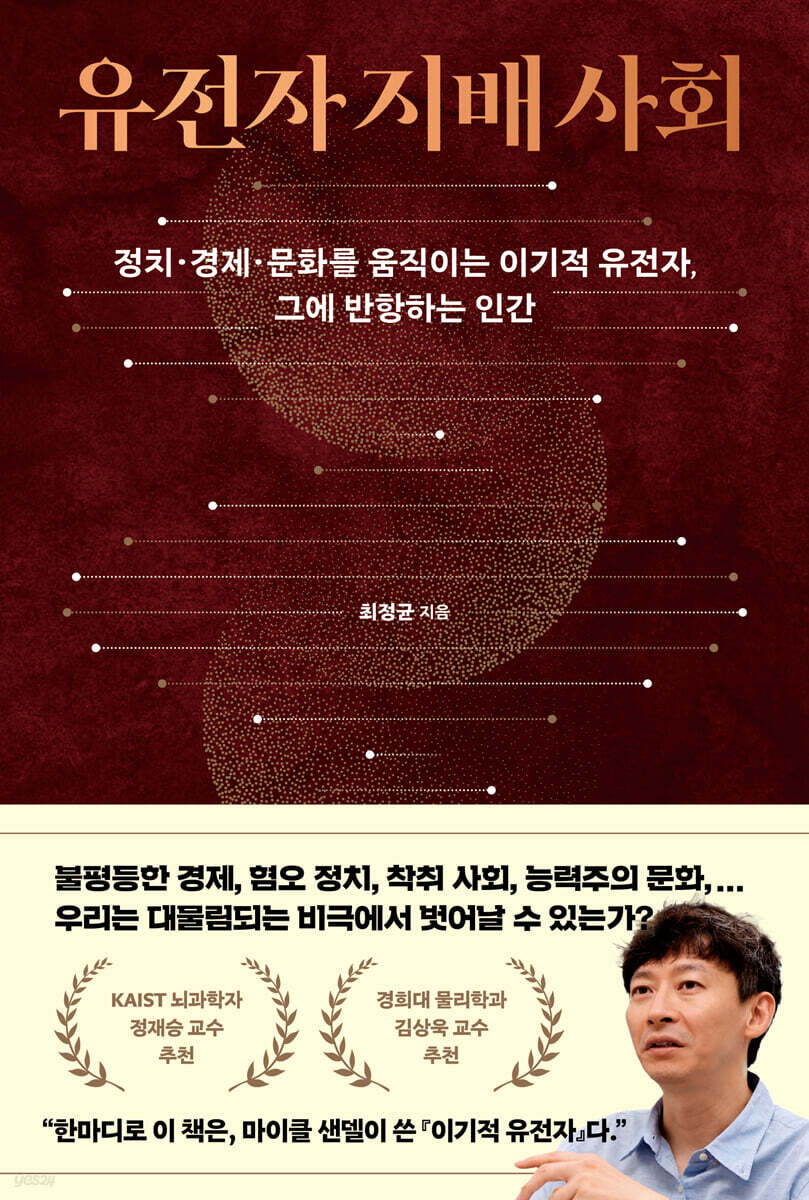
Genetically dominated society
 |
Description
Book Introduction
“In a word, this book is ‘The Selfish Gene’ by Michael Sandel.”
★ Recommended by KAIST Neuroscientist Professor Jaeseung Jeong ★
★ Recommended by Professor Sang-Wook Kim of the Department of Physics at Kyung Hee University ★
Conspicuous consumption, university rankings, and the conflict between progressives and conservatives.
Homophobia, lookism, capitalist exploitation, …
An expanded version of "The Selfish Gene," which dissects modern society from an evolutionary perspective!
It's been nearly 50 years since Richard Dawkins's "The Selfish Gene" was published, and a full 30 years since "The Evolution of Desire," which delved into the love between men and women, was published.
However, virtually no books have explored the family, politics, economy, society, and culture from an evolutionary or genetic perspective. The author, a professor of bio and brain engineering at KAIST and a human genomicist, addresses this issue. Drawing on cutting-edge research published in leading academic journals such as Nature, Science, and Cell, he dissects today's unequal economy, politics of hate, exploitative society, and meritocracy.
Specifically, it denounces how the human survival and reproductive instincts implanted by genes are disguised as distorted mating desires and twisted love for children, as hatred and social stigma, as conspicuous consumption and exploitative behavior, as justification for vested interests, as a vague fear of scientific progress, and as the illusion that nature is beautiful and sublime, leading to all sorts of misfortune and social absurdity.
Furthermore, we seek a way to escape from the various tragedies that arise from humans unconsciously following selfish genes.
★ Recommended by KAIST Neuroscientist Professor Jaeseung Jeong ★
★ Recommended by Professor Sang-Wook Kim of the Department of Physics at Kyung Hee University ★
Conspicuous consumption, university rankings, and the conflict between progressives and conservatives.
Homophobia, lookism, capitalist exploitation, …
An expanded version of "The Selfish Gene," which dissects modern society from an evolutionary perspective!
It's been nearly 50 years since Richard Dawkins's "The Selfish Gene" was published, and a full 30 years since "The Evolution of Desire," which delved into the love between men and women, was published.
However, virtually no books have explored the family, politics, economy, society, and culture from an evolutionary or genetic perspective. The author, a professor of bio and brain engineering at KAIST and a human genomicist, addresses this issue. Drawing on cutting-edge research published in leading academic journals such as Nature, Science, and Cell, he dissects today's unequal economy, politics of hate, exploitative society, and meritocracy.
Specifically, it denounces how the human survival and reproductive instincts implanted by genes are disguised as distorted mating desires and twisted love for children, as hatred and social stigma, as conspicuous consumption and exploitative behavior, as justification for vested interests, as a vague fear of scientific progress, and as the illusion that nature is beautiful and sublime, leading to all sorts of misfortune and social absurdity.
Furthermore, we seek a way to escape from the various tragedies that arise from humans unconsciously following selfish genes.
- You can preview some of the book's contents.
Preview
index
Entering
Chapter 1: The Self-Deception of Love
Genetically Fueled Parental Love│Genetically Fueled Parent-Child Conflict│Why Opposites Attract│The Deceptive Transaction of Marriage│Twisted Educational Fever and Meritocracy
Chapter 2 Society: Fear Disguised as Hatred
Stigma, Infected Wounds│The Evolutionary Origins of Hatred│Stereotypes, Prejudice, and Discrimination│The Struggle of All Against All│The Role of the Amygdala and the Sympathetic Nervous System│Human Love as Seen Through Homosexuality
Chapter 3: Economics: Reproductive Competition in a Capitalist World
Biological Interpretation of Neoclassical Economics│The Economics of Costly Signaling│Resource Competition Through Interference and Exploitation│The Exploitative Behavior of Giant Corporations│Costly Signaling and Meritocracy│The I-Lone-Man Society, the Second Gilded Age│'Scientific' Economics and Political Economy
Chapter 4 Politics: Natural Conservatism, Unnatural Progressivism
The Vague Definitions of Conservatism and Progressivism│A Larger Amygdala, More Sensitive Sympathetic Nervous System│Conservative Serotonin, Liberal Dopamine│Pheromones and Reproductive Rates│The Biological Definitions of Conservative and Progressive Ideologies│The Impact of Social Environment on Political Ideology│The Social Consequences of Political Ideology
Chapter 5: Medicine: Why We Must Get Sick, Grow Old, and Die
Another scapegoat, genes│The shadow of diversity, disease│The price of competition for reproduction, aging│Aging, the result of the struggle for survival│The illusion of civilization's fault│The possibility of a life-friendly nature│Blaming humans│Fear that hinders progress
Chapter 6 Religion: Humans Are Not Born
Nature Worship and Anti-Nature Thoughts│The Small Nature of Human Instinct│Solomon's Glory, the Marketplace Becomes a God│The Lost Dream and Stigmata of the Early Church│Love Against Nature│Humans Adopted by God
Going out
main
Chapter 1: The Self-Deception of Love
Genetically Fueled Parental Love│Genetically Fueled Parent-Child Conflict│Why Opposites Attract│The Deceptive Transaction of Marriage│Twisted Educational Fever and Meritocracy
Chapter 2 Society: Fear Disguised as Hatred
Stigma, Infected Wounds│The Evolutionary Origins of Hatred│Stereotypes, Prejudice, and Discrimination│The Struggle of All Against All│The Role of the Amygdala and the Sympathetic Nervous System│Human Love as Seen Through Homosexuality
Chapter 3: Economics: Reproductive Competition in a Capitalist World
Biological Interpretation of Neoclassical Economics│The Economics of Costly Signaling│Resource Competition Through Interference and Exploitation│The Exploitative Behavior of Giant Corporations│Costly Signaling and Meritocracy│The I-Lone-Man Society, the Second Gilded Age│'Scientific' Economics and Political Economy
Chapter 4 Politics: Natural Conservatism, Unnatural Progressivism
The Vague Definitions of Conservatism and Progressivism│A Larger Amygdala, More Sensitive Sympathetic Nervous System│Conservative Serotonin, Liberal Dopamine│Pheromones and Reproductive Rates│The Biological Definitions of Conservative and Progressive Ideologies│The Impact of Social Environment on Political Ideology│The Social Consequences of Political Ideology
Chapter 5: Medicine: Why We Must Get Sick, Grow Old, and Die
Another scapegoat, genes│The shadow of diversity, disease│The price of competition for reproduction, aging│Aging, the result of the struggle for survival│The illusion of civilization's fault│The possibility of a life-friendly nature│Blaming humans│Fear that hinders progress
Chapter 6 Religion: Humans Are Not Born
Nature Worship and Anti-Nature Thoughts│The Small Nature of Human Instinct│Solomon's Glory, the Marketplace Becomes a God│The Lost Dream and Stigmata of the Early Church│Love Against Nature│Humans Adopted by God
Going out
main
Detailed image

Into the book
Applying this hypothesis to the issue of inheritance, it is predicted that wealthier families will leave more money to their sons, while poorer families will leave more to their daughters.
This has been proven by actual data.
An analysis of 1,000 wills left by Canadians found that in wealthier families, sons received twice as much as daughters, while in poorer families the opposite was true.
--- p.34
Additionally, a study analyzing the wills of Americans found that when a husband dies before his wife, he often leaves most of his assets to his wife, whereas when a wife dies before her husband, the wife often disqualifies her husband from inheriting and passes the assets directly to her children.
The biological reasons are clear.
--- p.43
On March 4, 2020, to mark World Obesity Day, the journal Nature Medicine published a joint statement from experts around the world calling for an end to the stigma surrounding obesity.
Rather than working to reduce obesity, social pressure is actually worsening mental health problems, making it a serious health problem.
The bias against obese people is unjustified, as genetics account for as much as 40 to 70 percent of the variation in body mass index between individuals.
--- p.54~55
The biological basis for homosexual orientation is abundant.
(···) First, statistically, people who have a homosexual sibling are very likely to become homosexual themselves.
(···) Third, mothers of homosexual sons and their maternal female relatives have more children than heterosexual sons.
(···) However, this does not mean that homosexuality itself is a noble love.
(···) It is widely known that most of the sexual crimes committed in the Catholic Church were committed by priests who were homosexuals.
--- p.72~75
In particular, the striking and brilliant colors of birds, the peacock's tail or the deer's antlers that make movement difficult, and the bold behavior of the Thomson's gazelle, which jumps up and down in place instead of running away when encountering predators, are all display behaviors that advertise that they are healthy enough to survive even in unfavorable conditions.
This behavior is called 'costly signaling' based on the handicap theory proposed by Israeli animal ecologist Professor Amots Zahavi, which has been widely proven in evolutionary biology.
--- p.86
True play, as [Johann Huizinga] speaks of it, is a purely free act that becomes an end in itself.
But the fierce reproductive competition of Homo sapiens has transformed even play into a costly signal.
Playing well has become a symbol of wealth and power.
Even the mere act of showing off one's skills can be a huge money-maker in today's world of professional sports, entertainment, and popular arts.
In this way, Homo ludens evolved into a limited class of Homo sapiens who enjoyed playing with tools to show off their reproductive competitiveness.
--- p.90
The key to exploitation competition among living things is to secure an advantageous position, and this is also true in the human economy.
The act of first occupying land where production can take place and then taking the value generated there in the form of rent is exploitation.
(···) The concept of land is not limited to physical land.
Today, land taxes also apply to rents for residential and commercial buildings.
Simply put, renting a home is exploiting the wages of the workers who live there.
(···) Professor Machucato points out that today's IT-based giants, which are in the spotlight for their innovative image, are also carrying out massive value extraction in the form of unproductive rents.
--- p.95~97
First, a 2011 study used magnetic resonance imaging (MRI) to examine the brain structure of 90 people and found that people with a stronger progressive tendency had a larger gray matter volume in the anterior cingulate cortex, whereas people with a stronger conservative tendency had a larger gray matter volume in the amygdala.
(···) In 2022, a study was also published showing that functional MRI data can be analyzed using the latest artificial intelligence technique called deep learning to accurately estimate a person's political inclinations.
--- p.121
In fact, anthropologist Helen Fisher, after synthesizing the results of many previous studies, speculated that serotonin may be at the basis of conservative tendencies.
That is, people with high serotonin levels tend to follow social norms and avoid risks, prefer concrete and clear things over theoretical and complex things, value order and authority, and often have strong religious tendencies.
Conversely, Fisher identified dopamine as the neurotransmitter that creates progressive tendencies.
Dopamine is a neurotransmitter that governs the reward circuit, and when dopamine secretion is high, animals exhibit behaviors that explore new things.
--- p.125
Genome-wide association studies suggest that the genetic factors that determine these different mating behaviors are linked to political leanings, which, if true, could actually lead to differences in reproductive rates between conservatives and liberals.
(···) Accordingly, there is a study that actually compared the number of children between conservative and progressive groups.
The massive study, which surveyed more than 152,400 people from 100 countries around the world, including 65,900 Europeans and 6,200 Americans, found that families with conservative political leanings had significantly more children than those with liberal leanings.
--- p.130
In fact, there are studies that analyze the evolutionary patterns of those living in extreme environments, such as extremely cold climates or high altitudes.
Surprisingly, it was found that these mutations were positively selected in the population studied, meaning they were advantageous for adaptation to this environment.
In other words, cancer is not simply caused by the 'physical side effects' of cold 'weather', but rather genetic mutations that increase 'evolutionary fitness' in cold 'climates' biologically increase the incidence of cancer.
--- p.165
From a metaphysical point of view, this universe is not a space that exists for life.
(···) In fact, the quantum mechanical instability of the atoms that make up the universe has been causing problems since the beginning of life, right up until now.
For example, a phenomenon was observed in Nature where a specific nucleotide was instantly changed to a different sequence and then returned to its original state due to quantum fluctuations in DNA itself.
That is, when DNA polymerase recognizes the nucleotide that has changed instantaneously and combines the corresponding sequence, and when the changed nucleotide returns to its original state, an error occurs right there.
--- p.185
In 2012, to commemorate the 50th anniversary of the publication of Silent Spring, Professor Anthony Treobas, a botanist at the University of Edinburgh, along with Professor Christopher Lieber, a botanist at the University of Oxford, Professor Bruce Ames, a biochemist and molecular biologist at the University of California, Berkeley, Professor Peter Lachmann, an immunologist at the University of Cambridge, and Richard Tren of the American Food and Agriculture Organization (AFM), published a rebuttal in the journal Nature, arguing that it was not appropriate to call Silent Spring a "beacon of reason."
Because of the excessive fear of DDT based on faulty scientific evidence, an estimated 60 to 80 million people, including countless children, died needlessly.
This has been proven by actual data.
An analysis of 1,000 wills left by Canadians found that in wealthier families, sons received twice as much as daughters, while in poorer families the opposite was true.
--- p.34
Additionally, a study analyzing the wills of Americans found that when a husband dies before his wife, he often leaves most of his assets to his wife, whereas when a wife dies before her husband, the wife often disqualifies her husband from inheriting and passes the assets directly to her children.
The biological reasons are clear.
--- p.43
On March 4, 2020, to mark World Obesity Day, the journal Nature Medicine published a joint statement from experts around the world calling for an end to the stigma surrounding obesity.
Rather than working to reduce obesity, social pressure is actually worsening mental health problems, making it a serious health problem.
The bias against obese people is unjustified, as genetics account for as much as 40 to 70 percent of the variation in body mass index between individuals.
--- p.54~55
The biological basis for homosexual orientation is abundant.
(···) First, statistically, people who have a homosexual sibling are very likely to become homosexual themselves.
(···) Third, mothers of homosexual sons and their maternal female relatives have more children than heterosexual sons.
(···) However, this does not mean that homosexuality itself is a noble love.
(···) It is widely known that most of the sexual crimes committed in the Catholic Church were committed by priests who were homosexuals.
--- p.72~75
In particular, the striking and brilliant colors of birds, the peacock's tail or the deer's antlers that make movement difficult, and the bold behavior of the Thomson's gazelle, which jumps up and down in place instead of running away when encountering predators, are all display behaviors that advertise that they are healthy enough to survive even in unfavorable conditions.
This behavior is called 'costly signaling' based on the handicap theory proposed by Israeli animal ecologist Professor Amots Zahavi, which has been widely proven in evolutionary biology.
--- p.86
True play, as [Johann Huizinga] speaks of it, is a purely free act that becomes an end in itself.
But the fierce reproductive competition of Homo sapiens has transformed even play into a costly signal.
Playing well has become a symbol of wealth and power.
Even the mere act of showing off one's skills can be a huge money-maker in today's world of professional sports, entertainment, and popular arts.
In this way, Homo ludens evolved into a limited class of Homo sapiens who enjoyed playing with tools to show off their reproductive competitiveness.
--- p.90
The key to exploitation competition among living things is to secure an advantageous position, and this is also true in the human economy.
The act of first occupying land where production can take place and then taking the value generated there in the form of rent is exploitation.
(···) The concept of land is not limited to physical land.
Today, land taxes also apply to rents for residential and commercial buildings.
Simply put, renting a home is exploiting the wages of the workers who live there.
(···) Professor Machucato points out that today's IT-based giants, which are in the spotlight for their innovative image, are also carrying out massive value extraction in the form of unproductive rents.
--- p.95~97
First, a 2011 study used magnetic resonance imaging (MRI) to examine the brain structure of 90 people and found that people with a stronger progressive tendency had a larger gray matter volume in the anterior cingulate cortex, whereas people with a stronger conservative tendency had a larger gray matter volume in the amygdala.
(···) In 2022, a study was also published showing that functional MRI data can be analyzed using the latest artificial intelligence technique called deep learning to accurately estimate a person's political inclinations.
--- p.121
In fact, anthropologist Helen Fisher, after synthesizing the results of many previous studies, speculated that serotonin may be at the basis of conservative tendencies.
That is, people with high serotonin levels tend to follow social norms and avoid risks, prefer concrete and clear things over theoretical and complex things, value order and authority, and often have strong religious tendencies.
Conversely, Fisher identified dopamine as the neurotransmitter that creates progressive tendencies.
Dopamine is a neurotransmitter that governs the reward circuit, and when dopamine secretion is high, animals exhibit behaviors that explore new things.
--- p.125
Genome-wide association studies suggest that the genetic factors that determine these different mating behaviors are linked to political leanings, which, if true, could actually lead to differences in reproductive rates between conservatives and liberals.
(···) Accordingly, there is a study that actually compared the number of children between conservative and progressive groups.
The massive study, which surveyed more than 152,400 people from 100 countries around the world, including 65,900 Europeans and 6,200 Americans, found that families with conservative political leanings had significantly more children than those with liberal leanings.
--- p.130
In fact, there are studies that analyze the evolutionary patterns of those living in extreme environments, such as extremely cold climates or high altitudes.
Surprisingly, it was found that these mutations were positively selected in the population studied, meaning they were advantageous for adaptation to this environment.
In other words, cancer is not simply caused by the 'physical side effects' of cold 'weather', but rather genetic mutations that increase 'evolutionary fitness' in cold 'climates' biologically increase the incidence of cancer.
--- p.165
From a metaphysical point of view, this universe is not a space that exists for life.
(···) In fact, the quantum mechanical instability of the atoms that make up the universe has been causing problems since the beginning of life, right up until now.
For example, a phenomenon was observed in Nature where a specific nucleotide was instantly changed to a different sequence and then returned to its original state due to quantum fluctuations in DNA itself.
That is, when DNA polymerase recognizes the nucleotide that has changed instantaneously and combines the corresponding sequence, and when the changed nucleotide returns to its original state, an error occurs right there.
--- p.185
In 2012, to commemorate the 50th anniversary of the publication of Silent Spring, Professor Anthony Treobas, a botanist at the University of Edinburgh, along with Professor Christopher Lieber, a botanist at the University of Oxford, Professor Bruce Ames, a biochemist and molecular biologist at the University of California, Berkeley, Professor Peter Lachmann, an immunologist at the University of Cambridge, and Richard Tren of the American Food and Agriculture Organization (AFM), published a rebuttal in the journal Nature, arguing that it was not appropriate to call Silent Spring a "beacon of reason."
Because of the excessive fear of DDT based on faulty scientific evidence, an estimated 60 to 80 million people, including countless children, died needlessly.
--- p.194
Publisher's Review
KAIST human genomicist accuses
The source of human misery and social injustice
An unequal economy, hate politics, an exploitative society, a meritocratic culture, and...
Can we escape this inherited tragedy?
Despite the advancement of science that reduces everything to the workings of matter, love still seems to remain a sacred realm.
Chapter 1, “Assumption: The Self-Deception Called Love,” exposes this as an illusion and shows that the love we commonly see around us between men and women, the love between parents and their children, and even the love between same-sex people are all strategies devised by evolution for the purpose of genetic reproduction.
As specific examples, it reveals that the conflict between parents and children, which in severe cases can even lead to murder, the social phenomenon of leaving more inheritance to daughters than sons, the unconscious instinct to be attracted to the opposite sex with different personalities, and the distorted love for children that is so excessive that it is an understatement to say, are ultimately caused by the genetic desire to reproduce disguised as 'love'.
Meanwhile, if love is 'conditionally' exercised toward 'blood relatives' for the 'propagation' of genes, then hate is 'unconditionally' exercised toward 'others' for the 'survival' of genes.
Chapter 2, “Society: Fear Disguised as Hate,” explains why hate is primarily directed at immigrants and other ethnic groups, those with disabilities, deformities, or obesity that appear to deviate from the “normal,” and various sexual minorities, including homosexuals, using the mechanisms of the amygdala and the sympathetic nervous system.
It also examines how the genetic 'fear' disguised as disgust contaminates our cognitive systems and extends into stereotypes, prejudices, discrimination, and aggression.
“This is an interesting book by Jeong-Gyun Choi, ‘one of the most notable young scholars in our academic world’ who explores evolution at the genetic level, looking into human civilization from an evolutionary perspective.
Beginning with monogamy, this book offers a thoughtful and comprehensive reflection on how Homo sapiens developed the unique institutions and norms we know today, crossing over politics, economics, society, and religion.
The appeal of this book lies in its intellectual enjoyment for readers as it explores various biological anthropological topics using the keyword “gene.”
Jaeseung Jeong, Professor of Brain and Cognitive Sciences at KAIST and author of "Twelve Footsteps"
Robert Frank, an economics professor at Cornell University, said, “If you ask economists 100 years from now who the father of economics is, most will say Charles Darwin.”
Today's mainstream economists, who cite Adam Smith as the father of economics, argue that a market in which independent economic agents freely act according to their own rational desires will naturally reach a state of equilibrium. However, this argument leaves out the most important variable, biological competition.
Chapter 3, "Economy: Reproductive Competition in the Capitalist World," shows that the marginal utility of humans as biological entities and consumers never decreases, and that the reproductive competition, expressed through expensive signals, is fully reflected in the economic activities of modern people in a manner similar to an arms race.
Furthermore, the subtle and extensive exploitation of value in the form of rent in the markets of real estate, stocks, popular arts and sports, and so-called 'innovative' companies is analyzed as interference competition and exploitation competition in ecology, and the cause of such exploitation is pointed out as natural selection at the individual level and mainstream economics that assumes only independent individuals as economic subjects, excluding the class concepts of landlords, capitalists, and workers.
Meanwhile, Chapter 4, "Politics: Natural Conservatism, Unnatural Progressivism," redefines political progressivism and conservatism, which are not properly defined in dictionary terms, from a biological perspective, and explains why the two camps' positions on various issues related to the economy, education, foreign affairs, society, science and technology, and religion, such as abortion, same-sex marriage, gun ownership, national security, and immigration policy, are so consistently divided.
In particular, it explains how serotonin, which promotes behaviors that seek to establish social hierarchy and improve rank, and dopamine, which promotes behaviors that seek novelty, are related to the biological characteristics of conservatives and liberals, and illuminates the social and philosophical implications of each political attitude.
Selfish genes and the hostile nature that created them,
A new community path that resists such nature
“The enemy called nature is not only outside of us.
“Human instincts, implanted by genes, are also a part of nature.”
Genes are the cause of human misery and social injustice, but in reality, genes are just another victim of nature, which is surprisingly hostile to life.
In other words, even though the occurrence of mutations means death for each gene, the evolution of life inevitably proceeded in a way that secured diversity through mutations, all because of the harsh natural environment.
Chapter 5, "Medicine: Why We Must Get Sick, Grow Old, and Die," shows that the sacrifices that nature makes to genes in the name of "diversity" manifest in humans as disease, aging, and death.
Citing specific examples such as breast cancer, autoimmune diseases, and Alzheimer's disease, it explains why mutations that were advantageous for reproduction in youth can, on the contrary, accelerate aging or cause disease as we age, and why mutations that were advantageous for survival in variable and harsh environments can destroy us—in other words, why the things that save us can also kill us.
In other words, humans instinctively revere and admire nature, blame themselves for numerous problems, and fear the progress of civilization, but the argument points out that not only the survival struggle and social conflict that occur between individuals, but also the biological tragedy that occurs within individuals are ultimately created by nature.
Finally, Chapter 6, “Religion: Humans Are Not Born,” reveals that established religions are extreme manifestations of conservative tendencies, especially the human instinct to seek morality and norms in nature, while also reexamining the significance of Christianity in contrast to ancient primitive religions from the perspective of de-deification of nature.
When we examine the Bible in particular from this perspective, we see that the unnatural actions and teachings of one man, Jesus, whether a historical or fictional figure, remain groundbreaking even today, yet it is argued that these actions and teachings can only be achieved by the human community, not by some absolute superhuman.
The source of human misery and social injustice
An unequal economy, hate politics, an exploitative society, a meritocratic culture, and...
Can we escape this inherited tragedy?
Despite the advancement of science that reduces everything to the workings of matter, love still seems to remain a sacred realm.
Chapter 1, “Assumption: The Self-Deception Called Love,” exposes this as an illusion and shows that the love we commonly see around us between men and women, the love between parents and their children, and even the love between same-sex people are all strategies devised by evolution for the purpose of genetic reproduction.
As specific examples, it reveals that the conflict between parents and children, which in severe cases can even lead to murder, the social phenomenon of leaving more inheritance to daughters than sons, the unconscious instinct to be attracted to the opposite sex with different personalities, and the distorted love for children that is so excessive that it is an understatement to say, are ultimately caused by the genetic desire to reproduce disguised as 'love'.
Meanwhile, if love is 'conditionally' exercised toward 'blood relatives' for the 'propagation' of genes, then hate is 'unconditionally' exercised toward 'others' for the 'survival' of genes.
Chapter 2, “Society: Fear Disguised as Hate,” explains why hate is primarily directed at immigrants and other ethnic groups, those with disabilities, deformities, or obesity that appear to deviate from the “normal,” and various sexual minorities, including homosexuals, using the mechanisms of the amygdala and the sympathetic nervous system.
It also examines how the genetic 'fear' disguised as disgust contaminates our cognitive systems and extends into stereotypes, prejudices, discrimination, and aggression.
“This is an interesting book by Jeong-Gyun Choi, ‘one of the most notable young scholars in our academic world’ who explores evolution at the genetic level, looking into human civilization from an evolutionary perspective.
Beginning with monogamy, this book offers a thoughtful and comprehensive reflection on how Homo sapiens developed the unique institutions and norms we know today, crossing over politics, economics, society, and religion.
The appeal of this book lies in its intellectual enjoyment for readers as it explores various biological anthropological topics using the keyword “gene.”
Jaeseung Jeong, Professor of Brain and Cognitive Sciences at KAIST and author of "Twelve Footsteps"
Robert Frank, an economics professor at Cornell University, said, “If you ask economists 100 years from now who the father of economics is, most will say Charles Darwin.”
Today's mainstream economists, who cite Adam Smith as the father of economics, argue that a market in which independent economic agents freely act according to their own rational desires will naturally reach a state of equilibrium. However, this argument leaves out the most important variable, biological competition.
Chapter 3, "Economy: Reproductive Competition in the Capitalist World," shows that the marginal utility of humans as biological entities and consumers never decreases, and that the reproductive competition, expressed through expensive signals, is fully reflected in the economic activities of modern people in a manner similar to an arms race.
Furthermore, the subtle and extensive exploitation of value in the form of rent in the markets of real estate, stocks, popular arts and sports, and so-called 'innovative' companies is analyzed as interference competition and exploitation competition in ecology, and the cause of such exploitation is pointed out as natural selection at the individual level and mainstream economics that assumes only independent individuals as economic subjects, excluding the class concepts of landlords, capitalists, and workers.
Meanwhile, Chapter 4, "Politics: Natural Conservatism, Unnatural Progressivism," redefines political progressivism and conservatism, which are not properly defined in dictionary terms, from a biological perspective, and explains why the two camps' positions on various issues related to the economy, education, foreign affairs, society, science and technology, and religion, such as abortion, same-sex marriage, gun ownership, national security, and immigration policy, are so consistently divided.
In particular, it explains how serotonin, which promotes behaviors that seek to establish social hierarchy and improve rank, and dopamine, which promotes behaviors that seek novelty, are related to the biological characteristics of conservatives and liberals, and illuminates the social and philosophical implications of each political attitude.
Selfish genes and the hostile nature that created them,
A new community path that resists such nature
“The enemy called nature is not only outside of us.
“Human instincts, implanted by genes, are also a part of nature.”
Genes are the cause of human misery and social injustice, but in reality, genes are just another victim of nature, which is surprisingly hostile to life.
In other words, even though the occurrence of mutations means death for each gene, the evolution of life inevitably proceeded in a way that secured diversity through mutations, all because of the harsh natural environment.
Chapter 5, "Medicine: Why We Must Get Sick, Grow Old, and Die," shows that the sacrifices that nature makes to genes in the name of "diversity" manifest in humans as disease, aging, and death.
Citing specific examples such as breast cancer, autoimmune diseases, and Alzheimer's disease, it explains why mutations that were advantageous for reproduction in youth can, on the contrary, accelerate aging or cause disease as we age, and why mutations that were advantageous for survival in variable and harsh environments can destroy us—in other words, why the things that save us can also kill us.
In other words, humans instinctively revere and admire nature, blame themselves for numerous problems, and fear the progress of civilization, but the argument points out that not only the survival struggle and social conflict that occur between individuals, but also the biological tragedy that occurs within individuals are ultimately created by nature.
Finally, Chapter 6, “Religion: Humans Are Not Born,” reveals that established religions are extreme manifestations of conservative tendencies, especially the human instinct to seek morality and norms in nature, while also reexamining the significance of Christianity in contrast to ancient primitive religions from the perspective of de-deification of nature.
When we examine the Bible in particular from this perspective, we see that the unnatural actions and teachings of one man, Jesus, whether a historical or fictional figure, remain groundbreaking even today, yet it is argued that these actions and teachings can only be achieved by the human community, not by some absolute superhuman.
GOODS SPECIFICS
- Date of issue: April 30, 2024
- Page count, weight, size: 276 pages | 440g | 145*215*20mm
- ISBN13: 9788962622706
- ISBN10: 896262270X
You may also like
카테고리
korean


korean

![GQ KOREA Mark (Monthly): December [2025]](http://librairie.coreenne.fr/cdn/shop/files/8ef265dbbfbf186523ed75ba7319009d.jpg?v=1765340328&width=3840)


