

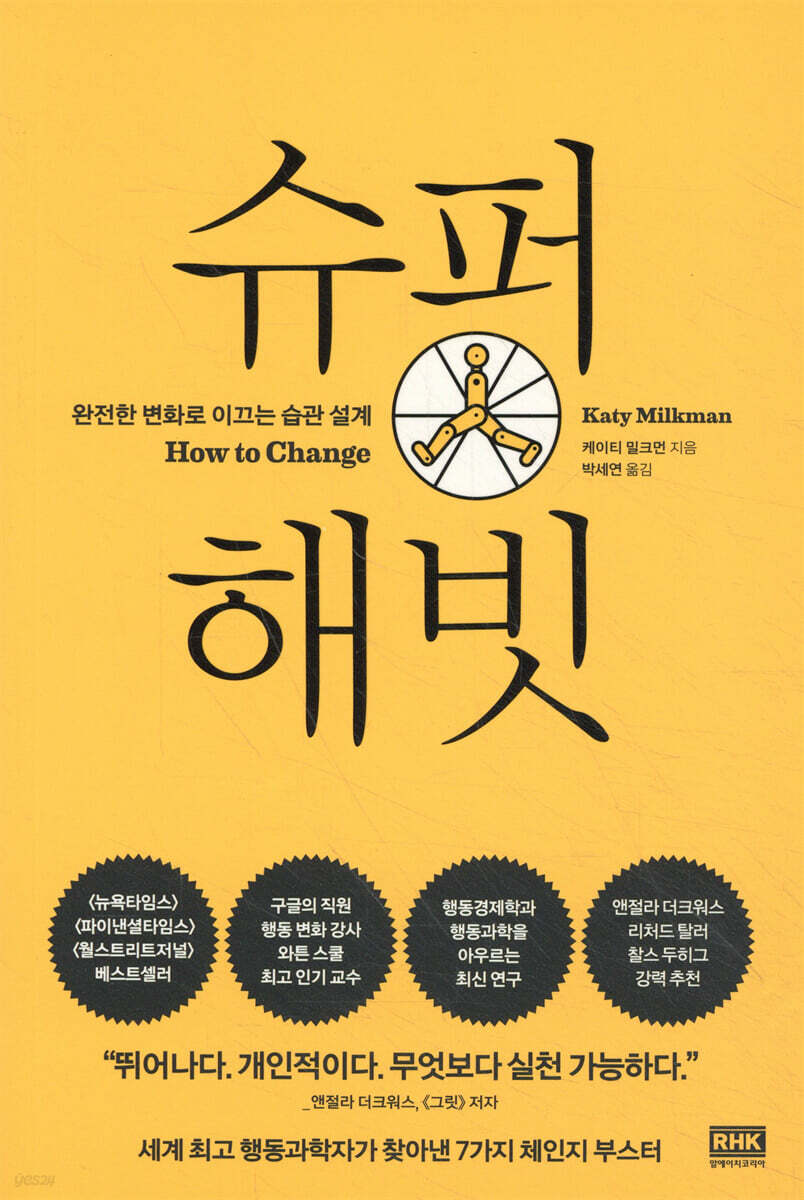
Super Habit
 |
Description
Book Introduction
“Nudge, Grit, Atomic Habits, What’s Next?” 7 Change Boosters Discovered by the World's Top Behavioral Scientists The New York Times' "8 Best Books for a Healthy Life" of 2021 Google's employee behavior change instructor and Wharton School's most popular professor Highly recommended by Angela Duckworth, Richard Thaler, and Charles Duhigg. Numerous bestsellers in the self-improvement field speak with one voice. Achieving goals depends on ‘habits’. But why do people still fail to achieve their goals? Why do ambitious plans always end in failure after just three days? Katie Milkman, a behavioral scientist at Wharton School and one of the 2021 Thinkers50 Most Influential Management Thinkers on Earth, says that seven obstacles inherent in human nature prevent us from forming the “long-term habits” that drive true change. In her first book, How to Change, she presents behavioral science-based solutions to overcome problems like when to change, impulsivity, procrastination, forgetfulness, laziness, self-doubt, and conformity. As Angela Duckworth, author of the international bestseller Grit, puts it in her foreword, the method is “brilliant, personal, and, above all, actionable.” As you read, you'll understand why Google's executives invited Professor Milkman to their California headquarters to seek advice and help in changing employee behavior. Tired of plans that always end in three days? Here's a change booster shot that will transform your life. If you want to break away from 'the me now' and become 'the me you want to be', I recommend reading this. |
- You can preview some of the book's contents.
Preview
index
Praise poured in for this book
Preface | What's Your Problem?_Angela Duckworth
Enter│Remove obstacles that block change
Chapter 1 Getting Started
The Power of a Blank Slate | The Fresh Start Effect | Beyond the Calendar | The Problem of Fresh Beginnings | When to Stimulate Change | Find an Opportunity to Begin | Summary
Chapter 2 Impulse
A Spoonful of Sugar | Temptation Bundling Strategies | Making Work Fun | What Gamification Can Do | Summary
Chapter 3 Procrastination
Breaking the Procrastination Habit | Handcuffing Yourself | Cash-Fulfillment Devices | Promises and Lax Follow-Throughs | Two Types of People | Summary
Chapter 4 Forgetting
Voter Promises Unfulfilled | Forgetting | Signal-Based Planning | The Best Signals | Increasing Voter Turnout | Increasing Vaccination Rates | Breaking It Down into Bite-Sized Pieces | Do It Yourself | Summary
Chapter 5 Laziness
The Path of Least Resistance | Set It and Forget It | The Power of Habits | Resilient Habits | Every Day | Summary
Chapter 6 Lack of Confidence
Need advice? | High expectations | Recovering from failure | Still, confident | Summary
Chapter 7 Sympathy
Why We Follow Social Norms | Copy and Paste | The Power of Social Norms | The Backlash of Social Influence | Someone's Watching You | Social Pressure to Do Good | Summary
Chapter 8 Change for Good
persistent habits
Acknowledgements
main
Preface | What's Your Problem?_Angela Duckworth
Enter│Remove obstacles that block change
Chapter 1 Getting Started
The Power of a Blank Slate | The Fresh Start Effect | Beyond the Calendar | The Problem of Fresh Beginnings | When to Stimulate Change | Find an Opportunity to Begin | Summary
Chapter 2 Impulse
A Spoonful of Sugar | Temptation Bundling Strategies | Making Work Fun | What Gamification Can Do | Summary
Chapter 3 Procrastination
Breaking the Procrastination Habit | Handcuffing Yourself | Cash-Fulfillment Devices | Promises and Lax Follow-Throughs | Two Types of People | Summary
Chapter 4 Forgetting
Voter Promises Unfulfilled | Forgetting | Signal-Based Planning | The Best Signals | Increasing Voter Turnout | Increasing Vaccination Rates | Breaking It Down into Bite-Sized Pieces | Do It Yourself | Summary
Chapter 5 Laziness
The Path of Least Resistance | Set It and Forget It | The Power of Habits | Resilient Habits | Every Day | Summary
Chapter 6 Lack of Confidence
Need advice? | High expectations | Recovering from failure | Still, confident | Summary
Chapter 7 Sympathy
Why We Follow Social Norms | Copy and Paste | The Power of Social Norms | The Backlash of Social Influence | Someone's Watching You | Social Pressure to Do Good | Summary
Chapter 8 Change for Good
persistent habits
Acknowledgements
main
Detailed image

Into the book
Why do these tools and programs designed to facilitate change so often fail? The answer is that change is so difficult.
But there is a more practical answer.
Because we haven't found the right strategy.
(Omitted) The most important thing to do to have the best chance of success is to understand your opponents and develop strategies tailored to address the specific challenges you face.
A panacea is never the best approach to success.
We need to develop specific approaches depending on the opponent.
--- p.23
When Americans were surveyed about how they felt about new beginnings, like New Year's Day or birthdays, many responded that new beginnings provide a kind of psychological "restart."
On such days, people feel far removed from past failures.
They act as if they are someone else, as if they have good reason to be optimistic about the future.
People seek more change on days that feel like new beginnings.
Because these moments help us overcome a common obstacle that blocks us from taking on new challenges toward our goals: the fear that we have failed before and will fail again.
--- p.
47
Memories come flooding in because they are stored and then reproduced through all types of signals: sight, hearing, smell, taste, and touch.
One of the most famous depictions of the amazing power of taste to evoke memories is in Marcel Proust's novel In Search of Lost Time, where the protagonist is transported back to his childhood memories while eating a madeleine cookie.
(Omitted) At that time, he had eaten that delicious snack.
The fact that cues have the power to trigger memories also means that you can increase the likelihood of remembering a plan by associating it with a cue you encounter—say, your nightly habit of brushing your teeth.
The signal brings back memories of the actions that were supposed to be done.
--- p.149~150
There are also some interesting new research findings.
The idea is that you can build new habits on top of old ones by connecting something you want to start doing regularly (like doing push-ups or eating fruit) with something you already do habitually (like having your morning coffee or going to work).
In one study, people trying to get into the habit of using interdental brushes were more successful when they were asked to use them after brushing rather than before.
Considering the power of signals, it is understandable that the act of putting the toothbrush back in the holder served as a cue to stimulate the use of interdental brushes.
New habits build on top of old ones.
--- p.200
When pursuing ambitious goals, frustration inevitably follows.
And when we get frustrated, the temptation to give up arises.
That's precisely why we need to be tolerant of mistakes and be careful not to let them ruin the positive flow of performance.
By preparing ourselves to recover from occasional setbacks and focusing on past successes, we can overcome self-doubt, build resilience, and more easily navigate future changes.
Even before you hit your first obstacle on your journey to success.
--- p.
235
My recent research has shown that we get more help when we actively implement copy-and-paste strategies.
But if humans could naturally derive strategies from their peers, there would be no need for nudges like copy-and-paste in the first place.
Fortunately, implementing a copy-and-paste strategy isn't that difficult.
When you fall short of your goals, look to your high-achieving peers for answers.
If you want to get a good night's sleep, you can get help from a friend who has similar lifestyle habits to you and gets enough sleep.
If you find someone who has already achieved what you want and copy and paste their strategies, you will reach your goals much faster than if you simply wait for social influence to seep into you.
--- p.255
Publisher's Review
“There are no more three-day resolutions!”
Solid behavioral science to prevent failure
Everyone wants to become a better version of themselves.
I want to become more competent at what I do now, and I hope to get a raise and a promotion.
I want to become healthy by quitting smoking, reducing alcohol consumption, and improving my eating habits.
If possible, it would be great to lose some weight, build up some muscle, and have a nice appearance.
It's not like there's no way.
Just by searching, useful information pours out.
Books that neatly organize methods that have been proven through numerous studies are also readily available.
Maybe you already know how to 'become what you want and desire'.
Isn't that right?
But most people cannot 'change' as they wish.
Why? Not because I don't know how, but because I can't make it a habit.
This is why nudges, which encourage smart choices through gentle intervention, grit, which emphasizes perseverance in overcoming adversity and failure, and atomic habits, which highlight the power of very small habits to lead to dramatic change, have received attention.
But if we're still at a standstill, what's the problem?
Katy Milkman, a Wharton professor voted the most popular by students and one of Forbes' 2020 "10 Behavioral Scientists You Need to Know," says it bluntly: change isn't a matter of will.
If you want to change, you need to identify the obstacles that are blocking it and then develop a tailored strategy.
In this book, Professor Milkman introduces "Superhabits," a scientific solution for sustainable and reliable change based on the latest research encompassing behavioral economics and behavioral science.
As you read this book, which Charles Duhigg, author of The Power of Habit, praised as “a must-read for anyone who wants to improve their habits and change their lives,” you will understand why it has been recommended by numerous celebrities such as Nobel Prize winner Richard Thaler of Nudge, Angela Duckworth of Grit, Dan Heath of Switch, Adam Grant of Originals, as well as Daniel Pink, Carol Dweck, Robert Cialdini, and Seth Godin, and why [The New York Times] selected this book as one of the “8 Best Books for Healthy Living” of 2021.
How to succeed vs.
How to avoid failure
A surefire solution for complete transformation
A person who moves forward without wavering toward a goal once set and achieves tremendous results.
We call them 'superhumans'.
Looking at them, you will feel ashamed of yourself for putting off dieting, saying, "Start tomorrow," even though you only set a goal for it.
But are superhumans truly different from ordinary people? One thing people often overlook is that there's no innate factor that determines success. Rather than obsessing over how to succeed, successful people develop strategies to avoid failure and focus on those strategies.
This is why behavioral scientists, who systematically and scientifically analyze the behavior of humans and human groups and develop technologies that lead to positive outcomes, identify 'problems' and devise 'solutions' to them.
Professor Milkman also first looked into the reasons why people who set ambitious goals fail.
There were seven.
The problem was choosing the wrong time to change, not being able to control your impulses, procrastinating, forgetting, being lazy, lacking confidence, and going along with others.
Unless we eliminate these causes of failure, we cannot form lasting habits that lead to complete change.
Professor Milkman has worked with dozens of the world's leading behavioral scientists, economists, psychologists, computer scientists, and doctors, including Angela Duckworth, author of Grit, and has conducted experiments with people and groups from all walks of life.
And this book contains behavioral science solutions that can resolve these seven human natures.
Chapter 1 introduces the "New Start Effect," which utilizes the best time to attempt change; Chapter 2 introduces the "Temptation Binding Strategy," which links impulses to action; and Chapter 3 introduces the "Self-Handcuffing" implementation device, which addresses the habit of procrastination.
Chapter 4 also presents the idea of 'signal-based planning' to solve forgetting, which is pointed out as the biggest obstacle to change, Chapter 5 suggests 'set and forget' to reverse the human nature of laziness, Chapter 6 suggests creating an 'advice club' to boost confidence, and Chapter 7 suggests the 'copy and paste' strategy to take advantage of the nature of easily agreeing with people around you.
Have you been frustrated with yourself and the reality that hasn't changed despite reading countless books? So, have you decided to stop reading self-help books? If you cultivate "superhabits" using the solutions Professor Katie Milkman reveals in her book, you'll never be able to fail.
And someday, when someone asks you what your secret to becoming a 'superhuman' is, you will say this:
"well.
Please read "Super Habits".
I was like you all.
But in this book, I learned how to connect what I want with what I need to do.
That was the beginning!”
Solid behavioral science to prevent failure
Everyone wants to become a better version of themselves.
I want to become more competent at what I do now, and I hope to get a raise and a promotion.
I want to become healthy by quitting smoking, reducing alcohol consumption, and improving my eating habits.
If possible, it would be great to lose some weight, build up some muscle, and have a nice appearance.
It's not like there's no way.
Just by searching, useful information pours out.
Books that neatly organize methods that have been proven through numerous studies are also readily available.
Maybe you already know how to 'become what you want and desire'.
Isn't that right?
But most people cannot 'change' as they wish.
Why? Not because I don't know how, but because I can't make it a habit.
This is why nudges, which encourage smart choices through gentle intervention, grit, which emphasizes perseverance in overcoming adversity and failure, and atomic habits, which highlight the power of very small habits to lead to dramatic change, have received attention.
But if we're still at a standstill, what's the problem?
Katy Milkman, a Wharton professor voted the most popular by students and one of Forbes' 2020 "10 Behavioral Scientists You Need to Know," says it bluntly: change isn't a matter of will.
If you want to change, you need to identify the obstacles that are blocking it and then develop a tailored strategy.
In this book, Professor Milkman introduces "Superhabits," a scientific solution for sustainable and reliable change based on the latest research encompassing behavioral economics and behavioral science.
As you read this book, which Charles Duhigg, author of The Power of Habit, praised as “a must-read for anyone who wants to improve their habits and change their lives,” you will understand why it has been recommended by numerous celebrities such as Nobel Prize winner Richard Thaler of Nudge, Angela Duckworth of Grit, Dan Heath of Switch, Adam Grant of Originals, as well as Daniel Pink, Carol Dweck, Robert Cialdini, and Seth Godin, and why [The New York Times] selected this book as one of the “8 Best Books for Healthy Living” of 2021.
How to succeed vs.
How to avoid failure
A surefire solution for complete transformation
A person who moves forward without wavering toward a goal once set and achieves tremendous results.
We call them 'superhumans'.
Looking at them, you will feel ashamed of yourself for putting off dieting, saying, "Start tomorrow," even though you only set a goal for it.
But are superhumans truly different from ordinary people? One thing people often overlook is that there's no innate factor that determines success. Rather than obsessing over how to succeed, successful people develop strategies to avoid failure and focus on those strategies.
This is why behavioral scientists, who systematically and scientifically analyze the behavior of humans and human groups and develop technologies that lead to positive outcomes, identify 'problems' and devise 'solutions' to them.
Professor Milkman also first looked into the reasons why people who set ambitious goals fail.
There were seven.
The problem was choosing the wrong time to change, not being able to control your impulses, procrastinating, forgetting, being lazy, lacking confidence, and going along with others.
Unless we eliminate these causes of failure, we cannot form lasting habits that lead to complete change.
Professor Milkman has worked with dozens of the world's leading behavioral scientists, economists, psychologists, computer scientists, and doctors, including Angela Duckworth, author of Grit, and has conducted experiments with people and groups from all walks of life.
And this book contains behavioral science solutions that can resolve these seven human natures.
Chapter 1 introduces the "New Start Effect," which utilizes the best time to attempt change; Chapter 2 introduces the "Temptation Binding Strategy," which links impulses to action; and Chapter 3 introduces the "Self-Handcuffing" implementation device, which addresses the habit of procrastination.
Chapter 4 also presents the idea of 'signal-based planning' to solve forgetting, which is pointed out as the biggest obstacle to change, Chapter 5 suggests 'set and forget' to reverse the human nature of laziness, Chapter 6 suggests creating an 'advice club' to boost confidence, and Chapter 7 suggests the 'copy and paste' strategy to take advantage of the nature of easily agreeing with people around you.
Have you been frustrated with yourself and the reality that hasn't changed despite reading countless books? So, have you decided to stop reading self-help books? If you cultivate "superhabits" using the solutions Professor Katie Milkman reveals in her book, you'll never be able to fail.
And someday, when someone asks you what your secret to becoming a 'superhuman' is, you will say this:
"well.
Please read "Super Habits".
I was like you all.
But in this book, I learned how to connect what I want with what I need to do.
That was the beginning!”
GOODS SPECIFICS
- Publication date: February 22, 2022
- Page count, weight, size: 336 pages | 532g | 145*215*30mm
- ISBN13: 9788925578804
- ISBN10: 8925578808
You may also like
카테고리
korean


korean

![ELLE 엘르 스페셜 에디션 A형 : 12월 [2025]](http://librairie.coreenne.fr/cdn/shop/files/b8e27a3de6c9538896439686c6b0e8fb.jpg?v=1766436872&width=3840)


