

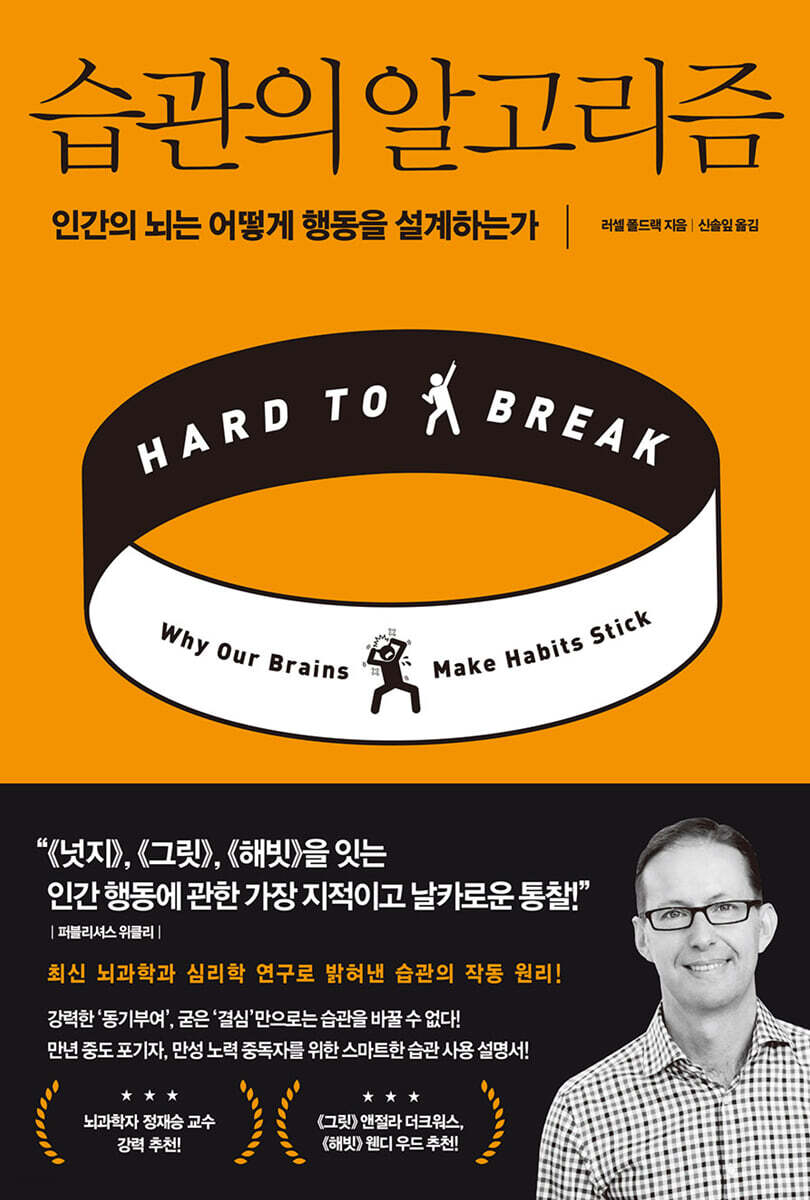
Algorithm of Habits
 |
Description
Book Introduction
Just picking up this book is already half the battle - Neuroscientist Professor Jaeseung Jeong
The algorithm of habits discovered by a Stanford psychology professor,
Unraveling the secrets of brain science that govern human habits!
American actor Philip Seymour Hoffman was a world-renowned actor known for his charming and outstanding acting.
He abused drugs and alcohol during his college years, but has remained drug-free for over 20 years through a drug addiction program.
However, in 2013, due to personal problems, my addiction relapsed and I fell back into that black hole.
Despite receiving treatment for drug addiction again, he died from an overdose of several drugs, including heroin, cocaine, and amphetamines, less than a year later.
Why did the addiction relapse even though I had endured it for a long time?
It's not just a drug addiction problem.
Many people make resolutions to diet, exercise, quit drinking, or quit smoking, but fail again and again.
What's the reason? Why do people who are habitually late, frequently late for meetings, and repeatedly postpone appointments continue to do so? Why is it so difficult to form good habits, while bad ones stubbornly follow us? We've long attributed these issues to a matter of willpower or mindset.
But Russell Poldrack, a professor of psychology at Stanford University, says habits aren't just a matter of will or passion.
Habits are formed and become fixed because of a special algorithm that arises when the human psychology and brain system interlock.
According to his argument, we have been perceiving and fighting habits in the wrong way so far.
In "The Algorithm of Habit," Russell Poldrack uses the latest brain science and psychology research to uncover how habits work and suggests ways to change behavior through these principles.
Strongly recommended by world-renowned scholars, including neuroscientist Professor Jaeseung Jeong, Angela Duckworth of Grit, and Wendy Wood of Habit, this book delivers depth of content and the joy of reading through the reliability of scientific research and vivid, rich examples.
Anyone curious about the truths and misconceptions surrounding habits, and the relationship between habits and brain science, will enjoy unraveling these mysterious secrets one by one.
“I can’t give you any ‘easy tricks’ to break bad habits.
In fact, many of the magical solutions to habits you've read about in other books are nothing more than mirages when viewed through the eyes of real science.
But I can promise you this one thing.
After reading this book, you will have a deep understanding of why habits are so persistent and why breaking them is so difficult.” This sentence, presented by the author at the beginning of the book, encapsulates the core of what the author ultimately wants to convey to the readers and conveys the essence of what he wants to say.
The algorithm of habits discovered by a Stanford psychology professor,
Unraveling the secrets of brain science that govern human habits!
American actor Philip Seymour Hoffman was a world-renowned actor known for his charming and outstanding acting.
He abused drugs and alcohol during his college years, but has remained drug-free for over 20 years through a drug addiction program.
However, in 2013, due to personal problems, my addiction relapsed and I fell back into that black hole.
Despite receiving treatment for drug addiction again, he died from an overdose of several drugs, including heroin, cocaine, and amphetamines, less than a year later.
Why did the addiction relapse even though I had endured it for a long time?
It's not just a drug addiction problem.
Many people make resolutions to diet, exercise, quit drinking, or quit smoking, but fail again and again.
What's the reason? Why do people who are habitually late, frequently late for meetings, and repeatedly postpone appointments continue to do so? Why is it so difficult to form good habits, while bad ones stubbornly follow us? We've long attributed these issues to a matter of willpower or mindset.
But Russell Poldrack, a professor of psychology at Stanford University, says habits aren't just a matter of will or passion.
Habits are formed and become fixed because of a special algorithm that arises when the human psychology and brain system interlock.
According to his argument, we have been perceiving and fighting habits in the wrong way so far.
In "The Algorithm of Habit," Russell Poldrack uses the latest brain science and psychology research to uncover how habits work and suggests ways to change behavior through these principles.
Strongly recommended by world-renowned scholars, including neuroscientist Professor Jaeseung Jeong, Angela Duckworth of Grit, and Wendy Wood of Habit, this book delivers depth of content and the joy of reading through the reliability of scientific research and vivid, rich examples.
Anyone curious about the truths and misconceptions surrounding habits, and the relationship between habits and brain science, will enjoy unraveling these mysterious secrets one by one.
“I can’t give you any ‘easy tricks’ to break bad habits.
In fact, many of the magical solutions to habits you've read about in other books are nothing more than mirages when viewed through the eyes of real science.
But I can promise you this one thing.
After reading this book, you will have a deep understanding of why habits are so persistent and why breaking them is so difficult.” This sentence, presented by the author at the beginning of the book, encapsulates the core of what the author ultimately wants to convey to the readers and conveys the essence of what he wants to say.
- You can preview some of the book's contents.
Preview
index
Recommendation (Brain Scientist Professor Jaeseung Jeong)
Part 1: The Machine of Habit
: Why We Can't Break Habits
Chapter 1: What is a Habit?
How habits work, automaticity
Thoughts are also habits
The Difference Between Habit and Purposeful Behavior
Why are habits imprinted on our bodies?
A Roadmap for Habit and Behavior Change
Chapter 2: Understanding the Brain's Habit System
The difference between habit and conscious memory
Can people with amnesia learn new things?
Looking into the lizard's brain
The outcome depends on which path you take.
Dopamine: Good or Bad
Dopamine and Brain Plasticity
The principle of learning through experience
How Desires Turn into Habits
Two mechanisms of habit formation
Chapter 3: Once a habit, always a habit.
Old habits die hard.
The process by which habits 'permeate' the brain
Once you start, you can't stop.
Forewarned: How Cues Trigger Habits
Why We Can't Ignore the Signals
The Secret in the Tenacity of Habit
Chapter 4: Me and My Fight
Is there a competition going on in your brain?
Interactions between memory systems
Formalizing the Difference Between Goals and Habits
Model-based reinforcement learning vs.
Model-free reinforcement learning
Can goals become habits?
Chapter 5: There's Nothing Wrong with Willpower
People whose personalities changed due to accidents
Biological Reasons Why Children Have Poor Self-Control
What skills are needed to execute a plan?
Stress Affecting Performance
What the Marshmallow Experiment Says
$20 in front of you vs.
$30 in two months
The Battle of Systems 1 and 2
How to Control Your Impulses
Stopping Bad Habits
Let go of your obsession with willpower
Chapter 6: Why Bad Habits Are Harder to Break
Drugs with addictive allure
This is your drugged brain
How Impulses Become Habits
The Link Between Stress and Addiction
Can addiction also be considered a habit?
My drug of choice is food.
Behavioral addiction as seen through digital addiction
Why Some People Get Addicted More Easily
Part 2: Habits Can Be Changed
: A Scientific Approach to Behavior Change
Chapter 7: Can Habits Really Be Changed?
It's too easy to fall back into old habits.
A new way of thinking in behavior change research
Analyze behavioral changes as if analyzing a disease
Mechanisms for habit change
Chapter 8: How to Plan for Success
Is 'nudge' a panacea?
Loss aversion and framing
Don't decide, make the rules
Trigger Warning: When You Intervene in a Habit
Reversing habits is possible
Mindfulness: Between Advertising and Therapy
Can self-control be improved through training?
If you fail to quit smoking, donate to the KKK without fail.
Principles for Successful Behavior Change
Chapter 9: Hacking the "Brain of Habit"
Can we just 'delete' bad habits?
“I forgot I was a smoker.”
Can you control your habits without getting rid of them?
How to Change Behavior with Medicine
Dreaming of ‘personalized habit therapy’
Concluding remarks
Acknowledgements
annotation
Part 1: The Machine of Habit
: Why We Can't Break Habits
Chapter 1: What is a Habit?
How habits work, automaticity
Thoughts are also habits
The Difference Between Habit and Purposeful Behavior
Why are habits imprinted on our bodies?
A Roadmap for Habit and Behavior Change
Chapter 2: Understanding the Brain's Habit System
The difference between habit and conscious memory
Can people with amnesia learn new things?
Looking into the lizard's brain
The outcome depends on which path you take.
Dopamine: Good or Bad
Dopamine and Brain Plasticity
The principle of learning through experience
How Desires Turn into Habits
Two mechanisms of habit formation
Chapter 3: Once a habit, always a habit.
Old habits die hard.
The process by which habits 'permeate' the brain
Once you start, you can't stop.
Forewarned: How Cues Trigger Habits
Why We Can't Ignore the Signals
The Secret in the Tenacity of Habit
Chapter 4: Me and My Fight
Is there a competition going on in your brain?
Interactions between memory systems
Formalizing the Difference Between Goals and Habits
Model-based reinforcement learning vs.
Model-free reinforcement learning
Can goals become habits?
Chapter 5: There's Nothing Wrong with Willpower
People whose personalities changed due to accidents
Biological Reasons Why Children Have Poor Self-Control
What skills are needed to execute a plan?
Stress Affecting Performance
What the Marshmallow Experiment Says
$20 in front of you vs.
$30 in two months
The Battle of Systems 1 and 2
How to Control Your Impulses
Stopping Bad Habits
Let go of your obsession with willpower
Chapter 6: Why Bad Habits Are Harder to Break
Drugs with addictive allure
This is your drugged brain
How Impulses Become Habits
The Link Between Stress and Addiction
Can addiction also be considered a habit?
My drug of choice is food.
Behavioral addiction as seen through digital addiction
Why Some People Get Addicted More Easily
Part 2: Habits Can Be Changed
: A Scientific Approach to Behavior Change
Chapter 7: Can Habits Really Be Changed?
It's too easy to fall back into old habits.
A new way of thinking in behavior change research
Analyze behavioral changes as if analyzing a disease
Mechanisms for habit change
Chapter 8: How to Plan for Success
Is 'nudge' a panacea?
Loss aversion and framing
Don't decide, make the rules
Trigger Warning: When You Intervene in a Habit
Reversing habits is possible
Mindfulness: Between Advertising and Therapy
Can self-control be improved through training?
If you fail to quit smoking, donate to the KKK without fail.
Principles for Successful Behavior Change
Chapter 9: Hacking the "Brain of Habit"
Can we just 'delete' bad habits?
“I forgot I was a smoker.”
Can you control your habits without getting rid of them?
How to Change Behavior with Medicine
Dreaming of ‘personalized habit therapy’
Concluding remarks
Acknowledgements
annotation
Detailed image
.jpg)
Into the book
If habits were truly central to how the mind works, we should find them everywhere we look, and indeed we do.
We all have a number of routines, complex patterns of behavior that we perform automatically within specific contexts.
These routines usually refer to behaviors that are performed on a daily basis, but may also occur rarely.
In the morning, I drink coffee, drive to work on a set route, prepare a meal before dinner, and brush my teeth before going to bed.
Of course, each action has its own purpose, but more often than not, we are not even aware that we are performing the action, let alone consciously thinking about that purpose while performing the action.
This unconscious nature of routines runs counter to the long-held belief in psychology that human behavior is primarily driven by purpose and beliefs.
---From Chapter 1, “What is a Habit?”
At any given moment, the actions we can take are nearly infinite.
Even the simple act of picking up a cup of coffee can be performed in countless ways.
Quickly, slowly, calmly, hastily, directly, indirectly, etc.
This is the important question we must ask to understand why we do what we do.
What is our "goal" when choosing an action? On the one hand, we seek to maximize the rewards we receive from the action.
It could be taking a sip of coffee without spilling it, or winning the maximum payout on a slot machine.
On the other hand, we want to minimize the cost of the action in terms of physical and mental effort and time.
You could lift a coffee cup over your head and lower it five times before bringing it to your mouth, but no one actually does that.
This is because the risk of spilling coffee increases, and the costs in terms of physical effort and time increase.
The basal ganglia and dopaminergic system appear to play a key role in the computations that determine what we will do at any given moment and how we will do it.
---From "Chapter 2 Understanding the Brain's Habit System"
When we look around the world, there are bound to be things that capture our attention more than others.
Often it's because of features like size or color, but sometimes it's because of something more unique that it catches your attention.
If you're a car enthusiast, your eyes might be drawn to the 1957 Ford Thunderbird, but if you're an ornithologist, you might be even more drawn to the green jay perched on the mailbox next to the car.
This phenomenon, commonly known as attentional bias, is a prominent feature of addiction.
---From Chapter 3, “Once a habit, always a habit”
Before participating in a variation of the marshmallow experiment, subjects aged 3 to 6 years had time to first meet the experimenter as part of an "art lesson."
The experimenter informed the children that they could either play with the old set of crayons or wait until the experimenter returned with a new set of art supplies.
For one group of children, the experimenter brought new supplies as promised, but for the other group of children, the experimenter returned and apologized, saying that there were no new supplies.
Afterwards, the children participated in a delay of gratification task, and as expected, children who perceived the experimenter as untrustworthy showed significantly less willingness to wait for a reward than children who believed the experimenter kept his promise.
Other studies have also shown that children are much less likely to wait when they do not trust the experimenter or when they do not trust people in general.
These results highlight the considerable difficulty of distinguishing between the various factors that may influence the association between delayed gratification and academic performance.
But even so, the ability to delay gratification is crucial for future success and
It is undeniable that it provides a theoretical foundation for demonstrating a reliable correlation.
---From Chapter 5, “There is nothing wrong with self-control”
Even the common belief that addiction is simply a "failure of willpower" implies that addiction is a phenomenon that occurs when the level of goal-oriented control is reduced.
But when you ask addicts, as Ankh Snoke and her colleagues did, their answers are less about a failure of willpower and more about powerful, goal-directed behavior toward the goal of obtaining and taking the drug.
As one of the participants in the study put it:
“You have such a strong will (laughs).
That's the problem.
“I’m just a very strong-willed person.” A growing number of researchers are beginning to believe that drug seeking may be more goal-directed than habitual.
---From Chapter 6, “Why It’s More Difficult to Break Bad Habits”
Studies of quitting smoking and drinking consistently show that only about one-third of people maintain abstinence for a year.
Losing weight is similarly difficult (regardless of what diet plan you follow), and while almost everyone loses weight in the short term, few keep it off for more than two years, and many end up gaining more weight than before.
Meanwhile, several studies examining people who have maintained change over time have provided some insights into key principles of successful behavior change, which we will explore in the next chapter.
---From Chapter 7: Can Habits Really Be Changed?
To give you an idea of what future precision behavior change therapies might look like, imagine someone trying to cut down on drinking.
When you first visit your doctor, you'll likely undergo a series of cognitive tests, a brain scan using an fMRI to measure brain connectivity, and a blood test for genomic analysis.
Genetic analysis could reveal a person's risk for various problems, as well as their sensitivity to alcohol rewards and how poor their executive functioning is, and cognitive tests could be tailored to measure only specific aspects of each function.
Doctors combine the results of various tests above with brain imaging analysis to uncover the brain mechanisms underlying an individual's drinking problem.
Based on this information, doctors choose a possible treatment regimen that would be most beneficial to the patient and test these different treatments individually or in combination in an N-of-1 trial.
It is our hope that the neuroscience research presented in this book will ultimately provide this approach to understanding the mechanisms underlying behavioral change problems.
We all have a number of routines, complex patterns of behavior that we perform automatically within specific contexts.
These routines usually refer to behaviors that are performed on a daily basis, but may also occur rarely.
In the morning, I drink coffee, drive to work on a set route, prepare a meal before dinner, and brush my teeth before going to bed.
Of course, each action has its own purpose, but more often than not, we are not even aware that we are performing the action, let alone consciously thinking about that purpose while performing the action.
This unconscious nature of routines runs counter to the long-held belief in psychology that human behavior is primarily driven by purpose and beliefs.
---From Chapter 1, “What is a Habit?”
At any given moment, the actions we can take are nearly infinite.
Even the simple act of picking up a cup of coffee can be performed in countless ways.
Quickly, slowly, calmly, hastily, directly, indirectly, etc.
This is the important question we must ask to understand why we do what we do.
What is our "goal" when choosing an action? On the one hand, we seek to maximize the rewards we receive from the action.
It could be taking a sip of coffee without spilling it, or winning the maximum payout on a slot machine.
On the other hand, we want to minimize the cost of the action in terms of physical and mental effort and time.
You could lift a coffee cup over your head and lower it five times before bringing it to your mouth, but no one actually does that.
This is because the risk of spilling coffee increases, and the costs in terms of physical effort and time increase.
The basal ganglia and dopaminergic system appear to play a key role in the computations that determine what we will do at any given moment and how we will do it.
---From "Chapter 2 Understanding the Brain's Habit System"
When we look around the world, there are bound to be things that capture our attention more than others.
Often it's because of features like size or color, but sometimes it's because of something more unique that it catches your attention.
If you're a car enthusiast, your eyes might be drawn to the 1957 Ford Thunderbird, but if you're an ornithologist, you might be even more drawn to the green jay perched on the mailbox next to the car.
This phenomenon, commonly known as attentional bias, is a prominent feature of addiction.
---From Chapter 3, “Once a habit, always a habit”
Before participating in a variation of the marshmallow experiment, subjects aged 3 to 6 years had time to first meet the experimenter as part of an "art lesson."
The experimenter informed the children that they could either play with the old set of crayons or wait until the experimenter returned with a new set of art supplies.
For one group of children, the experimenter brought new supplies as promised, but for the other group of children, the experimenter returned and apologized, saying that there were no new supplies.
Afterwards, the children participated in a delay of gratification task, and as expected, children who perceived the experimenter as untrustworthy showed significantly less willingness to wait for a reward than children who believed the experimenter kept his promise.
Other studies have also shown that children are much less likely to wait when they do not trust the experimenter or when they do not trust people in general.
These results highlight the considerable difficulty of distinguishing between the various factors that may influence the association between delayed gratification and academic performance.
But even so, the ability to delay gratification is crucial for future success and
It is undeniable that it provides a theoretical foundation for demonstrating a reliable correlation.
---From Chapter 5, “There is nothing wrong with self-control”
Even the common belief that addiction is simply a "failure of willpower" implies that addiction is a phenomenon that occurs when the level of goal-oriented control is reduced.
But when you ask addicts, as Ankh Snoke and her colleagues did, their answers are less about a failure of willpower and more about powerful, goal-directed behavior toward the goal of obtaining and taking the drug.
As one of the participants in the study put it:
“You have such a strong will (laughs).
That's the problem.
“I’m just a very strong-willed person.” A growing number of researchers are beginning to believe that drug seeking may be more goal-directed than habitual.
---From Chapter 6, “Why It’s More Difficult to Break Bad Habits”
Studies of quitting smoking and drinking consistently show that only about one-third of people maintain abstinence for a year.
Losing weight is similarly difficult (regardless of what diet plan you follow), and while almost everyone loses weight in the short term, few keep it off for more than two years, and many end up gaining more weight than before.
Meanwhile, several studies examining people who have maintained change over time have provided some insights into key principles of successful behavior change, which we will explore in the next chapter.
---From Chapter 7: Can Habits Really Be Changed?
To give you an idea of what future precision behavior change therapies might look like, imagine someone trying to cut down on drinking.
When you first visit your doctor, you'll likely undergo a series of cognitive tests, a brain scan using an fMRI to measure brain connectivity, and a blood test for genomic analysis.
Genetic analysis could reveal a person's risk for various problems, as well as their sensitivity to alcohol rewards and how poor their executive functioning is, and cognitive tests could be tailored to measure only specific aspects of each function.
Doctors combine the results of various tests above with brain imaging analysis to uncover the brain mechanisms underlying an individual's drinking problem.
Based on this information, doctors choose a possible treatment regimen that would be most beneficial to the patient and test these different treatments individually or in combination in an N-of-1 trial.
It is our hope that the neuroscience research presented in this book will ultimately provide this approach to understanding the mechanisms underlying behavioral change problems.
---From Chapter 9, Hacking the 'Brain of Habit'
Publisher's Review
Sleeping in, shopping, eating late at night, smoking, drinking…
What are habits, and why are they so hard to change?
“My routine is to go downstairs from my bedroom, turn on the espresso machine, make breakfast (plain yogurt with blueberries and nuts), then fire up my laptop and check my email, social media, and the news.
Do you know what's most amazing about this? We follow this routine effortlessly, without even thinking about what we're doing.
We rarely actually have conscious thoughts like, 'Now I need to pick up my spoon and scoop up some yogurt and put it in a bowl' or 'Now I need to walk from the refrigerator to the table'.
When people think of habits, they think of either "bad habits" like smoking, drinking, and overeating, or "good habits" like exercising and brushing their teeth.
But these behaviors are just a tiny part of the huge iceberg of habits we have.” _From the text
To understand the problem of habits, we must first understand what a 'habit' is.
Russell Poldrack offers a fresh perspective on habits as he describes his 'morning routine.'
According to him, it is no exaggeration to say that our entire life is made up of habits.
Because if habits disappear from our lives, we will quickly succumb to choice paralysis and will not be able to live properly.
In other words, habits are deeply ingrained in our lives, making it very difficult to change our behavior. However, the characteristics of these habits also allow us to navigate the complex world efficiently.
Although scientists define habits slightly differently, most agree on some basic characteristics.
First, it is a behavior or thought that is automatically triggered by a specific stimulus or situation.
There is no conscious intention involved here.
Second, habits are not tied to any specific goal.
A habit is something that starts simply because of a trigger.
Because the reward that triggered the habit is no longer present, the behavior continues.
Third, habits are persistent.
No matter how hard you try to hold back and break away, it always comes back to where it started. This is what happens when a person is at their weakest.
So why are habits so persistent? This book examines the various factors that contribute to habit persistence.
The author delves into neuroscience to understand why we form habits and what happens in our brains when bad habits become entrenched.
“We obsess over developing good habits, like brushing our teeth or reading, and make New Year’s resolutions every year to break bad habits, like smoking or speeding.
Perhaps the readers who picked up this book are those who have firmly resolved to have a wonderful 'life refresh' just this once.
If so, I would like to encourage you that just by picking up this book, you are 'halfway to success.'
This is because this book contains ‘everything about habits’ that you need to know to refresh your life, the first step to forming good habits and eliminating bad ones.” Neuroscientist Professor Jaeseung Jeong recommended this book, saying that understanding habits in itself does not fix habits, but if you properly understand how difficult the process of changing habits is, your mindset will change and you will be able to make specific plans for what to do.
A complete guide combining cutting-edge neuroscience research with fascinating and vivid case studies.
A smart habit user guide for perennial quitters and chronic effort addicts!
“A must-read for anyone who wonders why self-control alone doesn’t change habits.
“Foldrack draws on impressive personal experiences, compelling case studies, and cutting-edge neuroscience research to reveal the hidden brain systems that govern human behavior.” As Wendy Wood, author of Habit, puts it, “The Algorithm of Habit” blends scientific theory with vivid examples to provide a complete guide to habits.
This book is largely divided into two parts.
Part 1, “The Habit Machine: Why We Stuck in Our Habits,” covers what habits are and where in the brain they originate.
The author delves into the brain systems that form the basis of habits and why habits are so persistent, explaining why "motivation" or "determination" alone cannot change habits.
In the process, we will examine, through scientific research and verification, how different memory systems in the brain work to guide our actions in a wise direction.
Part 2, “Habits Can Be Changed: A Scientific Approach to Behavior Change,” presents scientific insights on the most effective ways to change behavior.
We also explore how important it is to change behavior when it comes to public health issues, and how difficult it can be.
Beyond examining the shortcomings of previous research on behavior change, we introduce a new approach that focuses on the underlying mechanisms that support behavior change.
Finally, we explore potential future intervention strategies based on neuroscience research.
Through this book, readers will experience their existing common sense and prejudices about 'habits' being shattered.
We will also discover that our words, movements, and actions follow programs deeply engraved in our brains.
Russell Poldrack takes us on a remarkable journey to discover how much of our lives is shaped by our habits, and how we can change the habits that have held us captive.
By joining Foldrack on his intellectual adventure, you'll discover fascinating stories about changing habits and behaviors, while also gaining valuable insights.
What are habits, and why are they so hard to change?
“My routine is to go downstairs from my bedroom, turn on the espresso machine, make breakfast (plain yogurt with blueberries and nuts), then fire up my laptop and check my email, social media, and the news.
Do you know what's most amazing about this? We follow this routine effortlessly, without even thinking about what we're doing.
We rarely actually have conscious thoughts like, 'Now I need to pick up my spoon and scoop up some yogurt and put it in a bowl' or 'Now I need to walk from the refrigerator to the table'.
When people think of habits, they think of either "bad habits" like smoking, drinking, and overeating, or "good habits" like exercising and brushing their teeth.
But these behaviors are just a tiny part of the huge iceberg of habits we have.” _From the text
To understand the problem of habits, we must first understand what a 'habit' is.
Russell Poldrack offers a fresh perspective on habits as he describes his 'morning routine.'
According to him, it is no exaggeration to say that our entire life is made up of habits.
Because if habits disappear from our lives, we will quickly succumb to choice paralysis and will not be able to live properly.
In other words, habits are deeply ingrained in our lives, making it very difficult to change our behavior. However, the characteristics of these habits also allow us to navigate the complex world efficiently.
Although scientists define habits slightly differently, most agree on some basic characteristics.
First, it is a behavior or thought that is automatically triggered by a specific stimulus or situation.
There is no conscious intention involved here.
Second, habits are not tied to any specific goal.
A habit is something that starts simply because of a trigger.
Because the reward that triggered the habit is no longer present, the behavior continues.
Third, habits are persistent.
No matter how hard you try to hold back and break away, it always comes back to where it started. This is what happens when a person is at their weakest.
So why are habits so persistent? This book examines the various factors that contribute to habit persistence.
The author delves into neuroscience to understand why we form habits and what happens in our brains when bad habits become entrenched.
“We obsess over developing good habits, like brushing our teeth or reading, and make New Year’s resolutions every year to break bad habits, like smoking or speeding.
Perhaps the readers who picked up this book are those who have firmly resolved to have a wonderful 'life refresh' just this once.
If so, I would like to encourage you that just by picking up this book, you are 'halfway to success.'
This is because this book contains ‘everything about habits’ that you need to know to refresh your life, the first step to forming good habits and eliminating bad ones.” Neuroscientist Professor Jaeseung Jeong recommended this book, saying that understanding habits in itself does not fix habits, but if you properly understand how difficult the process of changing habits is, your mindset will change and you will be able to make specific plans for what to do.
A complete guide combining cutting-edge neuroscience research with fascinating and vivid case studies.
A smart habit user guide for perennial quitters and chronic effort addicts!
“A must-read for anyone who wonders why self-control alone doesn’t change habits.
“Foldrack draws on impressive personal experiences, compelling case studies, and cutting-edge neuroscience research to reveal the hidden brain systems that govern human behavior.” As Wendy Wood, author of Habit, puts it, “The Algorithm of Habit” blends scientific theory with vivid examples to provide a complete guide to habits.
This book is largely divided into two parts.
Part 1, “The Habit Machine: Why We Stuck in Our Habits,” covers what habits are and where in the brain they originate.
The author delves into the brain systems that form the basis of habits and why habits are so persistent, explaining why "motivation" or "determination" alone cannot change habits.
In the process, we will examine, through scientific research and verification, how different memory systems in the brain work to guide our actions in a wise direction.
Part 2, “Habits Can Be Changed: A Scientific Approach to Behavior Change,” presents scientific insights on the most effective ways to change behavior.
We also explore how important it is to change behavior when it comes to public health issues, and how difficult it can be.
Beyond examining the shortcomings of previous research on behavior change, we introduce a new approach that focuses on the underlying mechanisms that support behavior change.
Finally, we explore potential future intervention strategies based on neuroscience research.
Through this book, readers will experience their existing common sense and prejudices about 'habits' being shattered.
We will also discover that our words, movements, and actions follow programs deeply engraved in our brains.
Russell Poldrack takes us on a remarkable journey to discover how much of our lives is shaped by our habits, and how we can change the habits that have held us captive.
By joining Foldrack on his intellectual adventure, you'll discover fascinating stories about changing habits and behaviors, while also gaining valuable insights.
GOODS SPECIFICS
- Publication date: February 15, 2022
- Page count, weight, size: 312 pages | 560g | 152*225*30mm
- ISBN13: 9791162542644
- ISBN10: 1162542640
You may also like
카테고리
korean


korean

![GQ KOREA Mark (Monthly): December [2025]](http://librairie.coreenne.fr/cdn/shop/files/8ef265dbbfbf186523ed75ba7319009d.jpg?v=1765340328&width=3840)


