

How Hormones Drive Me
 |
Description
Book Introduction
- A word from MD
-
I am not the main character of my lifeAlthough each person's life trajectory is slightly different, humans go through similar life cycles.
After going through the immature childhood and the stormy youth, you fall in love with someone and grow old.
Hormones control this.
This book explains important hormones for each period and also reveals ways to combat obesity, depression, and aging.
April 26, 2024. Natural Science PD Son Min-gyu
Overweight, lethargy, insomnia, lack of concentration… these are the perennial concerns of modern people.
If your body doesn't feel the same as it used to and you don't know why, it's time to pay attention to hormonal changes.
In his book, "How Hormones Move Me," Professor Max Nieudorf, a world-renowned endocrinologist, introduces how hormones activate and direct various bodily functions at each stage of life, from the birth of life through pregnancy and childbirth to the period of new hormonal balance after menopause.
Through this book, we will realize that hormones fluctuate according to life's turning points, and gain scientific answers on how to understand and prepare for the resulting physical and mental changes.
If your body doesn't feel the same as it used to and you don't know why, it's time to pay attention to hormonal changes.
In his book, "How Hormones Move Me," Professor Max Nieudorf, a world-renowned endocrinologist, introduces how hormones activate and direct various bodily functions at each stage of life, from the birth of life through pregnancy and childbirth to the period of new hormonal balance after menopause.
Through this book, we will realize that hormones fluctuate according to life's turning points, and gain scientific answers on how to understand and prepare for the resulting physical and mental changes.
- You can preview some of the book's contents.
Preview
index
Author's Note
Prologue: A Brief History of Hormones
1 Human birth begins in the brain, not the womb - Pregnancy and childbirth
No hormones, no new life. · Does stress have harmful effects that pass down through generations? · When two lines appear on a pregnancy test. · Pregnancy, natural or artificial, is not easy. · Changes depending on the sex of the fetus. · Did a female pope really exist? · If the mother has a big appetite, is it a boy? · The final hurdle of childbirth. · Do migraine sufferers have fewer symptoms during pregnancy? · Why does postpartum depression follow? · Morning sickness in dads.
2 The Great Awakening That Will Determine Your Future Life - Infancy
Is it harmless prepuberty or early puberty caused by hormones? · Breast development in children is becoming more common. · Why plastic materials are more dangerous the younger you are. · Factors affecting the reproductive ability of boys. · Opportunities to prevent gender identity confusion. · Is it hormones that make doll play more fun? · Why are boys more likely to develop autism? · The golden time that parents didn't know about.
3 From Growth Hormones to the Thrills of Love - Puberty
Puberty is starting earlier and earlier. Is rebellion natural or a result of parenting? Why kissing alone isn't enough. Stories of giants throughout history. Is sleeping and eating well the answer? Psychological stress slows growth.
4 What Hormones Determine and What They Don't: Gender and Sexuality
If men are women and women are men · The sex reassignment surgery that made headlines around the world · What's different about the brains of transgender people · What's different about the brains of homosexuals · Various hypotheses about sexual orientation
5 How Does Our Brain Cope with Hunger? - Appetite and Weight Control
The vicious cycle of overweight and lack of sleep · Sometimes, 'fat' is not a matter of 'will' · Hunger, the oldest desire in life · The lunch box inside my body that can be forgotten at any time · Why you should not make important decisions when hungry · Poverty brought about by the age of abundance · You are bound to return to that weight · Energy supply vs. energy consumption · The hormonal brake that prevents overweight · Why insulin resistance is dangerous · Why high-calorie foods taste so delicious · The ingenious brain creates complex eating habits · People who benefit from gastrectomy
Chapter 6: The Invisible Companions in Action: Gut Microbes
"All Diseases Start in the Gut" · Is There Something Living in My Gut? · The Effects of Fecal Transplants on Hormones · Love Isn't All Mom Gave Me · Protecting the Diversity of Your Gut Microbiome
7 When Stress Silently Ruins You _Adulthood
“I feel depressed and lethargic… but…” · Pay attention to the thyroid and adrenal glands · Regulating the body’s boiler · A brief history of the thyroid · When stress upsets our body’s balance · Hormones for coping with stress · People who practice yoga every day have lower blood sugar levels · Why athletes seek out testosterone
8 Decrease in sex hormones accelerates aging - menopause
The infamous hot flashes and excessive sweating · When did menopause become considered a 'disease'? · Why is the postmenopausal period called the golden age? · Is it okay to take synthetic estrogen? · Do birth control pills improve memory? · The 'optimal time' for human menopause has been found · Infertility and postmenopausal pregnancy · How are menopause in men and women different? · Testosterone is not a panacea.
9 New Hormonal Balance for Healthy Aging - Old Age
Why couples' faces start to resemble each other? · Wrinkles don't belie age? · Grandmothers are strong. · The second puberty after menopause. · The problems that arise when the male body conforms to the standard. · Why it's harder to lose weight as we age. · Towards a new youth. · Even hormones have their 'time.' · When you feel a little lacking, put down the spoon.
10 How old do you feel - Quality of life and hormones
Does the elixir of youth really exist? · The hypothalamus that sets the pace of life · Stem cells, hormones, and the aging process · Biological age and calendar age · If you're having sleepless nights · Exercise can never be emphasized enough · Why body odor can tell you your age · Changes in appetite and digestive hormones · Research on longevity · What immortal cells tell us · Sugar is eating away at our lifespan · What we should do outside the doctor's office
Epilogue: What awaits us beyond the unknown world
Americas
Prologue: A Brief History of Hormones
1 Human birth begins in the brain, not the womb - Pregnancy and childbirth
No hormones, no new life. · Does stress have harmful effects that pass down through generations? · When two lines appear on a pregnancy test. · Pregnancy, natural or artificial, is not easy. · Changes depending on the sex of the fetus. · Did a female pope really exist? · If the mother has a big appetite, is it a boy? · The final hurdle of childbirth. · Do migraine sufferers have fewer symptoms during pregnancy? · Why does postpartum depression follow? · Morning sickness in dads.
2 The Great Awakening That Will Determine Your Future Life - Infancy
Is it harmless prepuberty or early puberty caused by hormones? · Breast development in children is becoming more common. · Why plastic materials are more dangerous the younger you are. · Factors affecting the reproductive ability of boys. · Opportunities to prevent gender identity confusion. · Is it hormones that make doll play more fun? · Why are boys more likely to develop autism? · The golden time that parents didn't know about.
3 From Growth Hormones to the Thrills of Love - Puberty
Puberty is starting earlier and earlier. Is rebellion natural or a result of parenting? Why kissing alone isn't enough. Stories of giants throughout history. Is sleeping and eating well the answer? Psychological stress slows growth.
4 What Hormones Determine and What They Don't: Gender and Sexuality
If men are women and women are men · The sex reassignment surgery that made headlines around the world · What's different about the brains of transgender people · What's different about the brains of homosexuals · Various hypotheses about sexual orientation
5 How Does Our Brain Cope with Hunger? - Appetite and Weight Control
The vicious cycle of overweight and lack of sleep · Sometimes, 'fat' is not a matter of 'will' · Hunger, the oldest desire in life · The lunch box inside my body that can be forgotten at any time · Why you should not make important decisions when hungry · Poverty brought about by the age of abundance · You are bound to return to that weight · Energy supply vs. energy consumption · The hormonal brake that prevents overweight · Why insulin resistance is dangerous · Why high-calorie foods taste so delicious · The ingenious brain creates complex eating habits · People who benefit from gastrectomy
Chapter 6: The Invisible Companions in Action: Gut Microbes
"All Diseases Start in the Gut" · Is There Something Living in My Gut? · The Effects of Fecal Transplants on Hormones · Love Isn't All Mom Gave Me · Protecting the Diversity of Your Gut Microbiome
7 When Stress Silently Ruins You _Adulthood
“I feel depressed and lethargic… but…” · Pay attention to the thyroid and adrenal glands · Regulating the body’s boiler · A brief history of the thyroid · When stress upsets our body’s balance · Hormones for coping with stress · People who practice yoga every day have lower blood sugar levels · Why athletes seek out testosterone
8 Decrease in sex hormones accelerates aging - menopause
The infamous hot flashes and excessive sweating · When did menopause become considered a 'disease'? · Why is the postmenopausal period called the golden age? · Is it okay to take synthetic estrogen? · Do birth control pills improve memory? · The 'optimal time' for human menopause has been found · Infertility and postmenopausal pregnancy · How are menopause in men and women different? · Testosterone is not a panacea.
9 New Hormonal Balance for Healthy Aging - Old Age
Why couples' faces start to resemble each other? · Wrinkles don't belie age? · Grandmothers are strong. · The second puberty after menopause. · The problems that arise when the male body conforms to the standard. · Why it's harder to lose weight as we age. · Towards a new youth. · Even hormones have their 'time.' · When you feel a little lacking, put down the spoon.
10 How old do you feel - Quality of life and hormones
Does the elixir of youth really exist? · The hypothalamus that sets the pace of life · Stem cells, hormones, and the aging process · Biological age and calendar age · If you're having sleepless nights · Exercise can never be emphasized enough · Why body odor can tell you your age · Changes in appetite and digestive hormones · Research on longevity · What immortal cells tell us · Sugar is eating away at our lifespan · What we should do outside the doctor's office
Epilogue: What awaits us beyond the unknown world
Americas
Detailed image
Into the book
Let's go back to the womb.
Oxytocin helps form an emotional bond between mother and child.
But it's not just the mother's hormones that control everything.
From the 12th week onwards, the fetus begins to produce its own hormones, so it appears as if the fetus determines its own time of birth.
This was already evident in a study conducted about 40 years ago by neuroscientist Dick Swapp and obstetrician-gynecologist Kees Boer.
Two researchers in Amsterdam studied 'brainless' fetuses and demonstrated that in those without fully developed hypothalamus and pituitary glands, labor began earlier and progressed more rapidly than in healthy fetuses.
The fetus can control the timing of its own birth by secreting hormones that determine when labor begins.
---「1 Human birth begins in the brain, not the womb - Pregnancy and Childbirth」
Kissing releases oxytocin in addition to dopamine, which makes you feel good.
But that doesn't mean everything is good right away.
A recent, extensive study found that 50 percent of women who were initially attracted to a man's physical appearance ended the relationship after several kisses.
Only 15 percent of women responded that they could have sex without kissing.
In contrast, most men had no problem having sex before kissing.
These results may be explained by differences in the types and concentrations of hormones in the saliva of men and women.
Due to the influence of estrogen (which is involved in the menstrual cycle), women can send information about their fertility through their saliva.
For example, around ovulation, saliva contains more sugar, making kissing literally taste sweeter.
Men who smell the vaginal and armpit odor of an ovulating woman experience an increase in testosterone in their saliva within an hour, which increases their libido.
In both cases, exchanging saliva through kissing can unconsciously stimulate reproduction.
---From "3 Growth Hormones to the Thrills of Love - Puberty"
Ghrelin is produced when the stomach is fasting.
Blood concentrations of this hormone are highest before meals and lowest after meals.
So it is also known as the hunger hormone that signals hunger.
Recently, it has been discovered that men produce more ghrelin when exposed to sunlight, which leads them to consume more calories, especially in the summer.
This is not the case in women, because estrogen blocks ghrelin production.
Ghrelin also influences our decision-making speed, particularly in brain centers linked to addiction.
Ghrelin stimulates the brain to release dopamine, which makes us feel happy.
We want to feel this happy feeling more often, so we reward ourselves with a glass of wine or a piece of chocolate.
That's how addiction or dependence develops.
Perhaps that's why severely overweight people appear to be truly addicted to food.
---From "5 How Does Our Brain Cope with Hunger? - Weight and Appetite Control"
So we found that when the gut microbiome changes, the body becomes more sensitive to insulin and the effects of serotonin and dopamine in the brains of overweight people are reduced.
Consider a serotonin deficiency that instantly makes people depressed.
Germ-free mice, which have no bacteria in their guts, are more fearful and less able to learn than other mice.
Additionally, germ-free mice have underdeveloped intestines.
So I thought I'd take a closer look at what kind of "good" residents our chapter actually accommodates, and what kind of "trespassers" we have to be wary of.
---From "Chapter 6: The Activities of Invisible Companions - Intestinal Microorganisms"
The importance of healthy adrenal glands is still underestimated.
(…) When the adrenal glands are not functioning properly, like the thyroid gland, they work too fast or too slow, producing too much or too little hormones.
Chronic stress can be a cause of the adrenal glands not functioning properly.
When the adrenal glands are forced to work hard for long periods of time, they eventually become exhausted and out of sync with the other organs of the body.
It's like a rubber band that's been stretched so tight that it can't go back to its original shape.
Then the adrenal glands produce too little hormone, and the results are obvious.
---From "7 When Stress Silently Ruins You - Adulthood"
It has now been repeatedly confirmed that estrogen deficiency can actually cause memory problems.
A 31-year-old American woman provides a notable example of this.
During her time as a naval pilot trainee, her skills suddenly and unexpectedly declined.
After years of puzzlement, doctors discovered that her blood hormone levels were at levels consistent with early menopause.
She started taking birth control pills and recovered completely.
Estrogen contained in birth control pills is known to protect numerous tissue cells, including brain cells.
Estrogen may even increase the volume of gray matter in neuronal nuclei and prevent protein buildup, a symptom of Alzheimer's disease.
Oxytocin helps form an emotional bond between mother and child.
But it's not just the mother's hormones that control everything.
From the 12th week onwards, the fetus begins to produce its own hormones, so it appears as if the fetus determines its own time of birth.
This was already evident in a study conducted about 40 years ago by neuroscientist Dick Swapp and obstetrician-gynecologist Kees Boer.
Two researchers in Amsterdam studied 'brainless' fetuses and demonstrated that in those without fully developed hypothalamus and pituitary glands, labor began earlier and progressed more rapidly than in healthy fetuses.
The fetus can control the timing of its own birth by secreting hormones that determine when labor begins.
---「1 Human birth begins in the brain, not the womb - Pregnancy and Childbirth」
Kissing releases oxytocin in addition to dopamine, which makes you feel good.
But that doesn't mean everything is good right away.
A recent, extensive study found that 50 percent of women who were initially attracted to a man's physical appearance ended the relationship after several kisses.
Only 15 percent of women responded that they could have sex without kissing.
In contrast, most men had no problem having sex before kissing.
These results may be explained by differences in the types and concentrations of hormones in the saliva of men and women.
Due to the influence of estrogen (which is involved in the menstrual cycle), women can send information about their fertility through their saliva.
For example, around ovulation, saliva contains more sugar, making kissing literally taste sweeter.
Men who smell the vaginal and armpit odor of an ovulating woman experience an increase in testosterone in their saliva within an hour, which increases their libido.
In both cases, exchanging saliva through kissing can unconsciously stimulate reproduction.
---From "3 Growth Hormones to the Thrills of Love - Puberty"
Ghrelin is produced when the stomach is fasting.
Blood concentrations of this hormone are highest before meals and lowest after meals.
So it is also known as the hunger hormone that signals hunger.
Recently, it has been discovered that men produce more ghrelin when exposed to sunlight, which leads them to consume more calories, especially in the summer.
This is not the case in women, because estrogen blocks ghrelin production.
Ghrelin also influences our decision-making speed, particularly in brain centers linked to addiction.
Ghrelin stimulates the brain to release dopamine, which makes us feel happy.
We want to feel this happy feeling more often, so we reward ourselves with a glass of wine or a piece of chocolate.
That's how addiction or dependence develops.
Perhaps that's why severely overweight people appear to be truly addicted to food.
---From "5 How Does Our Brain Cope with Hunger? - Weight and Appetite Control"
So we found that when the gut microbiome changes, the body becomes more sensitive to insulin and the effects of serotonin and dopamine in the brains of overweight people are reduced.
Consider a serotonin deficiency that instantly makes people depressed.
Germ-free mice, which have no bacteria in their guts, are more fearful and less able to learn than other mice.
Additionally, germ-free mice have underdeveloped intestines.
So I thought I'd take a closer look at what kind of "good" residents our chapter actually accommodates, and what kind of "trespassers" we have to be wary of.
---From "Chapter 6: The Activities of Invisible Companions - Intestinal Microorganisms"
The importance of healthy adrenal glands is still underestimated.
(…) When the adrenal glands are not functioning properly, like the thyroid gland, they work too fast or too slow, producing too much or too little hormones.
Chronic stress can be a cause of the adrenal glands not functioning properly.
When the adrenal glands are forced to work hard for long periods of time, they eventually become exhausted and out of sync with the other organs of the body.
It's like a rubber band that's been stretched so tight that it can't go back to its original shape.
Then the adrenal glands produce too little hormone, and the results are obvious.
---From "7 When Stress Silently Ruins You - Adulthood"
It has now been repeatedly confirmed that estrogen deficiency can actually cause memory problems.
A 31-year-old American woman provides a notable example of this.
During her time as a naval pilot trainee, her skills suddenly and unexpectedly declined.
After years of puzzlement, doctors discovered that her blood hormone levels were at levels consistent with early menopause.
She started taking birth control pills and recovered completely.
Estrogen contained in birth control pills is known to protect numerous tissue cells, including brain cells.
Estrogen may even increase the volume of gray matter in neuronal nuclei and prevent protein buildup, a symptom of Alzheimer's disease.
---From "8 Decrease in sex hormones accelerates aging - menopause"
Publisher's Review
★ Dutch bestseller ★ Published in 9 countries worldwide
★ Finalist for the 2024 Austrian Science Book Award
★ Hormone User Manual from a World-Class Endocrinologist
Appetite and weight control, sleep quality, stress response, the immune system, reproduction and infertility… Hormones influence human life, aging, illness, death, and joy and sorrow!
Weight gain as you age, feeling tired no matter how much you sleep, and loss of motivation for no reason.
If your body no longer feels the same as it used to, it may be time to focus on your body's changes and pay attention to your hormones rather than building strength.
Behind our body's metabolism and emotional changes lie hormones that regulate various bodily functions through the bloodstream.
Even a slight disruption in the balance of these tiny chemicals can cause alarm bells to sound throughout the body.
Professor Max Nieudorf, a world-renowned endocrinologist, explains in his book, “How Hormones Move Me,” the major hormones and their functions at each stage of human life, from birth through pregnancy and childbirth to old age.
Looking at hormonal changes across the life cycle, we realize that hormones play a crucial role in determining quality of life, including why we wake up earlier as we age, the link between sleep disorders and diabetes, and changes in physical ability due to declines in sex hormones.
Until now, books on hormones have often focused on specific topics, such as why sexual differences exist between men and women, and how to improve habits to prevent aging.
That's why it's been a shame to be unable to comprehensively examine the vast and surprising influence of hormones.
This book covers the human life cycle, focusing on hormones, while also covering a variety of topics, including the nurture versus nature debate, appetite and weight control, gut microbiome, the immune system, sleep quality, and stress responses.
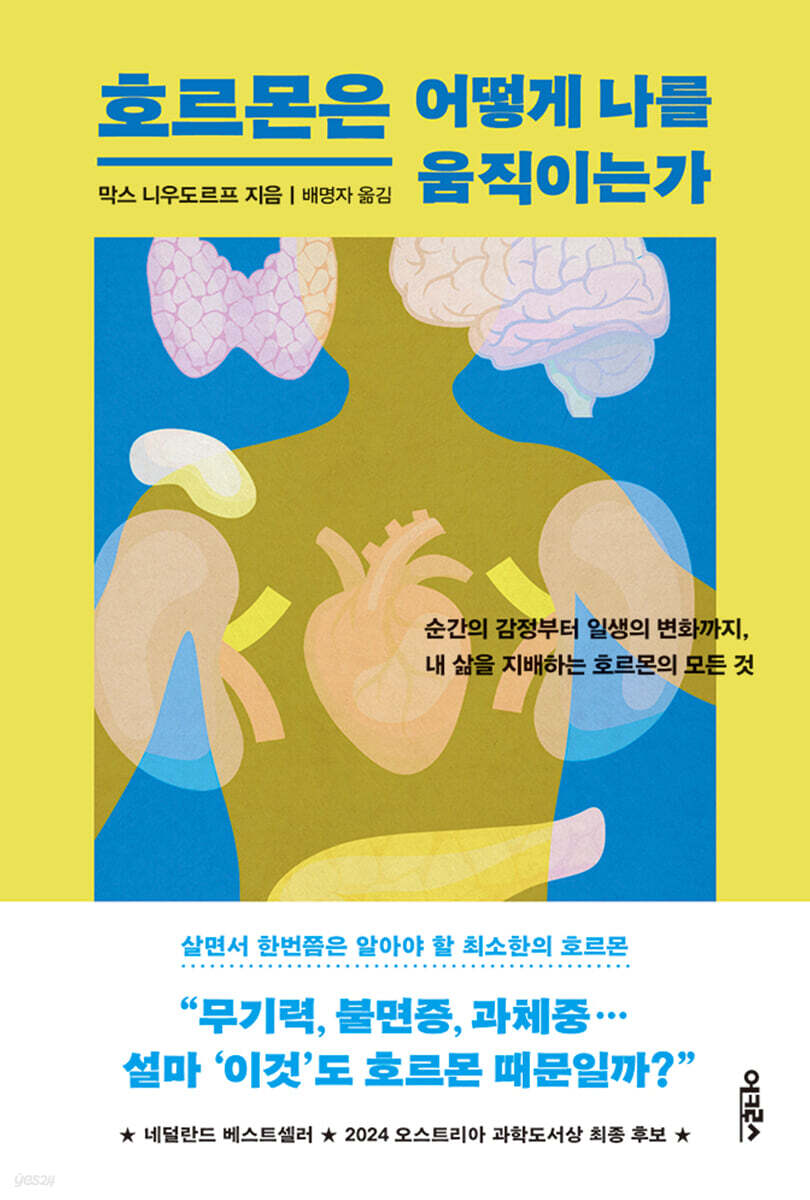
It shows the location and shape of representative hormone-secreting glands in pictures, and explains the hidden roles of familiar hormones that are often covered in the media, and that essential hormones that we did not know well, such as the hunger hormone 'ghrelin', are substances that drive not only momentary choices and emotions but also lifelong changes, in a very easy-to-understand way at the readers' level.
The birth of life begins not in the mother's womb, but in the brain?
A Life Cycle Hormone User's Guide for the Whole Family
Our bodies change throughout our lives, and we tend to experience more specific symptoms during life transitions.
In "How Hormones Move Me," the author shows how hormones play a crucial role at every stage of life.
We often think of life as beginning in the mother's womb, but it's hormones that create the egg and sperm cells and ensure they meet at the right place and time.
Reproduction begins in the brain.
Additionally, the fetus can determine the timing of the mother's labor through hormones and control the timing of its own birth.
Additionally, the author points out how crucial the first 1-3 years of life are, when hormonal storms occur, and that the 'micropuberty', which even parents were unaware of, is a golden time that determines the future of one's life.
We look into the physical and psychological characteristics of children in their growing years, who are greatly influenced by hormones, and do not spare any affectionate parenting advice.
For Koreans who have reached adulthood, the difference between their physical age and their actual age is particularly large.
Physical age refers to biological age, which indicates the state of health and degree of aging. For a healthy life, it is important to know how old you feel.
To do this, you need to be able to recognize the health warning signs that appear as you age.
These red flags are usually triggered by hormonal imbalances.
When the balance between 'ghrelin', which stimulates hunger, and 'leptin', which makes you feel full, is disrupted, it can lead to unwanted weight gain and diabetes, and when there is a lack of thyroid hormone, bowel movements become irregular and it can also have a significant impact on depression.
This book also suggests things we should check to prevent such a fragile hormonal balance.
Could a hormonal imbalance have caused a nuclear war?
From episodes of historical figures to the latest research on gut microbiota.
U.S. President John F.
Kennedy suffered from Addison's disease, a condition in which the adrenal glands malfunction and produce too few hormones.
Kennedy continued to receive hormone therapy, but the medical standards of the time made it difficult to maintain stable cortisol levels.
In the run-up to the 1961 Cuban Missile Crisis, he was scheduled to meet with Soviet leader Nikita Khrushchev.
Kennedy, as usual, took hormone injections in anticipation of this moment.
The problem was that Khrushchev was late for the meeting and Kennedy's cortisol levels were at rock bottom.
Many historians have noted that Kennedy was so disoriented that he could not speak properly, and that the breakdown in negotiations nearly led to nuclear war.
Meanwhile, Kennedy's hormonal imbalance also explains his beautiful complexion and voluptuous nature.
Hormones influence an individual's physical characteristics, behavior, emotions and moods, and even the decisions made at crucial moments that determine world peace.
In the early 1950s, Dutch female track and field athlete Fukje Dilemma was a top heroine who excelled in short distance races.
She had significantly higher testosterone levels than the average woman, which led the sports association to ban her from competing and require her to confirm her gender.
Although she lived her entire life as a woman, posthumous DNA testing revealed that she had a small, undescended testis in her abdominal cavity.
If there is a lack of the sex hormone testosterone during development, a boy may grow up as a girl with hidden external genitalia, or a genetic mosaic phenomenon may occur in which a boy is both male and female.
Other stories include the volatile personality of British Prime Minister Winston Churchill and the story of Joanna, the first female pope, who may have suffered from adrenogenital syndrome.
This book provides a wealth of reading material that will help you build your knowledge while also imparting scientific and health knowledge about hormones.
The author is leading research on the gut microbiome, a hot topic in science these days, and reveals how the various types of microbes that live in our gut affect hormone production and brain function.
Gut microbes are also expected to play an important role in the treatment of obesity and diabetes.
This will be an opportunity to examine scientific evidence that can help modern people with chronic diseases and their health.
Are humans destined to be 'slaves to hormones', obeying the commands of the brain?
A book that will help you break the invisible vicious cycle and regain control of your life.
If hormones are such powerful substances that control our bodies and minds, are we left to simply follow their commands? When we can't resist ordering a late-night snack, or when we're suddenly overcome by depression and abandon our work, we often blame it on our hormones.
The author warns that the common belief that humans are 'slaves to hormones' is incorrect.
While hormones can cloud our decision-making abilities, they shouldn't be an excuse to avoid responsibility for our actions.
This is because humans are a product of the interaction between body, mind, and environment, and there are certainly aspects where a proper understanding of our bodies can change our choices and decisions.
Appetite hormones can ruin your eating habits, but good eating habits can change your appetite hormones in turn.
If you want to break the invisible vicious cycle and take back control of your healthy life, hormones will give you the answer.
★ Finalist for the 2024 Austrian Science Book Award
★ Hormone User Manual from a World-Class Endocrinologist
Appetite and weight control, sleep quality, stress response, the immune system, reproduction and infertility… Hormones influence human life, aging, illness, death, and joy and sorrow!
Weight gain as you age, feeling tired no matter how much you sleep, and loss of motivation for no reason.
If your body no longer feels the same as it used to, it may be time to focus on your body's changes and pay attention to your hormones rather than building strength.
Behind our body's metabolism and emotional changes lie hormones that regulate various bodily functions through the bloodstream.
Even a slight disruption in the balance of these tiny chemicals can cause alarm bells to sound throughout the body.
Professor Max Nieudorf, a world-renowned endocrinologist, explains in his book, “How Hormones Move Me,” the major hormones and their functions at each stage of human life, from birth through pregnancy and childbirth to old age.
Looking at hormonal changes across the life cycle, we realize that hormones play a crucial role in determining quality of life, including why we wake up earlier as we age, the link between sleep disorders and diabetes, and changes in physical ability due to declines in sex hormones.
Until now, books on hormones have often focused on specific topics, such as why sexual differences exist between men and women, and how to improve habits to prevent aging.
That's why it's been a shame to be unable to comprehensively examine the vast and surprising influence of hormones.
This book covers the human life cycle, focusing on hormones, while also covering a variety of topics, including the nurture versus nature debate, appetite and weight control, gut microbiome, the immune system, sleep quality, and stress responses.
It shows the location and shape of representative hormone-secreting glands in pictures, and explains the hidden roles of familiar hormones that are often covered in the media, and that essential hormones that we did not know well, such as the hunger hormone 'ghrelin', are substances that drive not only momentary choices and emotions but also lifelong changes, in a very easy-to-understand way at the readers' level.
The birth of life begins not in the mother's womb, but in the brain?
A Life Cycle Hormone User's Guide for the Whole Family
Our bodies change throughout our lives, and we tend to experience more specific symptoms during life transitions.
In "How Hormones Move Me," the author shows how hormones play a crucial role at every stage of life.
We often think of life as beginning in the mother's womb, but it's hormones that create the egg and sperm cells and ensure they meet at the right place and time.
Reproduction begins in the brain.
Additionally, the fetus can determine the timing of the mother's labor through hormones and control the timing of its own birth.
Additionally, the author points out how crucial the first 1-3 years of life are, when hormonal storms occur, and that the 'micropuberty', which even parents were unaware of, is a golden time that determines the future of one's life.
We look into the physical and psychological characteristics of children in their growing years, who are greatly influenced by hormones, and do not spare any affectionate parenting advice.
For Koreans who have reached adulthood, the difference between their physical age and their actual age is particularly large.
Physical age refers to biological age, which indicates the state of health and degree of aging. For a healthy life, it is important to know how old you feel.
To do this, you need to be able to recognize the health warning signs that appear as you age.
These red flags are usually triggered by hormonal imbalances.
When the balance between 'ghrelin', which stimulates hunger, and 'leptin', which makes you feel full, is disrupted, it can lead to unwanted weight gain and diabetes, and when there is a lack of thyroid hormone, bowel movements become irregular and it can also have a significant impact on depression.
This book also suggests things we should check to prevent such a fragile hormonal balance.
Could a hormonal imbalance have caused a nuclear war?
From episodes of historical figures to the latest research on gut microbiota.
U.S. President John F.
Kennedy suffered from Addison's disease, a condition in which the adrenal glands malfunction and produce too few hormones.
Kennedy continued to receive hormone therapy, but the medical standards of the time made it difficult to maintain stable cortisol levels.
In the run-up to the 1961 Cuban Missile Crisis, he was scheduled to meet with Soviet leader Nikita Khrushchev.
Kennedy, as usual, took hormone injections in anticipation of this moment.
The problem was that Khrushchev was late for the meeting and Kennedy's cortisol levels were at rock bottom.
Many historians have noted that Kennedy was so disoriented that he could not speak properly, and that the breakdown in negotiations nearly led to nuclear war.
Meanwhile, Kennedy's hormonal imbalance also explains his beautiful complexion and voluptuous nature.
Hormones influence an individual's physical characteristics, behavior, emotions and moods, and even the decisions made at crucial moments that determine world peace.
In the early 1950s, Dutch female track and field athlete Fukje Dilemma was a top heroine who excelled in short distance races.
She had significantly higher testosterone levels than the average woman, which led the sports association to ban her from competing and require her to confirm her gender.
Although she lived her entire life as a woman, posthumous DNA testing revealed that she had a small, undescended testis in her abdominal cavity.
If there is a lack of the sex hormone testosterone during development, a boy may grow up as a girl with hidden external genitalia, or a genetic mosaic phenomenon may occur in which a boy is both male and female.
Other stories include the volatile personality of British Prime Minister Winston Churchill and the story of Joanna, the first female pope, who may have suffered from adrenogenital syndrome.
This book provides a wealth of reading material that will help you build your knowledge while also imparting scientific and health knowledge about hormones.
The author is leading research on the gut microbiome, a hot topic in science these days, and reveals how the various types of microbes that live in our gut affect hormone production and brain function.
Gut microbes are also expected to play an important role in the treatment of obesity and diabetes.
This will be an opportunity to examine scientific evidence that can help modern people with chronic diseases and their health.
Are humans destined to be 'slaves to hormones', obeying the commands of the brain?
A book that will help you break the invisible vicious cycle and regain control of your life.
If hormones are such powerful substances that control our bodies and minds, are we left to simply follow their commands? When we can't resist ordering a late-night snack, or when we're suddenly overcome by depression and abandon our work, we often blame it on our hormones.
The author warns that the common belief that humans are 'slaves to hormones' is incorrect.
While hormones can cloud our decision-making abilities, they shouldn't be an excuse to avoid responsibility for our actions.
This is because humans are a product of the interaction between body, mind, and environment, and there are certainly aspects where a proper understanding of our bodies can change our choices and decisions.
Appetite hormones can ruin your eating habits, but good eating habits can change your appetite hormones in turn.
If you want to break the invisible vicious cycle and take back control of your healthy life, hormones will give you the answer.
GOODS SPECIFICS
- Date of issue: April 9, 2024
- Page count, weight, size: 472 pages | 552g | 135*200*22mm
- ISBN13: 9791167741448
- ISBN10: 1167741447
You may also like
카테고리
korean


korean

![GQ KOREA Mark (Monthly): December [2025]](http://librairie.coreenne.fr/cdn/shop/files/8ef265dbbfbf186523ed75ba7319009d.jpg?v=1765340328&width=3840)


