

The material world
 |
Description
Book Introduction
- A word from MD
-
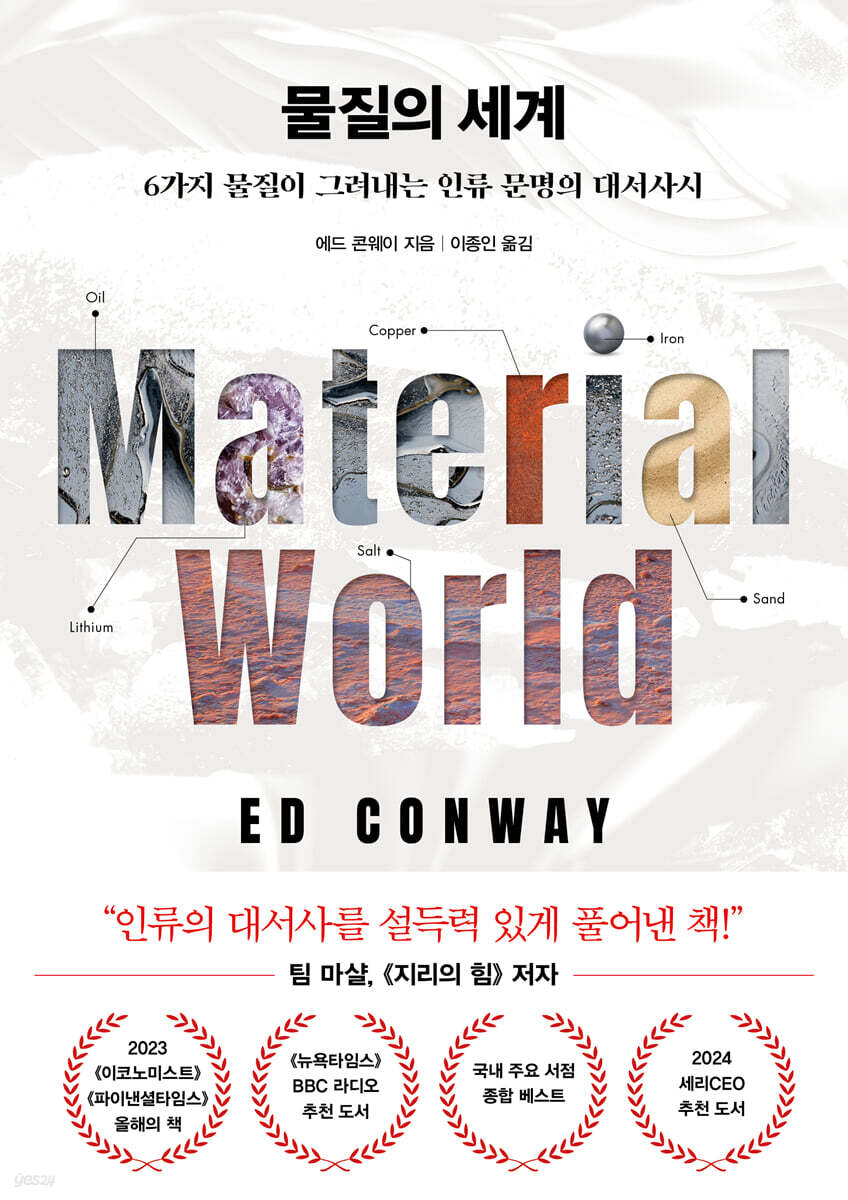
The epic created by matterThe popular educational book that took the world by storm in 2023 has finally been published in Korea.
A look at the history of mankind transformed by sand, salt, iron, copper, oil, and lithium.
From salt and iron, which determined the fate of ancient nations, to modern oil and lithium, a key material for secondary batteries.
This book is a must-read this year.
March 8, 2024. Humanities PD Son Min-gyu
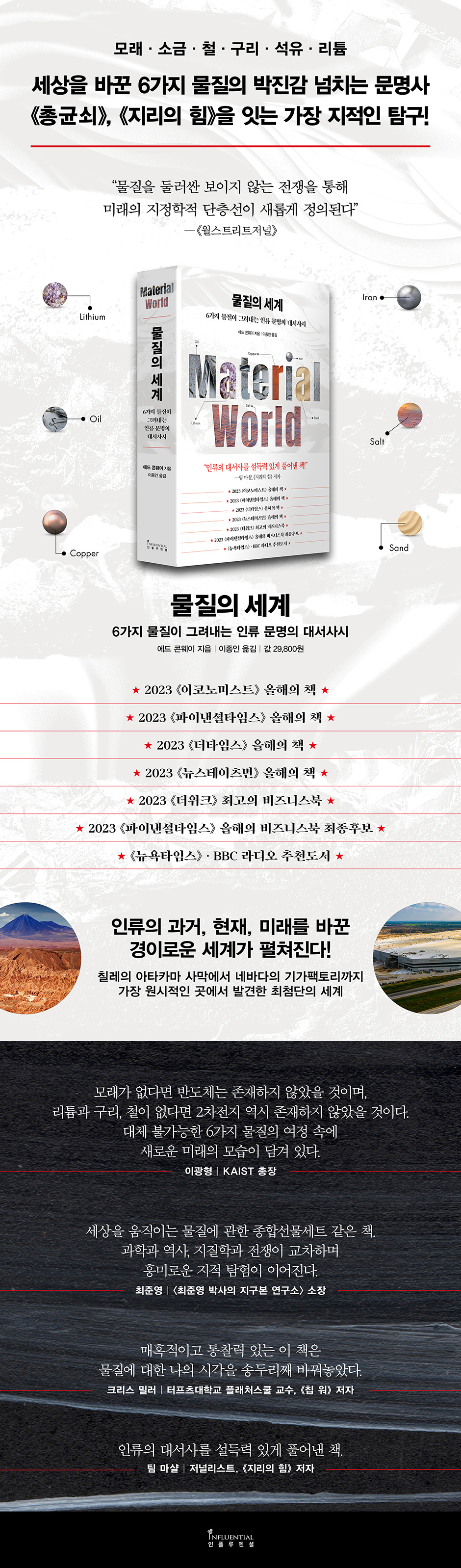
Sand, salt, iron, copper, petroleum, lithium
How Matter Moves History
The most intellectual exploration of matter that has expanded the human world
From Chile's Atacama Desert to Gigafactory Nevada,
A cutting-edge world discovered in the most primitive of places
* 2023 [Economist] Book of the Year / 2023 [New Statesman] Book of the Year
* 2023 [Financial Times] Book of the Year / 2023 [The Times] Book of the Year
* 2023 [The Week] Best Business Books
* 2023 [Financial Times] Business Book of the Year Finalist
* 2023 [New York Times] and BBC Radio Recommended Books
Sand, salt, iron, copper, petroleum, lithium.
These six substances are the most important substances in human history, expanding the human world from the Dark Ages to the highly developed society of modern times.
It powers our computers and smartphones, builds our homes and buildings, and makes life-saving medicines, yet most of us don't know what it is or how it affects our lives.
Ed Conway, author of "The World of Matter" and British journalist, guides readers into the wondrous world of matter we never knew existed.
From the sweltering depths of Europe's deepest mines to the pristine semiconductor factories of Taiwan and the salt lakes of Chile's Atacama Desert.
Through explorations around the world, the secrets of six irreplaceable substances that will bring about a new future for humanity are revealed.
How do materials evolve into amazingly complex products? Through the miraculous journeys of six substances and the stories of their hidden people, you can take a step closer to a new world of world-changing materials.
How Matter Moves History
The most intellectual exploration of matter that has expanded the human world
From Chile's Atacama Desert to Gigafactory Nevada,
A cutting-edge world discovered in the most primitive of places
* 2023 [Economist] Book of the Year / 2023 [New Statesman] Book of the Year
* 2023 [Financial Times] Book of the Year / 2023 [The Times] Book of the Year
* 2023 [The Week] Best Business Books
* 2023 [Financial Times] Business Book of the Year Finalist
* 2023 [New York Times] and BBC Radio Recommended Books
Sand, salt, iron, copper, petroleum, lithium.
These six substances are the most important substances in human history, expanding the human world from the Dark Ages to the highly developed society of modern times.
It powers our computers and smartphones, builds our homes and buildings, and makes life-saving medicines, yet most of us don't know what it is or how it affects our lives.
Ed Conway, author of "The World of Matter" and British journalist, guides readers into the wondrous world of matter we never knew existed.
From the sweltering depths of Europe's deepest mines to the pristine semiconductor factories of Taiwan and the salt lakes of Chile's Atacama Desert.
Through explorations around the world, the secrets of six irreplaceable substances that will bring about a new future for humanity are revealed.
How do materials evolve into amazingly complex products? Through the miraculous journeys of six substances and the stories of their hidden people, you can take a step closer to a new world of world-changing materials.
- You can preview some of the book's contents.
Preview
index
Prologue | A Journey into the Material World, Transcending Humanity's Past, Present, and Future
PART 1.
Sand | Cutting-edge technology born from the oldest
· Chapter 1: The World Seen Through Glass: In Search of the Most Perfect Grain of Sand
· Chapter 2: Light and Shadow in Concrete: A World Built on Sand
Chapter 3: The Birth of the Semiconductor: The Most Amazing Journey That Shaped Modern Society
PART 2.
Salt | The Magical Substance That Changes the World
Chapter 4: The Substance of Life: Human Civilization Begins on the Salt Road
Chapter 5: The Industrialization of Salt: The Revolution in Everyday Life Unleashed by Salt
Chapter 6 Gunpowder, the Trigger of War: Salt That Kills and Saves Life
―Behind the Scenes: He who controls salt controls the world.
PART 3.
Iron | The skeleton that makes up human society
Chapter 7: The War of Steel: Without Iron, There Is No Nation
Chapter 8: Into the Furnace: Fossil Fuels and the Industrial Revolution
· Chapter 9: A World Made of Steel: Things That Disappear in the Explosion
PART 4.
Copper | The Invisible Connected World
Chapter 10: The Copper Age: From Darkness to Light, the Birth of the Power Grid
· Chapter 11 Deeper Underground: Copper Shortages and the Depletion of Natural Resources
Chapter 12: New Frontiers: The Deep Sea, Deep-Sea Mining
PART 5.
Oil | Another Paradox of the Material World
Chapter 13: The Discovery of Crude Oil: The Energy That Moves the Earth
Chapter 14: Modern Alchemy: A Look at the Future from the Refinery
· Chapter 15: Fossil Fuel Products: Accidental Discoveries in the Plastic World
Behind the Scenes: The Energy Transition Begins
PART 6.
Lithium | Resource of the Future
Chapter 16: Salt Desert: The Lithium Industry That Started with White Gold
Chapter 17: The Age of Secondary Batteries: A New Energy Chronicle from the Gigafactory
Chapter 18: A Changing World: From the Resource Curse to the Future
Epilogue | In Search of the Hidden Driving Force of Matter and Humanity
Note
References
Acknowledgements
Search
PART 1.
Sand | Cutting-edge technology born from the oldest
· Chapter 1: The World Seen Through Glass: In Search of the Most Perfect Grain of Sand
· Chapter 2: Light and Shadow in Concrete: A World Built on Sand
Chapter 3: The Birth of the Semiconductor: The Most Amazing Journey That Shaped Modern Society
PART 2.
Salt | The Magical Substance That Changes the World
Chapter 4: The Substance of Life: Human Civilization Begins on the Salt Road
Chapter 5: The Industrialization of Salt: The Revolution in Everyday Life Unleashed by Salt
Chapter 6 Gunpowder, the Trigger of War: Salt That Kills and Saves Life
―Behind the Scenes: He who controls salt controls the world.
PART 3.
Iron | The skeleton that makes up human society
Chapter 7: The War of Steel: Without Iron, There Is No Nation
Chapter 8: Into the Furnace: Fossil Fuels and the Industrial Revolution
· Chapter 9: A World Made of Steel: Things That Disappear in the Explosion
PART 4.
Copper | The Invisible Connected World
Chapter 10: The Copper Age: From Darkness to Light, the Birth of the Power Grid
· Chapter 11 Deeper Underground: Copper Shortages and the Depletion of Natural Resources
Chapter 12: New Frontiers: The Deep Sea, Deep-Sea Mining
PART 5.
Oil | Another Paradox of the Material World
Chapter 13: The Discovery of Crude Oil: The Energy That Moves the Earth
Chapter 14: Modern Alchemy: A Look at the Future from the Refinery
· Chapter 15: Fossil Fuel Products: Accidental Discoveries in the Plastic World
Behind the Scenes: The Energy Transition Begins
PART 6.
Lithium | Resource of the Future
Chapter 16: Salt Desert: The Lithium Industry That Started with White Gold
Chapter 17: The Age of Secondary Batteries: A New Energy Chronicle from the Gigafactory
Chapter 18: A Changing World: From the Resource Curse to the Future
Epilogue | In Search of the Hidden Driving Force of Matter and Humanity
Note
References
Acknowledgements
Search
Detailed image
Into the book
Without this world, the beautiful smartphone in your hand wouldn't work, and electric cars wouldn't have batteries.
The material world may not provide you with a fancy home, but it does provide the support that keeps your home standing.
It keeps you warm, clean, well-fed and well-off without you having to worry about it.
---From "Prologue | A Journey into the Material World, Transcending Humanity's Past, Present, and Future"
Is it a coincidence that the Renaissance arose in places where cheap, efficient mirrors suddenly appeared, whether in northern Italy or the Netherlands? Is it a coincidence that the Enlightenment and the Industrial Revolution followed in countries that actively embraced glassmaking technology, while those that rejected it, like China and the Middle East, experienced economic decline over the next few centuries?
---「Part 1.
Sand | Chapter 1 From "The World Seen Through Glass"
“It’s really scary.
If someone were to spray a spruce pine mine with a truckload of pesticides, the entire world's semiconductor and solar panel production would be shut down within six months.” Without high-purity quartz, there would be no Czochralski crucibles.
Neither single-crystal silicon wafers nor semiconductors can be produced.
---「Part 1.
Sand | Chapter 3: The Birth of Semiconductors
Another reason why this material should not be ignored is that it is the best starting point for understanding capitalism and power.
Salt has been an essential commodity for human survival, and various unknown salts have supported our lives, so it has been used as a tool of power since the early days of mankind.
---「Part 2.
Salt | Chapter 4: The Substance of Life
Trump wasn't the only politician who thought steel deserved special treatment.
Almost every US president, Republican or Democratic, has protected the steel industry through special sanctions.
---「Part 3.
Iron | Chapter 7: The Steel War
This was not a simple industrial revolution.
It was a material revolution, and above all, an energy revolution.
It was humanity's first great energy transition, moving from wood and charcoal to fossil fuels.
---「Part 3.
Iron | Chapter 8 Into the Furnace
Copper has a special charm.
This glittering metal is a symbol of ancient history and a key to the future.
Mining magnate Robert Friedland once said:
“If we consider ecological and environmental problems, all solutions must be found in copper,” declared Goldman Sachs, an American investment bank, in a 2021 report, declaring that “copper is the new oil.”
---「Part 4.
Copper | Chapter 10 From "The Age of Copper"
While we've become more adept at extracting copper from old mines, the rate at which new mines are discovered and opened is slowing.
If things continue this way, a significant portion of the copper on the Earth's surface may become unminable.
This is a paradox we are just beginning to grapple with.
Without copper, the carbon neutrality blueprints outlined by governments and environmental agencies cannot be realized.
---「Part 4.
Copper | Chapter 11 Deeper into the Ground
The oil age, which followed the coal age, freed humanity from arduous and monotonous physical labor, raised global incomes, and allowed us to live longer.
Petroleum products and petroleum energy have reduced infant mortality and helped fight malnutrition.
In other words, it is difficult to imagine a world without oil, a source of fuel and chemicals.
---「Part 5.
Petroleum | Chapter 13: The Discovery of Crude Oil
But in the process of pumping crude oil from the ground, we are destroying geological cycles that have been going on since before humans existed.
As oil and gas are burned, carbon dioxide that had been sequestered underground is released back into the atmosphere, triggering a new era of global warming.
---「Part 5.
Petroleum | Chapter 13: The Discovery of Crude Oil
All of this makes lithium seem like a bit of an oddball in the material world.
The other five substances we've discussed so far have been essential to our lives for centuries, if not generations.
If this book had come out a few decades ago, lithium wouldn't have made it to the final list.
---「Part 6.
Lithium | Chapter 16 Salt Desert
The explanation is that Tesla was able to establish such a great position because it chose the right battery type at the right time.
As Tesla was rushing to assemble the components that would make up its first car, the Roadster, something groundbreaking was happening somewhere in the battery industry.
---「Part 6.
Lithium | Chapter 17: The Era of Secondary Batteries
Humanity faces some turbulent years ahead.
For decades, we have been convinced that the primary limitation of humankind is a lack of imagination.
We created a very sophisticated and sleek economic system, and then we completely forgot about the material that built it.
However, as we strive to achieve carbon neutrality, we face the unavoidable limitations of thermodynamics and material constraints.
The material world may not provide you with a fancy home, but it does provide the support that keeps your home standing.
It keeps you warm, clean, well-fed and well-off without you having to worry about it.
---From "Prologue | A Journey into the Material World, Transcending Humanity's Past, Present, and Future"
Is it a coincidence that the Renaissance arose in places where cheap, efficient mirrors suddenly appeared, whether in northern Italy or the Netherlands? Is it a coincidence that the Enlightenment and the Industrial Revolution followed in countries that actively embraced glassmaking technology, while those that rejected it, like China and the Middle East, experienced economic decline over the next few centuries?
---「Part 1.
Sand | Chapter 1 From "The World Seen Through Glass"
“It’s really scary.
If someone were to spray a spruce pine mine with a truckload of pesticides, the entire world's semiconductor and solar panel production would be shut down within six months.” Without high-purity quartz, there would be no Czochralski crucibles.
Neither single-crystal silicon wafers nor semiconductors can be produced.
---「Part 1.
Sand | Chapter 3: The Birth of Semiconductors
Another reason why this material should not be ignored is that it is the best starting point for understanding capitalism and power.
Salt has been an essential commodity for human survival, and various unknown salts have supported our lives, so it has been used as a tool of power since the early days of mankind.
---「Part 2.
Salt | Chapter 4: The Substance of Life
Trump wasn't the only politician who thought steel deserved special treatment.
Almost every US president, Republican or Democratic, has protected the steel industry through special sanctions.
---「Part 3.
Iron | Chapter 7: The Steel War
This was not a simple industrial revolution.
It was a material revolution, and above all, an energy revolution.
It was humanity's first great energy transition, moving from wood and charcoal to fossil fuels.
---「Part 3.
Iron | Chapter 8 Into the Furnace
Copper has a special charm.
This glittering metal is a symbol of ancient history and a key to the future.
Mining magnate Robert Friedland once said:
“If we consider ecological and environmental problems, all solutions must be found in copper,” declared Goldman Sachs, an American investment bank, in a 2021 report, declaring that “copper is the new oil.”
---「Part 4.
Copper | Chapter 10 From "The Age of Copper"
While we've become more adept at extracting copper from old mines, the rate at which new mines are discovered and opened is slowing.
If things continue this way, a significant portion of the copper on the Earth's surface may become unminable.
This is a paradox we are just beginning to grapple with.
Without copper, the carbon neutrality blueprints outlined by governments and environmental agencies cannot be realized.
---「Part 4.
Copper | Chapter 11 Deeper into the Ground
The oil age, which followed the coal age, freed humanity from arduous and monotonous physical labor, raised global incomes, and allowed us to live longer.
Petroleum products and petroleum energy have reduced infant mortality and helped fight malnutrition.
In other words, it is difficult to imagine a world without oil, a source of fuel and chemicals.
---「Part 5.
Petroleum | Chapter 13: The Discovery of Crude Oil
But in the process of pumping crude oil from the ground, we are destroying geological cycles that have been going on since before humans existed.
As oil and gas are burned, carbon dioxide that had been sequestered underground is released back into the atmosphere, triggering a new era of global warming.
---「Part 5.
Petroleum | Chapter 13: The Discovery of Crude Oil
All of this makes lithium seem like a bit of an oddball in the material world.
The other five substances we've discussed so far have been essential to our lives for centuries, if not generations.
If this book had come out a few decades ago, lithium wouldn't have made it to the final list.
---「Part 6.
Lithium | Chapter 16 Salt Desert
The explanation is that Tesla was able to establish such a great position because it chose the right battery type at the right time.
As Tesla was rushing to assemble the components that would make up its first car, the Roadster, something groundbreaking was happening somewhere in the battery industry.
---「Part 6.
Lithium | Chapter 17: The Era of Secondary Batteries
Humanity faces some turbulent years ahead.
For decades, we have been convinced that the primary limitation of humankind is a lack of imagination.
We created a very sophisticated and sleek economic system, and then we completely forgot about the material that built it.
However, as we strive to achieve carbon neutrality, we face the unavoidable limitations of thermodynamics and material constraints.
---「Part 6.
Lithium | Chapter 18 From “The Changing World”
Lithium | Chapter 18 From “The Changing World”
Publisher's Review
Sand, salt, iron, copper, petroleum, lithium
How Underground Materials Drive History Above Ground
A thrilling history of civilization, following in the footsteps of Guns, Germs, and Steel and The Power of Geography.
“A book that compellingly unravels the epic of humanity.”
—Tim Marshall, author of The Power of Geography
Ed Conway, an economics reporter for the British news channel Sky News, learned that it takes between 4 and 20 tons of ore to mine the gold used in his wedding ring at a mine he visited for reporting.
If such a huge amount of resources and materials are used to make even the small objects we use without thinking, how much of the truly important materials are made and how?
"The World of Materials" is a travelogue that explores the world and the history of human civilization as it travels to various locations around the globe in search of the six irreplaceable materials (sand, salt, iron, copper, petroleum, and lithium) that have changed the world and will shape the future.
Lithium produced in Chile's Atacama Salt Flats reaches us as secondary batteries at Gigafactory Nevada in the United States.
Sand from the UK's Localin mine becomes silicon, creating a cutting-edge future at Taiwan's TSMC semiconductor plant, where there's not a single speck of dust.
Amidst the invisible competition for resources, such as the Renaissance and the Industrial Revolution, wars and civil wars, what choices should we make for the future?
As you journey around the world in search of these six substances, you will gain new perspectives on the substances that create modern society and transform the future.
How did matter shape human civilization and history?
Semiconductors are born from sand, secondary batteries from lithium, and power grids from copper.
A cutting-edge world in the most primitive of places
We live in an immaterial world where intangible values like knowledge and information are prioritized, and the pursuit of material values like oil, iron, salt, and sand is considered outdated.
It's easy to think of modern society, centered on social media, the Internet, knowledge-based industries, and services, as well as a future society dominated by cutting-edge technologies like artificial intelligence and robots, as a post-material world, a world free from material things.
But media and the internet cannot exist without energy and power grids, and the spaces where services are provided and means of transportation like cars and airplanes cannot be sustained without concrete, cement, fossil fuels, and batteries.
The immaterial world we live in is built on the support of the material world, which is not apparent on the surface.
The resources that make up the material world are abundantly available throughout the world.
Chile, a treasure trove of salt, copper, and lithium, and an emerging resource powerhouse; Bolivia and Argentina, which together form South America's lithium triangle; Saudi Arabia, which possesses abundant oil reserves; and Russia and Ukraine, which are treasure troves of iron ore. If you follow the footsteps of civilizations and history created through materials over a long period of time, you will encounter the light and shadows cast by materials.
In countries that adopted glassmaking technology, the Renaissance and the Industrial Revolution followed, and World War II was also influenced by glass and iron.
The rich mineral wealth made Britain the starting point of the Industrial Revolution.
Why are pharmaceutical and chemical companies located in salt-producing regions? This book offers a glimpse into the pivotal moments in human history that shaped the material world.
Matter is the backbone of civilization, and without it humanity cannot survive.
● Sand, salt, iron, copper, petroleum, lithium
Why six substances?
The six substances covered in this book constitute essential elements of modern society, and in most areas there are no immediate substitutes.
Almost everything that surrounds us and constitutes our environment relies on the material world.
Part 1: Sand contains cutting-edge technologies born from the oldest things.
If we trace the footsteps of humans who have formed things around materials, we will find that everything from glass, the world's oldest product, to semiconductors, the most advanced technology today, to the concrete that forms the skyscrapers of our cities, all came from sand.
Part 2, Salt, covers the history, civilization, and war that developed along the Salt Road.
Salt can save lives, but it can also be used to take lives through gunpowder.
Without salt, mass food production would be impossible, the world would starve, and the COVID-19 vaccine would not be available to us.
Part 3: Iron deals with iron and steel, which enable us to live as instrumental human beings who cooperate.
We consume 15 tons of iron in our lifetime.
From iconic structures like the Eiffel Tower and city skyscrapers to why the Industrial Revolution began in Britain, we explore the journey of iron, which transformed our lives from rock to metal.
"Part 4 Copper" may seem a little distant from our lives.
But the power grid created by copper allows us to stay safe at night and live in a society that is connected to every corner of the globe.
Copper isn't just mined from the ground.
You'll experience a vivid scene where new frontiers are being defined through deep-sea mining operations.
Part 5: Oil deals with the irony of fossil fuels.
Oil, which brought efficiency from steam engines to internal combustion engines, triggered the era of global warming.
Although calls to reduce fossil fuel use are growing louder, oil and gas account for 55 percent of total energy, and humanity is still living in the age of fossil fuels.
Part 6: Lithium covers lithium, a key material in secondary batteries that is attracting attention as a new alternative energy source, and future resources.
Lithium produced in the salt flats of the Atacama Desert in Chile is turned into secondary batteries at Tesla's Gigafactory in Nevada, USA.
The massive amounts of cobalt mined in Congo can also lead to tragedy.
We are once again confronted with the irony of the material world, where companies that once exploited resources and labor are now transforming into renewable energy companies, leading the circular economy.
The presence or absence of these six substances does not threaten human survival.
But without these substances, humanity would not have been able to develop civilization and achieve prosperity.
From the Renaissance and the Industrial Revolution to World Wars I and II, material has been at the heart of crucial moments in human history, and the future that unfolds will also be built on material.
● “Through the invisible war surrounding material
“The geopolitical fault lines of the future are being redefined.”
A new perspective on the history of civilization that has captured the attention of the world
"The Material World" presents the history of civilization that humans have created and will create through sites around the world, based on a balanced perspective that transcends any one field, such as history, economics, science, or war.
Most people have enjoyed the fruits of the earth without having to dig and touch the material.
How was the smartphone we hold in our hands every day created? What process did the pen go through to reach my desk? Have you ever considered how much of the world's resources are being destroyed for our own convenience?
We must no longer be trapped in the immaterial world, but live a life connected to the material world.
Because the material world is not a space that remains in a disconnected past, but rather shows the way to the future.
The journey depicted by the six substances contained in this book will help us escape the world we live in and move into the material world, becoming the first step toward understanding it.
How Underground Materials Drive History Above Ground
A thrilling history of civilization, following in the footsteps of Guns, Germs, and Steel and The Power of Geography.
“A book that compellingly unravels the epic of humanity.”
—Tim Marshall, author of The Power of Geography
Ed Conway, an economics reporter for the British news channel Sky News, learned that it takes between 4 and 20 tons of ore to mine the gold used in his wedding ring at a mine he visited for reporting.
If such a huge amount of resources and materials are used to make even the small objects we use without thinking, how much of the truly important materials are made and how?
"The World of Materials" is a travelogue that explores the world and the history of human civilization as it travels to various locations around the globe in search of the six irreplaceable materials (sand, salt, iron, copper, petroleum, and lithium) that have changed the world and will shape the future.
Lithium produced in Chile's Atacama Salt Flats reaches us as secondary batteries at Gigafactory Nevada in the United States.
Sand from the UK's Localin mine becomes silicon, creating a cutting-edge future at Taiwan's TSMC semiconductor plant, where there's not a single speck of dust.
Amidst the invisible competition for resources, such as the Renaissance and the Industrial Revolution, wars and civil wars, what choices should we make for the future?
As you journey around the world in search of these six substances, you will gain new perspectives on the substances that create modern society and transform the future.
How did matter shape human civilization and history?
Semiconductors are born from sand, secondary batteries from lithium, and power grids from copper.
A cutting-edge world in the most primitive of places
We live in an immaterial world where intangible values like knowledge and information are prioritized, and the pursuit of material values like oil, iron, salt, and sand is considered outdated.
It's easy to think of modern society, centered on social media, the Internet, knowledge-based industries, and services, as well as a future society dominated by cutting-edge technologies like artificial intelligence and robots, as a post-material world, a world free from material things.
But media and the internet cannot exist without energy and power grids, and the spaces where services are provided and means of transportation like cars and airplanes cannot be sustained without concrete, cement, fossil fuels, and batteries.
The immaterial world we live in is built on the support of the material world, which is not apparent on the surface.
The resources that make up the material world are abundantly available throughout the world.
Chile, a treasure trove of salt, copper, and lithium, and an emerging resource powerhouse; Bolivia and Argentina, which together form South America's lithium triangle; Saudi Arabia, which possesses abundant oil reserves; and Russia and Ukraine, which are treasure troves of iron ore. If you follow the footsteps of civilizations and history created through materials over a long period of time, you will encounter the light and shadows cast by materials.
In countries that adopted glassmaking technology, the Renaissance and the Industrial Revolution followed, and World War II was also influenced by glass and iron.
The rich mineral wealth made Britain the starting point of the Industrial Revolution.
Why are pharmaceutical and chemical companies located in salt-producing regions? This book offers a glimpse into the pivotal moments in human history that shaped the material world.
Matter is the backbone of civilization, and without it humanity cannot survive.
● Sand, salt, iron, copper, petroleum, lithium
Why six substances?
The six substances covered in this book constitute essential elements of modern society, and in most areas there are no immediate substitutes.
Almost everything that surrounds us and constitutes our environment relies on the material world.
Part 1: Sand contains cutting-edge technologies born from the oldest things.
If we trace the footsteps of humans who have formed things around materials, we will find that everything from glass, the world's oldest product, to semiconductors, the most advanced technology today, to the concrete that forms the skyscrapers of our cities, all came from sand.
Part 2, Salt, covers the history, civilization, and war that developed along the Salt Road.
Salt can save lives, but it can also be used to take lives through gunpowder.
Without salt, mass food production would be impossible, the world would starve, and the COVID-19 vaccine would not be available to us.
Part 3: Iron deals with iron and steel, which enable us to live as instrumental human beings who cooperate.
We consume 15 tons of iron in our lifetime.
From iconic structures like the Eiffel Tower and city skyscrapers to why the Industrial Revolution began in Britain, we explore the journey of iron, which transformed our lives from rock to metal.
"Part 4 Copper" may seem a little distant from our lives.
But the power grid created by copper allows us to stay safe at night and live in a society that is connected to every corner of the globe.
Copper isn't just mined from the ground.
You'll experience a vivid scene where new frontiers are being defined through deep-sea mining operations.
Part 5: Oil deals with the irony of fossil fuels.
Oil, which brought efficiency from steam engines to internal combustion engines, triggered the era of global warming.
Although calls to reduce fossil fuel use are growing louder, oil and gas account for 55 percent of total energy, and humanity is still living in the age of fossil fuels.
Part 6: Lithium covers lithium, a key material in secondary batteries that is attracting attention as a new alternative energy source, and future resources.
Lithium produced in the salt flats of the Atacama Desert in Chile is turned into secondary batteries at Tesla's Gigafactory in Nevada, USA.
The massive amounts of cobalt mined in Congo can also lead to tragedy.
We are once again confronted with the irony of the material world, where companies that once exploited resources and labor are now transforming into renewable energy companies, leading the circular economy.
The presence or absence of these six substances does not threaten human survival.
But without these substances, humanity would not have been able to develop civilization and achieve prosperity.
From the Renaissance and the Industrial Revolution to World Wars I and II, material has been at the heart of crucial moments in human history, and the future that unfolds will also be built on material.
● “Through the invisible war surrounding material
“The geopolitical fault lines of the future are being redefined.”
A new perspective on the history of civilization that has captured the attention of the world
"The Material World" presents the history of civilization that humans have created and will create through sites around the world, based on a balanced perspective that transcends any one field, such as history, economics, science, or war.
Most people have enjoyed the fruits of the earth without having to dig and touch the material.
How was the smartphone we hold in our hands every day created? What process did the pen go through to reach my desk? Have you ever considered how much of the world's resources are being destroyed for our own convenience?
We must no longer be trapped in the immaterial world, but live a life connected to the material world.
Because the material world is not a space that remains in a disconnected past, but rather shows the way to the future.
The journey depicted by the six substances contained in this book will help us escape the world we live in and move into the material world, becoming the first step toward understanding it.
GOODS SPECIFICS
- Date of issue: March 8, 2024
- Page count, weight, size: 584 pages | 952g | 152*215*35mm
- ISBN13: 9791168341746
- ISBN10: 1168341744
You may also like
카테고리
korean


korean

![ELLE 엘르 스페셜 에디션 A형 : 12월 [2025]](http://librairie.coreenne.fr/cdn/shop/files/b8e27a3de6c9538896439686c6b0e8fb.jpg?v=1766436872&width=3840)


