

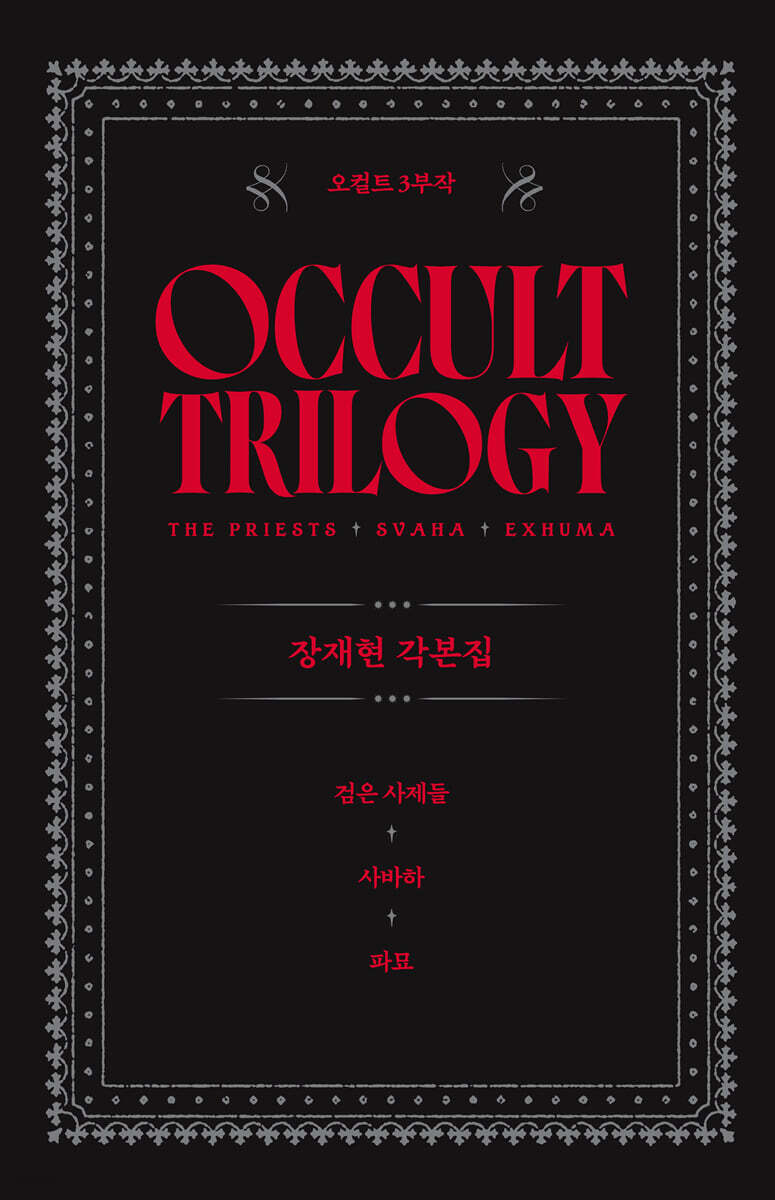
Occult Trilogy: Jang Jae-hyun's Screenplay Collection
 |
Description
Book Introduction
- A word from MD
-
Director Jang Jae-hyun's K-OccultA collection of scripts by director Jang Jae-hyun, who has built a K-occult worldview through “The Priests” in 2015, “Svaha: The Sixth Finger” in 2019, and “The Grave” in 2024.
Jang Jae-hyun shows the beginning, present, and future of the occult.
The original script, rich in detail, offers the pleasure of rereading the film in literal form, inviting readers into an occult world.
May 17, 2024. Art PD Ahn Hyun-jae
2015 The Priests | 2019 Svaha | 2024 Exhumed Grave
Jang Jae-hyun: The Beginning, Present, and Future of Occultism
Occult Trilogy: Jang Jae-hyun's Script Collection
A screenplay is the starting point of a work, where a story that existed only in the creator's mind before being made into a movie is revealed.
While it is a starting point, the script that you read after watching the final product, the film, is also a final gift for the audience, allowing them to revisit moments they may have missed or inadvertently overlooked in the film.
Director Jang Jae-hyun has created an unapproachable K-occult worldview that satisfies both artistic quality and popularity through “The Priests” in 2015, “Svaha: The Sixth Finger” in 2019, and “The Grave” in 2024.
Now, we will delve deeper and more deeply into the beginning, present, and future of Jang Jae-hyun's occult work with 『Occult Trilogy: Jang Jae-hyun's Script Collection』.
This set, which contains the screenplays for three films he created over a period of ten years, “The Priests,” “Svaha: The Sixth Finger,” and “The Grave,” contains many hints that will help you get one step closer to the world of director Jang Jae-hyun, who is famous for writing all of his screenplays on his own.
It also contains the director's gratitude to the audience who have loved his work for a long time since his debut, as well as his determination to build an even more anticipated occult filmography in the future.
- You can preview some of the book's contents.
Preview
Detailed image

Into the book
A huge crowd fills the street, and beyond that is the parking lot of Myeongdong Art Theater.
In a dark corner, someone dressed in black was smoking a cigarette anxiously.
Black coat with small briefcase.
That man looks a bit anxious.
And a shining Roman collar around his neck.
Happy-looking people moving busily on the bright streets.
A bride smoking a cigarette anxiously in the darkness beyond which no one knows.
I felt like he was going to save the world.
This is how the 〈12th Assistant Priest〉 and the 〈Black Priests〉 began.
---From "The Priests: The Director's Note"
Father Kim
Tell me! Why are you here?
Vice-Minister Choi
In nomine Patris, et Filii et Spiritus Sancti, ex te quaero.
Ad quid venisti huc?!
part.
saint.
I ask in the name of the Holy Spirit.
Why did you come here!
Youngshin
Wir sind gekommen um euch zu zeigen, dass ihr nichts als Affen seid.
And wir werden es eurem hochsten.
Richter beweisen.
Benutze doch deinen.
Verstand.
Homo sapiens sapiens!
we are...
I've come to prove to you that you are monkeys.
And I will show it to your judges.
Use your head.
sapient...
Sapiens...
---「'#81.
Yeongshin's House Attic, Night' / From the script for "The Priests"
“Sabaha” is a tragedy.
Countless children and people involved died during a process that seemed rather complicated.
So, on the day the gold coin was born, countless goats, that is, sacrificial lambs born in the same year, would have been weeping so sadly.
I simply didn't want to make the audience leave the theater with the futility and sadness of those sacrifices.
If it's greed, it's greed... but I wanted to talk, I wanted to resent, and I wanted to pray.
Where are you? Wake up… Rise up…
---From "The Director's Note from 'Savaha'"
that
Hey, why did you come only now? It took so long.
The hairs on the back of Nahan's neck stand on end when he hears its voice.
Nahan
Who are you...?
you...
that
I am the one who is crying
It moves its two hands slowly again, making a gesture of silence and continues speaking.
that
Don't be afraid, I've been waiting for you.
Hurry up, there's too much blood being shed.
---「'#126.
The House of Gold_ Inside the Barn, Night' / From the script for "Sabaha"
I heard the story about the concubine.
The story of another coffin discovered by chance underneath the first coffin, just as the cremation was being completed and the work was about to be finished.
So this movie also had to have a story.
The second task starts again by chance, just as the first task is over.
Just as the fox cut the tiger's waist... this story had to be cut in two.
But it was possible because there was a continuity of time that delved into pro-Japanese collaborators and Japanese militarism.
---From "The Director's Note from 'The Grave'"
Hwarim (Japanese)
As soon as I tell you, it's okay to say something.
As the owner of this place, I will ask again.
How long have you been here?
Oni (Old Japanese)
忘れもしない...いかづちの最中の大正14年10月15日...
だがわしのための祭祀ではなかった。畜生め...
Remember...
October 15, 1914, when thunder rumbled...
But there was no sacrifice for me.
Fuck...
/ Bonggil's hospital room
Bong-gil speaks through gritted teeth.
Bongil (Old Japanese)
To live, to live...
You fucking fox cub...
---「'#106.
Attention / Mountain Top_ Graveyard / Bonggil's Hospital Room.
Night' / From the script for "The Grave"
Publisher's Review
The first Korean film to reach 10 million viewers in 2024 and the highest-grossing Korean occult film of all time, "The Grave."
"Sabaha," which depicts the sorrow of humanity standing before God in 2019
2015 Korean Catholic Exorcism "Black Priests"
"Jang Jae-hyun's Occult" has become a genre, securing both artistic value and popularity.
Jang Jae-hyun: The Beginning, Present, and Future of Occultism
Meet the original script, revealed for the first time
Director Jang Jae-hyun began to attract attention with his debut film, The Priests (2015), which featured an occult mystery centered around two Catholic priests and featured Catholic exorcism, a rare phenomenon in Korean films.
In 2019, he once again delivers a profound message with "Sabaha," a solid story intricately interwoven with religious symbols and a question about the existence of God.
And in 2024, the film "The Digging Grave," which centers on the bizarre events that unfold among a geomancer, an undertaker, and shamans who try to relocate a suspicious grave, achieved the first 10 million viewers in 2024 and set a record as the highest-grossing Korean occult film of all time.
For the past 10 years, Jang Jae-hyun's Occult has been focusing solely on the occult, providing both meaning and entertainment to audiences, and has become a trusted brand and genre.
The beginning, present, and future of Jang Jae-hyun's occult filmography are revealed in an original script collection that has never been released before.
The joy of reading a script:
How to get to know the movies you love more deeply
Readers who watch the film first and then read the script will be able to understand and accept the film they saw, felt, and remembered in a new way through the letters and margins.
In particular, the joy of encountering parts in the original script that were not in the movie is perhaps the greatest pleasure of reading a script book.
As I encounter scenes and lines I was not familiar with, as I compare the flow of the script with the finished film after filming and editing, and as I discover detailed descriptions of beloved characters and the breathing and space between lines, I once again develop a special affection for the work.
In the scripts for “The Priests,” “Svaha,” and “The Grave,” which are being released for the first time, you will often encounter scenes, lines, and texts that are not in the films.
In particular, in this script collection, you can check out hidden details by revisiting the lines in the work.
The charm of seeing the lines expressed in various languages, including Latin, in “The Black Priests” and the original ancient Japanese text of “The Graveyard,” printed in print, is a special attraction unique to this script collection.
The pleasure of reading the original text and the Korean dialogue together and recalling the characters and actors who spoke those lines is another wonderful way to rediscover the film and preserve its lingering impact.
GOODS SPECIFICS
- Date of issue: May 16, 2024
- Page count, weight, size: 600 pages | 814g | 128*188*47mm
- ISBN13: 9791198656841
- ISBN10: 1198656840
You may also like
카테고리
korean


korean


