

The country is an illusion
 |
Description
Book Introduction
- A word from MD
-
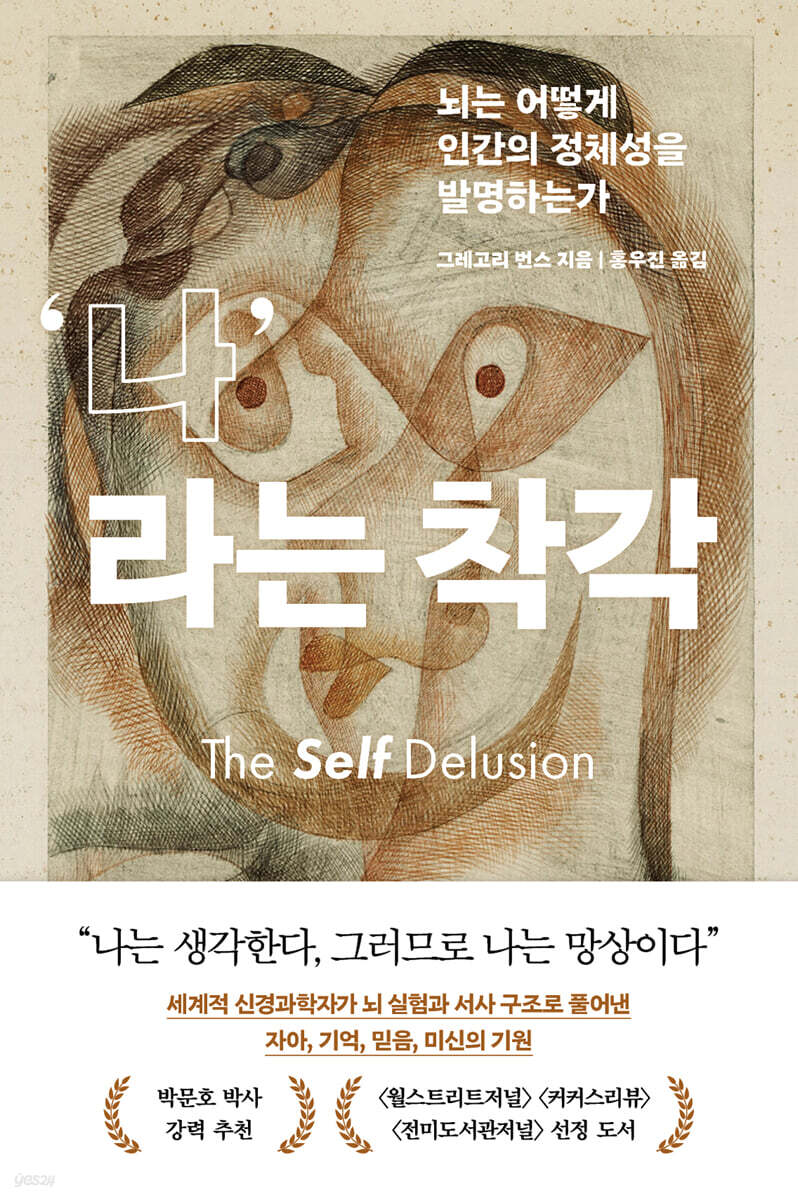
The Secret of the Brain That Creates 'The Me I Want'What is the self?
Neuroscientist Gregory Burns defines the self as "an edited story about myself," compiled from specific parts of countless memories.
Based on this, it is argued that if we understand the brain's mechanisms, we can create 'the me I want to be'.
We invite readers to the secrets of brain science that say we become what we eat.
March 15, 2024. Natural Science PD Ahn Hyun-jae
“I think, therefore I am delusional.”
A world-renowned neuroscientist explains the brain through experiments and narrative structure.
The origins of self, memory, belief, and superstition
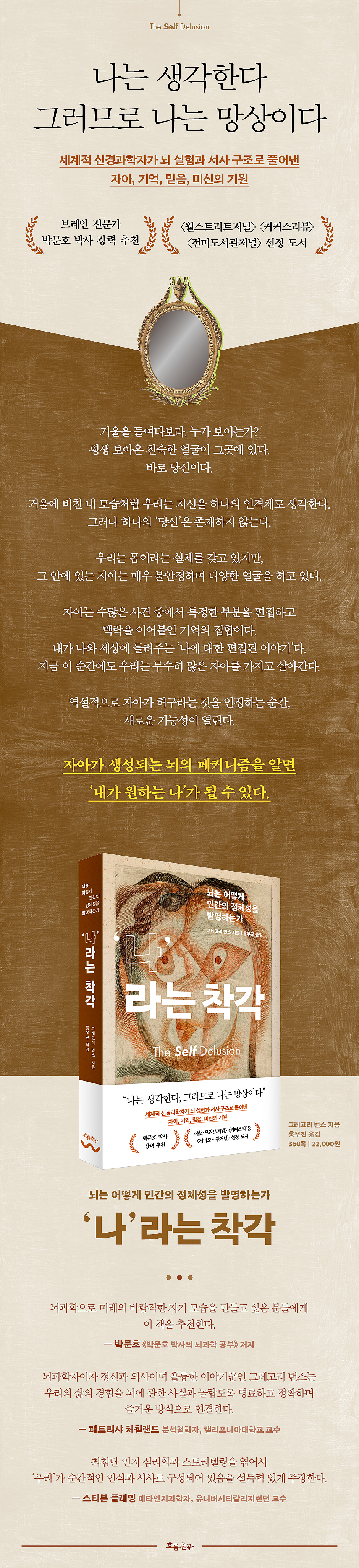
Look in the mirror.
What do you see?
There are familiar faces there that I have seen all my life.
It's you.
Like our reflection in the mirror, we think of ourselves as a single individual.
But neuroscientist and psychiatrist Gregory Burns says there is no one "you."
We have a physical body, but the self within it is very unstable and has many faces.
《The Illusion of a Nation》 draws on various disciplines, including neuroscience, psychology, and sociology, to reveal that the concept of 'self-identity' is actually a fiction created by the brain.
The self is a collection of memories that are composed of specific parts edited from countless events and put into context.
In other words, it is an ‘edited story about myself’ that I tell to myself and the world.
Even at this very moment, we live with countless selves.
Paradoxically, the moment we acknowledge that the self is a fiction, new possibilities open up.
If you know the brain mechanism through which the self is created, you can become 'the person you want to be'.
The answer is right here in this book.
A world-renowned neuroscientist explains the brain through experiments and narrative structure.
The origins of self, memory, belief, and superstition
Look in the mirror.
What do you see?
There are familiar faces there that I have seen all my life.
It's you.
Like our reflection in the mirror, we think of ourselves as a single individual.
But neuroscientist and psychiatrist Gregory Burns says there is no one "you."
We have a physical body, but the self within it is very unstable and has many faces.
《The Illusion of a Nation》 draws on various disciplines, including neuroscience, psychology, and sociology, to reveal that the concept of 'self-identity' is actually a fiction created by the brain.
The self is a collection of memories that are composed of specific parts edited from countless events and put into context.
In other words, it is an ‘edited story about myself’ that I tell to myself and the world.
Even at this very moment, we live with countless selves.
Paradoxically, the moment we acknowledge that the self is a fiction, new possibilities open up.
If you know the brain mechanism through which the self is created, you can become 'the person you want to be'.
The answer is right here in this book.
- You can preview some of the book's contents.
Preview
index
preface
I think therefore I am delusional.
Part 1: The Edited Self
Chapter 1: We Are a Simulation
The ego is an invention of the brain
It's currently 2 seconds
The past is an edited memory
The future is but a mirror of the past.
Chapter 2: First Memories
Justification of Faith
A memory storage algorithm solved through brain structure
How far back can you remember?
I'm talking soon
Chapter 3: The Brain is an Imperfect Editor
Me thinking about me thinking about me
Memories change depending on the perspective
The first kiss decides everything
Chapter 4: The Guessing Brain
Bayes' theorem, Bayesian brain
How to trick your brain
Sense also depends on experience
Chapter 5: Finding the Self
Where is the heart?
minimal self
narrative self
It's human to see what you want to see
Chapter 6: Multiple Personalities Within Me
Christine Beecham, a real-life Jekyll and Hyde
Freud's Lie
A multi-personality story loved by the public
A brain scientist's out-of-body experience
Chapter 7: The stories I believe in make me who I am.
The Birth of Superstition
Animals also believe in superstitions.
The Miracle of Sister Boniface
The power of faith to change the narrative
Chapter 8: The First Story
There is a separate story that is appealing.
Six Types of Stories
Narrative connects past, present, and future
Part 2: The Created Self
Chapter 9: Evolution Hates Individualism
Deer Hunting Dilemma
Understanding Cooperation Mechanisms Through Game Theory
Traces of evolution discovered through brain experiments
Chapter 10: The Illusion of My Choice
Ash's Experiment: Fear of Being on the Other Side
We evolved to conform
Your brain already knows what the next hit song will be.
Chapter 11: Faith, Belief, and Sacred Values
The paradox of absolute faith
The nature of faith revealed through brain experiments
Why we need sacred values
Chapter 12: Are the Brains of Ordinary People and Murderers Different?
Neuroscience in court
The killer's brain fingerprint
The banality of evil, the banality of the brain
Chapter 13 The Man with Half a Brain
What is mental illness?
“I only have half a brain!”
The content of faith is not important.
Belief adjustment
Part 3: The Dreaming Self
Chapter 14: I speak, therefore I am.
Can stories change the brain?
So I tried it
Books are the most effective medium for changing the brain.
Chapter 15: If you read trash, you become trash.
The story of "Planned Epidemic"
Conspiracy theories thrive on fear.
Why We're Drawn to Conspiracy Theories
How to avoid litter
Chapter 16: Regret, the Driver of Change
Distinguish between disappointment and regret
Regret-Minimizing Algorithm that Changes the Future
For a life without regrets
Chapter 17: Finding the true me
Eudaimonia and Morality
Self-change practice
Chapter 18: The Future Equation
A Brain Scientist's Proposal for Designing the Future
Future Equation
Conclusion
I decided to get off the train.
annotation
I think therefore I am delusional.
Part 1: The Edited Self
Chapter 1: We Are a Simulation
The ego is an invention of the brain
It's currently 2 seconds
The past is an edited memory
The future is but a mirror of the past.
Chapter 2: First Memories
Justification of Faith
A memory storage algorithm solved through brain structure
How far back can you remember?
I'm talking soon
Chapter 3: The Brain is an Imperfect Editor
Me thinking about me thinking about me
Memories change depending on the perspective
The first kiss decides everything
Chapter 4: The Guessing Brain
Bayes' theorem, Bayesian brain
How to trick your brain
Sense also depends on experience
Chapter 5: Finding the Self
Where is the heart?
minimal self
narrative self
It's human to see what you want to see
Chapter 6: Multiple Personalities Within Me
Christine Beecham, a real-life Jekyll and Hyde
Freud's Lie
A multi-personality story loved by the public
A brain scientist's out-of-body experience
Chapter 7: The stories I believe in make me who I am.
The Birth of Superstition
Animals also believe in superstitions.
The Miracle of Sister Boniface
The power of faith to change the narrative
Chapter 8: The First Story
There is a separate story that is appealing.
Six Types of Stories
Narrative connects past, present, and future
Part 2: The Created Self
Chapter 9: Evolution Hates Individualism
Deer Hunting Dilemma
Understanding Cooperation Mechanisms Through Game Theory
Traces of evolution discovered through brain experiments
Chapter 10: The Illusion of My Choice
Ash's Experiment: Fear of Being on the Other Side
We evolved to conform
Your brain already knows what the next hit song will be.
Chapter 11: Faith, Belief, and Sacred Values
The paradox of absolute faith
The nature of faith revealed through brain experiments
Why we need sacred values
Chapter 12: Are the Brains of Ordinary People and Murderers Different?
Neuroscience in court
The killer's brain fingerprint
The banality of evil, the banality of the brain
Chapter 13 The Man with Half a Brain
What is mental illness?
“I only have half a brain!”
The content of faith is not important.
Belief adjustment
Part 3: The Dreaming Self
Chapter 14: I speak, therefore I am.
Can stories change the brain?
So I tried it
Books are the most effective medium for changing the brain.
Chapter 15: If you read trash, you become trash.
The story of "Planned Epidemic"
Conspiracy theories thrive on fear.
Why We're Drawn to Conspiracy Theories
How to avoid litter
Chapter 16: Regret, the Driver of Change
Distinguish between disappointment and regret
Regret-Minimizing Algorithm that Changes the Future
For a life without regrets
Chapter 17: Finding the true me
Eudaimonia and Morality
Self-change practice
Chapter 18: The Future Equation
A Brain Scientist's Proposal for Designing the Future
Future Equation
Conclusion
I decided to get off the train.
annotation
Detailed image
Into the book
The self is a collection of memories that are composed of specific parts edited from countless events and put into context.
In other words, it is the 'edited story about myself' that I tell to myself and the world, and we live with countless selves.
--- p.8
When there is a gap in our memory, we all try to fill it using all the internal and external sources at our disposal.
This is instinct.
Neuroscientists call this memory filling in confabulation (filling in the gaps in our memories with fiction).
It is now clear that we have a problem.
Because of our mental structure, we believe that memories of our past selves are continuous with our present selves.
But if that's not true, whose memories do you possess? Like the rest of the body, the brain continues to develop until at least your mid-twenties.
So, the credibility of past memories, including those of childhood, must be questioned.
--- p.36
As hard as it may be to accept, our personal narratives are actually not that different from these illusions.
I consider myself one of a growing number of scientists who believe that the construction of our self-identity is nothing more than the low-resolution representations of other people we hold in our heads.
Computer scientists call this a recursive problem.
Let's assume the brain does all that.
It doesn't matter where the calculation takes place.
Because it happens inside our bodies.
If your brain contains 'you', then your brain must contain the 'you' who thinks 'your brain contains you'.
--- p.63
The advantage of schemas lies in their efficiency.
Once a schema is created, new events are processed and stored according to deviations from that schema.
Let's take your first kiss as an example.
Everyone will remember their first kiss.
This experience becomes the schema from which all other kisses are referenced.
Can you remember your second kiss? Probably not.
Because that memory is encoded as a deviation from the first kiss.
--- p.72
Think back in reverse chronological order to 9/11 or similar major events.
Isn't that difficult? If our memories were organized into a clear sequence of events, like digital records, we could replay them in reverse order.
But our brain can't do that.
This means that a 'structural form' has been imposed on our memory.
The brain organizes information in a 'meaningful way'.
And most of that composition takes the form of a story.
Storytelling is deeply intertwined with the biological structure of the human brain.
We don't simply use stories to make sense of the world around us.
Stories govern our perception of reality by imposing temporal order.
So we fall into the illusion that each of us is the protagonist of a story.
--- p.147
Groups are more likely to make accurate judgments than individuals.
In most situations, following the crowd may be a better choice than going your own way.
So, through a long evolutionary process, the human brain has developed the habit of following groups as a survival strategy.
--- p.168
In a way, people with schizophrenia are people who reveal their entire story to others.
And if their beliefs deviate from the majority view, they are labeled as dangerous.
Therefore, people who go their own way can sometimes be in danger.
But with risk comes great reward.
Although you may have to convince others to accept your idea (vision), this can be a path to financial success for entrepreneurs.
If there are many people with this vision, it will benefit society as a whole.
Uniformity of thinking is a dead end with no possibility of innovation.
--- p.258
Your future self is not a single entity.
No one can know the future with certainty.
The you of the future is a collection of possibilities and a being of possibility with multiple trajectories.
We can decide which future to choose through the processes of compression, prediction, and dissociation.
We already have in our heads the basic functions of a narrative that correspond to the values of life.
However, the process of replacing the narrative must be slow and careful.
In other words, it is the 'edited story about myself' that I tell to myself and the world, and we live with countless selves.
--- p.8
When there is a gap in our memory, we all try to fill it using all the internal and external sources at our disposal.
This is instinct.
Neuroscientists call this memory filling in confabulation (filling in the gaps in our memories with fiction).
It is now clear that we have a problem.
Because of our mental structure, we believe that memories of our past selves are continuous with our present selves.
But if that's not true, whose memories do you possess? Like the rest of the body, the brain continues to develop until at least your mid-twenties.
So, the credibility of past memories, including those of childhood, must be questioned.
--- p.36
As hard as it may be to accept, our personal narratives are actually not that different from these illusions.
I consider myself one of a growing number of scientists who believe that the construction of our self-identity is nothing more than the low-resolution representations of other people we hold in our heads.
Computer scientists call this a recursive problem.
Let's assume the brain does all that.
It doesn't matter where the calculation takes place.
Because it happens inside our bodies.
If your brain contains 'you', then your brain must contain the 'you' who thinks 'your brain contains you'.
--- p.63
The advantage of schemas lies in their efficiency.
Once a schema is created, new events are processed and stored according to deviations from that schema.
Let's take your first kiss as an example.
Everyone will remember their first kiss.
This experience becomes the schema from which all other kisses are referenced.
Can you remember your second kiss? Probably not.
Because that memory is encoded as a deviation from the first kiss.
--- p.72
Think back in reverse chronological order to 9/11 or similar major events.
Isn't that difficult? If our memories were organized into a clear sequence of events, like digital records, we could replay them in reverse order.
But our brain can't do that.
This means that a 'structural form' has been imposed on our memory.
The brain organizes information in a 'meaningful way'.
And most of that composition takes the form of a story.
Storytelling is deeply intertwined with the biological structure of the human brain.
We don't simply use stories to make sense of the world around us.
Stories govern our perception of reality by imposing temporal order.
So we fall into the illusion that each of us is the protagonist of a story.
--- p.147
Groups are more likely to make accurate judgments than individuals.
In most situations, following the crowd may be a better choice than going your own way.
So, through a long evolutionary process, the human brain has developed the habit of following groups as a survival strategy.
--- p.168
In a way, people with schizophrenia are people who reveal their entire story to others.
And if their beliefs deviate from the majority view, they are labeled as dangerous.
Therefore, people who go their own way can sometimes be in danger.
But with risk comes great reward.
Although you may have to convince others to accept your idea (vision), this can be a path to financial success for entrepreneurs.
If there are many people with this vision, it will benefit society as a whole.
Uniformity of thinking is a dead end with no possibility of innovation.
--- p.258
Your future self is not a single entity.
No one can know the future with certainty.
The you of the future is a collection of possibilities and a being of possibility with multiple trajectories.
We can decide which future to choose through the processes of compression, prediction, and dissociation.
We already have in our heads the basic functions of a narrative that correspond to the values of life.
However, the process of replacing the narrative must be slow and careful.
--- p.326
Publisher's Review
“I think, therefore I am delusional.”
The origins of self, memory, belief, and superstition, unraveled through brain experiments and narrative structure by a world-renowned neuroscientist.
★ Highly recommended by brain expert Dr. Park Moon-ho ★
★ Selected by the Wall Street Journal, Kirkus Reviews, and the National Library Journal ★
One sunny afternoon, a sixteen-year-old boy was riding his bicycle on a road parallel to the highway.
A truck driving on the highway suddenly veered off course and hit the boy.
The truck driver manages to swerve at the last moment just before hitting the boy, but the truck ends up overturning.
The impact threw the driver out of the truck and the boy rolled down the road.
Luckily, both of them survived.
But the testimony of the boy who was involved in this accident is interesting.
I was floating high above myself so I could see myself riding my bike.
I could see the fear in his eyes as the driver swerved at the last minute to avoid hitting me.
The truck slowly jackknifed as the driver's seat slammed into the hill directly in front of me, sending up a huge cloud of dust.
After a few minutes, the dust cloud began to clear, revealing me and the driver bouncing up the hill.
I ran to them.
Both were alive, groaning in pain.
But there was nothing I could do until the others arrived.
However, I remember giving my water bottle to the truck driver because he asked for water because he was thirsty.
After a while, a man came up to me and said,
“Little one, I saw it all from up on the hill.
“I thought you were dead.”
After a while, paramedics arrived and took the two people away.
- Chapter 6: Multiple Personalities Within Me.
Page 124
This boy, named Gregory Burns, grows up to become one of America's leading brain scientists.
For the past 20 years, he has been studying the brain's decision-making mechanisms and reward responses using functional magnetic resonance imaging (fMRI).
He is particularly famous as a scientist who used fMRI to track how the brain responds to rewards such as gambling, love, and power.
His research is evaluated to have taken brain research, which had been confined to the realm of observation, to the next level.
In his new book, "The Illusion of a Nation," the author says that during a car accident, he was looking down at himself while riding his bicycle and saw the truck crashing down on him as if in slow motion in a movie.
And it all felt like it was happening to someone else.
I experienced an out-of-body experience, which is a common supernatural phenomenon.
As a neuroscientist and psychiatrist, he explains his experiences as a symptom called 'depersonalization.'
Depersonalization is a condition characterized by experiences that are "dreamlike, foggy, lifeless, or visually distorted," and is also called "dissociative identity disorder."
Although it may seem like a rare experience, memory distortion is a common phenomenon, as a 1995 survey in North Carolina, USA, found that 19% of local residents reported experiencing similar symptoms over the past year.
The author makes the provocative claim that, as he himself experienced, human memory is not very reliable, and therefore the self, which is a collection of memories, is nothing more than a kind of delusion.
In search of the origin of the self hidden in the brain
The author defines the self as a collection of memories in which specific parts of numerous events are edited and contextualized.
In other words, it is an ‘edited story about myself’ that I tell to myself and the world.
But memories are quite different from documentary records.
No one can reproduce memories exactly as they were.
We can replay small fragments of memories, but they are just fragments of countless moments.
Our messy, complex, and contradictory past selves are curated into a highlight reel and stored in our brains.
And we humans give meaning to these fragments, creating a narrative structure that 'seems' to be a continuous continuation of our present self.
- Preface, I think therefore I am delusional.
Page 7
The ‘story of the country (self)’ created through this process of memory and compression is inherently bound to be a fiction.
In general, humans perceive themselves as a single entity.
This is also a delusion.
But it can be a useful illusion because our daily lives do not change much from day to day.
Yesterday's you is so similar to today's you and tomorrow's you that it takes a long time to distinguish the differences between the three selves.
Let's take out a photo from 10 years ago.
I would look like a completely different person ten years ago.
In fact, compared to 10 years ago, we have already become different people.
The changes that occur from childhood to adulthood are so profound that you are quite different from who you were in the past and who you are now, mentally, physically, and even at a cellular level.
So why do we continue to live as if we were a single entity? The author argues that over a long evolutionary process, the human brain invented the self for survival.
The book examines the reasons and processes by which our brains create the self, as well as the multiple personalities that exist within us, through the latest computational neuroscience and various psychological experiments.
Humans are not born with a self, but rather create a self to survive.
The assumption that humans can have multiple personalities is actually not new.
From Dr. Jekyll and Mr. Hyde to Batman, countless works have dealt with the subject of split egos, and some have been loved across time.
Freud also divided the mind into three parts: id, ego, and superego.
Carl Jung said that everyone has a "shadow," a dark side that can temporarily overwhelm the conscious side.
Multiple personality disorder is not a mental problem of a specific person, but rather an aspect of all of us.
The author also introduces the mechanism by which multiple personalities are created in the brain through various cases of multiple personality, from the case of Christine Beecham, who gave birth to the medical term split consciousness, to the treatment of Anna, which Freud exploited. (Chapter 6.
(The multiple personalities inside me).
Memories, like digital audio, are in a 'lossy' form.
Digital music compresses data using its own approximation and plays it back in the same way.
Inevitably, there will be differences from the original music.
Our memories, like digital audio sources, fill in the gaps that are not stored during the memorization process with the best approximation.
This is called confabulation.
In Oliver Sacks's The Man Who Mistook His Wife for a Hat, the protagonist suffers from a severe memory disorder and covers up his confusion with endless confabulations, completely oblivious to the fact that he is making everything up.
And yet, it nimbly bridges the huge gap in memory.
The author says that not only people in mental hospitals, but all human beings use confabulation to bring order to their existence.
If we cannot explain our purpose, our value, our reason for being born into this world, then we cannot give ourselves a reason to live in a 'terrifyingly random world.'
So, through a long evolutionary process, the brain has created a story by connecting meaningless fragments of memory, and through this, it has created a self with a purpose to live.
The author says that not only the ego but also religion, morality, and everything in the realm of belief, including superstitions, which constitute our identity, are all a kind of 'consensual delusion' (Chapter 11: Belief, Faith, and Sacred Values).
I speak therefore I am
Paradoxically, the moment we acknowledge that all beliefs, including the self, are inventions of the brain, new possibilities open up.
If you know the brain mechanism through which the self is created, you can become 'the person you want to be'.
If our brains invented the self through stories, we can recreate ourselves in the same way.
The author says that if we reverse engineer the narrative structure and workings of our brains to explain the world, we can live as we want.
The self as a continuous and consistent entity is a fiction.
To put it more bluntly, the ego is an illusion.
While specific details may vary from person to person, the model of the self is broadly similar and is filled with stories that enter our brains from the outside.
One might object that this is too extreme an idea.
right.
Our personal narratives are not entirely fictional.
There were events that everyone could agree on.
It would be more accurate to say that personal narratives are like 'historical novels' connected to real-world events.
Like the protagonist of a historical novel, we are constantly faced with moments of choice in the narrative that will determine our fate.
So far, I've presented a rather passive picture of how other people's opinions seep into our heads.
However, we do have some control over who we listen to, what books we read, and what media we watch.
In terms of information, I am what I eat.
- Chapter 14 I speak, therefore I am.
Page 262
The author, who narrowly survived a car accident when he was 16, still vividly remembers that day from a third-person perspective.
It is said that thanks to this, he became more alert to car accidents.
Going one step further, he says that we can change our brains by using the stories we read, see, and hear on a regular basis (Chapter 14: I speak, therefore I am), and redesign our future through the regret technique (Chapter 16:
The driving force of change, regret, Chapter 17: Finding the real me).
If you are looking for answers to the questions, "Who are you?" and "How can I live as the person I want to be?", this book, "The Illusion of Being," which presents new alternatives based on the latest brain science theories and various psychological thought experiments, will be the answer.
The origins of self, memory, belief, and superstition, unraveled through brain experiments and narrative structure by a world-renowned neuroscientist.
★ Highly recommended by brain expert Dr. Park Moon-ho ★
★ Selected by the Wall Street Journal, Kirkus Reviews, and the National Library Journal ★
One sunny afternoon, a sixteen-year-old boy was riding his bicycle on a road parallel to the highway.
A truck driving on the highway suddenly veered off course and hit the boy.
The truck driver manages to swerve at the last moment just before hitting the boy, but the truck ends up overturning.
The impact threw the driver out of the truck and the boy rolled down the road.
Luckily, both of them survived.
But the testimony of the boy who was involved in this accident is interesting.
I was floating high above myself so I could see myself riding my bike.
I could see the fear in his eyes as the driver swerved at the last minute to avoid hitting me.
The truck slowly jackknifed as the driver's seat slammed into the hill directly in front of me, sending up a huge cloud of dust.
After a few minutes, the dust cloud began to clear, revealing me and the driver bouncing up the hill.
I ran to them.
Both were alive, groaning in pain.
But there was nothing I could do until the others arrived.
However, I remember giving my water bottle to the truck driver because he asked for water because he was thirsty.
After a while, a man came up to me and said,
“Little one, I saw it all from up on the hill.
“I thought you were dead.”
After a while, paramedics arrived and took the two people away.
- Chapter 6: Multiple Personalities Within Me.
Page 124
This boy, named Gregory Burns, grows up to become one of America's leading brain scientists.
For the past 20 years, he has been studying the brain's decision-making mechanisms and reward responses using functional magnetic resonance imaging (fMRI).
He is particularly famous as a scientist who used fMRI to track how the brain responds to rewards such as gambling, love, and power.
His research is evaluated to have taken brain research, which had been confined to the realm of observation, to the next level.
In his new book, "The Illusion of a Nation," the author says that during a car accident, he was looking down at himself while riding his bicycle and saw the truck crashing down on him as if in slow motion in a movie.
And it all felt like it was happening to someone else.
I experienced an out-of-body experience, which is a common supernatural phenomenon.
As a neuroscientist and psychiatrist, he explains his experiences as a symptom called 'depersonalization.'
Depersonalization is a condition characterized by experiences that are "dreamlike, foggy, lifeless, or visually distorted," and is also called "dissociative identity disorder."
Although it may seem like a rare experience, memory distortion is a common phenomenon, as a 1995 survey in North Carolina, USA, found that 19% of local residents reported experiencing similar symptoms over the past year.
The author makes the provocative claim that, as he himself experienced, human memory is not very reliable, and therefore the self, which is a collection of memories, is nothing more than a kind of delusion.
In search of the origin of the self hidden in the brain
The author defines the self as a collection of memories in which specific parts of numerous events are edited and contextualized.
In other words, it is an ‘edited story about myself’ that I tell to myself and the world.
But memories are quite different from documentary records.
No one can reproduce memories exactly as they were.
We can replay small fragments of memories, but they are just fragments of countless moments.
Our messy, complex, and contradictory past selves are curated into a highlight reel and stored in our brains.
And we humans give meaning to these fragments, creating a narrative structure that 'seems' to be a continuous continuation of our present self.
- Preface, I think therefore I am delusional.
Page 7
The ‘story of the country (self)’ created through this process of memory and compression is inherently bound to be a fiction.
In general, humans perceive themselves as a single entity.
This is also a delusion.
But it can be a useful illusion because our daily lives do not change much from day to day.
Yesterday's you is so similar to today's you and tomorrow's you that it takes a long time to distinguish the differences between the three selves.
Let's take out a photo from 10 years ago.
I would look like a completely different person ten years ago.
In fact, compared to 10 years ago, we have already become different people.
The changes that occur from childhood to adulthood are so profound that you are quite different from who you were in the past and who you are now, mentally, physically, and even at a cellular level.
So why do we continue to live as if we were a single entity? The author argues that over a long evolutionary process, the human brain invented the self for survival.
The book examines the reasons and processes by which our brains create the self, as well as the multiple personalities that exist within us, through the latest computational neuroscience and various psychological experiments.
Humans are not born with a self, but rather create a self to survive.
The assumption that humans can have multiple personalities is actually not new.
From Dr. Jekyll and Mr. Hyde to Batman, countless works have dealt with the subject of split egos, and some have been loved across time.
Freud also divided the mind into three parts: id, ego, and superego.
Carl Jung said that everyone has a "shadow," a dark side that can temporarily overwhelm the conscious side.
Multiple personality disorder is not a mental problem of a specific person, but rather an aspect of all of us.
The author also introduces the mechanism by which multiple personalities are created in the brain through various cases of multiple personality, from the case of Christine Beecham, who gave birth to the medical term split consciousness, to the treatment of Anna, which Freud exploited. (Chapter 6.
(The multiple personalities inside me).
Memories, like digital audio, are in a 'lossy' form.
Digital music compresses data using its own approximation and plays it back in the same way.
Inevitably, there will be differences from the original music.
Our memories, like digital audio sources, fill in the gaps that are not stored during the memorization process with the best approximation.
This is called confabulation.
In Oliver Sacks's The Man Who Mistook His Wife for a Hat, the protagonist suffers from a severe memory disorder and covers up his confusion with endless confabulations, completely oblivious to the fact that he is making everything up.
And yet, it nimbly bridges the huge gap in memory.
The author says that not only people in mental hospitals, but all human beings use confabulation to bring order to their existence.
If we cannot explain our purpose, our value, our reason for being born into this world, then we cannot give ourselves a reason to live in a 'terrifyingly random world.'
So, through a long evolutionary process, the brain has created a story by connecting meaningless fragments of memory, and through this, it has created a self with a purpose to live.
The author says that not only the ego but also religion, morality, and everything in the realm of belief, including superstitions, which constitute our identity, are all a kind of 'consensual delusion' (Chapter 11: Belief, Faith, and Sacred Values).
I speak therefore I am
Paradoxically, the moment we acknowledge that all beliefs, including the self, are inventions of the brain, new possibilities open up.
If you know the brain mechanism through which the self is created, you can become 'the person you want to be'.
If our brains invented the self through stories, we can recreate ourselves in the same way.
The author says that if we reverse engineer the narrative structure and workings of our brains to explain the world, we can live as we want.
The self as a continuous and consistent entity is a fiction.
To put it more bluntly, the ego is an illusion.
While specific details may vary from person to person, the model of the self is broadly similar and is filled with stories that enter our brains from the outside.
One might object that this is too extreme an idea.
right.
Our personal narratives are not entirely fictional.
There were events that everyone could agree on.
It would be more accurate to say that personal narratives are like 'historical novels' connected to real-world events.
Like the protagonist of a historical novel, we are constantly faced with moments of choice in the narrative that will determine our fate.
So far, I've presented a rather passive picture of how other people's opinions seep into our heads.
However, we do have some control over who we listen to, what books we read, and what media we watch.
In terms of information, I am what I eat.
- Chapter 14 I speak, therefore I am.
Page 262
The author, who narrowly survived a car accident when he was 16, still vividly remembers that day from a third-person perspective.
It is said that thanks to this, he became more alert to car accidents.
Going one step further, he says that we can change our brains by using the stories we read, see, and hear on a regular basis (Chapter 14: I speak, therefore I am), and redesign our future through the regret technique (Chapter 16:
The driving force of change, regret, Chapter 17: Finding the real me).
If you are looking for answers to the questions, "Who are you?" and "How can I live as the person I want to be?", this book, "The Illusion of Being," which presents new alternatives based on the latest brain science theories and various psychological thought experiments, will be the answer.
GOODS SPECIFICS
- Date of issue: March 2, 2024
- Page count, weight, size: 360 pages | 516g | 145*218*25mm
- ISBN13: 9788965966197
- ISBN10: 8965966191
You may also like
카테고리
korean


korean

![GQ KOREA Mark (Monthly): December [2025]](http://librairie.coreenne.fr/cdn/shop/files/8ef265dbbfbf186523ed75ba7319009d.jpg?v=1765340328&width=3840)


