

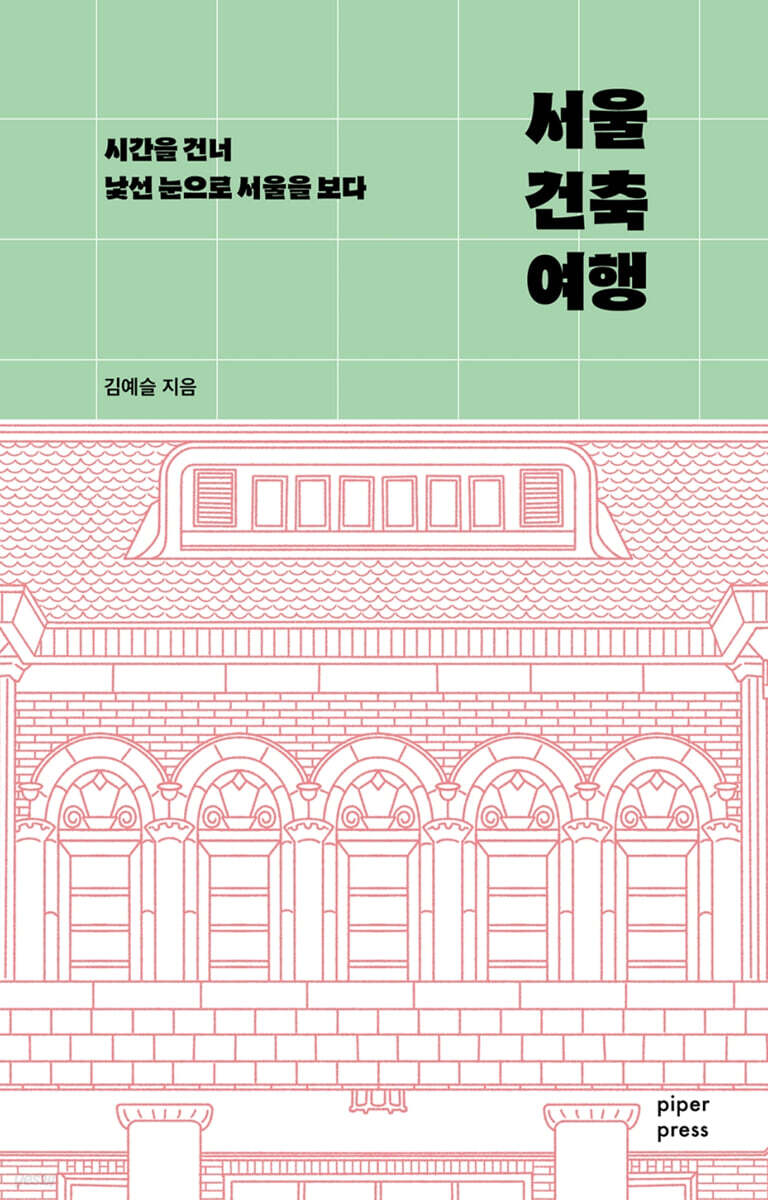
Seoul Architectural Tour
 |
Description
Book Introduction
- A word from MD
-
Fascinating modern and contemporary architecture in SeoulAuthor Kim Ye-seul, who has been exploring architectural sites across the country for the past ten years, walks through Seoul's homes, schools, hospitals, and museums to examine the city's turbulent modern and contemporary history.
This book will open your eyes to the world around you, reminding you that the cityscape is far more captivating than your smartphone screen.
March 26, 2024. Humanities PD Son Min-gyu
Cinematic scenes from the past unfold before your eyes, along with old buildings.
54 modern and contemporary buildings in Seoul and the stories of time and people contained within them.
Kim Ye-seul is an architectural traveler who has been traveling and documenting buildings across the country for nearly 10 years.
This book is the result of selecting 54 modern and contemporary buildings in Seoul from among those records and writing them in beautiful prose, filled with information, appreciation, history, and commentary on the people.
From works by familiar names that come to mind when thinking of Korean architecture, like Kim Chung-up and Kim Swoo-geun, to historical sites nestled between tall buildings in the city, to breathtakingly beautiful landscapes featuring unfamiliar names and events.
Spaces you've overlooked near subway stations, bus stops, offices, and restaurants unfold before your eyes like a movie, along with historical stories.
The buildings built in the modern and contemporary past, neither too far nor too close from the present, spoke to the author while still retaining traces of the past.
This book is one that gives eyes to discover new beauty to everyone living in or traveling through Seoul.
The moment you open the book, a journey begins where you see history, architecture, cities, and life in a new light through the eyes of an architectural traveler.
54 modern and contemporary buildings in Seoul and the stories of time and people contained within them.
Kim Ye-seul is an architectural traveler who has been traveling and documenting buildings across the country for nearly 10 years.
This book is the result of selecting 54 modern and contemporary buildings in Seoul from among those records and writing them in beautiful prose, filled with information, appreciation, history, and commentary on the people.
From works by familiar names that come to mind when thinking of Korean architecture, like Kim Chung-up and Kim Swoo-geun, to historical sites nestled between tall buildings in the city, to breathtakingly beautiful landscapes featuring unfamiliar names and events.
Spaces you've overlooked near subway stations, bus stops, offices, and restaurants unfold before your eyes like a movie, along with historical stories.
The buildings built in the modern and contemporary past, neither too far nor too close from the present, spoke to the author while still retaining traces of the past.
This book is one that gives eyes to discover new beauty to everyone living in or traveling through Seoul.
The moment you open the book, a journey begins where you see history, architecture, cities, and life in a new light through the eyes of an architectural traveler.
- You can preview some of the book's contents.
Preview
index
prolog.
Seoul's Architectural Traveler
[Home: People]
1.
Gyeonggyojang
2.
Jang Myeon House
3.
Hong Geon-ik House
4.
Dilkusha
5.
Seodaemun Presbyterian Church of Korea Missionary Training Center
[Home: Neighborhood]
6.
Gahoe-dong, Lee Jun-gu House, Bukchon Observatory
7.
Donuimun Museum Village
8.
Gusan-dong Library Village
9.
From Myeongdong Station to Hoehyeon Station, Apartment Tour
10.
A house tour from Galwol-dong to Huam-dong
[literature]
11.
Yun Dong-ju Literature Museum
12.
Sim Woo-jang
13.
Son Ki-jeong Cultural Library
14.
Han Moo-sook Literature Museum
15.
Dongyang Bookstore
[movie]
16.
Hanyangdoseong Hyehwa-dong Exhibition Information Center
17.
Dapsimni Film and Media Arts Center
18.
"Connection" and the Piccadilly Theatre
19.
Old Dongbu Theater
[art]
20.
Goh Hee-dong Art Museum
21.
Park No-soo Art Museum
22.
Kwon Jin-gyu Atelier
23.
Seongbuk-gu Choi Man-rin Art Museum
24.
Nam June Paik Memorial Hall
[building]
25.
Kim Joong-up House of Architecture and Culture
26.
Arario Museum in Space (formerly Space Building)
27.
Old Ganjo Gyeongseong branch
28.
9 Gongpyeong-dong
29.
Former Joseon Government-General Central Testing Laboratory Building
[school]
30.
Former Yongsan Theological Seminary
31.
Seoul Metropolitan University
32.
Seoul National University of Science and Technology
33.
Konkuk University
34.
Deoksung Women's University
[museum]
35.
Korea Military Academy Army Museum
36.
Bank of Korea Money Museum
37.
National Meteorological Museum
38.
Capital Museum
39.
Cheonggyecheon Museum
[hospital]
40.
Former Yongsan Railway Hospital (now Yongsan History Museum)
41.
Gu Gu-yeong-suk Pediatrics Clinic
42.
Bogunyeo Hall
43.
Former Seosan Obstetrics and Gynecology Hospital
44.
Hospital turned into commercial space
[Commercial facilities]
45.
Former Gyeongseong Textile Office Building
46.
Shina Memorial Hall
47.
Children's Grand Park Dream Maru
48.
Former Namsan Millennium Hilton Hotel
49.
Sun Plaza, the House of the Sun
[Religious facilities]
50.
Jeongdong Hanseong Church
51.
Former Air Force Academy Seongmu Church (Dongjak Art Gallery)
52.
Bulkwang-dong Cathedral
53.
Korean Orthodox St. Nicholas Cathedral
54.
Gilsangsa Temple
Epilogue.
A tour of Seoul's most iconic architecture
Seoul's Architectural Traveler
[Home: People]
1.
Gyeonggyojang
2.
Jang Myeon House
3.
Hong Geon-ik House
4.
Dilkusha
5.
Seodaemun Presbyterian Church of Korea Missionary Training Center
[Home: Neighborhood]
6.
Gahoe-dong, Lee Jun-gu House, Bukchon Observatory
7.
Donuimun Museum Village
8.
Gusan-dong Library Village
9.
From Myeongdong Station to Hoehyeon Station, Apartment Tour
10.
A house tour from Galwol-dong to Huam-dong
[literature]
11.
Yun Dong-ju Literature Museum
12.
Sim Woo-jang
13.
Son Ki-jeong Cultural Library
14.
Han Moo-sook Literature Museum
15.
Dongyang Bookstore
[movie]
16.
Hanyangdoseong Hyehwa-dong Exhibition Information Center
17.
Dapsimni Film and Media Arts Center
18.
"Connection" and the Piccadilly Theatre
19.
Old Dongbu Theater
[art]
20.
Goh Hee-dong Art Museum
21.
Park No-soo Art Museum
22.
Kwon Jin-gyu Atelier
23.
Seongbuk-gu Choi Man-rin Art Museum
24.
Nam June Paik Memorial Hall
[building]
25.
Kim Joong-up House of Architecture and Culture
26.
Arario Museum in Space (formerly Space Building)
27.
Old Ganjo Gyeongseong branch
28.
9 Gongpyeong-dong
29.
Former Joseon Government-General Central Testing Laboratory Building
[school]
30.
Former Yongsan Theological Seminary
31.
Seoul Metropolitan University
32.
Seoul National University of Science and Technology
33.
Konkuk University
34.
Deoksung Women's University
[museum]
35.
Korea Military Academy Army Museum
36.
Bank of Korea Money Museum
37.
National Meteorological Museum
38.
Capital Museum
39.
Cheonggyecheon Museum
[hospital]
40.
Former Yongsan Railway Hospital (now Yongsan History Museum)
41.
Gu Gu-yeong-suk Pediatrics Clinic
42.
Bogunyeo Hall
43.
Former Seosan Obstetrics and Gynecology Hospital
44.
Hospital turned into commercial space
[Commercial facilities]
45.
Former Gyeongseong Textile Office Building
46.
Shina Memorial Hall
47.
Children's Grand Park Dream Maru
48.
Former Namsan Millennium Hilton Hotel
49.
Sun Plaza, the House of the Sun
[Religious facilities]
50.
Jeongdong Hanseong Church
51.
Former Air Force Academy Seongmu Church (Dongjak Art Gallery)
52.
Bulkwang-dong Cathedral
53.
Korean Orthodox St. Nicholas Cathedral
54.
Gilsangsa Temple
Epilogue.
A tour of Seoul's most iconic architecture
Detailed image
.jpg)
Into the book
Some time stands still, and some time continues to smooth out.
The feeling of discomfort I felt while looking at the police officer hanging on the hospital wall and being kept alive is amplified as I walk along Jeongdong-gil.
I walk out to Deoksugung Palace and wander between the old and new Seoul City Hall buildings.
Where is the historical time flowing through Seoul?
---From "Gyeonggyojang"
The worn-out furnishings give the house a more lived-in feel.
Wasn't it Kim Yun-ok who loved this house the most?
I guess she must have been the one who swept and cleaned every corner of the house the most while raising seven children.
People who put in a lot of effort tend to love a space more than those who stay there for a long time.
This is something I always think about as I do my laundry, sweep the floor, and tidy up the traces my family left behind.
---From "Jangmyeon House"
When looking at a modern Hanok, the first thing to check is the patterned glass.
Every time I visit Hong Geon-ik's house, I look closely at the frosted glass with patterns that resemble ice.
This also remains in old photos.
If you look at the patterned glass left in old buildings, you can see a variety of types, including May flowers, peonies, peonies, and cloud-shaped peonies.
It is not just glass, it is a craft, made with the spirit of a craftsman by someone about 100 years ago.
---From "Hong Geon-ik's House"
My favorite place is Samdaegaok.
This house was built in 1956, and it is said that it was restored to its original state because it is in a good state of preservation.
Curved lines add style to the window frames, door handles, and decorations throughout the house.
In particular, the heavy handle reminiscent of a bull's horn is a design I've never seen before, so I never get tired of looking at it.
---From "Donuimun Museum Village"
The Mikuni Apartment building in Hoehyeon-dong still remains intact.
The three-story building is still used as a condominium, and its name remains the same as it was about 100 years ago.
Because the exterior and interior have been newly renovated, it looks like a newly built villa from a distance, but you can find unusual elements here and there.
In particular, if you look up from the building's entrance, you can see a circular decoration on the wall.
In today's buildings, the floor under the front door, which would normally be made of marble, is paved with stone.
Protruding decorations that match the length of the entrance and windows are also an element that is not found in new villas.
Look closely at the curved ends.
---From "Myeongdong to Hoehyeon Station, Apartment Tour"
I peek out the glass window in the kitchen.
The deep room also has a glass door on the floor.
I like the ceiling above the deep room.
Flower shapes cover the ceiling within a brown square wooden frame.
Although it is a small house like a hermitage, every time I look at this ceiling, I am reminded of the lanterns hanging inside the large Daeungjeon.
---From "Simwoojang"
Maybe because you've lived in this house for a long time without moving, everything - the sofa, furniture, lighting, piano - looks new for its age.
Among the photos displayed at the literature museum, the ones taken at home are immediately recognizable.
What is even more surprising is that the works of Chusa Kim Jeong-hui, Unbo Kim Gi-chang, Unchang Im Jik-sun, and Cheon Gyeong-ja are displayed casually on the wall.
I can't believe I'm in a space where I hang out with famous writers like Pearl Buck and Yasunari Kawabata.
---From "Han Moo-sook Literature Museum"
Seoul is a city as dynamic as the rapidly changing way people consume movies.
So perhaps we need an attitude that accepts that the disappearance of more familiar places is not something that should be taken for granted.
I wander around the Dongbu Theater for a while, feeling sorry for the loss of so many movie theaters in Seoul, including the Gukdo Theater with its old-fashioned appearance, the Danseongsa Theater, Korea's first theater, and the Scala Theater with its unique circular protruding building.
---From "Eastern Theater"
The studio, devoid of earth and fire, resembles early winter with fallen leaves.
The table and chairs he designed himself, and the furniture he used, look like trees with bare branches.
The floor is clean, but it feels like fallen leaves are crumbling every time I step on it.
Jin-gyu Kwon destroyed the large kiln in the backyard and ended his life in this studio.
It was May 3, 1973, the day after he saw his works at the opening ceremony of the Modern Art Gallery at the Korea University Museum.
It is said that on the stairs there was a will and 300,000 won received from selling the artwork.
---From "Kwon Jin-gyu Atelier"
The background in which the work was created and the space in which the artist worked and lived are as important as the work itself.
People go to Van Gogh Village to see Auvers Cathedral or wheat fields, and to Monet's house to see his garden.
It may be a travel destination sought out by those who want to get closer to everything the artist saw and felt.
What about Seoul?
I wanted to walk a little further in Changsin-dong, following the artists' footsteps, but I quickly lost my way.
---From the Nam June Paik Memorial Hall
When Kim Soo-geun was asked by his sister Kim Soon-ja to build a house for him, he is said to have said, "It would be inconvenient if I designed it."
The space that Kim Soo-geun pursued was not comfortable and simple.
The space building also pursues a segmented structure similar to a Korean traditional house, but it is far from convenient.
There are two staircases in the space building.
Both are narrow, but one is a triangular staircase that seems to suck you into a maze, while the other is a circular staircase in a cramped space without windows.
Through these two steps, space is repeatedly connected and divided.
---From "Arario Museum in Space (formerly Space Building)"
At that moment, the main building door opens in front of me and a slender, 178cm tall architecture student named Lee Sang comes in.
The young man Lee Sang, as described by poet Kim Ki-rim in his memoir, had 'white skin, long eyes, thick eyebrows, and bushy hair.'
It is a similar description to the photo taken in the architecture department's practical training room.
Kim Ki-rim was younger than he had seen during his architecture school days, so his face was youthful and his eyes were a bit more rebellious.
I picture myself standing in the noisy hallway with students coming and going in Japanese, with a completely indifferent expression, and then trudging along the creaking wooden floor at a tall height.
---From the "Former Central Testing Laboratory Building of the Government-General of Korea"
The people who use these buildings are not rich people, high-ranking executives, or individuals.
These are young men who were born during the Japanese colonial period, survived the war, and barely managed to become college students.
When commissioned to create a space for such people, what would they want to convey? Each architect will likely offer a different answer through their designs.
The answer Kim Jung-up gave was formative beauty.
Considering the situation at the time, which was undergoing post-war reconstruction, it probably didn't just mean a pretty building.
I guess he wanted to show us a future we have never experienced before through architecture.
---From "Konkuk University"
As he mentioned 'light' along with bricks while talking about his architectural philosophy, Kim Swoo-geun uses light in various ways.
Examples include protruding bricks or segmenting the walls of buildings and around window frames to create shadows cast on the bricks by sunlight.
This is why bricks, a simple material, do not appear monotonous in the architecture designed by Kim Soo-geun.
This characteristic can be felt precisely in the library building.
---From "Deoksung Women's University"
I can see a maple tree outside the window.
In the yard of the National Meteorological Museum, there are cherry trees and maple trees as standard observation trees.
When the news says that cherry blossoms are blooming or the leaves are changing color, it refers to the changes that occur in these trees.
The tree is over 100 years old, so it is large and has a rich shape.
It is designated as a registered cultural property along with the National Meteorological Museum.
---From the National Meteorological Museum
Gwanghuimun is located at Exit 3 of Dongdaemun History and Culture Park.
A four-lane road was built where the castle wall once stood.
I can see the disconnected city wall from Gwanghuimun Gate to the other side of the road.
At the end of it is the former Seosan Obstetrics and Gynecology Hospital (1966), designed by architect Kim Jung-up.
The obstetrics and gynecology building built next to the door where the dead used to come and go feels like a contrast between life and death, which is eerie.
---From "Old Seosan Obstetrics and Gynecology Hospital"
In the city, time seems to fly by in seconds and minutes.
If you're even one second late, the subway doors will close, and if you wake up even one minute late, you'll be late.
It is a daily routine where we pass by countless scenery without even realizing where we are.
But inside the old building, time does not flow, but rather piles up.
When I look at the bricks, windows, and ceilings inside the building and feel the past clearly, my present self inside the building also becomes clear.
This is why you can't stop exploring architecture in Seoul.
---From "Shin A Memorial Hall"
The House of the Sun gives a dynamic impression with numerous circles rolling and floating along the unfolding building structure.
As it is a building with many people coming and going, it gives it a sense of liveliness.
The circles that are scattered throughout the building seem to symbolize the community.
It seems to be saying that the people who come and go here are not just guests, but people who live in a neighborhood or this city.
---From "Sun Plaza, the House of the Sun"
The walls and ceiling of the chapel are filled with holy paintings.
When I look around the empty chapel alone, I get a strange feeling as if all the eyes in the paintings are following me.
I feel nervous, as if I've become an intruder infiltrating a 2D world.
In the Orthodox Church, holy pictures are called 'icons'.
The purpose was to spread the Bible even to those who could not read.
It is a form that contrasts with Catholic cathedrals that use gorgeous stained glass.
---From "St. Nicholas Cathedral of the Korean Orthodox Church"
Gilsangsa Temple does not have the ornate Dancheong and gongpo of typical temples.
Instead, it has a cute and charming charm all over it, resembling a Hanok villa.
I'm talking about parts like the curve of a bridge connecting buildings or the flower patterns on tiles on a wall.
If it had been used as a restaurant originally, it would have had its own charm, but as a temple, it has an even more special atmosphere.
It is a garden-like temple where Buddhists and citizens can walk comfortably.
---From "Gilsangsa"
During my architectural tour, I was amazed and saddened by the small details, such as doorknobs and window frames.
It was also a time to understand Seoul, a city I envied, hated, and loved.
Even after returning to my daily life, I began to look meaningfully at the small details of the scenery I encounter and the spaces I use and maintain.
The feeling of discomfort I felt while looking at the police officer hanging on the hospital wall and being kept alive is amplified as I walk along Jeongdong-gil.
I walk out to Deoksugung Palace and wander between the old and new Seoul City Hall buildings.
Where is the historical time flowing through Seoul?
---From "Gyeonggyojang"
The worn-out furnishings give the house a more lived-in feel.
Wasn't it Kim Yun-ok who loved this house the most?
I guess she must have been the one who swept and cleaned every corner of the house the most while raising seven children.
People who put in a lot of effort tend to love a space more than those who stay there for a long time.
This is something I always think about as I do my laundry, sweep the floor, and tidy up the traces my family left behind.
---From "Jangmyeon House"
When looking at a modern Hanok, the first thing to check is the patterned glass.
Every time I visit Hong Geon-ik's house, I look closely at the frosted glass with patterns that resemble ice.
This also remains in old photos.
If you look at the patterned glass left in old buildings, you can see a variety of types, including May flowers, peonies, peonies, and cloud-shaped peonies.
It is not just glass, it is a craft, made with the spirit of a craftsman by someone about 100 years ago.
---From "Hong Geon-ik's House"
My favorite place is Samdaegaok.
This house was built in 1956, and it is said that it was restored to its original state because it is in a good state of preservation.
Curved lines add style to the window frames, door handles, and decorations throughout the house.
In particular, the heavy handle reminiscent of a bull's horn is a design I've never seen before, so I never get tired of looking at it.
---From "Donuimun Museum Village"
The Mikuni Apartment building in Hoehyeon-dong still remains intact.
The three-story building is still used as a condominium, and its name remains the same as it was about 100 years ago.
Because the exterior and interior have been newly renovated, it looks like a newly built villa from a distance, but you can find unusual elements here and there.
In particular, if you look up from the building's entrance, you can see a circular decoration on the wall.
In today's buildings, the floor under the front door, which would normally be made of marble, is paved with stone.
Protruding decorations that match the length of the entrance and windows are also an element that is not found in new villas.
Look closely at the curved ends.
---From "Myeongdong to Hoehyeon Station, Apartment Tour"
I peek out the glass window in the kitchen.
The deep room also has a glass door on the floor.
I like the ceiling above the deep room.
Flower shapes cover the ceiling within a brown square wooden frame.
Although it is a small house like a hermitage, every time I look at this ceiling, I am reminded of the lanterns hanging inside the large Daeungjeon.
---From "Simwoojang"
Maybe because you've lived in this house for a long time without moving, everything - the sofa, furniture, lighting, piano - looks new for its age.
Among the photos displayed at the literature museum, the ones taken at home are immediately recognizable.
What is even more surprising is that the works of Chusa Kim Jeong-hui, Unbo Kim Gi-chang, Unchang Im Jik-sun, and Cheon Gyeong-ja are displayed casually on the wall.
I can't believe I'm in a space where I hang out with famous writers like Pearl Buck and Yasunari Kawabata.
---From "Han Moo-sook Literature Museum"
Seoul is a city as dynamic as the rapidly changing way people consume movies.
So perhaps we need an attitude that accepts that the disappearance of more familiar places is not something that should be taken for granted.
I wander around the Dongbu Theater for a while, feeling sorry for the loss of so many movie theaters in Seoul, including the Gukdo Theater with its old-fashioned appearance, the Danseongsa Theater, Korea's first theater, and the Scala Theater with its unique circular protruding building.
---From "Eastern Theater"
The studio, devoid of earth and fire, resembles early winter with fallen leaves.
The table and chairs he designed himself, and the furniture he used, look like trees with bare branches.
The floor is clean, but it feels like fallen leaves are crumbling every time I step on it.
Jin-gyu Kwon destroyed the large kiln in the backyard and ended his life in this studio.
It was May 3, 1973, the day after he saw his works at the opening ceremony of the Modern Art Gallery at the Korea University Museum.
It is said that on the stairs there was a will and 300,000 won received from selling the artwork.
---From "Kwon Jin-gyu Atelier"
The background in which the work was created and the space in which the artist worked and lived are as important as the work itself.
People go to Van Gogh Village to see Auvers Cathedral or wheat fields, and to Monet's house to see his garden.
It may be a travel destination sought out by those who want to get closer to everything the artist saw and felt.
What about Seoul?
I wanted to walk a little further in Changsin-dong, following the artists' footsteps, but I quickly lost my way.
---From the Nam June Paik Memorial Hall
When Kim Soo-geun was asked by his sister Kim Soon-ja to build a house for him, he is said to have said, "It would be inconvenient if I designed it."
The space that Kim Soo-geun pursued was not comfortable and simple.
The space building also pursues a segmented structure similar to a Korean traditional house, but it is far from convenient.
There are two staircases in the space building.
Both are narrow, but one is a triangular staircase that seems to suck you into a maze, while the other is a circular staircase in a cramped space without windows.
Through these two steps, space is repeatedly connected and divided.
---From "Arario Museum in Space (formerly Space Building)"
At that moment, the main building door opens in front of me and a slender, 178cm tall architecture student named Lee Sang comes in.
The young man Lee Sang, as described by poet Kim Ki-rim in his memoir, had 'white skin, long eyes, thick eyebrows, and bushy hair.'
It is a similar description to the photo taken in the architecture department's practical training room.
Kim Ki-rim was younger than he had seen during his architecture school days, so his face was youthful and his eyes were a bit more rebellious.
I picture myself standing in the noisy hallway with students coming and going in Japanese, with a completely indifferent expression, and then trudging along the creaking wooden floor at a tall height.
---From the "Former Central Testing Laboratory Building of the Government-General of Korea"
The people who use these buildings are not rich people, high-ranking executives, or individuals.
These are young men who were born during the Japanese colonial period, survived the war, and barely managed to become college students.
When commissioned to create a space for such people, what would they want to convey? Each architect will likely offer a different answer through their designs.
The answer Kim Jung-up gave was formative beauty.
Considering the situation at the time, which was undergoing post-war reconstruction, it probably didn't just mean a pretty building.
I guess he wanted to show us a future we have never experienced before through architecture.
---From "Konkuk University"
As he mentioned 'light' along with bricks while talking about his architectural philosophy, Kim Swoo-geun uses light in various ways.
Examples include protruding bricks or segmenting the walls of buildings and around window frames to create shadows cast on the bricks by sunlight.
This is why bricks, a simple material, do not appear monotonous in the architecture designed by Kim Soo-geun.
This characteristic can be felt precisely in the library building.
---From "Deoksung Women's University"
I can see a maple tree outside the window.
In the yard of the National Meteorological Museum, there are cherry trees and maple trees as standard observation trees.
When the news says that cherry blossoms are blooming or the leaves are changing color, it refers to the changes that occur in these trees.
The tree is over 100 years old, so it is large and has a rich shape.
It is designated as a registered cultural property along with the National Meteorological Museum.
---From the National Meteorological Museum
Gwanghuimun is located at Exit 3 of Dongdaemun History and Culture Park.
A four-lane road was built where the castle wall once stood.
I can see the disconnected city wall from Gwanghuimun Gate to the other side of the road.
At the end of it is the former Seosan Obstetrics and Gynecology Hospital (1966), designed by architect Kim Jung-up.
The obstetrics and gynecology building built next to the door where the dead used to come and go feels like a contrast between life and death, which is eerie.
---From "Old Seosan Obstetrics and Gynecology Hospital"
In the city, time seems to fly by in seconds and minutes.
If you're even one second late, the subway doors will close, and if you wake up even one minute late, you'll be late.
It is a daily routine where we pass by countless scenery without even realizing where we are.
But inside the old building, time does not flow, but rather piles up.
When I look at the bricks, windows, and ceilings inside the building and feel the past clearly, my present self inside the building also becomes clear.
This is why you can't stop exploring architecture in Seoul.
---From "Shin A Memorial Hall"
The House of the Sun gives a dynamic impression with numerous circles rolling and floating along the unfolding building structure.
As it is a building with many people coming and going, it gives it a sense of liveliness.
The circles that are scattered throughout the building seem to symbolize the community.
It seems to be saying that the people who come and go here are not just guests, but people who live in a neighborhood or this city.
---From "Sun Plaza, the House of the Sun"
The walls and ceiling of the chapel are filled with holy paintings.
When I look around the empty chapel alone, I get a strange feeling as if all the eyes in the paintings are following me.
I feel nervous, as if I've become an intruder infiltrating a 2D world.
In the Orthodox Church, holy pictures are called 'icons'.
The purpose was to spread the Bible even to those who could not read.
It is a form that contrasts with Catholic cathedrals that use gorgeous stained glass.
---From "St. Nicholas Cathedral of the Korean Orthodox Church"
Gilsangsa Temple does not have the ornate Dancheong and gongpo of typical temples.
Instead, it has a cute and charming charm all over it, resembling a Hanok villa.
I'm talking about parts like the curve of a bridge connecting buildings or the flower patterns on tiles on a wall.
If it had been used as a restaurant originally, it would have had its own charm, but as a temple, it has an even more special atmosphere.
It is a garden-like temple where Buddhists and citizens can walk comfortably.
---From "Gilsangsa"
During my architectural tour, I was amazed and saddened by the small details, such as doorknobs and window frames.
It was also a time to understand Seoul, a city I envied, hated, and loved.
Even after returning to my daily life, I began to look meaningfully at the small details of the scenery I encounter and the spaces I use and maintain.
---From "Epilogue: A Journey Through Seoul's Most Seoul-Style Architecture"
Publisher's Review
Living in Seoul, traveling around Seoul
The most beautiful travel guide for everyone
The face of Seoul seen for the first time through the filter of modern and contemporary architecture
The ever-changing cityscape, the glittering buildings that have been torn down and rebuilt without anyone knowing when.
In a rapidly changing Seoul, the author explores history, time, and beauty through old buildings, living through the eyes of a traveler.
The book tells a timeless, cinematic story, set in the heart of the city, a scene from everyday life.
The author meets historical figures, from architects Kim Swoo-geun and Kim Chung-up to poet Yi Sang and Korea's first female filmmaker Jeon Ok-sook, and experiences what it was like decades ago in everyday buildings like hospitals, apartments, and shopping malls.
Following the 54 buildings, you can see Seoul's past and present.
Just by looking at the architecture that fills today's landscape while embracing the past, Seoul looks different.
As the past becomes clearer, the way I live today also becomes clearer.
They say it's not the eyes that see, but the brain.
What we know is visible, but what we don't know is invisible even though it's right in front of us.
If you open your eyes to architectural traveler Kim Ye-seul, you will realize that you can become a stranger and travel even in everyday spaces.
The most beautiful travel guide for everyone
The face of Seoul seen for the first time through the filter of modern and contemporary architecture
The ever-changing cityscape, the glittering buildings that have been torn down and rebuilt without anyone knowing when.
In a rapidly changing Seoul, the author explores history, time, and beauty through old buildings, living through the eyes of a traveler.
The book tells a timeless, cinematic story, set in the heart of the city, a scene from everyday life.
The author meets historical figures, from architects Kim Swoo-geun and Kim Chung-up to poet Yi Sang and Korea's first female filmmaker Jeon Ok-sook, and experiences what it was like decades ago in everyday buildings like hospitals, apartments, and shopping malls.
Following the 54 buildings, you can see Seoul's past and present.
Just by looking at the architecture that fills today's landscape while embracing the past, Seoul looks different.
As the past becomes clearer, the way I live today also becomes clearer.
They say it's not the eyes that see, but the brain.
What we know is visible, but what we don't know is invisible even though it's right in front of us.
If you open your eyes to architectural traveler Kim Ye-seul, you will realize that you can become a stranger and travel even in everyday spaces.
GOODS SPECIFICS
- Date of issue: April 5, 2024
- Page count, weight, size: 572 pages | 702g | 128*200*35mm
- ISBN13: 9791198593559
- ISBN10: 1198593555
You may also like
카테고리
korean


korean

![GQ KOREA Mark (Monthly): December [2025]](http://librairie.coreenne.fr/cdn/shop/files/8ef265dbbfbf186523ed75ba7319009d.jpg?v=1765340328&width=3840)


