

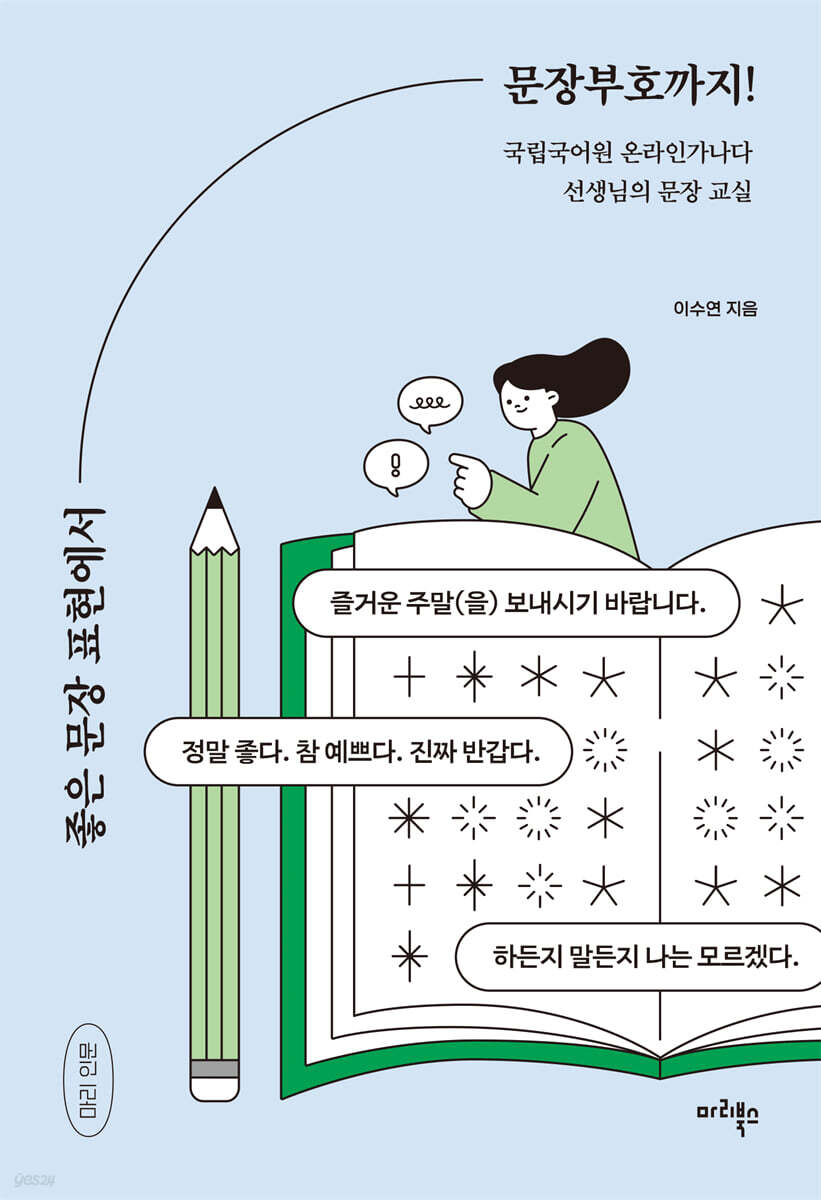
From good sentence expressions to punctuation!
 |
Description
Book Introduction
National Institute of the Korean Language Online Ganada, "Mobile Korean Language and Culture School"
Teacher's friendly sentence classroom
Make your speech and writing more refined, from good sentence expressions to punctuation.
Our language and social life are made up of countless sentences.
We frequently share our daily experiences and thoughts by writing short posts on social media.
At work, we write all kinds of official documents, such as proposals, plans, reports, and promotional materials, and exchange countless work emails.
Now, writing to clearly express my thoughts and intentions has become a part of my life.
Yet, we still find writing burdensome.
I wrote that I was going to write what I wanted to say, but when I actually wrote the sentences, they were awkward and vague, unlike my intention.
The National Institute of the Korean Language's online Ganada teacher Lee Su-yeon's sentence classroom, "From Good Sentence Expressions to Punctuation Marks," is a book that helps you find solutions when you want to say something exactly like that but keep expressing it in an awkward and incomplete way.
This book is based on questions the author received while working at the National Institute of the Korean Language's online Ganada for 17 years and while teaching as an instructor at the 'Mobile Korean Language and Culture School.'
Among the countless questions, we've carefully selected the ones that people find most confusing and curious about. You can either skim the table of contents and find the ones you're most curious about, or read through them from the beginning.
This book is filled with information you may have previously been unaware of, easily misunderstood, and even practical help in your language life. It will have you exclaiming "Aha!" or "Wow!"
Teacher's friendly sentence classroom
Make your speech and writing more refined, from good sentence expressions to punctuation.
Our language and social life are made up of countless sentences.
We frequently share our daily experiences and thoughts by writing short posts on social media.
At work, we write all kinds of official documents, such as proposals, plans, reports, and promotional materials, and exchange countless work emails.
Now, writing to clearly express my thoughts and intentions has become a part of my life.
Yet, we still find writing burdensome.
I wrote that I was going to write what I wanted to say, but when I actually wrote the sentences, they were awkward and vague, unlike my intention.
The National Institute of the Korean Language's online Ganada teacher Lee Su-yeon's sentence classroom, "From Good Sentence Expressions to Punctuation Marks," is a book that helps you find solutions when you want to say something exactly like that but keep expressing it in an awkward and incomplete way.
This book is based on questions the author received while working at the National Institute of the Korean Language's online Ganada for 17 years and while teaching as an instructor at the 'Mobile Korean Language and Culture School.'
Among the countless questions, we've carefully selected the ones that people find most confusing and curious about. You can either skim the table of contents and find the ones you're most curious about, or read through them from the beginning.
This book is filled with information you may have previously been unaware of, easily misunderstood, and even practical help in your language life. It will have you exclaiming "Aha!" or "Wow!"
- You can preview some of the book's contents.
Preview
index
preface
Chapter 1: Appropriate expressions that fit the meaning
If you mean 'if possible', use '한' after '가능'.
'-deul' written attached and 'deul' written with a space
Two uses of the dependent noun 'etc.'
'-deundeun' for 'choice', '-deundeunji' for 'past'
If the meaning is close, use '-go', if it is relatively far, use '-myeo'
'Means' means 'as', 'qualification' means 'as'
'Progress' is '-go ista', 'completion' is '-eo ista'
A 'happy weekend' isn't something you 'do', it's something you 'send'
'Please' is used too much
The meanings may overlap
'-goja hapnida' is used for 'future' events.
The subtle difference between 'from' and 'from'
If you raise the level of 'thank you', it becomes 'thank you'(?)
'Ege' and 'e', 'from' and 'from'
What 'and' and 'or' mean
If you think the meaning of 'too' has been expanded too much
Don't use 'various' in negative contexts.
You shouldn't use 'steadily' anywhere.
Is it 'significantly' or 'significantly, significantly'?
'Maintain' and 'continue' have different meanings.
Blind spots are not something to be 'excavated' but rather 'discovered'.
'Breakthrough' is used for pleasant events.
'About/about' and 'about/about' are also needed.
If you had to choose between '○○○ and 5 others' and '○○○ and 4 others'?
'Ro/e, (ro) due to, because' indicating reason
'Wednesday' or 'Wednesday day' is fine
'Increase by 3 times' and 'Increase by 4 times' have the same meaning.
'Our country' is not a colloquialism for 'our country'
"The oldest" not "one of the oldest"
It is impossible to 'roughly' 'understand' it
Should I add 'mi-' or 'bi-'?
"By consulting with experts" rather than "through the advice of experts"
Don't make a habit of using 'through'
'Show and improve' to 'Show and improve'
How to use 'whether' well
Although '어떡해' is an abbreviation of '어요해'
Wow, and, the relationship between commas
Chapter 2: Concise and well-structured sentence structure
If it ends with a 'predicate', it becomes a 'sentence', if it ends with a 'noun', it becomes a 'phrase'
'And' connects nouns (phrases) and nouns (phrases).
Transitive verbs require an object
Changing the sentence structure reduces the number of 'things'.
The particle '의' turns sentences into phrases.
Verb sentences are more natural than noun sentences.
'Adjective + Noun' that causes redundant expressions
A sentence in which an 'adverb' modifies a 'verb' is natural.
'-하다' or '-되' is determined by the subject
It's not "I will do it" but "I will do it"
When a grammatically correct expression becomes impossible because of 'possible'
Both 'noun' and 'noun+of' can be adjectives.
The descriptive particle '이다' sometimes omits '이-'
'-go is' rather than '~ is in the middle of'
'Do ○○' rather than 'do ○○'
The sentence structure changes depending on whether it is one word or not.
Chapter 3: Punctuation Marks: The More You Know, the More Useful They Are
Prevent ambiguity with punctuation marks
Commas and periods seem similar but are different.
The comma can be omitted
Be careful about interpreting the middle point.
Periods and tildes used in date notation
Apostrophe(') in 'year' notation?
Colon (:) spacing
Parentheses usage and spacing
What if you put parentheses in the text?
sickle (『 』, 「 」), angle brackets (《 》, 〈 〉), and quotation marks (“ ”, ' ')
A period is optional after a quotation or noun.
If the word order is reversed, put a comma!
Using ellipses (……, …)
What should I use as the end mark of a sentence?
Chapter 4: Honorific expressions should be neither excessive nor insufficient.
Is '-drida' better than '-hada'?
Don't 'ask' me, 'ask' me
How far should I go with honorifics?
When the honorific and non-honorific objects are grouped with 'wa/gwa'
The 'word' that lowers, the 'word' that elevates
When I say 'good job' to my superiors,
Manager Hong Gil-dong and Manager Hong Gil-dong
It becomes softer when you use the auxiliary verb '주다'
Use 'yo' after the connecting word to raise the level of respect of the other person
'Hello' and 'Hello'
Expressions that elevate things
The law of oppression in the home and society
Intuition about honorific expressions
Words referring to oneself
Chapter 1: Appropriate expressions that fit the meaning
If you mean 'if possible', use '한' after '가능'.
'-deul' written attached and 'deul' written with a space
Two uses of the dependent noun 'etc.'
'-deundeun' for 'choice', '-deundeunji' for 'past'
If the meaning is close, use '-go', if it is relatively far, use '-myeo'
'Means' means 'as', 'qualification' means 'as'
'Progress' is '-go ista', 'completion' is '-eo ista'
A 'happy weekend' isn't something you 'do', it's something you 'send'
'Please' is used too much
The meanings may overlap
'-goja hapnida' is used for 'future' events.
The subtle difference between 'from' and 'from'
If you raise the level of 'thank you', it becomes 'thank you'(?)
'Ege' and 'e', 'from' and 'from'
What 'and' and 'or' mean
If you think the meaning of 'too' has been expanded too much
Don't use 'various' in negative contexts.
You shouldn't use 'steadily' anywhere.
Is it 'significantly' or 'significantly, significantly'?
'Maintain' and 'continue' have different meanings.
Blind spots are not something to be 'excavated' but rather 'discovered'.
'Breakthrough' is used for pleasant events.
'About/about' and 'about/about' are also needed.
If you had to choose between '○○○ and 5 others' and '○○○ and 4 others'?
'Ro/e, (ro) due to, because' indicating reason
'Wednesday' or 'Wednesday day' is fine
'Increase by 3 times' and 'Increase by 4 times' have the same meaning.
'Our country' is not a colloquialism for 'our country'
"The oldest" not "one of the oldest"
It is impossible to 'roughly' 'understand' it
Should I add 'mi-' or 'bi-'?
"By consulting with experts" rather than "through the advice of experts"
Don't make a habit of using 'through'
'Show and improve' to 'Show and improve'
How to use 'whether' well
Although '어떡해' is an abbreviation of '어요해'
Wow, and, the relationship between commas
Chapter 2: Concise and well-structured sentence structure
If it ends with a 'predicate', it becomes a 'sentence', if it ends with a 'noun', it becomes a 'phrase'
'And' connects nouns (phrases) and nouns (phrases).
Transitive verbs require an object
Changing the sentence structure reduces the number of 'things'.
The particle '의' turns sentences into phrases.
Verb sentences are more natural than noun sentences.
'Adjective + Noun' that causes redundant expressions
A sentence in which an 'adverb' modifies a 'verb' is natural.
'-하다' or '-되' is determined by the subject
It's not "I will do it" but "I will do it"
When a grammatically correct expression becomes impossible because of 'possible'
Both 'noun' and 'noun+of' can be adjectives.
The descriptive particle '이다' sometimes omits '이-'
'-go is' rather than '~ is in the middle of'
'Do ○○' rather than 'do ○○'
The sentence structure changes depending on whether it is one word or not.
Chapter 3: Punctuation Marks: The More You Know, the More Useful They Are
Prevent ambiguity with punctuation marks
Commas and periods seem similar but are different.
The comma can be omitted
Be careful about interpreting the middle point.
Periods and tildes used in date notation
Apostrophe(') in 'year' notation?
Colon (:) spacing
Parentheses usage and spacing
What if you put parentheses in the text?
sickle (『 』, 「 」), angle brackets (《 》, 〈 〉), and quotation marks (“ ”, ' ')
A period is optional after a quotation or noun.
If the word order is reversed, put a comma!
Using ellipses (……, …)
What should I use as the end mark of a sentence?
Chapter 4: Honorific expressions should be neither excessive nor insufficient.
Is '-drida' better than '-hada'?
Don't 'ask' me, 'ask' me
How far should I go with honorifics?
When the honorific and non-honorific objects are grouped with 'wa/gwa'
The 'word' that lowers, the 'word' that elevates
When I say 'good job' to my superiors,
Manager Hong Gil-dong and Manager Hong Gil-dong
It becomes softer when you use the auxiliary verb '주다'
Use 'yo' after the connecting word to raise the level of respect of the other person
'Hello' and 'Hello'
Expressions that elevate things
The law of oppression in the home and society
Intuition about honorific expressions
Words referring to oneself
Detailed image
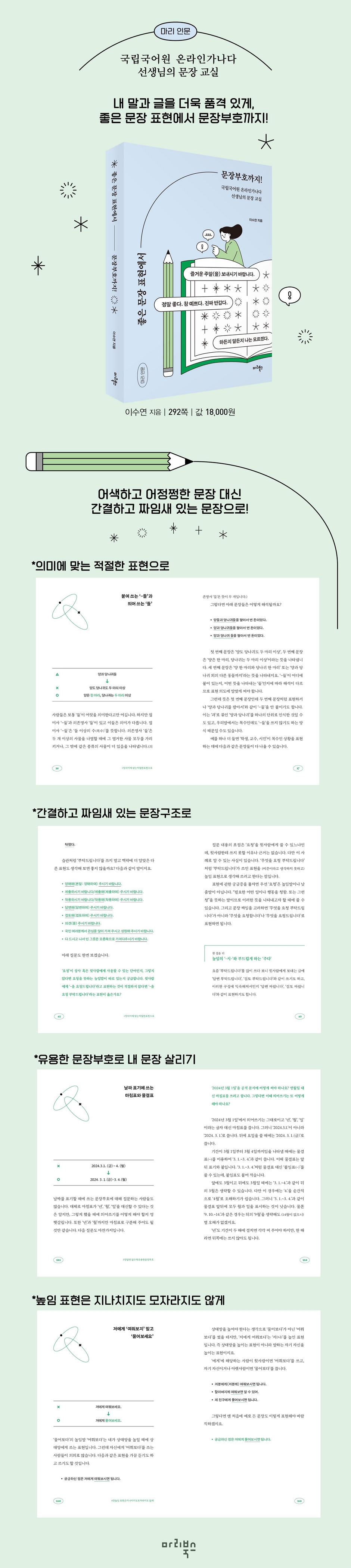
Into the book
'-go' is used to connect contents that are more closely related in meaning than '-myeo'.
I think that is why it is written as ‘coming and going affection’ and ‘high and low mountain peaks’ and not as ‘coming and going affection’ and ‘high and low mountain peaks’.
'Come-go' and 'high-low' are antonyms, but antonyms differ only in one element and are otherwise the same, meaning they are close.
--- p.27
First of all, let's get rid of the idea that 'as' is used for things and 'as' is used for people.
If you have a fixed idea that qualifications and status are 'people' and means and tools are 'things', you are bound to get confused.
There are contexts where 'people' become means or tools, and there are also contexts where the status or qualifications of 'things' are discussed.
Therefore, we must look at the context and choose between 'as' and 'as'.
(…) In addition, the context is still consistent even if ‘로’ is changed to ‘(을) 그가’, which indicates a means or method.
--- p.31
'Maintain' means "to preserve a certain state or situation as it is or to continue to support it without change."
The word 'maintenance', which implies 'preservation (to protect and preserve well)', does not fit in a negative context.
Because it is a positive object, it is preserved and continues to be maintained without change.
(…) On the other hand, ‘continuation’ means “a certain state continues for a long time.
Or, it means “continuing a certain state for a long time,” and is used in phrases like “continuing price increases” and “continuing studies.”
You can see that it has a different character from 'maintenance'.
The fact that it can be used as 'maintain continuously', such as 'maintain peace continuously' or 'select ○○ as a policy that must be maintained continuously', also shows that 'continue' and 'maintain' are different.
--- p.78~79
It's hard to say which one is better, but the sentence style is better for understanding the content, and the old style is better for expressing it simply.
So, when writing a report, if you want to simply write down the contents of a sub-item or table, the old method is often chosen.
However, if you only compose it in the old way to make it simple, it will increase fatigue when reading, so it is better to use both methods appropriately.
However, it is important to use the final tense consistently within an item.
--- p.134
The writer knows the context of what he is writing, so he can read and understand even if essential sentence elements are omitted, but other people cannot understand accurately if essential sentence elements are omitted.
You have no choice but to guess the meaning or just pass it by without knowing it.
If you want to write clear sentences with corresponding sentence elements, refer to the sentence pattern information in the Korean dictionary.
Below are the sentence patterns and meanings of 'participate (intransitive verb)' and 'create (transitive verb)' from the National Institute of the Korean Language's Korean Dictionary.
(…) We can see that ‘participate’ responds with the ‘e’ component (adverb) in addition to the subject, and ‘create’ responds with the ‘eul’ component (object) in addition to the subject.
By using the Korean dictionary in this way, you can check the sentence elements that correspond to the predicate and write well-structured sentences.
--- p.146~147
Since 'thing' is an abstract word that refers to 'things, events, phenomena', etc., it is used a lot.
But if 'thing' is used too much, it sounds unnatural.
If you can change it to another expression, it means that 'thing' does not necessarily have to be used.
When judging whether 'thing' is used appropriately, try omitting 'thing' or replacing it with another word.
If there is no problem in replacing 'geot' with another expression, or if it is not abstract but concrete, and the context still makes sense even if 'geotda' is omitted, then 'geot' is not a necessary word in that context.
--- p.150~151
Punctuation marks are tools designed to clearly reveal the structure of sentences in writing or to easily convey the writer's intention.
Make active use of punctuation to express yourself in concise and clear sentences without ambiguity.
Many people don't realize that there are punctuation rules, but they are very well established.
If you go to 'National Institute of the Korean Language website, Language Standards - View Language Rules', you can see the usage of various punctuation marks in detail.
--- p.202
In official documents, you should use 'appropriate honorifics'.
It is difficult to say exactly what the scope of 'appropriate' is, but I think '-o-' and '-dri-da', which indicate politeness, are a little more than appropriate in public documents.
In public documents, it is appropriate to use the most respectful '하다체(-ㅂ니다/-습니다)' for the other person, and use the subject respectful '-시-' for the other person, to express things like 'I am reporting this' or 'I would like to implement this, so please support me.'
Honorifics are largely influenced by the subjective perception of the other person, but public documents are objective, so you should use an appropriate amount of honorifics that is neither excessive nor insufficient.
I think that is why it is written as ‘coming and going affection’ and ‘high and low mountain peaks’ and not as ‘coming and going affection’ and ‘high and low mountain peaks’.
'Come-go' and 'high-low' are antonyms, but antonyms differ only in one element and are otherwise the same, meaning they are close.
--- p.27
First of all, let's get rid of the idea that 'as' is used for things and 'as' is used for people.
If you have a fixed idea that qualifications and status are 'people' and means and tools are 'things', you are bound to get confused.
There are contexts where 'people' become means or tools, and there are also contexts where the status or qualifications of 'things' are discussed.
Therefore, we must look at the context and choose between 'as' and 'as'.
(…) In addition, the context is still consistent even if ‘로’ is changed to ‘(을) 그가’, which indicates a means or method.
--- p.31
'Maintain' means "to preserve a certain state or situation as it is or to continue to support it without change."
The word 'maintenance', which implies 'preservation (to protect and preserve well)', does not fit in a negative context.
Because it is a positive object, it is preserved and continues to be maintained without change.
(…) On the other hand, ‘continuation’ means “a certain state continues for a long time.
Or, it means “continuing a certain state for a long time,” and is used in phrases like “continuing price increases” and “continuing studies.”
You can see that it has a different character from 'maintenance'.
The fact that it can be used as 'maintain continuously', such as 'maintain peace continuously' or 'select ○○ as a policy that must be maintained continuously', also shows that 'continue' and 'maintain' are different.
--- p.78~79
It's hard to say which one is better, but the sentence style is better for understanding the content, and the old style is better for expressing it simply.
So, when writing a report, if you want to simply write down the contents of a sub-item or table, the old method is often chosen.
However, if you only compose it in the old way to make it simple, it will increase fatigue when reading, so it is better to use both methods appropriately.
However, it is important to use the final tense consistently within an item.
--- p.134
The writer knows the context of what he is writing, so he can read and understand even if essential sentence elements are omitted, but other people cannot understand accurately if essential sentence elements are omitted.
You have no choice but to guess the meaning or just pass it by without knowing it.
If you want to write clear sentences with corresponding sentence elements, refer to the sentence pattern information in the Korean dictionary.
Below are the sentence patterns and meanings of 'participate (intransitive verb)' and 'create (transitive verb)' from the National Institute of the Korean Language's Korean Dictionary.
(…) We can see that ‘participate’ responds with the ‘e’ component (adverb) in addition to the subject, and ‘create’ responds with the ‘eul’ component (object) in addition to the subject.
By using the Korean dictionary in this way, you can check the sentence elements that correspond to the predicate and write well-structured sentences.
--- p.146~147
Since 'thing' is an abstract word that refers to 'things, events, phenomena', etc., it is used a lot.
But if 'thing' is used too much, it sounds unnatural.
If you can change it to another expression, it means that 'thing' does not necessarily have to be used.
When judging whether 'thing' is used appropriately, try omitting 'thing' or replacing it with another word.
If there is no problem in replacing 'geot' with another expression, or if it is not abstract but concrete, and the context still makes sense even if 'geotda' is omitted, then 'geot' is not a necessary word in that context.
--- p.150~151
Punctuation marks are tools designed to clearly reveal the structure of sentences in writing or to easily convey the writer's intention.
Make active use of punctuation to express yourself in concise and clear sentences without ambiguity.
Many people don't realize that there are punctuation rules, but they are very well established.
If you go to 'National Institute of the Korean Language website, Language Standards - View Language Rules', you can see the usage of various punctuation marks in detail.
--- p.202
In official documents, you should use 'appropriate honorifics'.
It is difficult to say exactly what the scope of 'appropriate' is, but I think '-o-' and '-dri-da', which indicate politeness, are a little more than appropriate in public documents.
In public documents, it is appropriate to use the most respectful '하다체(-ㅂ니다/-습니다)' for the other person, and use the subject respectful '-시-' for the other person, to express things like 'I am reporting this' or 'I would like to implement this, so please support me.'
Honorifics are largely influenced by the subjective perception of the other person, but public documents are objective, so you should use an appropriate amount of honorifics that is neither excessive nor insufficient.
--- p.248
Publisher's Review
“Instead of awkward and incoherent sentences, use concise and well-structured sentences!”
When I keep expressing myself 'awkwardly', contrary to my intentions
How to express myself concisely and clearly as I wish
Many people agree that it is better to express yourself in a structured way rather than in a vague way.
However, I doubt that changing just one of my habitually incorrect expressions will make a big difference.
However, well-structured, appropriate, and suitable expressions enhance the communication skills of my speech and writing, making my language life and social life smooth and smooth.
This book doesn't help you write fluent sentences.
But it definitely teaches me how to express what I want to say concisely and clearly, at least based on the basics of sentence structure.
If you want to write structured (systematic and concise) sentences instead of vague (ambiguous and incomplete) sentences, this book will be a helpful guide.
While writing, there must have been times when you were worried about what expression to use in this context.
In 'Chapter 1: Appropriate Expressions That Match the Meaning', we will discuss the content in detail.
It explains the subtle differences in meaning between the suffix '-deul' and the dependent noun 'deul', the connective endings '-go' and '-myeo', 'from' and 'from', 'etc.' and 'out'.
In addition, it thoroughly covers expressions that should be used with caution in contexts where their meanings do not match, such as ‘various,’ ‘steadily,’ ‘excellently,’ ‘maintain,’ and ‘roughly grasp.’
However, even if you choose an appropriate expression that fits the meaning, if you do not follow a natural Korean sentence structure, it will sound unnatural.
Chapter 2, Concise and Well-Organized Sentence Structure, teaches you how to write sentences in a natural, uncluttered, and well-coordinated manner in Korean.
It is packed with useful information such as how to distinguish between sentences (verb sentences, noun sentences) and phrases and create sentences consistently, how to create phrases, how to change sentence structure to reduce 'things', how to concisely change the 'adjective + noun' structure that causes redundant expressions, and how to choose '-하다/되' depending on the subject rather than always changing it to '-하다' of active verb instead of '-되' of passive verb.
In Chapter 3, 'The More You Know, the More Useful Punctuation Marks', punctuation marks are covered as the chapter title suggests.
Punctuation marks are used to reveal sentence structure or to easily convey the writer's intention. They are described in great detail in the appendix to the Korean spelling rules, but they are not being utilized properly.
So, here, I will teach you how to save your sentences by focusing on useful punctuation marks that are frequently used, such as how to prevent ambiguous interpretations with commas (,), how to interpret periods (·), how to use periods (.) in notating dates, and how to choose sentence-ending punctuation marks.
Chapter 4, “Not too much or too little honorifics” provides guidance on the appropriate level of honorifics.
It tells you the appropriate honorific expressions for public documents that must be objective, as well as how far you should go with honorific expressions in real life, and how to improve your intuition about honorific expressions.
Why is our language so difficult even though we use it as our native language?
Let's take a look back and see if we've ever taken care of the words and writing we're using now!
If you ask people whether they love their language and writing, nine out of ten will answer yes.
But are we really speaking and acting in a manner befitting that answer? The author says it doesn't seem to be the case, lamenting the reality that contradicts that answer.
Our familiar and natural language is often pushed to the back burner, caught up in the trend of excessive English and the emphasis on English.
It is also often seen that people do not pay much attention to writing correctly and accurately according to the rules of the Korean language.
Above all, we often complain that our language is difficult even though we use it as our native language.
The author says that it is because people have less interest and study less compared to foreign languages, but if you pay a little more attention to Korean and study it, it is not that difficult.
So, with the hope that this book will serve as an opportunity to study, love, and respect the Korean language more, the grammatical explanations are written in an interesting and easy-to-understand way, focusing only on the key points without being boring.
Also, the author does not claim that certain words should or should not be used.
This is because the speaker can naturally express what he or she wants to convey using Korean sentence structure and sentence expressions.
The starting point is to keep this book and a Korean dictionary by your side and look at them frequently.
The Korean dictionary contains detailed information on not only the meaning of words but also their usage and sentence patterns.
If you don't ignore your own grammatical intuitions that make you think, "Oh, something feels awkward and strange?" and open this book and a Korean dictionary to correct your sentences in various ways, you can correct your bad sentence expression habits.
Language is a living organism and if left unattended it dies.
The same goes for the language we use, so we need to take good care of it.
It is time to look back and see if I have ever taken good care of the words I am writing now.
When I keep expressing myself 'awkwardly', contrary to my intentions
How to express myself concisely and clearly as I wish
Many people agree that it is better to express yourself in a structured way rather than in a vague way.
However, I doubt that changing just one of my habitually incorrect expressions will make a big difference.
However, well-structured, appropriate, and suitable expressions enhance the communication skills of my speech and writing, making my language life and social life smooth and smooth.
This book doesn't help you write fluent sentences.
But it definitely teaches me how to express what I want to say concisely and clearly, at least based on the basics of sentence structure.
If you want to write structured (systematic and concise) sentences instead of vague (ambiguous and incomplete) sentences, this book will be a helpful guide.
While writing, there must have been times when you were worried about what expression to use in this context.
In 'Chapter 1: Appropriate Expressions That Match the Meaning', we will discuss the content in detail.
It explains the subtle differences in meaning between the suffix '-deul' and the dependent noun 'deul', the connective endings '-go' and '-myeo', 'from' and 'from', 'etc.' and 'out'.
In addition, it thoroughly covers expressions that should be used with caution in contexts where their meanings do not match, such as ‘various,’ ‘steadily,’ ‘excellently,’ ‘maintain,’ and ‘roughly grasp.’
However, even if you choose an appropriate expression that fits the meaning, if you do not follow a natural Korean sentence structure, it will sound unnatural.
Chapter 2, Concise and Well-Organized Sentence Structure, teaches you how to write sentences in a natural, uncluttered, and well-coordinated manner in Korean.
It is packed with useful information such as how to distinguish between sentences (verb sentences, noun sentences) and phrases and create sentences consistently, how to create phrases, how to change sentence structure to reduce 'things', how to concisely change the 'adjective + noun' structure that causes redundant expressions, and how to choose '-하다/되' depending on the subject rather than always changing it to '-하다' of active verb instead of '-되' of passive verb.
In Chapter 3, 'The More You Know, the More Useful Punctuation Marks', punctuation marks are covered as the chapter title suggests.
Punctuation marks are used to reveal sentence structure or to easily convey the writer's intention. They are described in great detail in the appendix to the Korean spelling rules, but they are not being utilized properly.
So, here, I will teach you how to save your sentences by focusing on useful punctuation marks that are frequently used, such as how to prevent ambiguous interpretations with commas (,), how to interpret periods (·), how to use periods (.) in notating dates, and how to choose sentence-ending punctuation marks.
Chapter 4, “Not too much or too little honorifics” provides guidance on the appropriate level of honorifics.
It tells you the appropriate honorific expressions for public documents that must be objective, as well as how far you should go with honorific expressions in real life, and how to improve your intuition about honorific expressions.
Why is our language so difficult even though we use it as our native language?
Let's take a look back and see if we've ever taken care of the words and writing we're using now!
If you ask people whether they love their language and writing, nine out of ten will answer yes.
But are we really speaking and acting in a manner befitting that answer? The author says it doesn't seem to be the case, lamenting the reality that contradicts that answer.
Our familiar and natural language is often pushed to the back burner, caught up in the trend of excessive English and the emphasis on English.
It is also often seen that people do not pay much attention to writing correctly and accurately according to the rules of the Korean language.
Above all, we often complain that our language is difficult even though we use it as our native language.
The author says that it is because people have less interest and study less compared to foreign languages, but if you pay a little more attention to Korean and study it, it is not that difficult.
So, with the hope that this book will serve as an opportunity to study, love, and respect the Korean language more, the grammatical explanations are written in an interesting and easy-to-understand way, focusing only on the key points without being boring.
Also, the author does not claim that certain words should or should not be used.
This is because the speaker can naturally express what he or she wants to convey using Korean sentence structure and sentence expressions.
The starting point is to keep this book and a Korean dictionary by your side and look at them frequently.
The Korean dictionary contains detailed information on not only the meaning of words but also their usage and sentence patterns.
If you don't ignore your own grammatical intuitions that make you think, "Oh, something feels awkward and strange?" and open this book and a Korean dictionary to correct your sentences in various ways, you can correct your bad sentence expression habits.
Language is a living organism and if left unattended it dies.
The same goes for the language we use, so we need to take good care of it.
It is time to look back and see if I have ever taken good care of the words I am writing now.
GOODS SPECIFICS
- Date of issue: February 15, 2024
- Page count, weight, size: 292 pages | 384g | 130*190*17mm
- ISBN13: 9791193270134
You may also like
카테고리
korean


korean

![ELLE 엘르 스페셜 에디션 A형 : 12월 [2025]](http://librairie.coreenne.fr/cdn/shop/files/b8e27a3de6c9538896439686c6b0e8fb.jpg?v=1766436872&width=3840)


