

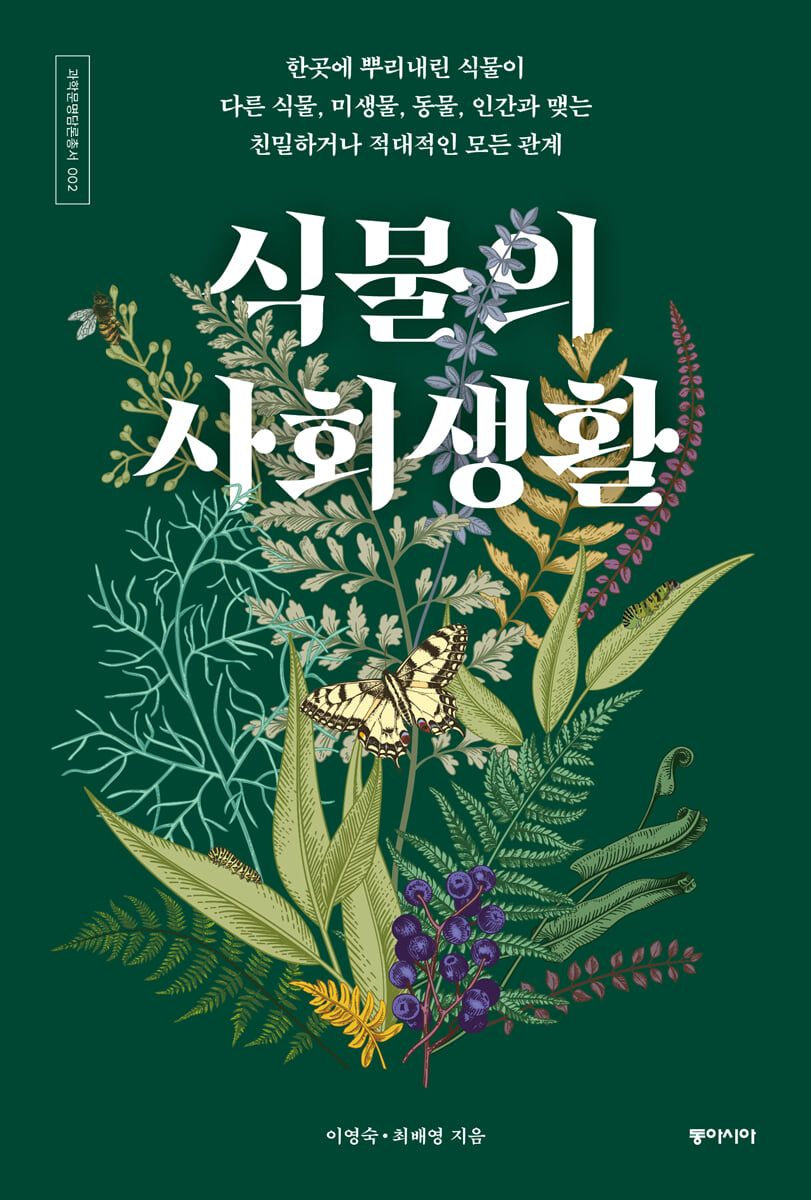
Social life of plants
 |
Description
Book Introduction
“Will you help, fight, or exploit?”
Two botanists draw
A vast and wondrous network of plants!
For a sustainable life
The social life of plants that must be protected
Using other living things
The diverse and unique survival strategies of plants
Jennifer Doudna and Emmanuel Charpentier, winners of the 2020 Nobel Prize in Chemistry.
The two scientists developed the original technology, 'CRISPR Cas9', which can cut genes to create new crops or treat diseases.
This technology has led to the development of plants that are resistant to fungi, pests, and drought, and has also raised the possibility of new cancer treatments.
In this way, the scientific community has recently been paying particular attention to technologies in the fields of biochemistry, genetics, and phylogenetics.
DNA sequencing technology, which analyzes base sequences, and metabolomics technology, which analyzes metabolites to find hidden mutants, are also making remarkable progress.
Why is the scientific community paying attention to technologies that utilize these plants?
Plants are the foundation of the Earth's ecosystem.
Plants survive by competing, cooperating, and defending themselves through their own social life.
There are countless ways plants survive that we don't know about.
Knowing the changes that occur inside and outside plants as they interact with other living things is clearly useful information for humans, who are social animals.
Through continuous research on plants, we can now understand what biochemical substances plants secrete, what genes are involved, and what evolutionary stages they are going through in the relationship between plants and various living organisms.
And humanity is using this to explore new ways of social life and survival.
This will soon provide hints on how all living things can live harmoniously and sustainably.
Two botanists draw
A vast and wondrous network of plants!
For a sustainable life
The social life of plants that must be protected
Using other living things
The diverse and unique survival strategies of plants
Jennifer Doudna and Emmanuel Charpentier, winners of the 2020 Nobel Prize in Chemistry.
The two scientists developed the original technology, 'CRISPR Cas9', which can cut genes to create new crops or treat diseases.
This technology has led to the development of plants that are resistant to fungi, pests, and drought, and has also raised the possibility of new cancer treatments.
In this way, the scientific community has recently been paying particular attention to technologies in the fields of biochemistry, genetics, and phylogenetics.
DNA sequencing technology, which analyzes base sequences, and metabolomics technology, which analyzes metabolites to find hidden mutants, are also making remarkable progress.
Why is the scientific community paying attention to technologies that utilize these plants?
Plants are the foundation of the Earth's ecosystem.
Plants survive by competing, cooperating, and defending themselves through their own social life.
There are countless ways plants survive that we don't know about.
Knowing the changes that occur inside and outside plants as they interact with other living things is clearly useful information for humans, who are social animals.
Through continuous research on plants, we can now understand what biochemical substances plants secrete, what genes are involved, and what evolutionary stages they are going through in the relationship between plants and various living organisms.
And humanity is using this to explore new ways of social life and survival.
This will soon provide hints on how all living things can live harmoniously and sustainably.
- You can preview some of the book's contents.
Preview
index
preface
Part 1: The Social Life of Plants and Their Neighbors
Chapter 1: Cooperation between Plants
Plants Connect and Help Each Other | Plants All Stand as Sentinels Against Pests and Disease | Plants as Nanny Plants | Do Plants Recognize Kin? | Molecular Evidence That Plants Distinguish Kin from Strangers
Chapter 2: Competition among Plants
Competition for light | Invasive species crowd out native species by blocking out light | Is it advantageous for plants to be taller than their neighbors? | Palm trees that walk to get light? | Plants also compete for more space | Don't come near me: allelopathy | Invasive species crowd out native species through allelopathy | Applications of allelopathy
Chapter 3: Parasitism of Plants
Parasitic plants that suck nutrients from other plants | Striga, a parasitic plant that causes significant damage to agriculture | Research to reduce Striga damage | Host plants' tactics to prevent parasitic plants from attaching
Part 2 Plants and Microorganisms
Chapter 4: Plants coexisting with microorganisms
The origin of symbiosis between plants and microorganisms | Microorganisms that aid plant growth | Formation of plant-microbiota | Symbiosis between plants and fungi: Formation of mycorrhiza | What do plants gain and lose from symbiosis with fungi? | Symbiosis between plants and nitrogen-fixing bacteria | Root nodule formation process | How plants manage root nodules | Material exchange in root nodules | Using nitrogen-fixing bacteria in agriculture
Chapter 5: The War Between Plants and Microorganisms
Basic defenses prepared in advance | Plant responses when invaded by pathogens | How plants detect a pathogen invasion | Plant defense mechanisms initiated after detecting a pathogen invasion | Operations of pathogens invading plants
Chapter 6: How Plants Recognize Beneficial and Harmful Microorganisms
Symbiosis or Defense? | How Symbiotic Bacteria Evade Plant Defense Mechanisms | Rice Distinguishing Between Symbiotic and Pathogenic Bacteria | How to Increase Virus Sensitivity Only When Wounded
Part 3: Plants and Animals
Chapter 7: The Relationship Between Plants and Insects
Insects that help plants reproduce | The exquisite way to trick insects into carrying pollen | Ants that coevolved with plants | The war between plants and pests that eat plants | Plant defense strategies against insects | How plants defend against insects | Volatiles that fight insects | How pests induce each other to eat each other | Chemicals that plants produce to defend against pests | How to elucidate the molecular mechanisms of plant pest defense | Plant proteins that fight insects | Camouflage to ward off insects | Bladder cells of halophytes that prevent insect invasion | Plants that move to repel insects | The mechanism by which plants respond to eggs laid by insects | How much should we invest in defending against insects? | How insects overcome plant defenses | Application of knowledge about the relationship between plants and insects to agriculture | Insect-eating plants | The origin and endangerment of insect-eating plants
Chapter 8: The Relationship Between Plants and Vertebrates
Herbivorous vertebrates fed and exploited by plants | Plant defense mechanisms against herbivores | The impact of herbivores on plant diversity | The tripartite relationship among plants, herbivores, and carnivores | The changing relationship between plants and herbivores due to climate change
Part 4: Plants and People
Chapter 9 Crops: Plants Cultivated by People
How plants changed as they became crops | Why farming requires pesticides | Why farming requires fertilizer | The problems with pesticides and fertilizers | Why crops need a lot of water | The problems with irrigation and irrigation facilities
Chapter 10: Genetic Changes in Plants Improved as Crops
How to Find Genes Changed During Crop Development | Examples of Genes Changed During Crop Development | How to Use Genes That Contributed to Crop Development
Chapter 11: The Impact of Agriculture on People
Chapter 12: Changes in the Earth's Environment and Plants Created by Humans
Global Warming and Agriculture | Changes in Plant Growth Due to Rising Atmospheric Carbon Dioxide Concentrations | Rising Atmospheric Carbon Dioxide Concentrations and Agriculture | Rising Atmospheric Carbon Dioxide Concentrations and Plant Diversity | Plant Extinction Rates | Efforts to Maintain Crop Diversity | Efforts to Maintain Overall Plant Diversity | Can Meat Alternatives Help Preserve Plant Diversity?
Chapter 13: The Future Relationship Between Plants and People
Can we grow plants in space? | What kind of plants will we grow in the future? | Development of superior crops using foreign genes | Excessive concerns about the environmental impact of GMOs | CRISPR technology and its future | Crops improved using CRISPR technology | Research cases for increasing crop yields | Is vertical farming an alternative for the future of agriculture? | Is environmentally friendly agriculture possible?
Conclusion
Acknowledgements
Appendix: Recent advances in biochemistry, genetics, and phylogenetics
References
Image source
Part 1: The Social Life of Plants and Their Neighbors
Chapter 1: Cooperation between Plants
Plants Connect and Help Each Other | Plants All Stand as Sentinels Against Pests and Disease | Plants as Nanny Plants | Do Plants Recognize Kin? | Molecular Evidence That Plants Distinguish Kin from Strangers
Chapter 2: Competition among Plants
Competition for light | Invasive species crowd out native species by blocking out light | Is it advantageous for plants to be taller than their neighbors? | Palm trees that walk to get light? | Plants also compete for more space | Don't come near me: allelopathy | Invasive species crowd out native species through allelopathy | Applications of allelopathy
Chapter 3: Parasitism of Plants
Parasitic plants that suck nutrients from other plants | Striga, a parasitic plant that causes significant damage to agriculture | Research to reduce Striga damage | Host plants' tactics to prevent parasitic plants from attaching
Part 2 Plants and Microorganisms
Chapter 4: Plants coexisting with microorganisms
The origin of symbiosis between plants and microorganisms | Microorganisms that aid plant growth | Formation of plant-microbiota | Symbiosis between plants and fungi: Formation of mycorrhiza | What do plants gain and lose from symbiosis with fungi? | Symbiosis between plants and nitrogen-fixing bacteria | Root nodule formation process | How plants manage root nodules | Material exchange in root nodules | Using nitrogen-fixing bacteria in agriculture
Chapter 5: The War Between Plants and Microorganisms
Basic defenses prepared in advance | Plant responses when invaded by pathogens | How plants detect a pathogen invasion | Plant defense mechanisms initiated after detecting a pathogen invasion | Operations of pathogens invading plants
Chapter 6: How Plants Recognize Beneficial and Harmful Microorganisms
Symbiosis or Defense? | How Symbiotic Bacteria Evade Plant Defense Mechanisms | Rice Distinguishing Between Symbiotic and Pathogenic Bacteria | How to Increase Virus Sensitivity Only When Wounded
Part 3: Plants and Animals
Chapter 7: The Relationship Between Plants and Insects
Insects that help plants reproduce | The exquisite way to trick insects into carrying pollen | Ants that coevolved with plants | The war between plants and pests that eat plants | Plant defense strategies against insects | How plants defend against insects | Volatiles that fight insects | How pests induce each other to eat each other | Chemicals that plants produce to defend against pests | How to elucidate the molecular mechanisms of plant pest defense | Plant proteins that fight insects | Camouflage to ward off insects | Bladder cells of halophytes that prevent insect invasion | Plants that move to repel insects | The mechanism by which plants respond to eggs laid by insects | How much should we invest in defending against insects? | How insects overcome plant defenses | Application of knowledge about the relationship between plants and insects to agriculture | Insect-eating plants | The origin and endangerment of insect-eating plants
Chapter 8: The Relationship Between Plants and Vertebrates
Herbivorous vertebrates fed and exploited by plants | Plant defense mechanisms against herbivores | The impact of herbivores on plant diversity | The tripartite relationship among plants, herbivores, and carnivores | The changing relationship between plants and herbivores due to climate change
Part 4: Plants and People
Chapter 9 Crops: Plants Cultivated by People
How plants changed as they became crops | Why farming requires pesticides | Why farming requires fertilizer | The problems with pesticides and fertilizers | Why crops need a lot of water | The problems with irrigation and irrigation facilities
Chapter 10: Genetic Changes in Plants Improved as Crops
How to Find Genes Changed During Crop Development | Examples of Genes Changed During Crop Development | How to Use Genes That Contributed to Crop Development
Chapter 11: The Impact of Agriculture on People
Chapter 12: Changes in the Earth's Environment and Plants Created by Humans
Global Warming and Agriculture | Changes in Plant Growth Due to Rising Atmospheric Carbon Dioxide Concentrations | Rising Atmospheric Carbon Dioxide Concentrations and Agriculture | Rising Atmospheric Carbon Dioxide Concentrations and Plant Diversity | Plant Extinction Rates | Efforts to Maintain Crop Diversity | Efforts to Maintain Overall Plant Diversity | Can Meat Alternatives Help Preserve Plant Diversity?
Chapter 13: The Future Relationship Between Plants and People
Can we grow plants in space? | What kind of plants will we grow in the future? | Development of superior crops using foreign genes | Excessive concerns about the environmental impact of GMOs | CRISPR technology and its future | Crops improved using CRISPR technology | Research cases for increasing crop yields | Is vertical farming an alternative for the future of agriculture? | Is environmentally friendly agriculture possible?
Conclusion
Acknowledgements
Appendix: Recent advances in biochemistry, genetics, and phylogenetics
References
Image source
Into the book
As a result of such experiments, we now know that when a plant becomes sick or is eaten by insects, it sends an alarm to the plants around it.
The chemical identity of this warning signal is a variety of aromatic compounds that plants release when they are injured by pests or diseases.
When these aromatic compounds spread through the air, nearby plants that have not yet been attacked smell the scent and switch from growth mode to defense mode, reducing damage from pests and diseases.
In plant society, there are no separate sentries; everyone can be seen as performing the role of sentry.
For this reason, people who experiment with plants are sometimes wary of spraying perfume on them, as the aromatic compounds in perfume can be mistaken for signals of injury from their neighbors, triggering a defensive response that could interfere with the experiment.
--- p.30
The biggest reason plants in nature don't get enough light is because other plants next to or above them absorb the light.
But how do plants sense that another plant is above them? Don't they have eyes, too? Our eyes detect light because they contain pigments that absorb light, and plant leaves also contain a variety of light-sensitive pigments spread evenly throughout their leaves.
So, could plants tell whether they're in shade or direct sunlight based on the color they absorb? Because plant leaves absorb a lot of red light for photosynthesis, if the leaves above absorb more red light, the leaves below will receive relatively less red light.
Knowing how much red light there is tells us what shade it is, and the pigments that absorb red light do that.
That is, a bluish-colored protein called phytochrome absorbs red light and plays an important role in helping plants perceive shade.
--- p.44~46
Not only people, but also ants grow plants.
In the rainforests of the Fiji Islands in the South Pacific, ants collect seeds of an epiphyte called Squamellaria and plant them in a sunny spot under the bark of the host plant.
Here, when the parasitic plant sprouts and grows, the ants provide nutrients to the parasitic plant by defecating on the absorption organs of the stem that the parasitic plant produces.
The clump of parasitic plants grown with such care becomes a home for ants, with one queen ant and 250,000 worker ants living in one clump.
The interaction between these two organisms can be considered symbiotic, as the ants spread the seeds of the parasitic plants, provide fertilizer, and provide protection, and the parasitic plants provide a comfortable habitat for the ants.
It is also said that ants practice agriculture because the way ants sow seeds, fertilize plants, obtain food, and use them as a place to live is similar to how people practice agriculture.
Among ants, 37 species and among plants, 200 species live in this symbiotic and co-habitating relationship.
--- p.156
In short, as the explosively growing population consumes more and better food and goods, the share of agriculture and industry continues to increase, resulting in large amounts of greenhouse gases being emitted.
Greenhouse gases emitted by human activities are becoming more concentrated in the atmosphere each year, accelerating global warming.
The concentration of carbon dioxide in the atmosphere, which was around 280 ppm until the 18th century before the Industrial Revolution 10,000 years ago, rose to 421 ppm in May 2022.
If greenhouse gases continue to be emitted into the atmosphere at the current rate, the partial pressure of carbon dioxide in the atmosphere is expected to exceed 1,000 ppm by 2100.
How does plant growth change under these conditions?
--- p.252
This vertical farming method has recently been attracting attention in Korea as well, based on predictions that this method could become a key component of future agriculture and precision agriculture.
Because our country is a leader in light-emitting diode (LED) technology and also has leading technology in the Internet of Things, it is expected that we will be able to take the lead in vertical farming technology that utilizes these technologies.
The home plant cultivation device 'Hweun' recently manufactured and sold by LG can also be considered a type of vertical farming device.
Also, a Korean startup called 'Enthing' is exporting container box-shaped vertical farming plant factory modules to people in the Middle East who want to grow and eat vegetables themselves, and a bio-app company that produces vaccines from plants is also using vertical farming to grow plants.
The chemical identity of this warning signal is a variety of aromatic compounds that plants release when they are injured by pests or diseases.
When these aromatic compounds spread through the air, nearby plants that have not yet been attacked smell the scent and switch from growth mode to defense mode, reducing damage from pests and diseases.
In plant society, there are no separate sentries; everyone can be seen as performing the role of sentry.
For this reason, people who experiment with plants are sometimes wary of spraying perfume on them, as the aromatic compounds in perfume can be mistaken for signals of injury from their neighbors, triggering a defensive response that could interfere with the experiment.
--- p.30
The biggest reason plants in nature don't get enough light is because other plants next to or above them absorb the light.
But how do plants sense that another plant is above them? Don't they have eyes, too? Our eyes detect light because they contain pigments that absorb light, and plant leaves also contain a variety of light-sensitive pigments spread evenly throughout their leaves.
So, could plants tell whether they're in shade or direct sunlight based on the color they absorb? Because plant leaves absorb a lot of red light for photosynthesis, if the leaves above absorb more red light, the leaves below will receive relatively less red light.
Knowing how much red light there is tells us what shade it is, and the pigments that absorb red light do that.
That is, a bluish-colored protein called phytochrome absorbs red light and plays an important role in helping plants perceive shade.
--- p.44~46
Not only people, but also ants grow plants.
In the rainforests of the Fiji Islands in the South Pacific, ants collect seeds of an epiphyte called Squamellaria and plant them in a sunny spot under the bark of the host plant.
Here, when the parasitic plant sprouts and grows, the ants provide nutrients to the parasitic plant by defecating on the absorption organs of the stem that the parasitic plant produces.
The clump of parasitic plants grown with such care becomes a home for ants, with one queen ant and 250,000 worker ants living in one clump.
The interaction between these two organisms can be considered symbiotic, as the ants spread the seeds of the parasitic plants, provide fertilizer, and provide protection, and the parasitic plants provide a comfortable habitat for the ants.
It is also said that ants practice agriculture because the way ants sow seeds, fertilize plants, obtain food, and use them as a place to live is similar to how people practice agriculture.
Among ants, 37 species and among plants, 200 species live in this symbiotic and co-habitating relationship.
--- p.156
In short, as the explosively growing population consumes more and better food and goods, the share of agriculture and industry continues to increase, resulting in large amounts of greenhouse gases being emitted.
Greenhouse gases emitted by human activities are becoming more concentrated in the atmosphere each year, accelerating global warming.
The concentration of carbon dioxide in the atmosphere, which was around 280 ppm until the 18th century before the Industrial Revolution 10,000 years ago, rose to 421 ppm in May 2022.
If greenhouse gases continue to be emitted into the atmosphere at the current rate, the partial pressure of carbon dioxide in the atmosphere is expected to exceed 1,000 ppm by 2100.
How does plant growth change under these conditions?
--- p.252
This vertical farming method has recently been attracting attention in Korea as well, based on predictions that this method could become a key component of future agriculture and precision agriculture.
Because our country is a leader in light-emitting diode (LED) technology and also has leading technology in the Internet of Things, it is expected that we will be able to take the lead in vertical farming technology that utilizes these technologies.
The home plant cultivation device 'Hweun' recently manufactured and sold by LG can also be considered a type of vertical farming device.
Also, a Korean startup called 'Enthing' is exporting container box-shaped vertical farming plant factory modules to people in the Middle East who want to grow and eat vegetables themselves, and a bio-app company that produces vaccines from plants is also using vertical farming to grow plants.
--- p.313
Publisher's Review
A plant rooted in one place
Interacting with other plants, microorganisms, animals, and humans
Any relationship, whether intimate or hostile
What we didn't know
Social life of plants
We think of humans as the only social animals that interact with other creatures, but plants also live social lives like people.
How do plants, seemingly stationary, manage to live socially? It would be a challenge for plants to survive and reproduce in an environment fraught with threats, unable to move.
But considering that most of the Earth is still covered in green, plants seem to be doing quite well with this social life.
First, plants live in society with other plants like themselves.
In addition, plants also interact with bacteria, viruses, fungi, insects, animals, and people.
Plants produce the substances that most life on Earth needs to survive, so most life forms depend on plants.
However, plants do not just give everything unilaterally.
Plants also use other living things to survive.
Plants obtain nutrients through symbiotic relationships with bacteria and fungi, and they also use insects for reproduction.
Additionally, living organisms produce toxic substances to fight off attacks from pathogens or herbivores, and to counter these plants, they devise ways to detoxify these toxic substances.
Plants are also a useful resource for animals and people.
People obtained food and shelter from the environment created by plants, and developed agriculture and industry, achieving tremendous progress.
Plants form the basis of all these ecosystems.
In other words, the Earth's ecosystem is constantly changing and enriched by the various relationships that plants form.
And we help each other
Plants that also compete
Plants need light, water, and mineral nutrients to survive.
Plants compete with other plants for these resources.
If there are many other plants around a plant, the total amount of light the plant can receive is reduced because the other plants absorb the red light that is good for photosynthesis.
Plants produce a bluish protein called 'phytochrome' to get more light.
In addition to shade perception, phytochrome also regulates leaf area and flowering time. In this way, phytochrome recognizes the environment and grows the plant stem longer to avoid that situation.
Plants compete for survival even underground, and to achieve this, they secrete allelopathic substances from their roots.
These substances create an allelopathic effect that prevents other plants from growing around the plant, providing a way for the plant to survive.
It is already a known fact that plants compete with each other.
But recent research has surprisingly revealed that plants cooperate to survive.
In the underground world, plants are closely connected to form large communities and help each other.
Mycorrhizal fungi are what make this possible.
'Mycorrhizal fungi' are fungi that live symbiotically on the roots of plants, and the structure in which fungi enter plant roots and live in this way is called 'mycorrhiza'.
Plants live in symbiosis with mycorrhizal fungi and come into physical contact with other plants.
Fungi grow by producing thin hyphae, and hyphae have a very large surface area, so they can absorb inorganic nutrients such as nitrogen, potassium, and phosphorus found throughout the soil.
The hyphae of these mycorrhizal fungi connect the roots of many plants, creating a plant community.
Plant communities share injury or pathogen signals with other plants through mycelia, send sugars to other plants, and older trees provide nutrients to younger trees for their early growth.
Additionally, when environmental conditions deteriorate, trees can overcome environmental stress by strengthening mycorrhizal connections with surrounding trees.
Cooperation is an active and clever survival strategy devised by plants.
The foundation of the Earth's ecosystem
The social life of plants
Plants have coexisted with many living organisms, regardless of species.
The organism with the longest history of coexistence with plants is microorganisms, namely fungi.
Beginning 450 million years ago, fungi called endomycorrhizal fungi helped early land plants survive together.
Many microorganisms break down complex substances in the soil and turn them into substances that plants can absorb, so microorganisms would have been essential for plants at the time, when it was difficult to find nutrients on land.
Even today, plants still live in symbiosis with microorganisms, the most representative of which are nitrogen-fixing bacteria.
Plants grow nitrogen-fixing bacteria and receive nitrogen fixed by the microbes, and in return, they provide the microbes with sugars, organic acids, and an oxygen-free environment necessary for nitrogen fixation.
Hornworts, liverworts, a type of water fern, and cycads among gymnosperms do not form special tissues but instead grow nitrogen-fixing bacteria in their internal spaces.
Meanwhile, legumes create special tissues called root nodules, which create an environment where bacteria can enter.
In these root nodules, bacteria continue to grow and divide, expressing genes necessary for nitrogen fixation and living symbiotically with the plant.
However, there are also side effects that come with coexistence with microorganisms.
Plants create cell walls to coexist with microorganisms, and pathogens can also invade through these walls.
When a pathogen invades, plants that were investing resources in growth stop doing so and focus on defense.
There are several defense responses to pathogens attacking plants. A representative example is the hypersensitive response, which kills pathogens by producing a lot of reactive oxygen species and also kills plant cells in the area where the pathogens have invaded, preventing the pathogens from spreading further.
Another method is to synthesize phytoalexins, a toxic compound, to protect the plant itself, or to synthesize disease-related proteins to attack invading pathogens.
It also stimulates the synthesis of salicylic acid and jasmonic acid, which are major plant hormones, to trigger an immune response and send signals to other parts of the plant, thereby creating systemic acquired resistance that prevents further invasion by pathogens.
Eating and being eaten
Survive and live
Plants also live in symbiosis with insects.
It appears that insects began to spread pollen between plants around 100 million years ago, and since then, plants and insects have helped each other and thrived.
About 200,000 species of animals carry pollen, most of them insects, including bees, bumblebees, wasps, butterflies, moths, flies, ants, and beetles.
Meanwhile, ants also cultivate plants like humans.
Ants living in the rainforests of the Fiji Islands in the South Pacific collect seeds of a plant called Squamellaria and plant them in sunny locations.
Ants provide nutrients to this plant, and its clump of stems becomes an ant colony where a queen and 250,000 worker ants live together.
Of course, more than 50 percent of insects also eat plants.
Depending on the species, insects eat leaves, sap, roots, and nutrients from plants.
Plants defend against insects using physical barriers such as cuticle layers, secretory hairs, epidermal layers, and bark, and also use biochemical methods such as secreting defense hormones.
For example, tomatoes secrete a peptide called cysteine, and when the tomato is wounded, this substance spreads throughout the plant and induces the synthesis of protein-digesting enzyme inhibitors, making it difficult for insects to digest the leaves.
This defense mechanism also appears similar when plants fight against herbivores.
Although plants fight back with various defense mechanisms, insects and animals can only survive if there are plants.
Therefore, the type and number of organisms are determined by the plant's habitat, which in turn affects the plant's growth.
For example, in places where there are many large herbivores, plants that use thorns or chemicals to defend themselves survive.
On the other hand, small herbivores do not go to dense forests but mainly eat small trees in the plains, so the empty spaces left by the disappearance of small trees are filled by large trees.
In this way, plants influence the form and distribution of all living things and form the basis of the Earth's ecosystem.
The social life of plants
Impact on human life
Plants also have a profound impact on human life.
Currently, humans cultivate about 150 types of crops.
Cultivated crops have larger seeds and fruits, higher sugar content, brighter colors, and less toxicity than their wild ancestors.
This is a change that occurred as people improved wild plants that were bitter, poisonous, had many branches, and had seeds that dispersed easily to survive.
As plants were improved as crops, research was conducted on what changes occurred in the genetic traits of the ancestral plants and crops, and humans are using this research to develop new, more preferred varieties of crops.
Moreover, humans have increased production by using fertilizers and pesticides, and have consistently managed the quality of crops through monoculture and installation of irrigation facilities.
Plants useful to people like this are being cultivated in greater numbers thanks to technological advancements, but even these crops are finding it difficult to survive without human management, and other wild plants are facing extinction due to habitat loss and reduced diversity.
The Earth's environment has changed more rapidly due to humans, which has also disrupted the social life of plants.
Due to the climate crisis and global warming, many life forms on Earth are seeking new ways to survive, and plants are no different.
But if plants become extinct, humans cannot survive either.
Climate crisis and global warming are already causing various problems all over the world.
As this recent crisis is detected, humanity is making efforts to reduce agricultural land as much as possible and develop smart farms to maintain plant diversity and revitalize the environment, or to develop vegetarian or alternative meats to reduce the crops used as feed.
Additionally, new technologies are being used to develop new plants that can help combat climate change or provide industrial raw materials.
In addition, efforts are underway to cultivate microalgae to reduce the proportion of crops and to create high-quality food ingredients using foreign genes.
All these attempts are the result of humanity's continuous efforts to understand the social lives of plants and to find scientific truths, even if they are small and trivial questions.
Among plants, only those individuals that succeeded in two social lives, cooperating with other organisms or defending themselves, survived.
In order to survive, we must coexist and respond appropriately to change.
In order for humanity to survive on Earth, where only a dark future is predicted, it must coexist with other living organisms and adapt to change.
The first step must begin with asking questions and exploring the relationships between plants.
Interacting with other plants, microorganisms, animals, and humans
Any relationship, whether intimate or hostile
What we didn't know
Social life of plants
We think of humans as the only social animals that interact with other creatures, but plants also live social lives like people.
How do plants, seemingly stationary, manage to live socially? It would be a challenge for plants to survive and reproduce in an environment fraught with threats, unable to move.
But considering that most of the Earth is still covered in green, plants seem to be doing quite well with this social life.
First, plants live in society with other plants like themselves.
In addition, plants also interact with bacteria, viruses, fungi, insects, animals, and people.
Plants produce the substances that most life on Earth needs to survive, so most life forms depend on plants.
However, plants do not just give everything unilaterally.
Plants also use other living things to survive.
Plants obtain nutrients through symbiotic relationships with bacteria and fungi, and they also use insects for reproduction.
Additionally, living organisms produce toxic substances to fight off attacks from pathogens or herbivores, and to counter these plants, they devise ways to detoxify these toxic substances.
Plants are also a useful resource for animals and people.
People obtained food and shelter from the environment created by plants, and developed agriculture and industry, achieving tremendous progress.
Plants form the basis of all these ecosystems.
In other words, the Earth's ecosystem is constantly changing and enriched by the various relationships that plants form.
And we help each other
Plants that also compete
Plants need light, water, and mineral nutrients to survive.
Plants compete with other plants for these resources.
If there are many other plants around a plant, the total amount of light the plant can receive is reduced because the other plants absorb the red light that is good for photosynthesis.
Plants produce a bluish protein called 'phytochrome' to get more light.
In addition to shade perception, phytochrome also regulates leaf area and flowering time. In this way, phytochrome recognizes the environment and grows the plant stem longer to avoid that situation.
Plants compete for survival even underground, and to achieve this, they secrete allelopathic substances from their roots.
These substances create an allelopathic effect that prevents other plants from growing around the plant, providing a way for the plant to survive.
It is already a known fact that plants compete with each other.
But recent research has surprisingly revealed that plants cooperate to survive.
In the underground world, plants are closely connected to form large communities and help each other.
Mycorrhizal fungi are what make this possible.
'Mycorrhizal fungi' are fungi that live symbiotically on the roots of plants, and the structure in which fungi enter plant roots and live in this way is called 'mycorrhiza'.
Plants live in symbiosis with mycorrhizal fungi and come into physical contact with other plants.
Fungi grow by producing thin hyphae, and hyphae have a very large surface area, so they can absorb inorganic nutrients such as nitrogen, potassium, and phosphorus found throughout the soil.
The hyphae of these mycorrhizal fungi connect the roots of many plants, creating a plant community.
Plant communities share injury or pathogen signals with other plants through mycelia, send sugars to other plants, and older trees provide nutrients to younger trees for their early growth.
Additionally, when environmental conditions deteriorate, trees can overcome environmental stress by strengthening mycorrhizal connections with surrounding trees.
Cooperation is an active and clever survival strategy devised by plants.
The foundation of the Earth's ecosystem
The social life of plants
Plants have coexisted with many living organisms, regardless of species.
The organism with the longest history of coexistence with plants is microorganisms, namely fungi.
Beginning 450 million years ago, fungi called endomycorrhizal fungi helped early land plants survive together.
Many microorganisms break down complex substances in the soil and turn them into substances that plants can absorb, so microorganisms would have been essential for plants at the time, when it was difficult to find nutrients on land.
Even today, plants still live in symbiosis with microorganisms, the most representative of which are nitrogen-fixing bacteria.
Plants grow nitrogen-fixing bacteria and receive nitrogen fixed by the microbes, and in return, they provide the microbes with sugars, organic acids, and an oxygen-free environment necessary for nitrogen fixation.
Hornworts, liverworts, a type of water fern, and cycads among gymnosperms do not form special tissues but instead grow nitrogen-fixing bacteria in their internal spaces.
Meanwhile, legumes create special tissues called root nodules, which create an environment where bacteria can enter.
In these root nodules, bacteria continue to grow and divide, expressing genes necessary for nitrogen fixation and living symbiotically with the plant.
However, there are also side effects that come with coexistence with microorganisms.
Plants create cell walls to coexist with microorganisms, and pathogens can also invade through these walls.
When a pathogen invades, plants that were investing resources in growth stop doing so and focus on defense.
There are several defense responses to pathogens attacking plants. A representative example is the hypersensitive response, which kills pathogens by producing a lot of reactive oxygen species and also kills plant cells in the area where the pathogens have invaded, preventing the pathogens from spreading further.
Another method is to synthesize phytoalexins, a toxic compound, to protect the plant itself, or to synthesize disease-related proteins to attack invading pathogens.
It also stimulates the synthesis of salicylic acid and jasmonic acid, which are major plant hormones, to trigger an immune response and send signals to other parts of the plant, thereby creating systemic acquired resistance that prevents further invasion by pathogens.
Eating and being eaten
Survive and live
Plants also live in symbiosis with insects.
It appears that insects began to spread pollen between plants around 100 million years ago, and since then, plants and insects have helped each other and thrived.
About 200,000 species of animals carry pollen, most of them insects, including bees, bumblebees, wasps, butterflies, moths, flies, ants, and beetles.
Meanwhile, ants also cultivate plants like humans.
Ants living in the rainforests of the Fiji Islands in the South Pacific collect seeds of a plant called Squamellaria and plant them in sunny locations.
Ants provide nutrients to this plant, and its clump of stems becomes an ant colony where a queen and 250,000 worker ants live together.
Of course, more than 50 percent of insects also eat plants.
Depending on the species, insects eat leaves, sap, roots, and nutrients from plants.
Plants defend against insects using physical barriers such as cuticle layers, secretory hairs, epidermal layers, and bark, and also use biochemical methods such as secreting defense hormones.
For example, tomatoes secrete a peptide called cysteine, and when the tomato is wounded, this substance spreads throughout the plant and induces the synthesis of protein-digesting enzyme inhibitors, making it difficult for insects to digest the leaves.
This defense mechanism also appears similar when plants fight against herbivores.
Although plants fight back with various defense mechanisms, insects and animals can only survive if there are plants.
Therefore, the type and number of organisms are determined by the plant's habitat, which in turn affects the plant's growth.
For example, in places where there are many large herbivores, plants that use thorns or chemicals to defend themselves survive.
On the other hand, small herbivores do not go to dense forests but mainly eat small trees in the plains, so the empty spaces left by the disappearance of small trees are filled by large trees.
In this way, plants influence the form and distribution of all living things and form the basis of the Earth's ecosystem.
The social life of plants
Impact on human life
Plants also have a profound impact on human life.
Currently, humans cultivate about 150 types of crops.
Cultivated crops have larger seeds and fruits, higher sugar content, brighter colors, and less toxicity than their wild ancestors.
This is a change that occurred as people improved wild plants that were bitter, poisonous, had many branches, and had seeds that dispersed easily to survive.
As plants were improved as crops, research was conducted on what changes occurred in the genetic traits of the ancestral plants and crops, and humans are using this research to develop new, more preferred varieties of crops.
Moreover, humans have increased production by using fertilizers and pesticides, and have consistently managed the quality of crops through monoculture and installation of irrigation facilities.
Plants useful to people like this are being cultivated in greater numbers thanks to technological advancements, but even these crops are finding it difficult to survive without human management, and other wild plants are facing extinction due to habitat loss and reduced diversity.
The Earth's environment has changed more rapidly due to humans, which has also disrupted the social life of plants.
Due to the climate crisis and global warming, many life forms on Earth are seeking new ways to survive, and plants are no different.
But if plants become extinct, humans cannot survive either.
Climate crisis and global warming are already causing various problems all over the world.
As this recent crisis is detected, humanity is making efforts to reduce agricultural land as much as possible and develop smart farms to maintain plant diversity and revitalize the environment, or to develop vegetarian or alternative meats to reduce the crops used as feed.
Additionally, new technologies are being used to develop new plants that can help combat climate change or provide industrial raw materials.
In addition, efforts are underway to cultivate microalgae to reduce the proportion of crops and to create high-quality food ingredients using foreign genes.
All these attempts are the result of humanity's continuous efforts to understand the social lives of plants and to find scientific truths, even if they are small and trivial questions.
Among plants, only those individuals that succeeded in two social lives, cooperating with other organisms or defending themselves, survived.
In order to survive, we must coexist and respond appropriately to change.
In order for humanity to survive on Earth, where only a dark future is predicted, it must coexist with other living organisms and adapt to change.
The first step must begin with asking questions and exploring the relationships between plants.
GOODS SPECIFICS
- Date of issue: February 2, 2024
- Page count, weight, size: 348 pages | 560g | 142*210*30mm
- ISBN13: 9788962620559
- ISBN10: 8962620553
You may also like
카테고리
korean


korean

![GQ KOREA Mark (Monthly): December [2025]](http://librairie.coreenne.fr/cdn/shop/files/8ef265dbbfbf186523ed75ba7319009d.jpg?v=1765340328&width=3840)


