

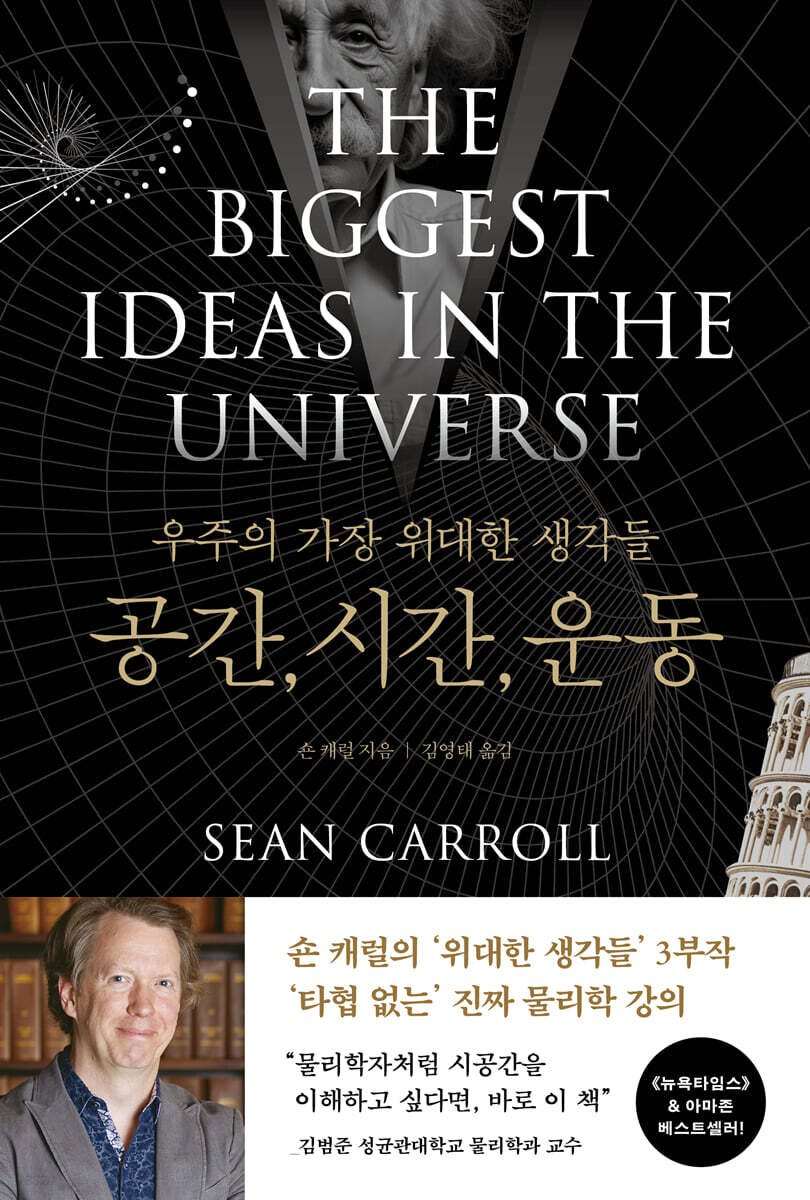
The Greatest Ideas in the Universe: Space, Time, and Motion
 |
Description
Book Introduction
Sean Carroll's The Greatest Thoughts in the Universe trilogy A Real, Uncompromising Physics Lecture Sean Carroll, Homewood Professor of Natural Philosophy in the Department of Physics and Department of Philosophy at Johns Hopkins University, guides readers through a "no-compromise" lecture on physics. As the title suggests, this bold book envisions a world where physics becomes a daily topic of conversation, like gossip about sports or celebrities. During the pandemic, the author, seeking ways to contribute to the world as a physicist, began a series of online lectures covering classical mechanics, relativity, quantum mechanics, and complexity theory to educate people about the deeper meaning behind the equations that describe the laws of physics. Based on this, this book is the first in a trilogy called 'The Greatest Ideas in the Universe' and covers classical mechanics established by Newton in the 17th century, as well as the special and general theories of relativity discovered by Einstein in the 20th century. From classical mechanics, which answers profound questions about the nature of space, time, and change, to Einstein's ideas about curved spacetime, and even astronomical phenomena like black holes and gravitational waves, this book covers mathematical ideas from centuries ago to the latest advances in physics. It guides readers through the true meaning of the laws of physics by tackling them head-on with accessible explanations, without replacing formulas with metaphors or analogies. Science writer Brian Clegg called it "a bridge between the world of popular science, which many thought impossible, and the mathematical world of professional physicists." |
- You can preview some of the book's contents.
Preview
index
introduction
1 Preservation
2 Changes
3 Dynamics
4 spaces
5 hours
6 space-time
7 Geometry
8 Gravity
9 black holes
supplement
Appendix A: Functions, Derivatives, and Integrators
Appendix B: Connections and Curvature
Translator's Note
Search
1 Preservation
2 Changes
3 Dynamics
4 spaces
5 hours
6 space-time
7 Geometry
8 Gravity
9 black holes
supplement
Appendix A: Functions, Derivatives, and Integrators
Appendix B: Connections and Curvature
Translator's Note
Search
Detailed image

Into the book
To physicists, conservation means 'something that remains the same over time.'
For example, you may have heard that energy is conserved.
Energy is not a type of matter like water or dust.
Energy is a property of an object, and it varies depending on what the object is and what situation it is in.
There is no such thing as an 'energy fluid' that moves from one place to another.
There are objects that simply have positions, velocities, and other properties, and because of these facts we can associate them with specific amounts of energy.
--- p.21, from “1 Preservation”
According to Laplace's paradigm of classical mechanics, if you know the current position and velocity of an object, and also the positions and velocities of all other objects relative to it that affect it, you can determine the future of that object.
Then we can find out what forces are acting on this object, and from Newton's second law we can find its acceleration.
With this in mind, how can we determine the trajectory of this object? If velocity is the rate of change of position and acceleration is the rate of change of velocity, we need to add up all the accumulated changes to determine how position and velocity have changed over time.
--- p.73, from “2 Changes”
The difference is that change is a completely general concept, whereas dynamics is specifically concerned only with changes that obey the equations of physics.
We will look at the properties of specific physical systems and see how classical mechanics explains their behavior.
We'll think about kinetic and potential energy and discover some interesting facts about the dynamics of other objects.
This method ultimately reconstructs dynamics from a global perspective that takes into account the entire history of the system.
This amazing idea is called the principle of least action.
--- p.87, from “3 Dynamics”
Most physicists today side with Newton, who treated space itself as a single thing, for several reasons.
First, the space between objects is not empty.
The space is filled with various types of chapters.
Second, space (as part of space-time) has a life of its own.
As we will discuss in Chapter 8, Einstein showed that the geometry of space corresponds to energy and can also change over time.
But we haven't reached a definitive answer yet.
--- p.132, from “4 Spaces”
The important thing is that the universe we observe started out in a state of low entropy, and entropy has been increasing ever since.
This is the ultimate cause of the direction of time.
Just as we live on Earth and the arrow of space exists close to us, so too (let's be honest) does the arrow of time exist because we live close to the Big Bang.
To be fair, there's still a lot to explain.
The arrow of time manifests itself in many ways: memory, causality, aging, and so on.
We have been talking about the 'thermodynamic' arrow of time so far, with the idea that the arrow of time ultimately underlies all these directional aspects.
But I wasn't careful to prove this.
These are questions that remain unanswered even at the research level.
--- p.190, from “5 Hours”
Space and time have independent identities, and no one has ever tied them together.
What binds them together is the theory of relativity, which emerged in the early 20th century, and relativity cannot avoid talking about space-time.
In the theory of relativity, the claim that space and time are separate, objective entities is no longer correct.
What really exists is space-time, and our division of space-time into space and time is merely a useful human convention.
--- p.199, from “6 Space-Time”
We can describe a set of axioms implying geometric properties of a two-dimensional space with constant negative curvature, sometimes called a hyperboloid (to contrast with Euclidean 'flat' surfaces).
Within this geometric system, we can prove theorems, derive formulas for the circumference and area of a circle, and answer any other geometric question we can think of.
We cannot simply create a space like the two-dimensional space we inhabit.
The exact hyperboloid exists only in our minds.
--- p.256, from “7 Geometry”
Particle physicists often talk about the four fundamental forces of nature, which include gravity, electromagnetism, the strong nuclear force, and the weak nuclear force.
But gravity is a different kind of force than these, because gravity is precisely a universal force.
Unlike other forces that affect objects differently depending on their charge, gravity affects everything in the same way.
This allows for a shift in thinking from thinking of force as something that propagates through space-time to thinking of it as a property of space-time itself.
For example, you may have heard that energy is conserved.
Energy is not a type of matter like water or dust.
Energy is a property of an object, and it varies depending on what the object is and what situation it is in.
There is no such thing as an 'energy fluid' that moves from one place to another.
There are objects that simply have positions, velocities, and other properties, and because of these facts we can associate them with specific amounts of energy.
--- p.21, from “1 Preservation”
According to Laplace's paradigm of classical mechanics, if you know the current position and velocity of an object, and also the positions and velocities of all other objects relative to it that affect it, you can determine the future of that object.
Then we can find out what forces are acting on this object, and from Newton's second law we can find its acceleration.
With this in mind, how can we determine the trajectory of this object? If velocity is the rate of change of position and acceleration is the rate of change of velocity, we need to add up all the accumulated changes to determine how position and velocity have changed over time.
--- p.73, from “2 Changes”
The difference is that change is a completely general concept, whereas dynamics is specifically concerned only with changes that obey the equations of physics.
We will look at the properties of specific physical systems and see how classical mechanics explains their behavior.
We'll think about kinetic and potential energy and discover some interesting facts about the dynamics of other objects.
This method ultimately reconstructs dynamics from a global perspective that takes into account the entire history of the system.
This amazing idea is called the principle of least action.
--- p.87, from “3 Dynamics”
Most physicists today side with Newton, who treated space itself as a single thing, for several reasons.
First, the space between objects is not empty.
The space is filled with various types of chapters.
Second, space (as part of space-time) has a life of its own.
As we will discuss in Chapter 8, Einstein showed that the geometry of space corresponds to energy and can also change over time.
But we haven't reached a definitive answer yet.
--- p.132, from “4 Spaces”
The important thing is that the universe we observe started out in a state of low entropy, and entropy has been increasing ever since.
This is the ultimate cause of the direction of time.
Just as we live on Earth and the arrow of space exists close to us, so too (let's be honest) does the arrow of time exist because we live close to the Big Bang.
To be fair, there's still a lot to explain.
The arrow of time manifests itself in many ways: memory, causality, aging, and so on.
We have been talking about the 'thermodynamic' arrow of time so far, with the idea that the arrow of time ultimately underlies all these directional aspects.
But I wasn't careful to prove this.
These are questions that remain unanswered even at the research level.
--- p.190, from “5 Hours”
Space and time have independent identities, and no one has ever tied them together.
What binds them together is the theory of relativity, which emerged in the early 20th century, and relativity cannot avoid talking about space-time.
In the theory of relativity, the claim that space and time are separate, objective entities is no longer correct.
What really exists is space-time, and our division of space-time into space and time is merely a useful human convention.
--- p.199, from “6 Space-Time”
We can describe a set of axioms implying geometric properties of a two-dimensional space with constant negative curvature, sometimes called a hyperboloid (to contrast with Euclidean 'flat' surfaces).
Within this geometric system, we can prove theorems, derive formulas for the circumference and area of a circle, and answer any other geometric question we can think of.
We cannot simply create a space like the two-dimensional space we inhabit.
The exact hyperboloid exists only in our minds.
--- p.256, from “7 Geometry”
Particle physicists often talk about the four fundamental forces of nature, which include gravity, electromagnetism, the strong nuclear force, and the weak nuclear force.
But gravity is a different kind of force than these, because gravity is precisely a universal force.
Unlike other forces that affect objects differently depending on their charge, gravity affects everything in the same way.
This allows for a shift in thinking from thinking of force as something that propagates through space-time to thinking of it as a property of space-time itself.
--- p.303-304, from “8 Gravity”
Publisher's Review
“If you want to understand space and time like a physicist, this is the book for you.”
- Kim Beom-jun, Professor of Physics, Sungkyunkwan University
From the fundamental concepts of physics to the nature of the universe,
A live lecture by theoretical physicist Sean Carroll!
Since time immemorial, perhaps even before language was systematized, humans have been studying how the world we live in came to be and how it works.
They developed astronomy by observing the movements of the sun, moon, and stars, and gave birth to geometry by measuring direction and distance.
The structure was built by calculating force and weight and calculating momentum.
Human arithmetic, which was initially very simple, gradually became more complex as the secrets of the world were revealed, and now it has become a world of high-order equations that are difficult even for experts to understand.
Natural philosophy, which used to explore the nature of the world solely through reasoning, has now become physics, which encompasses dozens of sub-fields.
This book is the first in a trilogy titled 'The Greatest Ideas in the Universe', and covers everything from classical mechanics established by Newton in the 17th century to the special and general theories of relativity discovered by Einstein in the 20th century.
From classical mechanics, which answers profound questions about the nature of space, time, and change, to Einstein's ideas about curved spacetime, and even astronomical phenomena like black holes and gravitational waves, this book covers mathematical ideas from centuries ago to the latest advances in physics.
Modern science has now become a precise discipline understood only by a small number of educated people.
In this series, Sean Carroll, a theoretical physicist at Johns Hopkins University and the author of this book, has undertaken the task of unveiling the most important and complex components of modern science, which has become so systematized and complex.
As “the most reliable explainer of the most implausible concepts,” he presents the fundamental ideas that inform the reality of modern physics in a unique and lucid voice.
Modern physics offers profound insights into how the universe works.
But such insights are often presented in the form of very complex equations.
Unlike conventional science textbooks that indirectly introduce modern physics through metaphors and vague interpretations, this book directly examines the key equations of modern physics.
By addressing difficult material directly, without beating around the bush, this book guides readers to understand the very equations that Einstein used to explain his general theory of relativity.
In the tradition of Richard Feynman's legendary lectures of 60 years ago, this book will serve as a dazzling, inspiring introduction to a way of seeing that will resonate across cultures and generations for years to come.
Humanity's 'greatest ideas' about the universe
Sean Carroll's "The Greatest Ideas in the Universe" series consists of three books.
These are ‘space, time, and motion’, ‘quantum and field’, and ‘complexity and emergence’.
This book, "The Greatest Ideas of the Universe - Space, Time, and Motion," is the first volume and covers everything from classical mechanics established by Newton in the 17th century to the special and general theories of relativity discovered by Einstein in the 20th century.
Classical mechanics and special relativity are dynamical theories that deal with the motion of objects in a flat three-dimensional space, while general relativity deals with the motion of objects in a curved four-dimensional spacetime, and their properties are quite different.
Classical mechanics and modern mechanics are sometimes divided based on these two.
In the process of refining the concepts of the theory of relativity and the birth of mechanics, various ideas were presented and precise definitions were created, such as the position, velocity, acceleration, momentum, energy, Lagrangian mechanics, Hamiltonian mechanics, conservation of physical quantities, the principle of least action, and the equivalence principle.
This book introduces definitions of several such concepts and explains how each has been applied to lead to the achievements of modern science.
Thanks to the advancement of science over the past century, starting with classical mechanics, humanity has come to understand much about the true nature of the universe.
Black holes, which were once objects of theoretical curiosity, are now being observed in practice, and their amazing properties are being revealed one after another.
As readers read this book, they will be forced to reconsider the mysteries and differences between space and time, which they had taken for granted.
The universe, once considered an empty vessel containing celestial bodies, will be vividly felt as a turbulent phenomenon with a life of its own, with this book.
“After reading this book, you will understand Einstein’s equations
“You can understand the meaning and relationships of all symbols.”
“The sentences give you a sense of what general relativity is, but the equations tell you precisely and clearly what actually happens.” _ From the text
Popular science textbooks always boast about being “easy to read” and free of equations and diagrams.
However, this approach only provides a superficial knowledge of science and does not grasp its underlying principles.
Without getting to the real content, we only get images and metaphors that roughly explain the most important mathematical principles in everyday terms.
Sean Carroll, the author of this book, says that popular science books that emphasize popularity always “miss the most important thing.”
It is certainly different to feel the allure of science and to clearly understand the process through which that allure arises.
The wonder of science is heightened when we learn the principles behind it.
So, this book has quite a few equation solutions.
Because you can't say you understand Einstein's theory until you understand the meaning of the symbols that make up the simple equation e=mc2.
Physics education consists primarily of learning to solve equations.
It's a bit of a delusion to think you can learn physics without math.
As the author states, this book is for "people who are willing to look at equations and think about their meaning, even if it's at the level of high school algebra," so for those who enjoy intellectual challenges, this book will be a satisfying challenge.
For those who enjoy intellectual challenges
Uncompromising, real physics lectures
Studying is like meeting a new world.
This book will provide an excellent idea of the types of physical debates one might encounter in college for anyone interested in fundamental physics, especially undergraduate physics majors, as well as for the general public interested in physics and cosmology, and for high school students exploring careers in science through advanced scientific study.
Those who consider themselves insufficiently skilled in mathematics will be able to follow this book as if they were taking a college course, cultivating their mathematical intuition and understanding the latest physics discussions.
Additionally, experts who already have a solid knowledge of mathematics and science will find the author's skill in telling his story very inspiring.
The goal of this series is to bridge the knowledge gap between experts and the public at large, building on the cutting edge of modern physics.
Readers will gain a clear understanding of the great achievements of physics, focusing on established knowledge rather than speculation.
For readers who find it difficult to follow the content based solely on the text, more detailed mathematical explanations are provided in the appendix.
You can also find all lecture videos related to the content of the text on the author's YouTube channel.
Readers can take an introductory physics class taught by a world-renowned star professor through a video that has gained incredible popularity, reaching 10 million cumulative views in just three years, a rare feat for authentic science content.
What is the universe, what is it made of, and how does it work?
Classical mechanics, exploring the nature of the world
Chapter 1 of this book deals with the concept of 'conservation'.
Of the countless patterns in the universe, the simplest are those that “do not change over time,” and the predictability that comes from them has enabled humanity to establish the discipline of physics.
For physicists, conservation means 'something that remains the same over time.'
The most fundamental quantities in physics, such as energy, momentum, information, and angular momentum, remain the same over time.
Understanding conservation is the first step in transitioning from pre-modern to modern science.
Chapter 2 deals with ‘change’.
To construct the entire history of a system, we must extract the results from one state to another.
At this point, the next state is determined by the current state and the laws of physics.
The 'instantaneous rate of change of certain physical quantities' and 'physical quantities that change over time', such as the progress of planets, the movement of galaxies, and the direction of light, were solved using calculus.
In Chapter 3, we encounter 'dynamics', a concept much more complex than change.
If change is a completely general concept, dynamics is a concept that is specifically concerned only with changes that follow the equations of physics.
Taking a dynamical perspective ultimately allows us to reconstruct dynamics from a global perspective that takes into account the entire history of the system.
Chapter 4 explores the concept of 'space', the space in which we live or that surrounds us.
For a long time, there have been two opposing views on space: substantialism, which regards space as a thing or a property of things, and relationism, which regards space as a thing or a property of things.
Questions about space lead us to Hamiltonian mechanics.
This mechanics, which differs subtly from Newtonian mechanics, plays a crucial role in understanding why space is such an important concept.
Chapter 5 explains 'time', the most important element in physics and the subject of the most active debate surrounding its reality.
The author describes time as “part of how we position ourselves in the universe.”
If time did not exist, there could be no movement, evolution, or change.
The past is fixed, the future is open.
Intuitively, time appears to flow from past to future.
Here we can examine the debates surrounding time, including presentism, perpetualism, and possibilitism.
How to make the invisible visible?
Modern mechanics proves the unprovable
Chapter 6 deals with the concept of 'spacetime', a new concept that Einstein developed through his special theory of relativity to think about space and time.
The long-held belief that time and space exist independently was unified by Einstein.
If we think of space-time as a unified four-dimensional continuum, we arrive at a completely new conclusion about the concept of space-time.
Chapter 7 covers the birth of the discipline of 'geometry' from its modern applications.
Geometry is commonly accepted as the study of the properties of straight lines and curves on a two-dimensional plane.
Traditional Euclidean geometry is valid only in a special two-dimensional space that is flat and uncurved.
But the world is a three-dimensional space and it is curved.
The curvature of the universe must be answered in Riemannian geometry beyond Euclidean geometry.
8 deals with gravity.
Gravity is one of the four fundamental forces of the universe, affecting everything in the same way, unlike the other three forces, which affect objects differently depending on their charge.
Because of this, a shift in thinking is possible, where gravity is considered a property of space-time itself.
What gravity is and how it works in the universe we live in can be explained by Einstein's equations.
Chapter 9 finally deals with one of the greatest mysteries of the universe: black holes.
For a long time, black holes have been objects of theoretical curiosity.
But the 2020 Nobel Prize in Physics went to three black hole researchers, putting them at the forefront of modern astronomy.
Astronomers estimate that there are hundreds of millions of stellar-mass black holes in our galaxy alone.
Given that there are hundreds of billions of galaxies in the universe, black holes could be an important window into understanding the universe.
“Reading this book is like taking an introductory physics class taught by a star professor.”
- Scientific American
“Sean Carroll is a brilliant science writer of unparalleled talent.
This book, which takes the popularization of science to a new level, will help create a world where everyone enjoys discussing science in their daily lives.”
- 《Science》
- Kim Beom-jun, Professor of Physics, Sungkyunkwan University
From the fundamental concepts of physics to the nature of the universe,
A live lecture by theoretical physicist Sean Carroll!
Since time immemorial, perhaps even before language was systematized, humans have been studying how the world we live in came to be and how it works.
They developed astronomy by observing the movements of the sun, moon, and stars, and gave birth to geometry by measuring direction and distance.
The structure was built by calculating force and weight and calculating momentum.
Human arithmetic, which was initially very simple, gradually became more complex as the secrets of the world were revealed, and now it has become a world of high-order equations that are difficult even for experts to understand.
Natural philosophy, which used to explore the nature of the world solely through reasoning, has now become physics, which encompasses dozens of sub-fields.
This book is the first in a trilogy titled 'The Greatest Ideas in the Universe', and covers everything from classical mechanics established by Newton in the 17th century to the special and general theories of relativity discovered by Einstein in the 20th century.
From classical mechanics, which answers profound questions about the nature of space, time, and change, to Einstein's ideas about curved spacetime, and even astronomical phenomena like black holes and gravitational waves, this book covers mathematical ideas from centuries ago to the latest advances in physics.
Modern science has now become a precise discipline understood only by a small number of educated people.
In this series, Sean Carroll, a theoretical physicist at Johns Hopkins University and the author of this book, has undertaken the task of unveiling the most important and complex components of modern science, which has become so systematized and complex.
As “the most reliable explainer of the most implausible concepts,” he presents the fundamental ideas that inform the reality of modern physics in a unique and lucid voice.
Modern physics offers profound insights into how the universe works.
But such insights are often presented in the form of very complex equations.
Unlike conventional science textbooks that indirectly introduce modern physics through metaphors and vague interpretations, this book directly examines the key equations of modern physics.
By addressing difficult material directly, without beating around the bush, this book guides readers to understand the very equations that Einstein used to explain his general theory of relativity.
In the tradition of Richard Feynman's legendary lectures of 60 years ago, this book will serve as a dazzling, inspiring introduction to a way of seeing that will resonate across cultures and generations for years to come.
Humanity's 'greatest ideas' about the universe
Sean Carroll's "The Greatest Ideas in the Universe" series consists of three books.
These are ‘space, time, and motion’, ‘quantum and field’, and ‘complexity and emergence’.
This book, "The Greatest Ideas of the Universe - Space, Time, and Motion," is the first volume and covers everything from classical mechanics established by Newton in the 17th century to the special and general theories of relativity discovered by Einstein in the 20th century.
Classical mechanics and special relativity are dynamical theories that deal with the motion of objects in a flat three-dimensional space, while general relativity deals with the motion of objects in a curved four-dimensional spacetime, and their properties are quite different.
Classical mechanics and modern mechanics are sometimes divided based on these two.
In the process of refining the concepts of the theory of relativity and the birth of mechanics, various ideas were presented and precise definitions were created, such as the position, velocity, acceleration, momentum, energy, Lagrangian mechanics, Hamiltonian mechanics, conservation of physical quantities, the principle of least action, and the equivalence principle.
This book introduces definitions of several such concepts and explains how each has been applied to lead to the achievements of modern science.
Thanks to the advancement of science over the past century, starting with classical mechanics, humanity has come to understand much about the true nature of the universe.
Black holes, which were once objects of theoretical curiosity, are now being observed in practice, and their amazing properties are being revealed one after another.
As readers read this book, they will be forced to reconsider the mysteries and differences between space and time, which they had taken for granted.
The universe, once considered an empty vessel containing celestial bodies, will be vividly felt as a turbulent phenomenon with a life of its own, with this book.
“After reading this book, you will understand Einstein’s equations
“You can understand the meaning and relationships of all symbols.”
“The sentences give you a sense of what general relativity is, but the equations tell you precisely and clearly what actually happens.” _ From the text
Popular science textbooks always boast about being “easy to read” and free of equations and diagrams.
However, this approach only provides a superficial knowledge of science and does not grasp its underlying principles.
Without getting to the real content, we only get images and metaphors that roughly explain the most important mathematical principles in everyday terms.
Sean Carroll, the author of this book, says that popular science books that emphasize popularity always “miss the most important thing.”
It is certainly different to feel the allure of science and to clearly understand the process through which that allure arises.
The wonder of science is heightened when we learn the principles behind it.
So, this book has quite a few equation solutions.
Because you can't say you understand Einstein's theory until you understand the meaning of the symbols that make up the simple equation e=mc2.
Physics education consists primarily of learning to solve equations.
It's a bit of a delusion to think you can learn physics without math.
As the author states, this book is for "people who are willing to look at equations and think about their meaning, even if it's at the level of high school algebra," so for those who enjoy intellectual challenges, this book will be a satisfying challenge.
For those who enjoy intellectual challenges
Uncompromising, real physics lectures
Studying is like meeting a new world.
This book will provide an excellent idea of the types of physical debates one might encounter in college for anyone interested in fundamental physics, especially undergraduate physics majors, as well as for the general public interested in physics and cosmology, and for high school students exploring careers in science through advanced scientific study.
Those who consider themselves insufficiently skilled in mathematics will be able to follow this book as if they were taking a college course, cultivating their mathematical intuition and understanding the latest physics discussions.
Additionally, experts who already have a solid knowledge of mathematics and science will find the author's skill in telling his story very inspiring.
The goal of this series is to bridge the knowledge gap between experts and the public at large, building on the cutting edge of modern physics.
Readers will gain a clear understanding of the great achievements of physics, focusing on established knowledge rather than speculation.
For readers who find it difficult to follow the content based solely on the text, more detailed mathematical explanations are provided in the appendix.
You can also find all lecture videos related to the content of the text on the author's YouTube channel.
Readers can take an introductory physics class taught by a world-renowned star professor through a video that has gained incredible popularity, reaching 10 million cumulative views in just three years, a rare feat for authentic science content.
What is the universe, what is it made of, and how does it work?
Classical mechanics, exploring the nature of the world
Chapter 1 of this book deals with the concept of 'conservation'.
Of the countless patterns in the universe, the simplest are those that “do not change over time,” and the predictability that comes from them has enabled humanity to establish the discipline of physics.
For physicists, conservation means 'something that remains the same over time.'
The most fundamental quantities in physics, such as energy, momentum, information, and angular momentum, remain the same over time.
Understanding conservation is the first step in transitioning from pre-modern to modern science.
Chapter 2 deals with ‘change’.
To construct the entire history of a system, we must extract the results from one state to another.
At this point, the next state is determined by the current state and the laws of physics.
The 'instantaneous rate of change of certain physical quantities' and 'physical quantities that change over time', such as the progress of planets, the movement of galaxies, and the direction of light, were solved using calculus.
In Chapter 3, we encounter 'dynamics', a concept much more complex than change.
If change is a completely general concept, dynamics is a concept that is specifically concerned only with changes that follow the equations of physics.
Taking a dynamical perspective ultimately allows us to reconstruct dynamics from a global perspective that takes into account the entire history of the system.
Chapter 4 explores the concept of 'space', the space in which we live or that surrounds us.
For a long time, there have been two opposing views on space: substantialism, which regards space as a thing or a property of things, and relationism, which regards space as a thing or a property of things.
Questions about space lead us to Hamiltonian mechanics.
This mechanics, which differs subtly from Newtonian mechanics, plays a crucial role in understanding why space is such an important concept.
Chapter 5 explains 'time', the most important element in physics and the subject of the most active debate surrounding its reality.
The author describes time as “part of how we position ourselves in the universe.”
If time did not exist, there could be no movement, evolution, or change.
The past is fixed, the future is open.
Intuitively, time appears to flow from past to future.
Here we can examine the debates surrounding time, including presentism, perpetualism, and possibilitism.
How to make the invisible visible?
Modern mechanics proves the unprovable
Chapter 6 deals with the concept of 'spacetime', a new concept that Einstein developed through his special theory of relativity to think about space and time.
The long-held belief that time and space exist independently was unified by Einstein.
If we think of space-time as a unified four-dimensional continuum, we arrive at a completely new conclusion about the concept of space-time.
Chapter 7 covers the birth of the discipline of 'geometry' from its modern applications.
Geometry is commonly accepted as the study of the properties of straight lines and curves on a two-dimensional plane.
Traditional Euclidean geometry is valid only in a special two-dimensional space that is flat and uncurved.
But the world is a three-dimensional space and it is curved.
The curvature of the universe must be answered in Riemannian geometry beyond Euclidean geometry.
8 deals with gravity.
Gravity is one of the four fundamental forces of the universe, affecting everything in the same way, unlike the other three forces, which affect objects differently depending on their charge.
Because of this, a shift in thinking is possible, where gravity is considered a property of space-time itself.
What gravity is and how it works in the universe we live in can be explained by Einstein's equations.
Chapter 9 finally deals with one of the greatest mysteries of the universe: black holes.
For a long time, black holes have been objects of theoretical curiosity.
But the 2020 Nobel Prize in Physics went to three black hole researchers, putting them at the forefront of modern astronomy.
Astronomers estimate that there are hundreds of millions of stellar-mass black holes in our galaxy alone.
Given that there are hundreds of billions of galaxies in the universe, black holes could be an important window into understanding the universe.
“Reading this book is like taking an introductory physics class taught by a star professor.”
- Scientific American
“Sean Carroll is a brilliant science writer of unparalleled talent.
This book, which takes the popularization of science to a new level, will help create a world where everyone enjoys discussing science in their daily lives.”
- 《Science》
GOODS SPECIFICS
- Date of issue: January 19, 2024
- Page count, weight, size: 412 pages | 728g | 153*225*25mm
- ISBN13: 9791166892028
- ISBN10: 1166892026
You may also like
카테고리
korean


korean

![GQ KOREA Mark (Monthly): December [2025]](http://librairie.coreenne.fr/cdn/shop/files/8ef265dbbfbf186523ed75ba7319009d.jpg?v=1765340328&width=3840)


