

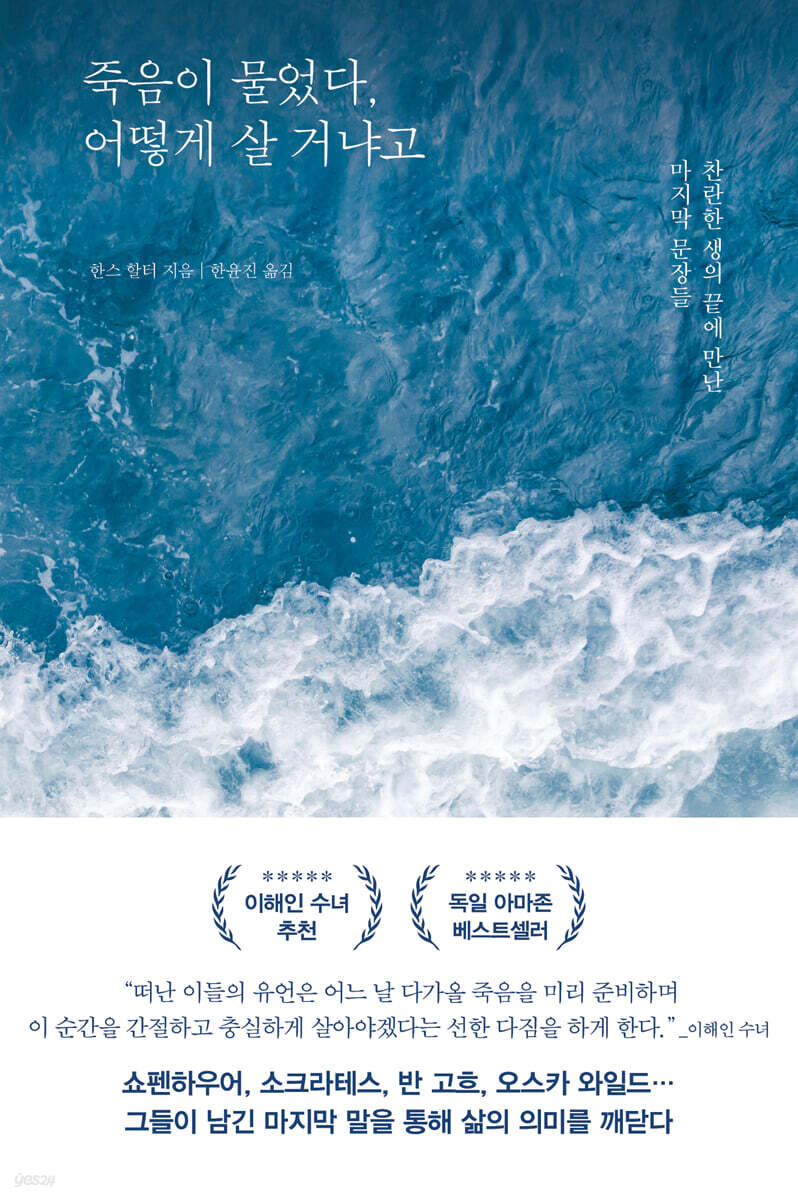
Death asked, how will you live?
 |
Description
Book Introduction
- A word from MD
-
Death asked, how will you live?A collection of the lives and deaths of historical heroes who illuminated human history.
It introduces the last words they left before they died and asks weighty questions about life.
There are some rather vain deaths and wills, and there are also some flashy and wonderful endings.
How to live and die.
It's a question everyone must bear.
January 5, 2024. Humanities PD Son Min-gyu
“Remember that you will die someday.
There is no more certain philosophy of life than that.
Death keeps us awake.”
Schopenhauer, Socrates, Van Gogh, Oscar Wilde…
The last sentences I encountered at the end of a brilliant life
Every human being is equally granted one birth and one death.
If birth is a part of life, then death is also a part of life.
Yet, many people regard death primarily as a fearful and cold horror, the annihilation of a being, and they avoid it as an abstract task.
Author Hans Halter, who has worked as a doctor for decades and cared for patients at the crossroads of life and death, says that he learned 'how to live' through the 'dying' of countless people.
Like many people who have passed away before, there will come a day when death will inevitably become my lot, so I must live this moment without regrets.
The author began writing to inform people that “carpe diem” begins when we keep “memento mori” in mind, and published this book, “Death Asks, How Will You Live?” by compiling the lives and wills of world-renowned sages such as Schopenhauer, Oscar Wilde, and Vincent van Gogh, philosophers, writers, artists, and politicians.
The 84 stories of life and death naturally lead readers to ask themselves, "How should I live now?" and leave a lasting, deep resonance, maintaining its position as a German Amazon bestseller ever since its publication.
One day we will all scatter like waves.
That is why we must change our goal in life from living well to dying well.
Then a lot of things become clear.
When we realize the finiteness of life, we can empty our lives of the clutter and greed and focus on the essentials.
So we must remember that we all die.
There is no more certain philosophy of life than that.
There is no more certain philosophy of life than that.
Death keeps us awake.”
Schopenhauer, Socrates, Van Gogh, Oscar Wilde…
The last sentences I encountered at the end of a brilliant life
Every human being is equally granted one birth and one death.
If birth is a part of life, then death is also a part of life.
Yet, many people regard death primarily as a fearful and cold horror, the annihilation of a being, and they avoid it as an abstract task.
Author Hans Halter, who has worked as a doctor for decades and cared for patients at the crossroads of life and death, says that he learned 'how to live' through the 'dying' of countless people.
Like many people who have passed away before, there will come a day when death will inevitably become my lot, so I must live this moment without regrets.
The author began writing to inform people that “carpe diem” begins when we keep “memento mori” in mind, and published this book, “Death Asks, How Will You Live?” by compiling the lives and wills of world-renowned sages such as Schopenhauer, Oscar Wilde, and Vincent van Gogh, philosophers, writers, artists, and politicians.
The 84 stories of life and death naturally lead readers to ask themselves, "How should I live now?" and leave a lasting, deep resonance, maintaining its position as a German Amazon bestseller ever since its publication.
One day we will all scatter like waves.
That is why we must change our goal in life from living well to dying well.
Then a lot of things become clear.
When we realize the finiteness of life, we can empty our lives of the clutter and greed and focus on the essentials.
So we must remember that we all die.
There is no more certain philosophy of life than that.
- You can preview some of the book's contents.
Preview
index
Recommendation
Preface: To speak of death is to speak of life.
Chapter 1_ Have you ever imagined your funeral?
Buddha │ Sultan Saladin │ Julius Caesar │ Vincent van Gogh │ Che Guevara │ Charles Darwin │ Søren Kierkegaard │ Albert Einstein │ Wolfgang Mozart │ Coco Chanel │ Martin Luther │ Diana Spencer │ Henry David Thoreau │ Muhammad │ Louis XVI │ Marie Antoinette
- Emperor Nero and the philosopher Seneca, two people who died the same but different.
Chapter 2: Live Today as if You'll Die Tomorrow
Oscar Wilde │ Genghis Khan │ Rainer Maria Rilke │ Maria Theresa │ Henry VIII │ Anne Boleyn │ Elizabeth I │ Winston Churchill │ Confucius │ Anna Pavlova │ Konrad Adenauer │ John Lennon │ Ernest Hemingway │ Hermann Boerhaave │ Karl Marx │ Mikhail Bakunin │ Dylan Thomas
- Jesus' last words on the cross
Chapter 3_ Because someday, the moment will come when the curtain will fall on the great play called life.
Immanuel Kant │ Archimedes │ Fyodor Dostoevsky │ Carl Jung │ Countess Dubarry │ Marie Curie │ Jan Hus │ Marlene Dietrich │ Ludwig van Beethoven │ Leo Tolstoy │ Gotthold Lessing │ Josephine Baker │ Alphonse Capone │ Ulrich Zwingli │ Toulouse-Lautrec │ Romy Schneider
- The truth and lies hidden in Goethe's will
Chapter 4: There is no philosophy of life more certain than death.
Mother Teresa │ Plato │ Franz Kafka │ Friedrich Nietzsche │ Maria Montessori │ Arthur Schopenhauer │ Georg Hegel │ Napoleon I │ Stefan Zweig │ Heinrich Heine │ Giuseppe Garibaldi │ Charlotte Corday │ Vladimir Lenin │ Emiliano Zapata │ Gottfried Benn │ Anton Chekhov │ Mahatma Gandhi
- Even if life deceives you, the great Russian writers
Chapter 5_ May you remain forever as one of nature
Thomas Edison │ Socrates │ Cleopatra │ Martin Luther King │ Franklin Roosevelt │ Aristotle │ John Paul II │ Sigmund Freud │ Elisabeth von Wieselbach │ Marilyn Monroe │ Horatio Nelson │ Bob Marley │ Gaspard de Coligny │ Honoré de Balzac │ Frederick William I │ Frederick William II │ Otto von Bismarck │ Mark Twain
- Every death has a name.
Preface: To speak of death is to speak of life.
Chapter 1_ Have you ever imagined your funeral?
Buddha │ Sultan Saladin │ Julius Caesar │ Vincent van Gogh │ Che Guevara │ Charles Darwin │ Søren Kierkegaard │ Albert Einstein │ Wolfgang Mozart │ Coco Chanel │ Martin Luther │ Diana Spencer │ Henry David Thoreau │ Muhammad │ Louis XVI │ Marie Antoinette
- Emperor Nero and the philosopher Seneca, two people who died the same but different.
Chapter 2: Live Today as if You'll Die Tomorrow
Oscar Wilde │ Genghis Khan │ Rainer Maria Rilke │ Maria Theresa │ Henry VIII │ Anne Boleyn │ Elizabeth I │ Winston Churchill │ Confucius │ Anna Pavlova │ Konrad Adenauer │ John Lennon │ Ernest Hemingway │ Hermann Boerhaave │ Karl Marx │ Mikhail Bakunin │ Dylan Thomas
- Jesus' last words on the cross
Chapter 3_ Because someday, the moment will come when the curtain will fall on the great play called life.
Immanuel Kant │ Archimedes │ Fyodor Dostoevsky │ Carl Jung │ Countess Dubarry │ Marie Curie │ Jan Hus │ Marlene Dietrich │ Ludwig van Beethoven │ Leo Tolstoy │ Gotthold Lessing │ Josephine Baker │ Alphonse Capone │ Ulrich Zwingli │ Toulouse-Lautrec │ Romy Schneider
- The truth and lies hidden in Goethe's will
Chapter 4: There is no philosophy of life more certain than death.
Mother Teresa │ Plato │ Franz Kafka │ Friedrich Nietzsche │ Maria Montessori │ Arthur Schopenhauer │ Georg Hegel │ Napoleon I │ Stefan Zweig │ Heinrich Heine │ Giuseppe Garibaldi │ Charlotte Corday │ Vladimir Lenin │ Emiliano Zapata │ Gottfried Benn │ Anton Chekhov │ Mahatma Gandhi
- Even if life deceives you, the great Russian writers
Chapter 5_ May you remain forever as one of nature
Thomas Edison │ Socrates │ Cleopatra │ Martin Luther King │ Franklin Roosevelt │ Aristotle │ John Paul II │ Sigmund Freud │ Elisabeth von Wieselbach │ Marilyn Monroe │ Horatio Nelson │ Bob Marley │ Gaspard de Coligny │ Honoré de Balzac │ Frederick William I │ Frederick William II │ Otto von Bismarck │ Mark Twain
- Every death has a name.
Detailed image

Into the book
Most people believe that death is not another transformation or a step closer to the essence of life, but rather the end itself, a step into emptiness.
On the other hand, we all feel a sense of fairness when it comes to the universal truth that 'all men must die'.
Perhaps this is the only equality that humans can have during their long journey through life.
--- p.8
I have researched and verified as much material as possible to ensure that the final statements the reader will encounter in this book are as accurate as possible.
Although the final words have been reproduced through such efforts, I believe there will be some who question their accuracy.
But a short piece about someone's life, achievements, and the circumstances of their death is enough to captivate us in its own right.
Because a person's life and his last words are one 'organism'.
A person's fundamental nature and the last words they leave behind are not always, but most of the time, consistent.
For this reason, the last words of famous people have been recorded throughout human history.
And many of them have persisted through the ages to this day.
--- p.10
Death does not blow its trumpet in advance.
So we cannot predict the last hours of our lives.
But as this book shows, death definitely gives us at least enough time to say our 'last words.'
--- p.12
On the day the Buddha's body was cremated, the monks had a big fight.
Looking at it that way, it seems that the Buddha's last words did not provide much comfort or guidance to his disciples.
Perhaps the Buddha had even anticipated such a situation.
Because his last words imply that all arguments on earth are futile.
“All things that are born are fleeting and will eventually die.”
--- p.22
Henry David Thoreau wandered the world from the age of 20, and at one time was an idealist who opposed canning and hunting.
He wrote several books, including 『Journey to Field and Wood』 and 『Walden』, and his representative work, 『Walden』, has been translated into many languages around the world and is still greatly loved today.
All of Thoreau's works, which he had written before he died of tuberculosis, his chronic illness, were compiled into 11 volumes.
As he faced death, the pastor asked him if God had always been with him.
America's most influential naturalist writer, who usually dedicated all his works to God's creation, answered quietly.
“I have never argued with God.”
--- p.61
Genghis Khan, who caused the deaths of approximately 5 million people in the wars he started, met a very peaceful end in contrast to his rough life.
His last words were:
“I slept enough that I didn’t even know what death was.”
After that, Genghis Khan ascended to heaven.
His tomb, said to be hidden somewhere in the prairie, has never been discovered despite endless research and exploration.
Genghis Khan, the master of all horsemen, is said to have ordered thousands of horsemen to walk over his grave to hide forever the traces of his resting place.
--- p.79-80
In 1959, Hemingway bought a house in Ketchum, Idaho, where he suffered from severe depression and eventually shot himself with a hunting rifle.
His head, which usually boasted dazzling silver hair, was blown off his torso by the impact (and after his death, both his younger sister and younger brother committed suicide).
His will was not passed down separately, but instead, on the monument in Sun Valley, there is an eulogy he wrote for a friend who had passed away while he was still alive, which reads as follows:
“He loved autumn more than anything.
The leaves of the willow tree are turning yellow, and they float down the stream where the trout swim, and above the high hills there is only a blue sky without a breath of wind.
Now, may you remain as one of nature forever.”
On the other hand, we all feel a sense of fairness when it comes to the universal truth that 'all men must die'.
Perhaps this is the only equality that humans can have during their long journey through life.
--- p.8
I have researched and verified as much material as possible to ensure that the final statements the reader will encounter in this book are as accurate as possible.
Although the final words have been reproduced through such efforts, I believe there will be some who question their accuracy.
But a short piece about someone's life, achievements, and the circumstances of their death is enough to captivate us in its own right.
Because a person's life and his last words are one 'organism'.
A person's fundamental nature and the last words they leave behind are not always, but most of the time, consistent.
For this reason, the last words of famous people have been recorded throughout human history.
And many of them have persisted through the ages to this day.
--- p.10
Death does not blow its trumpet in advance.
So we cannot predict the last hours of our lives.
But as this book shows, death definitely gives us at least enough time to say our 'last words.'
--- p.12
On the day the Buddha's body was cremated, the monks had a big fight.
Looking at it that way, it seems that the Buddha's last words did not provide much comfort or guidance to his disciples.
Perhaps the Buddha had even anticipated such a situation.
Because his last words imply that all arguments on earth are futile.
“All things that are born are fleeting and will eventually die.”
--- p.22
Henry David Thoreau wandered the world from the age of 20, and at one time was an idealist who opposed canning and hunting.
He wrote several books, including 『Journey to Field and Wood』 and 『Walden』, and his representative work, 『Walden』, has been translated into many languages around the world and is still greatly loved today.
All of Thoreau's works, which he had written before he died of tuberculosis, his chronic illness, were compiled into 11 volumes.
As he faced death, the pastor asked him if God had always been with him.
America's most influential naturalist writer, who usually dedicated all his works to God's creation, answered quietly.
“I have never argued with God.”
--- p.61
Genghis Khan, who caused the deaths of approximately 5 million people in the wars he started, met a very peaceful end in contrast to his rough life.
His last words were:
“I slept enough that I didn’t even know what death was.”
After that, Genghis Khan ascended to heaven.
His tomb, said to be hidden somewhere in the prairie, has never been discovered despite endless research and exploration.
Genghis Khan, the master of all horsemen, is said to have ordered thousands of horsemen to walk over his grave to hide forever the traces of his resting place.
--- p.79-80
In 1959, Hemingway bought a house in Ketchum, Idaho, where he suffered from severe depression and eventually shot himself with a hunting rifle.
His head, which usually boasted dazzling silver hair, was blown off his torso by the impact (and after his death, both his younger sister and younger brother committed suicide).
His will was not passed down separately, but instead, on the monument in Sun Valley, there is an eulogy he wrote for a friend who had passed away while he was still alive, which reads as follows:
“He loved autumn more than anything.
The leaves of the willow tree are turning yellow, and they float down the stream where the trout swim, and above the high hills there is only a blue sky without a breath of wind.
Now, may you remain as one of nature forever.”
--- p.111
Publisher's Review
- Recommended by Sister Lee Hae-in
- German Amazon bestseller, praised by local German media
- Reflections on the lives and deaths of world-renowned sages
“I have no fear of death.” _Charles Darwin
“Sadness lasts forever.
“I’m going home now.” _Van Gogh
“Now I am freed from my prison.” _Sultan Saladin
“I die as I have lived, more than I deserve.” _Oscar Wilde
“If today were the last day of your life
What will you do and what will you say?”
As you read the sentences in the book, you will naturally realize that a person's life is condensed into the last words he or she leaves behind.
Vincent van Gogh, the painter who had to struggle in poverty and pain during his lifetime, said to his younger brother Theo, “Please, don’t cry.
This is the best way for us.
He left behind a sad request, saying, “The sadness will remain forever.” Charles Darwin, a biologist who proposed the theory of evolution that shook the foundations of civilization, maintained a firm stance, saying, “I have no fear of death,” until the end of his life, and Einstein, a scientist who won the Nobel Prize in Physics, gave a calm greeting to his family, saying, “I think I’ve done everything I could do in this world.”
Meanwhile, actress Marlene Dietrich, who was greatly loved by the public for her confident attitude, never lost her cheerfulness until the end of her life, saying to a pastor who came to see her, “I have made an appointment with your boss.”
Now, close your eyes for a moment, take a slow breath, and visualize your 'last moment'.
If you were to die tomorrow, what would you do now?
And what words will you leave behind?
A short piece about someone's life, achievements, and the circumstances of their death is enough to captivate us in its own right.
Because a person's life and his last words are one 'organism'.
_From page 10 of the text
“At every turn in life, we must remember death.”
If you think about the things that people regret the most when they die,
Have you ever seen the works of the sculptor Giacometti?
His works, which appear to be bare and skeletal, are always accompanied by “memento mori.”
While Giacometti was traveling with a Dutchman, he died of a sudden heart attack, and Giacometti had to stay with his body all night.
Perhaps because of the shock he received at that time, the theme of death has always been included in his subsequent works.
Giacometti left the following words:
“How much more real would this world and life be if humans could die ‘twice’?”
As we all know, there are no second chances in life or death.
Life is inherently imperfect, so humans struggle with why and how to live, but in reality, the path life should take is simple.
According to a survey, the biggest regrets people have when they die are 'not doing what they wanted to do', 'not living the life they wanted', and 'not expressing things to their loved ones'.
Therefore, what we, the living beings, must do now is very clear.
Do what the dying person wanted, don't waste energy on unnecessary things, and look at the face of your loved one at least once more and express your feelings.
So everyone must remember death at every turn of life.
Nothing makes this life more desperate than death.
- German Amazon bestseller, praised by local German media
- Reflections on the lives and deaths of world-renowned sages
“I have no fear of death.” _Charles Darwin
“Sadness lasts forever.
“I’m going home now.” _Van Gogh
“Now I am freed from my prison.” _Sultan Saladin
“I die as I have lived, more than I deserve.” _Oscar Wilde
“If today were the last day of your life
What will you do and what will you say?”
As you read the sentences in the book, you will naturally realize that a person's life is condensed into the last words he or she leaves behind.
Vincent van Gogh, the painter who had to struggle in poverty and pain during his lifetime, said to his younger brother Theo, “Please, don’t cry.
This is the best way for us.
He left behind a sad request, saying, “The sadness will remain forever.” Charles Darwin, a biologist who proposed the theory of evolution that shook the foundations of civilization, maintained a firm stance, saying, “I have no fear of death,” until the end of his life, and Einstein, a scientist who won the Nobel Prize in Physics, gave a calm greeting to his family, saying, “I think I’ve done everything I could do in this world.”
Meanwhile, actress Marlene Dietrich, who was greatly loved by the public for her confident attitude, never lost her cheerfulness until the end of her life, saying to a pastor who came to see her, “I have made an appointment with your boss.”
Now, close your eyes for a moment, take a slow breath, and visualize your 'last moment'.
If you were to die tomorrow, what would you do now?
And what words will you leave behind?
A short piece about someone's life, achievements, and the circumstances of their death is enough to captivate us in its own right.
Because a person's life and his last words are one 'organism'.
_From page 10 of the text
“At every turn in life, we must remember death.”
If you think about the things that people regret the most when they die,
Have you ever seen the works of the sculptor Giacometti?
His works, which appear to be bare and skeletal, are always accompanied by “memento mori.”
While Giacometti was traveling with a Dutchman, he died of a sudden heart attack, and Giacometti had to stay with his body all night.
Perhaps because of the shock he received at that time, the theme of death has always been included in his subsequent works.
Giacometti left the following words:
“How much more real would this world and life be if humans could die ‘twice’?”
As we all know, there are no second chances in life or death.
Life is inherently imperfect, so humans struggle with why and how to live, but in reality, the path life should take is simple.
According to a survey, the biggest regrets people have when they die are 'not doing what they wanted to do', 'not living the life they wanted', and 'not expressing things to their loved ones'.
Therefore, what we, the living beings, must do now is very clear.
Do what the dying person wanted, don't waste energy on unnecessary things, and look at the face of your loved one at least once more and express your feelings.
So everyone must remember death at every turn of life.
Nothing makes this life more desperate than death.
GOODS SPECIFICS
- Date of issue: December 25, 2023
- Page count, weight, size: 312 pages | 396g | 125*188*20mm
- ISBN13: 9791193506219
- ISBN10: 1193506212
You may also like
카테고리
korean


korean

![ELLE 엘르 스페셜 에디션 A형 : 12월 [2025]](http://librairie.coreenne.fr/cdn/shop/files/b8e27a3de6c9538896439686c6b0e8fb.jpg?v=1766436872&width=3840)


