

The Origin of Time
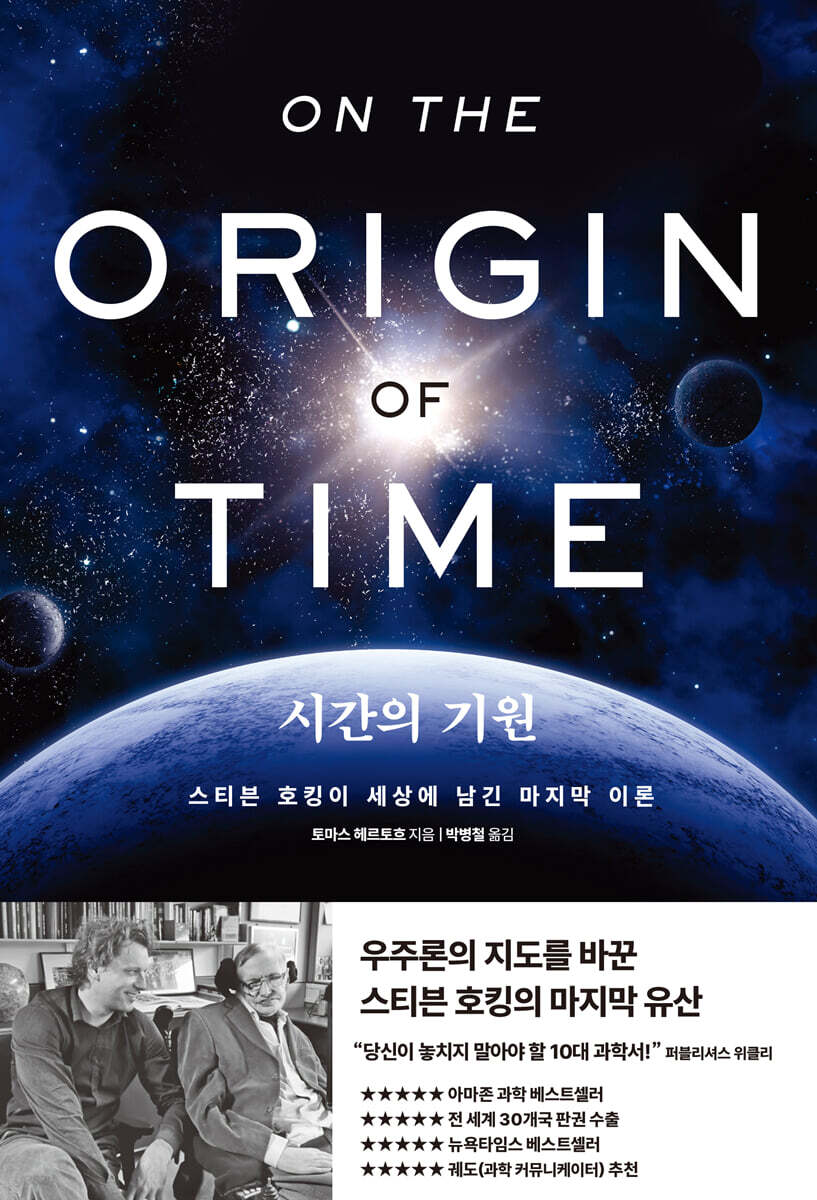 |
Description
Book Introduction
- A word from MD
-
Stephen Hawking's Last Theory"Why is the universe so hospitable to life?" Stephen Hawking's final theory.
Thomas Hertog, who worked with Hawking for 20 years, explores the nature of human origins, crossing physics and philosophy based on their joint research.
The theory of cosmic evolution, which resembles Darwin's theory of evolution, shows the world that Hawking explored until the day he died.
January 2, 2024. Natural Science PD Ahn Hyun-jae
Stephen Hawking's final legacy: reshaping the map of cosmology
Stephen Hawking x Thomas Hertog, the culmination of 20 years of joint research!
A New York Times bestseller, licensed to 30 countries worldwide, and an Amazon bestseller.
If asked to name a scientist who represents our time, many people would think of Stephen Hawking (1942-2018).
Next, a physicist is depicted confined to a wheelchair and communicating with the world through a computer.
Stephen Hawking, who is said to have shared the Nobel Prize in Physics with Roger Penrose in 2020 for his research into the beginning and end of time, is an astrophysicist who has left such a mark on the world of physics that it is hard to believe he never received the Nobel Prize.
“Why is the universe so hospitable to life?” Leaving behind a lifetime of searching for answers, one of our generation’s greatest minds passed away in March 2018.
Five years later, in 2023, the answer to that question and Hawking's final legacy to the universe was officially revealed to the world by his collaborator, Thomas Hertog.
This book, "On the Origin of Time," is, in a word, the definitive version of Stephen Hawking's final cosmology that he left to the world.
The author, Thomas Hertog, is currently a professor of theoretical physics at the Catholic University of Leuven in Belgium. His relationship with Hawking began in 1998 when he became Hawking's PhD student at Cambridge University.
For the next 20 years, the author had the honor of studying cosmology closely with Hawking.
As Sean Carroll, a theoretical physicist and professor of natural philosophy at Johns Hopkins University, said, “Hertoch resembles his teacher Hawking in his unwavering commitment to developing radical cosmological theories,” the author is one of many outstanding physicists produced by Hawking.
Therefore, this book is not only an opportunity to glimpse the bold research achievements of Thomas Hertog, a physicist with a promising future, but also a scientific book, an essay, and a memoir that honors Hawking's life as a scholar who dedicated his life to cosmology and as a human being who never lost his humor even in difficult times.
Hawking's research team, led by the author, began with research on the Big Bang and struggled for several years to uncover the secrets of the birth of a universe friendly to life, eventually presenting a cosmology that allows for the existence of life.
To resolve the contradictions of the ever-controversial multiverse hypothesis, we explore the extremes of quantum physics called the "holographic universe," and trace its origins by going back in time to discover a deep level of evolution where particles, forces, and even time disappear, and the laws of physics become extremely simple.
This leads to the conclusion that “the laws of physics are not fixed, but have evolved along with the formation of the universe.” If the title of this book reminds you of Charles Darwin’s “On the Origin of Species,” it is no coincidence.
In the 25 years since Hawking's best-selling book, A Brief History of Time, was published in 1988, Hawking's cosmology has become more and more similar to Darwin's theory of evolution.
What does it mean to live as a caretaker of Earth in a life-friendly universe? Hawking spent his final moments seeking answers to this profound question.
This fact alone makes his last book, The Origin of Time, a valuable scientific legacy.
Stephen Hawking x Thomas Hertog, the culmination of 20 years of joint research!
A New York Times bestseller, licensed to 30 countries worldwide, and an Amazon bestseller.
If asked to name a scientist who represents our time, many people would think of Stephen Hawking (1942-2018).
Next, a physicist is depicted confined to a wheelchair and communicating with the world through a computer.
Stephen Hawking, who is said to have shared the Nobel Prize in Physics with Roger Penrose in 2020 for his research into the beginning and end of time, is an astrophysicist who has left such a mark on the world of physics that it is hard to believe he never received the Nobel Prize.
“Why is the universe so hospitable to life?” Leaving behind a lifetime of searching for answers, one of our generation’s greatest minds passed away in March 2018.
Five years later, in 2023, the answer to that question and Hawking's final legacy to the universe was officially revealed to the world by his collaborator, Thomas Hertog.
This book, "On the Origin of Time," is, in a word, the definitive version of Stephen Hawking's final cosmology that he left to the world.
The author, Thomas Hertog, is currently a professor of theoretical physics at the Catholic University of Leuven in Belgium. His relationship with Hawking began in 1998 when he became Hawking's PhD student at Cambridge University.
For the next 20 years, the author had the honor of studying cosmology closely with Hawking.
As Sean Carroll, a theoretical physicist and professor of natural philosophy at Johns Hopkins University, said, “Hertoch resembles his teacher Hawking in his unwavering commitment to developing radical cosmological theories,” the author is one of many outstanding physicists produced by Hawking.
Therefore, this book is not only an opportunity to glimpse the bold research achievements of Thomas Hertog, a physicist with a promising future, but also a scientific book, an essay, and a memoir that honors Hawking's life as a scholar who dedicated his life to cosmology and as a human being who never lost his humor even in difficult times.
Hawking's research team, led by the author, began with research on the Big Bang and struggled for several years to uncover the secrets of the birth of a universe friendly to life, eventually presenting a cosmology that allows for the existence of life.
To resolve the contradictions of the ever-controversial multiverse hypothesis, we explore the extremes of quantum physics called the "holographic universe," and trace its origins by going back in time to discover a deep level of evolution where particles, forces, and even time disappear, and the laws of physics become extremely simple.
This leads to the conclusion that “the laws of physics are not fixed, but have evolved along with the formation of the universe.” If the title of this book reminds you of Charles Darwin’s “On the Origin of Species,” it is no coincidence.
In the 25 years since Hawking's best-selling book, A Brief History of Time, was published in 1988, Hawking's cosmology has become more and more similar to Darwin's theory of evolution.
What does it mean to live as a caretaker of Earth in a life-friendly universe? Hawking spent his final moments seeking answers to this profound question.
This fact alone makes his last book, The Origin of Time, a valuable scientific legacy.
- You can preview some of the book's contents.
Preview
Detailed image

Into the book
What can cosmology reveal about the world, and how do we fit into it? Thinking about these questions, physics is thrust out of its comfort zone and into an unfamiliar world.
This is the world Hawking explored until the day he died, and it is where his intuition, honed through decades of thought, exerted its immense power.
--- p.31
As I explored the edges of space and time with Hawking, I was able to glimpse into the inner world of the man himself.
When you do joint research, you tend to become close to each other, and Hawking, seen from the closest distance, was literally a 'true explorer'.
If you are around him, no matter how difficult the problem is, you will become an optimist who believes that “it will definitely be solved someday” without even realizing it.
Those of us who were directly influenced by Hawking right next to him felt strongly that we were “writing our own creation story,” and in some ways, we did.
--- p.32
We reached that crossroads while searching for an answer to the question, “Why is the universe so hospitable to life?”
This is because it is a question that goes beyond the realm of science and pursues the essence of life.
Since the essence of life is the essence of humanity, Hawking's final research was ultimately a study exploring the origins of humanity.
What does it mean to live as a "caretaker of Earth" in a life-friendly universe? Hawking spent his final moments seeking answers to this profound question.
This alone would make his final theory a valuable legacy for science.
--- p.35
In the early stages of his research, Hawking's goal was to unlock the secrets of a "designed universe" from the physical conditions given at the beginning of time.
He postulated that the mathematics hidden deep within the Big Bang causally explained “why the universe had to evolve into its present form.”
In other words, they believed that somewhere out there exists a final theory that will replace the physical universe (or multiverse).
But after Hawking turned cosmology upside down, he realized his thinking was wrong.
Because the top-down perspective we have chosen has completely changed the hierarchy between physical entities and laws.
According to top-down philosophy, the universe is not a machine that blindly follows laws, but a self-organizing entity that creates itself, within which all kinds of patterns emerge.
The most common of these we call 'laws of physics'.
In top-down cosmology, one could say that the universe exists for the laws, rather than the laws existing for the universe.
If there is an answer to the question of the origin of existence, it must be found within this world, not outside.
--- p.433
Top-down cosmology thus freed itself from the shackles of "absolute truth," providing new ways of thinking and complementary insights in fields ranging from science to art.
If our top-down thinking contains the seeds of a new worldview, it will undoubtedly be a pluralistic one.
The patterns of time and laws are based on the complexity of the universe that surrounds us and change depending on the questions we ask.
--- p.434
We learned how to love the world from Hawking.
So, we must look at the world with new eyes and never give up.
He lived most of his life trapped inside his body, yet he was freer than anyone else in the world.
This is the world Hawking explored until the day he died, and it is where his intuition, honed through decades of thought, exerted its immense power.
--- p.31
As I explored the edges of space and time with Hawking, I was able to glimpse into the inner world of the man himself.
When you do joint research, you tend to become close to each other, and Hawking, seen from the closest distance, was literally a 'true explorer'.
If you are around him, no matter how difficult the problem is, you will become an optimist who believes that “it will definitely be solved someday” without even realizing it.
Those of us who were directly influenced by Hawking right next to him felt strongly that we were “writing our own creation story,” and in some ways, we did.
--- p.32
We reached that crossroads while searching for an answer to the question, “Why is the universe so hospitable to life?”
This is because it is a question that goes beyond the realm of science and pursues the essence of life.
Since the essence of life is the essence of humanity, Hawking's final research was ultimately a study exploring the origins of humanity.
What does it mean to live as a "caretaker of Earth" in a life-friendly universe? Hawking spent his final moments seeking answers to this profound question.
This alone would make his final theory a valuable legacy for science.
--- p.35
In the early stages of his research, Hawking's goal was to unlock the secrets of a "designed universe" from the physical conditions given at the beginning of time.
He postulated that the mathematics hidden deep within the Big Bang causally explained “why the universe had to evolve into its present form.”
In other words, they believed that somewhere out there exists a final theory that will replace the physical universe (or multiverse).
But after Hawking turned cosmology upside down, he realized his thinking was wrong.
Because the top-down perspective we have chosen has completely changed the hierarchy between physical entities and laws.
According to top-down philosophy, the universe is not a machine that blindly follows laws, but a self-organizing entity that creates itself, within which all kinds of patterns emerge.
The most common of these we call 'laws of physics'.
In top-down cosmology, one could say that the universe exists for the laws, rather than the laws existing for the universe.
If there is an answer to the question of the origin of existence, it must be found within this world, not outside.
--- p.433
Top-down cosmology thus freed itself from the shackles of "absolute truth," providing new ways of thinking and complementary insights in fields ranging from science to art.
If our top-down thinking contains the seeds of a new worldview, it will undoubtedly be a pluralistic one.
The patterns of time and laws are based on the complexity of the universe that surrounds us and change depending on the questions we ask.
--- p.434
We learned how to love the world from Hawking.
So, we must look at the world with new eyes and never give up.
He lived most of his life trapped inside his body, yet he was freer than anyone else in the world.
--- p.445
Publisher's Review
The world Hawking explored until the day he died, trying to uncover the origins of existence.
Is there only one universe, or is it a multiverse? Is it designed or naturally formed? These are questions that have long remained unresolved in science.
The ultimate goal of Hawking's research team was also to find an answer to this question.
The core of Hawking's cosmological research was to elucidate the nature of the Big Bang and the cause of the existence of life, but equally important was to understand the true meaning underlying the laws of nature.
What can cosmology reveal about our world, and why we are the way we are? This was the world Hawking explored until the day he died.
This book is significant in that it contains Hawking's 'final' theory, which has never been covered in any other book and will never be covered in the future.
Not only can you read Stephen Hawking's well-organized research with the clear eyes of his closest collaborators, but it also provides a detailed introduction to the achievements and arguments of leading scientists who led the 20th century physics world, including Einstein, Georges Lemaître, Niels Bohr, Richard Feynman, and Jim Hartle.
A Life-Friendly Universe Discovered in Quantum Physics
The book begins with a brief overview of the history of cosmology, beginning with the theory of universe expansion proposed by Georges Lemaître, a Belgian priest and astronomer.
From ancient Greek philosophy from Aristotle to Plato, to Newtonian physics and Charles Darwin's theory of evolution, the author crosses the boundaries between physics and philosophy.
In 1927, Georges Lemaître claimed that “the universe is expanding,” but no one, including Einstein, believed him.
It wasn't until the 1990s that astronomers discovered the startling fact that the expansion of the universe began to accelerate about 5 billion years ago.
The history of cosmic expansion played a pivotal role in the acceptance of the fact that the universe possesses 'conditions that could support life.'
Lemaître figured out that there must have been a 'decelerator' where the expansion slowed down significantly for a while, considering that the universe would allow for the existence of life.
That is, there was a time when the expansion of the universe was very slow, allowing stars, planets, and life to be born.
If even the smallest of conditions had been violated, life could not have emerged in the universe.
So who allowed life to exist in the universe, and why?
To solve this puzzle, Hawking went back to the beginning and studied the Big Bang.
But his early research is jeopardized when he encounters the problem of the multiverse.
Early in his research, Hawking assumed that the mathematics hidden deep within the Big Bang would explain everything causally.
I believed that somewhere out there exists a final theory that will replace the multiverse.
But after Hawking turned cosmology upside down, he realized his thinking was wrong.
Because the top-down perspective completely changes the hierarchy between physical entities and laws.
According to top-down philosophy, the universe is not a machine that blindly follows laws, but a self-organizing entity that creates itself, and within it all kinds of patterns emerge.
The most common of these are what we call 'laws of physics'.
In top-down cosmology, the laws do not exist for the universe, but the universe exists for the laws.
If there is an answer to the question of the origin of existence, it must be found within this world, not outside.
In this way, through a top-down approach, the quantum universe creates its own form within possibilities, and we become the protagonists who create the history of the universe.
Just as the universe created us, we are creating the universe.
Hawking's last trace left on the world
Another way to read this book is to follow Hawking not only as a scholar but also as a human being.
The book is filled with vivid anecdotes that allow readers to feel the situation at the time, such as the first meeting between Hertoch and Hawking at Cambridge University, the episode of having to return to Cambridge in a hurry after receiving an emergency call from Hawking while traveling the Silk Road with his wife, and the incident where Hawking openly criticized Linde's inflation theory in front of Andrea Linde, who was interpreting for Hawking during a lecture to renowned Russian physicists, forcing Linde to deny her own theory.
Even after being diagnosed with Lou Gehrig's disease, Hawking continued to raise a family, have children, experience the world, and do his best to understand the universe.
Although he lived his entire life trapped inside his body, he was more free than anyone else in the world.
Hawking had a magical edge.
He always spoke with a mixture of wisdom and humor, and he truly loved humor.
Hawking, seen up close, was a true explorer, and being around him made one an optimist.
《The Origin of Time》 is a journey that goes beyond simply finding the origin of the universe that began with the Big Bang to finding the origin of 'us'.
Hawking believed that the future of humanity depended on how deeply we understood our roots.
His final theory of the universe was not limited to science, but was centered on humans.
Hawking combined the rigorous mathematics of Isaac Newton with the profound insights of Charles Darwin, and after his death he was buried between the graves of Newton and Darwin in Westminster Abbey.
We learned how to love the world from Hawking.
So, we must look at the world with new eyes and never give up.
As Hawking's final theory suggests, the history of the universe will change depending on the questions we ask.
“The great physicist Stephen Hawking explored the universe in his head with his boundless imagination, aiming for the origin that begins from ‘now.’
“In this unstoppable dimension of time, we too will be able to discover the wonders hidden everywhere through this book.”
Orbit (YouTube [Science That Won't Work], author of "Time for Science")
“It is beyond my comprehension not to wonder how and through what process the universe arrived at its current state.” - Stephen Hawking
"10 Science Books You Shouldn't Miss." Publisher's Weekly
"A masterpiece that expands our understanding of the universe." Martin Rees (Emeritus Professor of Astrophysics, University of Cambridge)
Is there only one universe, or is it a multiverse? Is it designed or naturally formed? These are questions that have long remained unresolved in science.
The ultimate goal of Hawking's research team was also to find an answer to this question.
The core of Hawking's cosmological research was to elucidate the nature of the Big Bang and the cause of the existence of life, but equally important was to understand the true meaning underlying the laws of nature.
What can cosmology reveal about our world, and why we are the way we are? This was the world Hawking explored until the day he died.
This book is significant in that it contains Hawking's 'final' theory, which has never been covered in any other book and will never be covered in the future.
Not only can you read Stephen Hawking's well-organized research with the clear eyes of his closest collaborators, but it also provides a detailed introduction to the achievements and arguments of leading scientists who led the 20th century physics world, including Einstein, Georges Lemaître, Niels Bohr, Richard Feynman, and Jim Hartle.
A Life-Friendly Universe Discovered in Quantum Physics
The book begins with a brief overview of the history of cosmology, beginning with the theory of universe expansion proposed by Georges Lemaître, a Belgian priest and astronomer.
From ancient Greek philosophy from Aristotle to Plato, to Newtonian physics and Charles Darwin's theory of evolution, the author crosses the boundaries between physics and philosophy.
In 1927, Georges Lemaître claimed that “the universe is expanding,” but no one, including Einstein, believed him.
It wasn't until the 1990s that astronomers discovered the startling fact that the expansion of the universe began to accelerate about 5 billion years ago.
The history of cosmic expansion played a pivotal role in the acceptance of the fact that the universe possesses 'conditions that could support life.'
Lemaître figured out that there must have been a 'decelerator' where the expansion slowed down significantly for a while, considering that the universe would allow for the existence of life.
That is, there was a time when the expansion of the universe was very slow, allowing stars, planets, and life to be born.
If even the smallest of conditions had been violated, life could not have emerged in the universe.
So who allowed life to exist in the universe, and why?
To solve this puzzle, Hawking went back to the beginning and studied the Big Bang.
But his early research is jeopardized when he encounters the problem of the multiverse.
Early in his research, Hawking assumed that the mathematics hidden deep within the Big Bang would explain everything causally.
I believed that somewhere out there exists a final theory that will replace the multiverse.
But after Hawking turned cosmology upside down, he realized his thinking was wrong.
Because the top-down perspective completely changes the hierarchy between physical entities and laws.
According to top-down philosophy, the universe is not a machine that blindly follows laws, but a self-organizing entity that creates itself, and within it all kinds of patterns emerge.
The most common of these are what we call 'laws of physics'.
In top-down cosmology, the laws do not exist for the universe, but the universe exists for the laws.
If there is an answer to the question of the origin of existence, it must be found within this world, not outside.
In this way, through a top-down approach, the quantum universe creates its own form within possibilities, and we become the protagonists who create the history of the universe.
Just as the universe created us, we are creating the universe.
Hawking's last trace left on the world
Another way to read this book is to follow Hawking not only as a scholar but also as a human being.
The book is filled with vivid anecdotes that allow readers to feel the situation at the time, such as the first meeting between Hertoch and Hawking at Cambridge University, the episode of having to return to Cambridge in a hurry after receiving an emergency call from Hawking while traveling the Silk Road with his wife, and the incident where Hawking openly criticized Linde's inflation theory in front of Andrea Linde, who was interpreting for Hawking during a lecture to renowned Russian physicists, forcing Linde to deny her own theory.
Even after being diagnosed with Lou Gehrig's disease, Hawking continued to raise a family, have children, experience the world, and do his best to understand the universe.
Although he lived his entire life trapped inside his body, he was more free than anyone else in the world.
Hawking had a magical edge.
He always spoke with a mixture of wisdom and humor, and he truly loved humor.
Hawking, seen up close, was a true explorer, and being around him made one an optimist.
《The Origin of Time》 is a journey that goes beyond simply finding the origin of the universe that began with the Big Bang to finding the origin of 'us'.
Hawking believed that the future of humanity depended on how deeply we understood our roots.
His final theory of the universe was not limited to science, but was centered on humans.
Hawking combined the rigorous mathematics of Isaac Newton with the profound insights of Charles Darwin, and after his death he was buried between the graves of Newton and Darwin in Westminster Abbey.
We learned how to love the world from Hawking.
So, we must look at the world with new eyes and never give up.
As Hawking's final theory suggests, the history of the universe will change depending on the questions we ask.
“The great physicist Stephen Hawking explored the universe in his head with his boundless imagination, aiming for the origin that begins from ‘now.’
“In this unstoppable dimension of time, we too will be able to discover the wonders hidden everywhere through this book.”
Orbit (YouTube [Science That Won't Work], author of "Time for Science")
“It is beyond my comprehension not to wonder how and through what process the universe arrived at its current state.” - Stephen Hawking
"10 Science Books You Shouldn't Miss." Publisher's Weekly
"A masterpiece that expands our understanding of the universe." Martin Rees (Emeritus Professor of Astrophysics, University of Cambridge)
GOODS SPECIFICS
- Date of issue: December 22, 2023
- Page count, weight, size: 496 pages | 716g | 150*220*30mm
- ISBN13: 9788925575674
- ISBN10: 8925575671
You may also like
카테고리
korean


korean

![GQ KOREA Mark (Monthly): December [2025]](http://librairie.coreenne.fr/cdn/shop/files/8ef265dbbfbf186523ed75ba7319009d.jpg?v=1765340328&width=3840)


