

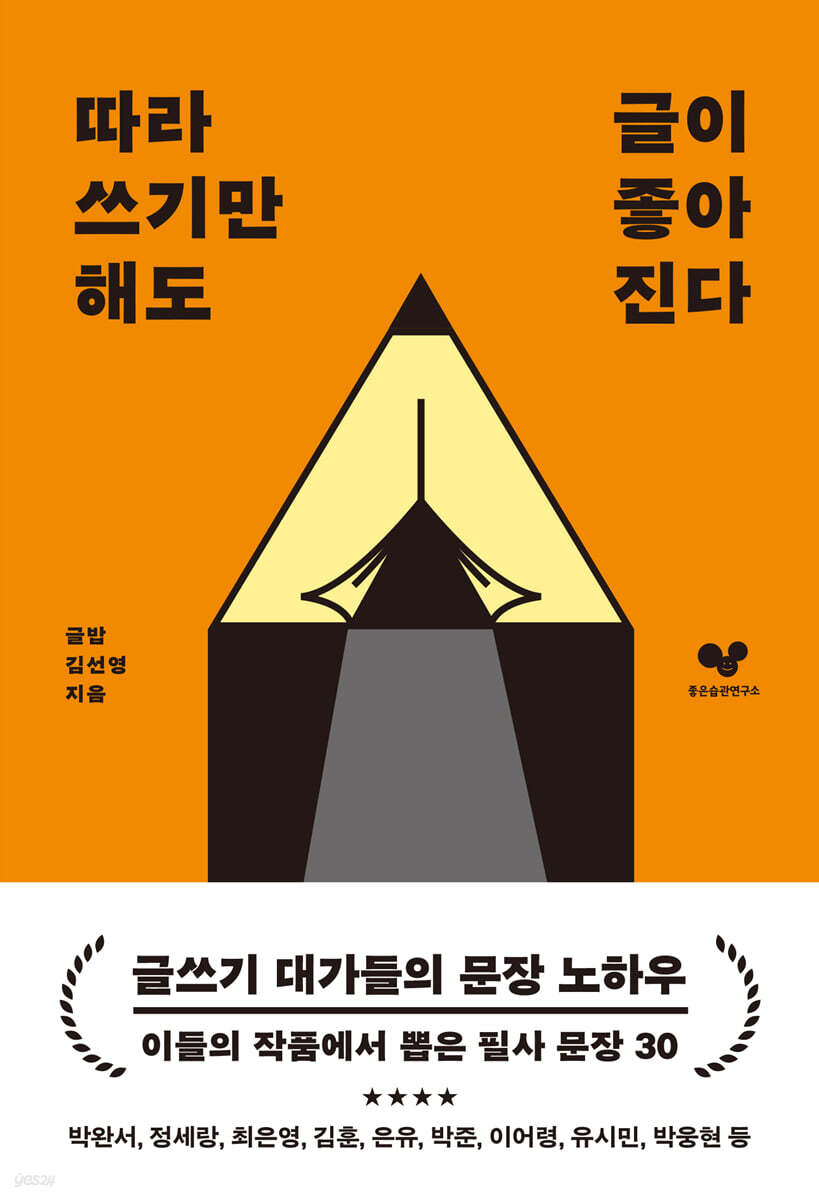
Just by following along, your writing will improve.
 |
Description
Book Introduction
Learn from thirty writing masters.
Kim Seon-yeong, a writer who is actively involved in writing lectures and writing, selected 30 sentences from the works of famous writers and added essay-style commentary.
By writing for 30 days, you will develop your writing skills, learn the power of observation, and reflect on the humanity that a writer should have.
This is the condition for good writing to be born.
Kim Seon-yeong, a writer who is actively involved in writing lectures and writing, selected 30 sentences from the works of famous writers and added essay-style commentary.
By writing for 30 days, you will develop your writing skills, learn the power of observation, and reflect on the humanity that a writer should have.
This is the condition for good writing to be born.
- You can preview some of the book's contents.
Preview
index
start.
The habit of writing every day, no matter how busy I am
Chapter 1.
How to Create an Unwavering Writing Routine
1.
Let's Be Shameless - Jeong Se-rang, "From the Gaze"
2.
Create Your Own Writing Tools and Rules - Kim Hoon, "Writing with a Pencil"
3.
How to Take Responsibility for Your Writing - Osamu Dazai, No Longer Human
4.
Even just walking can produce writing - David Le Breton, In Praise of Walking
5.
The important thing is an unwavering spirit - Mason Curry, The Art of Habit
6.
Let's Talk About Books Often - An So-young, "The Fool Who Only Reads Books"
7.
There is no such thing as perfect writing - Eric Weiner, The Socrates Express
8.
How to Recover Your Writing Energy - Eunyu, "Words of Writing"
9.
Why You Should Write About Personal and Trivial Matters - Kim Ji-soo and Lee Eo-ryeong, "Lee Eo-ryeong's Last Lesson"
10.
There are things I can only write now - Park Wan-seo, "Even a Grain of Truth"
Chapter 2.
How to express yourself more colorfully
11.
Writing My Dark History - Lee Seong-bok, "Infinite Flower Book"
12.
Let's Extract Similarities - Kim Ina, "Ordinary Languages"
13.
Dissecting, Analyzing, and Synthesizing - Kim Seung-ok, "Mujin Gihaeng"
14.
Breaking Free from Black-and-White Thinking - Charlie McCarthy, The Boy, the Mole, the Fox, and the Horse
15.
How to Write Well (1) Observe, then use the verb - Delia Owens, Where the Crawdads Sing
16.
How to Write Well (2) Open Your Nostrils and Ears - Heo Eun-sil, "I am a Book Open Only to You"
17.
How to Describe Well (3) Making the Invisible Visible - Eunyoung Choi, "Bright Night"
18.
Writing with Rhythm - Yun Seong-yong, "The Seasons of Life"
19.
Writing in the Seasons - Shin Young-bok, "Reflections from Prison"
20.
Expressing Complex Emotions - Lee Seung-woo, "A Gaze at Midday"
21.
Looking at Strangers Like a Traveler - Ekuni Kaori, "Twinkle Twinkle"
22.
Writing that Inspires with a Twist - Jeong Cheol, "Inspirational Calendar"
23.
Seeing Through a Child's Eyes - Park Wan-seo, "Homie"
24.
How to See the Unseen - Marcus Aurelius, Meditations
25.
Writing Outside the Box - Lim Tae-ju, "Sentences of Longing"
Chapter 3.
How to Become a Humane Writer
26.
When You Focus on Nothing - Park Woong-hyun, "Eight Words"
27.
Ask Yourself Why You Write - Stephen King, On Writing
28.
Questioning the Fast and the Convenient - Shin Young-bok, Reflections from Prison
29.
Remember the Power of Writing - Park Jun, "I Made Up Your Name and Ate It for a Few Days"
30.
The Joy of Writing - Kang Won-guk, "Kang Won-guk's Writing"
Epilogue: Writing to Build Resilience - Yoo Si-min, "How to Live"
supplement.
10 Recommended Books for Writing by Geulbap
The habit of writing every day, no matter how busy I am
Chapter 1.
How to Create an Unwavering Writing Routine
1.
Let's Be Shameless - Jeong Se-rang, "From the Gaze"
2.
Create Your Own Writing Tools and Rules - Kim Hoon, "Writing with a Pencil"
3.
How to Take Responsibility for Your Writing - Osamu Dazai, No Longer Human
4.
Even just walking can produce writing - David Le Breton, In Praise of Walking
5.
The important thing is an unwavering spirit - Mason Curry, The Art of Habit
6.
Let's Talk About Books Often - An So-young, "The Fool Who Only Reads Books"
7.
There is no such thing as perfect writing - Eric Weiner, The Socrates Express
8.
How to Recover Your Writing Energy - Eunyu, "Words of Writing"
9.
Why You Should Write About Personal and Trivial Matters - Kim Ji-soo and Lee Eo-ryeong, "Lee Eo-ryeong's Last Lesson"
10.
There are things I can only write now - Park Wan-seo, "Even a Grain of Truth"
Chapter 2.
How to express yourself more colorfully
11.
Writing My Dark History - Lee Seong-bok, "Infinite Flower Book"
12.
Let's Extract Similarities - Kim Ina, "Ordinary Languages"
13.
Dissecting, Analyzing, and Synthesizing - Kim Seung-ok, "Mujin Gihaeng"
14.
Breaking Free from Black-and-White Thinking - Charlie McCarthy, The Boy, the Mole, the Fox, and the Horse
15.
How to Write Well (1) Observe, then use the verb - Delia Owens, Where the Crawdads Sing
16.
How to Write Well (2) Open Your Nostrils and Ears - Heo Eun-sil, "I am a Book Open Only to You"
17.
How to Describe Well (3) Making the Invisible Visible - Eunyoung Choi, "Bright Night"
18.
Writing with Rhythm - Yun Seong-yong, "The Seasons of Life"
19.
Writing in the Seasons - Shin Young-bok, "Reflections from Prison"
20.
Expressing Complex Emotions - Lee Seung-woo, "A Gaze at Midday"
21.
Looking at Strangers Like a Traveler - Ekuni Kaori, "Twinkle Twinkle"
22.
Writing that Inspires with a Twist - Jeong Cheol, "Inspirational Calendar"
23.
Seeing Through a Child's Eyes - Park Wan-seo, "Homie"
24.
How to See the Unseen - Marcus Aurelius, Meditations
25.
Writing Outside the Box - Lim Tae-ju, "Sentences of Longing"
Chapter 3.
How to Become a Humane Writer
26.
When You Focus on Nothing - Park Woong-hyun, "Eight Words"
27.
Ask Yourself Why You Write - Stephen King, On Writing
28.
Questioning the Fast and the Convenient - Shin Young-bok, Reflections from Prison
29.
Remember the Power of Writing - Park Jun, "I Made Up Your Name and Ate It for a Few Days"
30.
The Joy of Writing - Kang Won-guk, "Kang Won-guk's Writing"
Epilogue: Writing to Build Resilience - Yoo Si-min, "How to Live"
supplement.
10 Recommended Books for Writing by Geulbap
Detailed image

Into the book
Why do people try to write?
The reasons may be different, such as wanting to record good sentences discovered while reading a book, hoping that copying great sentences will improve my writing, or wanting to emulate the author's spirit. The goal is the same.
It's because of the desire to 'write well too.'
--- p.13
When you say you can't write, writing teachers advise you to "give up the desire to write so well" and "let go of the pressure and start."
I know it in my head, but the more I use it, the more I become greedy.
In such a case, what if I took out the mask I'd kept in my drawer and put it on? The moment I put the mask on my face, no one would recognize me, and I'd become shameless.
--- p.34
It's okay to be a little shameless when writing.
However, shamelessness requires the premise that I will take responsibility for my writing.
It must be resolved through countless repeated reflections.
--- p.38
Writing is the act of expressing the thoughts that have been raised in your head out of your body.
(Omitted) Depending on how you write, the muscles that move are different.
There are also differences in the process and speed at which the letters are implemented.
Wouldn't that also affect each person's way of thinking and expression?
If you write by hand, the process of creating letters is bound to be slow.
Then, will the speed of thinking also slow down and become more cautious?
--- p.45
Another way to reduce misunderstandings is to choose your vocabulary carefully.
A text is a combination of words.
Words come together to form sentences, and sentences come together to form paragraphs.
Paragraphs come together to form a piece of writing, and writings come together to form a book.
If we trace back this simple relationship, we eventually reach the pinnacle of vocabulary.
--- p.53
Walking is not only a catalyst for writing, but can also be material for writing in its own right.
Walking is like a 'boundless library'.
For something that's not urgent but important, walking is a simple exercise that only requires two feet.
It temporarily liberates the mind that is trapped in the body and cannot move.
--- p.62
Some people choose writing to bring back to the surface the 'self' that is gradually disappearing while being buried in a role.
Instead of writing alone, we do it together, verifying ourselves every day and sitting in a chair specifically for writing.
The 'unbreakable system' helps the world not break me.
--- p.71
Books should not be kept in a bookshelf, but should be taken out and read again and again.
When you talk about a book out loud, both the speaker and the listener become more immersed in the content and remember it longer.
Books walk into life step by step.
The books that come into my life become the thought cells that make up me and are ultimately expressed in writing.
--- p.79
You have to let go of the obsession with being perfect to be able to write willingly.
The reason why I can't write is because I want to write too well.
It is because of excessive self-consciousness that makes you overly concerned about other people's evaluations.
You'll know once you try it.
It's so disappointing how little interest people have in my writing.
If you are receiving so much attention that you are afraid of other people's gaze, it is actually a blessing for the writer.
--- p.86
To write, you have to somehow sit down with your butt on a chair.
Anyone who has written anything knows that writing is the most difficult part of the entire process.
You need to get out of your cozy blanket and turn off your smartphone that constantly recommends interesting videos.
You have to push everything aside, sit down at your desk, and start 'writing mode' so that it gradually warms up and the writing engine turns on.
--- p.92
The power to write comes from the act of writing.
As the metaphor writer said, a manuscript that has expanded to a certain extent has the driving force to push forward writing.
That's why you have to write the first draft without hesitation, without worrying about whether it's a mess or not.
--- p.94
Hemingway compared his first drafts to rags or trash.
Moreover, my first impression was that it couldn't be a fluffy hotel towel.
The first sentence is always terrible and the first draft is trash.
But if you spread out the rag or trash and look at it again, you will see a corner that can be saved.
There is a difference in the sense of security between me empty-handed and me holding even a rag.
--- p.94
When I write, there are times when I get lost in thought because it is so personal that I wonder, 'Can I even write about something like this?'
I believe that it is okay, or rather, that you should write something as long as it does not harm others.
Only then can you escape from the sound of one or the other.
--- p.102
The writings of young people still have their own charm.
Cyworld is reopening, and anyone who has read something they wrote when they were twenty will understand what I mean, as if they were opening Pandora's box.
The writing from that time is as fresh and awkward as the picture of me with my country-style makeup on.
--- p.107
When you're having trouble deciding what to write, think about the countless dark moments of your past, like the stars in the night sky.
Someone might read my dark history and find courage.
You can mock my clumsy past self.
How relaxed and cool would I look if I looked at my past self with a mocking smile?
--- p.117
Emotions are invisible concepts, but lyricist Kim Eana, who wrote today's poem, has a more sensitive sense of touch than anyone else and understands the nature of emotions.
He skillfully extracts and ties together the similarities between love, happiness, and sadness, which are like heavy rain and drizzle, respectively, and 'getting wet'.
--- p.125
The secret to creative expression is to break it down, analyze it, and synthesize it.
If you carefully examine, turn over, and ponder even ordinary words or sentences, you can uncover the sub-elements that make them exist.
If you unfold this persuasively, it becomes your own creative sentence.
--- p.131
A person who sees a glass half full of water and says, "It's already half empty," is often described as negative, while someone who says, "There's still half left" is often described as positive.
If you quote this without thinking, you are being lazy.
I would have just made the obvious promise to myself to be a positive person who pays attention to half of everything.
I'm confessing that I've never questioned the question itself until now.
--- p.138
Author Delia Owens is an ecologist who has studied wetlands and observed them up close and for longer than anyone else.
Thanks to this, descriptions that are alive and moving were created throughout the novel.
There is bound to be a difference between the descriptions of wetlands used by people who have learned about them from books or videos and those who have actually lived near wetlands and studied them.
--- p.145
Description is not a momentary technique, but rather a mixture of observations made over time, like a salad.
If you want to be good at describing, you have to let go of the pride that you already know everything, get close to the subject, and start observing it intently.
--- p.145
In addition to the visual descriptions we often use, new expressions emerge when we recreate objects by awakening senses that we don't often use when writing, such as hearing or smell.
Like 'the lonely murmur of a high-rise building', 'the trembling crayon', 'the loud scream of spicy tteokbokki', 'the smell of sunflowers'.
--- p.152
There is also a good sentence that shows the heart in Choi Eun-young's short story, "Sister, My Little, Pure Sister" (included in the short story collection "Shoko's Smile").
This is the scene where the main character Hae-ok gives a cowhide wallet, bought at a department store, to her poor older sister Sun-ae, who is enduring a difficult life.
'I held the wallet with both hands and stroked it little by little as if it were a small animal.' The affection that was expressed through this small gesture was not enough to simply say that I 'cherished' the wallet.
It's amazing how technology can make the invisible visible.
--- p.162
When I read rhythmic sentences, it feels like I'm humming a song in my head.
When I copy, the rhythm penetrates deeper and sticks to my body.
This is also why I sometimes transcribe poetry.
--- p.170
When you awaken your sense of the seasons, forgotten memories come flooding back.
When I go back in time, I come across old faces of mine that I had forgotten.
It's a face that's similar to mine now, but different.
This also makes great material for writing.
--- p.180
In Lee Seung-woo's novel, "A Gaze at Midday," the protagonist desperately wants to meet his father, who was his deficiency, but at the same time does not want to meet him.
If you read the novel, you will understand why he experiences such confusing emotions.
In this way, novels are an art that persuades readers of complex emotions.
--- p.187
In a media interview, Ekuni Kaori said, “Reading novels is a journey.
“It’s like going on a trip, going to a different place from where you live, breathing in the air there and experiencing something different,” he said (Chosun Ilbo article).
Writing is both a result of expression and a process of thought.
When you read and follow along, you experience what the author saw, heard, and felt.
Become that person, even if only for a moment.
--- p.194
A piece with a twist has a plot.
It doesn't happen by chance, it requires design.
Through a familiar plot development, the reader is led to predict what will happen next.
It is about utilizing universal human emotions or reactions (or stereotypes in some ways).
When you let your guard down like that, the story takes an unexpected turn.
Exploiting a weakness.
--- p.202
If you want to see things from a child's perspective, one way is to actually lower yourself to be like a child.
Instead of sitting at the dining table every day, let's just plop down on the kitchen floor.
The surroundings look different.
Instead of the usual flat table top, what catches the eye is the pattern engraved on the table legs.
When you look up at the potted plant, which is waist-high, from below, it feels like a tall palm tree.
It's as if I've become Thumbelina and the world has become so big.
This unfamiliar feeling fuels the imagination.
It makes us turn over what we took for granted.
--- p.210
Marcus Aurelius summarized everything we encounter in life as sweat, dirt, soap scum, and greasy water.
I saw through the essence of life.
He criticized human history, which rejected nature and was stained with falsehood.
It was as if the bandages were being removed from my face after eye surgery, forcing me to face the truth that had been hidden.
--- p.219
Anything is allowed in the city.
You can swallow sounds, see smells, and hear tastes.
I laugh because I'm sad, I freeze because I'm hot, and I'm lonely because I have nothing.
As I read and transcribe poetry, I feel a desire to break free from the stifling framework and write freely.
The lyric sentence tells us to rest assured that the poet is not a god who came down from heaven.
I offer encouragement that you too can become a poet.
--- p.227
The beginning of writing is to realize that nothing is nothing.
The reason I can appreciate the pure white snowfield is because of my two feet that are silently stepping on the ground at this very moment.
--- p.236
Writing is the same.
If satisfying the need for recognition or publishing a book becomes your only goal, you will eventually become disillusioned.
We need to ask ourselves the question, 'Why do I write?' and follow it to its end.
"Why? Because I want to publish a book? Because I want to become famous? Because I want to share my thoughts with many people and resonate with them?" If so, you need to live well before you can even write.
You have to know what are the truly important values in life.
We need to think about how to have a positive influence on ourselves and others.
If you become a good person, good writing will naturally flow out.
--- p.244
Some people watch YouTube or OTT videos in fast forward mode.
I want to know the content quickly and see more content.
“I saw that” In an attempt to join in the conversation with people, the director’s direction, the actors’ performances, and even the background music that helps with immersion are all distorted and only the plot is consumed.
Doesn't it feel a bit sad to have a hobby where you can't even enjoy a single movie? Who really benefits from binge-watching movies?
--- p.251
Words have power.
George Orwell answered the question, "Why do I write?" with "political reasons."
I want to share my thoughts and aspirations, share my empathy, and even bring about change in my actions.
Writing is voice.
Even if we can't protest against each and every flawed system or go out and fight it ourselves, we can all make our voices heard through writing.
--- p.257
The book was different from the writing.
I had to find meaning in each and every episode.
To build rapport with readers, I needed a message that could be enjoyed by both parties, not just my own impressions.
The essence of writing a book is the act of looking back on my actions and discovering meaning.
--- p.264
Writing is 'the will to find one's own way of living.'
It captures the story of me getting back up after being hurt and falling down.
My writings document my growth process of falling apart and rebuilding, breaking and rebuilding, and how I overcame and rose again.
The writing reminds me that I have overcome even greater things in the past.
So, writing helps heal wounds and builds resilience.
The reasons may be different, such as wanting to record good sentences discovered while reading a book, hoping that copying great sentences will improve my writing, or wanting to emulate the author's spirit. The goal is the same.
It's because of the desire to 'write well too.'
--- p.13
When you say you can't write, writing teachers advise you to "give up the desire to write so well" and "let go of the pressure and start."
I know it in my head, but the more I use it, the more I become greedy.
In such a case, what if I took out the mask I'd kept in my drawer and put it on? The moment I put the mask on my face, no one would recognize me, and I'd become shameless.
--- p.34
It's okay to be a little shameless when writing.
However, shamelessness requires the premise that I will take responsibility for my writing.
It must be resolved through countless repeated reflections.
--- p.38
Writing is the act of expressing the thoughts that have been raised in your head out of your body.
(Omitted) Depending on how you write, the muscles that move are different.
There are also differences in the process and speed at which the letters are implemented.
Wouldn't that also affect each person's way of thinking and expression?
If you write by hand, the process of creating letters is bound to be slow.
Then, will the speed of thinking also slow down and become more cautious?
--- p.45
Another way to reduce misunderstandings is to choose your vocabulary carefully.
A text is a combination of words.
Words come together to form sentences, and sentences come together to form paragraphs.
Paragraphs come together to form a piece of writing, and writings come together to form a book.
If we trace back this simple relationship, we eventually reach the pinnacle of vocabulary.
--- p.53
Walking is not only a catalyst for writing, but can also be material for writing in its own right.
Walking is like a 'boundless library'.
For something that's not urgent but important, walking is a simple exercise that only requires two feet.
It temporarily liberates the mind that is trapped in the body and cannot move.
--- p.62
Some people choose writing to bring back to the surface the 'self' that is gradually disappearing while being buried in a role.
Instead of writing alone, we do it together, verifying ourselves every day and sitting in a chair specifically for writing.
The 'unbreakable system' helps the world not break me.
--- p.71
Books should not be kept in a bookshelf, but should be taken out and read again and again.
When you talk about a book out loud, both the speaker and the listener become more immersed in the content and remember it longer.
Books walk into life step by step.
The books that come into my life become the thought cells that make up me and are ultimately expressed in writing.
--- p.79
You have to let go of the obsession with being perfect to be able to write willingly.
The reason why I can't write is because I want to write too well.
It is because of excessive self-consciousness that makes you overly concerned about other people's evaluations.
You'll know once you try it.
It's so disappointing how little interest people have in my writing.
If you are receiving so much attention that you are afraid of other people's gaze, it is actually a blessing for the writer.
--- p.86
To write, you have to somehow sit down with your butt on a chair.
Anyone who has written anything knows that writing is the most difficult part of the entire process.
You need to get out of your cozy blanket and turn off your smartphone that constantly recommends interesting videos.
You have to push everything aside, sit down at your desk, and start 'writing mode' so that it gradually warms up and the writing engine turns on.
--- p.92
The power to write comes from the act of writing.
As the metaphor writer said, a manuscript that has expanded to a certain extent has the driving force to push forward writing.
That's why you have to write the first draft without hesitation, without worrying about whether it's a mess or not.
--- p.94
Hemingway compared his first drafts to rags or trash.
Moreover, my first impression was that it couldn't be a fluffy hotel towel.
The first sentence is always terrible and the first draft is trash.
But if you spread out the rag or trash and look at it again, you will see a corner that can be saved.
There is a difference in the sense of security between me empty-handed and me holding even a rag.
--- p.94
When I write, there are times when I get lost in thought because it is so personal that I wonder, 'Can I even write about something like this?'
I believe that it is okay, or rather, that you should write something as long as it does not harm others.
Only then can you escape from the sound of one or the other.
--- p.102
The writings of young people still have their own charm.
Cyworld is reopening, and anyone who has read something they wrote when they were twenty will understand what I mean, as if they were opening Pandora's box.
The writing from that time is as fresh and awkward as the picture of me with my country-style makeup on.
--- p.107
When you're having trouble deciding what to write, think about the countless dark moments of your past, like the stars in the night sky.
Someone might read my dark history and find courage.
You can mock my clumsy past self.
How relaxed and cool would I look if I looked at my past self with a mocking smile?
--- p.117
Emotions are invisible concepts, but lyricist Kim Eana, who wrote today's poem, has a more sensitive sense of touch than anyone else and understands the nature of emotions.
He skillfully extracts and ties together the similarities between love, happiness, and sadness, which are like heavy rain and drizzle, respectively, and 'getting wet'.
--- p.125
The secret to creative expression is to break it down, analyze it, and synthesize it.
If you carefully examine, turn over, and ponder even ordinary words or sentences, you can uncover the sub-elements that make them exist.
If you unfold this persuasively, it becomes your own creative sentence.
--- p.131
A person who sees a glass half full of water and says, "It's already half empty," is often described as negative, while someone who says, "There's still half left" is often described as positive.
If you quote this without thinking, you are being lazy.
I would have just made the obvious promise to myself to be a positive person who pays attention to half of everything.
I'm confessing that I've never questioned the question itself until now.
--- p.138
Author Delia Owens is an ecologist who has studied wetlands and observed them up close and for longer than anyone else.
Thanks to this, descriptions that are alive and moving were created throughout the novel.
There is bound to be a difference between the descriptions of wetlands used by people who have learned about them from books or videos and those who have actually lived near wetlands and studied them.
--- p.145
Description is not a momentary technique, but rather a mixture of observations made over time, like a salad.
If you want to be good at describing, you have to let go of the pride that you already know everything, get close to the subject, and start observing it intently.
--- p.145
In addition to the visual descriptions we often use, new expressions emerge when we recreate objects by awakening senses that we don't often use when writing, such as hearing or smell.
Like 'the lonely murmur of a high-rise building', 'the trembling crayon', 'the loud scream of spicy tteokbokki', 'the smell of sunflowers'.
--- p.152
There is also a good sentence that shows the heart in Choi Eun-young's short story, "Sister, My Little, Pure Sister" (included in the short story collection "Shoko's Smile").
This is the scene where the main character Hae-ok gives a cowhide wallet, bought at a department store, to her poor older sister Sun-ae, who is enduring a difficult life.
'I held the wallet with both hands and stroked it little by little as if it were a small animal.' The affection that was expressed through this small gesture was not enough to simply say that I 'cherished' the wallet.
It's amazing how technology can make the invisible visible.
--- p.162
When I read rhythmic sentences, it feels like I'm humming a song in my head.
When I copy, the rhythm penetrates deeper and sticks to my body.
This is also why I sometimes transcribe poetry.
--- p.170
When you awaken your sense of the seasons, forgotten memories come flooding back.
When I go back in time, I come across old faces of mine that I had forgotten.
It's a face that's similar to mine now, but different.
This also makes great material for writing.
--- p.180
In Lee Seung-woo's novel, "A Gaze at Midday," the protagonist desperately wants to meet his father, who was his deficiency, but at the same time does not want to meet him.
If you read the novel, you will understand why he experiences such confusing emotions.
In this way, novels are an art that persuades readers of complex emotions.
--- p.187
In a media interview, Ekuni Kaori said, “Reading novels is a journey.
“It’s like going on a trip, going to a different place from where you live, breathing in the air there and experiencing something different,” he said (Chosun Ilbo article).
Writing is both a result of expression and a process of thought.
When you read and follow along, you experience what the author saw, heard, and felt.
Become that person, even if only for a moment.
--- p.194
A piece with a twist has a plot.
It doesn't happen by chance, it requires design.
Through a familiar plot development, the reader is led to predict what will happen next.
It is about utilizing universal human emotions or reactions (or stereotypes in some ways).
When you let your guard down like that, the story takes an unexpected turn.
Exploiting a weakness.
--- p.202
If you want to see things from a child's perspective, one way is to actually lower yourself to be like a child.
Instead of sitting at the dining table every day, let's just plop down on the kitchen floor.
The surroundings look different.
Instead of the usual flat table top, what catches the eye is the pattern engraved on the table legs.
When you look up at the potted plant, which is waist-high, from below, it feels like a tall palm tree.
It's as if I've become Thumbelina and the world has become so big.
This unfamiliar feeling fuels the imagination.
It makes us turn over what we took for granted.
--- p.210
Marcus Aurelius summarized everything we encounter in life as sweat, dirt, soap scum, and greasy water.
I saw through the essence of life.
He criticized human history, which rejected nature and was stained with falsehood.
It was as if the bandages were being removed from my face after eye surgery, forcing me to face the truth that had been hidden.
--- p.219
Anything is allowed in the city.
You can swallow sounds, see smells, and hear tastes.
I laugh because I'm sad, I freeze because I'm hot, and I'm lonely because I have nothing.
As I read and transcribe poetry, I feel a desire to break free from the stifling framework and write freely.
The lyric sentence tells us to rest assured that the poet is not a god who came down from heaven.
I offer encouragement that you too can become a poet.
--- p.227
The beginning of writing is to realize that nothing is nothing.
The reason I can appreciate the pure white snowfield is because of my two feet that are silently stepping on the ground at this very moment.
--- p.236
Writing is the same.
If satisfying the need for recognition or publishing a book becomes your only goal, you will eventually become disillusioned.
We need to ask ourselves the question, 'Why do I write?' and follow it to its end.
"Why? Because I want to publish a book? Because I want to become famous? Because I want to share my thoughts with many people and resonate with them?" If so, you need to live well before you can even write.
You have to know what are the truly important values in life.
We need to think about how to have a positive influence on ourselves and others.
If you become a good person, good writing will naturally flow out.
--- p.244
Some people watch YouTube or OTT videos in fast forward mode.
I want to know the content quickly and see more content.
“I saw that” In an attempt to join in the conversation with people, the director’s direction, the actors’ performances, and even the background music that helps with immersion are all distorted and only the plot is consumed.
Doesn't it feel a bit sad to have a hobby where you can't even enjoy a single movie? Who really benefits from binge-watching movies?
--- p.251
Words have power.
George Orwell answered the question, "Why do I write?" with "political reasons."
I want to share my thoughts and aspirations, share my empathy, and even bring about change in my actions.
Writing is voice.
Even if we can't protest against each and every flawed system or go out and fight it ourselves, we can all make our voices heard through writing.
--- p.257
The book was different from the writing.
I had to find meaning in each and every episode.
To build rapport with readers, I needed a message that could be enjoyed by both parties, not just my own impressions.
The essence of writing a book is the act of looking back on my actions and discovering meaning.
--- p.264
Writing is 'the will to find one's own way of living.'
It captures the story of me getting back up after being hurt and falling down.
My writings document my growth process of falling apart and rebuilding, breaking and rebuilding, and how I overcame and rose again.
The writing reminds me that I have overcome even greater things in the past.
So, writing helps heal wounds and builds resilience.
--- p.272
Publisher's Review
“Novelists Park Wan-seo, Jeong Se-rang, Choi Eun-young, Kim Hoon, Kim Seung-ok, Lee Seung-woo, Ekuni Kaori, Delia Owens, and Stephen King.
And poets Lee Seong-bok, Heo Eun-sil, Park Jun, and Lim Tae-ju.
Others include Lee Eo-ryeong, Park Woong-hyun, Shin Young-bok, Yoo Si-min, Kim Ina, Eun-yu, Jeong Cheol, and Kang Won-guk.”
“Learn writing know-how from the masters of sentence structure!!”
The 34th habit from the Good Habits Institute is the habit of copying to improve your writing skills.
One of the things that people who study writing try to do at least once is to transcribe good writing.
Author Kim Seon-yeong, who has been publishing books and giving lectures on writing, has selected 30 sentences related to writing based on her own writing experience and introduced them to readers.
The author selected 30 sentences from the 1,400 he had transcribed.
It provides a good introduction to the background stories behind the selection of the best sentences, the reasons for their selection, and writing points to learn from the sentences of famous authors.
When people think of copying for writing, they often think of studying writing style and expressiveness through copying, but this book targets amateur writers who are just starting out and covers everything from creating a writing routine, how to get writing material, how to find fresh expressions, and even writing techniques, to the mindset and attitude that a writer should have.
It contains a wide range of knowledge related to writing.
And poets Lee Seong-bok, Heo Eun-sil, Park Jun, and Lim Tae-ju.
Others include Lee Eo-ryeong, Park Woong-hyun, Shin Young-bok, Yoo Si-min, Kim Ina, Eun-yu, Jeong Cheol, and Kang Won-guk.”
“Learn writing know-how from the masters of sentence structure!!”
The 34th habit from the Good Habits Institute is the habit of copying to improve your writing skills.
One of the things that people who study writing try to do at least once is to transcribe good writing.
Author Kim Seon-yeong, who has been publishing books and giving lectures on writing, has selected 30 sentences related to writing based on her own writing experience and introduced them to readers.
The author selected 30 sentences from the 1,400 he had transcribed.
It provides a good introduction to the background stories behind the selection of the best sentences, the reasons for their selection, and writing points to learn from the sentences of famous authors.
When people think of copying for writing, they often think of studying writing style and expressiveness through copying, but this book targets amateur writers who are just starting out and covers everything from creating a writing routine, how to get writing material, how to find fresh expressions, and even writing techniques, to the mindset and attitude that a writer should have.
It contains a wide range of knowledge related to writing.
GOODS SPECIFICS
- Date of issue: November 6, 2023
- Page count, weight, size: 278 pages | 344g | 128*188*20mm
- ISBN13: 9791198391926
- ISBN10: 1198391928
You may also like
카테고리
korean


korean

![GQ KOREA Mark (Monthly): December [2025]](http://librairie.coreenne.fr/cdn/shop/files/8ef265dbbfbf186523ed75ba7319009d.jpg?v=1765340328&width=3840)


