

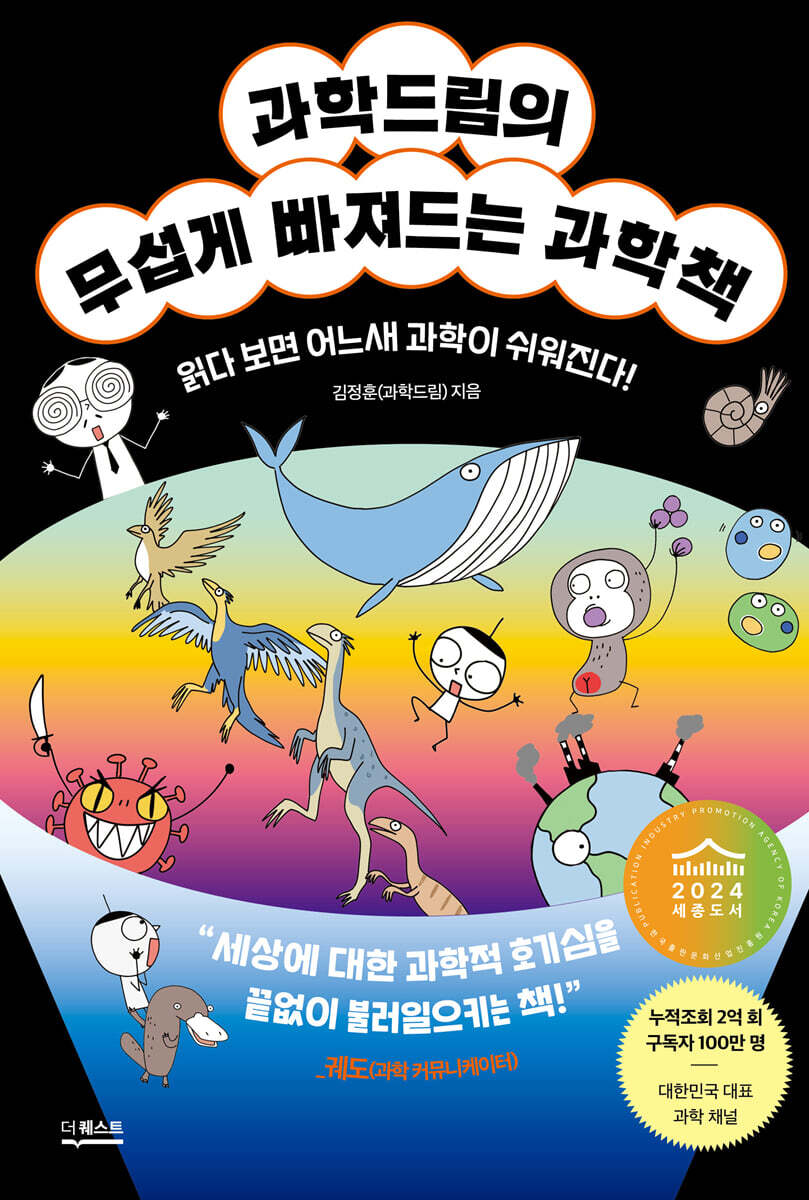
Science Dream's terrifyingly addictive science book
 |
Description
Book Introduction
- A word from MD
-
An exciting scientific journeyA book by science YouTuber 'Science Dream', who has 1 million subscribers and 200 million cumulative views.
It delivers scientific stories on various topics such as the Earth, paleontology, animals, humanity, and the environment in an easy and fun way.
It not only conveys accuracy through scientific papers and fact checks from foreign experts, but also broadens the foundation of knowledge by providing various food for thought.
October 27, 2023. Natural Science PD Ahn Hyun-jae
"A book that endlessly sparks scientific curiosity about the world!" _Orbit (science communicator, author of "The Time We Need Science")
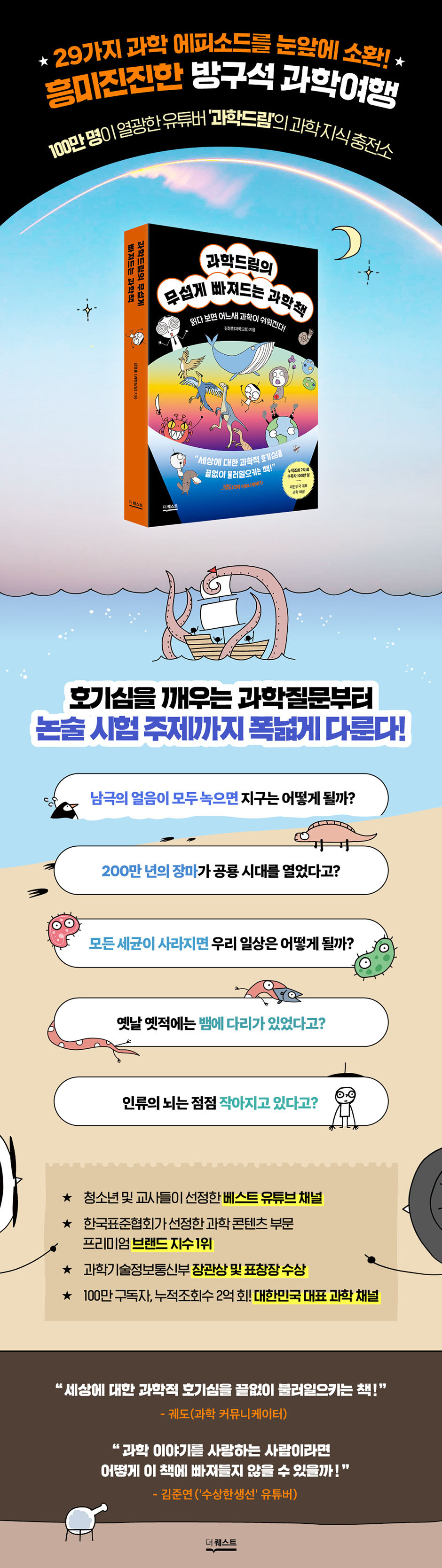
Covers a wide range of topics, from science questions that spark curiosity to essay test topics!
A science textbook for teenagers, parents, and teachers alike.
"Science Dream's Scary and Immersive Science Book" by YouTuber "Science Dream," renowned for its meticulous scientific research, humorous storytelling, and clear explanations that are easy to understand, has been published.
It contains exciting and overwhelming stories on a grand scale, such as 'How did the most powerful warming event in history change the Earth?', 'What effect did the monsoon season 2 million years ago have on the continent?', 'Why did the blue whale become the largest animal on Earth?', 'What would daily life be like if all the ice in Antarctica melted?', and 'Why do wisdom teeth grow in crooked and strangely?'
In particular, it delves into the scientific secrets hidden in our daily lives, from the birth of the universe to the beginning of life on Earth, the evolution of various plants and animals, and the rapidly progressing climate and environmental issues currently in progress.
Covering a wide range of fields, from biology to earth science and chemistry, this book will boldly draw into the world of science those seeking to satisfy their intellectual curiosity, parents seeking science books to read with their children, and teenagers who want to learn science in an easy and fun way.
Covers a wide range of topics, from science questions that spark curiosity to essay test topics!
A science textbook for teenagers, parents, and teachers alike.
"Science Dream's Scary and Immersive Science Book" by YouTuber "Science Dream," renowned for its meticulous scientific research, humorous storytelling, and clear explanations that are easy to understand, has been published.
It contains exciting and overwhelming stories on a grand scale, such as 'How did the most powerful warming event in history change the Earth?', 'What effect did the monsoon season 2 million years ago have on the continent?', 'Why did the blue whale become the largest animal on Earth?', 'What would daily life be like if all the ice in Antarctica melted?', and 'Why do wisdom teeth grow in crooked and strangely?'
In particular, it delves into the scientific secrets hidden in our daily lives, from the birth of the universe to the beginning of life on Earth, the evolution of various plants and animals, and the rapidly progressing climate and environmental issues currently in progress.
Covering a wide range of fields, from biology to earth science and chemistry, this book will boldly draw into the world of science those seeking to satisfy their intellectual curiosity, parents seeking science books to read with their children, and teenagers who want to learn science in an easy and fun way.
- You can preview some of the book's contents.
Preview
index
prolog
Chapter 1.
A strangely tangled tale of Earth
01.
From the birth of the universe to human civilization, a 13.8 billion-year journey
02.
The most boring billion years in Earth's history! What happened?
03.
Did 2 million years of monsoon rains usher in the age of dinosaurs?
04.
How did the most powerful global warming in history change the Earth?
05.
The Permian Extinction Formats the Earth?
[An increasingly engrossing scientific question] How is an oasis created in the middle of a desert?
ㅤ
Chapter 2.
The story of an ancient creature you've never heard of
01.
Why was Titanoboa so huge?
02.
Ancient beavers were the size of bears?
03.
Did whales walk on land on two feet, not in the water?
04.
What did the plates on the Stegosaurus' back do?
05.
What did Parasaurolophus use the crest on the back of its head for?
[An increasingly engrossing science question] Why aren't there any animals with wheels or winged apes?
ㅤ
Chapter 3.
Mysterious and mysterious animal stories
01.
How did the blue whale become the largest animal on Earth?
02.
Why is the shark's head so strangely shaped?
03.
Long ago, snakes also had legs?
04.
How did the platypus survive without becoming extinct?
05.
Are crows smarter than other birds?
[An increasingly engrossing scientific question] Why did deep-sea creatures grow so large?
ㅤ
Chapter 4.
A story about humanity that we've all been curious about at least once
01.
How did Australopithecus live?
02.
How did lost genes shape human evolution?
03.
Why is the human brain getting smaller?
04.
Why is the human body designed so messily?
05.
Why do wisdom teeth grow in crooked and strangely?
[An Increasingly Engaging Science Question] About Homo naledi, the Most Mysterious Ancient Human
ㅤ
Chapter 5.
Environmental stories you didn't know about
01.
Did the extinction of dinosaurs give birth to the Amazon rainforest?
02.
How did the hybrid between a grizzly bear and a polar bear come about?
03.
What would happen if all the Antarctic ice melted?
04.
Why don't we hear news about ozone layer destruction these days?
[An increasingly engrossing science question] What would happen if all the bacteria disappeared from Earth?
References
Chapter 1.
A strangely tangled tale of Earth
01.
From the birth of the universe to human civilization, a 13.8 billion-year journey
02.
The most boring billion years in Earth's history! What happened?
03.
Did 2 million years of monsoon rains usher in the age of dinosaurs?
04.
How did the most powerful global warming in history change the Earth?
05.
The Permian Extinction Formats the Earth?
[An increasingly engrossing scientific question] How is an oasis created in the middle of a desert?
ㅤ
Chapter 2.
The story of an ancient creature you've never heard of
01.
Why was Titanoboa so huge?
02.
Ancient beavers were the size of bears?
03.
Did whales walk on land on two feet, not in the water?
04.
What did the plates on the Stegosaurus' back do?
05.
What did Parasaurolophus use the crest on the back of its head for?
[An increasingly engrossing science question] Why aren't there any animals with wheels or winged apes?
ㅤ
Chapter 3.
Mysterious and mysterious animal stories
01.
How did the blue whale become the largest animal on Earth?
02.
Why is the shark's head so strangely shaped?
03.
Long ago, snakes also had legs?
04.
How did the platypus survive without becoming extinct?
05.
Are crows smarter than other birds?
[An increasingly engrossing scientific question] Why did deep-sea creatures grow so large?
ㅤ
Chapter 4.
A story about humanity that we've all been curious about at least once
01.
How did Australopithecus live?
02.
How did lost genes shape human evolution?
03.
Why is the human brain getting smaller?
04.
Why is the human body designed so messily?
05.
Why do wisdom teeth grow in crooked and strangely?
[An Increasingly Engaging Science Question] About Homo naledi, the Most Mysterious Ancient Human
ㅤ
Chapter 5.
Environmental stories you didn't know about
01.
Did the extinction of dinosaurs give birth to the Amazon rainforest?
02.
How did the hybrid between a grizzly bear and a polar bear come about?
03.
What would happen if all the Antarctic ice melted?
04.
Why don't we hear news about ozone layer destruction these days?
[An increasingly engrossing science question] What would happen if all the bacteria disappeared from Earth?
References
Detailed image
Into the book
2.7 billion years ago, the land plates did not move as they do today.
This is because the crust (the thin outermost layer of the Earth) simply floated on top of the mantle (the thick solid layer between the Earth's crust and core).
Plate movement occurs due to convection in the mantle.
The Earth today has a distinct temperature difference in the mantle, so large-scale convection occurs regularly.
However, 2.7 billion years ago, the Earth's mantle was hot overall, so temperature differences were minimal and convection was weak and irregular.
However, as the Earth gradually cooled, the outer layer cooled rapidly, creating a temperature difference in the mantle.
Accordingly, the Earth's crust began to move as large-scale convection currents occurred.
As a result, the supercontinent 'Nuna or Columbia' was created about 1.9 billion years ago.
This means that there was another supercontinent long before Pangaea, the supercontinent we are most familiar with.
However, despite the active convection in the mantle and the formation of a supercontinent, nothing much happened on Earth for a full 'billion years' from this time.
--- From "Chapter 1: The Strangely Intertwined Story of Earth"
How could Titanoboa, weighing over a ton, move on land with such a massive body? Many paleontologists answer this question by suggesting that Titanoboa's primary habitat was water, not land, making it effortless.
This is closely related to the teeth of Titanoboa.
While most snakes have teeth firmly attached to their jaws, Titanoboa's teeth are weakly attached to its jaws.
Also, unlike existing boa constrictors, they are numerous and dense.
These teeth are well suited for catching and eating fish whose bodies are slippery due to mucus.
This is a characteristic that appears in species such as yellow-lipped sea snakes and brown water snakes that actually eat fish.
Rather than preying on the giant crocodiles we often see in imagination, Titanoboa likely ate large fish.
Among the boa snakes, Titanoboa is the only one known to eat fish.
Titanoboa must have been a terror to the large lungfish and bony fish like pirarucu that lived in the river at the time.
But how did this giant snake that ruled the jungle river disappear?
--- From "Chapter 2: The Story of an Ancient Creature Never Heard of"
The topic of snake evolution is full of fascinating questions.
Another one of them is 'cobra venom'.
Cobras, which belong to the snake family, are famous for their venom.
The surprising fact is that many of them are known as 'spitting cobras', capable of spitting their venomous stingers up to 2-3 meters away.
This technique is used for self-protection rather than hunting, and is different from the offensive venom of other venomous snakes that use venom to paralyze prey in that it is spit towards the enemy.
But isn't it strange? Why did they evolve to spit venom so far? The answer, surprisingly, has to do with humanity.
--- From "Chapter 3: Mysterious and Mysterious Animal Stories"
This means that Australopithecus also needed help from people around them when giving birth.
This is evidence that our human ancestors lived in quite sophisticated cooperative societies long before we entered the genus Homo.
Lucy later gave up her place as the first human to another Homo species that emerged 2 million years ago.
Nevertheless, Lucy is clearly the 'first human', having walked on two feet, eaten meat, used tools, developed a more advanced brain, and even built a cooperative society.
The Andromeda Galaxy, about 2.7 million light-years away.
When light began to shine here, a primate was just beginning to take its first steps on Earth.
Could Lucy have ever imagined that millions of years from now, her descendants would discover her and leave a mark on human evolution?
--- From "Chapter 4: The Story of Humanity You've Always Wanted to Know"
What if the idea of all Antarctic ice melting becomes a reality? Major cities along the coast near Antarctica, as well as eastern China and the Amazon basin in South America, could be submerged, creating over a billion environmental refugees.
But the disaster is only just beginning.
Antarctic ice is fresh water with no dissolved salt.
Therefore, if all this ice melts and flows into the ocean, the salinity of the seawater will drop significantly, and this change in the marine environment could lead to the death of numerous marine life, including corals.
A bigger problem is the change in ocean circulation.
Large-scale ocean circulation is caused by differences in density due to seawater temperature and salinity.
If salinity drops, the density of seawater also changes, which can disrupt the Earth's ocean circulation.
Because ocean circulation is directly linked to atmospheric circulation, this could ultimately lead to extreme changes in weather across the globe.
Just like in the movie “The Day After Tomorrow,” the Earth may face a sudden ice age.
This is because the crust (the thin outermost layer of the Earth) simply floated on top of the mantle (the thick solid layer between the Earth's crust and core).
Plate movement occurs due to convection in the mantle.
The Earth today has a distinct temperature difference in the mantle, so large-scale convection occurs regularly.
However, 2.7 billion years ago, the Earth's mantle was hot overall, so temperature differences were minimal and convection was weak and irregular.
However, as the Earth gradually cooled, the outer layer cooled rapidly, creating a temperature difference in the mantle.
Accordingly, the Earth's crust began to move as large-scale convection currents occurred.
As a result, the supercontinent 'Nuna or Columbia' was created about 1.9 billion years ago.
This means that there was another supercontinent long before Pangaea, the supercontinent we are most familiar with.
However, despite the active convection in the mantle and the formation of a supercontinent, nothing much happened on Earth for a full 'billion years' from this time.
--- From "Chapter 1: The Strangely Intertwined Story of Earth"
How could Titanoboa, weighing over a ton, move on land with such a massive body? Many paleontologists answer this question by suggesting that Titanoboa's primary habitat was water, not land, making it effortless.
This is closely related to the teeth of Titanoboa.
While most snakes have teeth firmly attached to their jaws, Titanoboa's teeth are weakly attached to its jaws.
Also, unlike existing boa constrictors, they are numerous and dense.
These teeth are well suited for catching and eating fish whose bodies are slippery due to mucus.
This is a characteristic that appears in species such as yellow-lipped sea snakes and brown water snakes that actually eat fish.
Rather than preying on the giant crocodiles we often see in imagination, Titanoboa likely ate large fish.
Among the boa snakes, Titanoboa is the only one known to eat fish.
Titanoboa must have been a terror to the large lungfish and bony fish like pirarucu that lived in the river at the time.
But how did this giant snake that ruled the jungle river disappear?
--- From "Chapter 2: The Story of an Ancient Creature Never Heard of"
The topic of snake evolution is full of fascinating questions.
Another one of them is 'cobra venom'.
Cobras, which belong to the snake family, are famous for their venom.
The surprising fact is that many of them are known as 'spitting cobras', capable of spitting their venomous stingers up to 2-3 meters away.
This technique is used for self-protection rather than hunting, and is different from the offensive venom of other venomous snakes that use venom to paralyze prey in that it is spit towards the enemy.
But isn't it strange? Why did they evolve to spit venom so far? The answer, surprisingly, has to do with humanity.
--- From "Chapter 3: Mysterious and Mysterious Animal Stories"
This means that Australopithecus also needed help from people around them when giving birth.
This is evidence that our human ancestors lived in quite sophisticated cooperative societies long before we entered the genus Homo.
Lucy later gave up her place as the first human to another Homo species that emerged 2 million years ago.
Nevertheless, Lucy is clearly the 'first human', having walked on two feet, eaten meat, used tools, developed a more advanced brain, and even built a cooperative society.
The Andromeda Galaxy, about 2.7 million light-years away.
When light began to shine here, a primate was just beginning to take its first steps on Earth.
Could Lucy have ever imagined that millions of years from now, her descendants would discover her and leave a mark on human evolution?
--- From "Chapter 4: The Story of Humanity You've Always Wanted to Know"
What if the idea of all Antarctic ice melting becomes a reality? Major cities along the coast near Antarctica, as well as eastern China and the Amazon basin in South America, could be submerged, creating over a billion environmental refugees.
But the disaster is only just beginning.
Antarctic ice is fresh water with no dissolved salt.
Therefore, if all this ice melts and flows into the ocean, the salinity of the seawater will drop significantly, and this change in the marine environment could lead to the death of numerous marine life, including corals.
A bigger problem is the change in ocean circulation.
Large-scale ocean circulation is caused by differences in density due to seawater temperature and salinity.
If salinity drops, the density of seawater also changes, which can disrupt the Earth's ocean circulation.
Because ocean circulation is directly linked to atmospheric circulation, this could ultimately lead to extreme changes in weather across the globe.
Just like in the movie “The Day After Tomorrow,” the Earth may face a sudden ice age.
--- From "Chapter 5: Climate and Environment Stories You Didn't Know About"
Publisher's Review
1 million subscribers, 200 million cumulative views! Korea's leading science channel.
★Best YouTube Channels Chosen by Teens and Teachers
★Ranked 1st in the Premium Brand Index for Science Contents by the Korea Standards Association
★Received the Minister of Science and ICT Award and Commendation
Earth × Paleontology × Animals × Humanity × Climate Environment
A science knowledge recharge center of "Science Dream," which has captivated 1 million people.
“I’m a science teacher and I use this channel to prepare my classes.”
"I get inspiration for creating mock exams for Earth Science." "I watch five videos on my own, even without my mom telling me to."
“I see a problem here that I encountered in the K University admission essay test.” “Both the content and editing are top-notch in Korea!”
The "Science Dream" channel, enjoyed by science enthusiasts and even liberal arts nerds, is now available in book form! We've curated legendary episodes that have garnered over a million views, including "What Animal Was Born from 2 Million Years of Rainy Season?", "Why Is the Human Body So Chaotically Designed?", "Whales' Ancestors Were Bipedal Land Animals?", and "Is the Human Brain Actually Getting Smaller?"
Each topic is introduced with a four-panel comic strip, and over 200 illustrations are included to help even beginners flexibly overcome the barriers to science.
The author, who majored in science education and worked as a journalist for a science magazine for over 10 years, is known for his thorough research, including reviewing various related papers and fact-checking with foreign experts before making a video.
Therefore, the Science Dream Channel is famous not only for satisfying the general public's desire for knowledge and culture interested in science, but also as a YouTube channel that elementary, middle, and high school science teachers refer to when preparing for classes.
It is also widely known as a channel that students attending or preparing for gifted education programs enjoy watching in their free time.
In addition to the fun science story,
A useful cultural knowledge book that provides food for thought!
"Science Dream's Scary and Immersive Science Book" contains not only lighthearted stories about "snack culture," but also topics worth thinking about seriously.
For example, the question is, 'What would our daily lives be like if all the ice in Antarctica melted?'
The content is as follows.
Major cities along the coast near Antarctica, as well as many areas such as eastern China and the Amazon in South America, could be submerged under the sea, creating more than a billion environmental refugees.
Additionally, Antarctic ice is fresh water with no dissolved salt.
Therefore, if all the ice melts and flows into the ocean, the salinity of the seawater will drop significantly, and this change in the marine environment can lead to the death of numerous marine organisms, including corals.
A bigger problem is the change in ocean circulation.
Since this is directly related to atmospheric circulation, we could face either a rapid ice age or, conversely, extreme warming of the Earth.
In fact, there is another, more serious problem after all the ice in Antarctica melts.
It is a new infectious disease.
As all the ice melts, there is a risk that unknown pathogens trapped within the permafrost will awaken.
With 69 billion tons of Antarctic ice melting every year due to global warming, this is one of the issues we need to think about.
By providing stories that are relevant to real life, it fosters scientific imagination and broadens the foundation of knowledge.
Broadens your perspective on the world
An interesting science trip around the corner of the room
This book is divided into five chapters.
Chapter 1: The Strangely Intertwined Story of the Earth contains a wondrous chronology of what the Earth was like before humans settled there, including the story of the birth of the universe and the creation of today's civilization, and the environment created by 2 million years of monsoon rains.
Chapter 2: Stories of Ancient Creatures You've Never Heard of Before shows the giant snake Titanoboa and whales that walked on land.
And in Chapter 3, 'Stories of Mysterious and Wonderful Animals', we look at the evolution of animals living in the same era, such as crows that have evolved to be smarter than is generally known, and snakes that existed before they had legs.
In Chapter 4, ‘The Story of Humanity You’ve Ever Wondered About’, we talk about the appearance of the first human, Australopithecus, and in Chapter 5, ‘The Story of Climate and Environment You Never Knew’, we talk about the Earth we must protect, focusing on topics such as the ozone layer and Antarctica.
Many people ask this question.
“What difference does knowing science make?” asks the author.
“Your perspective on the world changes and your worldview expands.”
What if you realized that the whale you saw at the zoo last week actually originated from a single cell 3 billion years ago, evolving over billions of years into its current form? The newfound world you discover through closer inspection will undoubtedly bring you a new kind of enjoyment.
And through that joy, a deeper understanding of the world and nature begins.
Let's delve into the hidden stories of plants, animals, and the Earth that you would never hear about in regular class time, or even think to ask about yourself.
A new world you never knew existed will welcome you.
★Best YouTube Channels Chosen by Teens and Teachers
★Ranked 1st in the Premium Brand Index for Science Contents by the Korea Standards Association
★Received the Minister of Science and ICT Award and Commendation
Earth × Paleontology × Animals × Humanity × Climate Environment
A science knowledge recharge center of "Science Dream," which has captivated 1 million people.
“I’m a science teacher and I use this channel to prepare my classes.”
"I get inspiration for creating mock exams for Earth Science." "I watch five videos on my own, even without my mom telling me to."
“I see a problem here that I encountered in the K University admission essay test.” “Both the content and editing are top-notch in Korea!”
The "Science Dream" channel, enjoyed by science enthusiasts and even liberal arts nerds, is now available in book form! We've curated legendary episodes that have garnered over a million views, including "What Animal Was Born from 2 Million Years of Rainy Season?", "Why Is the Human Body So Chaotically Designed?", "Whales' Ancestors Were Bipedal Land Animals?", and "Is the Human Brain Actually Getting Smaller?"
Each topic is introduced with a four-panel comic strip, and over 200 illustrations are included to help even beginners flexibly overcome the barriers to science.
The author, who majored in science education and worked as a journalist for a science magazine for over 10 years, is known for his thorough research, including reviewing various related papers and fact-checking with foreign experts before making a video.
Therefore, the Science Dream Channel is famous not only for satisfying the general public's desire for knowledge and culture interested in science, but also as a YouTube channel that elementary, middle, and high school science teachers refer to when preparing for classes.
It is also widely known as a channel that students attending or preparing for gifted education programs enjoy watching in their free time.
In addition to the fun science story,
A useful cultural knowledge book that provides food for thought!
"Science Dream's Scary and Immersive Science Book" contains not only lighthearted stories about "snack culture," but also topics worth thinking about seriously.
For example, the question is, 'What would our daily lives be like if all the ice in Antarctica melted?'
The content is as follows.
Major cities along the coast near Antarctica, as well as many areas such as eastern China and the Amazon in South America, could be submerged under the sea, creating more than a billion environmental refugees.
Additionally, Antarctic ice is fresh water with no dissolved salt.
Therefore, if all the ice melts and flows into the ocean, the salinity of the seawater will drop significantly, and this change in the marine environment can lead to the death of numerous marine organisms, including corals.
A bigger problem is the change in ocean circulation.
Since this is directly related to atmospheric circulation, we could face either a rapid ice age or, conversely, extreme warming of the Earth.
In fact, there is another, more serious problem after all the ice in Antarctica melts.
It is a new infectious disease.
As all the ice melts, there is a risk that unknown pathogens trapped within the permafrost will awaken.
With 69 billion tons of Antarctic ice melting every year due to global warming, this is one of the issues we need to think about.
By providing stories that are relevant to real life, it fosters scientific imagination and broadens the foundation of knowledge.
Broadens your perspective on the world
An interesting science trip around the corner of the room
This book is divided into five chapters.
Chapter 1: The Strangely Intertwined Story of the Earth contains a wondrous chronology of what the Earth was like before humans settled there, including the story of the birth of the universe and the creation of today's civilization, and the environment created by 2 million years of monsoon rains.
Chapter 2: Stories of Ancient Creatures You've Never Heard of Before shows the giant snake Titanoboa and whales that walked on land.
And in Chapter 3, 'Stories of Mysterious and Wonderful Animals', we look at the evolution of animals living in the same era, such as crows that have evolved to be smarter than is generally known, and snakes that existed before they had legs.
In Chapter 4, ‘The Story of Humanity You’ve Ever Wondered About’, we talk about the appearance of the first human, Australopithecus, and in Chapter 5, ‘The Story of Climate and Environment You Never Knew’, we talk about the Earth we must protect, focusing on topics such as the ozone layer and Antarctica.
Many people ask this question.
“What difference does knowing science make?” asks the author.
“Your perspective on the world changes and your worldview expands.”
What if you realized that the whale you saw at the zoo last week actually originated from a single cell 3 billion years ago, evolving over billions of years into its current form? The newfound world you discover through closer inspection will undoubtedly bring you a new kind of enjoyment.
And through that joy, a deeper understanding of the world and nature begins.
Let's delve into the hidden stories of plants, animals, and the Earth that you would never hear about in regular class time, or even think to ask about yourself.
A new world you never knew existed will welcome you.
GOODS SPECIFICS
- Date of issue: October 20, 2023
- Page count, weight, size: 332 pages | 540g | 145*215*20mm
- ISBN13: 9791140706372
- ISBN10: 1140706373
You may also like
카테고리
korean


korean

![GQ KOREA Mark (Monthly): December [2025]](http://librairie.coreenne.fr/cdn/shop/files/8ef265dbbfbf186523ed75ba7319009d.jpg?v=1765340328&width=3840)


