

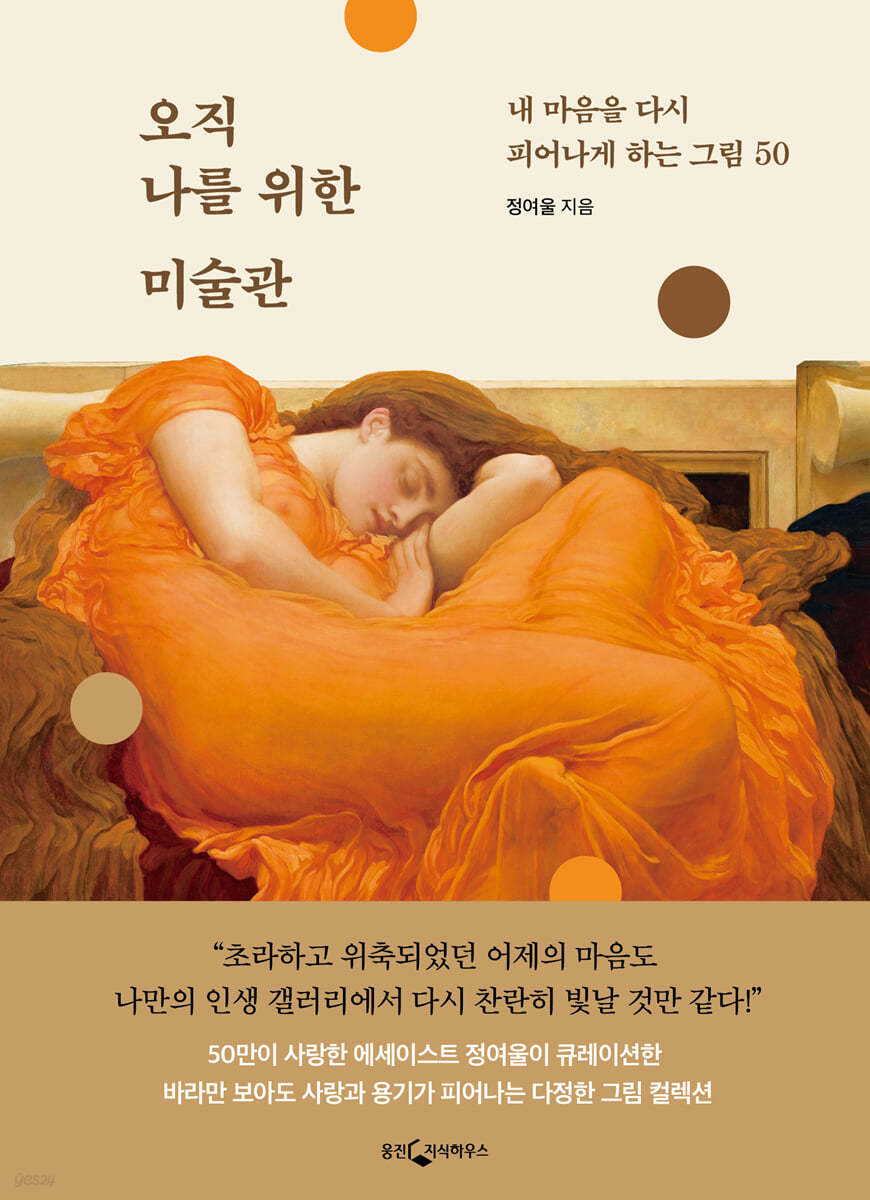
An art gallery just for me
 |
Description
Book Introduction
- A word from MD
-
The life story of artist Jeong Yeo-ulA collection of affectionate illustrations curated by essayist Yeo-ul Jeong, loved by 500,000 people.
We talk about 50 precious paintings of life that you want to keep by your side and look at forever.
By reading the author's warm words and life stories, you will learn to love and appreciate art even without any background knowledge of art history.
November 21, 2023. Art PD Ahn Hyun-jae
When I find the dazzling potential within myself, I look to the golden Klimt,
On days when I feel overwhelmed by the loneliness of being alone, I try a desperate hopper.
In moments when I feel shabby and discouraged, I think of the affectionate Botticelli…
Curated by essayist Jeong Yeo-ul, loved by 500,000 people
A collection of affectionate paintings that inspire love and courage just by looking at them.
What kind of painting do you like? The one you like without hesitation tells your story.
Paintings that you may have come across by chance in an art gallery, an art collection, a literary work, or a scene from a movie, but which immediately touch your heart and you want to keep by your side.
We call those paintings that make us smile for no reason and make our hearts bloom with flowers 'paintings of life.'
After visiting the life picture gallery in my heart, I feel like even my shabby and discouraged heart from yesterday will be able to shine brightly again.
"An Art Museum Just for Me" is a full-fledged art essay by essayist Jeong Yeo-ul, beloved by 500,000 readers, in which she discusses 50 precious paintings of her life that she wants to keep by her side and gaze upon forever.
Through the paintings and life stories he tells, readers become courageous walkers through art and learn to love and appreciate paintings without any background knowledge of the artist's style or art historical significance.
On days when I feel overwhelmed by the loneliness of being alone, I try a desperate hopper.
In moments when I feel shabby and discouraged, I think of the affectionate Botticelli…
Curated by essayist Jeong Yeo-ul, loved by 500,000 people
A collection of affectionate paintings that inspire love and courage just by looking at them.
What kind of painting do you like? The one you like without hesitation tells your story.
Paintings that you may have come across by chance in an art gallery, an art collection, a literary work, or a scene from a movie, but which immediately touch your heart and you want to keep by your side.
We call those paintings that make us smile for no reason and make our hearts bloom with flowers 'paintings of life.'
After visiting the life picture gallery in my heart, I feel like even my shabby and discouraged heart from yesterday will be able to shine brightly again.
"An Art Museum Just for Me" is a full-fledged art essay by essayist Jeong Yeo-ul, beloved by 500,000 readers, in which she discusses 50 precious paintings of her life that she wants to keep by her side and gaze upon forever.
Through the paintings and life stories he tells, readers become courageous walkers through art and learn to love and appreciate paintings without any background knowledge of the artist's style or art historical significance.
- You can preview some of the book's contents.
Preview
index
Prologue To you who dreams of brilliant liberation
Part 1: A Painting that Opens a Brilliant Tomorrow
1. The painting that brought out the dazzling gold within me: Gustav Klimt, Portrait of Madame Adele Bloch-Bauer
2 When you want to rediscover the excitement you've forgotten: Jean-Siméon Chardin, "Girl with a Racket"
3. A picture you need on a day when you never laugh: Henry Raeburn, "The Skating Preacher"
4 Paintings that Make You Dream of a Beautiful Flight: Georges Seurat, The Circus
5 The Right to Dream in Safety: Camille Claudel, Dreaming by the Fire
6 When My Passion Lost Its Way: Edouard Manet, A Bar at the Folies-Bergère
7. Stroking Your Bent Back: Henri de Toulouse-Lautrec, The Bathroom
8 How will life change after this moment passes? : Salvador Dali, "Girl at the Window"
Part 2: Love, Engrave the Moment That Becomes Eternal
9 When words cannot express all that I love: Marc Chagall, The Fiancé and the Eiffel Tower
10 When you feel overwhelmed by the loneliness of being left alone: Edward Hopper, “Hotel Room”
11 Where Does Our Love Go After a Kiss?: Francisco Hayez, The Kiss
12 Things That Disappear When We Lose Ourselves: Constantin Brancusi, The Kiss
13 Moments of Love You Want to Capture Forever: Gustav Klimt, "Love"
14 An unexpected love that blossoms amid hatred: Jacopo Tintoretto, The Origin of the Milky Way
15 The Most Beautiful Hospitality for You and Me: Sandro Botticelli, The Birth of Venus
16 Do not force the way of love: Giulio Barzelini, Pygmalion and Galatea
17 In the face of the cruel fate of love: John William Witterhouse, The Awakening of Adonis
Hall 3: All the world's landscapes depicted through the language of light
18 If You Could See What I Saw: Claude Monet, Arrival of the Train at the Gare Saint-Lazare
19 Enjoying the Natural Joy of Color: Georges Seurat, "Woman Applying Makeup"
20 When My Whole World Is Colored with Pain: Edvard Munch, "The Parting"
21 The solace that only purple can provide: Gustav Klimt, "Medda Primavesi"
22 Our Attitude to Welcome Spring: Electricity, "Plum Blossom Cottage"
23 Summer, a feast of intense colors and lines: Edward Hopper, "A Summer Day"
24 Listen to the sounds of autumn: Jackson Pollock, "Autumn Rhythm"
25 Winter, the time when you miss home: Pieter Bruegel the Elder, "Hunters in the Snow"
26 Vanitas, Nothing Still Flows: Caravaggio, Saint Jerome Writing
Chapter 4: What Makes Me Me
27 What Face Do You Make When You Concentrate: Johannes Vermeer, The Milkmaid
28 A woman has three faces: Gustav Klimt, “The Three Ages of a Woman”
29 Are You Free from All Temptation?: Franz von Stuck, "Sin"
30 When I Wish This Reality Were a Dream: Frida Kahlo, Broken Column
31 The Master's 'First Heart' that Remains Eternal: Michelangelo Buonarroti, Rondanini Pietà
32 While You Were Closed: Frederick Leighton, Flaming June
33 When you want to immerse yourself in a book: Pieter Janssens Ellinger, The Reading Woman
34 What Makes Me Me: Havriel Mecheux, The Man Who Writes
35 What to Do in a Room of One's Own: Vanessa Bell, Virginia Woolf
36 Reaching Out in Desperate Loneliness: Vincent van Gogh, "The Walk of the Prisoners"
37 A Story About the Power to Change the World: Norman Rockwell, "The Problem We All Have"
38 When you miss a simple meal shared with a family: Édouard Vuillard, "Family Lunch"
39 I became a mother only because of you: Elisabeth Vigée-Le Brun, Self-Portrait with Daughter
40 Paintings You'll Want to Keep Glancing at: Diego Velázquez, The Adornment of Venus (Venus of Rokeby)
41 The fingerprint of the soul drawn from the back: René Magritte, "Forbidden Representation"
Hall 5: God, Man, and the Museum of Liberation
42 Medusa, Throwing Off All Her Fetters: Caravaggio, Medusa
43 The Courage to Find Light Even in an Endless Nightmare: Johann Heinrich Füssli, "Nightmare"
44 Dali's Christ, the Enchantment of a Strange World: Salvador Dali, "Christ of Saint John of the Cross"
45 On the Nature of the Body: Alberto Giacometti, Walking Man
46 Orpheus, the eternal role model of the artistic spirit: John William Waterhouse, The Nymphs Finding the Head of Orpheus
47 Ophelia, in the face of a tragedy that is no one's fault: John Everett Millais, Ophelia
48 Judith, never to surrender to fate: Caravaggio, Judith beheading Holofernes
49 Salome, a provocation to unscrupulous gazes: Gustave Moreau, "Illusion"
50 Today, again, the courage to face it bravely: Paolo Uccello, Saint George Fighting the Dragon
Special Exhibition: Art Museums I Love
Epilogue: A warm art museum where our hearts meet
Part 1: A Painting that Opens a Brilliant Tomorrow
1. The painting that brought out the dazzling gold within me: Gustav Klimt, Portrait of Madame Adele Bloch-Bauer
2 When you want to rediscover the excitement you've forgotten: Jean-Siméon Chardin, "Girl with a Racket"
3. A picture you need on a day when you never laugh: Henry Raeburn, "The Skating Preacher"
4 Paintings that Make You Dream of a Beautiful Flight: Georges Seurat, The Circus
5 The Right to Dream in Safety: Camille Claudel, Dreaming by the Fire
6 When My Passion Lost Its Way: Edouard Manet, A Bar at the Folies-Bergère
7. Stroking Your Bent Back: Henri de Toulouse-Lautrec, The Bathroom
8 How will life change after this moment passes? : Salvador Dali, "Girl at the Window"
Part 2: Love, Engrave the Moment That Becomes Eternal
9 When words cannot express all that I love: Marc Chagall, The Fiancé and the Eiffel Tower
10 When you feel overwhelmed by the loneliness of being left alone: Edward Hopper, “Hotel Room”
11 Where Does Our Love Go After a Kiss?: Francisco Hayez, The Kiss
12 Things That Disappear When We Lose Ourselves: Constantin Brancusi, The Kiss
13 Moments of Love You Want to Capture Forever: Gustav Klimt, "Love"
14 An unexpected love that blossoms amid hatred: Jacopo Tintoretto, The Origin of the Milky Way
15 The Most Beautiful Hospitality for You and Me: Sandro Botticelli, The Birth of Venus
16 Do not force the way of love: Giulio Barzelini, Pygmalion and Galatea
17 In the face of the cruel fate of love: John William Witterhouse, The Awakening of Adonis
Hall 3: All the world's landscapes depicted through the language of light
18 If You Could See What I Saw: Claude Monet, Arrival of the Train at the Gare Saint-Lazare
19 Enjoying the Natural Joy of Color: Georges Seurat, "Woman Applying Makeup"
20 When My Whole World Is Colored with Pain: Edvard Munch, "The Parting"
21 The solace that only purple can provide: Gustav Klimt, "Medda Primavesi"
22 Our Attitude to Welcome Spring: Electricity, "Plum Blossom Cottage"
23 Summer, a feast of intense colors and lines: Edward Hopper, "A Summer Day"
24 Listen to the sounds of autumn: Jackson Pollock, "Autumn Rhythm"
25 Winter, the time when you miss home: Pieter Bruegel the Elder, "Hunters in the Snow"
26 Vanitas, Nothing Still Flows: Caravaggio, Saint Jerome Writing
Chapter 4: What Makes Me Me
27 What Face Do You Make When You Concentrate: Johannes Vermeer, The Milkmaid
28 A woman has three faces: Gustav Klimt, “The Three Ages of a Woman”
29 Are You Free from All Temptation?: Franz von Stuck, "Sin"
30 When I Wish This Reality Were a Dream: Frida Kahlo, Broken Column
31 The Master's 'First Heart' that Remains Eternal: Michelangelo Buonarroti, Rondanini Pietà
32 While You Were Closed: Frederick Leighton, Flaming June
33 When you want to immerse yourself in a book: Pieter Janssens Ellinger, The Reading Woman
34 What Makes Me Me: Havriel Mecheux, The Man Who Writes
35 What to Do in a Room of One's Own: Vanessa Bell, Virginia Woolf
36 Reaching Out in Desperate Loneliness: Vincent van Gogh, "The Walk of the Prisoners"
37 A Story About the Power to Change the World: Norman Rockwell, "The Problem We All Have"
38 When you miss a simple meal shared with a family: Édouard Vuillard, "Family Lunch"
39 I became a mother only because of you: Elisabeth Vigée-Le Brun, Self-Portrait with Daughter
40 Paintings You'll Want to Keep Glancing at: Diego Velázquez, The Adornment of Venus (Venus of Rokeby)
41 The fingerprint of the soul drawn from the back: René Magritte, "Forbidden Representation"
Hall 5: God, Man, and the Museum of Liberation
42 Medusa, Throwing Off All Her Fetters: Caravaggio, Medusa
43 The Courage to Find Light Even in an Endless Nightmare: Johann Heinrich Füssli, "Nightmare"
44 Dali's Christ, the Enchantment of a Strange World: Salvador Dali, "Christ of Saint John of the Cross"
45 On the Nature of the Body: Alberto Giacometti, Walking Man
46 Orpheus, the eternal role model of the artistic spirit: John William Waterhouse, The Nymphs Finding the Head of Orpheus
47 Ophelia, in the face of a tragedy that is no one's fault: John Everett Millais, Ophelia
48 Judith, never to surrender to fate: Caravaggio, Judith beheading Holofernes
49 Salome, a provocation to unscrupulous gazes: Gustave Moreau, "Illusion"
50 Today, again, the courage to face it bravely: Paolo Uccello, Saint George Fighting the Dragon
Special Exhibition: Art Museums I Love
Epilogue: A warm art museum where our hearts meet
Detailed image

Into the book
How do you change when you love someone?
I want to talk to that person.
I want to know even the smallest habits of that person.
I want to chat all night long, even about the smallest memories that even that person has forgotten.
I wanted to say that to the painting I love too.
So, I wanted to write something that would communicate strongly with the painting, rather than something that calmly interprets the painting.
The paintings I cover in this book were chosen based on the extremely subjective criterion of “paintings that pierced my heart” rather than their importance in art history.
I want to translate the messages these pictures convey to me, like sharp arrows that pierce my heart, into my own language and tell you.
---From the "Prologue"
“Whenever all my efforts went to waste, whenever I realized that this world was not as warm and kind as I had dreamed, I thought of those pictures and endured the difficult times.
Because in the healing space of my heart, Van Gogh's star shines, and only then can my weary heart rest.
We can create a healing space in our own hearts like this.
“As long as the seeds of Van Gogh’s Starlight, Monet’s Water Lilies, and Klimt’s The Kiss have nested in my heart, I will never be lonely, no matter where I am.”
---From the "Prologue"
The longer we gaze at the painting, the more it seems to tell us something different.
Something that cannot be erased no matter how much gold decoration you try to use.
Something that cannot be hidden no matter how much you try to cover it up with fancy decorations.
Isn't it Adele's uniqueness, her dazzling aura as a one-of-a-kind being in this world?
A dazzling beauty that cannot be hidden no matter how much you try to conceal it with a golden dress and a choker that tightens around your neck.
The writhing of life that breaks through all obstacles without even trying to look beautiful.
Adele's crushed vitality that nothing can trample on.
The intense energy of a woman who cannot be overcome by anything.
The life energy I feel from Adele breaks down the censors inside me that shout, 'You can't do it, you're not good enough, you're weak.'
---From "01 The Painting That Helped Me Find the Dazzling Gold Within Me"
Just imagining him skating with such childlike innocence and then returning to his daily routine and preaching to the congregation with a solemn expression on his face, I finally burst out laughing.
Infinitely solemn when praying, infinitely light when skating! That imaginary contrast makes this painting all the more interesting and enjoyable.
A cheerful pastor who glides gracefully across the ice as if he were performing ballet, as if gravity did not exist in the first place.
(Omitted) While giving a lecture at a high school on the topic of 'Time for Literature', we ended up talking about 'what is the bliss (inner joy) that immerses you the most regardless of the outcome, what makes you forget all your sorrows and become absorbed in it?'
I talked about the joy of writing, and the students talked about the joy of comics, basketball, singing, etc.
Among them, the answer from a male student who said he liked basketball was impressive.
When asked what moment was his favorite, the student smiled shyly and answered.
“I love every moment.” That was absolutely right.
---「03 A Picture You Need on a Day When You Never Smile」
Strangely enough, there is one picture I keep misremembering.
I remember the shape of the picture, but I keep distorting the title and remembering it in my own way.
I kept remembering Hopper's painting as "Abandoned Woman" rather than "Hotel Room."
Was she really abandoned?
Who would have left such a lonely person in such a desolate corner of a room?
Who did she desire so desperately that she suffered so desperately?
The despair of an unknown person seems to transcend the barriers of time and space and reach our hearts.
Although we can't even properly gauge her expression, we can feel her overwhelming sense of isolation.
The fear of being abandoned, the realization that you have finally been abandoned, the despair that you may continue to be abandoned like this for as long as you live.
We go beyond the dry title of 'Hotel Room' and convey a more desperate sensibility.
---From "10 When You Feel Lost in the Loneliness of Being Left Alone"
The objects of love of Venus, the goddess of love, are not just attractive strangers.
One of the best qualities Venus possesses is her endless love for herself.
She regrets nothing, kneels to no one, and never loses her dignity wherever she goes.
She seems to be whispering to us:
To admire yourself as the goddess of love admires her own beauty.
A love that forgets the fear of others, and the confidence of Venus that seems to have thrown away all self-loathing and complexes.
And I want to become someone who embodies the warmth of Horai, the goddess of the seasons, who practices the spirit of boundless hospitality toward others.
---From "14 Unexpected Love that Sprouts Even in Hatred"
In Caravaggio's "Saint Jerome Writing," Saint Jerome deliberately placed a skull in front of him.
Every time I look at the skull, I think of my impending death.
No matter how difficult it is, I can't stop writing when I think about death.
It wasn't his looks that made him resemble me, but his desperation and earnestness.
As my eyesight has deteriorated rapidly recently, I have been thinking of St. Jerome more and more.
Tears keep coming out of my eyes without warning.
If tears were shed out of sadness, I would feel catharsis, but these tears seem to be a symptom of dry eye and presbyopia.
Having written countless books over the years, overworking my eyes and fingers, I get scared at the slightest sign of something wrong with my eyes or wrists.
But it doesn't stop.
Because we don't know when death will come.
Even if it's not death, chronic stressors like slumps, presbyopia, or disk problems can threaten 'today's writing' at any time.
My weakening eyesight, my back pain that won't go away no matter how many times I go to the hospital, and even my weakened memory that makes me forget proper nouns every now and then - they all feel like 'St. Jerome's skull' to me.
But I'm not afraid of this skeleton.
---From "26 Vanitas, Nothing Does Not Flow"
Auguste Rodin discovered that all of Michelangelo's sculptures contained unspeakable suffering.
Rodin interprets it this way:
Michelangelo destroyed many of his works in his old age, saying that although he constantly sought eternity, art ultimately failed to satisfy him.
But I would like to interpret it differently.
Perhaps in Michelangelo's final moments, there was no longer a distinction between art and himself.
He pursued eternal beauty, not just visible smoothness, but something that liberated the 'angel in marble', even if it was in a rough and unfinished state.
Michelangelo said this:
“I saw an angel in marble, and I carved until the angel was free.” An artist is one who has the eye to see the angel trapped in marble, and who does not stop carving until the angel is finally and completely free.
---From "31 The Master's 'First Heart' That Remains Eternal"
The red-glowing hair, the eyes that seem to burn with an unquenchable desire despite all the desperate circumstances, and the expression that seems to yearn for something desperately make this painting look like another self-portrait of Van Gogh.
I want to grab that poor young man by the hand and drag him out of that hopeless situation right now.
And I think we need to liberate all those people who are suffering together.
What in the world has created such a stuffy space?
The painful realization that Van Gogh himself was one of those stigmatized beings, suffering, abandoned, alienated, and forever isolated, gripped my heart.
Looking at this painting makes my heart ache even more, as if Van Gogh was foreseeing his own tragic end.
I want to talk to that person.
I want to know even the smallest habits of that person.
I want to chat all night long, even about the smallest memories that even that person has forgotten.
I wanted to say that to the painting I love too.
So, I wanted to write something that would communicate strongly with the painting, rather than something that calmly interprets the painting.
The paintings I cover in this book were chosen based on the extremely subjective criterion of “paintings that pierced my heart” rather than their importance in art history.
I want to translate the messages these pictures convey to me, like sharp arrows that pierce my heart, into my own language and tell you.
---From the "Prologue"
“Whenever all my efforts went to waste, whenever I realized that this world was not as warm and kind as I had dreamed, I thought of those pictures and endured the difficult times.
Because in the healing space of my heart, Van Gogh's star shines, and only then can my weary heart rest.
We can create a healing space in our own hearts like this.
“As long as the seeds of Van Gogh’s Starlight, Monet’s Water Lilies, and Klimt’s The Kiss have nested in my heart, I will never be lonely, no matter where I am.”
---From the "Prologue"
The longer we gaze at the painting, the more it seems to tell us something different.
Something that cannot be erased no matter how much gold decoration you try to use.
Something that cannot be hidden no matter how much you try to cover it up with fancy decorations.
Isn't it Adele's uniqueness, her dazzling aura as a one-of-a-kind being in this world?
A dazzling beauty that cannot be hidden no matter how much you try to conceal it with a golden dress and a choker that tightens around your neck.
The writhing of life that breaks through all obstacles without even trying to look beautiful.
Adele's crushed vitality that nothing can trample on.
The intense energy of a woman who cannot be overcome by anything.
The life energy I feel from Adele breaks down the censors inside me that shout, 'You can't do it, you're not good enough, you're weak.'
---From "01 The Painting That Helped Me Find the Dazzling Gold Within Me"
Just imagining him skating with such childlike innocence and then returning to his daily routine and preaching to the congregation with a solemn expression on his face, I finally burst out laughing.
Infinitely solemn when praying, infinitely light when skating! That imaginary contrast makes this painting all the more interesting and enjoyable.
A cheerful pastor who glides gracefully across the ice as if he were performing ballet, as if gravity did not exist in the first place.
(Omitted) While giving a lecture at a high school on the topic of 'Time for Literature', we ended up talking about 'what is the bliss (inner joy) that immerses you the most regardless of the outcome, what makes you forget all your sorrows and become absorbed in it?'
I talked about the joy of writing, and the students talked about the joy of comics, basketball, singing, etc.
Among them, the answer from a male student who said he liked basketball was impressive.
When asked what moment was his favorite, the student smiled shyly and answered.
“I love every moment.” That was absolutely right.
---「03 A Picture You Need on a Day When You Never Smile」
Strangely enough, there is one picture I keep misremembering.
I remember the shape of the picture, but I keep distorting the title and remembering it in my own way.
I kept remembering Hopper's painting as "Abandoned Woman" rather than "Hotel Room."
Was she really abandoned?
Who would have left such a lonely person in such a desolate corner of a room?
Who did she desire so desperately that she suffered so desperately?
The despair of an unknown person seems to transcend the barriers of time and space and reach our hearts.
Although we can't even properly gauge her expression, we can feel her overwhelming sense of isolation.
The fear of being abandoned, the realization that you have finally been abandoned, the despair that you may continue to be abandoned like this for as long as you live.
We go beyond the dry title of 'Hotel Room' and convey a more desperate sensibility.
---From "10 When You Feel Lost in the Loneliness of Being Left Alone"
The objects of love of Venus, the goddess of love, are not just attractive strangers.
One of the best qualities Venus possesses is her endless love for herself.
She regrets nothing, kneels to no one, and never loses her dignity wherever she goes.
She seems to be whispering to us:
To admire yourself as the goddess of love admires her own beauty.
A love that forgets the fear of others, and the confidence of Venus that seems to have thrown away all self-loathing and complexes.
And I want to become someone who embodies the warmth of Horai, the goddess of the seasons, who practices the spirit of boundless hospitality toward others.
---From "14 Unexpected Love that Sprouts Even in Hatred"
In Caravaggio's "Saint Jerome Writing," Saint Jerome deliberately placed a skull in front of him.
Every time I look at the skull, I think of my impending death.
No matter how difficult it is, I can't stop writing when I think about death.
It wasn't his looks that made him resemble me, but his desperation and earnestness.
As my eyesight has deteriorated rapidly recently, I have been thinking of St. Jerome more and more.
Tears keep coming out of my eyes without warning.
If tears were shed out of sadness, I would feel catharsis, but these tears seem to be a symptom of dry eye and presbyopia.
Having written countless books over the years, overworking my eyes and fingers, I get scared at the slightest sign of something wrong with my eyes or wrists.
But it doesn't stop.
Because we don't know when death will come.
Even if it's not death, chronic stressors like slumps, presbyopia, or disk problems can threaten 'today's writing' at any time.
My weakening eyesight, my back pain that won't go away no matter how many times I go to the hospital, and even my weakened memory that makes me forget proper nouns every now and then - they all feel like 'St. Jerome's skull' to me.
But I'm not afraid of this skeleton.
---From "26 Vanitas, Nothing Does Not Flow"
Auguste Rodin discovered that all of Michelangelo's sculptures contained unspeakable suffering.
Rodin interprets it this way:
Michelangelo destroyed many of his works in his old age, saying that although he constantly sought eternity, art ultimately failed to satisfy him.
But I would like to interpret it differently.
Perhaps in Michelangelo's final moments, there was no longer a distinction between art and himself.
He pursued eternal beauty, not just visible smoothness, but something that liberated the 'angel in marble', even if it was in a rough and unfinished state.
Michelangelo said this:
“I saw an angel in marble, and I carved until the angel was free.” An artist is one who has the eye to see the angel trapped in marble, and who does not stop carving until the angel is finally and completely free.
---From "31 The Master's 'First Heart' That Remains Eternal"
The red-glowing hair, the eyes that seem to burn with an unquenchable desire despite all the desperate circumstances, and the expression that seems to yearn for something desperately make this painting look like another self-portrait of Van Gogh.
I want to grab that poor young man by the hand and drag him out of that hopeless situation right now.
And I think we need to liberate all those people who are suffering together.
What in the world has created such a stuffy space?
The painful realization that Van Gogh himself was one of those stigmatized beings, suffering, abandoned, alienated, and forever isolated, gripped my heart.
Looking at this painting makes my heart ache even more, as if Van Gogh was foreseeing his own tragic end.
---From "36 When Reaching Out in Desperate Loneliness"
Publisher's Review
■ “Is there a painting you can say you like without hesitation?”
- A special docent class for art museum wanderers seeking their own life painting.
Think of just five paintings in your life that you can say without hesitation that you truly love.
That painting you definitely want to see at the art museum during your trip, that painting you have to go through the fierce ticketing and the huge crowds to get there and take a commemorative photo of, and that painting you want to keep as a postcard or art book at the souvenir shop.
Why do you like that painting? It probably has nothing to do with its fame or art historical significance.
At some point in your life, if you find a painting that is just beautiful to look at, you can call it 'your own painting of life.'
Author Jeong Yeo-ul recalls that she was finally able to free herself from the inexplicable sense of lack in life when she wandered through art galleries and finally found a painting that touched her heart.
No matter how noisy the world may be and how much it torments us, if we have just one picture in our hearts, we will not be lonely.
As a literary critic, humanist, and essayist who has explored the beauty of literature and art, author Yeo-ul Jeong has come to readers with her art essay, “An Art Museum Just for Me,” which contains 50 of her “life paintings.”
This book curates paintings that inspired, gave hope, gave love, and gave courage, which I encountered while exploring art museums in unfamiliar cities around the world.
As readers wander through this private collection, a blend of beautiful paintings and the author's intimate life stories, they will find themselves inspired to create their own "gallery just for me."
■ “Walking through the gallery of the heart, filled with Van Gogh’s Starlight, Monet’s Water Lilies, and Klimt’s Kiss”
A collection of Jeong Yeo-ul's affectionate paintings, filled with love, courage, and inspiration for life.
Alain de Botton said, “One of the surprisingly important functions of art is that it teaches us to better tolerate pain.”
Isn't the usefulness of art derived from this healing function?
Painting has the power to allow the viewer to project the story of their own life while simultaneously sublimating all joys and sorrows into beautiful light and color.
In “An Art Museum Just for Me,” the author draws on his own experience, saying, “When I come to the art museum, my fluctuating heart becomes calm and I am able to see the light and shadow of life more clearly,” and confesses, “Whenever I face the barrier of reality and my hopes are dashed, I think of Van Gogh’s Starlight” (prologue).
When I think of Van Gogh's challenge to capture the essence of starlight through color, as in "Starry Night Over the Rhone," and his passion for art, I am able to spur myself out of complacency and embark on new endeavors and adventures.
Everyone has a picture like that.
The lives and works of great artists who were devoted to art, such as Klimt and Hopper, as well as representative artists loved by Koreans, such as Van Gogh, Monet, and Renoir, leave a deep impression on our hearts.
Van Gogh's 'Starlight', Monet's 'Water Lilies', and Klimt's 'The Kiss' become healing spaces for our hearts.
The 50 representative paintings in this book were carefully selected by the author based on the criteria of being paintings that I want to hang by my side and look at whenever I need inspiration, hope, the desire to love, and the courage to live tomorrow, rather than based on their importance in art history.
As Susan Sontag said, "Truly creative criticism must reclaim the eroticism of art," the author does not dissect and interpret art with the weapons of culture and knowledge, but stands before the painting honestly and courageously as a human being who loves art.
“I don’t explain, I don’t analyze logically.
“I just wanted to write about the full feeling of the moment when art spoke to me,” says the author, who, as a docent at this private gallery, personally demonstrates how to enjoy art with all one’s heart.
■ “On days when I haven’t smiled once, I want to send you this picture.”
From the warm welcome of Botticelli to the desperate loneliness of Hopper, 50 masterpieces of the century.
The five galleries included in this book, from Halls 1 to 5, display over 50 representative works, including everyone's favorite artist, Van Gogh, the symbol of love, Klimt, Hopper and Chagall, Monet and Dali's masterpieces, as well as Picasso's early works, female artists Frida Kahlo and Elisabeth Le Brun, and Norman Rockwell, a symbol of the American civil rights movement.
While these are masterpieces in their own right, the author, as the special curator of this private gallery, opens the door to dialogue by honestly and bravely sharing the stories behind the paintings, as well as his personal experiences of wounds, pain, and healing.
In this book, which contains the joys and sorrows of life, we can read every moment of life through each and every picture.
In Hall 1, “Paintings that Open a Brilliant Tomorrow,” you will encounter paintings that bring hope to life.
The author, through Gustav Klimt's "Portrait of Mrs. Adele Bloch-Bauer," vows to become a person with a shining soul, not trapped in splendid gold and choker necklaces like Adele, and also recommends, as a prescription, the painting "The Preacher on Skates" (by Henry Raeburn), which depicts a pastor who has laid down his authority and fallen into a moment of bliss (inner joy) on "a day when he never smiled."
In Camille Claudel's "Dreaming by the Fire," where she sleeps precariously by the fireplace, we read the pain of the past when she fell asleep in the bathroom of the house where she worked as a tutor during her youth, unable to overcome fatigue. In the empty expression of the waiter "Suson" in Édouard Manet's "The Bar at the Folies-Bergère," we also cheer for our passion to not lose its way any longer.
In the second section, “Love, Engrave the Moment That Became Eternal,” paintings that truly give you the courage to fall in love are displayed in a splendid manner.
Instead of commenting on Edward Hopper's "Hotel Room," the author projects his own experience of losing love and feeling desperately lonely onto the woman left alone in the painting.
Honoré de Balzac's famous quote, "A lonely person needs someone to tell him that solitude is okay," may have resonated with the woman in the painting.
But our love can rise again.
From Gustav Klimt to Francisco Hayez and Constantin Brancusi, the works that capture the essence of a kiss—sometimes desperate, sometimes thrilling, and sometimes transcending the boundaries of existence—warm the hearts of those who see them.
I nod inwardly at the author's interpretation, which asks whether this is the true 'hospitality' needed in this era, while focusing on the goddess Horai running barefoot and covering her with a cloak in Botticelli's "Birth of Venus."
In Hall 3, “Landscapes of the World Painted in the Language of Light,” we delve into the diverse language of light used by landscape and still life painters, from Claude Monet and Georges Seurat to Tian Qi, Caravaggio, and Jackson Pollock.
Like Monet, who sought to convey the light he saw as it was, the author, a natural storyteller, vividly recreates the splendid brilliance of the masterpieces he saw in words.
In this feast of colorful paintings and beautiful essays, any reader cannot help but tell his or her own story before the paintings.
■ “I want to talk with you about the pictures that pierced my heart.”
-Reading masterful paintings alongside myths and literary works, encountering the essence of Jeong Yeo-ul's essays.
The works in Hall 4, “What Makes Me Me,” which contains the faces loved by painters and the passion of artists, and Hall 5, “The Museum of God, Man, and Liberation,” which depicts the epics of characters from myths and literary works, speak of the passionate and intense desires of human beings.
Through Frida Kahlo, who suffered from a congenital disability and a broken spine in a car accident, we learn about the strength of the artist's spirit who transcended painful reality through painting. In Judith, who beheaded Holofernes, and Caravaggio's Medusa, we read about the artist's primal desire to fight painful reality even if it means becoming a monster.
The book offers a surprising interpretation of Hera, who transformed her hatred for Hercules into love in Greco-Roman mythology; Venus, who became the goddess of true love only after losing her love; and Orpheus, a role model for the artistic spirit. Powerful commentary on literature and art, from Hamlet to Virginia Woolf, adds even more depth to the viewer's appreciation of the paintings.
As you become absorbed in the text and pictures that vividly capture the joys and sorrows of characters in myths and literary works, it will soon be time to leave the museum.
For those who are reluctant to leave the museum, the author has prepared another special exhibition that showcases the sights of the museums that Jeong Yeo-ul loved, including the Musée d'Orsay and the Centre Pompidou in France, the Peggy Guggenheim Museum in Venice, and the Isabella Stewart Gardner Museum in Boston.
Artist Seungwon Lee's photographs, which capture the beautiful scenery of the art museum where the illustrations in this book are housed, add a sense of realism throughout the book, as if you were standing in an exhibition hall.
When you want to hide away in your own room from your busy daily life, visit this special art museum.
The moment we leave this special gallery, created just for 'me', we will surely become more affectionate people than we were yesterday.
- A special docent class for art museum wanderers seeking their own life painting.
Think of just five paintings in your life that you can say without hesitation that you truly love.
That painting you definitely want to see at the art museum during your trip, that painting you have to go through the fierce ticketing and the huge crowds to get there and take a commemorative photo of, and that painting you want to keep as a postcard or art book at the souvenir shop.
Why do you like that painting? It probably has nothing to do with its fame or art historical significance.
At some point in your life, if you find a painting that is just beautiful to look at, you can call it 'your own painting of life.'
Author Jeong Yeo-ul recalls that she was finally able to free herself from the inexplicable sense of lack in life when she wandered through art galleries and finally found a painting that touched her heart.
No matter how noisy the world may be and how much it torments us, if we have just one picture in our hearts, we will not be lonely.
As a literary critic, humanist, and essayist who has explored the beauty of literature and art, author Yeo-ul Jeong has come to readers with her art essay, “An Art Museum Just for Me,” which contains 50 of her “life paintings.”
This book curates paintings that inspired, gave hope, gave love, and gave courage, which I encountered while exploring art museums in unfamiliar cities around the world.
As readers wander through this private collection, a blend of beautiful paintings and the author's intimate life stories, they will find themselves inspired to create their own "gallery just for me."
■ “Walking through the gallery of the heart, filled with Van Gogh’s Starlight, Monet’s Water Lilies, and Klimt’s Kiss”
A collection of Jeong Yeo-ul's affectionate paintings, filled with love, courage, and inspiration for life.
Alain de Botton said, “One of the surprisingly important functions of art is that it teaches us to better tolerate pain.”
Isn't the usefulness of art derived from this healing function?
Painting has the power to allow the viewer to project the story of their own life while simultaneously sublimating all joys and sorrows into beautiful light and color.
In “An Art Museum Just for Me,” the author draws on his own experience, saying, “When I come to the art museum, my fluctuating heart becomes calm and I am able to see the light and shadow of life more clearly,” and confesses, “Whenever I face the barrier of reality and my hopes are dashed, I think of Van Gogh’s Starlight” (prologue).
When I think of Van Gogh's challenge to capture the essence of starlight through color, as in "Starry Night Over the Rhone," and his passion for art, I am able to spur myself out of complacency and embark on new endeavors and adventures.
Everyone has a picture like that.
The lives and works of great artists who were devoted to art, such as Klimt and Hopper, as well as representative artists loved by Koreans, such as Van Gogh, Monet, and Renoir, leave a deep impression on our hearts.
Van Gogh's 'Starlight', Monet's 'Water Lilies', and Klimt's 'The Kiss' become healing spaces for our hearts.
The 50 representative paintings in this book were carefully selected by the author based on the criteria of being paintings that I want to hang by my side and look at whenever I need inspiration, hope, the desire to love, and the courage to live tomorrow, rather than based on their importance in art history.
As Susan Sontag said, "Truly creative criticism must reclaim the eroticism of art," the author does not dissect and interpret art with the weapons of culture and knowledge, but stands before the painting honestly and courageously as a human being who loves art.
“I don’t explain, I don’t analyze logically.
“I just wanted to write about the full feeling of the moment when art spoke to me,” says the author, who, as a docent at this private gallery, personally demonstrates how to enjoy art with all one’s heart.
■ “On days when I haven’t smiled once, I want to send you this picture.”
From the warm welcome of Botticelli to the desperate loneliness of Hopper, 50 masterpieces of the century.
The five galleries included in this book, from Halls 1 to 5, display over 50 representative works, including everyone's favorite artist, Van Gogh, the symbol of love, Klimt, Hopper and Chagall, Monet and Dali's masterpieces, as well as Picasso's early works, female artists Frida Kahlo and Elisabeth Le Brun, and Norman Rockwell, a symbol of the American civil rights movement.
While these are masterpieces in their own right, the author, as the special curator of this private gallery, opens the door to dialogue by honestly and bravely sharing the stories behind the paintings, as well as his personal experiences of wounds, pain, and healing.
In this book, which contains the joys and sorrows of life, we can read every moment of life through each and every picture.
In Hall 1, “Paintings that Open a Brilliant Tomorrow,” you will encounter paintings that bring hope to life.
The author, through Gustav Klimt's "Portrait of Mrs. Adele Bloch-Bauer," vows to become a person with a shining soul, not trapped in splendid gold and choker necklaces like Adele, and also recommends, as a prescription, the painting "The Preacher on Skates" (by Henry Raeburn), which depicts a pastor who has laid down his authority and fallen into a moment of bliss (inner joy) on "a day when he never smiled."
In Camille Claudel's "Dreaming by the Fire," where she sleeps precariously by the fireplace, we read the pain of the past when she fell asleep in the bathroom of the house where she worked as a tutor during her youth, unable to overcome fatigue. In the empty expression of the waiter "Suson" in Édouard Manet's "The Bar at the Folies-Bergère," we also cheer for our passion to not lose its way any longer.
In the second section, “Love, Engrave the Moment That Became Eternal,” paintings that truly give you the courage to fall in love are displayed in a splendid manner.
Instead of commenting on Edward Hopper's "Hotel Room," the author projects his own experience of losing love and feeling desperately lonely onto the woman left alone in the painting.
Honoré de Balzac's famous quote, "A lonely person needs someone to tell him that solitude is okay," may have resonated with the woman in the painting.
But our love can rise again.
From Gustav Klimt to Francisco Hayez and Constantin Brancusi, the works that capture the essence of a kiss—sometimes desperate, sometimes thrilling, and sometimes transcending the boundaries of existence—warm the hearts of those who see them.
I nod inwardly at the author's interpretation, which asks whether this is the true 'hospitality' needed in this era, while focusing on the goddess Horai running barefoot and covering her with a cloak in Botticelli's "Birth of Venus."
In Hall 3, “Landscapes of the World Painted in the Language of Light,” we delve into the diverse language of light used by landscape and still life painters, from Claude Monet and Georges Seurat to Tian Qi, Caravaggio, and Jackson Pollock.
Like Monet, who sought to convey the light he saw as it was, the author, a natural storyteller, vividly recreates the splendid brilliance of the masterpieces he saw in words.
In this feast of colorful paintings and beautiful essays, any reader cannot help but tell his or her own story before the paintings.
■ “I want to talk with you about the pictures that pierced my heart.”
-Reading masterful paintings alongside myths and literary works, encountering the essence of Jeong Yeo-ul's essays.
The works in Hall 4, “What Makes Me Me,” which contains the faces loved by painters and the passion of artists, and Hall 5, “The Museum of God, Man, and Liberation,” which depicts the epics of characters from myths and literary works, speak of the passionate and intense desires of human beings.
Through Frida Kahlo, who suffered from a congenital disability and a broken spine in a car accident, we learn about the strength of the artist's spirit who transcended painful reality through painting. In Judith, who beheaded Holofernes, and Caravaggio's Medusa, we read about the artist's primal desire to fight painful reality even if it means becoming a monster.
The book offers a surprising interpretation of Hera, who transformed her hatred for Hercules into love in Greco-Roman mythology; Venus, who became the goddess of true love only after losing her love; and Orpheus, a role model for the artistic spirit. Powerful commentary on literature and art, from Hamlet to Virginia Woolf, adds even more depth to the viewer's appreciation of the paintings.
As you become absorbed in the text and pictures that vividly capture the joys and sorrows of characters in myths and literary works, it will soon be time to leave the museum.
For those who are reluctant to leave the museum, the author has prepared another special exhibition that showcases the sights of the museums that Jeong Yeo-ul loved, including the Musée d'Orsay and the Centre Pompidou in France, the Peggy Guggenheim Museum in Venice, and the Isabella Stewart Gardner Museum in Boston.
Artist Seungwon Lee's photographs, which capture the beautiful scenery of the art museum where the illustrations in this book are housed, add a sense of realism throughout the book, as if you were standing in an exhibition hall.
When you want to hide away in your own room from your busy daily life, visit this special art museum.
The moment we leave this special gallery, created just for 'me', we will surely become more affectionate people than we were yesterday.
GOODS SPECIFICS
- Date of issue: November 10, 2023
- Page count, weight, size: 372 pages | 594g | 145*200*20mm
- ISBN13: 9788901276892
- ISBN10: 8901276895
You may also like
카테고리
korean


korean

![GQ KOREA Mark (Monthly): December [2025]](http://librairie.coreenne.fr/cdn/shop/files/8ef265dbbfbf186523ed75ba7319009d.jpg?v=1765340328&width=3840)


