

Naming Nature
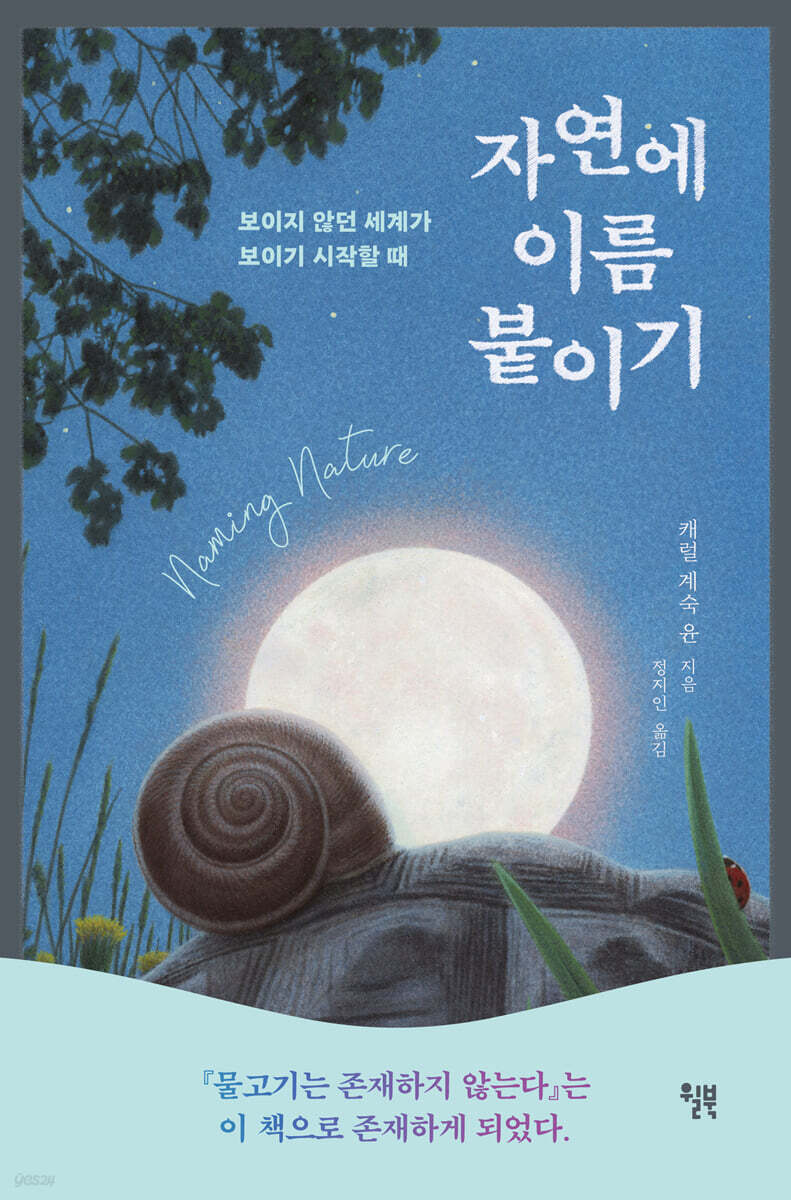 |
Description
Book Introduction
- A word from MD
-
When a name disappears, life disappears.A book that takes a fresh look at the long-standing relationship between humans and the living world, evolution and science, from the perspectives of taxonomy and evolutionary biology.
Scientific truth, created by the collision of intuitive sense and the world of rigorous science, reveals in detail what we have been missing.
The author's narrative and philosophical thoughts on existence that unfold the story are also interesting.
October 6, 2023. Natural Science PD Ahn Hyun-jae
"No book has had a greater influence on my thinking than this one."
- Lulu Miller, author of "Fish Don't Exist"
A masterpiece by Carol Gye-sook Yoon, a Korean-American scientist and science columnist for the New York Times.
A thrilling tale of taxonomy, evolutionary biology, and even life and science itself.
Lulu Miller, “The book that made ‘Fish Don’t Exist’ exist.”
Recommended by anthropologist Lee Sang-hee, director Lee Jeong-mo, and plant taxonomist Heo Tae-im
Carol Gye-sook Yoon's "Naming Nature" has been officially published in Korean.
Some readers may be delighted to see the original title, “Naming Nature.”
This book, which appeared as an 'incident' that shook the author's worldview in the popular science essay 'Fish Does Not Exist' and aroused the curiosity of many readers, was a finalist for the 2009 [Los Angeles Times] Book Award in the Science and Technology category, and was recommended by [New York Times], [Publisher's Weekly], and [Boston Globe], and is a masterpiece that received high praise from the time of its publication.
As the name suggests, the author, Carol Gye-sook Yoon, is a Korean-American who has been a science columnist for the New York Times for over 20 years and an evolutionary biologist born and raised by scientist parents.
As the translator puts it, she is also a talented storyteller who unfolds scientific tales 'like a neighborhood grandmother unfolding a bundle of old tales.'
The story of this book begins with the unexpected facts and the great shock he felt as he, a scholar and writer whose life was inseparable from science, jumped into the world of taxonomy, the study of the names and order of all living things.
The scene unfolds vividly, with the 'intuitive sense' I felt while interacting with countless colorful plants and animals in the forest behind my house as a child, and the world of 'rigorous science', which was the very value of life, fiercely competing.
Historically, the 'taxonomy' that Aristotle started and the Swedish 'great priest' Carl Linnaeus laid the foundation for eventually passed through Charles Darwin's heated theory of evolution, and faced dramatic events due to explosive changes in technology and academia. Laughter and thrills accompany every page turn.
Paradigms are constantly being overturned, and at the end of the debate, surprising scientific truths are being revealed.
The author's confession, revealing something he almost missed in the world of science that formed his values in life, is a must-read.
"Naming Nature" is a brilliant work by a scientist who, with his wonderful storytelling and eloquence, unravels the "history of discovery" surrounding the evolution of life. It is also a sincere confession from a man who witnessed the other side of the truth he had believed throughout his life.
We are presented with a captivating story, one that is captivating throughout, brimming with scientific knowledge, philosophical thought, and profoundly human emotions.
- Lulu Miller, author of "Fish Don't Exist"
A masterpiece by Carol Gye-sook Yoon, a Korean-American scientist and science columnist for the New York Times.
A thrilling tale of taxonomy, evolutionary biology, and even life and science itself.
Lulu Miller, “The book that made ‘Fish Don’t Exist’ exist.”
Recommended by anthropologist Lee Sang-hee, director Lee Jeong-mo, and plant taxonomist Heo Tae-im
Carol Gye-sook Yoon's "Naming Nature" has been officially published in Korean.
Some readers may be delighted to see the original title, “Naming Nature.”
This book, which appeared as an 'incident' that shook the author's worldview in the popular science essay 'Fish Does Not Exist' and aroused the curiosity of many readers, was a finalist for the 2009 [Los Angeles Times] Book Award in the Science and Technology category, and was recommended by [New York Times], [Publisher's Weekly], and [Boston Globe], and is a masterpiece that received high praise from the time of its publication.
As the name suggests, the author, Carol Gye-sook Yoon, is a Korean-American who has been a science columnist for the New York Times for over 20 years and an evolutionary biologist born and raised by scientist parents.
As the translator puts it, she is also a talented storyteller who unfolds scientific tales 'like a neighborhood grandmother unfolding a bundle of old tales.'
The story of this book begins with the unexpected facts and the great shock he felt as he, a scholar and writer whose life was inseparable from science, jumped into the world of taxonomy, the study of the names and order of all living things.
The scene unfolds vividly, with the 'intuitive sense' I felt while interacting with countless colorful plants and animals in the forest behind my house as a child, and the world of 'rigorous science', which was the very value of life, fiercely competing.
Historically, the 'taxonomy' that Aristotle started and the Swedish 'great priest' Carl Linnaeus laid the foundation for eventually passed through Charles Darwin's heated theory of evolution, and faced dramatic events due to explosive changes in technology and academia. Laughter and thrills accompany every page turn.
Paradigms are constantly being overturned, and at the end of the debate, surprising scientific truths are being revealed.
The author's confession, revealing something he almost missed in the world of science that formed his values in life, is a must-read.
"Naming Nature" is a brilliant work by a scientist who, with his wonderful storytelling and eloquence, unravels the "history of discovery" surrounding the evolution of life. It is also a sincere confession from a man who witnessed the other side of the truth he had believed throughout his life.
We are presented with a captivating story, one that is captivating throughout, brimming with scientific knowledge, philosophical thought, and profoundly human emotions.
- You can preview some of the book's contents.
Preview
index
prolog
Part 1.
Begin to wander in search of the natural order
Chapter 1 | The Little Trust Priest
Chapter 2 | A Miracle in a Barnacle
Chapter 3 | The Bottom Line
Part 2.
Revealed vision
Chapter 4 | The Surprise Discovered at the Tower of Babel
Chapter 5 | Umwelt in Babies and Brain Injury Patients
Chapter 6 | The Legacy of Warg
Part 3.
The birth of a science
Chapter 7 | Taxonomy in Numbers
Chapter 8 | Better Taxonomy Through Chemistry
Chapter 9 | The Death of a Fish
Part 4.
Regained Vision
Chapter 10 | Such a Strange Bus Stop
Chapter 11 | Beyond Science
Acknowledgements
Translator's Note
annotation
Part 1.
Begin to wander in search of the natural order
Chapter 1 | The Little Trust Priest
Chapter 2 | A Miracle in a Barnacle
Chapter 3 | The Bottom Line
Part 2.
Revealed vision
Chapter 4 | The Surprise Discovered at the Tower of Babel
Chapter 5 | Umwelt in Babies and Brain Injury Patients
Chapter 6 | The Legacy of Warg
Part 3.
The birth of a science
Chapter 7 | Taxonomy in Numbers
Chapter 8 | Better Taxonomy Through Chemistry
Chapter 9 | The Death of a Fish
Part 4.
Regained Vision
Chapter 10 | Such a Strange Bus Stop
Chapter 11 | Beyond Science
Acknowledgements
Translator's Note
annotation
Detailed image

Into the book
Like many children who wandered through the forest, I became a biologist.
I was an adult, and with that I had put aside any naive notions I might have harbored about the various kinds of tadpoles I had caught as a child, the various kinds of grasshoppers I had chased, the strange swimming masses that appeared in the swamp every spring but which I had never properly looked at.
So I was ready to embark on the truly scientific ordering of life.
Be prepared to be amazed.
--- p.23-24, from “Prologue | The Strange Circumstances of the Non-Existence of Fish”
Natural history was overflowing with names, categories were dissolved, and chaos continued to accumulate.
And so, just as the world of life was becoming a subject of ever-greater and more urgent concern to a growing number of people, the natural order, ironically, seemed to be slipping away, beyond human reach.
Today, the pain of giving order and names to life is the province of a small group of specialist scholars, but in Linnaeus's time, this growing problem was a dilemma shared and shared by all.
--- p.60, from “Chapter 1 | The Little Trust Priest”
It had been 100 years since Darwin published The Origin of Species.
He shook the foundations of science, philosophy, religion, and politics, and changed humanity's view of its place on Earth.
Yet somehow, even after a full century, his work has had no meaningful impact on how taxonomy works.
Taxonomy is the field in which his discoveries are of fundamental importance.
Even the revolution in experimental science, which was widely hailed as producing explosive breakthroughs in biology and rapidly changing humanity's vision of the universe, failed to change the order of life and the way we name it.
What on earth is the reason?
--- p.162-163, from “Chapter 3 | The Appearance of the Bottom”
It was only when I delved into the world of anthropology that I was able to witness this powerful and universal vision of life clearly drawn.
But to understand the true significance of Umwelt, we would have to dive into the bizarre world of psychology.
Because in that world, I learned about some strange people who had their Umwelt completely stolen.
And I see some tragic truths.
The fact that these people, like anyone else, are truly lost by losing their Umwelt.
--- p.210, from “Chapter 4 | Surprises Discovered at the Tower of Babel”
Taxonomy would take the first step toward pushing the human Umwelt further aside in the realm of classification and naming.
This field will become a rigorous, objective, and truly modern science.
But there would also be unintended consequences.
Soon scientists would begin to break free from the constraints of human senses, leaving behind, one by one, the universality of the Umwelt.
They finally abandon the pursuit of order that has continued since time immemorial and begin to embark on their own new and strange journey,
He would lead us on that journey together, even though we were completely unaware of it.
--- p.266, from “Chapter 6 | The Legacy of Warg”
Now taxonomists are faced with all sorts of new, cutting-edge nonsense (DNA sequencing, PCR, restriction enzymes) and even greater insults to the Umwelt.
Molecular biologists were challenging the idea that human senses themselves were paramount in understanding the biological world.
By doing so, he did something worse than insulting Umwelt.
Completely ignoring the Umwelt, they instead developed a completely new way of perceiving the world: reading individual molecules, DNA, and protein fragments from the cells of all kinds of organisms, a task only available to those with access to multimillion-dollar laboratories, state-of-the-art scientific equipment, and secretly transmitted, arcane knowledge and techniques.
--- p.329, from “Chapter 8 | Better Taxonomy through Chemistry”
This is how it happened.
The death of fish.
An inevitable result of Darwin's initiative to establish that taxonomy should be based on the lineage of life.
From the moment he realized that there was a vast tree of life beneath the natural order perceived by us, from the moment he witnessed that life truly evolves, the point at which science has inevitably run.
Darwin gave us directions, and now we have finally reached our destination.
Finally, cladists focused purely on the tree of evolutionary relationships, and on the branches named according to those relationships.
The fish were dead, and Hennig stood over them (at least in spirit, since the introverted Parisian taxonomist died in 1976), still clutching his smoking cladistics pistol.
--- p.355, from “Chapter 9 | The Death of a Fish”
We have left the classification and naming of life to the experts.
Scientists know best, and they tell us that there is no such thing as fish.
Funny enough, they even say that birds are dinosaurs.
Well, that's good.
They tell us that these fruit flies, although they look very similar, are actually two distinct species separated by time, and that these two birds, although they look very different, are actually the same species.
Of course.
Why would we spit on such words? And why would we bother doing such a thing?
I was an adult, and with that I had put aside any naive notions I might have harbored about the various kinds of tadpoles I had caught as a child, the various kinds of grasshoppers I had chased, the strange swimming masses that appeared in the swamp every spring but which I had never properly looked at.
So I was ready to embark on the truly scientific ordering of life.
Be prepared to be amazed.
--- p.23-24, from “Prologue | The Strange Circumstances of the Non-Existence of Fish”
Natural history was overflowing with names, categories were dissolved, and chaos continued to accumulate.
And so, just as the world of life was becoming a subject of ever-greater and more urgent concern to a growing number of people, the natural order, ironically, seemed to be slipping away, beyond human reach.
Today, the pain of giving order and names to life is the province of a small group of specialist scholars, but in Linnaeus's time, this growing problem was a dilemma shared and shared by all.
--- p.60, from “Chapter 1 | The Little Trust Priest”
It had been 100 years since Darwin published The Origin of Species.
He shook the foundations of science, philosophy, religion, and politics, and changed humanity's view of its place on Earth.
Yet somehow, even after a full century, his work has had no meaningful impact on how taxonomy works.
Taxonomy is the field in which his discoveries are of fundamental importance.
Even the revolution in experimental science, which was widely hailed as producing explosive breakthroughs in biology and rapidly changing humanity's vision of the universe, failed to change the order of life and the way we name it.
What on earth is the reason?
--- p.162-163, from “Chapter 3 | The Appearance of the Bottom”
It was only when I delved into the world of anthropology that I was able to witness this powerful and universal vision of life clearly drawn.
But to understand the true significance of Umwelt, we would have to dive into the bizarre world of psychology.
Because in that world, I learned about some strange people who had their Umwelt completely stolen.
And I see some tragic truths.
The fact that these people, like anyone else, are truly lost by losing their Umwelt.
--- p.210, from “Chapter 4 | Surprises Discovered at the Tower of Babel”
Taxonomy would take the first step toward pushing the human Umwelt further aside in the realm of classification and naming.
This field will become a rigorous, objective, and truly modern science.
But there would also be unintended consequences.
Soon scientists would begin to break free from the constraints of human senses, leaving behind, one by one, the universality of the Umwelt.
They finally abandon the pursuit of order that has continued since time immemorial and begin to embark on their own new and strange journey,
He would lead us on that journey together, even though we were completely unaware of it.
--- p.266, from “Chapter 6 | The Legacy of Warg”
Now taxonomists are faced with all sorts of new, cutting-edge nonsense (DNA sequencing, PCR, restriction enzymes) and even greater insults to the Umwelt.
Molecular biologists were challenging the idea that human senses themselves were paramount in understanding the biological world.
By doing so, he did something worse than insulting Umwelt.
Completely ignoring the Umwelt, they instead developed a completely new way of perceiving the world: reading individual molecules, DNA, and protein fragments from the cells of all kinds of organisms, a task only available to those with access to multimillion-dollar laboratories, state-of-the-art scientific equipment, and secretly transmitted, arcane knowledge and techniques.
--- p.329, from “Chapter 8 | Better Taxonomy through Chemistry”
This is how it happened.
The death of fish.
An inevitable result of Darwin's initiative to establish that taxonomy should be based on the lineage of life.
From the moment he realized that there was a vast tree of life beneath the natural order perceived by us, from the moment he witnessed that life truly evolves, the point at which science has inevitably run.
Darwin gave us directions, and now we have finally reached our destination.
Finally, cladists focused purely on the tree of evolutionary relationships, and on the branches named according to those relationships.
The fish were dead, and Hennig stood over them (at least in spirit, since the introverted Parisian taxonomist died in 1976), still clutching his smoking cladistics pistol.
--- p.355, from “Chapter 9 | The Death of a Fish”
We have left the classification and naming of life to the experts.
Scientists know best, and they tell us that there is no such thing as fish.
Funny enough, they even say that birds are dinosaurs.
Well, that's good.
They tell us that these fruit flies, although they look very similar, are actually two distinct species separated by time, and that these two birds, although they look very different, are actually the same species.
Of course.
Why would we spit on such words? And why would we bother doing such a thing?
--- p.375, from “Chapter 10 | Such a Strange Bus Stop”
Publisher's Review
About the human instinct to name all things
A strange, interesting, and beautiful story
The desire to know the name is another word for 'interest'.
We cannot give a name to something that passes us by without us even knowing it exists.
Among countless things, the interest in thinking, “This is special” or “It’s different from that” gave rise to observation and classification, and as the title of this book suggests, it led to the act of “naming nature.”
In this way, the scientific framework called ‘taxonomy’ was naturally established from ancient times.
When we see the author's name, 'Carol Kaesuk Yoon' or 'Carol Gye-suk Yoon', and think, "Oh, this person must be Korean," or "She must be from the Yoon family," it is thanks to that instinct for categorization that we are working.
Born to parents who were active scientists, Carol Gye-sook Yoon grew up surrounded by diverse flora and fauna in the forest behind her house, and she knew this feeling better than anyone else.
I experienced and believed in the power of intuition, which allowed me to understand the world by grouping together various similar-looking mushrooms, snakes, and rabbits, without anyone telling me or teaching me how to do so.
The author, who grew up to major in science, became fascinated by Darwin's theory of evolution, and eventually became an evolutionary biologist, encountered a surprising wall.
"Naming Nature" is a thrilling and exciting story of discovery and enlightenment by a scientist who discovers that the worlds of "intuitive sense" and "rigorous science," which he had thought were quite harmonious, are unexpectedly in fierce conflict.
Taxonomy vs. Evolutionary Biology
Into the scene of a confrontation that shook the worldview of scientists.
This book begins with the unexpected facts and the great shock he felt as he, a scholar and writer whose life has been inseparable from science, jumped into the world of taxonomy, the study of the names and order of all living things.
The story of how the 'intuitive sense' felt while interacting with countless different plants and animals as a child and the world of 'rigorous science', which was the very value of life, came into conflict is vividly unfolded.
Historically, the 'taxonomy' that Aristotle started and the Swedish 'great priest' Carl Linnaeus laid the foundation for eventually passed through Charles Darwin's hot theory of evolution, and went through ups and downs before facing a dramatic situation due to explosive changes in technology and learning. The author's writing style that describes this brings laughter and thrills with every page turn.
Paradigms are constantly being overturned, and at the end of the debate, surprising scientific truths are being revealed.
The author's confession, revealing something he almost missed in the world of science that formed his values in life, is a must-read.
Through this process of research and reflection, this book introduces the reader to the concept of 'umwelt'.
This concept, which means 'environment', 'surrounding world', and further 'worldview' in German, evokes thoughts about the unique human sense of looking at the living world.
The author emphasizes that every living thing has its own Umwelt, its own perceived world, and the fascinating story that follows from here crosses anthropology, biology, cognitive psychology, and ecology in search of the ultimate answer.
In this way, 『Naming Nature』 moves on to a story about taxonomy that is bigger than taxonomy, and to thoughts about the very old relationship between humans and the living world, evolution and science.
A blend of excellent and unstoppable storytelling
“The story is that fish must exist.”
There is another reason why this profound and entertaining book captivates us.
Scientist and science journalist Carol Gye-sook Yoon is a gifted storyteller who, as the translator puts it, unravels scientific tales “like a neighborhood grandmother unfolding a bundle of old tales.”
Starting with the colorful and somewhat scandalous personal life of Carl Linnaeus, the father of taxonomy, and the story of the barnacle, which was the object of deep affection for Darwin, who was soon to become a superstar with his theory of evolution, and the story of a brain-damaged patient who cannot remember the names of living things, and the story of a child who is enthusiastic about dinosaurs and Pokémon and learns their names, many new and exciting facts and truths that we had never thought of appear one after another.
In each of these aspects, Carol Gye-sook Yoon's storyteller side shines especially brightly.
A world I thought I already knew is revealed again.
It can be said that this point is inherited from the popular scientific essay, “Fish Does Not Exist,” which was greatly influenced by this book.
In "Fish Doesn't Exist," which captivated readers with its ability to weave in the author's own personal history while tracing the turbulent life of David Starr Jordan, an American biologist who lived in the late 19th century, "Naming Nature," which appeared as an "incident" that shook the author's worldview, has piqued the curiosity of many readers.
In “Fish Don’t Exist,” author Lulu Miller advises:
“I encourage you to run, not walk, toward Yoon’s book, Naming Nature, which details the surprising truth about the clash between intuition and truth.”
Naming Nature, a masterpiece that received high praise upon its publication, including being a finalist for the 2009 Los Angeles Times Book Award in the science and technology category and being recommended by the New York Times, Publisher's Weekly, and the Boston Globe, is a brilliant work by a scientist who unravels the 'history of discovery' related to the evolution of life with wonderful storytelling and eloquence, and is also an honest confession of a man who witnessed the other side of the truth he had believed throughout his life.
We are presented with a captivating story, one that is captivating throughout, brimming with scientific knowledge, philosophical thought, and profoundly human emotions.
A playful blend of popular science history and cultural criticism, this book defies simple categorization.
― The New York Times
"Naming Nature" is a book about taxonomy.
A story about taxonomy might seem like it would guarantee a night's sleep, but in Yoon's skillful hands, it becomes a thrilling roller coaster ride.
― The Boston Globe
Although it deals with a subject that may seem dull at first glance, it cleverly and refreshingly weaves together scientific knowledge and personal experience, keeping readers who never expected it to be so entertaining captivated.
Looking at this, Yoon is a very special science writer.
best.
― Kirkus Reviews
Full of fun and insight.
Carol Gye-sook Yoon encourages each of us to rediscover our own 'umwelt,' to step closer to the world of life, and to accept the wondrous diversity that appears in the classification of life as valid and just as it is.
It is an optimistic, exhilarating and revolutionary book.
― Publisher's Weekly
A strange, interesting, and beautiful story
The desire to know the name is another word for 'interest'.
We cannot give a name to something that passes us by without us even knowing it exists.
Among countless things, the interest in thinking, “This is special” or “It’s different from that” gave rise to observation and classification, and as the title of this book suggests, it led to the act of “naming nature.”
In this way, the scientific framework called ‘taxonomy’ was naturally established from ancient times.
When we see the author's name, 'Carol Kaesuk Yoon' or 'Carol Gye-suk Yoon', and think, "Oh, this person must be Korean," or "She must be from the Yoon family," it is thanks to that instinct for categorization that we are working.
Born to parents who were active scientists, Carol Gye-sook Yoon grew up surrounded by diverse flora and fauna in the forest behind her house, and she knew this feeling better than anyone else.
I experienced and believed in the power of intuition, which allowed me to understand the world by grouping together various similar-looking mushrooms, snakes, and rabbits, without anyone telling me or teaching me how to do so.
The author, who grew up to major in science, became fascinated by Darwin's theory of evolution, and eventually became an evolutionary biologist, encountered a surprising wall.
"Naming Nature" is a thrilling and exciting story of discovery and enlightenment by a scientist who discovers that the worlds of "intuitive sense" and "rigorous science," which he had thought were quite harmonious, are unexpectedly in fierce conflict.
Taxonomy vs. Evolutionary Biology
Into the scene of a confrontation that shook the worldview of scientists.
This book begins with the unexpected facts and the great shock he felt as he, a scholar and writer whose life has been inseparable from science, jumped into the world of taxonomy, the study of the names and order of all living things.
The story of how the 'intuitive sense' felt while interacting with countless different plants and animals as a child and the world of 'rigorous science', which was the very value of life, came into conflict is vividly unfolded.
Historically, the 'taxonomy' that Aristotle started and the Swedish 'great priest' Carl Linnaeus laid the foundation for eventually passed through Charles Darwin's hot theory of evolution, and went through ups and downs before facing a dramatic situation due to explosive changes in technology and learning. The author's writing style that describes this brings laughter and thrills with every page turn.
Paradigms are constantly being overturned, and at the end of the debate, surprising scientific truths are being revealed.
The author's confession, revealing something he almost missed in the world of science that formed his values in life, is a must-read.
Through this process of research and reflection, this book introduces the reader to the concept of 'umwelt'.
This concept, which means 'environment', 'surrounding world', and further 'worldview' in German, evokes thoughts about the unique human sense of looking at the living world.
The author emphasizes that every living thing has its own Umwelt, its own perceived world, and the fascinating story that follows from here crosses anthropology, biology, cognitive psychology, and ecology in search of the ultimate answer.
In this way, 『Naming Nature』 moves on to a story about taxonomy that is bigger than taxonomy, and to thoughts about the very old relationship between humans and the living world, evolution and science.
A blend of excellent and unstoppable storytelling
“The story is that fish must exist.”
There is another reason why this profound and entertaining book captivates us.
Scientist and science journalist Carol Gye-sook Yoon is a gifted storyteller who, as the translator puts it, unravels scientific tales “like a neighborhood grandmother unfolding a bundle of old tales.”
Starting with the colorful and somewhat scandalous personal life of Carl Linnaeus, the father of taxonomy, and the story of the barnacle, which was the object of deep affection for Darwin, who was soon to become a superstar with his theory of evolution, and the story of a brain-damaged patient who cannot remember the names of living things, and the story of a child who is enthusiastic about dinosaurs and Pokémon and learns their names, many new and exciting facts and truths that we had never thought of appear one after another.
In each of these aspects, Carol Gye-sook Yoon's storyteller side shines especially brightly.
A world I thought I already knew is revealed again.
It can be said that this point is inherited from the popular scientific essay, “Fish Does Not Exist,” which was greatly influenced by this book.
In "Fish Doesn't Exist," which captivated readers with its ability to weave in the author's own personal history while tracing the turbulent life of David Starr Jordan, an American biologist who lived in the late 19th century, "Naming Nature," which appeared as an "incident" that shook the author's worldview, has piqued the curiosity of many readers.
In “Fish Don’t Exist,” author Lulu Miller advises:
“I encourage you to run, not walk, toward Yoon’s book, Naming Nature, which details the surprising truth about the clash between intuition and truth.”
Naming Nature, a masterpiece that received high praise upon its publication, including being a finalist for the 2009 Los Angeles Times Book Award in the science and technology category and being recommended by the New York Times, Publisher's Weekly, and the Boston Globe, is a brilliant work by a scientist who unravels the 'history of discovery' related to the evolution of life with wonderful storytelling and eloquence, and is also an honest confession of a man who witnessed the other side of the truth he had believed throughout his life.
We are presented with a captivating story, one that is captivating throughout, brimming with scientific knowledge, philosophical thought, and profoundly human emotions.
A playful blend of popular science history and cultural criticism, this book defies simple categorization.
― The New York Times
"Naming Nature" is a book about taxonomy.
A story about taxonomy might seem like it would guarantee a night's sleep, but in Yoon's skillful hands, it becomes a thrilling roller coaster ride.
― The Boston Globe
Although it deals with a subject that may seem dull at first glance, it cleverly and refreshingly weaves together scientific knowledge and personal experience, keeping readers who never expected it to be so entertaining captivated.
Looking at this, Yoon is a very special science writer.
best.
― Kirkus Reviews
Full of fun and insight.
Carol Gye-sook Yoon encourages each of us to rediscover our own 'umwelt,' to step closer to the world of life, and to accept the wondrous diversity that appears in the classification of life as valid and just as it is.
It is an optimistic, exhilarating and revolutionary book.
― Publisher's Weekly
GOODS SPECIFICS
- Date of issue: October 11, 2023
- Page count, weight, size: 440 pages | 620g | 145*220*30mm
- ISBN13: 9791155816462
- ISBN10: 1155816463
You may also like
카테고리
korean


korean

![GQ KOREA Mark (Monthly): December [2025]](http://librairie.coreenne.fr/cdn/shop/files/8ef265dbbfbf186523ed75ba7319009d.jpg?v=1765340328&width=3840)


