

God does not play dice
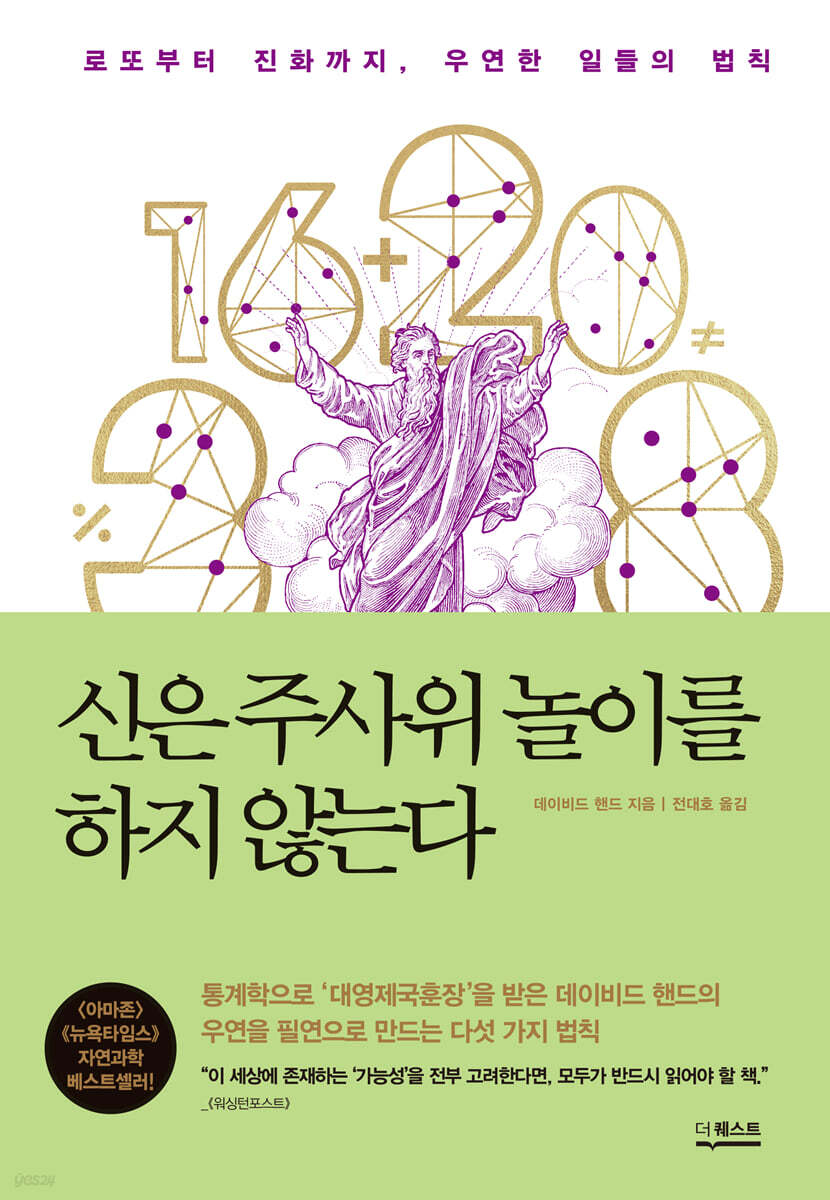 |
Description
Book Introduction
The Return of a Natural Science Bestseller
[Amazon] and [New York Times] bestseller
David Hand, who received the 'Member of the British Empire' for statistics,
Let's talk about the five laws that turn coincidence into inevitability!
It is often said that winning the lottery is like 'picking a star from the sky', but there are people who win the lottery first prize every week without fail.
On the other hand, there are unfortunate people who are hit by objects thrown from the roof by reckless children while walking down the street.
When people experience 'random' events that they cannot control, they believe that so-called 'luck' is at work behind the scenes and try to turn the tide in their favor.
David Hand, a world-renowned statistician who served as President of the Royal Statistical Society and received the Order of the British Empire, explains in his book, “God Doesn’t Play Dice,” that behind seemingly “absurd” events, there are strict mathematical and statistical laws.
He cites mysterious incidents that could appear on [Mysterious TV, Surprise] as examples and explains the five 'laws of coincidence' hidden behind them.
Moreover, it emphasizes that we can sufficiently understand and deal with the principles of how the world works without relying on fortune telling, religion, or superstition.
This book, strongly recommended by Kim Beom-jun, author of 『Physics of the World』 and professor of physics at Sungkyunkwan University, and comedian Lee Yoon-seok, a science book enthusiast, covers a variety of interesting topics, including 『How to Win the Lotto 100% of the Time (and the Strategy for Choosing Numbers Wisely)』, 『The Existence of the So-Called Lucky One in Gambling and Sports』, 『The Octopus That Guessed the Results of the World Cup and Nostradamus' Secret to Prophecy』, 『Why No One Can Predict the Economic Crisis and Why Stock Prices Fluctuate So Much』, 『How Life Evolves Through Chance Selection』, and 『Can Intelligent Life Appear Without a Creator』.
Immediately after its publication, "God Doesn't Play Dice," which became an unusually popular science book on Amazon and the New York Times, and received praise from influential media outlets such as the Washington Post and the Huffington Post, is a book full of bizarre cases that are not only fascinating but also show how wonderful and beautiful the rules of this universe are.
Miracles are not accidents.
[Amazon] and [New York Times] bestseller
David Hand, who received the 'Member of the British Empire' for statistics,
Let's talk about the five laws that turn coincidence into inevitability!
It is often said that winning the lottery is like 'picking a star from the sky', but there are people who win the lottery first prize every week without fail.
On the other hand, there are unfortunate people who are hit by objects thrown from the roof by reckless children while walking down the street.
When people experience 'random' events that they cannot control, they believe that so-called 'luck' is at work behind the scenes and try to turn the tide in their favor.
David Hand, a world-renowned statistician who served as President of the Royal Statistical Society and received the Order of the British Empire, explains in his book, “God Doesn’t Play Dice,” that behind seemingly “absurd” events, there are strict mathematical and statistical laws.
He cites mysterious incidents that could appear on [Mysterious TV, Surprise] as examples and explains the five 'laws of coincidence' hidden behind them.
Moreover, it emphasizes that we can sufficiently understand and deal with the principles of how the world works without relying on fortune telling, religion, or superstition.
This book, strongly recommended by Kim Beom-jun, author of 『Physics of the World』 and professor of physics at Sungkyunkwan University, and comedian Lee Yoon-seok, a science book enthusiast, covers a variety of interesting topics, including 『How to Win the Lotto 100% of the Time (and the Strategy for Choosing Numbers Wisely)』, 『The Existence of the So-Called Lucky One in Gambling and Sports』, 『The Octopus That Guessed the Results of the World Cup and Nostradamus' Secret to Prophecy』, 『Why No One Can Predict the Economic Crisis and Why Stock Prices Fluctuate So Much』, 『How Life Evolves Through Chance Selection』, and 『Can Intelligent Life Appear Without a Creator』.
Immediately after its publication, "God Doesn't Play Dice," which became an unusually popular science book on Amazon and the New York Times, and received praise from influential media outlets such as the Washington Post and the Huffington Post, is a book full of bizarre cases that are not only fascinating but also show how wonderful and beautiful the rules of this universe are.
Miracles are not accidents.
- You can preview some of the book's contents.
Preview
index
Recommended Reading: Mother's Funeral and the Cross-Shaped Sunlight
Introduction: Lottery Tickets, Lightning Strikes, and the Law of Chance
I.
Why do ridiculous things happen in the world?
1.
Amazing 'coincidence'
2.
Superstition, religion, and prophecy
3.
What is coincidence?
II.
Five Laws That Explain Chance
4.
The Law of Inevitability: It's bound to happen.
5.
The Law of Very Large Numbers: There are so many of them
6.
The Law of Selection: If you draw the target later
7.
The Law of Probability Leverage: The Butterfly's Wings
8.
The Law of Sufficiency: Let's Just Say It's Right
III.
God does not play dice
9.
Misunderstood animals, humans
10.
There are coincidences in life and the universe.
11.
How to use the law of chance?
Coming out: Miracles are not surprising at all
Appendix A: Mind-bogglingly large numbers and dizzyingly small numbers
Appendix B: Rules for Calculating Probabilities
Introduction: Lottery Tickets, Lightning Strikes, and the Law of Chance
I.
Why do ridiculous things happen in the world?
1.
Amazing 'coincidence'
2.
Superstition, religion, and prophecy
3.
What is coincidence?
II.
Five Laws That Explain Chance
4.
The Law of Inevitability: It's bound to happen.
5.
The Law of Very Large Numbers: There are so many of them
6.
The Law of Selection: If you draw the target later
7.
The Law of Probability Leverage: The Butterfly's Wings
8.
The Law of Sufficiency: Let's Just Say It's Right
III.
God does not play dice
9.
Misunderstood animals, humans
10.
There are coincidences in life and the universe.
11.
How to use the law of chance?
Coming out: Miracles are not surprising at all
Appendix A: Mind-bogglingly large numbers and dizzyingly small numbers
Appendix B: Rules for Calculating Probabilities
Detailed image

Into the book
Even events with extremely low probability of occurrence, that is, extremely low probability, are governed by laws.
I call the set of laws that explain why unexpected events occur the "laws of chance."
This tells us that we should expect the unexpected.
--- From "Entering_Lotto and Lightning, the Law of Chance"
In the summer of 1972, British actor Anthony Hopkins was offered the lead role in a film adaptation of George Pfeiffer's novel The Girl from Petrovka and went to London to buy the book.
But the large bookstore there didn't have the book.
While waiting for a train at Leicester Square tube station to go home, he found a book abandoned on the seat next to him.
That book was none other than The Girl from Petrovka.
The coincidences didn't end there.
Some time later, Hopkins met the author of the novel, Piper, and told her about his experiences in London.
Piper, with a look of surprise, gave her copy of The Girl from Petrovka to a friend in November 1971, who said she had lost it in Bayswater, London.
The book was annotated and marked with passages that had been changed from British English to American English for publication in the United States.
Hopkins showed Piper the book he had found.
Sure enough, it was the very book Piper had annotated and his friend had lost.
--- 「1.
From "Amazing 'Coincidences'"
The ambiguity of prophecy can also be seen in the predictions of Michel de Notre Dame, aka Nostradamus.
Nostradamus, a 16th-century French apothecary, healer, and mystic, published numerous prophecies in a series of almanacs, calendars, and quatrains.
His prophecies focused on epidemics, earthquakes, wars, floods, etc., but as far as I know, not a single one specifically pointed to a specific event.
Moreover, his prophecies dealt with events in the distant future.
This is a very good tactic.
Because if a prophet predicts the distant future, it cannot be proven wrong while the prophet is alive.
Another thing to note is that opinions differ even among his numerous followers as to what exactly Nostradamus predicted.
In any case, it could be said that this is a victory of ambiguity.
Making a lot of predictions is also a good strategy for someone who wants to be a prophet.
Because among countless predictions, even a few may be correct by chance.
Then, we can conveniently ignore the wrong predictions while emphasizing those predictions.
Given these characteristics of prophecy, if we were to write a book on how to become a successful prophet, the following three basic principles would serve as excellent starting points.
(i) Use signs that no one but you can understand.
(ii) Make all prophecies vague.
(iii) Make as many different predictions as possible.
--- 「2.
From “Superstition, Religion, and Prophecy”
In February 1992, a group calling itself the 'International Lotto Fund' was formed.
It was a group of 2,500 small investors, the majority of whom were Australian, but also included Americans, Europeans, and New Zealanders.
They raised the $7 million needed to buy all the sets of numbers.
The most difficult part of this undertaking was probably mobilizing the organization.
Because I had to buy 7 million lottery tickets within a week.
The International Lottery Fund formed a team of about 20 people and traveled throughout Virginia, purchasing lottery tickets at 125 retail stores across eight chains.
This was such a arduous task that the International Lottery Fund could only purchase 5 million lottery tickets.
So the business could have failed.
You can imagine how nervous the investors must have been.
Their odds of winning first prize were only 5 in 7.
So the probability of not winning first prize was more than 1 in 4.
(Omitted) On that day in February 1992, the winning lottery numbers were 8, 11, 13, 15, 19, and 20.
The International Lottery Fund, which had been examining 5 million lottery tickets with considerable anxiety, discovered that the numbers were printed on one of the tickets they had secured.
--- 「4.
From "The Law of Inevitability: It's bound to happen eventually"
These financial shocks are now becoming a familiar disaster.
On Friday, May 7, 2010, three years after 2007, Dennis Gottman said this in his Gottman Letter:
“We witnessed yesterday a series of unprecedented fluctuations.
Currency price fluctuations that were 6, 7, and 8 standard deviations out of the norm occurred…even unheard of 12-sigma events….
We learned that such massive price swings, corresponding to the edges of a bell curve, can only occur once in thousands of years.”
--- 「7.
From "The Law of Probability Leverage: The Flapping of Butterfly Wings"
The following is a scene from Charles Dickens' novel The Old Curio Shop where Kit's mother and Barbara's mother first meet and have a conversation.
“We’re both widows!” said Barbara’s mother.
“We’re only just getting to know each other now.”… As they went back from the effect to the cause, they naturally returned to the story of their dead husbands.
We discussed the lives, deaths, and funerals of the husbands, compared their characteristics, and discovered several circumstances that matched with surprising accuracy.
For example, Barbara's father was exactly four years and ten months older than Kit's father, one died on a Wednesday and the other on a Thursday, and both were of very noble birth and good looks.
I also discovered several other coincidences.
This is a perfect description of how the law of sufficiency works.
--- 「8.
From "The Law of Sufficiency: Let's Just Say It's Right"
Some insect species form large colonies each spring, during which time the queens fly in random directions to random locations to establish new colonies.
When winter comes, some of those habitats become vulnerable to the cold.
All insects living in such habitats are likely to die.
On the other hand, some habitats are slightly warmer than the original habitat of the population.
Maybe it's closer to the equator.
Insects in such habitats have a high chance of survival.
The surviving insects reproduce and divide into several groups again the following spring.
In this way, insects gradually move to warmer areas, areas more favorable for survival.
There is an inherent randomness to this process.
At each stage, there is an inherent randomness involved in deciding where the queens will settle.
Also, selection works.
Some insects accidentally migrate to places where they have a better chance of surviving and reproducing the following year.
Their children's generation starts their lives in warmer places.
It takes many generations for these habitat shifts to accumulate enough to be noticeable.
--- 「10.
From “There are coincidences in life and the universe”
If you're planning a trip, find out where Jason and Jenny Cairns-Lawrence of Dudley, England, travel and avoid them.
The two were in New York when hijacked planes crashed into the World Trade Center on September 11, 2001.
He was in London when the London Underground bombings occurred on July 7, 2005, and when several targets were attacked in Mumbai in November 2008.
Attorney John Woods' story is also quite complex.
On December 21, 1988, he canceled his reservation on Pan Am Flight 103.
It was to attend a party.
The plane was blown up over Lockerbie, Scotland.
On February 26, 1993, while he was in his office on the 39th floor of the World Trade Center, a car bomb exploded on the first floor of the building.
On September 11, 2001, he left his office just before the terrorists' planes crashed into the building.
Once you understand the laws of chance, these events are not surprising at all.
I call the set of laws that explain why unexpected events occur the "laws of chance."
This tells us that we should expect the unexpected.
--- From "Entering_Lotto and Lightning, the Law of Chance"
In the summer of 1972, British actor Anthony Hopkins was offered the lead role in a film adaptation of George Pfeiffer's novel The Girl from Petrovka and went to London to buy the book.
But the large bookstore there didn't have the book.
While waiting for a train at Leicester Square tube station to go home, he found a book abandoned on the seat next to him.
That book was none other than The Girl from Petrovka.
The coincidences didn't end there.
Some time later, Hopkins met the author of the novel, Piper, and told her about his experiences in London.
Piper, with a look of surprise, gave her copy of The Girl from Petrovka to a friend in November 1971, who said she had lost it in Bayswater, London.
The book was annotated and marked with passages that had been changed from British English to American English for publication in the United States.
Hopkins showed Piper the book he had found.
Sure enough, it was the very book Piper had annotated and his friend had lost.
--- 「1.
From "Amazing 'Coincidences'"
The ambiguity of prophecy can also be seen in the predictions of Michel de Notre Dame, aka Nostradamus.
Nostradamus, a 16th-century French apothecary, healer, and mystic, published numerous prophecies in a series of almanacs, calendars, and quatrains.
His prophecies focused on epidemics, earthquakes, wars, floods, etc., but as far as I know, not a single one specifically pointed to a specific event.
Moreover, his prophecies dealt with events in the distant future.
This is a very good tactic.
Because if a prophet predicts the distant future, it cannot be proven wrong while the prophet is alive.
Another thing to note is that opinions differ even among his numerous followers as to what exactly Nostradamus predicted.
In any case, it could be said that this is a victory of ambiguity.
Making a lot of predictions is also a good strategy for someone who wants to be a prophet.
Because among countless predictions, even a few may be correct by chance.
Then, we can conveniently ignore the wrong predictions while emphasizing those predictions.
Given these characteristics of prophecy, if we were to write a book on how to become a successful prophet, the following three basic principles would serve as excellent starting points.
(i) Use signs that no one but you can understand.
(ii) Make all prophecies vague.
(iii) Make as many different predictions as possible.
--- 「2.
From “Superstition, Religion, and Prophecy”
In February 1992, a group calling itself the 'International Lotto Fund' was formed.
It was a group of 2,500 small investors, the majority of whom were Australian, but also included Americans, Europeans, and New Zealanders.
They raised the $7 million needed to buy all the sets of numbers.
The most difficult part of this undertaking was probably mobilizing the organization.
Because I had to buy 7 million lottery tickets within a week.
The International Lottery Fund formed a team of about 20 people and traveled throughout Virginia, purchasing lottery tickets at 125 retail stores across eight chains.
This was such a arduous task that the International Lottery Fund could only purchase 5 million lottery tickets.
So the business could have failed.
You can imagine how nervous the investors must have been.
Their odds of winning first prize were only 5 in 7.
So the probability of not winning first prize was more than 1 in 4.
(Omitted) On that day in February 1992, the winning lottery numbers were 8, 11, 13, 15, 19, and 20.
The International Lottery Fund, which had been examining 5 million lottery tickets with considerable anxiety, discovered that the numbers were printed on one of the tickets they had secured.
--- 「4.
From "The Law of Inevitability: It's bound to happen eventually"
These financial shocks are now becoming a familiar disaster.
On Friday, May 7, 2010, three years after 2007, Dennis Gottman said this in his Gottman Letter:
“We witnessed yesterday a series of unprecedented fluctuations.
Currency price fluctuations that were 6, 7, and 8 standard deviations out of the norm occurred…even unheard of 12-sigma events….
We learned that such massive price swings, corresponding to the edges of a bell curve, can only occur once in thousands of years.”
--- 「7.
From "The Law of Probability Leverage: The Flapping of Butterfly Wings"
The following is a scene from Charles Dickens' novel The Old Curio Shop where Kit's mother and Barbara's mother first meet and have a conversation.
“We’re both widows!” said Barbara’s mother.
“We’re only just getting to know each other now.”… As they went back from the effect to the cause, they naturally returned to the story of their dead husbands.
We discussed the lives, deaths, and funerals of the husbands, compared their characteristics, and discovered several circumstances that matched with surprising accuracy.
For example, Barbara's father was exactly four years and ten months older than Kit's father, one died on a Wednesday and the other on a Thursday, and both were of very noble birth and good looks.
I also discovered several other coincidences.
This is a perfect description of how the law of sufficiency works.
--- 「8.
From "The Law of Sufficiency: Let's Just Say It's Right"
Some insect species form large colonies each spring, during which time the queens fly in random directions to random locations to establish new colonies.
When winter comes, some of those habitats become vulnerable to the cold.
All insects living in such habitats are likely to die.
On the other hand, some habitats are slightly warmer than the original habitat of the population.
Maybe it's closer to the equator.
Insects in such habitats have a high chance of survival.
The surviving insects reproduce and divide into several groups again the following spring.
In this way, insects gradually move to warmer areas, areas more favorable for survival.
There is an inherent randomness to this process.
At each stage, there is an inherent randomness involved in deciding where the queens will settle.
Also, selection works.
Some insects accidentally migrate to places where they have a better chance of surviving and reproducing the following year.
Their children's generation starts their lives in warmer places.
It takes many generations for these habitat shifts to accumulate enough to be noticeable.
--- 「10.
From “There are coincidences in life and the universe”
If you're planning a trip, find out where Jason and Jenny Cairns-Lawrence of Dudley, England, travel and avoid them.
The two were in New York when hijacked planes crashed into the World Trade Center on September 11, 2001.
He was in London when the London Underground bombings occurred on July 7, 2005, and when several targets were attacked in Mumbai in November 2008.
Attorney John Woods' story is also quite complex.
On December 21, 1988, he canceled his reservation on Pan Am Flight 103.
It was to attend a party.
The plane was blown up over Lockerbie, Scotland.
On February 26, 1993, while he was in his office on the 39th floor of the World Trade Center, a car bomb exploded on the first floor of the building.
On September 11, 2001, he left his office just before the terrorists' planes crashed into the building.
Once you understand the laws of chance, these events are not surprising at all.
--- From "Coming Out: Miracles Are Not Surprising at All"
Publisher's Review
Why do some people win the lottery,
Do unlucky people get struck by lightning?
In “God Doesn’t Play Dice” and “Mysterious TV, Surprise,” “What Lincoln and Kennedy Assassinations Have in Common,” “Nostradamus’ Prophecy Comes True!”, “The British Soccer Player Who Kills Celebrities Every Time He Scores a Goal,” “The Man Who Won the Lottery in a Row,” and “The Terribly Unlucky Man Who Got Striken by Lightning Seven Times” are mentioned.
Haven't you ever wondered, witnessing such a wondrous coincidence? "How could something like that happen?" "How could something like that happen again?"
'Coincidences' happen every day.
We experience coincidences every day, from minor things like being hit by bird droppings or picking up a 500 won coin on the street, to serious things like being hit by a car going the wrong way and getting injured on Jungang-ro.
Because coincidences like this always happen in our lives, we buy lottery tickets just in case, even though we know the odds are ridiculous.
David Hand, author and world-renowned statistician, says there are rules to everything from the seemingly trivial to the truly surprising.
And this was summarized as the 'Five Laws of Chance'.
There are five laws of chance.
Once you understand the five laws he introduces in this book, you will realize that all kinds of amazing coincidences are actually due to the 'laws of nature.'
Law of Chance 1.
The Law of Inevitability: It's bound to happen.
When you roll a standard 6-sided die, you get one of the numbers 1 through 6.
Also, if you flip a coin, it will either land on heads or tails.
If we could list all possible outcomes for any given example, then at least one of them would have to occur.
(Omitted) So, there is one sure way to win first prize in the lottery.
Of course, this is a method that can only be implemented if you are extremely wealthy.
You just have to buy every possible set of numbers.
Then one of the sets you bought must be the winning number.
Buying all the sets of numbers would obviously require a lot of money and some organizational effort, but it's not impossible.
This method has actually been implemented.
Law of Chance 2.
The Law of Very Large Numbers: The more opportunities there are, the more likely it is that something rare will happen.
Your chances of being in a train accident are low.
However, the odds definitely vary depending on how often you take the train.
A person who takes the train once a year is significantly less likely to be involved in a train accident than a person who commutes by train every day.
Likewise, if you have a large family, the chances of one of your family members being involved in a train accident are higher.
The same holds true when considering longer periods of time.
Bill and Jeanie Shaw, a couple we saw in Chapter 3, were in train accidents 15 years apart.
Likewise, while the odds of any unfortunate event happening to you or any particular individual on Earth may be low, it is important to remember that there are currently approximately 7 billion people on Earth.
If each person has a probability of being in an accident on a particular day p, and if each accident occurs independently, then the probability that no one among N people has an accident on that day is equal to (1-p) multiplied N times.
If N is the Earth's population of 7 billion and p is 1 in 1,000,000, then the probability that no one will have an accident that day is approximately 1 in 103,040, which is extremely small.
Given Borel's law, accidents are bound to happen somewhere.
Law of Chance 3.
The Law of Selection: When you select data after the fact, the probabilities change dramatically.
Publication bias is the tendency of scientific journals to favor papers that demonstrate the success of a phenomenon over papers that demonstrate its failure.
A paper concluding that a drug is effective is inherently more interesting than one concluding that a drug is ineffective.
Therefore, authors will prefer to submit papers of the former type rather than the latter, and editors will be more likely to publish papers of the first type in their journals.
Think about it.
What editor wants to fill his journal with papers claiming that a drug is ineffective?
The problem is that publication bias spreads misleading impressions about the drug's effectiveness.
Law of Chance 4.
The Law of the Probability Lever: Even the Flap of a Butterfly's Wings Can Change Probabilities
The odds of being struck by lightning in any given year are about 1 in 300,000.
But this is an average.
For some people, the odds are higher than average, and for others, they are lower than average.
It's easy to guess who has a higher chance of getting that.
The odds of an urban office worker being struck by lightning are no higher than average.
Take the case of Major Walter Summerford.
He was struck by lightning while riding a horse in Flanders in February 1918, leaving him paralyzed from the waist down for a time.
After this experience, he moved to Canada and took up fishing as a hobby.
But in 1924, while he was sitting under a tree fishing, the tree was struck by lightning.
This incident left him paralyzed on the right side of his body.
Fortunately, he recovered later, but in 1930, while walking in the park, he was struck by lightning again and became paralyzed.
He died two years later, in 1932, and the cause of death was not lightning.
But as if to make up for his mistake, his tombstone was struck by lightning in 1936.
If he had taken up knitting as a hobby, his life would certainly have been less dangerous.
Subtle changes in the model can have a big impact on the probability.
This is the law of probability leverage.
Law of Chance 5.
The Law of Sufficiency: Let's Just Say It's Right
There are countless passages in the Bible that you can explore to find specific spelling strings.
Moreover, the letters do not have to be consecutive and other arrangements are allowed.
For example, the letters you are looking for may be spaced evenly apart, or they may form a specific two-dimensional pattern on the page.
By extending the search range to allow for these arrangements, we can significantly increase the probability of finding the desired spelling string.
I've already given a few examples (I haven't yet found anyone hiding in this book crying out for help).
There are more ways to increase your chances of discovering your password.
If you relax the criteria for matching, the probability increases even more.
When I was looking for the word help as an example of a password in this book, I could have matched slightly misspelled words like hlpe and hepl.
Then, since we have three strings of letters to recognize as matches, the probability of finding a match will increase, and therefore, more matches will be found.
In fact, there are two additional rows of letters hidden in this book (with four letters spaced out between them).
The look-else effect increases the number of places you look, while the law of sufficiency increases the number of targets you seek.
How can we use the laws of chance?
If we utilize this law of chance, we can change our lives.
For example, you learn how futile it is to buy a lottery ticket, but if you insist on buying one, you learn how to choose the numbers wisely.
Additionally, David Hand says that while there is no way to increase your odds of winning the lottery, there are ways to maximize your chances of winning when you do.
It's about choosing numbers in a pattern that 'other people would never think of'.
This way, even if you win the lottery, you can reduce the number of competitors who have to share the winnings.
And since every pattern a human can think of is in fact something that others can think of as well, I recommend buying lottery tickets 'automatically (randomly)'.
You will also see why all kinds of fortune telling, prophecy, and superstition seem so plausible, but also what their flaws are.
You will learn why 'economic crises' recur irregularly, why stock prices suddenly plummet, how humans evolved through 'chance', and how the universe was able to take its current form without the hand of a 'Creator'.
The spectrum of coincidences is extremely broad.
It is no exaggeration to say that if we properly understand the laws that govern chance, we can understand all of human history.
And that realization will be a crucial hint that can actually change your life.
As soon as it was published, “God Doesn’t Play Dice” became a bestseller, entering the top 200 of Amazon’s comprehensive rankings, which is unusual for a natural science book.
And to this day, author David Hand continues to lecture passionately on the topic of this book. Perhaps this is because understanding chance is crucial to our lives. In a Korean society where even conglomerates rely on fortune telling to make important decisions, "God Doesn't Play Dice" will be a beacon of light, illuminating the eyes.
This book is like a rain of rain that makes you realize that the compass of life ultimately lies within yourself.
“Considering all the ‘possibilities’ that exist in this world, this is a book that everyone must read.”
_The Washington Post
“God Doesn't Play Dice” clearly explains why 'coincidences' constantly occur.”
_The Huffington Post
Do unlucky people get struck by lightning?
In “God Doesn’t Play Dice” and “Mysterious TV, Surprise,” “What Lincoln and Kennedy Assassinations Have in Common,” “Nostradamus’ Prophecy Comes True!”, “The British Soccer Player Who Kills Celebrities Every Time He Scores a Goal,” “The Man Who Won the Lottery in a Row,” and “The Terribly Unlucky Man Who Got Striken by Lightning Seven Times” are mentioned.
Haven't you ever wondered, witnessing such a wondrous coincidence? "How could something like that happen?" "How could something like that happen again?"
'Coincidences' happen every day.
We experience coincidences every day, from minor things like being hit by bird droppings or picking up a 500 won coin on the street, to serious things like being hit by a car going the wrong way and getting injured on Jungang-ro.
Because coincidences like this always happen in our lives, we buy lottery tickets just in case, even though we know the odds are ridiculous.
David Hand, author and world-renowned statistician, says there are rules to everything from the seemingly trivial to the truly surprising.
And this was summarized as the 'Five Laws of Chance'.
There are five laws of chance.
Once you understand the five laws he introduces in this book, you will realize that all kinds of amazing coincidences are actually due to the 'laws of nature.'
Law of Chance 1.
The Law of Inevitability: It's bound to happen.
When you roll a standard 6-sided die, you get one of the numbers 1 through 6.
Also, if you flip a coin, it will either land on heads or tails.
If we could list all possible outcomes for any given example, then at least one of them would have to occur.
(Omitted) So, there is one sure way to win first prize in the lottery.
Of course, this is a method that can only be implemented if you are extremely wealthy.
You just have to buy every possible set of numbers.
Then one of the sets you bought must be the winning number.
Buying all the sets of numbers would obviously require a lot of money and some organizational effort, but it's not impossible.
This method has actually been implemented.
Law of Chance 2.
The Law of Very Large Numbers: The more opportunities there are, the more likely it is that something rare will happen.
Your chances of being in a train accident are low.
However, the odds definitely vary depending on how often you take the train.
A person who takes the train once a year is significantly less likely to be involved in a train accident than a person who commutes by train every day.
Likewise, if you have a large family, the chances of one of your family members being involved in a train accident are higher.
The same holds true when considering longer periods of time.
Bill and Jeanie Shaw, a couple we saw in Chapter 3, were in train accidents 15 years apart.
Likewise, while the odds of any unfortunate event happening to you or any particular individual on Earth may be low, it is important to remember that there are currently approximately 7 billion people on Earth.
If each person has a probability of being in an accident on a particular day p, and if each accident occurs independently, then the probability that no one among N people has an accident on that day is equal to (1-p) multiplied N times.
If N is the Earth's population of 7 billion and p is 1 in 1,000,000, then the probability that no one will have an accident that day is approximately 1 in 103,040, which is extremely small.
Given Borel's law, accidents are bound to happen somewhere.
Law of Chance 3.
The Law of Selection: When you select data after the fact, the probabilities change dramatically.
Publication bias is the tendency of scientific journals to favor papers that demonstrate the success of a phenomenon over papers that demonstrate its failure.
A paper concluding that a drug is effective is inherently more interesting than one concluding that a drug is ineffective.
Therefore, authors will prefer to submit papers of the former type rather than the latter, and editors will be more likely to publish papers of the first type in their journals.
Think about it.
What editor wants to fill his journal with papers claiming that a drug is ineffective?
The problem is that publication bias spreads misleading impressions about the drug's effectiveness.
Law of Chance 4.
The Law of the Probability Lever: Even the Flap of a Butterfly's Wings Can Change Probabilities
The odds of being struck by lightning in any given year are about 1 in 300,000.
But this is an average.
For some people, the odds are higher than average, and for others, they are lower than average.
It's easy to guess who has a higher chance of getting that.
The odds of an urban office worker being struck by lightning are no higher than average.
Take the case of Major Walter Summerford.
He was struck by lightning while riding a horse in Flanders in February 1918, leaving him paralyzed from the waist down for a time.
After this experience, he moved to Canada and took up fishing as a hobby.
But in 1924, while he was sitting under a tree fishing, the tree was struck by lightning.
This incident left him paralyzed on the right side of his body.
Fortunately, he recovered later, but in 1930, while walking in the park, he was struck by lightning again and became paralyzed.
He died two years later, in 1932, and the cause of death was not lightning.
But as if to make up for his mistake, his tombstone was struck by lightning in 1936.
If he had taken up knitting as a hobby, his life would certainly have been less dangerous.
Subtle changes in the model can have a big impact on the probability.
This is the law of probability leverage.
Law of Chance 5.
The Law of Sufficiency: Let's Just Say It's Right
There are countless passages in the Bible that you can explore to find specific spelling strings.
Moreover, the letters do not have to be consecutive and other arrangements are allowed.
For example, the letters you are looking for may be spaced evenly apart, or they may form a specific two-dimensional pattern on the page.
By extending the search range to allow for these arrangements, we can significantly increase the probability of finding the desired spelling string.
I've already given a few examples (I haven't yet found anyone hiding in this book crying out for help).
There are more ways to increase your chances of discovering your password.
If you relax the criteria for matching, the probability increases even more.
When I was looking for the word help as an example of a password in this book, I could have matched slightly misspelled words like hlpe and hepl.
Then, since we have three strings of letters to recognize as matches, the probability of finding a match will increase, and therefore, more matches will be found.
In fact, there are two additional rows of letters hidden in this book (with four letters spaced out between them).
The look-else effect increases the number of places you look, while the law of sufficiency increases the number of targets you seek.
How can we use the laws of chance?
If we utilize this law of chance, we can change our lives.
For example, you learn how futile it is to buy a lottery ticket, but if you insist on buying one, you learn how to choose the numbers wisely.
Additionally, David Hand says that while there is no way to increase your odds of winning the lottery, there are ways to maximize your chances of winning when you do.
It's about choosing numbers in a pattern that 'other people would never think of'.
This way, even if you win the lottery, you can reduce the number of competitors who have to share the winnings.
And since every pattern a human can think of is in fact something that others can think of as well, I recommend buying lottery tickets 'automatically (randomly)'.
You will also see why all kinds of fortune telling, prophecy, and superstition seem so plausible, but also what their flaws are.
You will learn why 'economic crises' recur irregularly, why stock prices suddenly plummet, how humans evolved through 'chance', and how the universe was able to take its current form without the hand of a 'Creator'.
The spectrum of coincidences is extremely broad.
It is no exaggeration to say that if we properly understand the laws that govern chance, we can understand all of human history.
And that realization will be a crucial hint that can actually change your life.
As soon as it was published, “God Doesn’t Play Dice” became a bestseller, entering the top 200 of Amazon’s comprehensive rankings, which is unusual for a natural science book.
And to this day, author David Hand continues to lecture passionately on the topic of this book. Perhaps this is because understanding chance is crucial to our lives. In a Korean society where even conglomerates rely on fortune telling to make important decisions, "God Doesn't Play Dice" will be a beacon of light, illuminating the eyes.
This book is like a rain of rain that makes you realize that the compass of life ultimately lies within yourself.
“Considering all the ‘possibilities’ that exist in this world, this is a book that everyone must read.”
_The Washington Post
“God Doesn't Play Dice” clearly explains why 'coincidences' constantly occur.”
_The Huffington Post
GOODS SPECIFICS
- Date of issue: October 11, 2023
- Format: Hardcover book binding method guide
- Page count, weight, size: 320 pages | 612g | 164*230*30mm
- ISBN13: 9791140706327
- ISBN10: 1140706322
You may also like
카테고리
korean


korean

![GQ KOREA Mark (Monthly): December [2025]](http://librairie.coreenne.fr/cdn/shop/files/8ef265dbbfbf186523ed75ba7319009d.jpg?v=1765340328&width=3840)


