

This is a story about Raoul Dufy
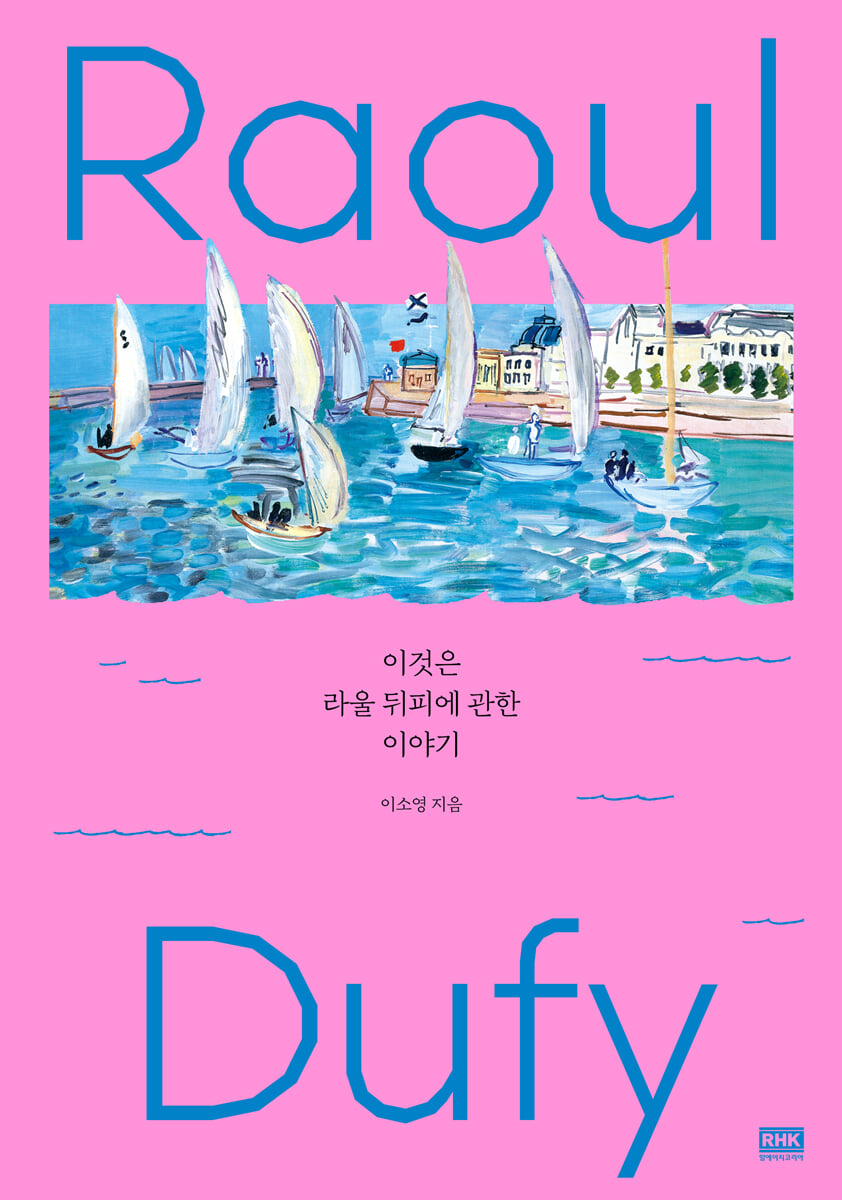 |
Description
Book Introduction
“Every time I saw a Dufy painting, I loved him.” - David Hockney A painter who colorfully expressed the joy of life through the harmony and rhythm of colors. And the life and art of the integrated artist Raoul Dufy ** Includes approximately 200 works by Raoul Dufy ** tvN [You Quiz on the Block] A new work by the hot topic, art messenger Lee So-young There is a painter who captures people's hearts with his lively brushstrokes and colorful colors. His name is Raoul Dufy. Dufy lived in the same era as Monet and Matisse, but unlike them, he did not receive much public attention. However, he followed the path of an integrated artist, working not only in painting but also in printmaking, illustration, textiles, ceramics, and stage decoration. And with the motto of life, 'Life is like joyful music,' he expressed his positive mind through drawings. Gertrude Stein, an American collector and writer, said, “Dufy’s work is a joy in itself,” Hockney confessed, “I loved him every time I saw his paintings,” and Picasso said, “His paintings always make me happy.” Born and raised by the sea, he loved the sea and was a member of the Fauvist school, but he did not belong to any school because he had his own unique style, the 'Dufy style'. He also believes that 'color is light' and uses vibrant colors to capture everyday spaces such as the beach, atelier, and racetrack, as well as people's happy moments, in his works. Art messenger writer So-Young Lee, who has been working to introduce relatively underrated artists to the world compared to famous painters through her books, “Carl Larsson, Why I Draw Happiness Today” and “Grandma Moses,” has recently focused on the integrated artist Raoul Dufy. And he wrote an art essay that tells the story of Raoul Dufy from his own perspective. The era we live in desperately needs the "power of synthesis" of Raoul Dufy, who thinks and expresses himself across genre boundaries. In such an era, Dupuy's life and work could become a milestone in our lives. |
- You can preview some of the book's contents.
Preview
index
Intro A lively feast of brushstrokes, Raoul Dufy
Prologue
The Chronicles of Raoul Dufy
chatper1 Le Havre
A child born by the sea and longing for the sea
Dufy and Le Havre
Self-portrait by Dufy
Art collector group, Contemporary Art Club
Chapter 2: Fauvism
Fauvism and Dufy
Cubism and Dufy
Dupuis and Regatta
Dufy's watercolors
chatper3 Dupi's friends
Gallerist Bert Weil
Painter Emil Otton Fries
painter Georges Braque
Paul Poiret, the king of fashion
Ceramicist Lawrence Artigas and architect Maria Rubio Tudurio
Jacques Marozer, chemist and media researcher
Collector and businesswoman Marie Cutoli
Jean Dufy, Raoul Dufy's painter brother
Chapter 4 Decorative Arts
Dufy as an illustrator
Dufy as a textile designer
The influence of costume designer Dufy on modern times
Dupuy's furniture design
Chapter 5 Madame Dufy
Dufy's wife, Emilie
New companion Bert Reyes
Chapter 6 Dupi Style
Dupi style
Dupuy and horse racing
Dufy's nude paintings and atelier
Dupuy and music
Dufy as a public artist
The world's largest oil painting, "The Electric Fairy"
The Black Cargo Ship series from his later years
Outro For our rosy life
Epilogue
Raoul Dufy's collection
References
Detailed image

Into the book
In 1901, Dufy had his first exhibition.
As with everyone, having one exhibition doesn't mean you will be recognized as an artist.
Like most new artists, Dupuy also observed and diligently absorbed the painting styles of his predecessors.
The impressionist behind the scenes
It didn't stay in the style of painting.
--- p.71 From "The Fauves and Dufy"
Looking at Dufy's Cubist period works, they don't resemble Braque or Picasso, nor do they remind me of Cezanne.
That is, from the Impressionism of the late 1890s to the Fauvism and Cubism of the early 1900s, he pursued his own techniques while showing a spirit of exploration and adventure toward new painting, and he incorporated the outside world into his works, harmoniously organizing and expressing the strengths of each movement.
Ultimately, the meaning of not belonging to any school of thought is, more precisely, the same as not believing in or following any particular school of thought.
--- p.94 From “Cubism and Dufy”
Dufy was a painter who, throughout his life, crossed the boundaries of various fields and passionately transformed his art to suit each field.
He began designing textiles from patterns made from woodcuts, thanks to Poiret's suggestion, and he also created prints on certain fabrics using engraved wooden stamps.
After that, he continued to work actively in the fields of decorative arts and clothing, designing patterns and making fabrics using various plants, animals, and materials that appear in his paintings as motifs.
--- p.195 From “Dufy as a Textile Designer”
Portrait of Émilie Dufy is the most famous and beloved of Émilie's portraits.
Emilie is wearing a fabric dress designed by Dufy at the time.
Since the 1920s, Art Nouveau design has been prevalent in the European fashion world, and Art Deco has followed suit.
The design is a mixture of geometric shapes, plant-themed arabesque patterns, and an orientalist feel. The clothes and tablecloth worn by Madame Dupuis also feature plant-themed patterns.
--- p.214 From "Emilie, Dufy's Wife"
In the series called “Black Cargo Ship,” he paints a work with a composition very similar to this one.
The beach at Sainte-Adès, a recurring theme in the artist's work, provides a sense of spaciousness despite the very high horizon, with the sky occupying the narrowest area at the top of the painting.
In his paintings, Dufy recreates seascapes that are real yet seem impossible.
This work is also one of the works donated by Dufy's wife to the André Malraux Museum of Modern Art in 1963.
--- p.248 From "Dupee Style"
The women attending Royal Ascot in Dufy's paintings are also wearing dresses below the knee and hats of various designs, showing off their fashion in accordance with the dress code.
They are enjoying their heyday after World War I.
Dupuy's paintings focus on the audience rather than simply what happens on the track.
In this way, we can see the soul of that era through the back.
--- p.257 From "Dupy and Horse Racing"
The work "Orchestra of the Théâtre de Le Havre," which depicts the Le Havre orchestra in 1902, is a work by Dufy in his mid-twenties that depicts the orchestra of his hometown, Le Havre.
Dora Perez-Tebi, in her book "Dufy," said that Dufy's lifelong journey into music began with this work.
It is interesting to compare this painting with that of Edgar Degas, a senior Impressionist painter who thought seriously about music and the orchestra.
--- p.291 From "Dupy and Music"
The mural, titled “Electric Fairy,” is made up of 250 panels on a curved wall and measures 10 meters high and 60 meters long.
That's why this work is also called 'the world's largest oil painting'.
Inspired by the electric genie in De Rerum Natura, written by the ancient Roman poet and philosopher Lucretius Carus (96-55 BC), Dufy planned to express the process of the history of electricity from the past to the present of mankind.
Beneath the brightly glowing electric fairy flying by, an orchestra praises the glory of electricity.
In "The Electric Fairy," Dupuy fully demonstrates his storytelling skills.
--- p.213 From “The World’s Largest Oil Painting, “Electric Fairy”
Publisher's Review
“My eyes were born to erase the ugly.”
The life and works of Raoul Dufy, who painted melodies of lively colors.
Artist So-Young Lee, who introduces art works and artists to people every day as an art messenger, has published a book titled “This is a story about Raoul Dufy,” which sheds light on the world of Raoul Dufy’s work.
He discovered and told stories about painters who were not yet widely known in Korea, and focused on the life and works of the painter Raoul Dufy.
Raoul Dufy, born into an ordinary family in Le Havre, France, is a painter who attempted various pictorial challenges, starting with Impressionism and moving across Fauvism and Cubism.
He left behind many works depicting the seaside scenery of Le Havre and Sainte-Adès, where he was born, and was active as an integrated artist, working not only in painting but also in book illustrations, ceramics, fashion design, tapestries, and murals.
This book contains the story of Dufy's time in the Impressionist period, the Fauvist and Cubist periods, and his work in illustration, woodcuts, tapestries, ceramics, fashion design, and murals.
You can also hear stories about his masterpiece, “The Electric Fairy,” the world’s largest mural, as well as stories about his wife, Émilie Dufy, and his artist friends.
In particular, you can see around 200 works by Raoul Dufy from different periods, allowing you to feel as if you are traveling through the colorful world of Dufy's works.
Artist friends who shared Dupuy's works and art world through the ages
The period when Dufy was born was a time when Impressionist painters were very active, and Dufy also painted many of his early works in the Impressionist style.
The first work he sold as a painter was also an Impressionist painting.
After the Impressionist period, while living in the south of France, Dufy experienced a major turning point due to the exhibition of Paul Signac and the works of Matisse held at the gallery at the time.
He became interested in the Fauvist movement.
Looking at Dufy's work from this period, Yachts and Small Boats in the Harbor, we can see that he was fascinated by Matisse and the Fauvist style.
But Dufy did not stop at the Fauvist style.
In 1908, he was fascinated by Paul Cézanne and the Cubist style, and his work, "Marie Christine Casino at Le Havre," shows that he was into Cubism.
He attempted various pictorial challenges by crossing over Impressionism, Fauvism, and Cubism, and did not stay with any one movement.
In 『This is a story about Raoul Dufy』, you can see Dufy's works by period, detailed commentary on his works, and even the works of his fellow artists.
It contains works and stories of his close friends, painters Émile Otton Friez and Georges Braque, fashion king Paul Poiret, gallerist Berthe Weyl, businesswoman and collector Marie Coutoly, and Dufy's painter brother Jean Dufy.
Dufy's watercolors and oil paintings, and the world's largest oil painting
The Electric Fairy and other works
“Dufy’s work punctures the theory that one must suffer in order to create.
He rejects the cliché that artists must explore their darkest pain or personal failures to produce.” -Beth Herma, art essayist
The most famous of Dufy's murals is the large mural titled "The Electric Fairy."
The project, commissioned in 1937 by the Parisian power company CPDE, aimed to create a painting on the exterior of the power company's building that would epically convey the importance of electricity and its positive impact on humanity.
The Electric Fairy is filled with 250 panels on a curved wall, and is 10 meters high and 60 meters long.
That's why this work is also called 'the world's largest oil painting'.
In "The Electric Genie," Dupuy depicted 111 scientists and casualties who contributed to the development of electricity.
Among them are Leonardo da Vinci, Bernoulli, Watt, Madame Curie, Edison, and Bell.
The work begins with a thunderbolt from the ancient god Zeus and takes place in Normandy, Dufy's hometown, bathed in bright sunlight, depicting the agricultural society of the past, factories in the early days of industrialization, and the splendid nightscape of France, passing by speeding trains.
This book contains original photographs and lithographs of “The Electric Fairy,” as well as a story about the period when Dufy was creating “The Electric Fairy” and an explanation of the work.
“Perhaps the color blue is almost synonymous with Raoul Dufy.”
Raoul Dufy, who loved everyday landscapes and the color blue
Dufy left behind many works that used blue in particular. His oil paintings of his wife, “Portrait of Émilie Dufy,” “The Sea at Sainte-Adrée,” and “Nice, Beach of the Angels,” as well as the watercolors “Navigators on the Beach” and “La Menara,” show how much he loved the color blue.
He also said this about the color blue:
“Blue is the only color that retains its own individuality no matter what the tone.
Look at all shades of blue, from the darkest to the lightest.
Blue is always blue.”
This book is rich in works by Dufy depicting the beaches of Le Havre and Sainte-Adès, which he loved and cherished, music, horse racing, yachting, nudes, and his own studio, all of which he painted during various periods.
“Life didn’t always smile at me.
But I always smiled at life.”
About the artist Raoul Dufy, who portrayed the joy of life even in difficult times.
Dupuy suffered from rheumatoid arthritis due to his various works.
In his later years, he moved to Forcalquier, France, for his health, and died on March 25, 1953.
Dufy's body was buried in the cemetery of the Abbey of Chimièze in Nice, France.
It was not far from the grave of Henri Matisse, a senior painter he admired.
Raoul Dufy, who lived through both World War I and World War II, did not want to include the disasters of humanity or his own illness in his work.
The Normandy beaches he loved were bombed during World War II, and by the time the area was rebuilt, Dufy's life was over.
He showed humanity the collaboration between artists and fashion designers and the symbiosis of decorative arts, a century ahead of his contemporaries.
“Life did not smile at me,” he said.
But if you ponder the words, “But I smiled at life,” you can see that until the day he died, he wanted to fill his paintings with hope, happiness, and optimism rather than pain and sadness.
“Although Dufy was prolific, his works were all different, and he was constantly renewing himself and being independent, trying not to be confined to one field.
The more I learned about him, the more I was impressed by the fact that he was not just a painter who painted beautiful landscapes, but a painter who constantly worried and agonized over whether the path he was taking in his creations was the right one.”_From the text
“Looking at Dupuy’s life and work, I get the feeling that the world can be beautiful in the end.”_From the text
GOODS SPECIFICS
- Date of issue: August 16, 2023
- Page count, weight, size: 356 pages | 740g | 165*235*19mm
- ISBN13: 9788925576152
- ISBN10: 8925576155
You may also like
카테고리
korean


korean


