

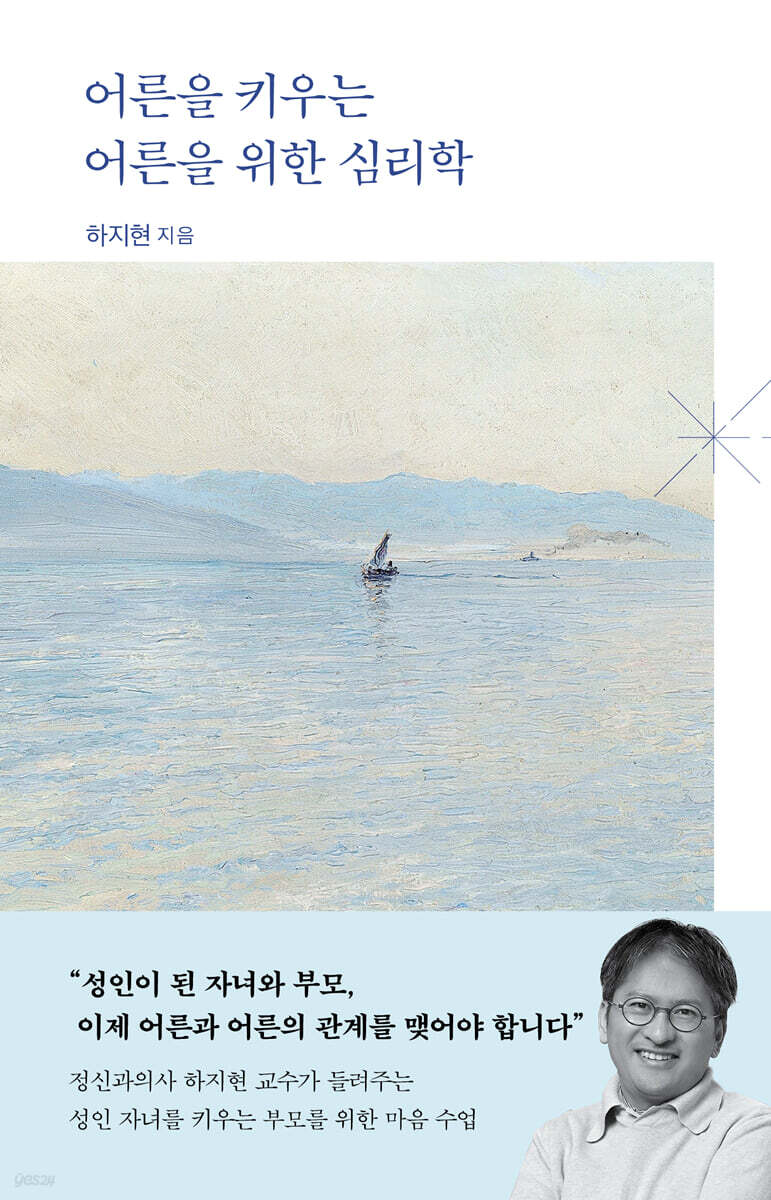
Psychology for Adults Raising Adults
 |
Description
Book Introduction
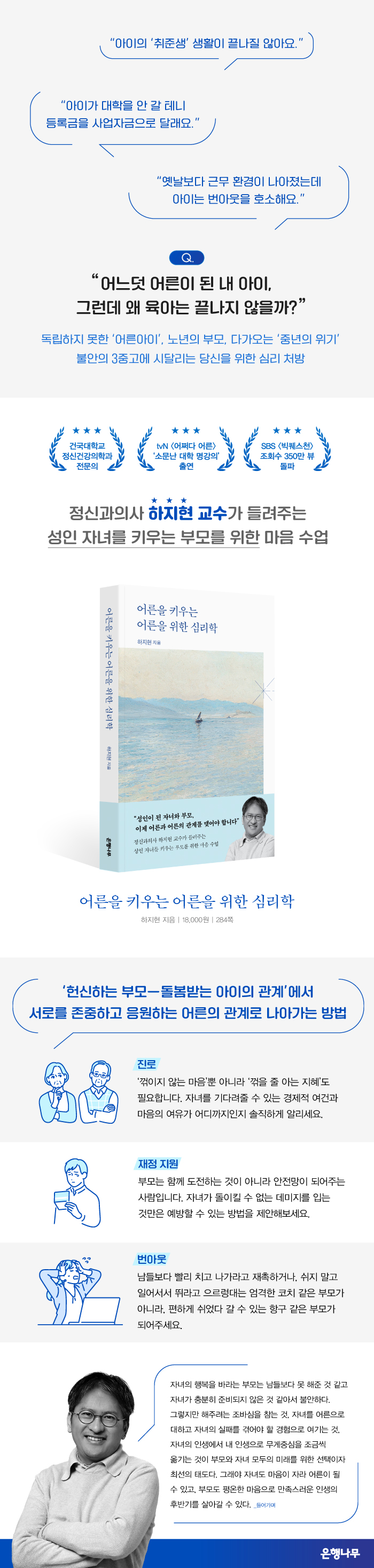
“My child has grown up before I knew it, and now it’s time to build relationships with other adults!” In the relationship between 'dedicated parents and cared-for children' A psychology class that moves toward adult relationships that respect and support each other. Professor Ha Ji-Hyeon, a psychiatrist trusted by many for her keen analysis of mental issues and clear-cut solutions, has now published a book for parents of adult children titled “Psychology for Adults Raising Adults.” As employment and marriage become later, many adult children are unable to become independent from their parents, and it is also common for children to live with their parents without getting married at all. Now that they are adults, it seems like 'parenting' is over, but when parents look at their children, they see themselves as children and things that they need to take care of. Meanwhile, adult children are grateful for their parents' help, but they feel resentful of being treated like children. I thought things would get easier once my child became an adult, but instead, things get more complicated and I have to face more serious issues than before, such as financial support, independence, marriage, and raising grandchildren. On top of that, I have to worry about preparing for my old age and caring for my elderly parents, so I can't help but feel suffocated. The author provides step-by-step guidance on how to achieve balance and happiness in life for "adults raising adults" who face the triple whammy of adult children who are unable to become independent, aging parents, and a "midlife crisis." First, he says, you need to focus on your own life, free from the desire for your child's success and anxiety about failure. This book presents specific ways to shift the center of gravity of life from your children to yourself, using examples of situations in which parents may feel anxious and conflict with their children, such as children who endlessly continue their "job-seeking" life, children who ask for financial support, and children who complain of early burnout after getting a job. Furthermore, it also provides relationship skills that can help maintain a smooth relationship with adult children, such as conversation methods and attitudes that avoid conflict with adult children, tips for getting along well with married/unmarried children, and the responsibilities and roles of grandparents. This book offers support, empathy, and solutions to help parents and children build adult-to-adult relationships, so that they can look upon their adult children with pride and enjoy the latter half of their lives. |
- You can preview some of the book's contents.
Preview
index
Entering
Chapter 1: The Weight of Parenting and Anxiety
The saying, "When you're in the belly, you're the best" really rings true.
The Triple Whammy of Anxiety: I'm having a hard time, but my children and parents are also having a hard time.
Let's look at the time ahead of me.
About the attitude toward old age
The Path to Anxiety and Disappointment: Distinguishing Between Desires and Needs
Chapter 2: Education, Career, and Financial Support
Studying for mental growth is also necessary.
What if you asked for business funds instead of college tuition?
How long will the 'Studying in Progress' sign be valid?
Burnout doesn't seem to have happened for long
How far will the financial support go?
What is the best gift to give your children?
Chapter 3: Building Relationships Between Adults
The mindset needed to build a good relationship with your children
Why Parents Are Getting Angry: The Strike Zone Is Changing
Talking to Your Adult Child: It's Okay to Just Hold On
Don't control your children with money.
To make your child feel comfortable talking about his or her work
How to Repair a Broken Relationship with Your Child
Chapter 4: Children's Marriage and Grandchildren
Don't worry if your unmarried children are doing well.
If your child has decided to get married
Weddings aren't my thing
The Newlywed Adjustment Process: The Stress of Group Chats on Messenger
Caring for Grandchildren: A Bliss or a Shackle of Old Age?
Give your grandchildren what their parents can't give them.
Chapter 5: Be a "Good Enough Adult" Rather than a Meddling Parent
I'm done with parenting, now it's time to find happiness in my life.
If you're feeling anxious and dissatisfied with your life, wait five years.
Between middle-aged children and elderly parents
Don't be a picky adult
Happiness in the second half of life: Enjoying today
If someone asks me if I am happy
Americas
Chapter 1: The Weight of Parenting and Anxiety
The saying, "When you're in the belly, you're the best" really rings true.
The Triple Whammy of Anxiety: I'm having a hard time, but my children and parents are also having a hard time.
Let's look at the time ahead of me.
About the attitude toward old age
The Path to Anxiety and Disappointment: Distinguishing Between Desires and Needs
Chapter 2: Education, Career, and Financial Support
Studying for mental growth is also necessary.
What if you asked for business funds instead of college tuition?
How long will the 'Studying in Progress' sign be valid?
Burnout doesn't seem to have happened for long
How far will the financial support go?
What is the best gift to give your children?
Chapter 3: Building Relationships Between Adults
The mindset needed to build a good relationship with your children
Why Parents Are Getting Angry: The Strike Zone Is Changing
Talking to Your Adult Child: It's Okay to Just Hold On
Don't control your children with money.
To make your child feel comfortable talking about his or her work
How to Repair a Broken Relationship with Your Child
Chapter 4: Children's Marriage and Grandchildren
Don't worry if your unmarried children are doing well.
If your child has decided to get married
Weddings aren't my thing
The Newlywed Adjustment Process: The Stress of Group Chats on Messenger
Caring for Grandchildren: A Bliss or a Shackle of Old Age?
Give your grandchildren what their parents can't give them.
Chapter 5: Be a "Good Enough Adult" Rather than a Meddling Parent
I'm done with parenting, now it's time to find happiness in my life.
If you're feeling anxious and dissatisfied with your life, wait five years.
Between middle-aged children and elderly parents
Don't be a picky adult
Happiness in the second half of life: Enjoying today
If someone asks me if I am happy
Americas
Detailed image
Into the book
This book will contain such stories.
As society changes rapidly and competition intensifies, there are many things to prepare for as an adult to become independent.
Parents who want their children to be happy feel anxious because they feel like they are not doing as well as others and that their children are not fully prepared.
However, holding back from the impatience to do something, treating your child as an adult and considering their failures as experiences to be endured, and gradually shifting the center of gravity from your child's life to your own is the choice and the best attitude for the future of both parents and children.
Only then can children grow mentally and become adults, and parents can live the latter half of their lives with peace and satisfaction.
--- p.9~10, from “Introduction”
Pediatrician and psychoanalyst Donald Winnicott says a good parent is a "good enough mother."
Everyone wants to be the perfect parent, but being a perfect parent can hinder your child's growth.
As children grow, they imagine themselves surpassing their parents and go out into the world, but perfect parents feel like an insurmountable wall, making the child feel comfortable in the shadow of the parents.
Because parents provide answers to all of life's questions and problems, children are unable to make decisions on their own and are unable to develop a sense of responsibility.
For a child to grow into an independent adult, it is important to create an environment where the child can have a sense of security and see the world as a trustworthy place.
A sense of security is the feeling that your parents are always there to support you, even when they are not there.
It is the belief that if you fall, your parents will support you and you will not be seriously hurt, and that your parents will hold your hand and help you up.
A child who has acquired a sense of security can get back up again without collapsing even when experiencing frustration and failure.
--- p.24~26, from “The saying ‘being in the belly is the best’ feels true”
The psychology of parents who go to great lengths to ensure their children's success as if it were their own is a complex mix of worries that their children will not be happy if they fall behind, anxiety that their own life will also fail in the competition, and fear that their old age will be miserable.
This kind of feeling does not disappear even after the child becomes an adult in his or her twenties.
The desire to go to a better university leads to the desire to get into a large company.
We provide support to ensure that you can build up your qualifications without difficulty, such as interning at a good company, going on a working holiday or language training program, obtaining a certificate, or winning a competition.
It might be a little painful to watch your child navigate life on his own, but it's so hard to keep your distance.
It is because I have long hoped that my desires would be realized through my children.
In your head, you think, 'I'm all grown up now, so I should live my own life,' but in your heart, your desires and wants are already attached to you, so you can't act as you think.
The frustration that comes when the pursuit of a desire combined with a need fails is not limited to the disappointment of not having the desire fulfilled, but can lead to the fear that even the desires directly related to survival may be threatened.
The anxiety that a desire is threatened is quite intense and does not easily go away.
Obsessed with that anxiety, devoting one's life to educating one's children is unlikely to have a good ending, contrary to one's intentions.
--- p.59~60, from “The Way Out of Anxiety and Disappointment: Distinguishing Between Desire and Need”
Whether it's because you're worried your children need to settle down quickly, or because they're asking for help or complaining about the difficulties, neglecting retirement planning while helping your children is like "putting the oxygen mask on your child first."
Moreover, there are more cases than you might think where parents do not receive gratitude in return even when they provide significant support during the early stages of their careers or when they begin married life. In addition, if parents who provide excessive support end up financially dependent on their children in their old age, it can actually become a burden to the children.
Parents should put on their oxygen masks first, prioritizing retirement planning and providing only the necessary support to their adult children to prevent both from falling into dangerous situations.
--- p.114, from “How far does economic support go?”
Many parents believe they know their children better than anyone else.
It's true and yet false.
If the child is 7 years old, this is normal.
When you visit a pediatrician, the doctor will ask your child about their symptoms, but they will trust what the parents say more.
As children enter their teens, shutting their doors and creating their own worlds, there are more things parents don't know about them, but they still know their children's constitutions, habits, and personalities better than anyone else.
Even if there are parts you don't know, there are also parts you know well, so don't think you don't know much about your child.
If you assume you know 100% about your child when they are 7 years old, you should assume you know less than 40% after they are in their 20s.
But I believe most parents know at least 70% or 80%.
The reason we make this mistake is because our children do not reveal their entire world to us.
--- p.129, from “The Mind Required for a Good Relationship with Children”
As a young man, I grew up working at a company, so I was able to see my parents in a different light.
Over the past year, the young man has been working at a company and has spent extended time with adults other than his family for the first time.
Then, I naturally started comparing myself to my family, and I began to notice my parents' daily lives, their speech patterns and behaviors that were a result of their personalities, in a different way.
Things that we took for granted and normal become uncomfortable and feel like they don't respect us after we start living in society.
As this discomfort built up, every word and action of my parents became irritating, and eventually, my conversations with them also decreased.
The young man said his symptoms had worsened, as he felt similar to when he was depressed, but I saw that he was on a desirable growth trajectory.
From a growth perspective, the concerns of young people come into focus.
The discomfort caused by parents' words and actions that were previously harmless is the result of a rapidly expanding field of vision.
Before I entered the company, my parents, whom I had seen since I was young, were my standards for adults, and my family's standards were my standards.
However, when he entered the company and had time to interact with unfamiliar adults, the young man observed others to adapt, understood and accepted others' standards to some extent, and created his own standards.
This is a memorable moment of adulthood and should be interpreted as a sign of social maturity.
It's not that the young man suddenly became sensitive; he is going through the process of growing into a mature adult by going outside the family fence, forming relationships with people.
--- p.137~138, from “Why Children Become Aggrieved by Their Parents’ Words: Changes in the Strike Zone”
Caring for your grandchildren is a valuable activity that contributes to the well-being of your family and helps your children advance in social status and careers.
But if that becomes a parental responsibility and threatens their future, then we need to find another way to care for our grandchildren.
If parents' health deteriorates while they are trying to put oxygen masks on their children, it becomes a greater burden on the children than raising them, and if the children are struggling, the grandchildren are also at risk.
Rather than trying to force yourself to hold on a little longer when a warning signal appears, it would be wise for adults to say, "It seems like it will be difficult to continue caring for my grandchild," as if putting on an oxygen mask at the appropriate time.
It's about acknowledging my limitations and drawing a line before I burn out, carrying the stress of caring for my grandchildren with a sense of responsibility and duty that is becoming increasingly difficult to handle.
Caring for grandchildren can be a happy turning point in life, but it's sad when parents sacrifice and feel the burden of old age.
I hope you keep an open mind for your children and grandchildren, but also carefully consider your own limits and how to ensure the safety and happiness of your entire family.
--- p.216~217, from “Caring for Grandchildren: Happiness or the Shackles of Old Age”
What kind of mindset do we need in middle age, when our children are gone? The priority should be to shift the balance between ourselves and our children.
If you have been living with the weight of '70% for your children, 30% for yourself' until now, you should gradually increase the weight you put on yourself and adjust it to around '30% for your children, 70% for yourself'.
A shift in your center of gravity is necessary to prevent the energy you pour into your children from losing its direction and to move beyond a child-centered mindset and live a life focused on yourself.
I need to realize that my "results" in raising my children are not the most important indicator of my life, and that I should evaluate my life by what I have accomplished, my values, and my choices.
Only then can we maintain a healthy self and sufficient self-esteem even when faced with an empty nest.
It may seem strange to have children play a smaller role in your life and mind, but that is the direction of a healthy life.
A 'bucket list' is a practical way to focus on myself.
Let's take stock of the things we've been putting off for childcare and make a list of things we can accomplish from now on.
Anything is fine, whether it's a hobby you've always wanted to learn, a place you've always wanted to visit, or something you've always wanted to try.
It is also a good idea for a couple to write it together with the intention of slowly achieving and revising it over the next 10 or 20 years.
Raising children together while fulfilling bucket lists can help you untangle the knots in your heart.
As society changes rapidly and competition intensifies, there are many things to prepare for as an adult to become independent.
Parents who want their children to be happy feel anxious because they feel like they are not doing as well as others and that their children are not fully prepared.
However, holding back from the impatience to do something, treating your child as an adult and considering their failures as experiences to be endured, and gradually shifting the center of gravity from your child's life to your own is the choice and the best attitude for the future of both parents and children.
Only then can children grow mentally and become adults, and parents can live the latter half of their lives with peace and satisfaction.
--- p.9~10, from “Introduction”
Pediatrician and psychoanalyst Donald Winnicott says a good parent is a "good enough mother."
Everyone wants to be the perfect parent, but being a perfect parent can hinder your child's growth.
As children grow, they imagine themselves surpassing their parents and go out into the world, but perfect parents feel like an insurmountable wall, making the child feel comfortable in the shadow of the parents.
Because parents provide answers to all of life's questions and problems, children are unable to make decisions on their own and are unable to develop a sense of responsibility.
For a child to grow into an independent adult, it is important to create an environment where the child can have a sense of security and see the world as a trustworthy place.
A sense of security is the feeling that your parents are always there to support you, even when they are not there.
It is the belief that if you fall, your parents will support you and you will not be seriously hurt, and that your parents will hold your hand and help you up.
A child who has acquired a sense of security can get back up again without collapsing even when experiencing frustration and failure.
--- p.24~26, from “The saying ‘being in the belly is the best’ feels true”
The psychology of parents who go to great lengths to ensure their children's success as if it were their own is a complex mix of worries that their children will not be happy if they fall behind, anxiety that their own life will also fail in the competition, and fear that their old age will be miserable.
This kind of feeling does not disappear even after the child becomes an adult in his or her twenties.
The desire to go to a better university leads to the desire to get into a large company.
We provide support to ensure that you can build up your qualifications without difficulty, such as interning at a good company, going on a working holiday or language training program, obtaining a certificate, or winning a competition.
It might be a little painful to watch your child navigate life on his own, but it's so hard to keep your distance.
It is because I have long hoped that my desires would be realized through my children.
In your head, you think, 'I'm all grown up now, so I should live my own life,' but in your heart, your desires and wants are already attached to you, so you can't act as you think.
The frustration that comes when the pursuit of a desire combined with a need fails is not limited to the disappointment of not having the desire fulfilled, but can lead to the fear that even the desires directly related to survival may be threatened.
The anxiety that a desire is threatened is quite intense and does not easily go away.
Obsessed with that anxiety, devoting one's life to educating one's children is unlikely to have a good ending, contrary to one's intentions.
--- p.59~60, from “The Way Out of Anxiety and Disappointment: Distinguishing Between Desire and Need”
Whether it's because you're worried your children need to settle down quickly, or because they're asking for help or complaining about the difficulties, neglecting retirement planning while helping your children is like "putting the oxygen mask on your child first."
Moreover, there are more cases than you might think where parents do not receive gratitude in return even when they provide significant support during the early stages of their careers or when they begin married life. In addition, if parents who provide excessive support end up financially dependent on their children in their old age, it can actually become a burden to the children.
Parents should put on their oxygen masks first, prioritizing retirement planning and providing only the necessary support to their adult children to prevent both from falling into dangerous situations.
--- p.114, from “How far does economic support go?”
Many parents believe they know their children better than anyone else.
It's true and yet false.
If the child is 7 years old, this is normal.
When you visit a pediatrician, the doctor will ask your child about their symptoms, but they will trust what the parents say more.
As children enter their teens, shutting their doors and creating their own worlds, there are more things parents don't know about them, but they still know their children's constitutions, habits, and personalities better than anyone else.
Even if there are parts you don't know, there are also parts you know well, so don't think you don't know much about your child.
If you assume you know 100% about your child when they are 7 years old, you should assume you know less than 40% after they are in their 20s.
But I believe most parents know at least 70% or 80%.
The reason we make this mistake is because our children do not reveal their entire world to us.
--- p.129, from “The Mind Required for a Good Relationship with Children”
As a young man, I grew up working at a company, so I was able to see my parents in a different light.
Over the past year, the young man has been working at a company and has spent extended time with adults other than his family for the first time.
Then, I naturally started comparing myself to my family, and I began to notice my parents' daily lives, their speech patterns and behaviors that were a result of their personalities, in a different way.
Things that we took for granted and normal become uncomfortable and feel like they don't respect us after we start living in society.
As this discomfort built up, every word and action of my parents became irritating, and eventually, my conversations with them also decreased.
The young man said his symptoms had worsened, as he felt similar to when he was depressed, but I saw that he was on a desirable growth trajectory.
From a growth perspective, the concerns of young people come into focus.
The discomfort caused by parents' words and actions that were previously harmless is the result of a rapidly expanding field of vision.
Before I entered the company, my parents, whom I had seen since I was young, were my standards for adults, and my family's standards were my standards.
However, when he entered the company and had time to interact with unfamiliar adults, the young man observed others to adapt, understood and accepted others' standards to some extent, and created his own standards.
This is a memorable moment of adulthood and should be interpreted as a sign of social maturity.
It's not that the young man suddenly became sensitive; he is going through the process of growing into a mature adult by going outside the family fence, forming relationships with people.
--- p.137~138, from “Why Children Become Aggrieved by Their Parents’ Words: Changes in the Strike Zone”
Caring for your grandchildren is a valuable activity that contributes to the well-being of your family and helps your children advance in social status and careers.
But if that becomes a parental responsibility and threatens their future, then we need to find another way to care for our grandchildren.
If parents' health deteriorates while they are trying to put oxygen masks on their children, it becomes a greater burden on the children than raising them, and if the children are struggling, the grandchildren are also at risk.
Rather than trying to force yourself to hold on a little longer when a warning signal appears, it would be wise for adults to say, "It seems like it will be difficult to continue caring for my grandchild," as if putting on an oxygen mask at the appropriate time.
It's about acknowledging my limitations and drawing a line before I burn out, carrying the stress of caring for my grandchildren with a sense of responsibility and duty that is becoming increasingly difficult to handle.
Caring for grandchildren can be a happy turning point in life, but it's sad when parents sacrifice and feel the burden of old age.
I hope you keep an open mind for your children and grandchildren, but also carefully consider your own limits and how to ensure the safety and happiness of your entire family.
--- p.216~217, from “Caring for Grandchildren: Happiness or the Shackles of Old Age”
What kind of mindset do we need in middle age, when our children are gone? The priority should be to shift the balance between ourselves and our children.
If you have been living with the weight of '70% for your children, 30% for yourself' until now, you should gradually increase the weight you put on yourself and adjust it to around '30% for your children, 70% for yourself'.
A shift in your center of gravity is necessary to prevent the energy you pour into your children from losing its direction and to move beyond a child-centered mindset and live a life focused on yourself.
I need to realize that my "results" in raising my children are not the most important indicator of my life, and that I should evaluate my life by what I have accomplished, my values, and my choices.
Only then can we maintain a healthy self and sufficient self-esteem even when faced with an empty nest.
It may seem strange to have children play a smaller role in your life and mind, but that is the direction of a healthy life.
A 'bucket list' is a practical way to focus on myself.
Let's take stock of the things we've been putting off for childcare and make a list of things we can accomplish from now on.
Anything is fine, whether it's a hobby you've always wanted to learn, a place you've always wanted to visit, or something you've always wanted to try.
It is also a good idea for a couple to write it together with the intention of slowly achieving and revising it over the next 10 or 20 years.
Raising children together while fulfilling bucket lists can help you untangle the knots in your heart.
--- p.234~235, from “Growing Up, Now It’s Time to Find Happiness in My Life”
Publisher's Review
Let's endure parental anxiety and hand over life choices to our children.
From the moment a child is born, parents feel anxious.
The anxiety of raising a newborn, the worries of starting school, the rebelliousness and fearful looks of adolescence, etc. build up, and the anxiety of 'what if something like this happens?'
So parents have a desire to provide the 'right answer' before a problem arises.
They use all their experience and knowledge to make the best decisions for their children and guide their lives.
This mindset can actually become stronger after children become adults, as they have to make much more important decisions such as employment, housing, and marriage.
But when you become the 'perfect parent' and make choices for your children, your children become complacent in your shadow.
They cannot grow into adults and go out into the world.
So, the role of parents is not to provide the perfect answer, but to provide a sense of security that even if you fall, your parents will support you and you can get back up.
When parents can manage their own anxieties and watch their children overcome failures, their children grow into responsible adults.
Realizing that failure doesn't ruin your life, you can look forward to the future positively and create the life you want.
So, once your child becomes an adult, parents should place more weight on their child's decisions, from the position of giving advice.
“Parents should put on the oxygen mask first.”
When parents are in danger, children are also in danger.
However, just because your child is an adult doesn't mean he or she can do everything on his or her own.
Even if you make your own decisions, there will come a time when you desperately need your parents' support, such as when preparing for a job, getting married, or caring for your grandchildren.
At this time, parents, out of love for their children, provide financial support with retirement funds or even take on the responsibility of caring for their grandchildren.
Helping children build stable lives or caring for grandchildren can bring great joy to parents.
However, if parents' devotion to their children puts their old age at risk, it can actually put a huge burden on the children's lives.
When the situation for the child becomes difficult, the parent's devotion becomes a choice that sinks along with the child.
Airplane safety training includes the instruction that “adults should put on oxygen masks first.”
When an emergency arises, parents unconsciously put the oxygen mask on their child first, but if the parent loses consciousness, the child is also put in danger.
So, the right order is for parents to take care of their children after ensuring their safety.
Our attitude toward adult children should be similar.
Helping my children is only as long as it doesn't threaten my old age.
Moreover, if parents are healthy, financially stable, and have good relationships, children do not have to spend time caring for them in their old age.
In that sense, parents putting on the oxygen mask first is also supporting their adult children.
How to Openly Communicate with Your Adult Children
: Let's stay away from evaluations and advice and be curious.
Just as important as parents' attitude and mindset is how they communicate.
Children who live in society come to view their parents as adults rather than family members, and their parents' words do not carry the same authority as before.
However, parents are accustomed to evaluating and correcting their children's behavior, and it is difficult to tolerate nagging when the children's bad habits are still noticeable when they are young.
If you talk to your children like you did when you needed their advice and help, you're bound to clash on every little thing.
When parents evaluate and advise their adult children, arguments are bound to arise.
Whether your child's life unfolds successfully or faces adversity, now is the time for them to make choices and take responsibility.
Instead, let's ask questions out of pure curiosity.
It is about respecting your child as an adult and trying to understand his or her feelings.
This way, children can talk about their work comfortably, naturally ask each other for opinions, and get the answers they need.
Parents also learn from their children's experiences in the new world and listen to their children's inner feelings to help them improve their own negative emotional habits.
It is a progression from a relationship of 'parents teaching - children learning' to a relationship of adults supporting and encouraging each other.
Graduating from parenting, it's time to find happiness in my life.
: 'Empty Nest' must be filled with the happiness of my life.
The current generation of parents with adult children has lived in an era where their children's colleges, jobs, and marital status are considered "report cards of their lives."
Many people put their children first in their lives, believing that their children's success is their own success.
But what if your child grows up and leaves you? A sudden, massive void can emerge, disrupting your life's balance, leading to "empty nest syndrome."
A life devoted to raising children may feel empty, parents may try to interfere with their children's daily lives even though they are already independent, and if they try to make their children their "best friend" out of loneliness, their relationship may become strained.
Psychoanalyst Paul Verhaeger said, “The measure of a parent’s success is his or her child’s ability to leave him or her.”
A child's independence is proof that you have raised him or her well.
So, with a grateful heart, it is now time to focus on finding happiness in my life.
It's about creating a daily life filled with small joys, such as organizing and accomplishing things you've put off for childcare into a bucket list, raising pets or plants, or forming exercise or hobby groups with friends.
If you keep finding happy things every day, your empty nest will soon be filled with happiness in your life.
From the moment a child is born, parents feel anxious.
The anxiety of raising a newborn, the worries of starting school, the rebelliousness and fearful looks of adolescence, etc. build up, and the anxiety of 'what if something like this happens?'
So parents have a desire to provide the 'right answer' before a problem arises.
They use all their experience and knowledge to make the best decisions for their children and guide their lives.
This mindset can actually become stronger after children become adults, as they have to make much more important decisions such as employment, housing, and marriage.
But when you become the 'perfect parent' and make choices for your children, your children become complacent in your shadow.
They cannot grow into adults and go out into the world.
So, the role of parents is not to provide the perfect answer, but to provide a sense of security that even if you fall, your parents will support you and you can get back up.
When parents can manage their own anxieties and watch their children overcome failures, their children grow into responsible adults.
Realizing that failure doesn't ruin your life, you can look forward to the future positively and create the life you want.
So, once your child becomes an adult, parents should place more weight on their child's decisions, from the position of giving advice.
“Parents should put on the oxygen mask first.”
When parents are in danger, children are also in danger.
However, just because your child is an adult doesn't mean he or she can do everything on his or her own.
Even if you make your own decisions, there will come a time when you desperately need your parents' support, such as when preparing for a job, getting married, or caring for your grandchildren.
At this time, parents, out of love for their children, provide financial support with retirement funds or even take on the responsibility of caring for their grandchildren.
Helping children build stable lives or caring for grandchildren can bring great joy to parents.
However, if parents' devotion to their children puts their old age at risk, it can actually put a huge burden on the children's lives.
When the situation for the child becomes difficult, the parent's devotion becomes a choice that sinks along with the child.
Airplane safety training includes the instruction that “adults should put on oxygen masks first.”
When an emergency arises, parents unconsciously put the oxygen mask on their child first, but if the parent loses consciousness, the child is also put in danger.
So, the right order is for parents to take care of their children after ensuring their safety.
Our attitude toward adult children should be similar.
Helping my children is only as long as it doesn't threaten my old age.
Moreover, if parents are healthy, financially stable, and have good relationships, children do not have to spend time caring for them in their old age.
In that sense, parents putting on the oxygen mask first is also supporting their adult children.
How to Openly Communicate with Your Adult Children
: Let's stay away from evaluations and advice and be curious.
Just as important as parents' attitude and mindset is how they communicate.
Children who live in society come to view their parents as adults rather than family members, and their parents' words do not carry the same authority as before.
However, parents are accustomed to evaluating and correcting their children's behavior, and it is difficult to tolerate nagging when the children's bad habits are still noticeable when they are young.
If you talk to your children like you did when you needed their advice and help, you're bound to clash on every little thing.
When parents evaluate and advise their adult children, arguments are bound to arise.
Whether your child's life unfolds successfully or faces adversity, now is the time for them to make choices and take responsibility.
Instead, let's ask questions out of pure curiosity.
It is about respecting your child as an adult and trying to understand his or her feelings.
This way, children can talk about their work comfortably, naturally ask each other for opinions, and get the answers they need.
Parents also learn from their children's experiences in the new world and listen to their children's inner feelings to help them improve their own negative emotional habits.
It is a progression from a relationship of 'parents teaching - children learning' to a relationship of adults supporting and encouraging each other.
Graduating from parenting, it's time to find happiness in my life.
: 'Empty Nest' must be filled with the happiness of my life.
The current generation of parents with adult children has lived in an era where their children's colleges, jobs, and marital status are considered "report cards of their lives."
Many people put their children first in their lives, believing that their children's success is their own success.
But what if your child grows up and leaves you? A sudden, massive void can emerge, disrupting your life's balance, leading to "empty nest syndrome."
A life devoted to raising children may feel empty, parents may try to interfere with their children's daily lives even though they are already independent, and if they try to make their children their "best friend" out of loneliness, their relationship may become strained.
Psychoanalyst Paul Verhaeger said, “The measure of a parent’s success is his or her child’s ability to leave him or her.”
A child's independence is proof that you have raised him or her well.
So, with a grateful heart, it is now time to focus on finding happiness in my life.
It's about creating a daily life filled with small joys, such as organizing and accomplishing things you've put off for childcare into a bucket list, raising pets or plants, or forming exercise or hobby groups with friends.
If you keep finding happy things every day, your empty nest will soon be filled with happiness in your life.
GOODS SPECIFICS
- Date of issue: September 20, 2023
- Page count, weight, size: 284 pages | 434g | 135*210*20mm
- ISBN13: 9791167373540
- ISBN10: 1167373545
You may also like
카테고리
korean


korean

![ELLE 엘르 스페셜 에디션 A형 : 12월 [2025]](http://librairie.coreenne.fr/cdn/shop/files/b8e27a3de6c9538896439686c6b0e8fb.jpg?v=1766436872&width=3840)


