

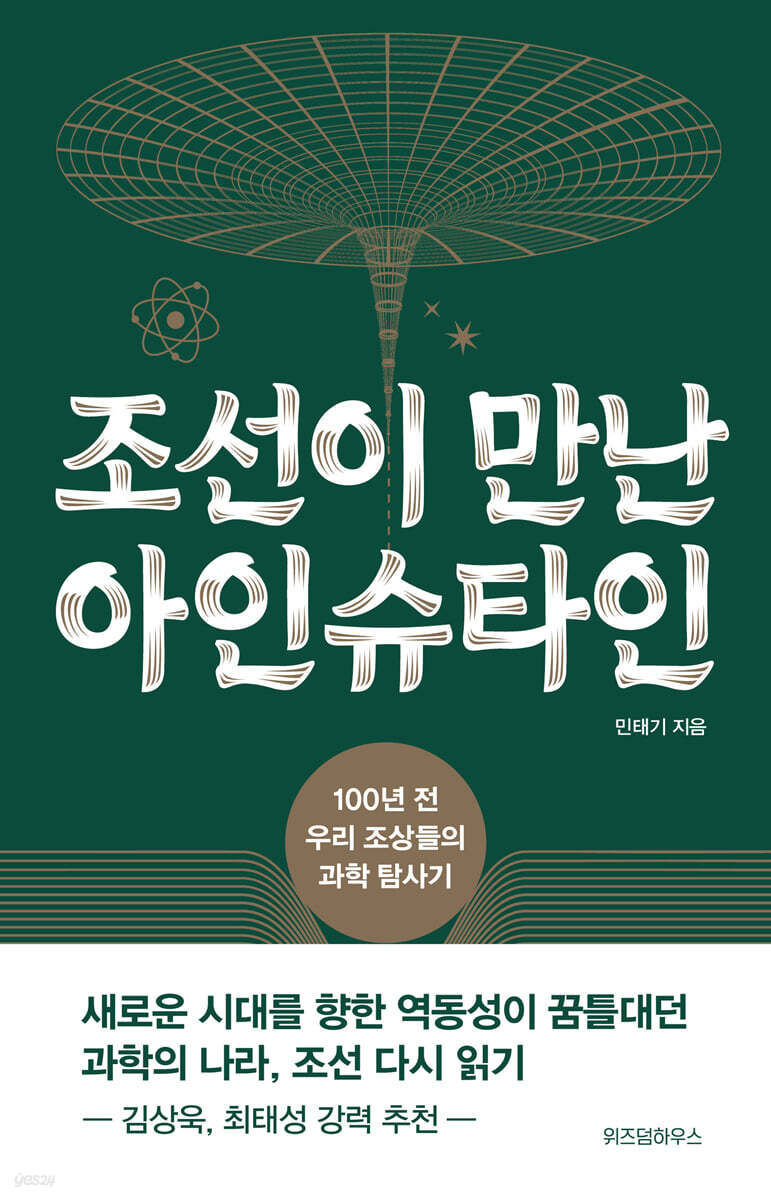
Joseon meets Einstein
 |
Description
Book Introduction
Was the theory of relativity at the foundation of the independence movement? In an era when physics lectures were held nationwide and lunar exploration, rockets, and drones were featured prominently in the media, we read about Joseon, the "land of science." At a time when Einstein, Heisenberg, and Schrödinger were shaking up the scientific world, our scientists also followed the trend of the times, showing a wide range of international activities. This book is an unforgettable story of those who tried to overcome the pain and tragedy of their time through science. The author, who is credited with opening a new horizon for liberal arts science with his previous work, "Fanta Ray," ultimately wanted to convey the message of our hidden scientific history. History is re-illuminated through Min Tae-gi's fingertips, encompassing science, engineering, art, and philosophy. |
- You can preview some of the book's contents.
Preview
index
prolog
Seo Jae-pil's return to Korea in 1895
Ahn Chang-ho and Hawaii in San Francisco in 1902
Ahn Chang-ho and Hwang Jin-nam in Shanghai in 1919
The theory of relativity appeared in Seoul Chosun in 1921
Einstein's visit to Japan in Tokyo in 1922
1923 Joseon-wide relativity lecture
The 1923 Great Kanto Earthquake in Tokyo and Wu Jang-chun, Hwang Jin-nam and Lee Geuk-ro in Berlin
Choi Kyu-nam, a baseball star who became Seoul's first doctor of physics in 1926.
The 1931 Kyoto Bunaro Movement and Lee Tae-gyu's frustration as an intellectual
Introduction to Quantum Mechanics on Science Day 1934
1937 Kyoto Woo Jang-chun, Lee Tae-gyu, Lee Seung-gi
Hwang Jin-nam's return to Korea from Hamheung in 1940
The dream of liberated Seoul in 1945
Jeju's Left-Right Confrontation and the Division of North and South Korea in 1946
1947 Boston, Yeo Un-hyeong, Hwang Jin-nam, and Seo Jae-pil
Woo Jang-chun's return to Korea from Busan in 1950
Panmunjom Hangul typewriter and Woo Jang-chun in 1953
The end of the war and the end of the old regime
Epilogue
References and Figure Sources
Seo Jae-pil's return to Korea in 1895
Ahn Chang-ho and Hawaii in San Francisco in 1902
Ahn Chang-ho and Hwang Jin-nam in Shanghai in 1919
The theory of relativity appeared in Seoul Chosun in 1921
Einstein's visit to Japan in Tokyo in 1922
1923 Joseon-wide relativity lecture
The 1923 Great Kanto Earthquake in Tokyo and Wu Jang-chun, Hwang Jin-nam and Lee Geuk-ro in Berlin
Choi Kyu-nam, a baseball star who became Seoul's first doctor of physics in 1926.
The 1931 Kyoto Bunaro Movement and Lee Tae-gyu's frustration as an intellectual
Introduction to Quantum Mechanics on Science Day 1934
1937 Kyoto Woo Jang-chun, Lee Tae-gyu, Lee Seung-gi
Hwang Jin-nam's return to Korea from Hamheung in 1940
The dream of liberated Seoul in 1945
Jeju's Left-Right Confrontation and the Division of North and South Korea in 1946
1947 Boston, Yeo Un-hyeong, Hwang Jin-nam, and Seo Jae-pil
Woo Jang-chun's return to Korea from Busan in 1950
Panmunjom Hangul typewriter and Woo Jang-chun in 1953
The end of the war and the end of the old regime
Epilogue
References and Figure Sources
Detailed image
.jpg)
Into the book
Surprisingly, I learned that the theory of relativity was introduced to our country in the 1920s, at the very time when Einstein was receiving attention in major countries.
It wasn't just a simple introduction; lecture tours were held all over the country, people flocked to the area, and major newspapers and magazines published stories about the birth of a new science.
It even covered quantum mechanics, which was the latest theory at the time.
Surprisingly, this happened 100 years ago.
--- p.11, from “Prologue”
The Korean media led the Einstein boom by reporting in detail on the local atmosphere and how great a figure Einstein was.
Einstein's visit to Japan, which lasted over a month, was met with such great interest that Einstein and the theory of relativity were now considered essential knowledge for intellectuals in Joseon.
--- p.93, from “Tokyo, 1922: Einstein’s Visit to Japan”
As the police officer sits on the podium and continues to interfere with the speaker's speech, the audience protests and the lecture is interrupted.
Undeterred, the lecture group pushed ahead with its schedule.
Despite the scorching heat and heavy rain, the audience kept coming in, and musical performances such as solos and violin solos were included to liven up the atmosphere, and the audience was enthusiastic about the new knowledge that the students were sharing.
--- p.100, from “1923 Joseon Campaign: Lectures on the Theory of Relativity”
In 1919, the first graduating class of the Department of Astronomy at Yonhui College was born, and among them, Won-cheol Lee, who had outstanding grades, went to study abroad in the United States in 1922 and received a doctorate in astronomy from the University of Michigan in 1926.
The first doctor of science was born in our country.
--- p.129, from “1926 Seoul: Choi Kyu-nam, the baseball star who became the first person to receive a Ph.D. in physics”
In the 1930s, the trend in the world of science was undoubtedly quantum mechanics.
With Heisenberg winning the Nobel Prize in 1932, and Dirac and Schrödinger in 1933, quantum theory was gradually taking hold despite Einstein's skeptical view of quantum mechanics.
Joseon scientists, who quickly absorbed quantum theory without missing this, defined Einstein's theory of relativity, which dominated the 1920s, as outdated 'classical physics' and announced the emergence of a new paradigm called the denial of causality and the uncertainty principle.
--- p.160, from "Science Day 1934: Introduction to Quantum Mechanics"
Dr. Tae-Gyu Lee, who majored in quantum chemistry, received international attention for his research on how to express the viscosity of non-Newtonian fluids with Professor Eyring at the University of Utah in the United States.
This is called the 'Lee-Eyring viscosity relations'.
For his achievements, Lee Tae-gyu was nominated for the Nobel Prize, and in 1965, he became the first Korean to serve on the Nobel Prize nomination committee.
--- p.231, from “Jeju 1946: Left-Right Confrontation and Division of North and South”
In 1954, vegetable seeds finally began to be produced in Jindo after much effort.
Radish and cabbage were essential to the Korean diet.
Research that continued unabated even during the war bore fruit.
The greatest achievement was the creation of kimchi cabbage here.
Woo Jang-chun believed that traditional Korean cabbage, Chinese cabbage, and Japanese cabbage were all unsuitable for kimchi.
So, he tried to use his own breeding technology to create a cabbage variety that suited the Korean soil and the Korean palate.
In addition, they even developed pepper seeds.
This is the birth of 'Horticulture No. 1', the ancestor of the cabbage we eat today.
--- p.273, from “Panmunjeom, 1953: The Korean Typewriter and Woo Jang-chun”
Our ancestors were not helpless.
He showed a wide range of activities internationally and followed the trends of the time.
Science was no exception.
There was a pioneer who introduced the theory of relativity, which was the hottest topic of debate in the scientific community at the time, and there was also a young man who traveled around Joseon giving lectures.
What were their thoughts on being so passionate about promoting the theory of relativity? This is a story of overcoming reality, a resolve never to fall behind science again, believing that science could change the world.
It wasn't just a simple introduction; lecture tours were held all over the country, people flocked to the area, and major newspapers and magazines published stories about the birth of a new science.
It even covered quantum mechanics, which was the latest theory at the time.
Surprisingly, this happened 100 years ago.
--- p.11, from “Prologue”
The Korean media led the Einstein boom by reporting in detail on the local atmosphere and how great a figure Einstein was.
Einstein's visit to Japan, which lasted over a month, was met with such great interest that Einstein and the theory of relativity were now considered essential knowledge for intellectuals in Joseon.
--- p.93, from “Tokyo, 1922: Einstein’s Visit to Japan”
As the police officer sits on the podium and continues to interfere with the speaker's speech, the audience protests and the lecture is interrupted.
Undeterred, the lecture group pushed ahead with its schedule.
Despite the scorching heat and heavy rain, the audience kept coming in, and musical performances such as solos and violin solos were included to liven up the atmosphere, and the audience was enthusiastic about the new knowledge that the students were sharing.
--- p.100, from “1923 Joseon Campaign: Lectures on the Theory of Relativity”
In 1919, the first graduating class of the Department of Astronomy at Yonhui College was born, and among them, Won-cheol Lee, who had outstanding grades, went to study abroad in the United States in 1922 and received a doctorate in astronomy from the University of Michigan in 1926.
The first doctor of science was born in our country.
--- p.129, from “1926 Seoul: Choi Kyu-nam, the baseball star who became the first person to receive a Ph.D. in physics”
In the 1930s, the trend in the world of science was undoubtedly quantum mechanics.
With Heisenberg winning the Nobel Prize in 1932, and Dirac and Schrödinger in 1933, quantum theory was gradually taking hold despite Einstein's skeptical view of quantum mechanics.
Joseon scientists, who quickly absorbed quantum theory without missing this, defined Einstein's theory of relativity, which dominated the 1920s, as outdated 'classical physics' and announced the emergence of a new paradigm called the denial of causality and the uncertainty principle.
--- p.160, from "Science Day 1934: Introduction to Quantum Mechanics"
Dr. Tae-Gyu Lee, who majored in quantum chemistry, received international attention for his research on how to express the viscosity of non-Newtonian fluids with Professor Eyring at the University of Utah in the United States.
This is called the 'Lee-Eyring viscosity relations'.
For his achievements, Lee Tae-gyu was nominated for the Nobel Prize, and in 1965, he became the first Korean to serve on the Nobel Prize nomination committee.
--- p.231, from “Jeju 1946: Left-Right Confrontation and Division of North and South”
In 1954, vegetable seeds finally began to be produced in Jindo after much effort.
Radish and cabbage were essential to the Korean diet.
Research that continued unabated even during the war bore fruit.
The greatest achievement was the creation of kimchi cabbage here.
Woo Jang-chun believed that traditional Korean cabbage, Chinese cabbage, and Japanese cabbage were all unsuitable for kimchi.
So, he tried to use his own breeding technology to create a cabbage variety that suited the Korean soil and the Korean palate.
In addition, they even developed pepper seeds.
This is the birth of 'Horticulture No. 1', the ancestor of the cabbage we eat today.
--- p.273, from “Panmunjeom, 1953: The Korean Typewriter and Woo Jang-chun”
Our ancestors were not helpless.
He showed a wide range of activities internationally and followed the trends of the time.
Science was no exception.
There was a pioneer who introduced the theory of relativity, which was the hottest topic of debate in the scientific community at the time, and there was also a young man who traveled around Joseon giving lectures.
What were their thoughts on being so passionate about promoting the theory of relativity? This is a story of overcoming reality, a resolve never to fall behind science again, believing that science could change the world.
--- p.292, from "Epilogue"
Publisher's Review
The scientific studies of our ancestors who did their best to survive the dark ages
The theory of relativity that Einstein was right about, and quantum entanglement that Einstein was wrong about.
Our scientists knew 100 years ago
"The Hidden History of Science in a Dark Age: The Amazing Story of Our Science" _ Physicist Kim Sang-wook
"A book brimming with dynamism toward a new era" _ Choi Tae-seong, Korean history lecturer
Was the theory of relativity at the foundation of the independence movement? What was the future of art a century ago, permeated by quantum mechanics? In an era when physics lectures were held nationwide and lunar exploration, rockets, and drones were featured prominently in the media, we explore Joseon, the "land of science."
When Einstein, Heisenberg, Schrödinger, and other pioneers of modern physics were redefining the landscape of human knowledge, our scientists also followed the trends of their time, exhibiting broad international activities.
This book is an unforgettable story of those who, during the Japanese colonial period and the liberation period, tried to overcome the pain and tragedy of the era through science.
The author, who is credited with opening a new horizon for liberal arts science with his previous work, "Fanta Ray," ultimately wanted to convey the message of our hidden scientific history.
History is re-illuminated through Min Tae-gi's fingertips, encompassing science, engineering, art, and philosophy.
The scientific knowledge we have from the Joseon Dynasty to the present has not changed.
Even during this period, scientists who established modern physics were still alive.
How did cutting-edge science, including the theory of relativity, quantum mechanics, and nuclear physics, come about, when did they become known, and why were they disseminated and digested by the public? And who were the science communicators? The author accurately portrays the historical landscape, drawing on diverse sources, of people eager to quickly acquire new knowledge, flocking to lecture halls.
Newspaper and magazine articles that strive to convey scientific news from around the world without time lag are full of realism.
Especially when reading the material the author has compiled over several decades, one is struck by how much the desire of many to understand science is no different from the present.
In his previous work, “Fanta Ray,” the author presented an interesting interpretation of fluid dynamics within the history of Western science. In “Joseon Meets Einstein,” the author presents a unique perspective on Joseon, a dynamic country where science, art, and culture came together.
Our history of science has never been featured in history books or science textbooks.
This book is a story of the struggles of our scientists who have continuously strived to illuminate the dark ages through science, and is also a missing link in our country's history.
The passionate history of Joseon's science unfolded around the world's most famous theory.
The theory of relativity becomes the basis for the armed struggle for independence.
“As long as human cultural history continues, the name Einstein will live forever.”
_《Dong-A Ilbo》 1922, Hwang Jin-nam
In the early 20th century, when Korea was liberated from Japanese colonial rule, modern physics emerged, completely changing the human knowledge system, and scientists were engaged in fierce debate.
Max Planck opened the door to quantum mechanics, Curie discovered radioactivity, and Einstein brought about fundamental changes in physics with the theory of relativity.
Here, Heisenberg and Schrödinger join in, and the golden age of physics unfolds.
The author, who was carefully examining the material, had a question.
During this period of scientific revolution, did our ancestors know about Einstein? Did Joseon intellectuals study quantum mechanics? Surprisingly, even before Einstein won the Nobel Prize in 1920, the theory of relativity was already a hot topic in Joseon, and public lectures explaining it were serialized in newspapers.
During the Japanese colonial period, Joseon society took note of the influence that science had on the world through overseas news.
Realizing that they had to acquire science and technology to reclaim their country, intellectuals in colonial Korea began to take action.
And our ancestors made the theory of relativity a symbol of the independence movement.
For Koreans, science meant independence.
Traces of science can be easily found in countless newspapers, magazines, novels, poems, and paintings of that time.
But why haven't we ever looked into this record properly?
As we search for the answer, we discover a modern and contemporary history stained with wounds.
During the Japanese colonial period, the division between left and right, and the division of North and South, countless scientists were forced to make choices, and as ideologies became intertwined, they disappeared from memory one by one.
Now is the time to re-examine our scientific foundations.
The author argues that we must properly evaluate the progress we have made from the ruins of colonialism and war and face the past.
And we want to tell the stories of scientists who have done their best to overcome the dark times to the next generation.
In search of the science, scientists, and science communicators who shook Joseon 100 years ago.
From poet Lee Sang's quantum mechanics to baseball star Choi Kyu-nam's lunar exploration rocket.
"Why do I need to know the theory of relativity? I can't afford to be left behind."
_《Donggwang》 1932, anonymous contributor
Major Korean newspapers and magazines published articles on the birth of new science one after another.
Additionally, the Joseon Students Association, which led the February 8th Independence Declaration in 1919, traveled around the country every summer giving lectures on the theory of relativity, and the audience's enthusiasm was tremendous.
In the end, these students pushed ahead with their schedule, even clashing with the police, and did not stop promoting science.
In this way, Joseon's scientific studies continued without interruption.
Na Kyung-seok, who attracted attention with a seven-part series explaining the theory of relativity; Hwang Jin-nam, who met Einstein at the German Academy of Sciences and brought the vivid experience to Korea; scientists in 1935 who introduced the EPR paradox, the subject of the 2022 Nobel Prize; astronomer Lee Won-cheol, the first Korean to receive a doctorate in science; baseball star and physics doctor Choi Kyu-nam; Woo Jang-chun, who overturned Darwin's 'Origin of Species'; mathematician Lee Im-hak, who unknowingly entered the international stage by submitting a paper to an American academic journal he found at Namdaemun Market; quantum chemist Lee Tae-gyu, Korea's first Nobel Prize nominee... Various characters are vividly depicted, from the audience in the lecture hall taking notes on formulas to scientists and science communicators.
The passionate history of Joseon's science unfolds around the world's most famous formula.
Our ancestors were never helpless.
Beginning with the pioneer who introduced the theory of relativity, which was a topic of global debate at the time, they attempted to overcome the pain and tragedy of the times through the study of science.
We read about the history of overcoming reality, believing that science could change the world and vowing never to fall behind again.
This book vividly demonstrates that modern Korean history was not filled with despair, but rather a driving force toward a new era.
The theory of relativity that Einstein was right about, and quantum entanglement that Einstein was wrong about.
Our scientists knew 100 years ago
"The Hidden History of Science in a Dark Age: The Amazing Story of Our Science" _ Physicist Kim Sang-wook
"A book brimming with dynamism toward a new era" _ Choi Tae-seong, Korean history lecturer
Was the theory of relativity at the foundation of the independence movement? What was the future of art a century ago, permeated by quantum mechanics? In an era when physics lectures were held nationwide and lunar exploration, rockets, and drones were featured prominently in the media, we explore Joseon, the "land of science."
When Einstein, Heisenberg, Schrödinger, and other pioneers of modern physics were redefining the landscape of human knowledge, our scientists also followed the trends of their time, exhibiting broad international activities.
This book is an unforgettable story of those who, during the Japanese colonial period and the liberation period, tried to overcome the pain and tragedy of the era through science.
The author, who is credited with opening a new horizon for liberal arts science with his previous work, "Fanta Ray," ultimately wanted to convey the message of our hidden scientific history.
History is re-illuminated through Min Tae-gi's fingertips, encompassing science, engineering, art, and philosophy.
The scientific knowledge we have from the Joseon Dynasty to the present has not changed.
Even during this period, scientists who established modern physics were still alive.
How did cutting-edge science, including the theory of relativity, quantum mechanics, and nuclear physics, come about, when did they become known, and why were they disseminated and digested by the public? And who were the science communicators? The author accurately portrays the historical landscape, drawing on diverse sources, of people eager to quickly acquire new knowledge, flocking to lecture halls.
Newspaper and magazine articles that strive to convey scientific news from around the world without time lag are full of realism.
Especially when reading the material the author has compiled over several decades, one is struck by how much the desire of many to understand science is no different from the present.
In his previous work, “Fanta Ray,” the author presented an interesting interpretation of fluid dynamics within the history of Western science. In “Joseon Meets Einstein,” the author presents a unique perspective on Joseon, a dynamic country where science, art, and culture came together.
Our history of science has never been featured in history books or science textbooks.
This book is a story of the struggles of our scientists who have continuously strived to illuminate the dark ages through science, and is also a missing link in our country's history.
The passionate history of Joseon's science unfolded around the world's most famous theory.
The theory of relativity becomes the basis for the armed struggle for independence.
“As long as human cultural history continues, the name Einstein will live forever.”
_《Dong-A Ilbo》 1922, Hwang Jin-nam
In the early 20th century, when Korea was liberated from Japanese colonial rule, modern physics emerged, completely changing the human knowledge system, and scientists were engaged in fierce debate.
Max Planck opened the door to quantum mechanics, Curie discovered radioactivity, and Einstein brought about fundamental changes in physics with the theory of relativity.
Here, Heisenberg and Schrödinger join in, and the golden age of physics unfolds.
The author, who was carefully examining the material, had a question.
During this period of scientific revolution, did our ancestors know about Einstein? Did Joseon intellectuals study quantum mechanics? Surprisingly, even before Einstein won the Nobel Prize in 1920, the theory of relativity was already a hot topic in Joseon, and public lectures explaining it were serialized in newspapers.
During the Japanese colonial period, Joseon society took note of the influence that science had on the world through overseas news.
Realizing that they had to acquire science and technology to reclaim their country, intellectuals in colonial Korea began to take action.
And our ancestors made the theory of relativity a symbol of the independence movement.
For Koreans, science meant independence.
Traces of science can be easily found in countless newspapers, magazines, novels, poems, and paintings of that time.
But why haven't we ever looked into this record properly?
As we search for the answer, we discover a modern and contemporary history stained with wounds.
During the Japanese colonial period, the division between left and right, and the division of North and South, countless scientists were forced to make choices, and as ideologies became intertwined, they disappeared from memory one by one.
Now is the time to re-examine our scientific foundations.
The author argues that we must properly evaluate the progress we have made from the ruins of colonialism and war and face the past.
And we want to tell the stories of scientists who have done their best to overcome the dark times to the next generation.
In search of the science, scientists, and science communicators who shook Joseon 100 years ago.
From poet Lee Sang's quantum mechanics to baseball star Choi Kyu-nam's lunar exploration rocket.
"Why do I need to know the theory of relativity? I can't afford to be left behind."
_《Donggwang》 1932, anonymous contributor
Major Korean newspapers and magazines published articles on the birth of new science one after another.
Additionally, the Joseon Students Association, which led the February 8th Independence Declaration in 1919, traveled around the country every summer giving lectures on the theory of relativity, and the audience's enthusiasm was tremendous.
In the end, these students pushed ahead with their schedule, even clashing with the police, and did not stop promoting science.
In this way, Joseon's scientific studies continued without interruption.
Na Kyung-seok, who attracted attention with a seven-part series explaining the theory of relativity; Hwang Jin-nam, who met Einstein at the German Academy of Sciences and brought the vivid experience to Korea; scientists in 1935 who introduced the EPR paradox, the subject of the 2022 Nobel Prize; astronomer Lee Won-cheol, the first Korean to receive a doctorate in science; baseball star and physics doctor Choi Kyu-nam; Woo Jang-chun, who overturned Darwin's 'Origin of Species'; mathematician Lee Im-hak, who unknowingly entered the international stage by submitting a paper to an American academic journal he found at Namdaemun Market; quantum chemist Lee Tae-gyu, Korea's first Nobel Prize nominee... Various characters are vividly depicted, from the audience in the lecture hall taking notes on formulas to scientists and science communicators.
The passionate history of Joseon's science unfolds around the world's most famous formula.
Our ancestors were never helpless.
Beginning with the pioneer who introduced the theory of relativity, which was a topic of global debate at the time, they attempted to overcome the pain and tragedy of the times through the study of science.
We read about the history of overcoming reality, believing that science could change the world and vowing never to fall behind again.
This book vividly demonstrates that modern Korean history was not filled with despair, but rather a driving force toward a new era.
GOODS SPECIFICS
- Date of issue: August 15, 2023
- Page count, weight, size: 316 pages | 464g | 135*210*20mm
- ISBN13: 9791168126855
- ISBN10: 1168126851
You may also like
카테고리
korean


korean

![GQ KOREA Mark (Monthly): December [2025]](http://librairie.coreenne.fr/cdn/shop/files/8ef265dbbfbf186523ed75ba7319009d.jpg?v=1765340328&width=3840)


