

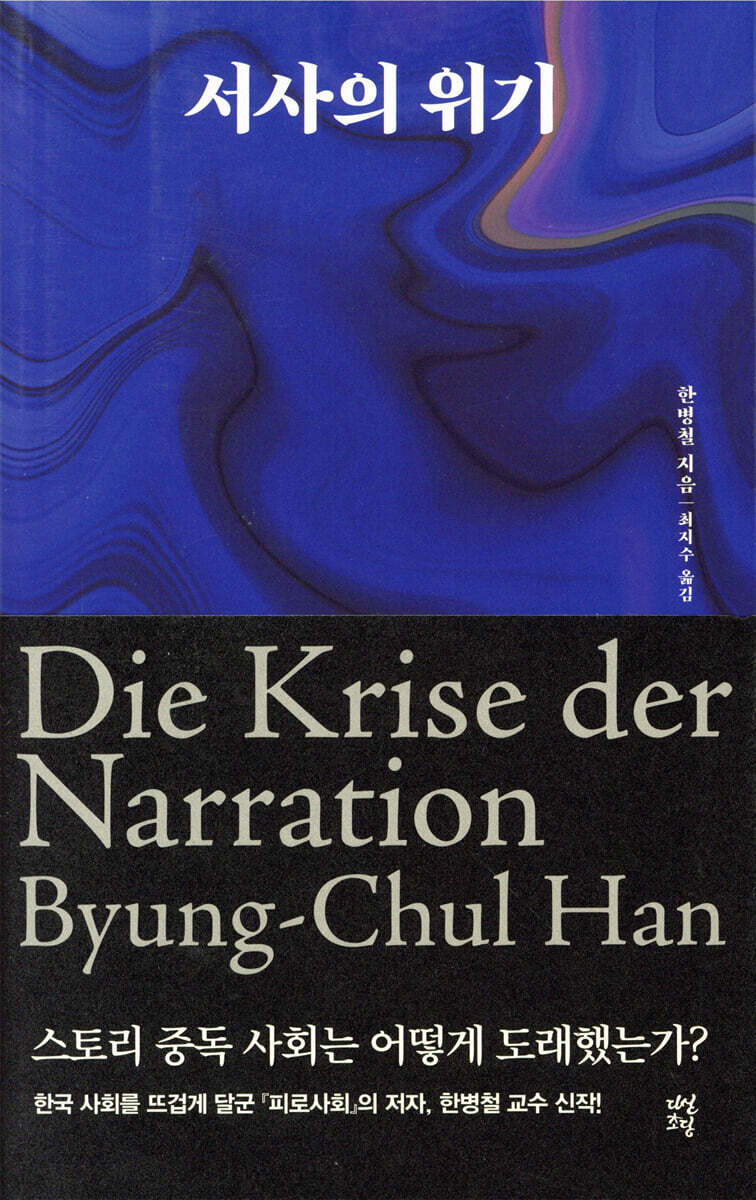
Crisis of the narrative
 |
Description
Book Introduction
- A word from MD
-
A sobering analysis of the isolated modern man.Why do modern people, constantly connected by smartphones, feel lonely? Han Byung-chul, author of "The Fatigued Society," says it's because narrative has disappeared.
This book, which explains modern society by contrasting narratives and stories, offers keen insight into the times.
Are you living a busy life but feeling empty? "The Crisis of Narrative" will tell you why.
September 22, 2023. Humanities PD Son Min-gyu
60th printing, cumulative sales of 170,000 copies
Professor Han Byung-chul, whose book "The Burnout Society" hit Korean society hard in 2010.
The publication of 『The Crisis of Narrative』, a controversial work that raises new topics after more than 10 years!
How did the story-addicted society come about?
Sounding the alarm in an era of profound nihilism, driven only by issues.
The world's most widely read living philosopher
Translations published in 11 countries, including the United States, China, and France.
Han Byung-chul, a German philosopher who heated up Korean society with his book "The Fatigue Society," now denounces a society addicted to stories that has become distant from its own thoughts while chasing only issues that appear and disappear quickly.
The key words of this book, which raises new topics after more than 10 years since “The Fatigued Society,” are “narrative” and “story.”
If my own thoughts and context are a narrative, then the news and information that flash by and disappear are stories.
Han Byung-chul points out that we are being manipulated into posting our lives on social media and informatizing them in a smart ruling system without oppression or resistance.
Even when looking at a beautiful flower, instead of feeling the emotion and delving into one's inner self, one quickly takes a picture with one's smartphone and uploads it to an Instagram story, failing to create one's own narrative.
The end result of a society that has lost its own unique story, a society that cannot express its thoughts and feelings but instead parrots out input information, is an 'empty life' without narrative.
Professor Han Byung-chul, whose book "The Burnout Society" hit Korean society hard in 2010.
The publication of 『The Crisis of Narrative』, a controversial work that raises new topics after more than 10 years!
How did the story-addicted society come about?
Sounding the alarm in an era of profound nihilism, driven only by issues.
The world's most widely read living philosopher
Translations published in 11 countries, including the United States, China, and France.
Han Byung-chul, a German philosopher who heated up Korean society with his book "The Fatigue Society," now denounces a society addicted to stories that has become distant from its own thoughts while chasing only issues that appear and disappear quickly.
The key words of this book, which raises new topics after more than 10 years since “The Fatigued Society,” are “narrative” and “story.”
If my own thoughts and context are a narrative, then the news and information that flash by and disappear are stories.
Han Byung-chul points out that we are being manipulated into posting our lives on social media and informatizing them in a smart ruling system without oppression or resistance.
Even when looking at a beautiful flower, instead of feeling the emotion and delving into one's inner self, one quickly takes a picture with one's smartphone and uploads it to an Instagram story, failing to create one's own narrative.
The end result of a society that has lost its own unique story, a society that cannot express its thoughts and feelings but instead parrots out input information, is an 'empty life' without narrative.
- You can preview some of the book's contents.
Preview
index
Translator's Preface
From story to information
poverty of experience
Life Explained
Naked life
Demystifying the world
From shock to like
Theory as a story
Storytelling of Healing
story community
Storyselling
main
From story to information
poverty of experience
Life Explained
Naked life
Demystifying the world
From shock to like
Theory as a story
Storytelling of Healing
story community
Storyselling
main
Detailed image
.jpg)
Into the book
A story is not a narrative.
Stories, or information, are constantly replaced by the next story that appears and disappears.
On the other hand, narrative is my own context, story, and life itself.
It has a direction that connects my distant past, present, and future.
A society that has lost its own story, swept away by information that will soon disappear, a society that cannot express its own thoughts, feelings, and emotions and instead spits out inputted information like a parrot, will end in an 'empty life' without a narrative.
--- p.7, from the “Translator’s Preface”
Hippolyte de Villemessant, founder of the French daily newspaper Le Figaro, summarized the essence of information in one sentence:
“Our readers are more interested in a roof fire in the Latin Hotel in Paris than in a revolution in Madrid,” Walter Benjamin said, making this even more concrete:
“Only information that provides clues to what will happen next, not knowledge coming from afar, resonates.” Newspaper readers’ attention never goes beyond what is immediately in front of them.
Their interest is reduced to curiosity.
Instead of focusing their attention on a distant topic, modern newspaper readers simply shift their attention from one news story to another.
--- p.13, from “From Story to Information”
The 'stories' on digital platforms like Instagram and Facebook are not stories in the true sense of the word.
These do not appear to be of any narrative length.
It's just a series of captured moments and doesn't say anything.
In reality, they are just visual information that disappears quickly.
Nothing remains.
Instagram's advertising slogan is:
“Turn your precious everyday moments into stories.
Stories are usually fun and light-hearted and last only 24 hours.” The time limit has a special psychological effect.
It creates a feeling of constant change, creating a subtle compulsion to communicate more.
--- p.46, from “Life Explained”
In this digitalized postmodern era, we constantly post, like, and share, pretending not to know the meaning of naked, empty life.
Communication noise and information noise prevent us from revealing the unsettling emptiness of life.
The crisis today is not 'to live or to talk' but 'to live or to post'.
Even selfie addiction isn't due to narcissism.
The inner emptiness led to selfie addiction.
I lack the meaning that gives me a stable identity.
Faced with the inner emptiness, the 'I' permanently produces itself.
A selfie is an empty copy of yourself.
--- p.64-65, from “Naked Life”
Freud also understood suffering as a symptom that reveals a blockage in the individual's story.
A person who is blocked cannot continue his story.
Psychological disorders are expressions of blocked narratives.
Healing occurs when we free patients from narrative blockages and enable those who cannot speak to express their stories in words.
Patients are healed when they are free to speak for themselves.
--- p.114, from “Storytelling of Healing”
Stories create social cohesion.
Stories provide meaning and convey values that build community.
These should be distinguished from the narratives that create the system.
The narrative that underpins the neoliberal system hinders the very formation of community.
The neoliberal performance narrative makes everyone their own entrepreneur.
Everyone exists in competition with others.
Achievement narratives do not create social cohesion, that is, we.
Rather, it dismantles not only solidarity but also empathy.
Neoliberal narratives of self-optimization, self-actualization, or authenticity destabilize society by isolating people.
A stable community cannot be formed where people worship themselves, where they are their own leaders, where everyone produces and performs for themselves.
--- p.126, from “Story Community”
Life is a story.
Humans, as narrative animals (animal narrans), are distinguished from animals in that they realize new forms of life narratively.
Stories have the power to create new beginnings.
Every act that changes the world presupposes a story.
Storytelling, on the other hand, presupposes only one form of life: the consumerist form of life.
Storytelling as storytelling cannot portray other forms of life.
Because in the world of storytelling, everything is reduced to consumption.
It blinds us to other stories, other forms of life, other perceptions and realities.
Herein lies the crisis of narrative in the age of storytelling.
Stories, or information, are constantly replaced by the next story that appears and disappears.
On the other hand, narrative is my own context, story, and life itself.
It has a direction that connects my distant past, present, and future.
A society that has lost its own story, swept away by information that will soon disappear, a society that cannot express its own thoughts, feelings, and emotions and instead spits out inputted information like a parrot, will end in an 'empty life' without a narrative.
--- p.7, from the “Translator’s Preface”
Hippolyte de Villemessant, founder of the French daily newspaper Le Figaro, summarized the essence of information in one sentence:
“Our readers are more interested in a roof fire in the Latin Hotel in Paris than in a revolution in Madrid,” Walter Benjamin said, making this even more concrete:
“Only information that provides clues to what will happen next, not knowledge coming from afar, resonates.” Newspaper readers’ attention never goes beyond what is immediately in front of them.
Their interest is reduced to curiosity.
Instead of focusing their attention on a distant topic, modern newspaper readers simply shift their attention from one news story to another.
--- p.13, from “From Story to Information”
The 'stories' on digital platforms like Instagram and Facebook are not stories in the true sense of the word.
These do not appear to be of any narrative length.
It's just a series of captured moments and doesn't say anything.
In reality, they are just visual information that disappears quickly.
Nothing remains.
Instagram's advertising slogan is:
“Turn your precious everyday moments into stories.
Stories are usually fun and light-hearted and last only 24 hours.” The time limit has a special psychological effect.
It creates a feeling of constant change, creating a subtle compulsion to communicate more.
--- p.46, from “Life Explained”
In this digitalized postmodern era, we constantly post, like, and share, pretending not to know the meaning of naked, empty life.
Communication noise and information noise prevent us from revealing the unsettling emptiness of life.
The crisis today is not 'to live or to talk' but 'to live or to post'.
Even selfie addiction isn't due to narcissism.
The inner emptiness led to selfie addiction.
I lack the meaning that gives me a stable identity.
Faced with the inner emptiness, the 'I' permanently produces itself.
A selfie is an empty copy of yourself.
--- p.64-65, from “Naked Life”
Freud also understood suffering as a symptom that reveals a blockage in the individual's story.
A person who is blocked cannot continue his story.
Psychological disorders are expressions of blocked narratives.
Healing occurs when we free patients from narrative blockages and enable those who cannot speak to express their stories in words.
Patients are healed when they are free to speak for themselves.
--- p.114, from “Storytelling of Healing”
Stories create social cohesion.
Stories provide meaning and convey values that build community.
These should be distinguished from the narratives that create the system.
The narrative that underpins the neoliberal system hinders the very formation of community.
The neoliberal performance narrative makes everyone their own entrepreneur.
Everyone exists in competition with others.
Achievement narratives do not create social cohesion, that is, we.
Rather, it dismantles not only solidarity but also empathy.
Neoliberal narratives of self-optimization, self-actualization, or authenticity destabilize society by isolating people.
A stable community cannot be formed where people worship themselves, where they are their own leaders, where everyone produces and performs for themselves.
--- p.126, from “Story Community”
Life is a story.
Humans, as narrative animals (animal narrans), are distinguished from animals in that they realize new forms of life narratively.
Stories have the power to create new beginnings.
Every act that changes the world presupposes a story.
Storytelling, on the other hand, presupposes only one form of life: the consumerist form of life.
Storytelling as storytelling cannot portray other forms of life.
Because in the world of storytelling, everything is reduced to consumption.
It blinds us to other stories, other forms of life, other perceptions and realities.
Herein lies the crisis of narrative in the age of storytelling.
--- p.136-137, from "Storytelling"
Publisher's Review
“Why Are Our Lives So Unstable and Empty?”
A scathing critique of the contemporary era, where stories have been robbed of their narratives.
『The Crisis of Narrative』 published in Korea!
Today, we constantly look at our smartphones, whether we're alone or talking to others.
Check real-time news and read short videos and photos on YouTube and social media.
There is virtually no time to focus on your inner story with long, slow breaths.
We're busy consuming provocative stories all day long.
Byung-Chul Han, a world-renowned bestselling author and “the world’s most widely read living philosopher” (El País, Spain’s leading daily newspaper), diagnoses the current era, in which stories have been robbed of their own unique narratives, as a “crisis of narrative” in his new book, “The Crisis of Narrative.”
A story that flashes and disappears cannot offer any direction or meaning to life, so the crisis of narrative directly leads to the crisis of life.
According to the author, humans are not beings who live by moving from one moment to the next.
You can find meaning when you connect the entirety of life between birth and death and move forward in your own context.
Only the stories that connect my past, present, and future give value to life.
This is why the more you become addicted to a story that only makes 'this moment' important, the deeper the nihilism you fall into.
The 'narrative crisis' is a contemporary problem that is being experienced not only in Korean society but also around the world.
Overseas readers who first read this book praised it, saying, “It is an excellent, accurate, and almost perfect book,” “It identifies the disasters of our time while simultaneously suggesting solutions,” and “It sharply points out problems that we have overlooked because they are part of our current lives,” proving the sharpness of Han Byung-chul’s philosophy that sees through the times.
In 『The Crisis of Narrative』, Byung-Chul Han interprets the meaning of narrative by quoting a variety of figures, from philosophers Walter Benjamin, Hannah Arendt, and Theodor Adorno to writers Georg Büchner, Bertolt Brecht, Paul Marr, and Michael Ende.
Furthermore, he emphasizes that only the recovery of narrative is the way to live without anxiety in an unpredictable world.
It is not a life where you are idly dragged along by what everyone else does, but a life where you create a unique life, a different story, within your own context.
Han Byung-chul's uniquely deep and clear philosophical thinking guides readers who are lost in finding meaning in life to recover their inner narrative and fully appreciate the value of life.
“It’s not storytelling, it’s storyselling!”
Thinking about human existence reduced to consumerism
“Storytelling is very popular these days.
It's so popular that it feels like we're talking about it again more often.
But storytelling is never the return of the story.
Rather, it is being used to instrumentalize and commercialize stories.
“It transforms things that are worthless in themselves into valuable goods.”
_『The Crisis of Narrative』, p. 133
In a capitalist society, modern people, addicted to stories, are reduced to consumers of products rather than subjects of life.
This is because companies give stories to things that have no value in themselves, and stimulate us to buy 'products'.
Author Han Byeong-cheol calls this phenomenon ‘storyselling.’
The problem doesn't end there.
The author points out that modern people are being manipulated into posting, sharing, and telling stories about their lives on social media under a smart ruling system that leaves no room for oppression or resistance.
When looking at a beautiful flower, instead of feeling the emotion and delving into one's inner self, one quickly takes a picture with one's smartphone and uploads it to social media, thereby informatizing oneself and observing other people's reactions.
In this way, we are storytelling ourselves, endlessly reducing ourselves to information that can be consumed and disappear at any time.
The life of an information hunter, meaninglessly moving from issue to issue and suffering from an obsession with updates, is empty.
This is because experiences and thoughts are not accumulated one by one, but are simply listed as information.
Because we focus solely on sharing new information rather than empathizing with others through conversation, our relationships become less about community than community.
Lost in history and caught up in chance, he drifts in the middle of a storm.
The only power that heals deep emptiness
“Only true stories that transcend the list of information
“It will help you find the meaning of life.”
How can we overcome the crisis of narrative?
Author Han Byeong-cheol suggests ‘listening’ using Michael Ende’s novel ‘Momo’ as an example.
In the novel, the protagonist Momo encourages others to speak for themselves by listening thoughtfully to what they have to say.
This allows the other person to realize their own value and even feel loved.
The only way to restore the narrative is to listen carefully to what other people say.
This restored narrative heals the pain.
Han Byung-chul reemphasizes the power of healing by quoting Walter Benjamin and Hannah Arendt.
“The healing of a patient’s illness begins with telling the doctor about his symptoms” (Walter Benjamin), and “All sorrows can be endured if they can be told or expressed through stories” (Hannah Arendt).
Unfortunately, modern people do not have the time or patience to listen to stories.
The world of efficiency, where we must quickly absorb as much information as possible and produce results, does not wait for the long, slow unfolding of narratives.
There is no happiness in a life without narrative.
Today is just a continuation of yesterday, a continuation of survival without any narrative that gives life meaning.
No one wants a life like this.
If you want to accurately face the era we live in now, and if you want to start a new story about your life, read this book.
It will be a time of reflection that will turn life's crisis into an opportunity.
“Life is a story.
Humans, as narrative animals, are distinguished from animals in that they realize new forms of life narratively.
Stories have the power to create new beginnings.
“Every act that changes the world presupposes a story.”
_『The Crisis of Narrative』, pp. 136-137
The world's most widely read living German philosopher is a Korean, Byung-Chul Han.
Spain's leading daily newspaper, El País
Han Byung-chul points out the wounds of our times.
The information society alienates and objectifies people, destroying ancient human values.
Surprisingly, in this book he both identifies the disaster and offers a solution.
_German Amazon Reader Fit*************
Modern people have lost the ability to tell stories.
Rather than talking to people around you, you focus only on your smartphone.
The narrative of community building has disappeared.
This book contains images of our society where stories have disappeared.
_German Amazon Reader Chr************
A great philosopher.
Accurate and concise.
_German Amazon Reader S**
It's a wonderful, accurate, and almost perfect book.
Han Byung-chul once again hits the nail on the head on the problems of modern society.
His philosophy, which brilliantly developed Benjamin's concept of narrative to suit the late modern era, is remarkable.
_Spanish Amazon Reader Ni***** ********
A book that sharply points out problems that are part of our current lives and that we have been unable to see.
_German Amazon Reader Dr***
A scathing critique of the contemporary era, where stories have been robbed of their narratives.
『The Crisis of Narrative』 published in Korea!
Today, we constantly look at our smartphones, whether we're alone or talking to others.
Check real-time news and read short videos and photos on YouTube and social media.
There is virtually no time to focus on your inner story with long, slow breaths.
We're busy consuming provocative stories all day long.
Byung-Chul Han, a world-renowned bestselling author and “the world’s most widely read living philosopher” (El País, Spain’s leading daily newspaper), diagnoses the current era, in which stories have been robbed of their own unique narratives, as a “crisis of narrative” in his new book, “The Crisis of Narrative.”
A story that flashes and disappears cannot offer any direction or meaning to life, so the crisis of narrative directly leads to the crisis of life.
According to the author, humans are not beings who live by moving from one moment to the next.
You can find meaning when you connect the entirety of life between birth and death and move forward in your own context.
Only the stories that connect my past, present, and future give value to life.
This is why the more you become addicted to a story that only makes 'this moment' important, the deeper the nihilism you fall into.
The 'narrative crisis' is a contemporary problem that is being experienced not only in Korean society but also around the world.
Overseas readers who first read this book praised it, saying, “It is an excellent, accurate, and almost perfect book,” “It identifies the disasters of our time while simultaneously suggesting solutions,” and “It sharply points out problems that we have overlooked because they are part of our current lives,” proving the sharpness of Han Byung-chul’s philosophy that sees through the times.
In 『The Crisis of Narrative』, Byung-Chul Han interprets the meaning of narrative by quoting a variety of figures, from philosophers Walter Benjamin, Hannah Arendt, and Theodor Adorno to writers Georg Büchner, Bertolt Brecht, Paul Marr, and Michael Ende.
Furthermore, he emphasizes that only the recovery of narrative is the way to live without anxiety in an unpredictable world.
It is not a life where you are idly dragged along by what everyone else does, but a life where you create a unique life, a different story, within your own context.
Han Byung-chul's uniquely deep and clear philosophical thinking guides readers who are lost in finding meaning in life to recover their inner narrative and fully appreciate the value of life.
“It’s not storytelling, it’s storyselling!”
Thinking about human existence reduced to consumerism
“Storytelling is very popular these days.
It's so popular that it feels like we're talking about it again more often.
But storytelling is never the return of the story.
Rather, it is being used to instrumentalize and commercialize stories.
“It transforms things that are worthless in themselves into valuable goods.”
_『The Crisis of Narrative』, p. 133
In a capitalist society, modern people, addicted to stories, are reduced to consumers of products rather than subjects of life.
This is because companies give stories to things that have no value in themselves, and stimulate us to buy 'products'.
Author Han Byeong-cheol calls this phenomenon ‘storyselling.’
The problem doesn't end there.
The author points out that modern people are being manipulated into posting, sharing, and telling stories about their lives on social media under a smart ruling system that leaves no room for oppression or resistance.
When looking at a beautiful flower, instead of feeling the emotion and delving into one's inner self, one quickly takes a picture with one's smartphone and uploads it to social media, thereby informatizing oneself and observing other people's reactions.
In this way, we are storytelling ourselves, endlessly reducing ourselves to information that can be consumed and disappear at any time.
The life of an information hunter, meaninglessly moving from issue to issue and suffering from an obsession with updates, is empty.
This is because experiences and thoughts are not accumulated one by one, but are simply listed as information.
Because we focus solely on sharing new information rather than empathizing with others through conversation, our relationships become less about community than community.
Lost in history and caught up in chance, he drifts in the middle of a storm.
The only power that heals deep emptiness
“Only true stories that transcend the list of information
“It will help you find the meaning of life.”
How can we overcome the crisis of narrative?
Author Han Byeong-cheol suggests ‘listening’ using Michael Ende’s novel ‘Momo’ as an example.
In the novel, the protagonist Momo encourages others to speak for themselves by listening thoughtfully to what they have to say.
This allows the other person to realize their own value and even feel loved.
The only way to restore the narrative is to listen carefully to what other people say.
This restored narrative heals the pain.
Han Byung-chul reemphasizes the power of healing by quoting Walter Benjamin and Hannah Arendt.
“The healing of a patient’s illness begins with telling the doctor about his symptoms” (Walter Benjamin), and “All sorrows can be endured if they can be told or expressed through stories” (Hannah Arendt).
Unfortunately, modern people do not have the time or patience to listen to stories.
The world of efficiency, where we must quickly absorb as much information as possible and produce results, does not wait for the long, slow unfolding of narratives.
There is no happiness in a life without narrative.
Today is just a continuation of yesterday, a continuation of survival without any narrative that gives life meaning.
No one wants a life like this.
If you want to accurately face the era we live in now, and if you want to start a new story about your life, read this book.
It will be a time of reflection that will turn life's crisis into an opportunity.
“Life is a story.
Humans, as narrative animals, are distinguished from animals in that they realize new forms of life narratively.
Stories have the power to create new beginnings.
“Every act that changes the world presupposes a story.”
_『The Crisis of Narrative』, pp. 136-137
The world's most widely read living German philosopher is a Korean, Byung-Chul Han.
Spain's leading daily newspaper, El País
Han Byung-chul points out the wounds of our times.
The information society alienates and objectifies people, destroying ancient human values.
Surprisingly, in this book he both identifies the disaster and offers a solution.
_German Amazon Reader Fit*************
Modern people have lost the ability to tell stories.
Rather than talking to people around you, you focus only on your smartphone.
The narrative of community building has disappeared.
This book contains images of our society where stories have disappeared.
_German Amazon Reader Chr************
A great philosopher.
Accurate and concise.
_German Amazon Reader S**
It's a wonderful, accurate, and almost perfect book.
Han Byung-chul once again hits the nail on the head on the problems of modern society.
His philosophy, which brilliantly developed Benjamin's concept of narrative to suit the late modern era, is remarkable.
_Spanish Amazon Reader Ni***** ********
A book that sharply points out problems that are part of our current lives and that we have been unable to see.
_German Amazon Reader Dr***
GOODS SPECIFICS
- Date of issue: September 15, 2023
- Page count, weight, size: 144 pages | 256g | 125*200*12mm
- ISBN13: 9791130646091
- ISBN10: 1130646092
You may also like
카테고리
korean


korean

![ELLE 엘르 스페셜 에디션 A형 : 12월 [2025]](http://librairie.coreenne.fr/cdn/shop/files/b8e27a3de6c9538896439686c6b0e8fb.jpg?v=1766436872&width=3840)


