

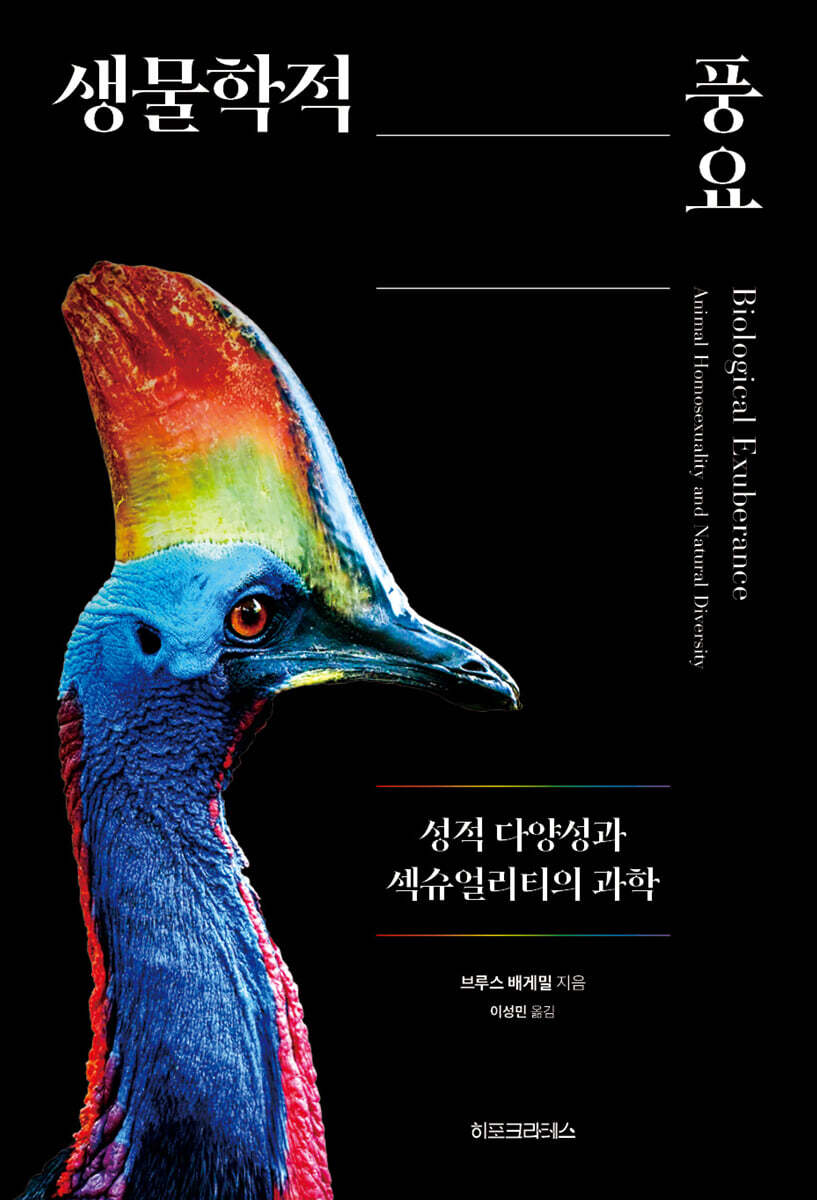
biological abundance
 |
Description
Book Introduction
A classic on animal homosexuality
- A word from MD
-
A classic on animal homosexualityA watershed and first encyclopedia in the study of animal sexual diversity and sexuality.
It criticizes the ideology that has been commonly used in the scientific community and the resulting misinterpretations.
Reading scientific accounts that deliberately exclude political messages will force you to accept that animal homosexuality is a "natural phenomenon" and to recognize the narrow, human-centered perspective.
August 22, 2023. Natural Science PD Ahn Hyun-jae
A landmark book of 1999, selected by the New York Public Library!
Quote from the 2003 US sodomy law abolition ruling!
A magnificent and groundbreaking compilation of the sexual identities of life on Earth.
A monumental book that marked a scientific turning point in the study of human homosexuality through a biological lens.
“Our limitations are not what we see, but our own vision.”
A translation of Bruce Bagemill's controversial work, Biological Exuberance (1999), has been published in Korea.
This book by Canadian biologist and linguist Bagemil is so extensive and controversial that it has become a watershed in the study of animal sexuality, encompassing homosexuality, bisexuality, transgenderism, and non-reproductive sexual activity.
Of the approximately 450 documented cases of homosexuality in animals up to the late 20th century, this comprehensive list includes cases of homosexuality in approximately 190 mammalian and bird species, as well as reptiles, amphibians, fish, and insects, along with photographs and illustrations.
It is no exaggeration to say that it is the first encyclopedia or zoological journal on animal sexuality.
Bagemi's extensive work proceeds to critically examine existing biological perspectives on animal homosexuality.
By examining research on animal homosexuality over 200 years, the book exposes the ideology that has been implicitly accepted in the scientific community and critiques the misinterpretations based on it.
What's interesting is the way Bagemil challenges the established strongholds of biology.
Rather than turning his extensive analytical material into political rhetoric accepting of homosexuality, he chose to let the scientific record speak for itself.
It was largely thanks to this argument that Bagemi's book was cited in the US sodomy law abolition ruling (2003) and the Indian Supreme Court's ruling decriminalizing homosexuality (2018).
In this bold attempt by Bae Ge-mil to transform the question of 'right and wrong' into the question of 'right and wrong,' we can feel the power of science to dismantle ideology.
Quote from the 2003 US sodomy law abolition ruling!
A magnificent and groundbreaking compilation of the sexual identities of life on Earth.
A monumental book that marked a scientific turning point in the study of human homosexuality through a biological lens.
“Our limitations are not what we see, but our own vision.”
A translation of Bruce Bagemill's controversial work, Biological Exuberance (1999), has been published in Korea.
This book by Canadian biologist and linguist Bagemil is so extensive and controversial that it has become a watershed in the study of animal sexuality, encompassing homosexuality, bisexuality, transgenderism, and non-reproductive sexual activity.
Of the approximately 450 documented cases of homosexuality in animals up to the late 20th century, this comprehensive list includes cases of homosexuality in approximately 190 mammalian and bird species, as well as reptiles, amphibians, fish, and insects, along with photographs and illustrations.
It is no exaggeration to say that it is the first encyclopedia or zoological journal on animal sexuality.
Bagemi's extensive work proceeds to critically examine existing biological perspectives on animal homosexuality.
By examining research on animal homosexuality over 200 years, the book exposes the ideology that has been implicitly accepted in the scientific community and critiques the misinterpretations based on it.
What's interesting is the way Bagemil challenges the established strongholds of biology.
Rather than turning his extensive analytical material into political rhetoric accepting of homosexuality, he chose to let the scientific record speak for itself.
It was largely thanks to this argument that Bagemi's book was cited in the US sodomy law abolition ruling (2003) and the Indian Supreme Court's ruling decriminalizing homosexuality (2018).
In this bold attempt by Bae Ge-mil to transform the question of 'right and wrong' into the question of 'right and wrong,' we can feel the power of science to dismantle ideology.
- You can preview some of the book's contents.
Preview
index
Praise for this book · 4
Introduction · 16
World Map of Animal Homosexuality · 26
Part I: The World of Polysexuals and Polygenders
Chapter 1: The Birds and the Bees · 31
Various forms of animal homosexuality
What good does that goose get?
: Comparison of male and female homosexuality
One Hundred and One Lesbian Behaviors: Calculating the Frequency of Homosexual Behaviors
Within gender, without gender, beyond gender
Chapter 2: Human-like Animals, Animal-like Humans · 85
From Federasty to Butch-Femme: Is It Only Human?
The Origins of Homosexuality and Culture in Primates
unnatural nature
Chapter 3: 200 Years of Perspectives on Wild Homosexuality · 153
A Brief History of Animal Homosexuality Research
"The Corruption of Moral Norms Among Butterflies": Homophobia in Zoology
Something that is never sex
Chapter 4: A Cover-Up of Animal Homosexuality · 220
“What kind of guy plays the female role?” · Homosexuality viewed through the lens of pseudo-heterosexuality
"The Path Forward for the Underprivileged" · Homosexuality as a Substitute for Heterosexuality
"The Errors in Their Way of Doing It" · Homosexuality as a Misidentification of Sex
Homosexuality as a pathological phenomenon: "a total abnormality of behavior"
Chapter 5: Not Just Having Babies: Daily Life and Reproduction · 297
The evolutionary 'value' of homosexuality
Homosexuality contributing to heterosexuality
Non-reproductive heterosexuality and alternative heterosexuality in animals
Chapter 6: A New Paradigm: Biological Abundance · 371
Left-Handed Bears and Hermaphrodites: Indigenous Knowledge Brings Biology to Life
A Revolution in Progress: Perspectives from Modern Science and Philosophy
Back to the Source: Indigenous Cosmology and Fractal Sexuality
The majestic excess of the real world
Part II: The Wonderful World of Animals
The Wild Side of Homosexuality, Bisexuality, and Transgenderism
Introduction · 456
Chapter 1 Mammals
primates
Apes · 462
Langurs and Lutungs · 504
Macaque · 519
Other primates · 558
marine mammals
Dolphins and Whales · 584
Seals and Manatees · 620
ungulates
Deer · 651
Giraffes, antelopes, and gazelles · 674
Wild sheep, goats, and buffalo · 696
Other dairy animals · 719
Other mammals
Carnivora · 743
Jewish · 772
Rodents, Insectivores, Bats · 793
Chapter 2 Birds
harriers and other waterfowl
Geese, Swans, Ducks · 822
Other waterfowl · 860
Long-legged wading birds · 878
wading bird
The snipe and its relatives · 908
Gulls and Terns · 936
Torches and songbirds
Ornamental birds, manakins, and others · 977
Swallows, pine grouse, finches, and more · 1001
Sparrow, Starling, and Crow · 1035
Birds of paradise, bowerbirds, and others · 1059
Other birds
The Flightless Bird · 1074
Birds of Prey, Galliformes · 1092
Hummingbirds, woodpeckers, and others · 1106
Acknowledgments · 1134
Translator's Note · 1139
supplement
Other types · 1147
References for other species · 1158
Notes and References for Part I · 1175
Permission to use photos · 1323
Animal Name Table · 1329
Find animal names · 1343
Introduction · 16
World Map of Animal Homosexuality · 26
Part I: The World of Polysexuals and Polygenders
Chapter 1: The Birds and the Bees · 31
Various forms of animal homosexuality
What good does that goose get?
: Comparison of male and female homosexuality
One Hundred and One Lesbian Behaviors: Calculating the Frequency of Homosexual Behaviors
Within gender, without gender, beyond gender
Chapter 2: Human-like Animals, Animal-like Humans · 85
From Federasty to Butch-Femme: Is It Only Human?
The Origins of Homosexuality and Culture in Primates
unnatural nature
Chapter 3: 200 Years of Perspectives on Wild Homosexuality · 153
A Brief History of Animal Homosexuality Research
"The Corruption of Moral Norms Among Butterflies": Homophobia in Zoology
Something that is never sex
Chapter 4: A Cover-Up of Animal Homosexuality · 220
“What kind of guy plays the female role?” · Homosexuality viewed through the lens of pseudo-heterosexuality
"The Path Forward for the Underprivileged" · Homosexuality as a Substitute for Heterosexuality
"The Errors in Their Way of Doing It" · Homosexuality as a Misidentification of Sex
Homosexuality as a pathological phenomenon: "a total abnormality of behavior"
Chapter 5: Not Just Having Babies: Daily Life and Reproduction · 297
The evolutionary 'value' of homosexuality
Homosexuality contributing to heterosexuality
Non-reproductive heterosexuality and alternative heterosexuality in animals
Chapter 6: A New Paradigm: Biological Abundance · 371
Left-Handed Bears and Hermaphrodites: Indigenous Knowledge Brings Biology to Life
A Revolution in Progress: Perspectives from Modern Science and Philosophy
Back to the Source: Indigenous Cosmology and Fractal Sexuality
The majestic excess of the real world
Part II: The Wonderful World of Animals
The Wild Side of Homosexuality, Bisexuality, and Transgenderism
Introduction · 456
Chapter 1 Mammals
primates
Apes · 462
Langurs and Lutungs · 504
Macaque · 519
Other primates · 558
marine mammals
Dolphins and Whales · 584
Seals and Manatees · 620
ungulates
Deer · 651
Giraffes, antelopes, and gazelles · 674
Wild sheep, goats, and buffalo · 696
Other dairy animals · 719
Other mammals
Carnivora · 743
Jewish · 772
Rodents, Insectivores, Bats · 793
Chapter 2 Birds
harriers and other waterfowl
Geese, Swans, Ducks · 822
Other waterfowl · 860
Long-legged wading birds · 878
wading bird
The snipe and its relatives · 908
Gulls and Terns · 936
Torches and songbirds
Ornamental birds, manakins, and others · 977
Swallows, pine grouse, finches, and more · 1001
Sparrow, Starling, and Crow · 1035
Birds of paradise, bowerbirds, and others · 1059
Other birds
The Flightless Bird · 1074
Birds of Prey, Galliformes · 1092
Hummingbirds, woodpeckers, and others · 1106
Acknowledgments · 1134
Translator's Note · 1139
supplement
Other types · 1147
References for other species · 1158
Notes and References for Part I · 1175
Permission to use photos · 1323
Animal Name Table · 1329
Find animal names · 1343
Detailed image

Into the book
In fact, there are numerous animals whose only couple bond is homosexual rather than heterosexual.
For example, male bottlenose dolphins form lifelong partnerships with each other, but males and females of this species typically do not mate at all.
Other animals that commonly form companionships, forming same-sex pairs rather than opposite-sex pairs, include musk oxen, elk, white-tailed deer, cheetahs, eastern grey kangaroos, red squirrels, and capuchins.
--- p.52, from “Part I, Chapter 1”
It is widespread among animals for an individual to engage in both homosexual and heterosexual activity.
Bisexuality occurs in more than half of mammalian and bird species where same-sex activity is found.
However, there are various forms and degrees of bisexuality, and these must be carefully distinguished when discussing sexual orientation in animals.
A useful distinction to make is between simultaneous bisexuality and its opposite, sequential bisexuality.
This is a chronological or chronological distinction between homosexual and heterosexual pursuits.
In sequential or serial bisexuality, periods of exclusive same-sex activity alternate with periods of exclusively opposite-sex activity.
In simultaneous bisexuality, homosexual and heterosexual activity occur simultaneously within a relatively short period of time (e.g., within the same mating season).
--- p.97-98, from “Part I, Chapter 2”
For most people, animals are symbolic.
The importance of animals lies not in what they are, but in what we think of them.
We attribute meaning and value to the existence and behavior of animals in ways that have little to do with their biological or social realities, ultimately treating them as symbols of natural purity or animality to justify our views of other humans.
The animals themselves remain enigmatic, silent in the face of what seems like an endless barrage of human interpretations of their lives.
If this were merely a matter of debate between people, perhaps it could be seen from a proper perspective as simply another human folly.
Unfortunately, the interpretations people apply to animal (sexual) behavior are far from harmless.
This can have serious consequences for both humans and animals, and can even be a matter of life and death.
For example, when a perpetrator assaults or murders a gay or lesbian person because he or she believes homosexuality is “unnatural,” or when politicians frame legislation and judicial decisions regarding homosexuality with terms like “crimes against nature,” much more is at stake than scientific interpretations of animal behavior.
--- p.146-147, from “Part I, Chapter 2”
From a dominance-based perspective on homosexual mounting, it is assumed that the mounting animal is a less voluntary participant in the interaction, while at the same time 'submitting' to the will of the more dominant individual who asserts his 'superiority'.
But in more than 30 species, the animal that actually provides the mount actually initiates the interaction.
As an invitation to mount, they 'present' their buttocks to other individuals, sometimes actively promoting anal penetration (among males) or other forms of interaction.
In situations where the animal giving the butt is a subordinate animal, this can simply be interpreted as a strengthening of the dominance system.
However, in many species, the animal that actively encourages and offers its buttocks for a lower-ranking animal to mount is actually the dominant individual.
Additionally, the 'explanation' of dominance often ignores not only the clear distinction between consensual and non-consensual mounts (or rape), but also evidence of sexual arousal and pleasure on the part of the mount-bearing animal.
--- p.199, from “Part I, Chapter 3”
The 'pseudo-heterosexual' interpretation of animal behavior shows striking similarities with stereotypes about human homosexuality.
The scientific quandary over assigning animals the role of "male" or "female" brings to mind a question often heard by gay and lesbian people: "Which one plays the man (or woman)?"
This assumption implies that homosexual relationships should be modeled after heterosexual relationships.
This is as narrow a view of human relationships as the concept of animal sexuality.
While each partner in a gay or lesbian relationship is often seen as "playing" half the role of a heterosexual couple, the reality is that gender categories are much more complex and multidimensional.
--- p.238, from “Part I, Chapter 4”
Most animal populations can sustain large numbers of non-breeding individuals without experiencing population decline.
In fact, in many species, the majority of individuals do not reproduce, yet they generally have no negative impact on the population.
For example, 90-98% of Damaraland mole-rat populations never reproduce, yet the population persists and even continues to grow regardless.
Scientists also calculated that a stable killer whale population could contain up to 30% of non-breeding females and still not experience any population decline.
Many other species also have significant non-breeding populations, with up to 90% or more of one sex unable to mate or reproduce.
Therefore, for homosexuality to affect population growth and size, exclusive homosexuality would have to occur on a much larger scale than has been seen in any other species.
--- p.303-304, from “Part I, Chapter 5”
In some animals, reproduction is actually actively 'suppressed'.
For example, in wolves, dominant members of the pack often physically attack lower-ranking individuals attempting to mate.
Female Savannah baboons sometimes form alliances to attack breeding females, disrupting fertile females or causing aborted pregnancies.
Also, in many mammals, high-ranking males prevent other males from approaching females.
However, in other species, the term suppression is a misnomer, as there is no coercion.
For example, young American bison are not 'disturbed' from mating by older males.
They just don't participate to the same extent (as discussed in Chapter 4).
In other species (particularly primates such as tamarins and marmosets, as well as birds with group breeding systems such as the horned kingfisher), scientists explain that individuals' reproductive efforts are not 'involuntarily' suppressed, but rather 'choose' to either forgo reproduction or 'refrain' from participating in reproductive opportunities.
--- p.347, from “Part I, Chapter 5”
Contrary to what you may have learned in high school, reproduction is not the ultimate 'goal' or inevitable outcome of biology.
This is just one consequence of a much larger pattern of energy 'expenditure', within which the overriding force is the need to use up surplus.
In this process, many organisms inherit genes, but about the same number of organisms lead a life in which they rarely reproduce.
The abundance of the Earth will not simply be 'contained' within reproduction.
That is, it overflows upon it… A life that is intensely short-lived or a life that burns continuously, whether procreative or simply creative, is fueled by the generosity of each being.
The equation of life simultaneously fosters enormous productivity and fruitless debauchery.
For example, male bottlenose dolphins form lifelong partnerships with each other, but males and females of this species typically do not mate at all.
Other animals that commonly form companionships, forming same-sex pairs rather than opposite-sex pairs, include musk oxen, elk, white-tailed deer, cheetahs, eastern grey kangaroos, red squirrels, and capuchins.
--- p.52, from “Part I, Chapter 1”
It is widespread among animals for an individual to engage in both homosexual and heterosexual activity.
Bisexuality occurs in more than half of mammalian and bird species where same-sex activity is found.
However, there are various forms and degrees of bisexuality, and these must be carefully distinguished when discussing sexual orientation in animals.
A useful distinction to make is between simultaneous bisexuality and its opposite, sequential bisexuality.
This is a chronological or chronological distinction between homosexual and heterosexual pursuits.
In sequential or serial bisexuality, periods of exclusive same-sex activity alternate with periods of exclusively opposite-sex activity.
In simultaneous bisexuality, homosexual and heterosexual activity occur simultaneously within a relatively short period of time (e.g., within the same mating season).
--- p.97-98, from “Part I, Chapter 2”
For most people, animals are symbolic.
The importance of animals lies not in what they are, but in what we think of them.
We attribute meaning and value to the existence and behavior of animals in ways that have little to do with their biological or social realities, ultimately treating them as symbols of natural purity or animality to justify our views of other humans.
The animals themselves remain enigmatic, silent in the face of what seems like an endless barrage of human interpretations of their lives.
If this were merely a matter of debate between people, perhaps it could be seen from a proper perspective as simply another human folly.
Unfortunately, the interpretations people apply to animal (sexual) behavior are far from harmless.
This can have serious consequences for both humans and animals, and can even be a matter of life and death.
For example, when a perpetrator assaults or murders a gay or lesbian person because he or she believes homosexuality is “unnatural,” or when politicians frame legislation and judicial decisions regarding homosexuality with terms like “crimes against nature,” much more is at stake than scientific interpretations of animal behavior.
--- p.146-147, from “Part I, Chapter 2”
From a dominance-based perspective on homosexual mounting, it is assumed that the mounting animal is a less voluntary participant in the interaction, while at the same time 'submitting' to the will of the more dominant individual who asserts his 'superiority'.
But in more than 30 species, the animal that actually provides the mount actually initiates the interaction.
As an invitation to mount, they 'present' their buttocks to other individuals, sometimes actively promoting anal penetration (among males) or other forms of interaction.
In situations where the animal giving the butt is a subordinate animal, this can simply be interpreted as a strengthening of the dominance system.
However, in many species, the animal that actively encourages and offers its buttocks for a lower-ranking animal to mount is actually the dominant individual.
Additionally, the 'explanation' of dominance often ignores not only the clear distinction between consensual and non-consensual mounts (or rape), but also evidence of sexual arousal and pleasure on the part of the mount-bearing animal.
--- p.199, from “Part I, Chapter 3”
The 'pseudo-heterosexual' interpretation of animal behavior shows striking similarities with stereotypes about human homosexuality.
The scientific quandary over assigning animals the role of "male" or "female" brings to mind a question often heard by gay and lesbian people: "Which one plays the man (or woman)?"
This assumption implies that homosexual relationships should be modeled after heterosexual relationships.
This is as narrow a view of human relationships as the concept of animal sexuality.
While each partner in a gay or lesbian relationship is often seen as "playing" half the role of a heterosexual couple, the reality is that gender categories are much more complex and multidimensional.
--- p.238, from “Part I, Chapter 4”
Most animal populations can sustain large numbers of non-breeding individuals without experiencing population decline.
In fact, in many species, the majority of individuals do not reproduce, yet they generally have no negative impact on the population.
For example, 90-98% of Damaraland mole-rat populations never reproduce, yet the population persists and even continues to grow regardless.
Scientists also calculated that a stable killer whale population could contain up to 30% of non-breeding females and still not experience any population decline.
Many other species also have significant non-breeding populations, with up to 90% or more of one sex unable to mate or reproduce.
Therefore, for homosexuality to affect population growth and size, exclusive homosexuality would have to occur on a much larger scale than has been seen in any other species.
--- p.303-304, from “Part I, Chapter 5”
In some animals, reproduction is actually actively 'suppressed'.
For example, in wolves, dominant members of the pack often physically attack lower-ranking individuals attempting to mate.
Female Savannah baboons sometimes form alliances to attack breeding females, disrupting fertile females or causing aborted pregnancies.
Also, in many mammals, high-ranking males prevent other males from approaching females.
However, in other species, the term suppression is a misnomer, as there is no coercion.
For example, young American bison are not 'disturbed' from mating by older males.
They just don't participate to the same extent (as discussed in Chapter 4).
In other species (particularly primates such as tamarins and marmosets, as well as birds with group breeding systems such as the horned kingfisher), scientists explain that individuals' reproductive efforts are not 'involuntarily' suppressed, but rather 'choose' to either forgo reproduction or 'refrain' from participating in reproductive opportunities.
--- p.347, from “Part I, Chapter 5”
Contrary to what you may have learned in high school, reproduction is not the ultimate 'goal' or inevitable outcome of biology.
This is just one consequence of a much larger pattern of energy 'expenditure', within which the overriding force is the need to use up surplus.
In this process, many organisms inherit genes, but about the same number of organisms lead a life in which they rarely reproduce.
The abundance of the Earth will not simply be 'contained' within reproduction.
That is, it overflows upon it… A life that is intensely short-lived or a life that burns continuously, whether procreative or simply creative, is fueled by the generosity of each being.
The equation of life simultaneously fosters enormous productivity and fruitless debauchery.
--- p.439-440, from “Part I, Chapter 6”
Publisher's Review
★ Selected as a monumental book of 1999 by the New York Public Library
★ Publisher's Weekly "Best Book of 1999"
★ Quote from the 2003 U.S. sodomy law abolition ruling
★ Quote from the 2018 Indian Supreme Court ruling decriminalizing homosexuality
★ Finalist in the 2020 Stonewall Book Award Nonfiction category
A magnificent and groundbreaking compilation of the sexual identities of life on Earth.
Through a biological lens on homosexuality,
The power of science to dismantle the ideology of sexuality and confront it solely through argument and interpretation.
“Our limitations are not what we see, but our vision.”
A translation of Bruce Bagemill's controversial work, Biological Exuberance (1999), has been published in Korea.
This book, which compiles over 200 years of scientific analysis of animal sexuality by Canadian biologist and linguist Bagemil, is so extensive and controversial that it has become a watershed moment in the study of animal homosexuality.
This book comprehensively lists, with photographs and illustrations, approximately 190 mammalian and bird species, among the approximately 450 scientifically documented cases of homosexuality in animals up to the late 20th century, as well as cases of homosexuality in reptiles, amphibians, fish, insects, spiders, and domestic animals.
It is no exaggeration to say that it is the first encyclopedia or zoological journal on animal sexuality.
Bagemi's analysis of the diverse sexualities of animals, encompassing homosexuality, bisexuality, and transgenderism, is overwhelming and magnificent in its scope and depth.
However, this extensive work by Bae Ge-mil does not merely serve as a source for future research.
Because the history of scientific research on animal homosexuality parallels the history of human perspectives on homosexuality, the discussion shifts to the question of scientific interpretation of homosexuality, bisexuality, and transgenderism.
He examines the research on animal homosexuality in zoology and biology over the past two to three centuries, starting in the 1700s, and exposes the problems of their argumentative methods: faulty premises, assumptions, analogies, and generalizations.
This forces us to confront the ideology that has been implicitly accepted even in the scientific community, which is considered to be at the forefront of objectivity.
What's interesting, as biologist Michael Zimmerman notes, is how Bagemil responds to challenging such ideologies.
Rather than turning his analysis into a political statement arguing for the acceptance of homosexuality, he chose to let the scientific record speak for itself.
In Bae Ge-mil's attempt to transform the question of 'right and wrong' into the question of 'right and wrong,' we can feel the power of science to dismantle ideology.
Human Self-Projection into the Animal World: Heterosexuality and Reproductive Empowerment
“The lives of queer animals are far more diverse than we ever imagined.”
The ideology that has dominated the fields of zoology and biology can be described as 'human self-projection onto the animal world.'
It is an interpretation of the various sexualities of animals, including homosexuality, bisexuality, and transgenderism, with the beliefs, emotions, and desires of humans.
Human self-projection, represented by heterosexuality and reproductive-centeredness, takes the form of assuming homosexuality as heterosexuality, terminological denial of homosexual activity, inappropriate or inconsistent application, and omission or suppression of information.
There is a deep-seated hatred for homosexuality in the view that mounts or other sexual activities between animals of the same sex are activities that supplement or replace heterosexuality, or that they are errors caused by misidentification of the sex or illness.
Bagemi exposes the problems of this perspective through extensive field research data.
Not only does it list numerous examples of homosexuality, bisexuality, transgenderism, and non-reproductive sexual behavior in mammals—primates, marine mammals, ungulates, marsupials, rodents, etc.—and birds to refute misinterpretations (Part 1), it also presents sexuality profiles of individual animals within those species separately (Part 2).
The animal sexual activities he enumerates are so diverse that they obscure the distinction between heterosexuality and homosexuality, and so confusing that there are no consistently applicable categories.
It is expressed in infinitely diverse forms according to the life of an individual, various communities, different species, the order of time, etc.
In Bae Ge-mil's view, the ignorance of biology so far stems from the single-minded attempt to explain the diverse sexualities of animals, such as homosexuality, bisexuality, transgenderism, and non-reproductive sexual activity, solely based on reproduction.
In fact, such attempts are still continuing.
As John Haldane, whom Baggemil also quotes, said, “If the natural world is stranger than we know, we must also accept that the lives of ‘queer’ animals are far more varied than we ever imagined.”
A false debate filled with uniform interspecies comparisons
We must turn our attention to nature itself, not to humans interpreting it.
The debate surrounding animal homosexuality often boils down to polarized arguments:
“There is no homosexuality in animals.
Therefore, human homosexuality is abnormal”, “Since homosexuality appears in animals, homosexuality is natural.
Therefore, human homosexuality should also be accepted as natural.”
The issues at stake in this debate converge on two points.
The first is whether homosexuality exists in the animal world, and the second is whether the animal world and human society can be equated.
Bagemi points out that both of these arguments fall into overly simplistic logical schemata.
The logic that animals are nature itself, and that what happens in nature should also be acknowledged by humans.
Only the presence or absence of animal homosexuality is considered.
Therefore, on one hand, each side supports its own claims with omitted information or biased interpretation of observed or reported phenomena, and on the other hand, with indiscriminate acceptance and hasty generalization.
It's like Procrustes from Greek mythology, who cuts or stretches the traveler's body to fit the length of the bed.
First of all, Baegemil does not limit the meaning of homosexuality to sex, but expands it to a broader meaning that includes courtship, affection, pair bonding, and child rearing.
These activities are not mutually exclusive and often intermingle, but they help us understand the diverse forms of homosexuality that occur in the animal kingdom.
At the same time, he examines animal homosexuality in relation to communication, tool making and use, taboos, rituals, etc., and states that we should never exclude the formation of an animal-specific culture.
Animals, too, have their own unique culture, and animal homosexuality combines biological and cultural dimensions to present countless forms, variations, and uniqueness.
Animal sexuality is a continuous and broad spectrum.
As the polarized debate surrounding animal homosexuality demonstrates, many feel a strong temptation to draw conclusions (positive or negative) about human homosexuality based on animal behavior.
In this regard, Bagemi points out that without considering the full complexity and richness of expressions of homosexuality in both animals and humans, it is impossible to comprehensively grasp the essential nature and context of the phenomenon of homosexuality, as well as its significance in interspecies comparisons.
The question, "Is homosexuality natural? Is homosexuality normal?" is nothing more than a wasteful debate, swayed by human subjective standards.
As Bae Ge-mil said, it is time to turn our eyes from interpreting nature to nature itself, the object of study.
A New Paradigm for Understanding Nature's Nonlinear Complexity: Biological Abundance
Examining the diverse sexualities of living things at the intersection of indigenous culture and modern thought.
So how can we study nature beyond the subjective standards of human beings? Bae Ge-mil seeks to decipher the powerful ideology that has dominated Western science for over 200 years.
He makes it clear that this exploration is not about replacing or supplementing existing theories with new theories or explanations.
Rather, this exploration represents a fundamental shift in perspective on what we think we understand, and a new worldview for viewing nature.
To quote him, it is not about adding new facts to existing knowledge, but about adding new knowledge patterns to existing facts.
Interestingly, Bagemil focuses on indigenous cultures that have been tabooed by the scientific community as unscientific.
The common perceptions of animal homosexuality and transgenderism among Native American, New Guinean and Melanesian, and Siberian and Arctic cultures closely resemble and align with modern scientific observations.
Of course, we cannot simply accept the fantastical and mythical beliefs that permeate their culture, but we can read a new paradigm for studying nature from their inclusive perspective that accepts the polysexual and polygendered natural world as it is.
It is at this point that Bagemi combines modern science, such as post-Darwinian evolutionary theory, chaos theory, and biodiversity studies, with the general economic theory of Georges Bataille.
At the intersection of indigenous culture and modern thought, nonlinear and unpredictable natural phenomena, destructive or counterproductive events, countless inconsistent or counterintuitive transformations, and seemingly wasteful excesses of life are not the results or byproducts of larger forces like evolution, the laws of physics, or the progress of history.
It is itself a component of a disharmonious whole, and the excessive waste and abundance of the natural world is the source and essence of life from which all other phenomena flow.
“Ultimately, the synthesis of scientific views represented by biological abundance brings us full circle.
This perspective resolves dichotomous oppositions and integrates dualisms while valuing differences.
And we embrace paradox, recognizing the coexistence of seemingly contradictory phenomena… In this worldview, which is both primordial and futuristic, gender is kaleidoscopically diverse, sexuality is diverse, and the categories of male and female are fluid and changeable.
In a word, it is the world we live in.”
(Part I, Chapter 6, Section 4.
(From 'The Majestic Excess of the Real World')
A paradigm shift is bound to be painful and shocking.
It's painful to realize how many lies and prejudices we've previously held, but it's also difficult to accept that so many truths and secrets lie before us.
As Bruce Bagemill says, his Biological Abundance is not a final and definitive statement on animal sexuality.
How the prologue he bravely opened unfolds and what the ending will be will depend on our ability to overcome the pain and shock.
★ Publisher's Weekly "Best Book of 1999"
★ Quote from the 2003 U.S. sodomy law abolition ruling
★ Quote from the 2018 Indian Supreme Court ruling decriminalizing homosexuality
★ Finalist in the 2020 Stonewall Book Award Nonfiction category
A magnificent and groundbreaking compilation of the sexual identities of life on Earth.
Through a biological lens on homosexuality,
The power of science to dismantle the ideology of sexuality and confront it solely through argument and interpretation.
“Our limitations are not what we see, but our vision.”
A translation of Bruce Bagemill's controversial work, Biological Exuberance (1999), has been published in Korea.
This book, which compiles over 200 years of scientific analysis of animal sexuality by Canadian biologist and linguist Bagemil, is so extensive and controversial that it has become a watershed moment in the study of animal homosexuality.
This book comprehensively lists, with photographs and illustrations, approximately 190 mammalian and bird species, among the approximately 450 scientifically documented cases of homosexuality in animals up to the late 20th century, as well as cases of homosexuality in reptiles, amphibians, fish, insects, spiders, and domestic animals.
It is no exaggeration to say that it is the first encyclopedia or zoological journal on animal sexuality.
Bagemi's analysis of the diverse sexualities of animals, encompassing homosexuality, bisexuality, and transgenderism, is overwhelming and magnificent in its scope and depth.
However, this extensive work by Bae Ge-mil does not merely serve as a source for future research.
Because the history of scientific research on animal homosexuality parallels the history of human perspectives on homosexuality, the discussion shifts to the question of scientific interpretation of homosexuality, bisexuality, and transgenderism.
He examines the research on animal homosexuality in zoology and biology over the past two to three centuries, starting in the 1700s, and exposes the problems of their argumentative methods: faulty premises, assumptions, analogies, and generalizations.
This forces us to confront the ideology that has been implicitly accepted even in the scientific community, which is considered to be at the forefront of objectivity.
What's interesting, as biologist Michael Zimmerman notes, is how Bagemil responds to challenging such ideologies.
Rather than turning his analysis into a political statement arguing for the acceptance of homosexuality, he chose to let the scientific record speak for itself.
In Bae Ge-mil's attempt to transform the question of 'right and wrong' into the question of 'right and wrong,' we can feel the power of science to dismantle ideology.
Human Self-Projection into the Animal World: Heterosexuality and Reproductive Empowerment
“The lives of queer animals are far more diverse than we ever imagined.”
The ideology that has dominated the fields of zoology and biology can be described as 'human self-projection onto the animal world.'
It is an interpretation of the various sexualities of animals, including homosexuality, bisexuality, and transgenderism, with the beliefs, emotions, and desires of humans.
Human self-projection, represented by heterosexuality and reproductive-centeredness, takes the form of assuming homosexuality as heterosexuality, terminological denial of homosexual activity, inappropriate or inconsistent application, and omission or suppression of information.
There is a deep-seated hatred for homosexuality in the view that mounts or other sexual activities between animals of the same sex are activities that supplement or replace heterosexuality, or that they are errors caused by misidentification of the sex or illness.
Bagemi exposes the problems of this perspective through extensive field research data.
Not only does it list numerous examples of homosexuality, bisexuality, transgenderism, and non-reproductive sexual behavior in mammals—primates, marine mammals, ungulates, marsupials, rodents, etc.—and birds to refute misinterpretations (Part 1), it also presents sexuality profiles of individual animals within those species separately (Part 2).
The animal sexual activities he enumerates are so diverse that they obscure the distinction between heterosexuality and homosexuality, and so confusing that there are no consistently applicable categories.
It is expressed in infinitely diverse forms according to the life of an individual, various communities, different species, the order of time, etc.
In Bae Ge-mil's view, the ignorance of biology so far stems from the single-minded attempt to explain the diverse sexualities of animals, such as homosexuality, bisexuality, transgenderism, and non-reproductive sexual activity, solely based on reproduction.
In fact, such attempts are still continuing.
As John Haldane, whom Baggemil also quotes, said, “If the natural world is stranger than we know, we must also accept that the lives of ‘queer’ animals are far more varied than we ever imagined.”
A false debate filled with uniform interspecies comparisons
We must turn our attention to nature itself, not to humans interpreting it.
The debate surrounding animal homosexuality often boils down to polarized arguments:
“There is no homosexuality in animals.
Therefore, human homosexuality is abnormal”, “Since homosexuality appears in animals, homosexuality is natural.
Therefore, human homosexuality should also be accepted as natural.”
The issues at stake in this debate converge on two points.
The first is whether homosexuality exists in the animal world, and the second is whether the animal world and human society can be equated.
Bagemi points out that both of these arguments fall into overly simplistic logical schemata.
The logic that animals are nature itself, and that what happens in nature should also be acknowledged by humans.
Only the presence or absence of animal homosexuality is considered.
Therefore, on one hand, each side supports its own claims with omitted information or biased interpretation of observed or reported phenomena, and on the other hand, with indiscriminate acceptance and hasty generalization.
It's like Procrustes from Greek mythology, who cuts or stretches the traveler's body to fit the length of the bed.
First of all, Baegemil does not limit the meaning of homosexuality to sex, but expands it to a broader meaning that includes courtship, affection, pair bonding, and child rearing.
These activities are not mutually exclusive and often intermingle, but they help us understand the diverse forms of homosexuality that occur in the animal kingdom.
At the same time, he examines animal homosexuality in relation to communication, tool making and use, taboos, rituals, etc., and states that we should never exclude the formation of an animal-specific culture.
Animals, too, have their own unique culture, and animal homosexuality combines biological and cultural dimensions to present countless forms, variations, and uniqueness.
Animal sexuality is a continuous and broad spectrum.
As the polarized debate surrounding animal homosexuality demonstrates, many feel a strong temptation to draw conclusions (positive or negative) about human homosexuality based on animal behavior.
In this regard, Bagemi points out that without considering the full complexity and richness of expressions of homosexuality in both animals and humans, it is impossible to comprehensively grasp the essential nature and context of the phenomenon of homosexuality, as well as its significance in interspecies comparisons.
The question, "Is homosexuality natural? Is homosexuality normal?" is nothing more than a wasteful debate, swayed by human subjective standards.
As Bae Ge-mil said, it is time to turn our eyes from interpreting nature to nature itself, the object of study.
A New Paradigm for Understanding Nature's Nonlinear Complexity: Biological Abundance
Examining the diverse sexualities of living things at the intersection of indigenous culture and modern thought.
So how can we study nature beyond the subjective standards of human beings? Bae Ge-mil seeks to decipher the powerful ideology that has dominated Western science for over 200 years.
He makes it clear that this exploration is not about replacing or supplementing existing theories with new theories or explanations.
Rather, this exploration represents a fundamental shift in perspective on what we think we understand, and a new worldview for viewing nature.
To quote him, it is not about adding new facts to existing knowledge, but about adding new knowledge patterns to existing facts.
Interestingly, Bagemil focuses on indigenous cultures that have been tabooed by the scientific community as unscientific.
The common perceptions of animal homosexuality and transgenderism among Native American, New Guinean and Melanesian, and Siberian and Arctic cultures closely resemble and align with modern scientific observations.
Of course, we cannot simply accept the fantastical and mythical beliefs that permeate their culture, but we can read a new paradigm for studying nature from their inclusive perspective that accepts the polysexual and polygendered natural world as it is.
It is at this point that Bagemi combines modern science, such as post-Darwinian evolutionary theory, chaos theory, and biodiversity studies, with the general economic theory of Georges Bataille.
At the intersection of indigenous culture and modern thought, nonlinear and unpredictable natural phenomena, destructive or counterproductive events, countless inconsistent or counterintuitive transformations, and seemingly wasteful excesses of life are not the results or byproducts of larger forces like evolution, the laws of physics, or the progress of history.
It is itself a component of a disharmonious whole, and the excessive waste and abundance of the natural world is the source and essence of life from which all other phenomena flow.
“Ultimately, the synthesis of scientific views represented by biological abundance brings us full circle.
This perspective resolves dichotomous oppositions and integrates dualisms while valuing differences.
And we embrace paradox, recognizing the coexistence of seemingly contradictory phenomena… In this worldview, which is both primordial and futuristic, gender is kaleidoscopically diverse, sexuality is diverse, and the categories of male and female are fluid and changeable.
In a word, it is the world we live in.”
(Part I, Chapter 6, Section 4.
(From 'The Majestic Excess of the Real World')
A paradigm shift is bound to be painful and shocking.
It's painful to realize how many lies and prejudices we've previously held, but it's also difficult to accept that so many truths and secrets lie before us.
As Bruce Bagemill says, his Biological Abundance is not a final and definitive statement on animal sexuality.
How the prologue he bravely opened unfolds and what the ending will be will depend on our ability to overcome the pain and shock.
“There are books that seem absolutely fateful the moment they are published.
Biological Abundance is just such a book.
It's a masterpiece of unconscious humor, an outrage at the ways in which the truth about animal homosexuality has been suppressed in the past, and an epic poem about the abundance of animal homosexuality in nature.
“With its irresistible interest as you turn the pages, this book will contribute greatly to the enjoyment of the public.”
Evening Standard (London)
“Bae Ge-mil’s monumental book, Biological Abundance, embraces paradoxes and attempts to make a compelling argument for the very essential phenomena of existence that seem incompatible.
“It is a milestone in scientific literature.”
Chicago Tribune
“Every now and then, a work of art comes out into the world and ignites a burning passion.
Biological Abundance may not be exactly a scientific revolution, but it is at least the foundation for a remarkable paradigm shift in the realm of animal sexuality, and ultimately human sexuality.
“This book literally challenges our entire concept of the word ‘nature.’”
"gear"
“A brilliant and important challenge to conventional wisdom, this book thoroughly demonstrates the diverse sexual orientations of animals, providing both general readers and experts with compelling examples.
Instead of arguing that humans need to accept homosexuality, it has been elevated to a comprehensive and monumental biological interpretation of the world.”
Publisher's Weekly
“Biologist Bruce Bagemill brought nature out into the gay-friendly world of the post-Darwinian era.
The general reader will find the writing elegant, persuasive, and highly engaging.
“Also, the photographs and illustrations documenting sexual diversity make this book unique and easy to read.”
Washington Blade
“In this remarkable book, Bruce Bagemill shows that homosexuality is essentially ubiquitous.
Bagemil leverages and compellingly interprets vast amounts of data dating back decades.
And it challenges the stubborn claims of mainstream biology.
Ignore the criticism that Biological Abundance is comprised of two or three volumes.
Because just one of them is enough to change the world.”
The Observer (London)
In Biological Abundance, author Bruce Bagemill describes an animal kingdom that embraces all sexual orientations.
From a pair of female grizzly bears raising their cubs together to male lions chasing away envious males to enjoy trysts, they paint a complex mosaic of humanity.
In this book, Bagemil deconstructs the heterosexual Noah's Ark myth we know, where only male and female ark passengers were present, and reveals the dusty truth.”
The Advocate
“Baegemil has collected a wealth of information on homosexuality and non-reproductive heterosexuality.
This topic has been written in an academic yet accessible manner.
“I recommend this book to anyone interested in animal sexual behavior.”
Animal Behavior
“Bae Ge-mil has written a wonderful book about the lives of gay, lesbian, bisexual, and transgender animals.
It's so captivating that I find myself turning the pages without even realizing it.
Filled with photos of homosexual pairings and sexual encounters between our furry and feathered friends, Biological Abundance is one of the most entertaining and compelling science books of the year.
Buy it now.
“It’s amazing.”
barnesandnoble.com (Official Review) “There are books that seem absolutely destined the moment they are published.
Biological Abundance is just such a book.
It's a masterpiece of unconscious humor, an outrage at the ways in which the truth about animal homosexuality has been suppressed in the past, and an epic poem about the abundance of animal homosexuality in nature.
“With its irresistible interest as you turn the pages, this book will contribute greatly to the enjoyment of the public.”
Evening Standard (London)
“Bae Ge-mil’s monumental book, Biological Abundance, embraces paradoxes and attempts to make a compelling argument for the very essential phenomena of existence that seem incompatible.
“It is a milestone in scientific literature.”
Chicago Tribune
“Every now and then, a work of art comes out into the world and ignites a burning passion.
Biological Abundance may not be exactly a scientific revolution, but it is at least the foundation for a remarkable paradigm shift in the realm of animal sexuality, and ultimately human sexuality.
“This book literally challenges our entire concept of the word ‘nature.’”
"gear"
“A brilliant and important challenge to conventional wisdom, this book thoroughly demonstrates the diverse sexual orientations of animals, providing both general readers and experts with compelling examples.
Instead of arguing that humans need to accept homosexuality, it has been elevated to a comprehensive and monumental biological interpretation of the world.”
Publisher's Weekly
“Biologist Bruce Bagemill brought nature out into the gay-friendly world of the post-Darwinian era.
The general reader will find the writing elegant, persuasive, and highly engaging.
“Also, the photographs and illustrations documenting sexual diversity make this book unique and easy to read.”
Washington Blade
“In this remarkable book, Bruce Bagemill shows that homosexuality is essentially ubiquitous.
Bagemil leverages and compellingly interprets vast amounts of data dating back decades.
And it challenges the stubborn claims of mainstream biology.
Ignore the criticism that Biological Abundance is comprised of two or three volumes.
Because just one of them is enough to change the world.”
The Observer (London)
In Biological Abundance, author Bruce Bagemill describes an animal kingdom that embraces all sexual orientations.
From a pair of female grizzly bears raising their cubs together to male lions chasing away envious males to enjoy trysts, they paint a complex mosaic of humanity.
In this book, Bagemil deconstructs the heterosexual Noah's Ark myth we know, where only male and female ark passengers were present, and reveals the dusty truth.”
The Advocate
“Baegemil has collected a wealth of information on homosexuality and non-reproductive heterosexuality.
This topic has been written in an academic yet accessible manner.
“I recommend this book to anyone interested in animal sexual behavior.”
Animal Behavior
“Bae Ge-mil has written a wonderful book about the lives of gay, lesbian, bisexual, and transgender animals.
It's so captivating that I find myself turning the pages without even realizing it.
Filled with photos of homosexual pairings and sexual encounters between our furry and feathered friends, Biological Abundance is one of the most entertaining and compelling science books of the year.
Buy it now.
“It’s amazing.”
barnesandnoble.com (official review)
Biological Abundance is just such a book.
It's a masterpiece of unconscious humor, an outrage at the ways in which the truth about animal homosexuality has been suppressed in the past, and an epic poem about the abundance of animal homosexuality in nature.
“With its irresistible interest as you turn the pages, this book will contribute greatly to the enjoyment of the public.”
Evening Standard (London)
“Bae Ge-mil’s monumental book, Biological Abundance, embraces paradoxes and attempts to make a compelling argument for the very essential phenomena of existence that seem incompatible.
“It is a milestone in scientific literature.”
Chicago Tribune
“Every now and then, a work of art comes out into the world and ignites a burning passion.
Biological Abundance may not be exactly a scientific revolution, but it is at least the foundation for a remarkable paradigm shift in the realm of animal sexuality, and ultimately human sexuality.
“This book literally challenges our entire concept of the word ‘nature.’”
"gear"
“A brilliant and important challenge to conventional wisdom, this book thoroughly demonstrates the diverse sexual orientations of animals, providing both general readers and experts with compelling examples.
Instead of arguing that humans need to accept homosexuality, it has been elevated to a comprehensive and monumental biological interpretation of the world.”
Publisher's Weekly
“Biologist Bruce Bagemill brought nature out into the gay-friendly world of the post-Darwinian era.
The general reader will find the writing elegant, persuasive, and highly engaging.
“Also, the photographs and illustrations documenting sexual diversity make this book unique and easy to read.”
Washington Blade
“In this remarkable book, Bruce Bagemill shows that homosexuality is essentially ubiquitous.
Bagemil leverages and compellingly interprets vast amounts of data dating back decades.
And it challenges the stubborn claims of mainstream biology.
Ignore the criticism that Biological Abundance is comprised of two or three volumes.
Because just one of them is enough to change the world.”
The Observer (London)
In Biological Abundance, author Bruce Bagemill describes an animal kingdom that embraces all sexual orientations.
From a pair of female grizzly bears raising their cubs together to male lions chasing away envious males to enjoy trysts, they paint a complex mosaic of humanity.
In this book, Bagemil deconstructs the heterosexual Noah's Ark myth we know, where only male and female ark passengers were present, and reveals the dusty truth.”
The Advocate
“Baegemil has collected a wealth of information on homosexuality and non-reproductive heterosexuality.
This topic has been written in an academic yet accessible manner.
“I recommend this book to anyone interested in animal sexual behavior.”
Animal Behavior
“Bae Ge-mil has written a wonderful book about the lives of gay, lesbian, bisexual, and transgender animals.
It's so captivating that I find myself turning the pages without even realizing it.
Filled with photos of homosexual pairings and sexual encounters between our furry and feathered friends, Biological Abundance is one of the most entertaining and compelling science books of the year.
Buy it now.
“It’s amazing.”
barnesandnoble.com (Official Review) “There are books that seem absolutely destined the moment they are published.
Biological Abundance is just such a book.
It's a masterpiece of unconscious humor, an outrage at the ways in which the truth about animal homosexuality has been suppressed in the past, and an epic poem about the abundance of animal homosexuality in nature.
“With its irresistible interest as you turn the pages, this book will contribute greatly to the enjoyment of the public.”
Evening Standard (London)
“Bae Ge-mil’s monumental book, Biological Abundance, embraces paradoxes and attempts to make a compelling argument for the very essential phenomena of existence that seem incompatible.
“It is a milestone in scientific literature.”
Chicago Tribune
“Every now and then, a work of art comes out into the world and ignites a burning passion.
Biological Abundance may not be exactly a scientific revolution, but it is at least the foundation for a remarkable paradigm shift in the realm of animal sexuality, and ultimately human sexuality.
“This book literally challenges our entire concept of the word ‘nature.’”
"gear"
“A brilliant and important challenge to conventional wisdom, this book thoroughly demonstrates the diverse sexual orientations of animals, providing both general readers and experts with compelling examples.
Instead of arguing that humans need to accept homosexuality, it has been elevated to a comprehensive and monumental biological interpretation of the world.”
Publisher's Weekly
“Biologist Bruce Bagemill brought nature out into the gay-friendly world of the post-Darwinian era.
The general reader will find the writing elegant, persuasive, and highly engaging.
“Also, the photographs and illustrations documenting sexual diversity make this book unique and easy to read.”
Washington Blade
“In this remarkable book, Bruce Bagemill shows that homosexuality is essentially ubiquitous.
Bagemil leverages and compellingly interprets vast amounts of data dating back decades.
And it challenges the stubborn claims of mainstream biology.
Ignore the criticism that Biological Abundance is comprised of two or three volumes.
Because just one of them is enough to change the world.”
The Observer (London)
In Biological Abundance, author Bruce Bagemill describes an animal kingdom that embraces all sexual orientations.
From a pair of female grizzly bears raising their cubs together to male lions chasing away envious males to enjoy trysts, they paint a complex mosaic of humanity.
In this book, Bagemil deconstructs the heterosexual Noah's Ark myth we know, where only male and female ark passengers were present, and reveals the dusty truth.”
The Advocate
“Baegemil has collected a wealth of information on homosexuality and non-reproductive heterosexuality.
This topic has been written in an academic yet accessible manner.
“I recommend this book to anyone interested in animal sexual behavior.”
Animal Behavior
“Bae Ge-mil has written a wonderful book about the lives of gay, lesbian, bisexual, and transgender animals.
It's so captivating that I find myself turning the pages without even realizing it.
Filled with photos of homosexual pairings and sexual encounters between our furry and feathered friends, Biological Abundance is one of the most entertaining and compelling science books of the year.
Buy it now.
“It’s amazing.”
barnesandnoble.com (official review)
GOODS SPECIFICS
- Date of issue: August 8, 2023
- Format: Hardcover book binding method guide
- Page count, weight, size: 1,356 pages | 1,788g | 152*225*60mm
- ISBN13: 9791198356604
- ISBN10: 119835660X
You may also like
카테고리
korean


korean

![GQ KOREA Mark (Monthly): December [2025]](http://librairie.coreenne.fr/cdn/shop/files/8ef265dbbfbf186523ed75ba7319009d.jpg?v=1765340328&width=3840)


