

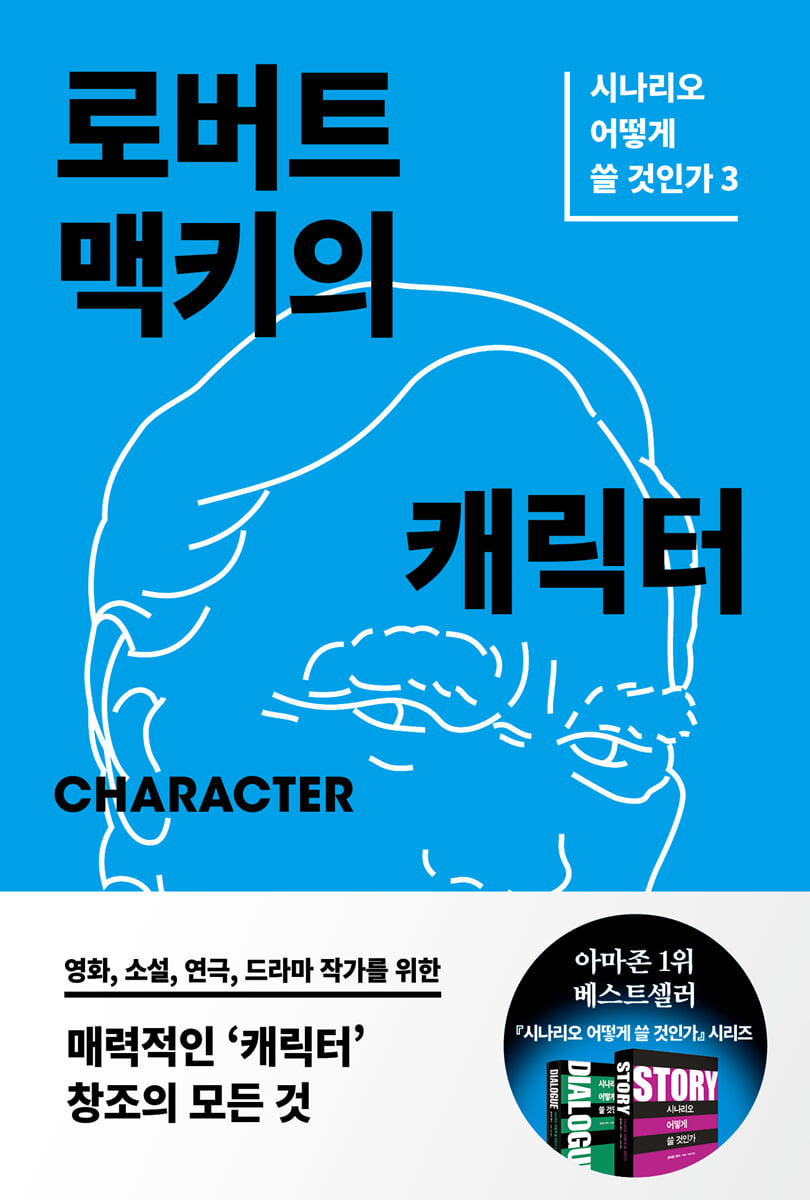
Robert Mackie's character
 |
Description
Book Introduction
“The story is the character, and the character is the story!”
Storytelling master Robert McKee
The complete trilogy of "Story," "Dialogue," and "Characters."
Robert Mackie, author of the #1 Amazon bestseller "How to Write a Story Screenplay," has published "Robert Mackie's Characters," a book that covers everything about character creation for writers of films, novels, dramas, and plays.
This book is the final installment of a trilogy that follows 『How to Write a Story Screenplay』 and 『How to Write a Dialogue Screenplay 2』, which have been recognized as canonical books in the field of writing for the past 25 years.
Robert McKee has taught countless screenwriters, novelists, playwrights, producers, and directors, including Peter Jackson of "The Lord of the Rings" and the creative teams at Pixar and Disney. His Story Seminar, known as "The Legendary Lecture," is famous for producing 60 Academy Award winners, 200 Academy Award nominees, 200 Emmy Award winners, 1,000 Emmy Award nominees, 100 Writers Guild of America Award winners, and 50 Directors Guild of America Award winners.
In Korea, it was translated and published as 『STORY How to Write a Scenario』 (2002) and 『DIALOGUE How to Write a Scenario 2』 (2018), selling over 150,000 copies and establishing itself as a representative textbook in playwriting, creative writing, and film departments.
"Robert Mackie's Characters," following his previous works "Story" and "Dialogue," delves into how characters in various genres, including film, novels, drama, and theater, can satisfy our curiosity and trust.
From Homer's epic poems and Shakespeare's plays, to the film "A Fish Called Wanda," the novels "Pride and Prejudice" and "Heart of Darkness," and the TV series "Game of Thrones," "Sex and the City," "The Sopranos," and "Breaking Bad," it systematically explains the techniques and strategies for creating characters by deconstructing stories of various genres.
Storytelling master Robert McKee
The complete trilogy of "Story," "Dialogue," and "Characters."
Robert Mackie, author of the #1 Amazon bestseller "How to Write a Story Screenplay," has published "Robert Mackie's Characters," a book that covers everything about character creation for writers of films, novels, dramas, and plays.
This book is the final installment of a trilogy that follows 『How to Write a Story Screenplay』 and 『How to Write a Dialogue Screenplay 2』, which have been recognized as canonical books in the field of writing for the past 25 years.
Robert McKee has taught countless screenwriters, novelists, playwrights, producers, and directors, including Peter Jackson of "The Lord of the Rings" and the creative teams at Pixar and Disney. His Story Seminar, known as "The Legendary Lecture," is famous for producing 60 Academy Award winners, 200 Academy Award nominees, 200 Emmy Award winners, 1,000 Emmy Award nominees, 100 Writers Guild of America Award winners, and 50 Directors Guild of America Award winners.
In Korea, it was translated and published as 『STORY How to Write a Scenario』 (2002) and 『DIALOGUE How to Write a Scenario 2』 (2018), selling over 150,000 copies and establishing itself as a representative textbook in playwriting, creative writing, and film departments.
"Robert Mackie's Characters," following his previous works "Story" and "Dialogue," delves into how characters in various genres, including film, novels, drama, and theater, can satisfy our curiosity and trust.
From Homer's epic poems and Shakespeare's plays, to the film "A Fish Called Wanda," the novels "Pride and Prejudice" and "Heart of Darkness," and the TV series "Game of Thrones," "Sex and the City," "The Sopranos," and "Breaking Bad," it systematically explains the techniques and strategies for creating characters by deconstructing stories of various genres.
- You can preview some of the book's contents.
Preview
index
preface
Part 1: In Praise of Character
Chapter 1: Characters vs. Humans
Chapter 2: Aristotle's Controversy
Chapter 3: The Writer's Preparation
Part 2: Character Building
Chapter 4 Character Inspiration: From Outside In
Chapter 5 Character Inspiration: From the Inside Out
Chapter 6: Role vs. Character
Chapter 7 Character Appearance
Chapter 8: The Character's Inner Side
Chapter 9: Character Dimensionality
Chapter 10: Character Complexity
Chapter 11: Completing the Character
Chapter 12 Symbolic Characters
Chapter 13 Radical Characters
Part 3: The Universe of Characters
Chapter 14 Genre and Character
Chapter 15 Character Behavior
Chapter 16 Character Performance
Part 4: Character Relationships
Chapter 17 Character Design
Conclusion | Revolutionary Writing
Acknowledgements
main
supplement
Part 1: In Praise of Character
Chapter 1: Characters vs. Humans
Chapter 2: Aristotle's Controversy
Chapter 3: The Writer's Preparation
Part 2: Character Building
Chapter 4 Character Inspiration: From Outside In
Chapter 5 Character Inspiration: From the Inside Out
Chapter 6: Role vs. Character
Chapter 7 Character Appearance
Chapter 8: The Character's Inner Side
Chapter 9: Character Dimensionality
Chapter 10: Character Complexity
Chapter 11: Completing the Character
Chapter 12 Symbolic Characters
Chapter 13 Radical Characters
Part 3: The Universe of Characters
Chapter 14 Genre and Character
Chapter 15 Character Behavior
Chapter 16 Character Performance
Part 4: Character Relationships
Chapter 17 Character Design
Conclusion | Revolutionary Writing
Acknowledgements
main
supplement
Detailed image

Into the book
“At the heart of all explanations about character design lies the ‘principle of contradiction.’
In the book, we will place two opposing terms.
Character vs. human, organization vs. individual, trait vs. truth, outer life vs. inner life, etc.
Of course, we know that there are many shades that overlap and blend vaguely between the extremes of the spectrum.
Yet, to clearly perceive the complexity of a character, one must have a sensitivity to contrast and paradox.
“You need to have an eye for contradictions to discover diverse creative possibilities.”
--- p.11
“Characters shape our lives in a different way than real people do.
Education plays a significant role in shaping our inner selves, but as we grow older and begin to encounter stories, characters become equally important guides and models—to the point where they far surpass the standards recognized by parents and society.
“Fictional beings can be invaluable in enlightening us and helping us understand ourselves and those around us.”
--- p.15
“Ideas also have a lifespan.
However, because stories usually have a short lifespan, they are prone to rust.
The more meaning is trapped in a time period, the shorter the story's lifespan becomes.
No matter how great a story is, its themes must constantly be reinterpreted from a contemporary perspective to survive.
What remains in the end is the character.
Homer's Odysseus, Shakespeare's Cleopatra, James Joyce's Leopold Bloom, Arthur Miller's Willy Loman, Mario Puzo's Michael Corleone, Margaret Atwood's Offred, the Charles brothers' Fraser and Niles Crane—these are the characters who will live on in people's hearts long after the stories they tell have faded from memory.”
--- p.21~22
“Fate and free will are fascinatingly intertwined in storytelling.
When the story begins, the future as seen by the reader/audience seems to be one in which everything is possible, and hundreds of paths seem randomly open for the narrative's free journey in search of destiny.
But when we look back at the story's climax and its starting point, we realize that the narrative was destined to follow an inevitable path.
These two perspectives unfold differently in plot-driven and character-driven stories, respectively.”
--- p.48
"When you bundle these traits into a single character, you often end up with an antihero: a loner hardened by misfortune yet vulnerable to the suffering of others; a stoic person bewildered by their own adversity; a witty person in public but self-deprecating when alone; a cynical person about social norms but loyal to their own code; a romantic who is wary of romance."
--- p.246
“Next, it’s time to ask this question.
What events could lead him to the fullest depths of thought, to the depths of his being? What pressures, conflicts, choices, actions, and reactions could bring out the fullest of his humanity? The author's story lies within the answers to these questions.
Ironically, the character's humanity is realized through wounds.
That is why the words of characters who have reached perfection often contain reflections on this irony.”
--- p.278
“In the process of creating a character’s actions, the writer may have to reconsider previous choices.
A new scene might give you a new idea for action, prompting you to revise your character's portrayal, or you might find yourself redefining your character's true personality as you explore new tactics to suit a new turning point.
It is something to be unconditionally welcomed.
The interplay of action and reaction from scene to scene develops the writer's initial inspiration.
“That’s how complex characters and a compelling story are created.”
In the book, we will place two opposing terms.
Character vs. human, organization vs. individual, trait vs. truth, outer life vs. inner life, etc.
Of course, we know that there are many shades that overlap and blend vaguely between the extremes of the spectrum.
Yet, to clearly perceive the complexity of a character, one must have a sensitivity to contrast and paradox.
“You need to have an eye for contradictions to discover diverse creative possibilities.”
--- p.11
“Characters shape our lives in a different way than real people do.
Education plays a significant role in shaping our inner selves, but as we grow older and begin to encounter stories, characters become equally important guides and models—to the point where they far surpass the standards recognized by parents and society.
“Fictional beings can be invaluable in enlightening us and helping us understand ourselves and those around us.”
--- p.15
“Ideas also have a lifespan.
However, because stories usually have a short lifespan, they are prone to rust.
The more meaning is trapped in a time period, the shorter the story's lifespan becomes.
No matter how great a story is, its themes must constantly be reinterpreted from a contemporary perspective to survive.
What remains in the end is the character.
Homer's Odysseus, Shakespeare's Cleopatra, James Joyce's Leopold Bloom, Arthur Miller's Willy Loman, Mario Puzo's Michael Corleone, Margaret Atwood's Offred, the Charles brothers' Fraser and Niles Crane—these are the characters who will live on in people's hearts long after the stories they tell have faded from memory.”
--- p.21~22
“Fate and free will are fascinatingly intertwined in storytelling.
When the story begins, the future as seen by the reader/audience seems to be one in which everything is possible, and hundreds of paths seem randomly open for the narrative's free journey in search of destiny.
But when we look back at the story's climax and its starting point, we realize that the narrative was destined to follow an inevitable path.
These two perspectives unfold differently in plot-driven and character-driven stories, respectively.”
--- p.48
"When you bundle these traits into a single character, you often end up with an antihero: a loner hardened by misfortune yet vulnerable to the suffering of others; a stoic person bewildered by their own adversity; a witty person in public but self-deprecating when alone; a cynical person about social norms but loyal to their own code; a romantic who is wary of romance."
--- p.246
“Next, it’s time to ask this question.
What events could lead him to the fullest depths of thought, to the depths of his being? What pressures, conflicts, choices, actions, and reactions could bring out the fullest of his humanity? The author's story lies within the answers to these questions.
Ironically, the character's humanity is realized through wounds.
That is why the words of characters who have reached perfection often contain reflections on this irony.”
--- p.278
“In the process of creating a character’s actions, the writer may have to reconsider previous choices.
A new scene might give you a new idea for action, prompting you to revise your character's portrayal, or you might find yourself redefining your character's true personality as you explore new tactics to suit a new turning point.
It is something to be unconditionally welcomed.
The interplay of action and reaction from scene to scene develops the writer's initial inspiration.
“That’s how complex characters and a compelling story are created.”
--- p.364
Publisher's Review
The author's insights into human nature are condensed into his characters.
As the reader/audience follows the story, they discover the true nature of the character hidden behind his/her appearance through the choices and actions he/she takes when faced with an event.
Therefore, the writer must design and compose various elements, including events, plots, personalities, supporting characters, and dilemmas, according to the principles of storytelling, such as designing events to reveal characters and devising psychology to make characters' choices and actions persuasive.
The book explores the sources of inspiration for character design, such as an approach that moves from the character's appearance to the character's inner self and back again, and presents a process for creating unique and new characters by expanding the discussion to the character's three-dimensionality.
By examining the driving forces, choices, actions, and psychological contradictions that drive the characters in a work, the author's insight into completing the character's universe from the character's inner self will deepen.
The dimensionality of the characters and the composition of the characters are organized into a diagram to provide a three-dimensional view.
Robert McKee examines real characters from over 140 films, 30 TV series, 140 novels, and 70 plays, helping you hone your creative skills to create three-dimensional characters for every work, from the protagonist to the first to third supporting characters and even the most nameless extras.
It also provides specific methods for creating and deploying characters while examining the characteristics of characters in 16 different genres and the diverse contexts in which characters are placed according to the reader/audience/character relationship.
In addition, the book provides an easy-to-understand character composition diagram using various works such as "A Fish Called Wanda," "Pride and Prejudice," "Heart of Darkness," "Game of Thrones," "Sex and the City," "The Sopranos," and "Breaking Bad" as examples, and explains the principles and techniques of character design in detail.
As the author says, “Stories are metaphors for life, and characters are meaningful metaphors that reveal humanity,” this book will help readers more creatively view and understand not only the characters in the work, but also the mystery of humanity.
As the reader/audience follows the story, they discover the true nature of the character hidden behind his/her appearance through the choices and actions he/she takes when faced with an event.
Therefore, the writer must design and compose various elements, including events, plots, personalities, supporting characters, and dilemmas, according to the principles of storytelling, such as designing events to reveal characters and devising psychology to make characters' choices and actions persuasive.
The book explores the sources of inspiration for character design, such as an approach that moves from the character's appearance to the character's inner self and back again, and presents a process for creating unique and new characters by expanding the discussion to the character's three-dimensionality.
By examining the driving forces, choices, actions, and psychological contradictions that drive the characters in a work, the author's insight into completing the character's universe from the character's inner self will deepen.
The dimensionality of the characters and the composition of the characters are organized into a diagram to provide a three-dimensional view.
Robert McKee examines real characters from over 140 films, 30 TV series, 140 novels, and 70 plays, helping you hone your creative skills to create three-dimensional characters for every work, from the protagonist to the first to third supporting characters and even the most nameless extras.
It also provides specific methods for creating and deploying characters while examining the characteristics of characters in 16 different genres and the diverse contexts in which characters are placed according to the reader/audience/character relationship.
In addition, the book provides an easy-to-understand character composition diagram using various works such as "A Fish Called Wanda," "Pride and Prejudice," "Heart of Darkness," "Game of Thrones," "Sex and the City," "The Sopranos," and "Breaking Bad" as examples, and explains the principles and techniques of character design in detail.
As the author says, “Stories are metaphors for life, and characters are meaningful metaphors that reveal humanity,” this book will help readers more creatively view and understand not only the characters in the work, but also the mystery of humanity.
GOODS SPECIFICS
- Date of issue: May 18, 2023
- Format: Paperback book binding method guide
- Page count, weight, size: 512 pages | 664g | 152*225*24mm
- ISBN13: 9791170522478
- ISBN10: 1170522475
You may also like
카테고리
korean


korean

![GQ KOREA Mark (Monthly): December [2025]](http://librairie.coreenne.fr/cdn/shop/files/8ef265dbbfbf186523ed75ba7319009d.jpg?v=1765340328&width=3840)


