

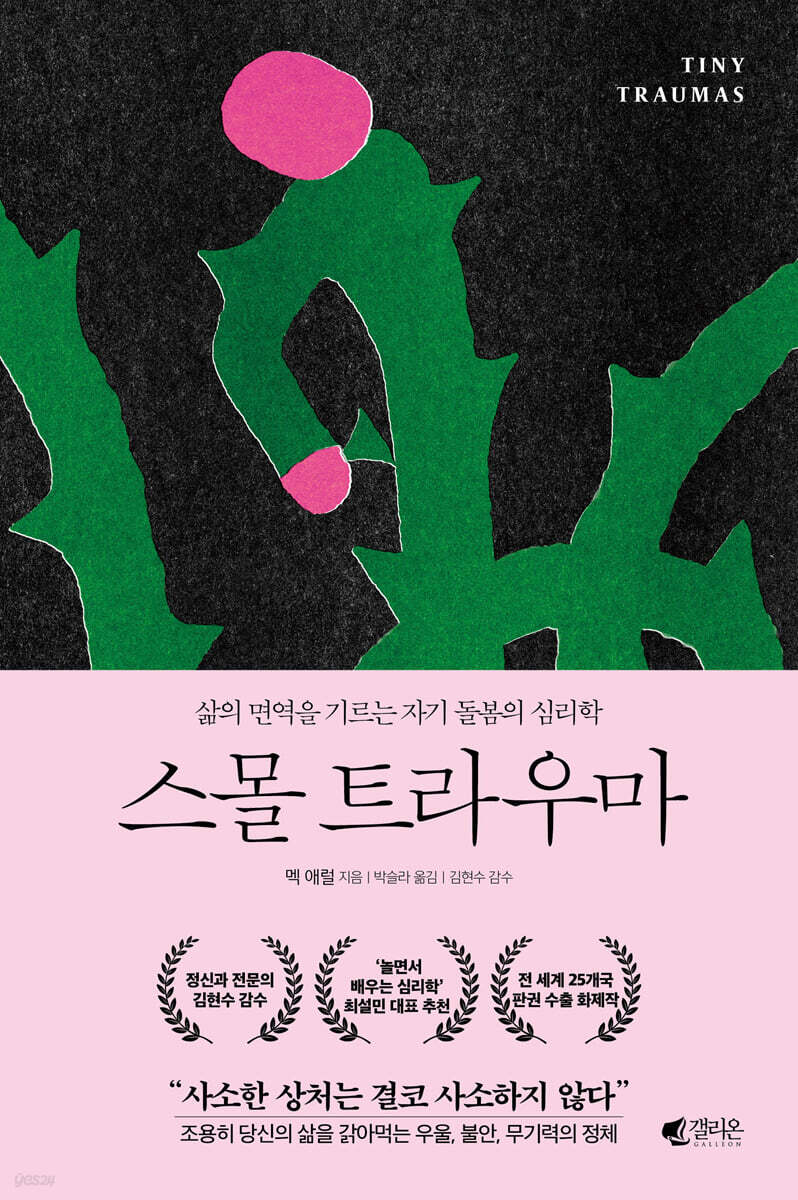
small trauma
 |
Description
Book Introduction
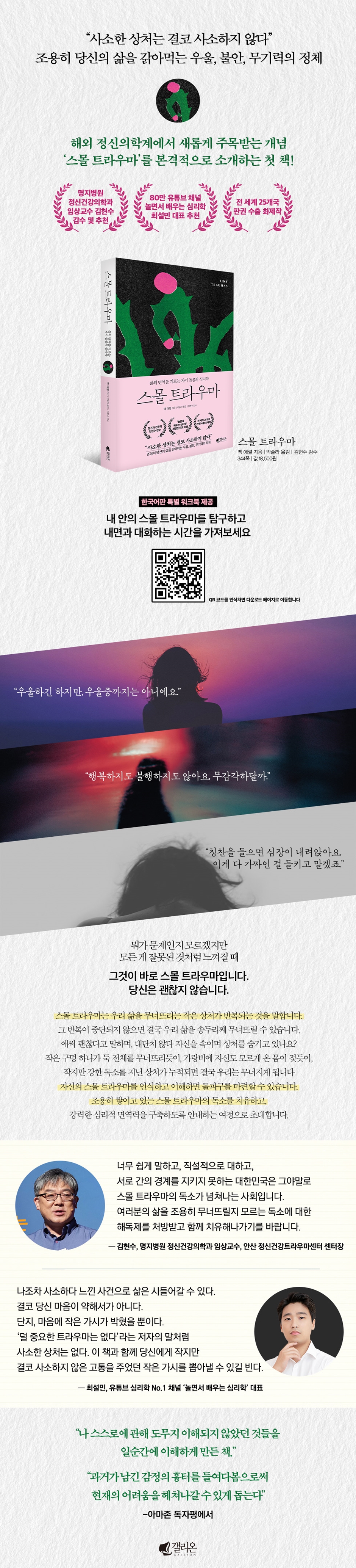
“A small wound is never small.” The identity of depression, anxiety, and lethargy that quietly eat away at your life A hit film whose copyrights have been exported to 25 countries around the world. The first book to fully address "small trauma," a concept gaining new attention in the field of psychiatry. Reviewed by Dr. Kim Hyeon-su, a psychiatrist and director of the Ansan Mental Health Trauma Center “South Korea is a society overflowing with the toxins of small trauma. “There is a way to decipher it in this book.” Choi Seol-min, a YouTube psychology channel with 800,000 followers, strongly recommends "Learn Psychology While Playing." As the author says, "There is no such thing as a lesser trauma." Just as the small, everyday things make our lives precious, it is also the small, everyday wounds that drain our vitality, passion, and potential. 'Small trauma' refers to repeated everyday experiences and events that are small but leave deep wounds. If this repetition doesn't stop, it can eventually destroy your life. Are you trying to hide your wounds, trying to pretend you're okay, deceiving yourself into thinking they're nothing serious? Just as a small hole can cause an entire dam to collapse, or a drizzle can unknowingly soak your entire body, the accumulation of small but toxic wounds will ultimately destroy our bodies and minds. In particular, Korean society, where people speak too easily and fail to maintain appropriate distance, is a place overflowing with small traumas. This book was written for those who suffer from the pain of small trauma, but who feel their life energy being stolen day by day in an inexplicable sense of deficiency, depression, helplessness, and anxiety without even recognizing it themselves. Recognizing and understanding your own small traumas can provide a breakthrough. We invite you on a journey to heal the vicious cycle of small traumas that quietly eat away at your life, and to build a strong psychological immune system. |
- You can preview some of the book's contents.
Preview
index
A society overflowing with the toxicity of small traumas
When you go in and you don't know what the problem is, but everything feels wrong
Chapter 1: What is Small Trauma?
Even if it is not a life-shaking event · A journey to understand small trauma · Small trauma in childhood · Parental shackles · School wounds · Small trauma accumulates · Small trauma in human relationships · Missed love · Broken friendships · Small trauma in the workplace · The gap between reality and ideals · It will be found out someday · Small trauma in society · The hamster wheel of endless effort · Digital small trauma · 'Perfect' others · The loneliness epidemic · Vicarious trauma and permanent crisis · Small trauma and the psychological immune system · Can it be a 'vaccine'? · Acceptance is not resignation · Key questions to start with
Chapter 2: The Obsession with Being Happy
AAA Level 1: Awareness · What on earth is happiness? · Why can't I be happy? - Toxic Positivity · AAA Level 2: Acceptance · The misery of saying, "I just want to be happy" · Hedonic Adaptation · AAA Level 3: Action · Simple tips for a brighter day · A prescription for sustainable self-satisfaction
Chapter 3: People Who Are Comfortable in a Numb State
"It's not depression" · AAA Level 1: Awareness · Why is it difficult to express emotions? · AAA Level 2: Acceptance · Exploring nonverbal emotions · Diversity is important in the emotional ecosystem · A wide vocabulary to express emotions · AAA Level 3: Action · Emotion playlist · Strengthening the emotional ecosystem with the power of memories · Shoulder to shoulder
Chapter 4: What's the Difference Between Stress and Anxiety?
AAA Level 1: Awareness · What is stress? · Innate reasons for stress · How to 'condition' your stress response · The difference between stress and anxiety · AAA Level 2: Acceptance · Controlling your physiological stress response · AAA Level 3: Action · Tips for stopping your stress response right now · Building a stress-resistant brain · ASK for breaking out of negative thinking patterns
Chapter 5: The Paradox of Perfectionism
Is perfectionism innate? · AAA Level 1: Awareness · Maladaptive vs. Adaptive Perfectionism · Habitual Procrastination · When Procrastination Helps · AAA Level 2: Acceptance · Separating Perfectionism from Success · AAA Level 3: Action · Practical Tips for Breaking Habitual Procrastination · How to Manage Perfectionism Long-Term · Turn Failure into Feedback
Chapter 6: Mask Syndrome and Microaggressions
AAA Level 1: Awareness · The voice that whispers, "I'm a fake!" · People who suffer from imposter syndrome particularly badly · Microaggressions Small Traumas · Sarcastic Compliments · Things that hurt your feelings · Too many reference points · Overflowing regrets · AAA Level 2: Acceptance · Naming your feelings · Ignoring rude passersby · AAA Level 3: Action · Silencing your inner imposter · How to deal with microaggressions · Long-term solutions to imposter syndrome
Chapter 7: Why We Eat Until We Burp
AAA Step 1: Awareness · Food as Love · Food as Reward · AAA Step 2: Acceptance · Reasons for Eating · Establishing a Strong Identity · AAA Step 3: Action · Short-Term Strategies for Overcoming Food Cravings · Overcoming Barriers to Change
Chapter 8: Love Like War
Classification of Love · AAA Level 1: Awareness · Attachment Styles and Touch Hunger · Love is in Motion · AAA Level 2: Acceptance · Friendship is in Motion · Coping with the Breakdown of Friendship · The Illusion of Perfect Friendship · AAA Level 3: Action · The Art of Loving LISTEN & LOVE
Chapter 9: Why Is It So Hard to Fall Asleep?
Why We're Obsessed with Sleep · AAA Level 1: Awareness · Introduction to Sleep Science · Self-Fulfilling Sleep Prophecy · AAA Level 2: Acceptance · People Who Are More Sensitive Than Others · AAA Level 3: Action · Bedtime Strategies Using 'Deactivation' and 'Association'
Chapter 10: How to Move on to the Next Stage of Life
What stage of life are you at now? · Transitional crises that everyone experiences · Pressures from the social clock · AAA Stage 1: Awareness · A child thrown into the adult world · AAA Stage 2: Acceptance · Boundary space and the 'onion of transition' · Menopause and the sandwich generation · AAA Stage 3: Action · Let go of the rope · A letter from the future · Preparing for the transitional crisis of old age
Chapter 11: Jump in, Not Stare: A Prescription for Life
AAA Approach to Life · AAA Level 1: Awareness · Purpose of Life · Too Many Possibilities · Don't Jump In · AAA Level 2: Acceptance · Practice Speaking to Avoid Getting Stuck in Small Traumas · AAA Level 3: Action · Sunshine is Your Friend · The Art of Relaxation · Healthy Food and Exercise · Human Connection is Essential · Find Something to Be Grateful For Today · It's Okay Not to Love Yourself · But Be Kind to Yourself
Acknowledgements
main
When you go in and you don't know what the problem is, but everything feels wrong
Chapter 1: What is Small Trauma?
Even if it is not a life-shaking event · A journey to understand small trauma · Small trauma in childhood · Parental shackles · School wounds · Small trauma accumulates · Small trauma in human relationships · Missed love · Broken friendships · Small trauma in the workplace · The gap between reality and ideals · It will be found out someday · Small trauma in society · The hamster wheel of endless effort · Digital small trauma · 'Perfect' others · The loneliness epidemic · Vicarious trauma and permanent crisis · Small trauma and the psychological immune system · Can it be a 'vaccine'? · Acceptance is not resignation · Key questions to start with
Chapter 2: The Obsession with Being Happy
AAA Level 1: Awareness · What on earth is happiness? · Why can't I be happy? - Toxic Positivity · AAA Level 2: Acceptance · The misery of saying, "I just want to be happy" · Hedonic Adaptation · AAA Level 3: Action · Simple tips for a brighter day · A prescription for sustainable self-satisfaction
Chapter 3: People Who Are Comfortable in a Numb State
"It's not depression" · AAA Level 1: Awareness · Why is it difficult to express emotions? · AAA Level 2: Acceptance · Exploring nonverbal emotions · Diversity is important in the emotional ecosystem · A wide vocabulary to express emotions · AAA Level 3: Action · Emotion playlist · Strengthening the emotional ecosystem with the power of memories · Shoulder to shoulder
Chapter 4: What's the Difference Between Stress and Anxiety?
AAA Level 1: Awareness · What is stress? · Innate reasons for stress · How to 'condition' your stress response · The difference between stress and anxiety · AAA Level 2: Acceptance · Controlling your physiological stress response · AAA Level 3: Action · Tips for stopping your stress response right now · Building a stress-resistant brain · ASK for breaking out of negative thinking patterns
Chapter 5: The Paradox of Perfectionism
Is perfectionism innate? · AAA Level 1: Awareness · Maladaptive vs. Adaptive Perfectionism · Habitual Procrastination · When Procrastination Helps · AAA Level 2: Acceptance · Separating Perfectionism from Success · AAA Level 3: Action · Practical Tips for Breaking Habitual Procrastination · How to Manage Perfectionism Long-Term · Turn Failure into Feedback
Chapter 6: Mask Syndrome and Microaggressions
AAA Level 1: Awareness · The voice that whispers, "I'm a fake!" · People who suffer from imposter syndrome particularly badly · Microaggressions Small Traumas · Sarcastic Compliments · Things that hurt your feelings · Too many reference points · Overflowing regrets · AAA Level 2: Acceptance · Naming your feelings · Ignoring rude passersby · AAA Level 3: Action · Silencing your inner imposter · How to deal with microaggressions · Long-term solutions to imposter syndrome
Chapter 7: Why We Eat Until We Burp
AAA Step 1: Awareness · Food as Love · Food as Reward · AAA Step 2: Acceptance · Reasons for Eating · Establishing a Strong Identity · AAA Step 3: Action · Short-Term Strategies for Overcoming Food Cravings · Overcoming Barriers to Change
Chapter 8: Love Like War
Classification of Love · AAA Level 1: Awareness · Attachment Styles and Touch Hunger · Love is in Motion · AAA Level 2: Acceptance · Friendship is in Motion · Coping with the Breakdown of Friendship · The Illusion of Perfect Friendship · AAA Level 3: Action · The Art of Loving LISTEN & LOVE
Chapter 9: Why Is It So Hard to Fall Asleep?
Why We're Obsessed with Sleep · AAA Level 1: Awareness · Introduction to Sleep Science · Self-Fulfilling Sleep Prophecy · AAA Level 2: Acceptance · People Who Are More Sensitive Than Others · AAA Level 3: Action · Bedtime Strategies Using 'Deactivation' and 'Association'
Chapter 10: How to Move on to the Next Stage of Life
What stage of life are you at now? · Transitional crises that everyone experiences · Pressures from the social clock · AAA Stage 1: Awareness · A child thrown into the adult world · AAA Stage 2: Acceptance · Boundary space and the 'onion of transition' · Menopause and the sandwich generation · AAA Stage 3: Action · Let go of the rope · A letter from the future · Preparing for the transitional crisis of old age
Chapter 11: Jump in, Not Stare: A Prescription for Life
AAA Approach to Life · AAA Level 1: Awareness · Purpose of Life · Too Many Possibilities · Don't Jump In · AAA Level 2: Acceptance · Practice Speaking to Avoid Getting Stuck in Small Traumas · AAA Level 3: Action · Sunshine is Your Friend · The Art of Relaxation · Healthy Food and Exercise · Human Connection is Essential · Find Something to Be Grateful For Today · It's Okay Not to Love Yourself · But Be Kind to Yourself
Acknowledgements
main
Detailed image
Into the book
A Society That Ignores Small Traumas
The majority of clients who come to me have never experienced any serious psychological trauma.
But the road is always full of potholes and protruding ledges that can cause injuries.
We have been taught to ignore these 'small traumas'.
Small wounds that are difficult to detect or reveal accumulate and accumulate deep within our emotional selves.
And this psychological toll ultimately affects our happiness and well-being.
Even if your body and mind aren't completely exhausted, you can clearly sense the weight of it pulling you down, causing fatigue, anxiety, and a lack of confidence.
Ignoring this is extremely dangerous.
If left untreated, it can lead to a number of mental and physical health problems unique to modern society.
---From "Page 9, Introduction"
The Subtle Wounds of School Days
Small traumas arise from more subtle interactions than from serious violence, such as bullying.
Overt bullying or exclusion at school is a major childhood trauma that many children struggle to endure.
But for many children, less blatant neglect, the feeling of being stuck as a round peg in a square hole, humiliation on the playground, test stress, and the pressure to succeed in an environment that prioritizes class rank over meaningful learning can also be small traumas.
---From "Page 30, Chapter 1: What is Small Trauma"
In an Age of the Loneliness Epidemic
Never in history have people felt so connected and yet so deeply lonely.
While loneliness and social isolation were on the rise even before the COVID-19 pandemic, this global pandemic has pushed many people's mental health to the brink.
I mentioned this before, but I'll emphasize it again here.
We humans are social beings.
While it's wonderful that we've been able to weather the pandemic with cutting-edge technologies like working from home, endless video calls, and online shopping, the lack of physical contact has created microtraumas for many.
Chronic loneliness is as harmful to your health as smoking 15 cigarettes a day.
Before the COVID-19 outbreak, this was a topic primarily raised among older adults, but even before 2020, reports indicated that many young people were struggling with loneliness-related issues.
The important thing to keep in mind here is that loneliness is a symptom, not a cause, of social isolation.
---From "Page 47, Chapter 1: What is Small Trauma"
Breathing Exercises to Calm Uncomfortable Emotions
Let me introduce you to one of my favorite simple yet powerful exercises.
As we age, we tend to stress breathe, breathing into our chest.
Place one hand on your upper chest and one hand on your stomach and notice how you breathe.
Which hand is moving? If the hand on your chest is moving up and down, it means your body is stressed.
Well, that's not really surprising, since we're exploring small traumas.
The way to solve this is to activate the parasympathetic nervous system through diaphragmatic breathing.
· First, find the location of the diaphragm.
Adjust the position so that the little finger of the hand placed on your stomach is just above your belly button.
Then the diaphragm muscle will be located just below the palm.
Place the other hand on your chest.
· Inhale slowly and steadily through your nose and count to three.
Take a deep breath, all the way down to your tailbone.
· Then, exhale slowly four times while repeating in your mind, “Calm down.”
· Feel your belly expand with each breath you take.
· Feel your stomach deflate when you exhale.
At this time, the hand on the chest should not move.
---From "Page 57, Chapter 1: What is Small Trauma"
"I feel like I'll never be happy"
“I just want you to be happy” is something you hear very often.
Not only is it harmless, it is also warm, affectionate, and encouraging.
But this is one of the most harmful sentiments in modern society.
There is something fundamentally wrong with wanting only other people or yourself to be happy.
It's like telling a child, "I want you to catch a very beautiful and colorful butterfly and put it in a bottle and keep it there forever."
Butterflies do exist, and it is certainly possible to capture one and keep it in a bottle, but it would not live long.
And if your loved ones keep telling you that the best thing in the world is to have a butterfly, chances are you don't have one.
So, always trying to be happy can also be a kind of small trauma.
This is because there is a high possibility that you will never feel happy throughout your life and will constantly pursue happiness.
---From "Page 75, Chapter 2: The Obsession with Being Happy"
Why Emotional Literacy Matters
In extreme cases, there is 'emotional blindness', or technically 'alexithymia', which is the difficulty in accurately identifying one's own feelings.
It is associated with experiencing emotional dullness or frontal lobe brain damage during childhood and adolescence (fortunately, very few people experience the latter).
Some people with this condition experience only positive emotions and are completely unaware of negative ones, while others experience no emotions at all.
However, while most people can describe intense emotions, they generally have difficulty naming more subtle and delicate emotions.
I call this 'emotional literacy.'
Emotional literacy is crucial, as becoming proficient in the language we use to express our emotions can greatly help us navigate small traumas and live fulfilling lives.
---From "Page 93, Chapter 3, People Who Are Comfortable in a Numb State"
The Difference Between Stress and Anxiety
The fundamental difference between stress and anxiety is their temporal location.
Stress responses are triggered by present threats or associations (in Charlie's case, the classroom environment), whereas anxiety stems from thoughts about the future (worry) or the past (rumination).
If you want to know if you are experiencing stress or anxiety, ask yourself these questions:
'Where do I spend most of my time: past, present, or future?'
(…) Small traumas can be related to both stress and anxiety.
This is because past experiences can induce stress responses in certain situations.
But small traumas can also affect our cognition, triggering anxiety and sending us down countless mental rabbit holes, which can in turn trigger stress responses and other physiological symptoms.
---From "Pages 119-121, Chapter 4: What is the difference between stress and anxiety?"
Habitual Procrastination and Perfectionism
Habitual procrastination is not about being lazy, bad-tempered, incompetent, or uncaring.
In fact, it's quite the opposite.
People who procrastinate are usually conscientious.
Because I'm worried that I might do something wrong.
So we procrastinate until we're stressed to the max, and then, in the last few hours, we fret and convince ourselves that the outcome will be dire and that we're really stupid.
But before we get to this point, we've already spent too much mental energy thinking about this thing or trying not to think about it.
By the time our bodies notice these maladaptive patterns, we've already reached burnout because we've expended so much of our mental, physical, and emotional resources.
---From "Page 142, Chapter 5, The Paradox of Perfectionism"
Retaliatory Bedtime Procrastination
If you find yourself procrastinating by saying, “Just watch one more episode of a drama,” or “Just watch a few more minutes of social media,” then there’s a very good chance that you’re doing it out of revenge.
The reason we do this is essentially to 'get back at' ourselves for neglecting important needs during the day.
At the end of a long day, the rebellious self within stubbornly demands some "me" time, even though it knows it will leave you tired and cranky the next day.
Retaliatory bedtime procrastination is more common in younger adults and women and is a response to daytime stress and lack of free time while awake.
But research shows that we actually have a lot of free time during the day.
However, unlike the ancients, we have 'crumbs of time' scattered throughout the day rather than in large chunks.
The problem arises because we tend to fill this free time with work, life management, or other unpleasant tasks.
The majority of clients who come to me have never experienced any serious psychological trauma.
But the road is always full of potholes and protruding ledges that can cause injuries.
We have been taught to ignore these 'small traumas'.
Small wounds that are difficult to detect or reveal accumulate and accumulate deep within our emotional selves.
And this psychological toll ultimately affects our happiness and well-being.
Even if your body and mind aren't completely exhausted, you can clearly sense the weight of it pulling you down, causing fatigue, anxiety, and a lack of confidence.
Ignoring this is extremely dangerous.
If left untreated, it can lead to a number of mental and physical health problems unique to modern society.
---From "Page 9, Introduction"
The Subtle Wounds of School Days
Small traumas arise from more subtle interactions than from serious violence, such as bullying.
Overt bullying or exclusion at school is a major childhood trauma that many children struggle to endure.
But for many children, less blatant neglect, the feeling of being stuck as a round peg in a square hole, humiliation on the playground, test stress, and the pressure to succeed in an environment that prioritizes class rank over meaningful learning can also be small traumas.
---From "Page 30, Chapter 1: What is Small Trauma"
In an Age of the Loneliness Epidemic
Never in history have people felt so connected and yet so deeply lonely.
While loneliness and social isolation were on the rise even before the COVID-19 pandemic, this global pandemic has pushed many people's mental health to the brink.
I mentioned this before, but I'll emphasize it again here.
We humans are social beings.
While it's wonderful that we've been able to weather the pandemic with cutting-edge technologies like working from home, endless video calls, and online shopping, the lack of physical contact has created microtraumas for many.
Chronic loneliness is as harmful to your health as smoking 15 cigarettes a day.
Before the COVID-19 outbreak, this was a topic primarily raised among older adults, but even before 2020, reports indicated that many young people were struggling with loneliness-related issues.
The important thing to keep in mind here is that loneliness is a symptom, not a cause, of social isolation.
---From "Page 47, Chapter 1: What is Small Trauma"
Breathing Exercises to Calm Uncomfortable Emotions
Let me introduce you to one of my favorite simple yet powerful exercises.
As we age, we tend to stress breathe, breathing into our chest.
Place one hand on your upper chest and one hand on your stomach and notice how you breathe.
Which hand is moving? If the hand on your chest is moving up and down, it means your body is stressed.
Well, that's not really surprising, since we're exploring small traumas.
The way to solve this is to activate the parasympathetic nervous system through diaphragmatic breathing.
· First, find the location of the diaphragm.
Adjust the position so that the little finger of the hand placed on your stomach is just above your belly button.
Then the diaphragm muscle will be located just below the palm.
Place the other hand on your chest.
· Inhale slowly and steadily through your nose and count to three.
Take a deep breath, all the way down to your tailbone.
· Then, exhale slowly four times while repeating in your mind, “Calm down.”
· Feel your belly expand with each breath you take.
· Feel your stomach deflate when you exhale.
At this time, the hand on the chest should not move.
---From "Page 57, Chapter 1: What is Small Trauma"
"I feel like I'll never be happy"
“I just want you to be happy” is something you hear very often.
Not only is it harmless, it is also warm, affectionate, and encouraging.
But this is one of the most harmful sentiments in modern society.
There is something fundamentally wrong with wanting only other people or yourself to be happy.
It's like telling a child, "I want you to catch a very beautiful and colorful butterfly and put it in a bottle and keep it there forever."
Butterflies do exist, and it is certainly possible to capture one and keep it in a bottle, but it would not live long.
And if your loved ones keep telling you that the best thing in the world is to have a butterfly, chances are you don't have one.
So, always trying to be happy can also be a kind of small trauma.
This is because there is a high possibility that you will never feel happy throughout your life and will constantly pursue happiness.
---From "Page 75, Chapter 2: The Obsession with Being Happy"
Why Emotional Literacy Matters
In extreme cases, there is 'emotional blindness', or technically 'alexithymia', which is the difficulty in accurately identifying one's own feelings.
It is associated with experiencing emotional dullness or frontal lobe brain damage during childhood and adolescence (fortunately, very few people experience the latter).
Some people with this condition experience only positive emotions and are completely unaware of negative ones, while others experience no emotions at all.
However, while most people can describe intense emotions, they generally have difficulty naming more subtle and delicate emotions.
I call this 'emotional literacy.'
Emotional literacy is crucial, as becoming proficient in the language we use to express our emotions can greatly help us navigate small traumas and live fulfilling lives.
---From "Page 93, Chapter 3, People Who Are Comfortable in a Numb State"
The Difference Between Stress and Anxiety
The fundamental difference between stress and anxiety is their temporal location.
Stress responses are triggered by present threats or associations (in Charlie's case, the classroom environment), whereas anxiety stems from thoughts about the future (worry) or the past (rumination).
If you want to know if you are experiencing stress or anxiety, ask yourself these questions:
'Where do I spend most of my time: past, present, or future?'
(…) Small traumas can be related to both stress and anxiety.
This is because past experiences can induce stress responses in certain situations.
But small traumas can also affect our cognition, triggering anxiety and sending us down countless mental rabbit holes, which can in turn trigger stress responses and other physiological symptoms.
---From "Pages 119-121, Chapter 4: What is the difference between stress and anxiety?"
Habitual Procrastination and Perfectionism
Habitual procrastination is not about being lazy, bad-tempered, incompetent, or uncaring.
In fact, it's quite the opposite.
People who procrastinate are usually conscientious.
Because I'm worried that I might do something wrong.
So we procrastinate until we're stressed to the max, and then, in the last few hours, we fret and convince ourselves that the outcome will be dire and that we're really stupid.
But before we get to this point, we've already spent too much mental energy thinking about this thing or trying not to think about it.
By the time our bodies notice these maladaptive patterns, we've already reached burnout because we've expended so much of our mental, physical, and emotional resources.
---From "Page 142, Chapter 5, The Paradox of Perfectionism"
Retaliatory Bedtime Procrastination
If you find yourself procrastinating by saying, “Just watch one more episode of a drama,” or “Just watch a few more minutes of social media,” then there’s a very good chance that you’re doing it out of revenge.
The reason we do this is essentially to 'get back at' ourselves for neglecting important needs during the day.
At the end of a long day, the rebellious self within stubbornly demands some "me" time, even though it knows it will leave you tired and cranky the next day.
Retaliatory bedtime procrastination is more common in younger adults and women and is a response to daytime stress and lack of free time while awake.
But research shows that we actually have a lot of free time during the day.
However, unlike the ancients, we have 'crumbs of time' scattered throughout the day rather than in large chunks.
The problem arises because we tend to fill this free time with work, life management, or other unpleasant tasks.
---From "Page 256, Chapter 9, Why Is It So Hard to Fall Asleep?"
Publisher's Review
“I’m depressed, but not depressed.”
─ Small Trauma: The Identity of Depression, Anxiety, and Apathy That Silently Destroy Your Life
It is true that the fields of psychology and psychiatry have so far focused on trauma caused by large-scale negative events.
This is because 'big trauma' such as war, disaster, childhood abuse, neglect, and sexual assault can cause serious mental and physical health problems.
It was only recently that I began to notice that the wounds that I had dismissed as trivial and neglected were quietly eating away at our daily lives.
'Small trauma' refers to the recurrence of everyday experiences or events in an individual's life that cause them to lose self-esteem.
For example, bullying or teasing experienced in childhood, embarrassing mistakes, inappropriate emotional interactions with parents, indirect experiences of social disasters, and subtle discrimination and insults experienced at work.
These experiences accumulate and combine with each other, negatively affecting us and making us live a life that is dissatisfying and disappointing.
Data shows that its effects lead to not only mental problems such as depression, but also physical ailments such as heart disease, asthma, diabetes, and cancer.
Do you feel like all your life energy is being robbed? "It's not enough to warrant a psychiatrist," but are you struggling to get through each day with inexplicable discomfort, deprivation, lethargy, depression, anxiety, and even pain? If so, you need to examine your own "small traumas."
We are held back by the idea that unless we have experienced significant trauma, we do not need to seek treatment.
However, just because the wound is small doesn't mean the pain is small or that you don't deserve help.
We all need a little help sometimes.
“There is no less important trauma.” “Small trauma,” which has recently begun to attract attention in the field of psychiatry, is establishing itself as a key to solving numerous chronic illnesses and mental difficulties that could not previously be explained psychologically or medically.
Based on the author's 20 years of research and clinical experience, this book delves into the mechanisms of "small trauma," including what it is, how it arises, and what symptoms it leads to, and presents specific solutions for how to deal with it.
So that small traumas can act as a vaccine for life.
─The Psychology of Self-Care: Building a Psychological Immune System
Dr. Meg Arrell, a British clinical psychologist and author of this book, was studying the impact of various physical illnesses on mental health at the University of East London's Chronic Illness Research Team when she discovered that many people suffer from chronic mental and physical illnesses even though they have not experienced serious trauma, and began to delve into the topic of 'small traumas.'
This book introduces the mechanisms of occurrence of small trauma and its mental and physical manifestations.
It faithfully provides various cases and psychological theories and concepts that help understand the mechanism.
Furthermore, it includes specific and practical practice activities and action guidelines based on the three-step AAA approach (Awareness-Acceptance-Act), which is designed to help people self-diagnose and resolve various problems caused by small trauma.
However, because wounds are a highly subjective area and the context of life varies from person to person, the elements of small trauma are bound to be countless.
Therefore, the author selected representative small trauma topics classified from his long clinical experience and chose to deal with the causes, theoretical background, and solutions of each topic from various angles.
The book presents the causes and cases of various small traumas, including representative small traumas experienced in childhood, interpersonal relationships, work life, and social life, as well as attachment issues with parents, the breakdown of friendships, trauma from betrayal, perfectionism, hate speech, and microaggressions.
We examine the typical symptoms of depression, anxiety disorder, panic disorder, burnout, eating disorders, insomnia, and mask syndrome, and explore various checklists and response methods that readers can use to diagnose and resolve the problem on their own.
This book was written to help people who suffer from small traumas but are consumed by inexplicable discomfort, lack, helplessness, depression, and anxiety day after day without even realizing it.
Because recognizing and understanding your own small traumas can provide a breakthrough.
Furthermore, you can build a strong psychological immune system and pursue a balanced and solid life.
The author urges us to use this book as a parachute and jump into our own abyss.
This is a healing book for everyone that helps wounds become vaccines for life, not holes in life.
* What is covered in each chapter *
Chapter 1, “What is a Small Trauma?” covers the differences between “small” trauma and “big” trauma, the various causes of small trauma, and small trauma as a psychological antibody to strengthen the psychological immune system.
Chapter 2, "The Obsession with Being Happy," explores the definition of happiness and its seven determinants, the harmful positivity that fuels the obsession with happiness, and how to pursue lasting self-satisfaction.
Chapter 3, "People Who Are Comfortable with Numbness," examines "emotional numbness," a common symptom in modern society, sometimes called mental weakness, and explores ways to improve emotional diversity and emotional literacy.
Chapter 4, “What is the difference between stress and anxiety?” explores the differences between stress and anxiety and the different coping techniques for each.
Chapter 5, “The Paradox of Perfectionism,” explores perfectionism and its small traumas that lead to habitual procrastination and burnout, and seeks solutions.
Chapter 6, “Impostor Syndrome and Microaggressions,” examines the various small traumas that lead to impostor syndrome and, in particular, explores ways to deal with microaggressions that are prevalent in everyday life.
Chapter 7, “Why We Eat Until We’re Full,” explores the small traumas that cause eating problems, particularly emotional eating related to identity, and how to overcome it.
Chapter 8, “Love Like War,” explores the classification of love, attachment types, friendship and betrayal trauma, and suggests listening and loving skills useful in all relationships.
Chapter 9, "Why Is It So Hard to Fall Asleep?" examines the small traumas that cause sleep disorders that plague modern people and introduces strategies to improve the quantity and quality of sleep.
Chapter 10, "How to Move to the Next Stage of Life," identifies important life transitions and the small traumas associated with their pressures, and creates a life map to help you let go of your fear of transition.
Chapter 11, "Leap, Not Stare," encourages you to strengthen your psychological immune system by applying the AAA approach to all aspects of your life.
* Amazon Bookstore Reader Reviews *
“We come across small moments that may have had a big impact on our lives.”
“A book that made me instantly understand things about myself that I had never understood before.”
“It helps you navigate present difficulties by examining the emotional scars left by the past.”
─ Small Trauma: The Identity of Depression, Anxiety, and Apathy That Silently Destroy Your Life
It is true that the fields of psychology and psychiatry have so far focused on trauma caused by large-scale negative events.
This is because 'big trauma' such as war, disaster, childhood abuse, neglect, and sexual assault can cause serious mental and physical health problems.
It was only recently that I began to notice that the wounds that I had dismissed as trivial and neglected were quietly eating away at our daily lives.
'Small trauma' refers to the recurrence of everyday experiences or events in an individual's life that cause them to lose self-esteem.
For example, bullying or teasing experienced in childhood, embarrassing mistakes, inappropriate emotional interactions with parents, indirect experiences of social disasters, and subtle discrimination and insults experienced at work.
These experiences accumulate and combine with each other, negatively affecting us and making us live a life that is dissatisfying and disappointing.
Data shows that its effects lead to not only mental problems such as depression, but also physical ailments such as heart disease, asthma, diabetes, and cancer.
Do you feel like all your life energy is being robbed? "It's not enough to warrant a psychiatrist," but are you struggling to get through each day with inexplicable discomfort, deprivation, lethargy, depression, anxiety, and even pain? If so, you need to examine your own "small traumas."
We are held back by the idea that unless we have experienced significant trauma, we do not need to seek treatment.
However, just because the wound is small doesn't mean the pain is small or that you don't deserve help.
We all need a little help sometimes.
“There is no less important trauma.” “Small trauma,” which has recently begun to attract attention in the field of psychiatry, is establishing itself as a key to solving numerous chronic illnesses and mental difficulties that could not previously be explained psychologically or medically.
Based on the author's 20 years of research and clinical experience, this book delves into the mechanisms of "small trauma," including what it is, how it arises, and what symptoms it leads to, and presents specific solutions for how to deal with it.
So that small traumas can act as a vaccine for life.
─The Psychology of Self-Care: Building a Psychological Immune System
Dr. Meg Arrell, a British clinical psychologist and author of this book, was studying the impact of various physical illnesses on mental health at the University of East London's Chronic Illness Research Team when she discovered that many people suffer from chronic mental and physical illnesses even though they have not experienced serious trauma, and began to delve into the topic of 'small traumas.'
This book introduces the mechanisms of occurrence of small trauma and its mental and physical manifestations.
It faithfully provides various cases and psychological theories and concepts that help understand the mechanism.
Furthermore, it includes specific and practical practice activities and action guidelines based on the three-step AAA approach (Awareness-Acceptance-Act), which is designed to help people self-diagnose and resolve various problems caused by small trauma.
However, because wounds are a highly subjective area and the context of life varies from person to person, the elements of small trauma are bound to be countless.
Therefore, the author selected representative small trauma topics classified from his long clinical experience and chose to deal with the causes, theoretical background, and solutions of each topic from various angles.
The book presents the causes and cases of various small traumas, including representative small traumas experienced in childhood, interpersonal relationships, work life, and social life, as well as attachment issues with parents, the breakdown of friendships, trauma from betrayal, perfectionism, hate speech, and microaggressions.
We examine the typical symptoms of depression, anxiety disorder, panic disorder, burnout, eating disorders, insomnia, and mask syndrome, and explore various checklists and response methods that readers can use to diagnose and resolve the problem on their own.
This book was written to help people who suffer from small traumas but are consumed by inexplicable discomfort, lack, helplessness, depression, and anxiety day after day without even realizing it.
Because recognizing and understanding your own small traumas can provide a breakthrough.
Furthermore, you can build a strong psychological immune system and pursue a balanced and solid life.
The author urges us to use this book as a parachute and jump into our own abyss.
This is a healing book for everyone that helps wounds become vaccines for life, not holes in life.
* What is covered in each chapter *
Chapter 1, “What is a Small Trauma?” covers the differences between “small” trauma and “big” trauma, the various causes of small trauma, and small trauma as a psychological antibody to strengthen the psychological immune system.
Chapter 2, "The Obsession with Being Happy," explores the definition of happiness and its seven determinants, the harmful positivity that fuels the obsession with happiness, and how to pursue lasting self-satisfaction.
Chapter 3, "People Who Are Comfortable with Numbness," examines "emotional numbness," a common symptom in modern society, sometimes called mental weakness, and explores ways to improve emotional diversity and emotional literacy.
Chapter 4, “What is the difference between stress and anxiety?” explores the differences between stress and anxiety and the different coping techniques for each.
Chapter 5, “The Paradox of Perfectionism,” explores perfectionism and its small traumas that lead to habitual procrastination and burnout, and seeks solutions.
Chapter 6, “Impostor Syndrome and Microaggressions,” examines the various small traumas that lead to impostor syndrome and, in particular, explores ways to deal with microaggressions that are prevalent in everyday life.
Chapter 7, “Why We Eat Until We’re Full,” explores the small traumas that cause eating problems, particularly emotional eating related to identity, and how to overcome it.
Chapter 8, “Love Like War,” explores the classification of love, attachment types, friendship and betrayal trauma, and suggests listening and loving skills useful in all relationships.
Chapter 9, "Why Is It So Hard to Fall Asleep?" examines the small traumas that cause sleep disorders that plague modern people and introduces strategies to improve the quantity and quality of sleep.
Chapter 10, "How to Move to the Next Stage of Life," identifies important life transitions and the small traumas associated with their pressures, and creates a life map to help you let go of your fear of transition.
Chapter 11, "Leap, Not Stare," encourages you to strengthen your psychological immune system by applying the AAA approach to all aspects of your life.
* Amazon Bookstore Reader Reviews *
“We come across small moments that may have had a big impact on our lives.”
“A book that made me instantly understand things about myself that I had never understood before.”
“It helps you navigate present difficulties by examining the emotional scars left by the past.”
GOODS SPECIFICS
- Date of issue: July 14, 2023
- Page count, weight, size: 344 pages | 482g | 143*215*20mm
- ISBN13: 9788901273440
- ISBN10: 8901273446
You may also like
카테고리
korean


korean

![ELLE 엘르 스페셜 에디션 A형 : 12월 [2025]](http://librairie.coreenne.fr/cdn/shop/files/b8e27a3de6c9538896439686c6b0e8fb.jpg?v=1766436872&width=3840)


