

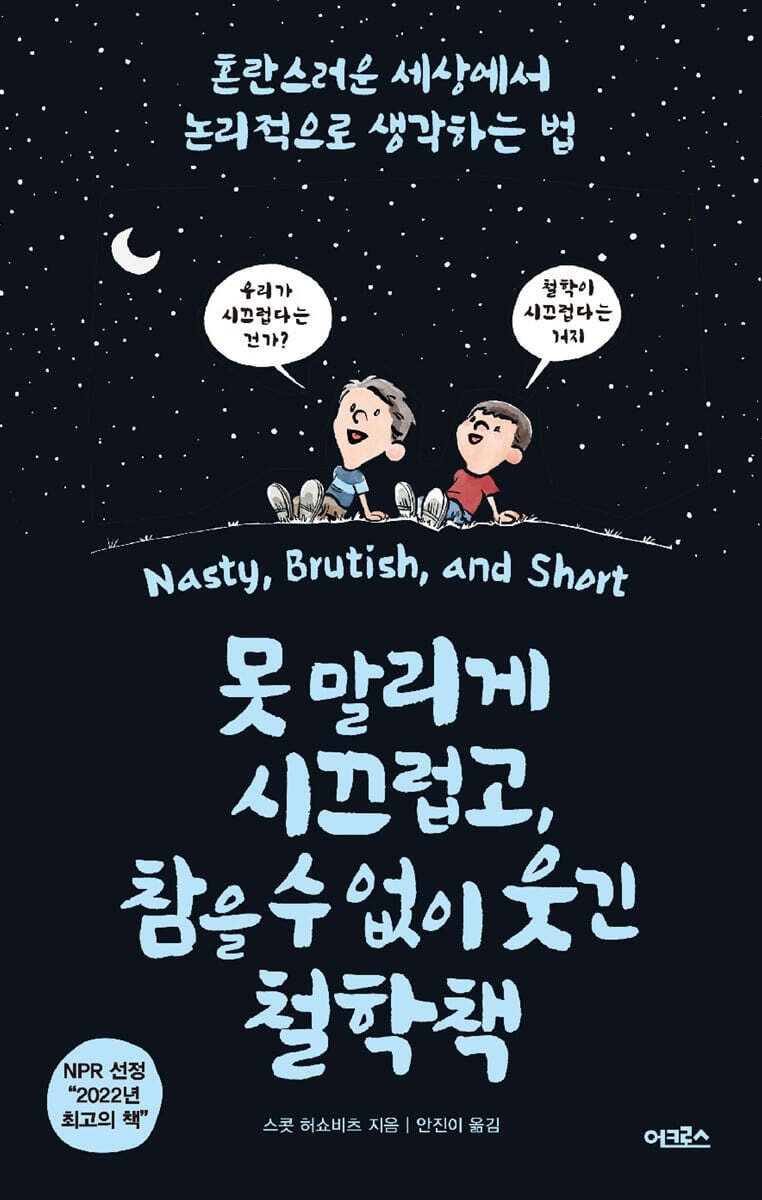
A philosophy book that is unstoppably loud and unbearably funny.
 |
Description
Book Introduction
- A word from MD
-
A funny philosophy and parenting bookAn introduction to philosophy that shows that philosophy is both wonderful and practical.
It's also a funny philosophy book.
The author is Scott Hershowitz, a father of two and philosopher.
Answers children's absurd questions in a humorous yet profound way.
This book is also a parenting book.
Helps parents who are helpless against their rebellious children.
June 16, 2023. Humanities PD Son Min-gyu
Scott Hershowitz, who served as a law clerk for Justice Ruth Bader Ginsburg and is a professor of law and philosophy at the University of Michigan, has two children, Rex and Hank.
As the children began to express themselves, they began having bizarre but very serious philosophical conversations with their father.
Should you do what your dad tells you to do? Is it okay for Gordon Ramsay to lecture any chef? Is it okay to lie and then find out it's true? Why are some words for poop considered insults and others not? Hershowitz engages his children in a series of provocative questions, exploring weightier themes like punishment, authority, justice, revenge, and God.
"The Unstoppably Loud, Unbearably Funny Philosophy Book" shows us that we don't have to be afraid of philosophy.
In fact, the more absurd and daring it is, the more interesting philosophy becomes.
Because not taking the obvious for granted is the basis of philosophy.
Debate with your child on the question, "Is Donald Trump a good president?" and embark on a philosophical journey to think logically in this confusing world with delightful philosopher Scott Hershowitz, who argues that every child should learn to swear early.
As the children began to express themselves, they began having bizarre but very serious philosophical conversations with their father.
Should you do what your dad tells you to do? Is it okay for Gordon Ramsay to lecture any chef? Is it okay to lie and then find out it's true? Why are some words for poop considered insults and others not? Hershowitz engages his children in a series of provocative questions, exploring weightier themes like punishment, authority, justice, revenge, and God.
"The Unstoppably Loud, Unbearably Funny Philosophy Book" shows us that we don't have to be afraid of philosophy.
In fact, the more absurd and daring it is, the more interesting philosophy becomes.
Because not taking the obvious for granted is the basis of philosophy.
Debate with your child on the question, "Is Donald Trump a good president?" and embark on a philosophical journey to think logically in this confusing world with delightful philosopher Scott Hershowitz, who argues that every child should learn to swear early.
- You can preview some of the book's contents.
Preview
index
Preface: To Become a Thinker
Part 1: Acting Morally Is Harder Than You Think
1.
Rights: I have the right to drink soda.
2.
Revenge: You called me a fool, so you can get revenge.
3.
Punishment: I'm innocent because I didn't do it on purpose.
4.
Authority: “Because Dad told me to” is not the reason.
5.
Language: Every child should learn to say “fuck” fluently.
Part 2 I don't know what kind of being I am either
6.
Gender: Is it embarrassing if a man runs slower than a woman?
7.
Race: Take responsibility for a mistake I didn't make
Part 3: I Want to See the Invisible World
8.
Knowledge: When I don't know what I know or don't know
9.
Truth: If you lie and then find out it's true, is that a lie?
10.
Mind: I don't know if the red my mom sees is the same as the red I see.
11.
Infinity: Just because the universe is so big doesn't mean I'm insignificant.
12.
God: Numbers are invisible, but they exist in this world.
Conclusion: The Moment We Become Socrates
Acknowledgements
References
main
Part 1: Acting Morally Is Harder Than You Think
1.
Rights: I have the right to drink soda.
2.
Revenge: You called me a fool, so you can get revenge.
3.
Punishment: I'm innocent because I didn't do it on purpose.
4.
Authority: “Because Dad told me to” is not the reason.
5.
Language: Every child should learn to say “fuck” fluently.
Part 2 I don't know what kind of being I am either
6.
Gender: Is it embarrassing if a man runs slower than a woman?
7.
Race: Take responsibility for a mistake I didn't make
Part 3: I Want to See the Invisible World
8.
Knowledge: When I don't know what I know or don't know
9.
Truth: If you lie and then find out it's true, is that a lie?
10.
Mind: I don't know if the red my mom sees is the same as the red I see.
11.
Infinity: Just because the universe is so big doesn't mean I'm insignificant.
12.
God: Numbers are invisible, but they exist in this world.
Conclusion: The Moment We Become Socrates
Acknowledgements
References
main
Detailed image
Into the book
Caden's eyes alone won't help Hank.
But gouging out Caden's eyes definitely helps.
If people perceived Hank as a man who always seeks revenge, they would think carefully before attacking him.
Gaining fame through revenge is a kind of insurance.
Revenge keeps us from getting hurt.
And revenge is much better than regular insurance.
Because revenge prevents the injury itself, rather than paying to treat the injury after it has occurred.
---From Chapter 2, "Revenge: You Called Me a Fool, So I Can Get Revenge"
Just because Ramsay is a talented chef doesn't mean he has the right to dictate to everyone in the world.
On Gordon Ramsay's New York Times, the chefs agreed to appear on the show, so they would have had an obligation to fit the show's setting.
But even if they had an obligation, it was because they agreed to appear, not because Ramsay was a better cook than them.
Ramsay's talent doesn't give him the right to barge into any kitchen and bark orders.
---From Chapter 4, “Authority: “Because Dad told me to” is not the reason”
Every language has words that are considered taboo.
Such words vary from country to country, but they share common elements.
Some words relate to taboo topics like sex, defecation, and disease, while others carry the risk of being blasphemous.
But we can talk about these topics without swearing.
So it remains a mystery why certain words should not be spoken.
---From Chapter 5, “Language: Every Child Should Learn to Say “Fuck” Proficiently”
When my children were young, I would role-play with them and was amazed at how much fun they had.
I wanted to feel that kind of fun too.
Sometimes I felt happy, but it was just a feeling that made the children happy.
Most of the time, I would feel bored in my head, wanting to finish the game quickly and do more rational tasks.
I should feel guilty for feeling that way.
“I’ll miss those days,” people say.
That's true.
I already miss my kids.
And I tell my kids I miss them too.
“How could you miss me?” Hank asks.
“I’m still here.”
“You are here,” I reply.
“But the child you were a minute ago is no longer there, and he will never return.”
But gouging out Caden's eyes definitely helps.
If people perceived Hank as a man who always seeks revenge, they would think carefully before attacking him.
Gaining fame through revenge is a kind of insurance.
Revenge keeps us from getting hurt.
And revenge is much better than regular insurance.
Because revenge prevents the injury itself, rather than paying to treat the injury after it has occurred.
---From Chapter 2, "Revenge: You Called Me a Fool, So I Can Get Revenge"
Just because Ramsay is a talented chef doesn't mean he has the right to dictate to everyone in the world.
On Gordon Ramsay's New York Times, the chefs agreed to appear on the show, so they would have had an obligation to fit the show's setting.
But even if they had an obligation, it was because they agreed to appear, not because Ramsay was a better cook than them.
Ramsay's talent doesn't give him the right to barge into any kitchen and bark orders.
---From Chapter 4, “Authority: “Because Dad told me to” is not the reason”
Every language has words that are considered taboo.
Such words vary from country to country, but they share common elements.
Some words relate to taboo topics like sex, defecation, and disease, while others carry the risk of being blasphemous.
But we can talk about these topics without swearing.
So it remains a mystery why certain words should not be spoken.
---From Chapter 5, “Language: Every Child Should Learn to Say “Fuck” Proficiently”
When my children were young, I would role-play with them and was amazed at how much fun they had.
I wanted to feel that kind of fun too.
Sometimes I felt happy, but it was just a feeling that made the children happy.
Most of the time, I would feel bored in my head, wanting to finish the game quickly and do more rational tasks.
I should feel guilty for feeling that way.
“I’ll miss those days,” people say.
That's true.
I already miss my kids.
And I tell my kids I miss them too.
“How could you miss me?” Hank asks.
“I’m still here.”
“You are here,” I reply.
“But the child you were a minute ago is no longer there, and he will never return.”
---From Chapter 10, "Mind: I Don't Know If the Red My Mom Sees Is the Same as the Red I See"
Publisher's Review
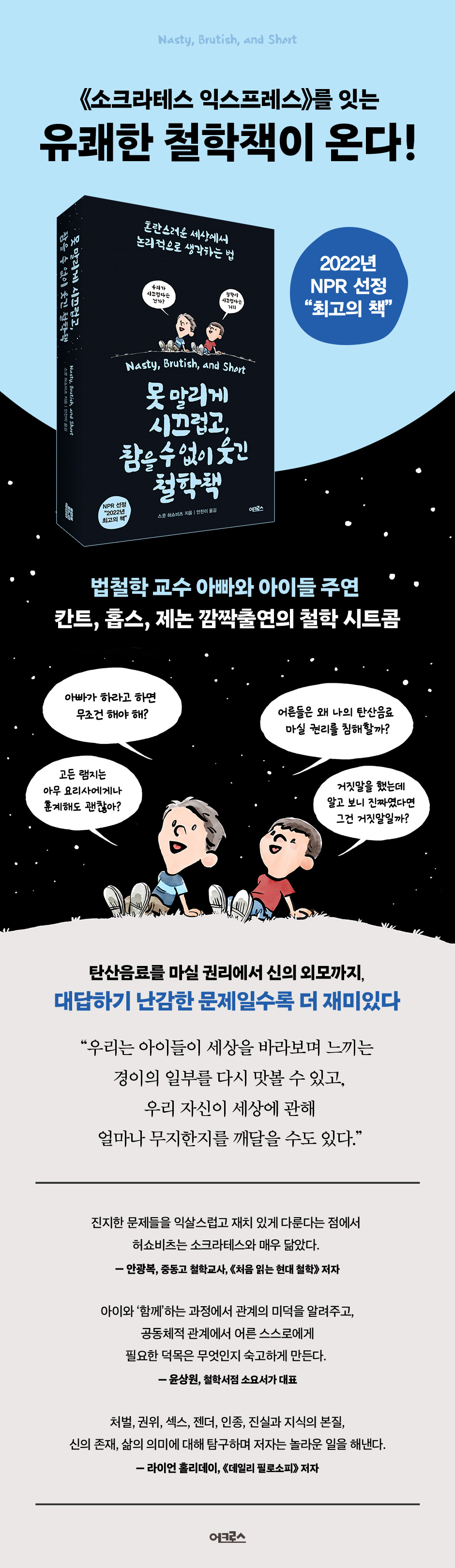
NPR's "Best Books of 2022"
The Christian Science Monitor's "Book of the Month"
Praised by international bestselling authors Ryan Holiday and Jordan Ellenberg!
The Joyful World of Philosophy from Scott Hershowitz, Professor of Philosophy of Law at the University of Michigan
The world becomes more wondrous when you master the art of thinking.
Starring a father and children who are professors of legal philosophy,
A philosophy sitcom featuring surprise appearances by Kant, Hobbes, and Zeno.
Scott Hershowitz, who served as a law clerk for Justice Ruth Bader Ginsburg and is a professor of law and philosophy at the University of Michigan, has two children, Rex and Hank.
As the children began to express themselves, they began having bizarre but very serious philosophical conversations with their father.
《The Unstoppably Loud, Unbearably Funny Philosophy Book》 begins with conversations between Hershowitz and children and introduces philosophical thought encompassing ethics and metaphysics, as well as the techniques of thinking that deal with them.
Hershowitz and the children's journey is peppered with questions that turn everyday life upside down.
Should you do what your dad tells you to do? Is it okay for Gordon Ramsay to lecture any chef? Is it okay to lie and then find out it's true? Why are some words for poop considered insults and others not? Hershowitz engages his children in a series of provocative questions, exploring weightier themes like punishment, authority, justice, revenge, and God.
He also expands the question in a more interesting direction by citing famous philosophers such as Descartes and Hobbes.
Hershowitz shows us that we need not fear philosophy.
In fact, the more absurd and daring it is, the more interesting philosophy becomes.
Because not taking the obvious for granted is the basis of philosophy.
Debate with your child on the question, "Is Donald Trump a good president?" and embark on a philosophical journey to think logically in this confusing world with delightful philosopher Scott Hershowitz, who argues that every child should learn to swear early.
*The original title of this book, “Nasty, Brutish, and Short,” is taken from a phrase used by philosopher Thomas Hobbes to describe the state of nature.
Life in the state of nature, which is “a war of all against all,” is “solitary, poor, filthy, brutish, and short.”
The author used Hobbes' expression as the title because he thought that the image of a house with children was a "war of all against all."
The children are “Nasty, Brutish, and Short”.
The Korean title was changed to “An Unstoppably Loud and Unbearably Funny Philosophy Book” with the permission of the copyright holder.
“Because Dad told me to” cannot be a reason for action!
The more I think about it, the more confusing it becomes: Finding the source of 'morality'
“You don’t have to do everything your dad tells you to do,” Rex said.
“If Dad tells you to do something, you have to do it.”
"no."
“What an unlucky guy.”
- From Chapter 4, 'Authority: "Because Dad told me to" is not the reason.'
I have to leave the house, but my child doesn't want to put on his shoes.
The child is throwing a tantrum.
“Why should I wear shoes?” What would you say in response to this?
There are countless reasons why parents may say things like, "I don't want my children's feet to get dirty," or "I don't want my children's feet to get hurt," but they always end up coming up with the following answer.
“If Dad (or Mom) tells you to do it, do it!” Hershowitz’s situation is no different.
If you keep coming up with rational reasons, you won't be able to leave the house.
But Hershowitz pauses here to ask whether children should really do what their parents tell them to do.
Where does authority come from? Philosopher Robert Paul Wolff argues that all authority is without foundation.
An autonomous human being does not need to obey any orders.
Wait, if I want to become a better cook, shouldn't I also follow the culinary instructor's orders? That's why philosopher Joseph Raz says the source of authority lies in "the ability to make better decisions."
The authority of teachers and parents also comes from their ability to make better choices than their children.
Wait, but that doesn't mean Gordon Ramsay can just barge into any restaurant and lecture everyone. And can we really say that all parents are exceptionally skilled at raising their children? Philosopher Thomas Hobbes argues that absolute authority is necessary to prevent conflict.
Any attempt to impose constraints on rulers leads to war.
But we know how many wars unchecked authority has caused.
Hershowitz constantly asks questions and reveals new aspects of the problem.
As a result, we are forced to rethink from the ground up what ‘morality’ is.
Could revenge prevent violence? Are there times when swearing is necessary to foster bonds? Couldn't we use dog training to get our husbands to do chores? These are questions that are difficult to answer with just a desire to be good.
This book demonstrates the art of thinking by starting with questions about morality, and it is intellectually shocking to see how our individual moral judgments sometimes lead to diametrically opposed conclusions.
“I never discriminated, so I’m not responsible.”
Race, gender… Contemplating the countless identities that make me who I am
“I wish I were black,” Rex said.
I asked why.
“White people do a lot of bad things to black people.
That's why I'm sad."
“There were a lot of sad things,” I answered.
“I wish we hadn’t done that.”
- From Chapter 7, 'Race: Taking Responsibility for a Mistake I Didn't Make'
Hershowitz's son, Rex, says he wishes he were black.
Because I read a book about the history of racism and saw myself as part of a group that did bad things.
Is Rex's guilt justified? At only four years old, Rex has never discriminated against black people, and he didn't live through slavery.
If I think about it, I don't have to take responsibility for the mistakes my grandfather made.
Therefore, I may not feel responsible for the mistakes made by the group I belong to.
But am I not responsible for my child's mistakes? If the parents of a student who committed school violence claimed they had no responsibility, everyone would be outraged.
Even though that person was not at the scene of the school violence.
For Hershowitz, the question of identity becomes the key to the problem of discrimination.
We become discriminated against or discriminate because of an identity we did not choose ourselves.
Hershowitz is disappointed to see Rex embarrassed for losing to a girl.
Because I discovered in my son the prejudice that being good at sports is proof of masculinity.
The stereotype that boys should be better at sports than girls can make a boy's masculinity dependent on his athletic ability and can also deprive girls of the opportunity to experience the joy of exercise.
Hershowitz explores the elements that define our identity, the conditions under which our lives are bound, and what we are called to do as individuals.
Even if it is not an identity we have chosen and we have never directly committed violence, the moment we benefit from discrimination, we have a responsibility to change.
It's not my fault that I inherited a broken house, but it is my responsibility to fix it.
Hershowitz's courage to tackle sensitive issues and his logic for dealing with hate are the weapons we need most right now.
“Is there any meaning to our suffering in an infinite universe?”
Philosophical questions are ultimately about what makes a life worth living.
“There are so many things in the world,” said Rex.
“What’s so important about us?”
We continued walking and talking.
After a while I asked Rex.
“Can I punch you in the face?”
“No,” Rex replied, startled.
“Why don’t you like it?” I asked.
“You said we weren’t important.”
“It’s important to me,” Rex said with a grin.
- From Chapter 11, 'Infinity: Just because the universe is so big doesn't mean I'm insignificant'
Having warmed up with questions of morality and identity, Hershowitz enters the world of pure philosophy in earnest in the latter half of the book.
According to him, there are many things in the world we cannot know.
I don't know if the red my mom sees is the same as the red I see, if this world is a game or reality, and if our lives are worth anything in an infinite universe.
Knowledge, truth, the mind—the very things we thought were certain are, in fact, incredibly uncertain! As Descartes, quoted by Hershowitz, said, everything around us may actually be a trick of the devil.
But instead of destroying all knowledge by saying we can never know anything, Hershowitz shows us how much mental play these puzzles provide us.
The question of whether we see the same color leads us to ask whether 'knowing information about the color red' and 'the experience of seeing the color red' are the same, and the hypothesis that the world we live in might be a game leads to the conclusion that 'a body made of bits' and 'a body made of muscles' are surprisingly not that different.
Above all, all these philosophical questions lead to the question of what makes a life worth living.
The realization that my life is less important than I thought in the infinite universe can serve as the basis for making morally courageous decisions.
The question of whether God exists is inseparable from the question of why suffering exists in the world we live in.
Both metaphysical and epistemological questions return to the questions of morality and values discussed in the first half of the book.
Philosophy is the art of thinking.
Philosophy can begin when we let go of the attitude of “That’s just how it is” and develop our thoughts freely by asking “Why?” and “Why?”
Let's ask questions whenever they come to mind, like Hershowitz and his children, who begin to philosophize regardless of time and place, whether it's a table full of vegetables, a house in disarray, or a children's marathon.
That question is the starting point for judging right and wrong in a confusing world.
This book encourages children to rediscover the wonders of the world through philosophy and to become another Socrates who takes an interest in the thoughts of others and thinks together with them.
The Christian Science Monitor's "Book of the Month"
Praised by international bestselling authors Ryan Holiday and Jordan Ellenberg!
The Joyful World of Philosophy from Scott Hershowitz, Professor of Philosophy of Law at the University of Michigan
The world becomes more wondrous when you master the art of thinking.
Starring a father and children who are professors of legal philosophy,
A philosophy sitcom featuring surprise appearances by Kant, Hobbes, and Zeno.
Scott Hershowitz, who served as a law clerk for Justice Ruth Bader Ginsburg and is a professor of law and philosophy at the University of Michigan, has two children, Rex and Hank.
As the children began to express themselves, they began having bizarre but very serious philosophical conversations with their father.
《The Unstoppably Loud, Unbearably Funny Philosophy Book》 begins with conversations between Hershowitz and children and introduces philosophical thought encompassing ethics and metaphysics, as well as the techniques of thinking that deal with them.
Hershowitz and the children's journey is peppered with questions that turn everyday life upside down.
Should you do what your dad tells you to do? Is it okay for Gordon Ramsay to lecture any chef? Is it okay to lie and then find out it's true? Why are some words for poop considered insults and others not? Hershowitz engages his children in a series of provocative questions, exploring weightier themes like punishment, authority, justice, revenge, and God.
He also expands the question in a more interesting direction by citing famous philosophers such as Descartes and Hobbes.
Hershowitz shows us that we need not fear philosophy.
In fact, the more absurd and daring it is, the more interesting philosophy becomes.
Because not taking the obvious for granted is the basis of philosophy.
Debate with your child on the question, "Is Donald Trump a good president?" and embark on a philosophical journey to think logically in this confusing world with delightful philosopher Scott Hershowitz, who argues that every child should learn to swear early.
*The original title of this book, “Nasty, Brutish, and Short,” is taken from a phrase used by philosopher Thomas Hobbes to describe the state of nature.
Life in the state of nature, which is “a war of all against all,” is “solitary, poor, filthy, brutish, and short.”
The author used Hobbes' expression as the title because he thought that the image of a house with children was a "war of all against all."
The children are “Nasty, Brutish, and Short”.
The Korean title was changed to “An Unstoppably Loud and Unbearably Funny Philosophy Book” with the permission of the copyright holder.
“Because Dad told me to” cannot be a reason for action!
The more I think about it, the more confusing it becomes: Finding the source of 'morality'
“You don’t have to do everything your dad tells you to do,” Rex said.
“If Dad tells you to do something, you have to do it.”
"no."
“What an unlucky guy.”
- From Chapter 4, 'Authority: "Because Dad told me to" is not the reason.'
I have to leave the house, but my child doesn't want to put on his shoes.
The child is throwing a tantrum.
“Why should I wear shoes?” What would you say in response to this?
There are countless reasons why parents may say things like, "I don't want my children's feet to get dirty," or "I don't want my children's feet to get hurt," but they always end up coming up with the following answer.
“If Dad (or Mom) tells you to do it, do it!” Hershowitz’s situation is no different.
If you keep coming up with rational reasons, you won't be able to leave the house.
But Hershowitz pauses here to ask whether children should really do what their parents tell them to do.
Where does authority come from? Philosopher Robert Paul Wolff argues that all authority is without foundation.
An autonomous human being does not need to obey any orders.
Wait, if I want to become a better cook, shouldn't I also follow the culinary instructor's orders? That's why philosopher Joseph Raz says the source of authority lies in "the ability to make better decisions."
The authority of teachers and parents also comes from their ability to make better choices than their children.
Wait, but that doesn't mean Gordon Ramsay can just barge into any restaurant and lecture everyone. And can we really say that all parents are exceptionally skilled at raising their children? Philosopher Thomas Hobbes argues that absolute authority is necessary to prevent conflict.
Any attempt to impose constraints on rulers leads to war.
But we know how many wars unchecked authority has caused.
Hershowitz constantly asks questions and reveals new aspects of the problem.
As a result, we are forced to rethink from the ground up what ‘morality’ is.
Could revenge prevent violence? Are there times when swearing is necessary to foster bonds? Couldn't we use dog training to get our husbands to do chores? These are questions that are difficult to answer with just a desire to be good.
This book demonstrates the art of thinking by starting with questions about morality, and it is intellectually shocking to see how our individual moral judgments sometimes lead to diametrically opposed conclusions.
“I never discriminated, so I’m not responsible.”
Race, gender… Contemplating the countless identities that make me who I am
“I wish I were black,” Rex said.
I asked why.
“White people do a lot of bad things to black people.
That's why I'm sad."
“There were a lot of sad things,” I answered.
“I wish we hadn’t done that.”
- From Chapter 7, 'Race: Taking Responsibility for a Mistake I Didn't Make'
Hershowitz's son, Rex, says he wishes he were black.
Because I read a book about the history of racism and saw myself as part of a group that did bad things.
Is Rex's guilt justified? At only four years old, Rex has never discriminated against black people, and he didn't live through slavery.
If I think about it, I don't have to take responsibility for the mistakes my grandfather made.
Therefore, I may not feel responsible for the mistakes made by the group I belong to.
But am I not responsible for my child's mistakes? If the parents of a student who committed school violence claimed they had no responsibility, everyone would be outraged.
Even though that person was not at the scene of the school violence.
For Hershowitz, the question of identity becomes the key to the problem of discrimination.
We become discriminated against or discriminate because of an identity we did not choose ourselves.
Hershowitz is disappointed to see Rex embarrassed for losing to a girl.
Because I discovered in my son the prejudice that being good at sports is proof of masculinity.
The stereotype that boys should be better at sports than girls can make a boy's masculinity dependent on his athletic ability and can also deprive girls of the opportunity to experience the joy of exercise.
Hershowitz explores the elements that define our identity, the conditions under which our lives are bound, and what we are called to do as individuals.
Even if it is not an identity we have chosen and we have never directly committed violence, the moment we benefit from discrimination, we have a responsibility to change.
It's not my fault that I inherited a broken house, but it is my responsibility to fix it.
Hershowitz's courage to tackle sensitive issues and his logic for dealing with hate are the weapons we need most right now.
“Is there any meaning to our suffering in an infinite universe?”
Philosophical questions are ultimately about what makes a life worth living.
“There are so many things in the world,” said Rex.
“What’s so important about us?”
We continued walking and talking.
After a while I asked Rex.
“Can I punch you in the face?”
“No,” Rex replied, startled.
“Why don’t you like it?” I asked.
“You said we weren’t important.”
“It’s important to me,” Rex said with a grin.
- From Chapter 11, 'Infinity: Just because the universe is so big doesn't mean I'm insignificant'
Having warmed up with questions of morality and identity, Hershowitz enters the world of pure philosophy in earnest in the latter half of the book.
According to him, there are many things in the world we cannot know.
I don't know if the red my mom sees is the same as the red I see, if this world is a game or reality, and if our lives are worth anything in an infinite universe.
Knowledge, truth, the mind—the very things we thought were certain are, in fact, incredibly uncertain! As Descartes, quoted by Hershowitz, said, everything around us may actually be a trick of the devil.
But instead of destroying all knowledge by saying we can never know anything, Hershowitz shows us how much mental play these puzzles provide us.
The question of whether we see the same color leads us to ask whether 'knowing information about the color red' and 'the experience of seeing the color red' are the same, and the hypothesis that the world we live in might be a game leads to the conclusion that 'a body made of bits' and 'a body made of muscles' are surprisingly not that different.
Above all, all these philosophical questions lead to the question of what makes a life worth living.
The realization that my life is less important than I thought in the infinite universe can serve as the basis for making morally courageous decisions.
The question of whether God exists is inseparable from the question of why suffering exists in the world we live in.
Both metaphysical and epistemological questions return to the questions of morality and values discussed in the first half of the book.
Philosophy is the art of thinking.
Philosophy can begin when we let go of the attitude of “That’s just how it is” and develop our thoughts freely by asking “Why?” and “Why?”
Let's ask questions whenever they come to mind, like Hershowitz and his children, who begin to philosophize regardless of time and place, whether it's a table full of vegetables, a house in disarray, or a children's marathon.
That question is the starting point for judging right and wrong in a confusing world.
This book encourages children to rediscover the wonders of the world through philosophy and to become another Socrates who takes an interest in the thoughts of others and thinks together with them.
GOODS SPECIFICS
- Date of issue: June 8, 2023
- Page count, weight, size: 552 pages | 728g | 140*220*28mm
- ISBN13: 9791167741042
- ISBN10: 1167741048
You may also like
카테고리
korean


korean

![ELLE 엘르 스페셜 에디션 A형 : 12월 [2025]](http://librairie.coreenne.fr/cdn/shop/files/b8e27a3de6c9538896439686c6b0e8fb.jpg?v=1766436872&width=3840)


