

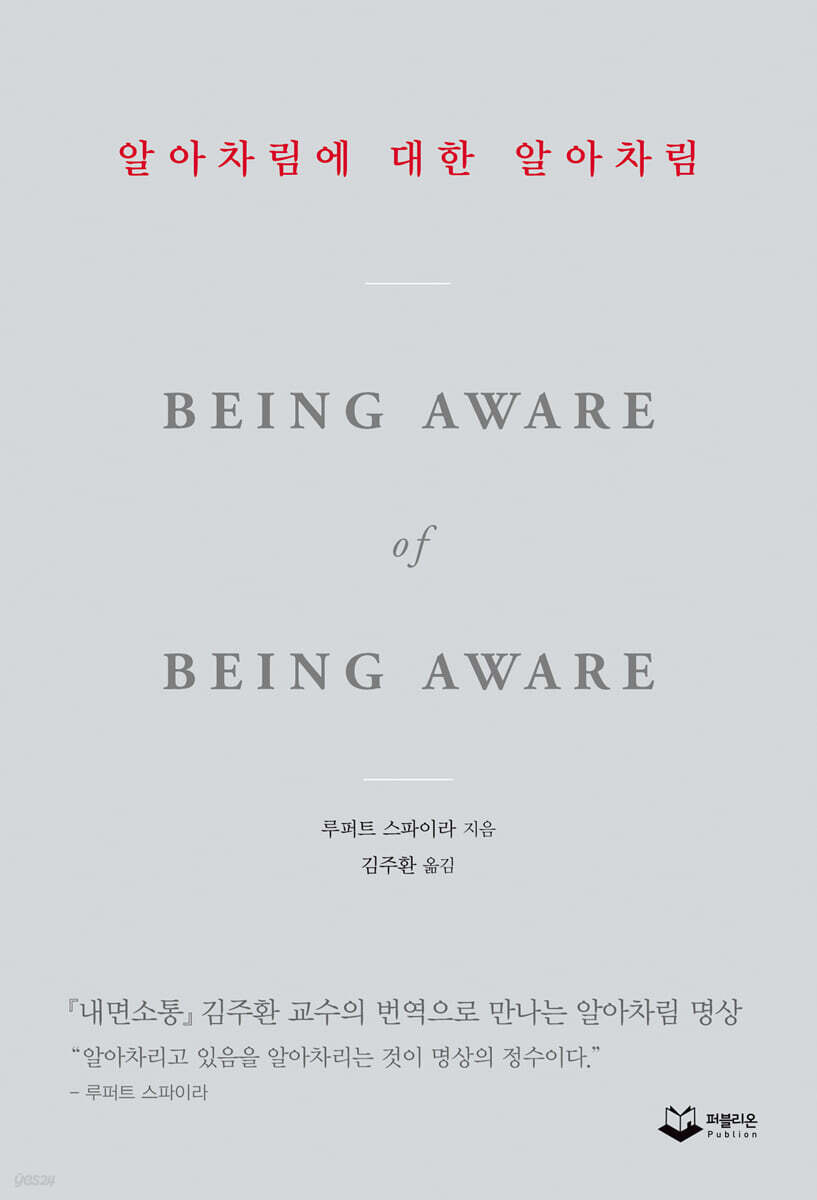
Awareness of awareness
 |
Description
Book Introduction
- A word from MD
-
The Best Introduction to MeditationAn introductory book on meditation translated and recommended by Professor Kim Joo-hwan.
Meditation is a universal language.
Many world religions and modern psychology have emphasized the positive effects of meditation on the mind.
If you are unfamiliar with meditation, you can follow the guidance in “Awareness of Awareness.”
You will reach happiness and fulfillment.
June 9, 2023. Humanities PD Son Min-gyu
Mindfulness Meditation in Professor Kim Joo-hwan's translation of "Inner Communication"
“Self-Exploration” by world-renowned meditator Rupert Spira
Who am I? Am I aware?
“Being aware of being aware is the essence of meditation.” Rupert Spira emphasizes that meditation is not about seeking special enlightenment or new experiences.
To reach the deepest, most essential inner peace and happiness, most meditations teach us to quiet the mind, focus the mind, and observe the mind.
Here, meditation is solely about seeing clearly the nature of the mind.
It shows that it is the only form of meditation that does not require directing the mind anywhere, nor does it require concentration or control of the mind.
The book begins with an exploration of the “nature of the self.”
It is a concise and insightful answer to the profound teachings of the Upanishads and the central questions of Indian Vedanta philosophy: “Who am I?” and “Am I aware?”
They say that true meditation is finding the real me, realizing my true self.
Through this “awareness,” I realize that my true nature is peace and happiness.
This book, which explores ourselves, will help us discover that the enduring peace and unexplained joy in life we all long for already resides within us.
“Self-Exploration” by world-renowned meditator Rupert Spira
Who am I? Am I aware?
“Being aware of being aware is the essence of meditation.” Rupert Spira emphasizes that meditation is not about seeking special enlightenment or new experiences.
To reach the deepest, most essential inner peace and happiness, most meditations teach us to quiet the mind, focus the mind, and observe the mind.
Here, meditation is solely about seeing clearly the nature of the mind.
It shows that it is the only form of meditation that does not require directing the mind anywhere, nor does it require concentration or control of the mind.
The book begins with an exploration of the “nature of the self.”
It is a concise and insightful answer to the profound teachings of the Upanishads and the central questions of Indian Vedanta philosophy: “Who am I?” and “Am I aware?”
They say that true meditation is finding the real me, realizing my true self.
Through this “awareness,” I realize that my true nature is peace and happiness.
This book, which explores ourselves, will help us discover that the enduring peace and unexplained joy in life we all long for already resides within us.
- You can preview some of the book's contents.
Preview
index
Translator's Note
To the reader
Introduction: The Intuition of Happiness
Chapter 1: Noticing
Chapter 2 The Nature of Awareness
Chapter 3: Examining the Core of Our Nature
Chapter 4: Untangling Tangled Awareness
Chapter 5: The Effortless Path
Chapter 6: The Path Inward
Chapter 7: Leading the Cloud of Glory
Chapter 8: The Sea of Awareness
Translator's note
To the reader
Introduction: The Intuition of Happiness
Chapter 1: Noticing
Chapter 2 The Nature of Awareness
Chapter 3: Examining the Core of Our Nature
Chapter 4: Untangling Tangled Awareness
Chapter 5: The Effortless Path
Chapter 6: The Path Inward
Chapter 7: Leading the Cloud of Glory
Chapter 8: The Sea of Awareness
Translator's note
Detailed image
Into the book
Spira's discussion is primarily based on Vedanta philosophy, but he also makes occasional references to Christian and Buddhist perspectives.
Rather than dealing with Vedanta philosophy itself, this book strips away mystical and religious elements, extracting only the core arguments and explaining them in modern, everyday language.
In doing so, it conveys the most spiritual message.
His discussion, which extracts only the essence of Vedanta philosophy through a distillation process, connects naturally with the teachings of Christianity and Buddhism.
He is not religious at all, yet he delivers a more spiritual message than any traditional religious leader.
At the same time, he presents a more specific and clear meditation method than any other meditation instructor.
---From "Page 8, "Translator's Note"
The experience of “I am aware” is the knowledge of the self of awareness.
Therefore, our knowledge of ourselves is the knowledge of ourselves through awareness.
The sun does not need to send its light in any particular direction to shine on its own.
Likewise, awareness does not require directing one's "attention," that is, the light of knowing, in a particular direction in order to know itself.
In fact, no matter which way the sun sends its light, it always illuminates something other than itself.
Likewise, no matter which way awareness sends the light of knowing, it only brings knowledge of something other than itself.
---From "Noticing" on page 57
The screen itself never shakes because of the content of the movie.
Likewise, awareness itself is never disturbed by the content of the experience.
Your thoughts may be shaken, your emotions may be in pain, your body may be aching, and your world may be in disarray.
But pure awareness itself is not disturbed by anything that happens during these experiences.
Therefore, the essence of awareness is tranquility itself.
---From "The Essence of Awareness" on page 61
We often become so caught up in the content of our experiences—thoughts, images, feelings, sensations, and perceptions—that we forget to be aware of all knowledge and experience.
Awareness is always present in the background of all experience.
Yet we overlook the simple experience of unchanging awareness.
We ignore the very act of noticing.
We overlook the simple fact that we ourselves are beings of awareness.
In other words, we have forgotten our own essential nature.
Instead, we live our lives under the illusion that we are a collection of thoughts, images, memories, feelings, sensations, and perceptions.
---From "Examining the Core of Our Essence" on page 77
Imagine you are in bright sunlight and then go into a dark room.
There is nothing the mind can do to make the object in the darkness appear.
If you just stay still and relax, things will slowly begin to come into view.
Meditation is like this too.
There is nothing the mind can do to discover or understand awareness.
Because the mind is a limited form of awareness itself.
The more the mind does something, the more it obscures awareness.
Meditation is the quieting of the mind's activity, thereby revealing to itself the true nature of mind as pure knowing, or awareness.
---From "Untangling Tangled Awareness" on pages 96-97
Awareness is our fundamental experience.
Being aware is the fundamental experience of awareness.
Before awareness knows objective experience, awareness knows itself.
In order for awareness to know what appears to be other than itself—that is, to know thoughts, feelings, sensations, and perceptions—it must shine the light of its own attention, its knowing, on that object.
But in order for awareness to know itself, it does not need to send the light of knowing to any object other than itself.
- Page 115, "The Effortless Path"
The essence of awareness is pure knowing.
It is self-luminous, self-knowing, self-aware.
Being aware of being aware is the essence of meditation.
This is the only form of meditation that does not require directing the mind anywhere, nor does it require concentration or control.
No matter what we do, we cannot become who we really are.
Through practice, you can only become something other than your original being.
---From "The Effortless Path" on page 121
“What do I know or notice about my experience?”
“Where do my thoughts come from?”
“What is the essence of knowledge that all knowledge and experience reveal?”
“Am I aware?”
“Who am I?”
As the mind ponders these questions, it gradually becomes refined, gradually purifying the objective and limited qualities of the mind as it moves through the various layers of objective experience.
---From "The Path to the Inner Self" on page 136
If we compare awareness to the ocean, thoughts are waves moving on the surface, and feelings are the currents flowing underneath.
Just as waves and currents can be called the movement or activity of the sea, so the mind is the movement or activity of awareness.
The deep sea is always quiet.
Likewise, the center of awareness is always calm and peaceful.
Therefore, to attain the peace that the mind so longs for, one must sink into the center of awareness.
Rather than dealing with Vedanta philosophy itself, this book strips away mystical and religious elements, extracting only the core arguments and explaining them in modern, everyday language.
In doing so, it conveys the most spiritual message.
His discussion, which extracts only the essence of Vedanta philosophy through a distillation process, connects naturally with the teachings of Christianity and Buddhism.
He is not religious at all, yet he delivers a more spiritual message than any traditional religious leader.
At the same time, he presents a more specific and clear meditation method than any other meditation instructor.
---From "Page 8, "Translator's Note"
The experience of “I am aware” is the knowledge of the self of awareness.
Therefore, our knowledge of ourselves is the knowledge of ourselves through awareness.
The sun does not need to send its light in any particular direction to shine on its own.
Likewise, awareness does not require directing one's "attention," that is, the light of knowing, in a particular direction in order to know itself.
In fact, no matter which way the sun sends its light, it always illuminates something other than itself.
Likewise, no matter which way awareness sends the light of knowing, it only brings knowledge of something other than itself.
---From "Noticing" on page 57
The screen itself never shakes because of the content of the movie.
Likewise, awareness itself is never disturbed by the content of the experience.
Your thoughts may be shaken, your emotions may be in pain, your body may be aching, and your world may be in disarray.
But pure awareness itself is not disturbed by anything that happens during these experiences.
Therefore, the essence of awareness is tranquility itself.
---From "The Essence of Awareness" on page 61
We often become so caught up in the content of our experiences—thoughts, images, feelings, sensations, and perceptions—that we forget to be aware of all knowledge and experience.
Awareness is always present in the background of all experience.
Yet we overlook the simple experience of unchanging awareness.
We ignore the very act of noticing.
We overlook the simple fact that we ourselves are beings of awareness.
In other words, we have forgotten our own essential nature.
Instead, we live our lives under the illusion that we are a collection of thoughts, images, memories, feelings, sensations, and perceptions.
---From "Examining the Core of Our Essence" on page 77
Imagine you are in bright sunlight and then go into a dark room.
There is nothing the mind can do to make the object in the darkness appear.
If you just stay still and relax, things will slowly begin to come into view.
Meditation is like this too.
There is nothing the mind can do to discover or understand awareness.
Because the mind is a limited form of awareness itself.
The more the mind does something, the more it obscures awareness.
Meditation is the quieting of the mind's activity, thereby revealing to itself the true nature of mind as pure knowing, or awareness.
---From "Untangling Tangled Awareness" on pages 96-97
Awareness is our fundamental experience.
Being aware is the fundamental experience of awareness.
Before awareness knows objective experience, awareness knows itself.
In order for awareness to know what appears to be other than itself—that is, to know thoughts, feelings, sensations, and perceptions—it must shine the light of its own attention, its knowing, on that object.
But in order for awareness to know itself, it does not need to send the light of knowing to any object other than itself.
- Page 115, "The Effortless Path"
The essence of awareness is pure knowing.
It is self-luminous, self-knowing, self-aware.
Being aware of being aware is the essence of meditation.
This is the only form of meditation that does not require directing the mind anywhere, nor does it require concentration or control.
No matter what we do, we cannot become who we really are.
Through practice, you can only become something other than your original being.
---From "The Effortless Path" on page 121
“What do I know or notice about my experience?”
“Where do my thoughts come from?”
“What is the essence of knowledge that all knowledge and experience reveal?”
“Am I aware?”
“Who am I?”
As the mind ponders these questions, it gradually becomes refined, gradually purifying the objective and limited qualities of the mind as it moves through the various layers of objective experience.
---From "The Path to the Inner Self" on page 136
If we compare awareness to the ocean, thoughts are waves moving on the surface, and feelings are the currents flowing underneath.
Just as waves and currents can be called the movement or activity of the sea, so the mind is the movement or activity of awareness.
The deep sea is always quiet.
Likewise, the center of awareness is always calm and peaceful.
Therefore, to attain the peace that the mind so longs for, one must sink into the center of awareness.
---From "The Sea of Awareness" on page 167
Publisher's Review
“Awareness is always deep in the sea, regardless of the storms raging on the sea.”
The core idea of the Upanishads and the essence of Indian Vedanta philosophy
Simple truths of life shine through as powerful metaphors!
『Awareness of Awareness』, translated by Professor Kim Joo-hwan, author of the best-selling 『Inner Communication』, is the first volume in the "Essence of Meditation" series by world-renowned meditator Rupert Spira.
The Essential Meditation series is a compilation of meditations conducted by Rupert Spira in his own circles and retreats, exploring the essential Advaita understanding that lies at the heart of all great religious and spiritual traditions.
Spira says that the practice of meditation must pass through two stages.
The first step is to break away from everyday experiences and find the 'true self' (the true self) as pure consciousness, and the second step is to return to everyday life and realistic experiences and integrate pure consciousness with real experiences.
This simple and clear meditation, which encourages us to see our experience clearly rather than suggesting any effort or training, helps us see that our existence is inherently filled with peace and unexplained joy.
We will come to realize that awareness (“awareness”) of our existence is happiness itself.
The sea of awareness that meets the true self
Just as the deep sea is always calm even when a storm rages, the mind of awareness is always calm and peaceful, no matter what state of thoughts and emotions it is in.
That is the refuge.
Spyra likens awareness to the sea, explaining that thoughts are the moving waves and feelings are the currents flowing underneath.
Just as waves and currents can be called movement or activity, so our mind can be called the movement or activity of awareness.
Therefore, it is clearly stated that in order to attain the peace that the mind so longs for, one must sink into the center of awareness.
It is said that a wave cannot find peace and contentment within another wave, and that the only way for a wave to find lasting peace and contentment is to gradually become unshakable as it sinks into the abyss beneath itself.
Likewise, the only place where the finite mind, which appears to be an individual self, can find lasting peace and contentment is in the abyss of its own being.
The finite mind, the individual self that wanders in search of peace and contentment in objective experience, is like the ocean currents wandering in search of water in the sea.
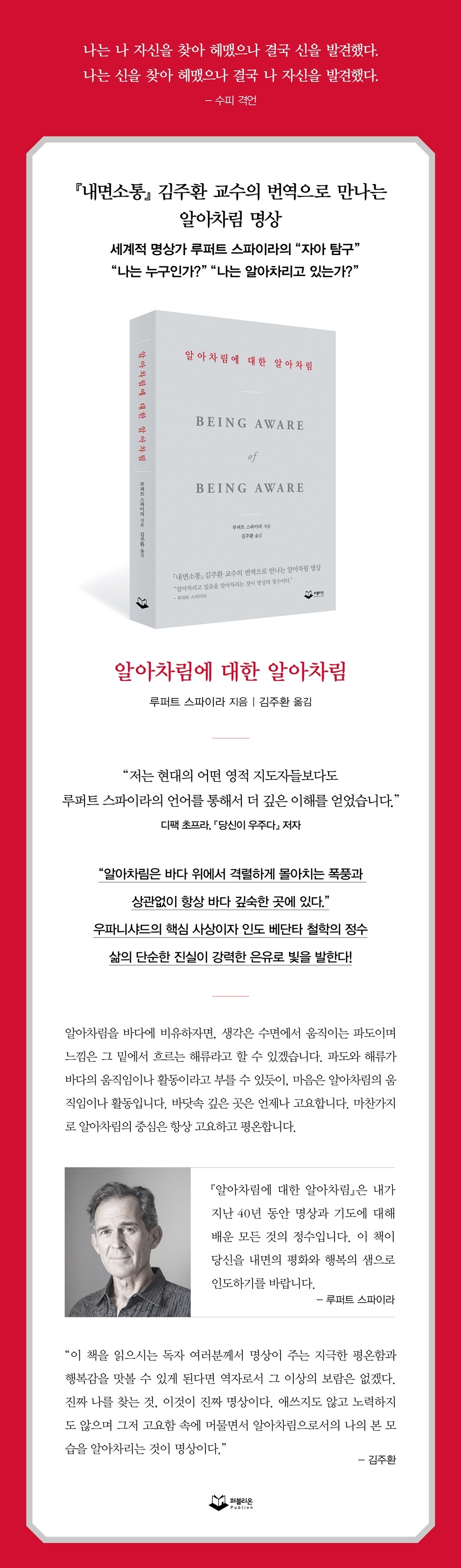
I searched for myself, but eventually I found God.
I wandered around looking for God
I finally found myself.
 ̄Sufi proverbs
Awareness of existence is happiness itself.
"Awareness of Awareness" explores our primary and most intimate experience: the awareness of our own existence.
However, the experience of awareness, or simply 'noticing', is not the object of awareness and is therefore usually overlooked or ignored.
To return awareness to awareness itself, to be aware of awareness, this is the essence of meditation and prayer, and the direct path to lasting peace and happiness.
The more I realize that my thoughts, emotions, and feelings are not me, but a series of events that happen to me, the more I can step back and observe them without being swept away by them.
As a subject of perception, I am also gradually becoming more and more able to see that I am always calm, peaceful, and unshakable.
“To reach the deepest, most essential inner peace and happiness, most meditations teach you to quiet the mind, focus the mind, and observe the mind.
Meditation here is never about seeking new experiences.
“I just want to see the essence of the mind clearly.”
Rupert Spira
“Finding the real me, this is true meditation.
Meditation is simply being aware of your true self as awareness, without trying or exerting yourself, but simply remaining in stillness.
It's not that I become peaceful and happy, but rather that I realize that my true nature is peace and happiness.
“When you withdraw your attention from the objective experience and simply become aware of the awareness, you will be filled with such perfect fulfillment and satisfaction that you will want nothing more.”  ̄ From the “Translator’s Note”
The core idea of the Upanishads and the essence of Indian Vedanta philosophy
Simple truths of life shine through as powerful metaphors!
『Awareness of Awareness』, translated by Professor Kim Joo-hwan, author of the best-selling 『Inner Communication』, is the first volume in the "Essence of Meditation" series by world-renowned meditator Rupert Spira.
The Essential Meditation series is a compilation of meditations conducted by Rupert Spira in his own circles and retreats, exploring the essential Advaita understanding that lies at the heart of all great religious and spiritual traditions.
Spira says that the practice of meditation must pass through two stages.
The first step is to break away from everyday experiences and find the 'true self' (the true self) as pure consciousness, and the second step is to return to everyday life and realistic experiences and integrate pure consciousness with real experiences.
This simple and clear meditation, which encourages us to see our experience clearly rather than suggesting any effort or training, helps us see that our existence is inherently filled with peace and unexplained joy.
We will come to realize that awareness (“awareness”) of our existence is happiness itself.
The sea of awareness that meets the true self
Just as the deep sea is always calm even when a storm rages, the mind of awareness is always calm and peaceful, no matter what state of thoughts and emotions it is in.
That is the refuge.
Spyra likens awareness to the sea, explaining that thoughts are the moving waves and feelings are the currents flowing underneath.
Just as waves and currents can be called movement or activity, so our mind can be called the movement or activity of awareness.
Therefore, it is clearly stated that in order to attain the peace that the mind so longs for, one must sink into the center of awareness.
It is said that a wave cannot find peace and contentment within another wave, and that the only way for a wave to find lasting peace and contentment is to gradually become unshakable as it sinks into the abyss beneath itself.
Likewise, the only place where the finite mind, which appears to be an individual self, can find lasting peace and contentment is in the abyss of its own being.
The finite mind, the individual self that wanders in search of peace and contentment in objective experience, is like the ocean currents wandering in search of water in the sea.
I searched for myself, but eventually I found God.
I wandered around looking for God
I finally found myself.
 ̄Sufi proverbs
Awareness of existence is happiness itself.
"Awareness of Awareness" explores our primary and most intimate experience: the awareness of our own existence.
However, the experience of awareness, or simply 'noticing', is not the object of awareness and is therefore usually overlooked or ignored.
To return awareness to awareness itself, to be aware of awareness, this is the essence of meditation and prayer, and the direct path to lasting peace and happiness.
The more I realize that my thoughts, emotions, and feelings are not me, but a series of events that happen to me, the more I can step back and observe them without being swept away by them.
As a subject of perception, I am also gradually becoming more and more able to see that I am always calm, peaceful, and unshakable.
“To reach the deepest, most essential inner peace and happiness, most meditations teach you to quiet the mind, focus the mind, and observe the mind.
Meditation here is never about seeking new experiences.
“I just want to see the essence of the mind clearly.”
Rupert Spira
“Finding the real me, this is true meditation.
Meditation is simply being aware of your true self as awareness, without trying or exerting yourself, but simply remaining in stillness.
It's not that I become peaceful and happy, but rather that I realize that my true nature is peace and happiness.
“When you withdraw your attention from the objective experience and simply become aware of the awareness, you will be filled with such perfect fulfillment and satisfaction that you will want nothing more.”  ̄ From the “Translator’s Note”
GOODS SPECIFICS
- Date of issue: May 25, 2023
- Page count, weight, size: 204 pages | 270g | 128*188*16mm
- ISBN13: 9791191587418
- ISBN10: 119158741X
You may also like
카테고리
korean


korean

![GQ KOREA Mark (Monthly): December [2025]](http://librairie.coreenne.fr/cdn/shop/files/8ef265dbbfbf186523ed75ba7319009d.jpg?v=1765340328&width=3840)


