

Sunday Music Room
 |
Description
Book Introduction
- A word from MD
-
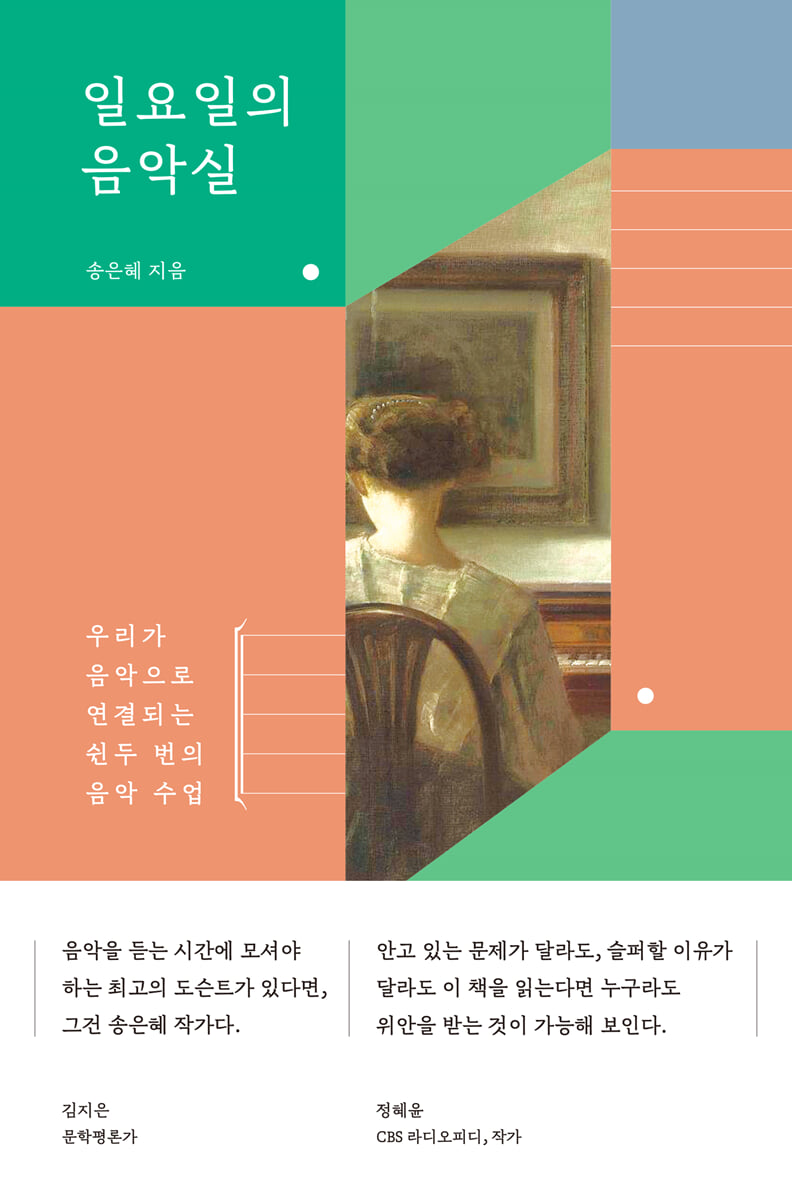
A warm introduction to classical music, unfolding every week『The Language of Music』 is a classical introduction and music essay by author Eunhye Song.
He has explained the method of appreciating music in a friendly and accurate way so that even readers unfamiliar with classical music can easily approach it.
It helps you appreciate songs you've heard before in a variety of ways.
Immerse yourself in a new world of classics with books for a full 52 weeks, a year.
April 18, 2023. Art PD Kim Yu-ri
Song Eun-hye, a music docent who connects music, life, and the heart,
We opened the Sunday Music Room.
Author Song Eun-hye, who received much love for her first book, "The Language of Music," published in 2021, presents a new work after two years.
The author, who studied organ, harpsichord, musicology, piano, and accompaniment in Korea, the United States, and France, and currently teaches students at the Rennes Conservatory of Music and the Rennes Municipal Conservatory of Music in France, has been consistently communicating with people through social media and talking about music and the lives of foreigners.
This time, we are collecting articles that have been serialized for over a year in the Channel Yes webzine under the title “Sunday’s Music Room,” and approaching readers with “Sunday’s Music Room,” an introduction to classical music and music essay, with more information that will be helpful when listening to classical music.
If you read all 52 chapters, one per week, in a tone that invites people into a cozy space every Sunday and tells music stories in a thoughtful voice, it will be a truly year-long classical journey.
This book is divided into seven parts and categorizes music by genre (string music, concertos, keyboard music, dance music, orchestral music, dramatic music, vocal music) and provides information on various works, composers, and musical terms.
For readers unfamiliar with classical music, it provides easy-to-understand explanations of the basic theories of classical genres and forms, such as string quartets, sonatas, concertos, and variations, thereby deepening their understanding of music. So, even those who are just beginning to approach classical music can follow the friendly guidance without being intimidated.
It also suggests various ways to appreciate music so that anyone can naturally immerse themselves in it.
When talking about music, the author neither rigidly explains it based on theory nor falls into subjective appreciation. He has an outstanding ability to appropriately blend the composer's intentions with the listener's psychology.
Connecting music, life, and the heart is also one of Song Eun-hye's specialties.
Therefore, it will be an opportunity for even serious classical music lovers to enjoy music from a different perspective and with a new feeling.
- You can preview some of the book's contents.
Preview
index
Entering the Music Room_How to Remember Life Through Music
1.
Strings: From Solo to Orchestra
First Story_ Viola da Gamba's Invocation: Marin Marais's "The Human Voice"
Second Story_Death and the Maiden's Irony: Schubert's "Death and the Maiden"
Third Story_Music Class: String Quartet, Bewitched by the Beauty of Form
Story Four: I'm Publishing My Music Now: Fanny Hensel's "Piano Trio"
Fifth Story_The Blue Energy of Teenagers: Mendelssohn's "String Octet"
Story Six: No Exit: Samuel Barber's "Adagio for Strings"
Seventh Story_music class: Sonata, what do you want?
2.
Concerto
Story 8: Aria Without Lyrics: Mozart's Piano Concerto No. 23, 2nd Movement, Adagio
Story 9: The Fading Song of a Precious Swan: Edward Elgar's Cello Concerto
Story 10: Art that Touches the Heart: Rachmaninoff's Piano Concerto No. 2
Eleventh Story: A New Look at Spring, Summer, Fall, and Winter: Antonio Vivaldi and Max Richter's The Four Seasons
Twelfth Story_Music Class: Conflict vs. Harmony, Our Approach to Concertos
3.
Keyboard music
Story 13: Was It Really a Lullaby?: Bach's "Goldberg Variations"
Story Fourteen: Dedicated to Adults: Schumann's "Children's Scenes"
Fifteenth Story_Like a Tree Enduring the Wind: Frédéric Chopin's "Nocturne"
Story Sixteen: Comfort from the Brilliant Rainbow Starry Sky: Debussy's "Dream"
Seventeenth Story_The Eternal Gymnopédist: Erik Satie's "Three Gymnopédies"
Story 18: Mystery Through Contemporary Music: Olivier Messiaen's "The Birth of the Redeemer"
Story 19: Dances with Ghosts: William Bolcom's Ghost Rag
Story 20: Love Engraved in Music: Clara Schumann's Variations on a Theme of Robert Schumann
Story 21_Music Class: From Seed to Flower, Variations
4.
dance song
Story Twenty-Second_Dancing with the Cello: Casals's Bach
Story Twenty-Third: How to Dance to Dry Music: Orlando Gibbons, Lord Salisbury's Pavane and Galliard
Story Twenty-Fourth_Remembering Happiness: Tchaikovsky's "The Nutcracker"
Story Twenty-Fifth_Marketplace Ballet: Darius Milhaud's "The Ox on the Roof"
Story 26_Music Class: Music Drawn in the Air, Singing Dance
5.
Orchestral music
Story Twenty-Seventh: What is the New World for You? Dvořák's Symphony No. 9, "New World"
Story Twenty-Eighth_Dance of the Living and the Dead: Saint-Saëns's "Dance of Death"
Story 29: Learning Musical Instruments Through Musical Fairy Tales: Prokofiev's "Peter and the Wolf"
Story 30: Dreaming of Symbols: Debussy's "Prelude to the Afternoon of a Faun"
Story 31: Like Drawing a Line with a Brush: Yun Isang's "Yeak"
Story 32: A Letter to Humanity: Beethoven's 9th Symphony (Choral)
Story 33_Music Class: Everything You Can Imagine with Sound, Symphony
6.
Dramatic music: Opera
Story 34: Love Hidden in a Joke: Lully's "The Common Nobleman"
The Thirty-Fifth Story_The French Mozart: Elisabeth Jacquet de la Guerre's "The Sleep of Odysseus"
Story 36: A Feast of Fragrant Comedy and Clear Music: Mendelssohn's "A Midsummer Night's Dream"
Story 37: An Opera That Delves into the Cracks of Thought: Saint-Saëns's Samson and Delilah
Story 38: Making Strange with Music: Kurt Weill's The Threepenny Opera
Story 39_Music Class: Opera: Adding Art to Art
7.
Vocal music: from solo to chorus
Story 40: Between Religion and Secularity, Oratorio in the Theater: Handel's "Messiah"
Story 41: Music or Tears: Barbara Strozzi's "My Tears"
Story 42_Musical Rest: Henry Purcell's "Music for a Moment"
Story 43: The Music Poet's Guide to Love: Schumann's "Poet's Love"
Story 44: Poetry Drawn with Sound: Monteverdi's "Lament of a Nymph"
Story 45_Music Class: The Art of Overlapping, Counterpoint
Story 46: Philosophers and Music: Steve Reich's "Proverbs"
Story 47: A Prayer for the World: Lily Boulanger, "Ancient Buddhist Prayers"
Story 48: There Are No Boundaries in Music: Jin Eun-sook's "Song of the Children of the Stars"
Story 49_music class: Praise of the choir
The Fifth Story_Sacred Silence: The Hymn of the Grigoreo
The Fifty-First Story_Song of Ecstasy: Hildegard of Bingen, "O Jerusalem, Golden City"
The Fifty-Second and Final Story_Eternity Engraved in Stone: "The Song of Seikilus"
Closing the music room door
Musical terms
List of works in this book
Detailed image
Into the book
Fanny Mendelssohn, who was supposed to be a good wife and mother, was restricted from pursuing her musical career by emphasizing that music was merely a 'decoration' of life.
Her younger brother, Felix Mendelssohn, also recognized his sister's talent from an early age, but always told her that it was more important for a woman to take care of the home.
But for Fanny Mendelssohn, music could not be 'decoration'.
While her brother was out in the world, meeting the public, Fanny Mendelssohn continued to compose and play the piano without stopping within her own world.
---p.38~39
The journey through a tunnel with no visible exit is painful.
Like Barber's Adagio, which progresses slowly but relentlessly toward its climax, like the life we endure and live.
But Camus said that 'every crumb of stone, every piece of mineral on that dark mountain' had meaning for Sisyphus.
Because the struggle to reach the top of the mountain fills the emptiness of human hearts.
A fleeting moment of freedom at the end of endless suffering and despair, and then a new beginning.
It is sometimes amazing how faithful a person can be to the journey of life itself.
---p.54
When the piano and orchestra sing the same theme, experiencing the same emotion with completely different sounds is also part of the charm of the concerto.
When the piano melody, which sings of simple and intense emotions, endlessly expands into sounds unimaginable from other instruments, we feel a sense of fullness, as if our ears have been blessed with balm.
---p.67
I looked up the word ‘Jeonggyeong’ in the dictionary in ‘Children’s Jeonggyeong’ and found 1.
A captivating view, 2.
It is called the situation a person is in (Korea University Korean Dictionary).
The original title of the work is 'Kinderszenen', which literally translates to 'Children's Scenes'.
Rather than the one-time, objective, and detached feeling that comes from 'scene,' the quiet word 'scenery', which is connected to the heart, seems to better express Schumann's music, which evokes childhood memories through emotions.
---p.112
The reason why nocturnes soothe our hearts is not because they simply sway in the wind according to our emotions.
This is because there is a left-hand accompaniment section that provides strong and firm support so that the melody can move freely.
Chopin instinctively knew that the more he shook, the more firmly he had to stand on the ground.
When we listen to nocturnes, we notice two feelings taking place in our hearts.
The present is precariously balanced between shaking and support.
When we listen to his music, we look into our own sorrow, not his.
And you learn to bear grief with your heart, not your head.
---p.126
Erik Satie's whole life was a contradiction.
Father Rami, the saint of the poor, who visited Sati as he lay dying, said this before leaving him.
“Sati is a man of upright heart and honesty.” In Sati’s unpredictable life, Father Rami may be the only one who has seen through his soul.
---p.138
Variations are a form of music that develops through repetition.
It is also a novel composition method that allows listeners to feel familiar with a song even when they hear it for the first time, as it transforms a simple theme in various ways.
In reality, our brains are designed to predict things and then verify the results.
When listening to music, listeners anticipate what will come next, no matter what element it is, and they unconsciously sing along in their heads.
In particular, variations, which are easier to anticipate than other forms, constantly anticipate the future, and the music progresses like an internal dialogue between the listener and the composer responding to those anticipations.
---p.166
How about taking a breather from your busy daily routine and quietly swaying your heart to the simple dances of Pavane and Galliard? Immerse yourself in the tranquility you've been missing from your stimulating daily life.
If you listen to the silence between sounds rather than the sounds themselves, another world may open up.
Hold your breath so you can hear the sound of a dragonfly's wings, and listen carefully.
The flow of air, your silence.
---p.184
Unlike Western music, which gains expressive power through melody, harmony, rhythm, and form as notes are connected, Yun Isang's music depicts the changes of a single note being created, expanded, and disappearing, like ink spreading across rice paper.
So, even if the notes are written differently in the score, they are considered to be a kind of derivative note that spreads out from the central note.
---p.250
The works of Brecht and Weill, which expose and abhor the problems of opera that neither reflect the social spirit nor criticize reality, have achieved enormous commercial success, been translated into many languages, and reproduced as films.
It was thanks to the consumption of the bourgeois class that they had so criticized.
Perhaps the social criticism they wanted to convey was met with conventional art and their success was based on public misunderstanding.
However, it is clear that this marked the end of an era in which art was enjoyed only by a certain class, and that a real movement reflecting a new way of life was also revealed in musicals.
---p.301~302
Bertolt Brecht said this:
“The reason opera defies common sense is that no matter how much we use logical elements and how much we claim to be objective and real, music renders everything powerless.” Discover how music transcends reason through opera.
If you experience the parallax that moves your heart before your mind understands, you will find it difficult to escape the charm of opera.
---p.307~308
Just because history has erased women doesn't mean their talents and strengths have disappeared.
Barbara Strozzi's songs are proof of that.
---p.321
The human voice has a narrow range compared to instruments, which has limitations.
But the expressive power of the voice that can sing poetry has a power that no instrument can match.
The Renaissance madrigal was a complex and sensual genre that expressed human emotions with extreme delicacy through lyrics and music.
---p.355
Jin Eun-sook answers that although she didn't have much access to records or radio when she was young, music filled her daily life.
It is true that I was exposed to Western music at church, but on the way home from church, there was a shaman's house, and I heard traditional Korean shamanic music there every day.
It was probably these daily experiences that erased the boundaries of music for Jin Eun-sook.
So, for him, the distinction between Western and Eastern music is meaningless.
The same goes for popular music and classical music, traditional music and contemporary music.
All sounds are just sounds, and any sound can be a material for expressing our thoughts.
---p.371
When people with different backgrounds and goals come together and sing with one voice or to the same music, they experience a universality that transcends their individual selves.
When weave our voices together like bricks, singing the same emotion with slightly different colors, a miraculous harmony that is difficult to experience in reality occurs in choral music.
So, when many people come together and sing a song, it has a powerful effect on us.
Because all humans have a voice and are accustomed to using their voice to express their feelings.
When the sound we possess rises to the realm of art, we feel a special fulfillment different from that of an instrument.
---p.378~379
Publisher's Review
The one who connects music, life and heart
We opened a music room on Sunday
Author Song Eun-hye, who received much love for her first book, "The Language of Music," published in 2021, presents a new work after two years.
The author, who studied organ, harpsichord, musicology, piano, and accompaniment in Korea, the United States, and France, and currently teaches students at the Rennes Conservatory of Music and the Rennes Municipal Conservatory of Music in France, has been consistently communicating with people through social media and talking about music and the lives of foreigners.
This time, we are collecting articles that have been serialized for over a year in the Channel Yes webzine under the title “Sunday’s Music Room,” and approaching readers with “Sunday’s Music Room,” an introduction to classical music and music essay, with more information that will be helpful when listening to classical music.
If you read all 52 chapters, one per week, in a tone that invites people into a cozy space every Sunday and tells music stories in a thoughtful voice, it will be a truly year-long classical journey.
This book is divided into seven parts and categorizes music by genre (string music, concertos, keyboard music, dance music, orchestral music, dramatic music, vocal music) and provides information on various works, composers, and musical terms.
For readers unfamiliar with classical music, it provides easy-to-understand explanations of the basic theories of classical genres and forms, such as string quartets, sonatas, concertos, and variations, thereby deepening their understanding of music. So, even those who are just beginning to approach classical music can follow the friendly guidance without being intimidated.
It also suggests various ways to appreciate music so that anyone can naturally immerse themselves in it.
When talking about music, the author neither rigidly explains it based on theory nor falls into subjective appreciation. He has an outstanding ability to appropriately blend the composer's intentions with the listener's psychology.
Connecting music, life, and the heart is also one of Song Eun-hye's specialties.
Therefore, it will be an opportunity for even serious classical music lovers to enjoy music from a different perspective and with a new feeling.
Samuel Barber's Adagio for Strings overwhelms us with its slow, long breaths.
As the melody gradually rises in quarter notes, the supporting harmony stretches out the beats so long that it is difficult to discern the measure just by listening.
Like a sunset stretching across the sky, the boundaries of time are erased, and we are lost among the slow notes.
This is also a moment when the power of stringed instruments, which can sustain notes for much longer than a human breath, is demonstrated.
We, who want to breathe regularly with the music we listen to, find ourselves unable to breathe comfortably in the midst of the long, drawn-out string melody.
Even if the sound is cut off, it doesn't feel like a cut off unless the dissonance is resolved.
The endless crescendo toward the higher notes gradually tightens the listener's heart with dissonances that are never comfortably resolved.
(pages 52-53)
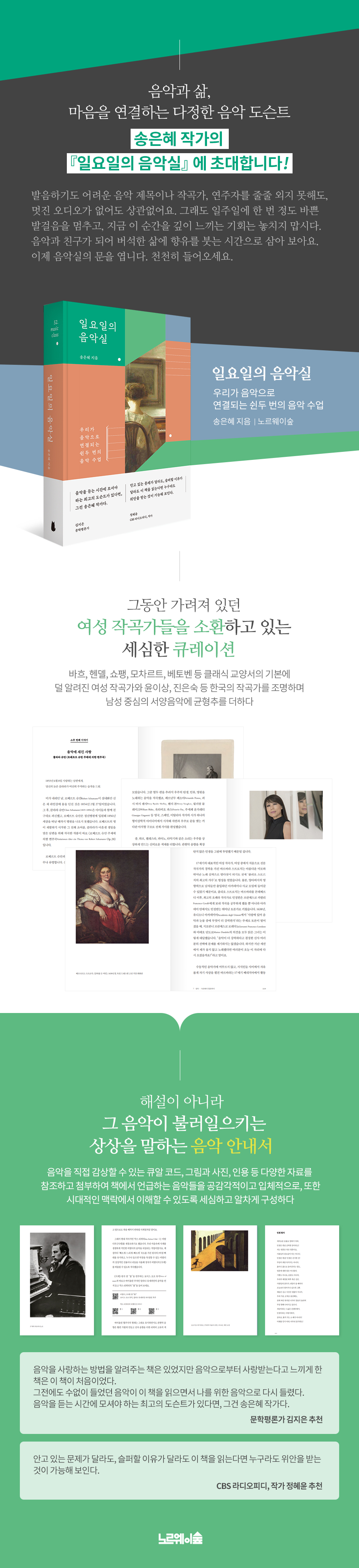
Adding a counterweight to the existing view of male-centered Western music,
A classic educational book for this era!
This book not only solidly adheres to the basics of classical literature by covering well-known musicians and their works, such as Bach, Handel, Chopin, Mozart, Beethoven, Debussy, Saint-Saëns, and Vivaldi, but also has a special aspect that makes this book shine even more.
It is precisely because it introduces female musicians and their works, such as Fanny Hensel, Clara Schumann, Lili Boulanger, and Hildegard von Bingen, who need to be better known to us.
The act of summoning and naming somewhat unfamiliar musicians, especially female artists who have been hidden for a long time, is a very noticeable characteristic of ‘Sunday Music Room.’
In addition, it introduces Korean musicians such as Yun Isang and Jin Eun-sook and their works, adding a balance to the existing perspective that is biased towards male-centered Western music.
It can be said that this is the most timely classic textbook for us in this day and age.
Synesthetically and three-dimensionally,
A book that talks about the imagination that the music evokes, rather than a commentary.
Music is an invisible art form.
When the 'language' referred to as 'lyrics' does not appear or assist, it is easy to approach it in a more abstract way.
In particular, classical music, rather than contemporary music, can feel somewhat ambiguous or difficult. To compensate for this, various materials such as drawings, photographs, and quotations were referenced and attached, and the book was carefully and informatively organized so that readers can understand the music mentioned in the book in a synesthetic and three-dimensional way, and in the context of the times.
This book, which takes the form of inviting readers to a music room to listen to the music together, actually inserts QR codes throughout the story so that readers can listen to the music themselves.
I recommend a reading method that involves listening to the music that appears from time to time while simultaneously following the author's story.
While you will gain a richer understanding of the commentary, you will also have the opportunity to interpret it with your own feelings.
It is also the goal of this book to help readers capture their own moments and scenes, with music.
Questions to ask before listening to music
“What journey of life are you on right now?”
The author says that it is difficult to give a good answer right away to a beginner's question asking for recommendations for classical music.
This is because music that others listen to without knowing the context of the person's life is unlikely to connect with his or her life.
So the author says that it might be better to ask, “What kind of life are you living now?” but even then, he doesn’t have the confidence to recommend the right music.
The author's delicate and affectionate attitude, consideration, and humility actually give a sense of security and trust.
Now I feel like I can visit this music room with peace of mind.
It doesn't matter if you can't pronounce difficult song titles, composers, or performers, or if you don't have great audio.
Still, let's not miss the opportunity to stop our busy steps once a week and deeply feel this moment.
Let's make friends with music and use it as a time to pour fragrance into our dull lives.
Now open the door to the music room.
Please come in slowly.
(Page 14)
GOODS SPECIFICS
- Date of issue: April 20, 2023
- Format: Hardcover book binding method guide
- Page count, weight, size: 420 pages | 652g | 130*200*30mm
- ISBN13: 9791197791741
- ISBN10: 1197791744
You may also like
카테고리
korean


korean


