

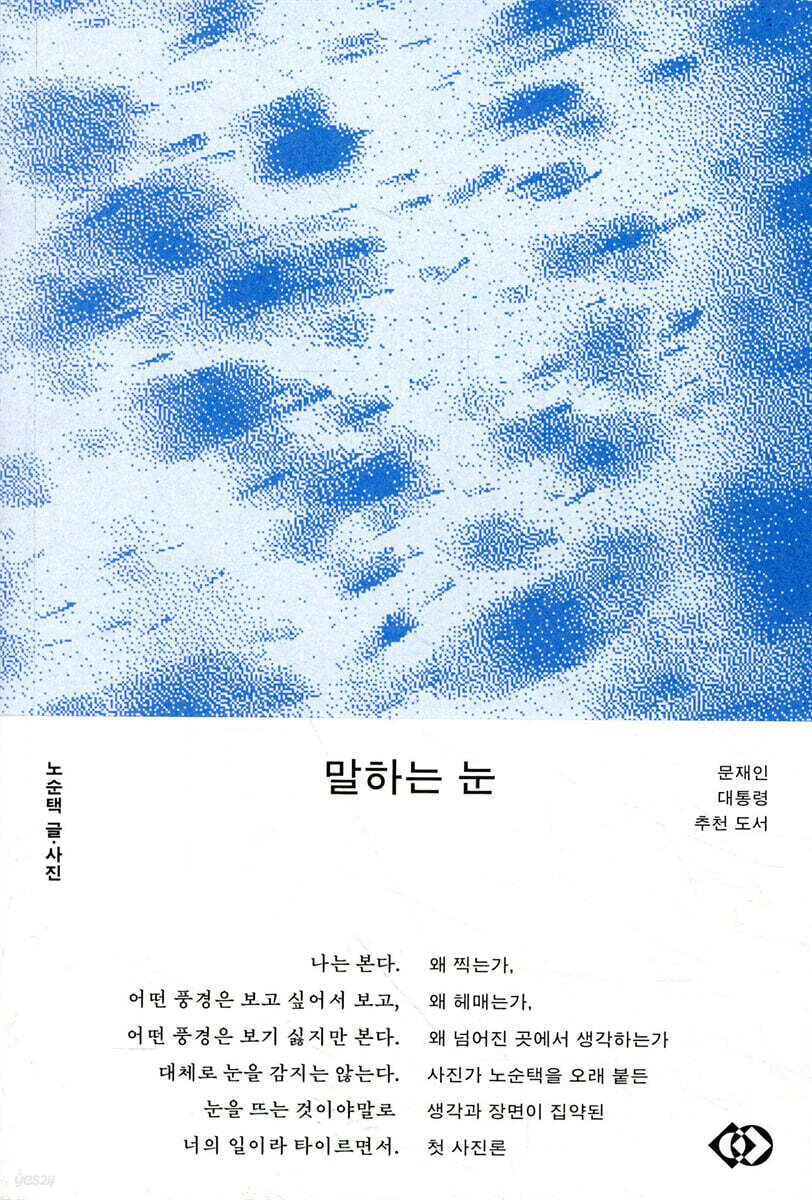
Talking eyes
 |
Description
Book Introduction
“I see.
I see some scenery because I want to see it, and I see some scenery because I don't want to see it.
Usually, I don't close my eyes.
“It is your job to open your eyes,” he said.
Why do we take pictures, why do we wander, why do we think about where we fell?
The first photography theory, "Speaking Eyes," is a collection of the thoughts and scenes that have long haunted photographer Noh Sun-taek.
“Some eyes speak.
It's not just about speaking with your mouth, and it's not just about listening with your ears.
To hear what the eyes are saying, you must make eye contact.
Even when hiding behind the camera, eye contact is made.
“Because I saw the eyes that spoke, I also tried to talk about what I saw with my own eyes.” Noh Sun-taek has captured the contradictions of a divided nation and the malfunctioning landscape of state power in series such as [Scent of Division], [State of Emergency], [Forgetting Machine], and [Black Feather], and is the first photographer to receive the ‘Artist of the Year’ award from the National Museum of Modern and Contemporary Art.
He is known not only for his unique photographic work, but also for his sophisticated and resonant writing that captures the struggles of his work.
Nevertheless, he has never published a single volume that comprehensively organizes and condenses his thoughts, except for a collection of his photo works or a book that compiles his serialized writings.
"Speaking Eyes" is the "first theory of photography" that condenses the thoughts and scenes that have long haunted photographer Noh Sun-taek.
This book, which contains thoughts on photography, people, and society, is composed of four chapters: “The Scissors of Photography,” which contemplates the cutting of photographs and the sewing of meaning; “The Trigger, Bullet, and Film,” which observes the context in which photographs are placed; “The Time of Photography,” which reflects on the presence and absence contained in photographs; and “The Struggle for Memory,” which talks about those who have preserved memories through the struggle against oblivion.
Noh Sun-taek lingers in the photographs and writings he took, tied to the single fact that “I was there at that time.”
He says.
Some eyes say they speak.
Because I saw the eyes that spoke, I also tried to talk about what I saw with my own eyes.
If you can't think about the 'debt you owe for seeing', then you should stop taking pictures.
Critic and writer John Berger said that in photography, 'the visible calls forth the invisible.'
The truth of a photograph can be found when we carefully observe both what is visible and what is invisible.
"Speaking Eyes" is a book that conveys its meaning powerfully.
I see some scenery because I want to see it, and I see some scenery because I don't want to see it.
Usually, I don't close my eyes.
“It is your job to open your eyes,” he said.
Why do we take pictures, why do we wander, why do we think about where we fell?
The first photography theory, "Speaking Eyes," is a collection of the thoughts and scenes that have long haunted photographer Noh Sun-taek.
“Some eyes speak.
It's not just about speaking with your mouth, and it's not just about listening with your ears.
To hear what the eyes are saying, you must make eye contact.
Even when hiding behind the camera, eye contact is made.
“Because I saw the eyes that spoke, I also tried to talk about what I saw with my own eyes.” Noh Sun-taek has captured the contradictions of a divided nation and the malfunctioning landscape of state power in series such as [Scent of Division], [State of Emergency], [Forgetting Machine], and [Black Feather], and is the first photographer to receive the ‘Artist of the Year’ award from the National Museum of Modern and Contemporary Art.
He is known not only for his unique photographic work, but also for his sophisticated and resonant writing that captures the struggles of his work.
Nevertheless, he has never published a single volume that comprehensively organizes and condenses his thoughts, except for a collection of his photo works or a book that compiles his serialized writings.
"Speaking Eyes" is the "first theory of photography" that condenses the thoughts and scenes that have long haunted photographer Noh Sun-taek.
This book, which contains thoughts on photography, people, and society, is composed of four chapters: “The Scissors of Photography,” which contemplates the cutting of photographs and the sewing of meaning; “The Trigger, Bullet, and Film,” which observes the context in which photographs are placed; “The Time of Photography,” which reflects on the presence and absence contained in photographs; and “The Struggle for Memory,” which talks about those who have preserved memories through the struggle against oblivion.
Noh Sun-taek lingers in the photographs and writings he took, tied to the single fact that “I was there at that time.”
He says.
Some eyes say they speak.
Because I saw the eyes that spoke, I also tried to talk about what I saw with my own eyes.
If you can't think about the 'debt you owe for seeing', then you should stop taking pictures.
Critic and writer John Berger said that in photography, 'the visible calls forth the invisible.'
The truth of a photograph can be found when we carefully observe both what is visible and what is invisible.
"Speaking Eyes" is a book that conveys its meaning powerfully.
- You can preview some of the book's contents.
Preview
index
Opening Remarks: Eyes That Tried to Speak ·7
Scissors for photos 16
I'll take a picture of you when you fall down. ·20
Flesh, Life, and Photography ·24 / This is Not the President ·31 / The Awkwardness of Things Taken for Granted ·36 / When Death and Laughter Fight and Cry ·43 / Who is the Owner of the Same Photograph? ·50 / Those Who Depend Know and Don't Know ·56
Trigger, Bullet, and Film 62
Don't shoot while eating ·66
There is no country for the photographed ·68 / At that time, the photographer's hand was trembling ·73 / The insult of being photographed, the insult of being photographed ·80 / There is no bad ending, there is a good ending ·84 / Watching and protecting ·89
Time of the photo 96
Time of Photography, Time of Photography ·100
When the sleeping film awakens one day ·103 / Time takes memories with it ·109 / Accumulated beginnings ·113 / What was not visible then, but is visible now ·116 / The giant ball launched by the new past ·123 / If B was everything to A, if it were so ·127 / I wish it was right, I wish it was wrong ·131 / In the evening, he struck my ear with death ·136 / A person crying in a car ·139 / Bird, bird ·144 / The death of those who do not know ·147 / The arrow that does not return ·150 / When my mother was buried, snow fell, like coincidence or inevitability ·154
Memory Struggle 158
Is memory good, and forgetting evil? ·162
Answer me, if you want to ask why I cry ·167 / The verdict of a society doomed in advance ·173 / A certain movie I know ·179 / Drought ·182 / I hated Baek Gi-wan ·186 / Can you see this fire? ·190 / His fight always failed ·195 / Who is responsible for the April 3rd incident after April 3rd? ·200 / When someone's death becomes a harbinger of more deaths ·204 / The man said no again ·213 / Understanding the theme ·225
Closing Remarks: The Meaning of What I Saw Then ·229
Photo List ·253
Source of the article ·254
Scissors for photos 16
I'll take a picture of you when you fall down. ·20
Flesh, Life, and Photography ·24 / This is Not the President ·31 / The Awkwardness of Things Taken for Granted ·36 / When Death and Laughter Fight and Cry ·43 / Who is the Owner of the Same Photograph? ·50 / Those Who Depend Know and Don't Know ·56
Trigger, Bullet, and Film 62
Don't shoot while eating ·66
There is no country for the photographed ·68 / At that time, the photographer's hand was trembling ·73 / The insult of being photographed, the insult of being photographed ·80 / There is no bad ending, there is a good ending ·84 / Watching and protecting ·89
Time of the photo 96
Time of Photography, Time of Photography ·100
When the sleeping film awakens one day ·103 / Time takes memories with it ·109 / Accumulated beginnings ·113 / What was not visible then, but is visible now ·116 / The giant ball launched by the new past ·123 / If B was everything to A, if it were so ·127 / I wish it was right, I wish it was wrong ·131 / In the evening, he struck my ear with death ·136 / A person crying in a car ·139 / Bird, bird ·144 / The death of those who do not know ·147 / The arrow that does not return ·150 / When my mother was buried, snow fell, like coincidence or inevitability ·154
Memory Struggle 158
Is memory good, and forgetting evil? ·162
Answer me, if you want to ask why I cry ·167 / The verdict of a society doomed in advance ·173 / A certain movie I know ·179 / Drought ·182 / I hated Baek Gi-wan ·186 / Can you see this fire? ·190 / His fight always failed ·195 / Who is responsible for the April 3rd incident after April 3rd? ·200 / When someone's death becomes a harbinger of more deaths ·204 / The man said no again ·213 / Understanding the theme ·225
Closing Remarks: The Meaning of What I Saw Then ·229
Photo List ·253
Source of the article ·254
Into the book
What on earth is the past for us?
What does it mean to look back?
Can we capture the past in a photograph?
Photography is inherently backward-looking.
The moment you take a picture of the present, it is already a scene from the past, and no photograph has ever been invented to capture the future.
Countless articles about photography, whether written by me or by others, also wander through the past, wandering through the past.
It's painful to look back.
Even the fun things...
---From "Opening Note: Eyes That Tried to Speak"
The judgment is not a final one.
It's layered.
While physical judgment is involved, mental judgment is also involved.
Anyway, it's stuck.
Therefore, the photographs we encounter are the product of decisions made through layers of selection and exclusion.
…to say that a photograph shows something is to say that it hides something.
---From "The Scissors of Photography"
There was an impressive speech.
The saying goes, “There is no bad ending, but there is a good ending.”
… That one sentence has been running through my head for days.
There is no bad ending, but there is a good ending.
It seemed like there were many ways to read that word.
My mother spoke of the 'good end of goodness', but I thought of the 'limits of goodness'.
There is a limit to human kindness.
There is no limit to human evil.
Isn't making people human ultimately a bad thing?
---From "Trigger, Bullet and Film"
There is no standard to judge whether there is good intention in a photograph or not.
After all, a photograph is just a text that depends on its context, and the only question that remains is in which context the photograph will be placed and in which context the photograph will be read.
Photography can never be a good medium.
It is a clever medium that can easily turn any 'good intention' into 'malice' and even 'malice' into 'good intention'.
The standard for judging good and evil cannot be the photograph itself, but rather the context in which the photograph is placed.
…you could call it a trap of photography, or you could consider it a possibility.
Perhaps the very fact that photographs themselves contain no built-in yardstick for judging good intentions is precisely why we must constantly think about the production and use of photographs that capture the suffering of others.
---From "Trigger, Bullet and Film"
The scenes captured on camera become proof of the time we spent together, but soon become proof of absence, that the time we spent together has now passed.
The paradox of photography: it was born to testify to existence, but ends up testifying to absence.
…our memories, photos, pressed down in the anxiety of not being able to hold onto time, so if we could time travel as we pleased, would we take more photos or fewer?
---From "Time of Photography"
It's shaking.
Fall down.
Go down the wrong path.
I need to take pictures of living people, but I often end up taking pictures of dead people, old pictures of dead people.
You have to take pictures of the land of the living, but sometimes you end up taking pictures of the graves of the dead.
I need to look at my own photos, but my eyes wander to photos of people I don't know.
Is there a road in the photo?
Is there such a thing as the so-called 'right path'?
If there is, I would like to know.
So that we can avoid that path.
Just as there is no one who is eternal before time, there will be no eternal photographs.
People and photos crumble before time.
---From "Time of Photography"
What is the difference between fighting one war firsthand and witnessing several wars?
The sensitivity and weight of what we experience and what we see are bound to be different.
But can we quantify that weight, can we measure it with any sensitivity?
I lived my life struggling, not even knowing the weight of the burden I was carrying.
I tried to gauge the weight of another's burden, but I knew it was impossible.
It's a difficult task.
It is to measure the weight of the suffering of others.
Just because you see something and accumulate it doesn't mean you have experienced it.
Sometimes the antennae break.
---From "The Struggle for Memory"
Is catastrophe a distant space and time?
It hasn't reached you yet, but it's already been a disaster everywhere, and it's been a disaster every now and then.
… do you believe the pictures?
Photography deals with things as they are, but does not show them as they are.
What does it mean to look back?
Can we capture the past in a photograph?
Photography is inherently backward-looking.
The moment you take a picture of the present, it is already a scene from the past, and no photograph has ever been invented to capture the future.
Countless articles about photography, whether written by me or by others, also wander through the past, wandering through the past.
It's painful to look back.
Even the fun things...
---From "Opening Note: Eyes That Tried to Speak"
The judgment is not a final one.
It's layered.
While physical judgment is involved, mental judgment is also involved.
Anyway, it's stuck.
Therefore, the photographs we encounter are the product of decisions made through layers of selection and exclusion.
…to say that a photograph shows something is to say that it hides something.
---From "The Scissors of Photography"
There was an impressive speech.
The saying goes, “There is no bad ending, but there is a good ending.”
… That one sentence has been running through my head for days.
There is no bad ending, but there is a good ending.
It seemed like there were many ways to read that word.
My mother spoke of the 'good end of goodness', but I thought of the 'limits of goodness'.
There is a limit to human kindness.
There is no limit to human evil.
Isn't making people human ultimately a bad thing?
---From "Trigger, Bullet and Film"
There is no standard to judge whether there is good intention in a photograph or not.
After all, a photograph is just a text that depends on its context, and the only question that remains is in which context the photograph will be placed and in which context the photograph will be read.
Photography can never be a good medium.
It is a clever medium that can easily turn any 'good intention' into 'malice' and even 'malice' into 'good intention'.
The standard for judging good and evil cannot be the photograph itself, but rather the context in which the photograph is placed.
…you could call it a trap of photography, or you could consider it a possibility.
Perhaps the very fact that photographs themselves contain no built-in yardstick for judging good intentions is precisely why we must constantly think about the production and use of photographs that capture the suffering of others.
---From "Trigger, Bullet and Film"
The scenes captured on camera become proof of the time we spent together, but soon become proof of absence, that the time we spent together has now passed.
The paradox of photography: it was born to testify to existence, but ends up testifying to absence.
…our memories, photos, pressed down in the anxiety of not being able to hold onto time, so if we could time travel as we pleased, would we take more photos or fewer?
---From "Time of Photography"
It's shaking.
Fall down.
Go down the wrong path.
I need to take pictures of living people, but I often end up taking pictures of dead people, old pictures of dead people.
You have to take pictures of the land of the living, but sometimes you end up taking pictures of the graves of the dead.
I need to look at my own photos, but my eyes wander to photos of people I don't know.
Is there a road in the photo?
Is there such a thing as the so-called 'right path'?
If there is, I would like to know.
So that we can avoid that path.
Just as there is no one who is eternal before time, there will be no eternal photographs.
People and photos crumble before time.
---From "Time of Photography"
What is the difference between fighting one war firsthand and witnessing several wars?
The sensitivity and weight of what we experience and what we see are bound to be different.
But can we quantify that weight, can we measure it with any sensitivity?
I lived my life struggling, not even knowing the weight of the burden I was carrying.
I tried to gauge the weight of another's burden, but I knew it was impossible.
It's a difficult task.
It is to measure the weight of the suffering of others.
Just because you see something and accumulate it doesn't mean you have experienced it.
Sometimes the antennae break.
---From "The Struggle for Memory"
Is catastrophe a distant space and time?
It hasn't reached you yet, but it's already been a disaster everywhere, and it's been a disaster every now and then.
… do you believe the pictures?
Photography deals with things as they are, but does not show them as they are.
---From "Closing Note: The Meaning of What I Saw Then"
Publisher's Review
The photographer's time and space, inside and outside of the photograph
Traces of reflection while observing, lingering, and capturing the 'scene'
"Speaking Eyes" is not a collection of texts and photographs, but rather an art essay in which texts that weave condensed thoughts are read alongside carefully arranged photographs.
However, instead of photo essay or photo prose, the term ‘photo theory’ was added here.
Doesn't that mean that we will thoroughly reflect on 'photography'?
This book is filled with the author's struggles and struggles as a photographer, observing, staying, and capturing the 'scene'.
The scenes he captures and focuses on do not exist in an art world separate from reality, but rather encounter and intersect with our daily lives in Seoul, Jeju, Gwangju, Pyeongtaek, and elsewhere.
『Speaking Eyes』 consists of four chapters: “The Scissors of Photography,” “The Trigger, Bullets and Film,” “The Time of Photography,” and “The Struggle for Memory.”
In "The Scissors of Photography," it is pointed out that the idea of a photograph being "objective, neutral, fair, and impartial" is nothing more than a play on words, and that the creation of a photograph necessarily involves expansion, contraction, and refraction of meaning.
A photograph that cuts through the unfolding and continuous space-time necessarily contains concealment.
To say that a photograph shows something is to say that it hides something.
You can glimpse the intense struggles of cutting out time and space, while simultaneously exploring the front and back of the cut time and the inside and outside of the cut space, and threading meaning through the process.
In "Trigger, Bullet, and Film," we ponder how to judge the intentions behind photographs in an era where the number of photographs taken per day has increased beyond the number of spoonfuls eaten.
A photograph is a text that depends on context.
The important thing is how to use the photos produced and in what context to place them.
Even a photograph placed in a well-intentioned context can serve a purpose for evil.
Noh Sun-taek says that this is the trap of photography, but also its potential.
In "Time of Photography," I reminisce about my frequent visits to the graves of the dead as much as the places of the living, and contemplate people and photographs that crumble before time.
It sharply delves into the relationships and meanings of past, present, and future between life and death, existence and absence.
He says, “There is no present in life that moves forward without stepping on the stepping stones of the past.”
In "The Struggle for Memory," we witness those who have preserved their memories through a arduous struggle against oblivion.
The sight of people who have become one with their wounds in the pain where even memories and records sometimes become materials for oblivion comes with a piercing pain.
A photograph is a mysterious bead, a window through which we look out upon the world and a mirror reflecting us.
Making you stop in front of the mirror, that is what the author wants to convey through the photo.
That is why Noh Sun-taek's question, "Do you believe in photography?" and his insight that "photography deals with things as they are, but does not show them as they are" shake and shake the hearts of readers.
From the book's cover to its copyright, from its contents to its physical properties,
A deep narrative that continues from the moment you open the book until you close it.
『Speaking Eyes』 was designed to be a size that is easy to hold in one hand and read while immersing oneself in the text, but the images are arranged so that each takes up a separate page so that the photographs can be fully appreciated.
The photo frame was designed to capture the meaning contained in Noh Sun-taek's photographs, which speak to both the world seen within the photograph and the world outside it.
The photo in the center focuses on what the photo is saying, while the photo touching the outer boundary suggests a world connected to the outside of the photo.
The title at the bottom of the text and cover design symbolize a perspective and thoughts that go beyond the existing hierarchy.
Additionally, to allow readers to experience the depth of Noh Sun-taek's photographs more specifically, the book was completed with 5-color printing instead of the usual 4-color printing.
The density and depth of field in black and white photography are particularly noteworthy.
The cover was printed using silkscreen printing, realizing the metaphorical meaning of the book through design and physical properties.
The design of the belt also catches the eye as it sensually captures the message the book is trying to convey.
There are books that I read and then reflect on carefully.
This is not a book you should just look back at because it's beautiful, but a book you should hold your breath and carefully contemplate, as if searching for life sunk deep in the ocean.
"Speaking Eyes" is a book that takes you back in time to reflect on the meaning and reasoning behind Noh Sun-taek's photographs and writings, and then deeply resonates with you as you discover that the world you encounter in the book connects with your own life.
When you reread the meaning embedded in a photograph you'd casually passed over, when you discover a hidden story in a story you'd read like water, when you realize what meaning a cover you'd glanced at unintentionally holds, you can feel a wave of energy rushing through your body.
The book begins with “To the Grave” and ends with the story of the young worker Kim Yong-gyun.
What can and cannot be said with a photograph?
"The Speaking Eye" will be a book that will be kept close by, read often, and cherished for a long time by those who seek to capture and gain insight into life with a delicate perspective, those who grapple with the world's absurdities and contradictions, those who struggle on the border between despair and hope, and those who explore the medium of photography and ponder its true nature.
Traces of reflection while observing, lingering, and capturing the 'scene'
"Speaking Eyes" is not a collection of texts and photographs, but rather an art essay in which texts that weave condensed thoughts are read alongside carefully arranged photographs.
However, instead of photo essay or photo prose, the term ‘photo theory’ was added here.
Doesn't that mean that we will thoroughly reflect on 'photography'?
This book is filled with the author's struggles and struggles as a photographer, observing, staying, and capturing the 'scene'.
The scenes he captures and focuses on do not exist in an art world separate from reality, but rather encounter and intersect with our daily lives in Seoul, Jeju, Gwangju, Pyeongtaek, and elsewhere.
『Speaking Eyes』 consists of four chapters: “The Scissors of Photography,” “The Trigger, Bullets and Film,” “The Time of Photography,” and “The Struggle for Memory.”
In "The Scissors of Photography," it is pointed out that the idea of a photograph being "objective, neutral, fair, and impartial" is nothing more than a play on words, and that the creation of a photograph necessarily involves expansion, contraction, and refraction of meaning.
A photograph that cuts through the unfolding and continuous space-time necessarily contains concealment.
To say that a photograph shows something is to say that it hides something.
You can glimpse the intense struggles of cutting out time and space, while simultaneously exploring the front and back of the cut time and the inside and outside of the cut space, and threading meaning through the process.
In "Trigger, Bullet, and Film," we ponder how to judge the intentions behind photographs in an era where the number of photographs taken per day has increased beyond the number of spoonfuls eaten.
A photograph is a text that depends on context.
The important thing is how to use the photos produced and in what context to place them.
Even a photograph placed in a well-intentioned context can serve a purpose for evil.
Noh Sun-taek says that this is the trap of photography, but also its potential.
In "Time of Photography," I reminisce about my frequent visits to the graves of the dead as much as the places of the living, and contemplate people and photographs that crumble before time.
It sharply delves into the relationships and meanings of past, present, and future between life and death, existence and absence.
He says, “There is no present in life that moves forward without stepping on the stepping stones of the past.”
In "The Struggle for Memory," we witness those who have preserved their memories through a arduous struggle against oblivion.
The sight of people who have become one with their wounds in the pain where even memories and records sometimes become materials for oblivion comes with a piercing pain.
A photograph is a mysterious bead, a window through which we look out upon the world and a mirror reflecting us.
Making you stop in front of the mirror, that is what the author wants to convey through the photo.
That is why Noh Sun-taek's question, "Do you believe in photography?" and his insight that "photography deals with things as they are, but does not show them as they are" shake and shake the hearts of readers.
From the book's cover to its copyright, from its contents to its physical properties,
A deep narrative that continues from the moment you open the book until you close it.
『Speaking Eyes』 was designed to be a size that is easy to hold in one hand and read while immersing oneself in the text, but the images are arranged so that each takes up a separate page so that the photographs can be fully appreciated.
The photo frame was designed to capture the meaning contained in Noh Sun-taek's photographs, which speak to both the world seen within the photograph and the world outside it.
The photo in the center focuses on what the photo is saying, while the photo touching the outer boundary suggests a world connected to the outside of the photo.
The title at the bottom of the text and cover design symbolize a perspective and thoughts that go beyond the existing hierarchy.
Additionally, to allow readers to experience the depth of Noh Sun-taek's photographs more specifically, the book was completed with 5-color printing instead of the usual 4-color printing.
The density and depth of field in black and white photography are particularly noteworthy.
The cover was printed using silkscreen printing, realizing the metaphorical meaning of the book through design and physical properties.
The design of the belt also catches the eye as it sensually captures the message the book is trying to convey.
There are books that I read and then reflect on carefully.
This is not a book you should just look back at because it's beautiful, but a book you should hold your breath and carefully contemplate, as if searching for life sunk deep in the ocean.
"Speaking Eyes" is a book that takes you back in time to reflect on the meaning and reasoning behind Noh Sun-taek's photographs and writings, and then deeply resonates with you as you discover that the world you encounter in the book connects with your own life.
When you reread the meaning embedded in a photograph you'd casually passed over, when you discover a hidden story in a story you'd read like water, when you realize what meaning a cover you'd glanced at unintentionally holds, you can feel a wave of energy rushing through your body.
The book begins with “To the Grave” and ends with the story of the young worker Kim Yong-gyun.
What can and cannot be said with a photograph?
"The Speaking Eye" will be a book that will be kept close by, read often, and cherished for a long time by those who seek to capture and gain insight into life with a delicate perspective, those who grapple with the world's absurdities and contradictions, those who struggle on the border between despair and hope, and those who explore the medium of photography and ponder its true nature.
GOODS SPECIFICS
- Publication date: December 11, 2022
- Page count, weight, size: 256 pages | 330g | 128*188*16mm
- ISBN13: 9791198043306
- ISBN10: 119804330X
You may also like
카테고리
korean


korean

![GQ KOREA Mark (Monthly): December [2025]](http://librairie.coreenne.fr/cdn/shop/files/8ef265dbbfbf186523ed75ba7319009d.jpg?v=1765340328&width=3840)


