

Details of habits
 |
Description
Book Introduction
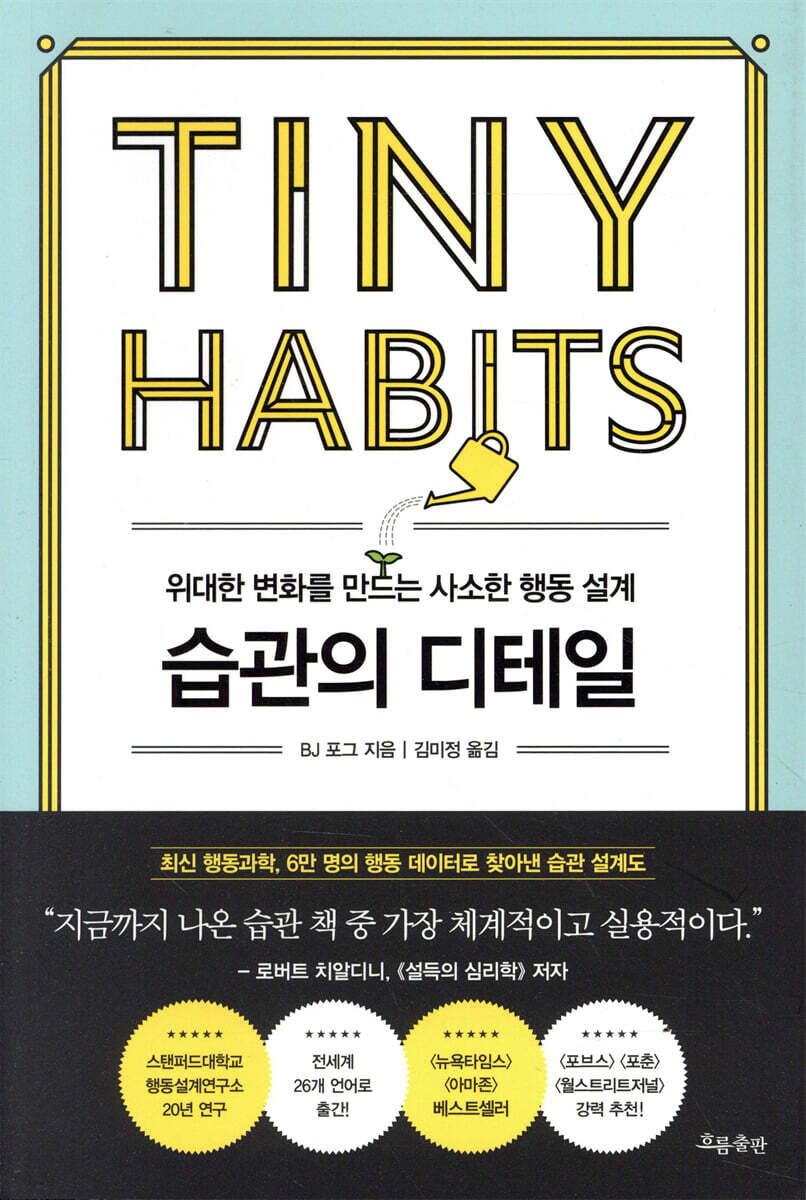
“The most systematic and practical habit book ever written.” - Robert Cialdini, author of The Psychology of Persuasion An Amazon New York Times bestseller upon publication, and a long-term Amazon self-care bestseller. Published in 26 languages worldwide… Highly recommended by Forbes, Fortune, and the Wall Street Journal! The director of Stanford University's Behavioral Design Lab has developed a book called "Habit Design: The Details of Habits," which details the habits of 60,000 people over 20 years. BJ Fogg, a rising guru in Silicon Valley and director of Stanford University's Behavioral Design Lab, has discovered surprising secrets by tracking the lives of 60,000 people for 20 years. Just like the butterfly effect, where the flapping of a butterfly's wings in Brazil can cause a tornado in Texas, people who make small actions into habits can dramatically change their lives. Inspired by this, the author compiled behavioral data from 60,000 people and the latest behavioral science and brain science research to establish a step-by-step, systematic habit design law (TINY HABITS) that anyone can implement. The author says that motivation, willpower, and effort are not important in creating a habit. Instead, we say that if we repeatedly practice small, trivial actions like 'doing two push-ups', 'holding a plank for five seconds', or 'writing a post-it note' by linking them to everyday stimuli, and immediately celebrating each time we do them, our brain will accept these actions as habits. 『The Details of Habits』 contains a scientific method that anyone can easily and enjoyably create habits through 7 steps of behavior design that turn small actions into habits. If you learn the habit design rules of Robert Cialdini, author of 『The Psychology of Persuasion』, and Dr. BJ Fogg, who has been highly praised by celebrities and media outlets around the world, including the New York Times and Harvard Business Review, you too can develop good habits, such as organizing your desk and exercising in the morning, and get rid of bad habits, such as excessive cell phone use, drinking, and smoking. |
- You can preview some of the book's contents.
Preview
index
Prologue: A Behavioral Scientist's Habit Design Method
Chapter 1.
What Makes Us tick? | The Three Elements of Human Behavior
The three elements that move humans
Whether it's a good habit or a bad one, the principle of operation is the same.
Four Principles That Determine Action
Knowing the principles can change your behavior.
If you know the principles, you can change the other person's behavior.
Ability over motivation, stimulation over ability
Habits are systems
Chapter 2.
Don't trust your motives | motives
A fickle person called Donggi
“Save $500” vs.
“Save your change every day.”
Clear aspirations, concrete actions
Interlude: Bad Advice
Focus Map: If I had a magic wand…
Find the golden action
Chapter 3.
Start small, very small | Ability
Details of hidden habits on Instagram
False myths
Break it into very small pieces and divide it.
Easy and simple
Case Study: Creating a Habit of Doing 20 Push-ups
Simplicity is key to success
Chapter 4.
Finding the Habit Switch | Stimulation
The miracle of one post-it note
How to Switch on a Habit
Habit switch, anchor
Find the anchor that's right for you
Unpleasant stimuli can also be utilized
Chapter 5.
Emotions Create Habits | Emotions
Why you should celebrate even if it's forced
Positive experiences addict the brain
How the Brain Remembers Habits
How to Hack Your Brain
'Big reward later' doesn't work.
A one-two punch of celebration that will make your brain dance
Find the celebration that's right for you
A prescription for those who are embarrassed to congratulate
Nutrition of Habits
Chapter 6.
The Habit Design System for Creating Great Change | Summary
Habits are designs
Habits grow
Small choices make a huge difference
The Art of Change: A Complete Guide to Building Small Habits
Chapter 7.
Goodbye! Bad habits
If you can make it, you can destroy it.
3 Steps to Breaking Bad Habits
Block, dodge, ignore
Break the ability chain
Last resort, motivation control
If that doesn't work...
Goodbye! Bad habits
Chapter 8.
The butterfly effect of habit
Designing Habits for Everyone
Designing Group Habits
Case Study: Overcoming Learning Disabilities Through Family Partnership
Case Study: Reducing Nurse Stress
Epilogue: Small Changes Change Everything
supplement
Behavioral Design: Models, Methods, and Principles
Make it easy to do
32 Ways to Express Success
Chapter 1.
What Makes Us tick? | The Three Elements of Human Behavior
The three elements that move humans
Whether it's a good habit or a bad one, the principle of operation is the same.
Four Principles That Determine Action
Knowing the principles can change your behavior.
If you know the principles, you can change the other person's behavior.
Ability over motivation, stimulation over ability
Habits are systems
Chapter 2.
Don't trust your motives | motives
A fickle person called Donggi
“Save $500” vs.
“Save your change every day.”
Clear aspirations, concrete actions
Interlude: Bad Advice
Focus Map: If I had a magic wand…
Find the golden action
Chapter 3.
Start small, very small | Ability
Details of hidden habits on Instagram
False myths
Break it into very small pieces and divide it.
Easy and simple
Case Study: Creating a Habit of Doing 20 Push-ups
Simplicity is key to success
Chapter 4.
Finding the Habit Switch | Stimulation
The miracle of one post-it note
How to Switch on a Habit
Habit switch, anchor
Find the anchor that's right for you
Unpleasant stimuli can also be utilized
Chapter 5.
Emotions Create Habits | Emotions
Why you should celebrate even if it's forced
Positive experiences addict the brain
How the Brain Remembers Habits
How to Hack Your Brain
'Big reward later' doesn't work.
A one-two punch of celebration that will make your brain dance
Find the celebration that's right for you
A prescription for those who are embarrassed to congratulate
Nutrition of Habits
Chapter 6.
The Habit Design System for Creating Great Change | Summary
Habits are designs
Habits grow
Small choices make a huge difference
The Art of Change: A Complete Guide to Building Small Habits
Chapter 7.
Goodbye! Bad habits
If you can make it, you can destroy it.
3 Steps to Breaking Bad Habits
Block, dodge, ignore
Break the ability chain
Last resort, motivation control
If that doesn't work...
Goodbye! Bad habits
Chapter 8.
The butterfly effect of habit
Designing Habits for Everyone
Designing Group Habits
Case Study: Overcoming Learning Disabilities Through Family Partnership
Case Study: Reducing Nurse Stress
Epilogue: Small Changes Change Everything
supplement
Behavioral Design: Models, Methods, and Principles
Make it easy to do
32 Ways to Express Success
Detailed image

Into the book
The reason change fails is not because of me, but because of my approach.
Let's think about it this way.
If you're assembling a cabinet, but the instructions are wrong and there are missing parts, you'll never be able to complete it.
Whose fault is it? It's not mine.
It's the manufacturer's fault.
But we don't blame the 'manufacturer' when we try and fail.
Blame yourself.
When results fall short of expectations, our inner critic doesn't miss the opportunity.
So when we fail to get things done efficiently, lose weight, or exercise regularly, we tend to blame ourselves for the problem.
You're not the cause of your failure! It's your approach to change that's the problem.
It's not a character flaw, it's a design flaw.
As we will see, developing habits and making positive changes is not difficult.
If you know the right approach.
We need systems that are based on human psychological mechanisms, procedures that facilitate change, and tools that don't rely on guesswork and flawed principles.
--- Prologue: A Behavioral Scientist's Habit Design Method
You can change your life by changing your actions.
It's a fact we all know.
However, it is less well known that there are only three variables that trigger behavior.
The Fog Behavior Model is the key to unlocking the mystery.
This model uses simple formulas and diagrams to describe the three factors that determine every human behavior (from flossing to running a marathon) and their interrelationships.
Understanding the Fogg Behavior Model allows us to logically analyze human behavior by eliminating unmeasurable factors such as personality and self-control.
Furthermore, we can use this model to design behavioral changes for ourselves and others.
Behavior occurs when three factors, namely MAP (Motivation, Ability, and Prompt), work simultaneously.
Motivation is the 'desire' to perform a certain action.
Ability is the 'potential' to perform that action.
A stimulus is a 'signal' to perform that action.
--- Chapter 1 What Makes Humans Move
Unfortunately, many people believe that motivation is the real driving force behind behavior change.
Perhaps because words like reward and incentive are often mentioned, I think we can develop any habit if we just find the right carrot and wave it in front of our eyes.
This kind of approach makes sense.
Motivation is one of the three elements of behavior.
But it is often fickle.
The motivation is similar to that of a party animal friend.
A friend who is nice to hang out with for a night, but not someone you can trust and ask to pick you up at the airport.
You need to understand the role and limitations of such a friend and decide when you cannot rely on a fickle friend.
--- Chapter 2 Don't Trust Motives
Small actions may not seem fancy, but they are easy to do and sustainable.
In reality, most of the life changes people want to make are achieved through small, subtle actions rather than major, bold steps.
The higher the stakes on an action, the greater the self-criticism and disappointment.
We already know that motivation is what drives us to do great things, and then when things get tough, we like to slip away.
We often push ourselves beyond our physical, emotional, and mental capabilities.
Humans can make such efforts for a short time, but not continuously.
Even if you break down the work into steps, each step is often too grandiose or complicated.
Even in this case, if motivation drops sharply, you will feel a great burden and deviate from the path.
--- Chapter 3 Start Small, Very Small
I used 'going to the bathroom', one of the most basic and reliable actions, as the stimulus (anchor) for 'push-ups'.
I decided to do two push-ups after flushing the toilet.
It might seem like a strange thing to do, but at the time I was working mostly from home, so it wasn't a problem.
Before long, this habit became ingrained.
It was like a puzzle piece that fit perfectly.
I started doing push-ups several times a day after urinating.
I quickly gained strength and increased the number of push-ups I did.
Even after 7 years, I still keep this habit.
Some days I do over 50 push-ups, but I do at least two after each urination.
Doing two push-ups after urinating has become my little habit recipe.
Anchors are a very practical stimulus design method because everyone has them.
You don't need an expensive smartwatch or the latest app to create new habits.
You can design more effective stimuli yourself.
The anchor's effect is closer to a chemical reaction than magic.
By combining the right actions with the right sequence, new habits can be formed quickly.
--- Chapter 4: Finding the Habit Switch
When we experience positive reinforcement, our brains do not do magic, but rather neurochemical reactions.
Pleasant feelings stimulate the production of a neurotransmitter (a chemical messenger in the brain) called dopamine.
Dopamine controls the brain's "reward system," which helps us remember behaviors that make us feel good and make us do them again.
With the help of dopamine, the brain encodes causal relationships, which allows us to predict the future.
We can intervene in this reward system by causing something in the brain that neuroscientists call a reward prediction error.
The brain constantly re-evaluates experiences, sights, sounds, smells, and movements of the world around us.
And based on past experiences, we predict what kind of experience we will have in a given situation.
Your brain predicts what will happen if you drop your phone on a concrete floor (no!) and what the soup at your favorite restaurant will taste like (it will be delicious).
When an experience deviates from the brain's expected pattern (oh, my phone didn't break), a reward prediction error occurs, and neurons in the brain adjust their dopamine release to update their expectations.
Let's think about it this way.
If you're assembling a cabinet, but the instructions are wrong and there are missing parts, you'll never be able to complete it.
Whose fault is it? It's not mine.
It's the manufacturer's fault.
But we don't blame the 'manufacturer' when we try and fail.
Blame yourself.
When results fall short of expectations, our inner critic doesn't miss the opportunity.
So when we fail to get things done efficiently, lose weight, or exercise regularly, we tend to blame ourselves for the problem.
You're not the cause of your failure! It's your approach to change that's the problem.
It's not a character flaw, it's a design flaw.
As we will see, developing habits and making positive changes is not difficult.
If you know the right approach.
We need systems that are based on human psychological mechanisms, procedures that facilitate change, and tools that don't rely on guesswork and flawed principles.
--- Prologue: A Behavioral Scientist's Habit Design Method
You can change your life by changing your actions.
It's a fact we all know.
However, it is less well known that there are only three variables that trigger behavior.
The Fog Behavior Model is the key to unlocking the mystery.
This model uses simple formulas and diagrams to describe the three factors that determine every human behavior (from flossing to running a marathon) and their interrelationships.
Understanding the Fogg Behavior Model allows us to logically analyze human behavior by eliminating unmeasurable factors such as personality and self-control.
Furthermore, we can use this model to design behavioral changes for ourselves and others.
Behavior occurs when three factors, namely MAP (Motivation, Ability, and Prompt), work simultaneously.
Motivation is the 'desire' to perform a certain action.
Ability is the 'potential' to perform that action.
A stimulus is a 'signal' to perform that action.
--- Chapter 1 What Makes Humans Move
Unfortunately, many people believe that motivation is the real driving force behind behavior change.
Perhaps because words like reward and incentive are often mentioned, I think we can develop any habit if we just find the right carrot and wave it in front of our eyes.
This kind of approach makes sense.
Motivation is one of the three elements of behavior.
But it is often fickle.
The motivation is similar to that of a party animal friend.
A friend who is nice to hang out with for a night, but not someone you can trust and ask to pick you up at the airport.
You need to understand the role and limitations of such a friend and decide when you cannot rely on a fickle friend.
--- Chapter 2 Don't Trust Motives
Small actions may not seem fancy, but they are easy to do and sustainable.
In reality, most of the life changes people want to make are achieved through small, subtle actions rather than major, bold steps.
The higher the stakes on an action, the greater the self-criticism and disappointment.
We already know that motivation is what drives us to do great things, and then when things get tough, we like to slip away.
We often push ourselves beyond our physical, emotional, and mental capabilities.
Humans can make such efforts for a short time, but not continuously.
Even if you break down the work into steps, each step is often too grandiose or complicated.
Even in this case, if motivation drops sharply, you will feel a great burden and deviate from the path.
--- Chapter 3 Start Small, Very Small
I used 'going to the bathroom', one of the most basic and reliable actions, as the stimulus (anchor) for 'push-ups'.
I decided to do two push-ups after flushing the toilet.
It might seem like a strange thing to do, but at the time I was working mostly from home, so it wasn't a problem.
Before long, this habit became ingrained.
It was like a puzzle piece that fit perfectly.
I started doing push-ups several times a day after urinating.
I quickly gained strength and increased the number of push-ups I did.
Even after 7 years, I still keep this habit.
Some days I do over 50 push-ups, but I do at least two after each urination.
Doing two push-ups after urinating has become my little habit recipe.
Anchors are a very practical stimulus design method because everyone has them.
You don't need an expensive smartwatch or the latest app to create new habits.
You can design more effective stimuli yourself.
The anchor's effect is closer to a chemical reaction than magic.
By combining the right actions with the right sequence, new habits can be formed quickly.
--- Chapter 4: Finding the Habit Switch
When we experience positive reinforcement, our brains do not do magic, but rather neurochemical reactions.
Pleasant feelings stimulate the production of a neurotransmitter (a chemical messenger in the brain) called dopamine.
Dopamine controls the brain's "reward system," which helps us remember behaviors that make us feel good and make us do them again.
With the help of dopamine, the brain encodes causal relationships, which allows us to predict the future.
We can intervene in this reward system by causing something in the brain that neuroscientists call a reward prediction error.
The brain constantly re-evaluates experiences, sights, sounds, smells, and movements of the world around us.
And based on past experiences, we predict what kind of experience we will have in a given situation.
Your brain predicts what will happen if you drop your phone on a concrete floor (no!) and what the soup at your favorite restaurant will taste like (it will be delicious).
When an experience deviates from the brain's expected pattern (oh, my phone didn't break), a reward prediction error occurs, and neurons in the brain adjust their dopamine release to update their expectations.
--- Chapter 5: Emotions Create Habits
Publisher's Review
The latest behavioral science: A blueprint for habits discovered through behavioral data from 60,000 people.
“The most systematic and practical habit book ever written.” - Robert Cialdini, author of The Psychology of Persuasion
It is often said that 'small is mighty'.
But at least in life, everyone dreams of huge and dramatic changes.
No, I believe that only such a change can change one's life.
So today, I set my alarm to wake up at 5 a.m., plan my meals and exercise to lose 10 kg in a month, and resolve to study English for at least one hour a day.
Is that all?
At the end of the year, I always resolve to quit smoking, drinking, and dieting.
But what is the reality? Everyone has probably experienced the truth that the saying "three days of resolution" isn't just a myth.
Dr. BJ Fogg, founder and director of Stanford University's Behavioral Economics Lab, has observed and coached the lives of more than 60,000 people for over 20 years and discovered one thing.
"I want to eat healthy food in the morning." "I want to exercise for at least 10 minutes a day." "I want to get a good night's sleep." "I want to say positive things to my children." People who put these small resolutions into action and make them into small daily habits have dramatically changed their lives.
Just like the butterfly effect, where the flapping of a butterfly's wings in Brazil can cause a tornado in Texas, small habits can change your life.
When I tell this story, many people say this.
“It’s not because I didn’t do it. If I put my mind to it, I could do it.” According to a Stanford University study in which the author participated, the answer is no.
Even people who pride themselves on being strong-willed have trouble turning small actions into habits.
When we follow the daily lives of people who suffer from severe levels of obesity, insomnia, and stress, we often see that small failures pile up and lead to major frustrations.
Small things are powerful, but small changes are not as easy as you think.
So, is there a way to create good habits and practice them consistently?
In his book, "Habits in Detail," Dr. BJ Fogg, a rising guru in Silicon Valley, introduces the laws of step-by-step, systematic habit design (TINY HABITS) that anyone can implement by condensing behavioral data from over 60,000 people and the latest behavioral and brain science research.
According to the author, any human behavior occurs when three elements come together: motivation, ability, and stimulation.
Therefore, depending on how you control these three elements, you can create or eliminate habits.
However, contrary to popular belief, he emphasizes that one should not rely on factors such as motivation and willpower.
How Behavioral Scientists Change Habits
Small actions + daily stimulation + immediate celebration = habit completion
The author says that before learning the laws of habit design, you must first stop 'blaming yourself'.
“I ended up binge drinking again yesterday.
“I was wrong.” “I overslept again.”
“Why am I so lazy?” “I skipped exercise again.
“I am so weak-willed.” We are accustomed to a culture of blaming ourselves.
You blame yourself for sleeping in, binge drinking, and skipping exercise.
However, the author points out that the cause of failure in change lies not in 'me' but in 'the approach'.
For example, if you're assembling a cabinet, but the instructions are wrong and some parts are missing, you'll never be able to complete the cabinet.
Whose fault is it? It's not mine.
It's the manufacturer's fault.
But we don't blame the 'manufacturer' when we try and fail.
Blame yourself.
When results fall short of expectations, our inner critic doesn't miss the opportunity.
So when we fail to get things done efficiently, lose weight, or exercise regularly, we often blame ourselves for the problem.
“If I had been a better person, I wouldn’t have failed.” “If I had followed the rules and the program exactly, if I had kept my promises to myself, I would have succeeded.” “If I had just calmed down and tried harder, things would have turned out well.”
The author emphasizes that the cause of failure in forming habits should be sought in design flaws, not in character flaws.
Therefore, it is said that a method that emphasizes motivation and willpower cannot lead to fundamental change.
"The Details of Habits" introduces a method of creating habits by breaking away from conventional methods and connecting the repetition (ability) of small, trivial actions with the emotions that dominate our brains.
To create good habits, you must follow a seven-step behavioral design.
First, draw your desired goal into concrete actions (step 1) and make a list of actionable actions (step 2).
Afterwards, find daily stimuli that can be paired with specific actions, such as “do two push-ups after going to the bathroom” (Step 3) and connect them (Step 4).
However, all actions are broken down and divided into the smallest possible units that can be put into practice (Step 5).
After practicing, immediately celebrate so that dopamine is released in the brain (step 6).
By repeating and expanding the previous steps (step 7), you can turn any desired behavior into a habit and eliminate any bad habit.
The author and over 40,000 people around the world who have received his coaching have experienced remarkable changes through his habit design principles.
In fact, the author suffered from severe insomnia and stress due to the death of his beloved nephew and business failure.
Then one day, he discovers that he has a habit of sitting up in bed for a moment every morning when he wakes up.
Afterwards, I practiced the small habit of 'waking up and putting my feet on the floor (stimulus)', then saying 'it's going to be a great day' (action) and smiling (celebration).
Now, no matter how difficult the task, he says he can fill every morning with positive energy.
In addition to the author's own experiences, this book vividly contains the amazing stories and know-how of people who changed their lives through small habits, such as "doing two push-ups after going to the bathroom," "flossing one tooth every morning," and "writing down one thing to do today after sending the child to school."
Put your toothbrush in a new place, unload the dishwasher and put it away every morning before breakfast, water your plants every evening, do two squats while making your coffee in the morning, take out the trash on Wednesdays, quit smoking or smoking, be on Instagram until 3 a.m., kiss your husband after work, make your bed or not, eat chocolate or not.
Some of the behaviors listed above are positive habits, and some are not.
What I've found is that all of these components of human behavior are the same.
Actions and reactions arise from the relationships between components.
They determine our actions.
Whether it's a good habit or a bad habit, the principle of operation is the same.
Understanding how the components of human behavior work and being able to regulate them can help us escape helplessness.
I can be who I want to be.
- From the prologue
As the author says, whether it's a good habit or a bad one, the operating principle is the same.
No more willpower or self-esteem-damaging motivational methods.
Let's turn our dreams into small, insignificant actions and connect them to motivation.
And celebrate yourself every moment.
The time and number of times are not important.
It's okay to fail for a while.
Small habits are actions that last from 10 seconds to 3 minutes, so even if you fail for a day or two, you can start again.
“There’s a new guru for our time you need to remember.” - Fortune
An Amazon New York Times bestseller upon publication, and a long-term Amazon self-care bestseller.
"The Details of Habits" immediately became a bestseller on Amazon and the New York Times upon its publication, and received rave reviews from major media outlets such as Business Insider and Forbes.
Fortune also named the author one of “10 New Gurus You Need to Remember.”
Kevin Systrom, the creator of Instagram, and Tristan Harris, known as the conscience of Silicon Valley, are also his disciples who were influenced by him.
The Harvard Business Review praised his research, saying it “marked a significant milestone in understanding human behavior and its causes.”
Compared to previous books on habits that mainly borrowed from personal experiences or various scientific theories, 『The Details of Habits』 is recognized as a book that catches two birds with one stone: science and practicality.
As the reviews say, “If you know someone who is always late to meetings or forgets appointments, give them this book (Business Insider)” and “If you are discouraged by repeated failures in dieting, quitting drinking, and quitting smoking, it is time to meet BJ Fogg (Wall Street Journal)”, this book will be a new breakthrough for those who dream of a change in life but are lost because they do not know how, and for those who are looking for specific ways to create good habits and eliminate bad ones.
“The most systematic and practical habit book ever written.” - Robert Cialdini, author of The Psychology of Persuasion
It is often said that 'small is mighty'.
But at least in life, everyone dreams of huge and dramatic changes.
No, I believe that only such a change can change one's life.
So today, I set my alarm to wake up at 5 a.m., plan my meals and exercise to lose 10 kg in a month, and resolve to study English for at least one hour a day.
Is that all?
At the end of the year, I always resolve to quit smoking, drinking, and dieting.
But what is the reality? Everyone has probably experienced the truth that the saying "three days of resolution" isn't just a myth.
Dr. BJ Fogg, founder and director of Stanford University's Behavioral Economics Lab, has observed and coached the lives of more than 60,000 people for over 20 years and discovered one thing.
"I want to eat healthy food in the morning." "I want to exercise for at least 10 minutes a day." "I want to get a good night's sleep." "I want to say positive things to my children." People who put these small resolutions into action and make them into small daily habits have dramatically changed their lives.
Just like the butterfly effect, where the flapping of a butterfly's wings in Brazil can cause a tornado in Texas, small habits can change your life.
When I tell this story, many people say this.
“It’s not because I didn’t do it. If I put my mind to it, I could do it.” According to a Stanford University study in which the author participated, the answer is no.
Even people who pride themselves on being strong-willed have trouble turning small actions into habits.
When we follow the daily lives of people who suffer from severe levels of obesity, insomnia, and stress, we often see that small failures pile up and lead to major frustrations.
Small things are powerful, but small changes are not as easy as you think.
So, is there a way to create good habits and practice them consistently?
In his book, "Habits in Detail," Dr. BJ Fogg, a rising guru in Silicon Valley, introduces the laws of step-by-step, systematic habit design (TINY HABITS) that anyone can implement by condensing behavioral data from over 60,000 people and the latest behavioral and brain science research.
According to the author, any human behavior occurs when three elements come together: motivation, ability, and stimulation.
Therefore, depending on how you control these three elements, you can create or eliminate habits.
However, contrary to popular belief, he emphasizes that one should not rely on factors such as motivation and willpower.
How Behavioral Scientists Change Habits
Small actions + daily stimulation + immediate celebration = habit completion
The author says that before learning the laws of habit design, you must first stop 'blaming yourself'.
“I ended up binge drinking again yesterday.
“I was wrong.” “I overslept again.”
“Why am I so lazy?” “I skipped exercise again.
“I am so weak-willed.” We are accustomed to a culture of blaming ourselves.
You blame yourself for sleeping in, binge drinking, and skipping exercise.
However, the author points out that the cause of failure in change lies not in 'me' but in 'the approach'.
For example, if you're assembling a cabinet, but the instructions are wrong and some parts are missing, you'll never be able to complete the cabinet.
Whose fault is it? It's not mine.
It's the manufacturer's fault.
But we don't blame the 'manufacturer' when we try and fail.
Blame yourself.
When results fall short of expectations, our inner critic doesn't miss the opportunity.
So when we fail to get things done efficiently, lose weight, or exercise regularly, we often blame ourselves for the problem.
“If I had been a better person, I wouldn’t have failed.” “If I had followed the rules and the program exactly, if I had kept my promises to myself, I would have succeeded.” “If I had just calmed down and tried harder, things would have turned out well.”
The author emphasizes that the cause of failure in forming habits should be sought in design flaws, not in character flaws.
Therefore, it is said that a method that emphasizes motivation and willpower cannot lead to fundamental change.
"The Details of Habits" introduces a method of creating habits by breaking away from conventional methods and connecting the repetition (ability) of small, trivial actions with the emotions that dominate our brains.
To create good habits, you must follow a seven-step behavioral design.
First, draw your desired goal into concrete actions (step 1) and make a list of actionable actions (step 2).
Afterwards, find daily stimuli that can be paired with specific actions, such as “do two push-ups after going to the bathroom” (Step 3) and connect them (Step 4).
However, all actions are broken down and divided into the smallest possible units that can be put into practice (Step 5).
After practicing, immediately celebrate so that dopamine is released in the brain (step 6).
By repeating and expanding the previous steps (step 7), you can turn any desired behavior into a habit and eliminate any bad habit.
The author and over 40,000 people around the world who have received his coaching have experienced remarkable changes through his habit design principles.
In fact, the author suffered from severe insomnia and stress due to the death of his beloved nephew and business failure.
Then one day, he discovers that he has a habit of sitting up in bed for a moment every morning when he wakes up.
Afterwards, I practiced the small habit of 'waking up and putting my feet on the floor (stimulus)', then saying 'it's going to be a great day' (action) and smiling (celebration).
Now, no matter how difficult the task, he says he can fill every morning with positive energy.
In addition to the author's own experiences, this book vividly contains the amazing stories and know-how of people who changed their lives through small habits, such as "doing two push-ups after going to the bathroom," "flossing one tooth every morning," and "writing down one thing to do today after sending the child to school."
Put your toothbrush in a new place, unload the dishwasher and put it away every morning before breakfast, water your plants every evening, do two squats while making your coffee in the morning, take out the trash on Wednesdays, quit smoking or smoking, be on Instagram until 3 a.m., kiss your husband after work, make your bed or not, eat chocolate or not.
Some of the behaviors listed above are positive habits, and some are not.
What I've found is that all of these components of human behavior are the same.
Actions and reactions arise from the relationships between components.
They determine our actions.
Whether it's a good habit or a bad habit, the principle of operation is the same.
Understanding how the components of human behavior work and being able to regulate them can help us escape helplessness.
I can be who I want to be.
- From the prologue
As the author says, whether it's a good habit or a bad one, the operating principle is the same.
No more willpower or self-esteem-damaging motivational methods.
Let's turn our dreams into small, insignificant actions and connect them to motivation.
And celebrate yourself every moment.
The time and number of times are not important.
It's okay to fail for a while.
Small habits are actions that last from 10 seconds to 3 minutes, so even if you fail for a day or two, you can start again.
“There’s a new guru for our time you need to remember.” - Fortune
An Amazon New York Times bestseller upon publication, and a long-term Amazon self-care bestseller.
"The Details of Habits" immediately became a bestseller on Amazon and the New York Times upon its publication, and received rave reviews from major media outlets such as Business Insider and Forbes.
Fortune also named the author one of “10 New Gurus You Need to Remember.”
Kevin Systrom, the creator of Instagram, and Tristan Harris, known as the conscience of Silicon Valley, are also his disciples who were influenced by him.
The Harvard Business Review praised his research, saying it “marked a significant milestone in understanding human behavior and its causes.”
Compared to previous books on habits that mainly borrowed from personal experiences or various scientific theories, 『The Details of Habits』 is recognized as a book that catches two birds with one stone: science and practicality.
As the reviews say, “If you know someone who is always late to meetings or forgets appointments, give them this book (Business Insider)” and “If you are discouraged by repeated failures in dieting, quitting drinking, and quitting smoking, it is time to meet BJ Fogg (Wall Street Journal)”, this book will be a new breakthrough for those who dream of a change in life but are lost because they do not know how, and for those who are looking for specific ways to create good habits and eliminate bad ones.
GOODS SPECIFICS
- Publication date: October 26, 2020
- Page count, weight, size: 373 pages | 580g | 153*225*30mm
- ISBN13: 9788965964049
- ISBN10: 8965964040
You may also like
카테고리
korean


korean

![GQ KOREA Mark (Monthly): December [2025]](http://librairie.coreenne.fr/cdn/shop/files/8ef265dbbfbf186523ed75ba7319009d.jpg?v=1765340328&width=3840)


