

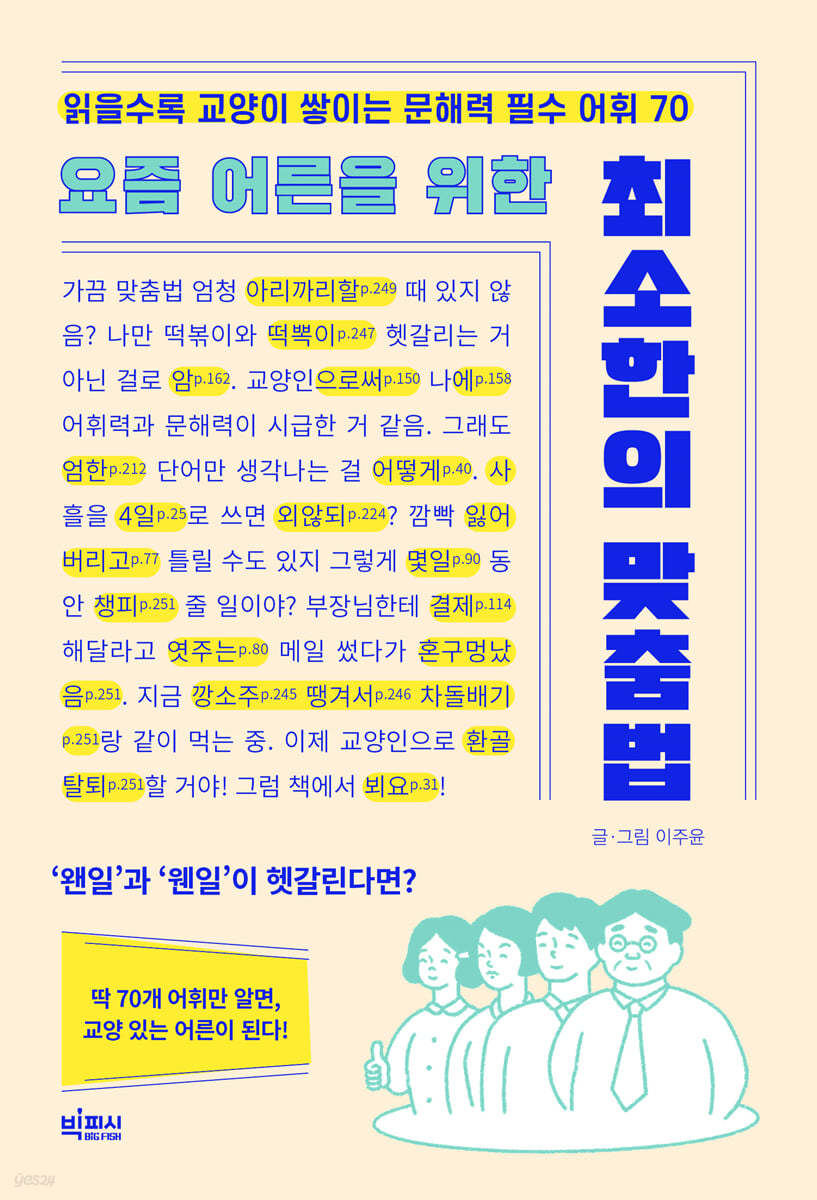
Minimum spelling for adults these days
 |
Description
Book Introduction
- A word from MD
-
What a fun spelling!Lack of literacy is a hot topic.
Literacy issues are intertwined with spelling.
If you just learn the correct spelling, you will be less likely to misunderstand sentences.
We've explained 70 confusing words with example sentences, including "sincere apology," "payment," and "settlement," and "how many days."
Don't miss out on the unique spelling memorization tips you'll find only in this book.
April 4, 2023. Humanities PD Son Min-gyu
Only the most confusing spellings,
Just by reading, you will acquire an adult's vocabulary!
“Have you ever been shocked by the spelling of people around you?”, “I was chatting with a friend on KakaoTalk and he said, ‘Your face looks familiar’, but he said, ‘It’s daytime!’!” “I was completely shocked by your spelling...” In this day and age, we have to write sentences properly, whether they’re short or long, whether they’re on social media, in self-introductions, work emails, or various official documents.
At this point, even a minor spelling mistake can completely destroy trust.
In fact, there are statistics that show that 9 out of 10 HR managers will give a negative evaluation if they make a spelling mistake.
Author Lee Ju-yoon, who received praise for her previous work, saying, “No other author explains spelling so delightfully,” has now carefully selected 70 of the most confusing words for Korean adults and introduced essential spelling rules that they absolutely must know.
This book will be a welcome gift for office workers who need to write clear documents such as business plans and proposals, college students and job seekers who lack confidence in writing self-introductions, and aspiring writers, planners, or editors in the publishing and broadcasting industries.
Of course, you also feel that there are a lot of confusing spellings these days.
Just by reading, you will acquire an adult's vocabulary!
“Have you ever been shocked by the spelling of people around you?”, “I was chatting with a friend on KakaoTalk and he said, ‘Your face looks familiar’, but he said, ‘It’s daytime!’!” “I was completely shocked by your spelling...” In this day and age, we have to write sentences properly, whether they’re short or long, whether they’re on social media, in self-introductions, work emails, or various official documents.
At this point, even a minor spelling mistake can completely destroy trust.
In fact, there are statistics that show that 9 out of 10 HR managers will give a negative evaluation if they make a spelling mistake.
Author Lee Ju-yoon, who received praise for her previous work, saying, “No other author explains spelling so delightfully,” has now carefully selected 70 of the most confusing words for Korean adults and introduced essential spelling rules that they absolutely must know.
This book will be a welcome gift for office workers who need to write clear documents such as business plans and proposals, college students and job seekers who lack confidence in writing self-introductions, and aspiring writers, planners, or editors in the publishing and broadcasting industries.
Of course, you also feel that there are a lot of confusing spellings these days.
- You can preview some of the book's contents.
Preview
index
Introduction
PART 1: BASICS
I thought I knew this much, but…
01 Why and why
02 A sincere apology
03 letters
04 You came out
05 See you soon
06 Half-belief and half-bunny
07 Future Hopes and Funeral Hopes
08 How and what to do
09 Different and wrong
10 I and my family
11. Come and kneel
12 Side and underarm sweat
13 Account number and password
14 Mortality and cooking rates
15 It's not funny and it's not funny
16 Gajin and Gajin
17. Insert and plug in
18 Free
19 Forget and lose
20 I'll ask you and give you a peek
21 The beauty of the last days and the beauty of the last days
PART 2: Intermediate
Top 28 Spelling Rules You Actually Knew Wrong
22 Today
23 days and days
24 Match and match
25 Mountain Peaks and Peaks
26 Borrow and borrow
27 Invasion of Privacy and Privacy Dementia
28 Good luck and good luck with boxing
29th day
30 Orientation and Subtraction
31 Payment and Settlement
32 Subsidies and Contributions
33 Touch and touch
34. Becoming a Mentor and Living as a Mentor
35 It is not different from other than
36 handfuls and handfuls
37 Get it and go where you want to go
38. To nudge and to pester
39. Scam and Scam Recharge
40 Messeokgeoda and gourmet
41 Harsh Acts and Gaoqing
42 Do this and that and work hard and bow down
43 As and As
44 Meda and Maeda
45 Ewa
46. The rise and fall, the knowledge and the darkness
47 Repay and repay
48 Wishing you good luck
49 Ignorance is the Best Policy and Walking an Unknown Dog
PART 3: ADVANCED
Finally, I have mastered spelling and vocabulary!
50 Disturbed and Distressed
51 Shrimp and Bird
52 Chase, chase and fuck
53 A long time and a long time
54 Must and definitely
55 Excuse me, but trust me
56. To be killed and to be murdered
57 Dun and Dun
58 Whispers and whispers
59 Appearances and Appearances
60 Get well soon and have a baby
61 Amen and Strict
62 To stir up trouble and stir up trouble
63 No news and no sound
64 I will do it and I will do it
65 and it's done and it's done
66 When and how to take it off
67 Difficulty and difficulty level
68 Yes and yes
69 Focus and get drunk
70 To stand out and to be noticed
supplement
300 Commonly Confused Spellings
Find misspellings
Correct answer
PART 1: BASICS
I thought I knew this much, but…
01 Why and why
02 A sincere apology
03 letters
04 You came out
05 See you soon
06 Half-belief and half-bunny
07 Future Hopes and Funeral Hopes
08 How and what to do
09 Different and wrong
10 I and my family
11. Come and kneel
12 Side and underarm sweat
13 Account number and password
14 Mortality and cooking rates
15 It's not funny and it's not funny
16 Gajin and Gajin
17. Insert and plug in
18 Free
19 Forget and lose
20 I'll ask you and give you a peek
21 The beauty of the last days and the beauty of the last days
PART 2: Intermediate
Top 28 Spelling Rules You Actually Knew Wrong
22 Today
23 days and days
24 Match and match
25 Mountain Peaks and Peaks
26 Borrow and borrow
27 Invasion of Privacy and Privacy Dementia
28 Good luck and good luck with boxing
29th day
30 Orientation and Subtraction
31 Payment and Settlement
32 Subsidies and Contributions
33 Touch and touch
34. Becoming a Mentor and Living as a Mentor
35 It is not different from other than
36 handfuls and handfuls
37 Get it and go where you want to go
38. To nudge and to pester
39. Scam and Scam Recharge
40 Messeokgeoda and gourmet
41 Harsh Acts and Gaoqing
42 Do this and that and work hard and bow down
43 As and As
44 Meda and Maeda
45 Ewa
46. The rise and fall, the knowledge and the darkness
47 Repay and repay
48 Wishing you good luck
49 Ignorance is the Best Policy and Walking an Unknown Dog
PART 3: ADVANCED
Finally, I have mastered spelling and vocabulary!
50 Disturbed and Distressed
51 Shrimp and Bird
52 Chase, chase and fuck
53 A long time and a long time
54 Must and definitely
55 Excuse me, but trust me
56. To be killed and to be murdered
57 Dun and Dun
58 Whispers and whispers
59 Appearances and Appearances
60 Get well soon and have a baby
61 Amen and Strict
62 To stir up trouble and stir up trouble
63 No news and no sound
64 I will do it and I will do it
65 and it's done and it's done
66 When and how to take it off
67 Difficulty and difficulty level
68 Yes and yes
69 Focus and get drunk
70 To stand out and to be noticed
supplement
300 Commonly Confused Spellings
Find misspellings
Correct answer
Detailed image

Into the book
Because we are so familiar with the word 'knee', we often mistakenly use 'knees' instead of 'mu-eup-sse-go', which means to endure hardships and difficulties.
No matter how much I look at it, the word 'reup' is still unfamiliar.
At best, it is only used for things like burdock or chureup, so it can't be helped.
Okay, let's think about it simply.
When you endure hardships and difficulties, you will use your courage and strength, not your knees.
If you are using your knees every time you feel tired, you may soon get a sore throat, so I earnestly request that you stop here.
---From “Come on Your Own Knees” (page 53)
'Si-dap-jjan-da' is a shortened form of 'Si-dap-ji-da', and means unsatisfactory due to its unsightly appearance.
However, people often misuse this word as 'shitupjjanda'.
If this word is to be recognized as standard, other words that start with 'dapda' will also have to be changed to 'dupda'.
In the movie Tazza, Kwak Cheol-yong says to Goni, “Hey, young man.
If I say, "Behave like a gentleman," it's going to sound weird, right? "Siddupjanda" is just as weird! So, hey, young man.
Speak like a Korean.
---From “Siddapjanda and Siddupjanda” (pp. 63-164)
The word 'pinch' means to put something in or insert it so that it does not fall over or fall out.
It's like putting flowers in a vase.
However, there are some people who mistakenly use 'kopda' instead of 'pinda'.
'Kkopda' is a word used when counting by counting fingers one by one or when selecting and pointing out something.
But, no one calls a "flower arrangement" "flower-shaped" (꽃꼬이), right? No one calls a "book shelf" "책꼬이" (책꼬이)? I believe no one calls a "pencil holder" "연필꼬이" (연필꼬이).
---From “Flower and Pick” (pp. 70-71)
There is a shopping mall that delivers items like a rocket.
This is a place that advertises same-day delivery, saying that if you order in the morning, it will arrive in the afternoon.
However, since same-day delivery items are ordered and arrive today, some people mistake same-day for today.
The same day means 'that day' when something happens, and today means 'this day' that is passing by right now.
Let's say you put dried squid in your shopping cart at the mall to go with your beer tonight.
They said they would deliver it on the same day, but it's past midnight and there's still no news.
Why is that?
That's because you haven't made a deposit yet.
So, same-day delivery does not mean that it will be sent on the same day unconditionally, but rather that it will be sent on the same day based on a specific point in time, such as payment.
If you deposit after a week, same-day delivery will be completed on that day.
---From “On the Same Day” (pp. 108-2109)
The word 'wikda' means to sweep and scold.
I've always wondered why the final consonant of '딱달하다', which means to scold someone by harshly nagging them, is always double-sided.
After learning the hidden meaning of 'wipe', my doubts were resolved.
Since the word '삭달하다' is derived from '죽다', the original form of the word must be written down.
---From “Nagging and Nagging” (pp. 135-136)
These days, I spend most of my time online, so I use the clitoris a lot.
I think that the communication will be better when you use the language that is most comfortable for you, so from now on I will use the clitoral font.
I think even those of you who can't live without the internet will be fluent in the clitoris.
But did you know that a lot of people get this wrong? Most people end the two sentences I mentioned earlier with "I think" and "I think it's true."
However, when using words with the final consonant 'ㄹ' such as '들다' and '알다' in the vocal form, the final consonant 'ㄻ' should be used instead of 'ㅁ'.
The appearance of ‘reum’ and ‘knowledge’ may seem unfamiliar and therefore feel like a rejection.
But if you think about it, it's not that strange to write 'to live' as 'life'.
No matter how much I look at it, the word 'reup' is still unfamiliar.
At best, it is only used for things like burdock or chureup, so it can't be helped.
Okay, let's think about it simply.
When you endure hardships and difficulties, you will use your courage and strength, not your knees.
If you are using your knees every time you feel tired, you may soon get a sore throat, so I earnestly request that you stop here.
---From “Come on Your Own Knees” (page 53)
'Si-dap-jjan-da' is a shortened form of 'Si-dap-ji-da', and means unsatisfactory due to its unsightly appearance.
However, people often misuse this word as 'shitupjjanda'.
If this word is to be recognized as standard, other words that start with 'dapda' will also have to be changed to 'dupda'.
In the movie Tazza, Kwak Cheol-yong says to Goni, “Hey, young man.
If I say, "Behave like a gentleman," it's going to sound weird, right? "Siddupjanda" is just as weird! So, hey, young man.
Speak like a Korean.
---From “Siddapjanda and Siddupjanda” (pp. 63-164)
The word 'pinch' means to put something in or insert it so that it does not fall over or fall out.
It's like putting flowers in a vase.
However, there are some people who mistakenly use 'kopda' instead of 'pinda'.
'Kkopda' is a word used when counting by counting fingers one by one or when selecting and pointing out something.
But, no one calls a "flower arrangement" "flower-shaped" (꽃꼬이), right? No one calls a "book shelf" "책꼬이" (책꼬이)? I believe no one calls a "pencil holder" "연필꼬이" (연필꼬이).
---From “Flower and Pick” (pp. 70-71)
There is a shopping mall that delivers items like a rocket.
This is a place that advertises same-day delivery, saying that if you order in the morning, it will arrive in the afternoon.
However, since same-day delivery items are ordered and arrive today, some people mistake same-day for today.
The same day means 'that day' when something happens, and today means 'this day' that is passing by right now.
Let's say you put dried squid in your shopping cart at the mall to go with your beer tonight.
They said they would deliver it on the same day, but it's past midnight and there's still no news.
Why is that?
That's because you haven't made a deposit yet.
So, same-day delivery does not mean that it will be sent on the same day unconditionally, but rather that it will be sent on the same day based on a specific point in time, such as payment.
If you deposit after a week, same-day delivery will be completed on that day.
---From “On the Same Day” (pp. 108-2109)
The word 'wikda' means to sweep and scold.
I've always wondered why the final consonant of '딱달하다', which means to scold someone by harshly nagging them, is always double-sided.
After learning the hidden meaning of 'wipe', my doubts were resolved.
Since the word '삭달하다' is derived from '죽다', the original form of the word must be written down.
---From “Nagging and Nagging” (pp. 135-136)
These days, I spend most of my time online, so I use the clitoris a lot.
I think that the communication will be better when you use the language that is most comfortable for you, so from now on I will use the clitoral font.
I think even those of you who can't live without the internet will be fluent in the clitoris.
But did you know that a lot of people get this wrong? Most people end the two sentences I mentioned earlier with "I think" and "I think it's true."
However, when using words with the final consonant 'ㄹ' such as '들다' and '알다' in the vocal form, the final consonant 'ㄻ' should be used instead of 'ㅁ'.
The appearance of ‘reum’ and ‘knowledge’ may seem unfamiliar and therefore feel like a rejection.
But if you think about it, it's not that strange to write 'to live' as 'life'.
---From “Dump and Dum, Knowledge and Darkness” (p. 163)
Publisher's Review
What if you get confused between 'Why' and 'Why'?
Now is the time to open this book!
"Have you ever been shocked by someone's spelling?", "I was chatting with a friend on KakaoTalk, and he said, 'You look familiar' when he said, 'You look like you're in the daytime!'", "I was completely shocked by their spelling..."
These days, posts attacking 'spelling villains' frequently appear in online communities.
Is that all?
BTS's RM, who correctly spelled "tomorrow," "day after tomorrow," "geulpi," and a rapper who confused the difference between "sa-hul" and "shil," also became a hot topic. In this day and age, accurate sentences are crucial for social media, cover letters, work emails, and various official documents, whether short or long.
At this point, even a minor spelling mistake can completely destroy trust.
In fact, there are statistics that show that 9 out of 10 HR managers will give a negative evaluation if they make a spelling mistake.
For today's adults who have unintentionally become "spelling villains," and for readers who hesitate even when writing short sentences, this book will instantly provide them with "spelling," "vocabulary," and "literacy" skills that will remain with them for a lifetime.
Spelling villains seem like someone else's problem? Let's choose the correct answer between "Why?" and "Why?"
3, 2, 1, done! If you've hesitated for more than three seconds, now is the time to open this book.
Adult spelling + vocabulary + literacy
The best strategy book to help you level up quickly
I don't like reading anything longer than three lines.
There are words whose meaning and usage are sometimes confusing, such as ‘I wish you good luck’, ‘Free’, and ‘Contribution and burial money’.
I have trouble remembering the correct vocabulary when writing or speaking.
These are all problems that arise from a lack of spelling, vocabulary, and literacy.
≪Minimum Spelling Rules for Adults Today≫, as the title suggests, carefully selects 70 of the most confusing words for adults in Korea today and explains the essential spelling rules they must know.
In particular, because it clearly distinguishes words that are easy to confuse because they are similar in pronunciation and appearance in a 'super simple' and 'super clear' three-stage structure, the words are organized in your head just by reading them.
In the first stage, he clearly explains confusing points as if he were a daily instructor, so that you will remember them for a lifetime.
For example, it is like this.
For those who are confused about the difference between 'direction' and 'avoidance', I will give a brief and concise explanation.
(Note the ㅎ and ㅇ!)
Direction = Ham
Avoidance = Not Doing _ [Orientation and Avoidance], page 112
In the second step, we provide a 'two-line summary' for readers who do not like to read more than two lines.
If you're pressed for time or just want to quickly resolve a question, just read this two-line summary corner and you'll get the gist.
'Payment' means 'I' spent all this money!
"Approval" is handled by the incompetent Manager Kim! _ [Payment and Approval], page 116
In the third and final step, you will go through a review process to check whether you really understood it correctly with a 'comprehension quiz'.
While you're laughing through the fresh and witty examples, you'll find yourself learning correct spelling without even realizing it!
I'm a drinker, so I'll try to limit my drinking! (O, X) _ [Aims and Avoidance], page 113
Never read in a quiet place!
A book bursting with laughter, fun, and culture every minute.
If you thought it was just a boring spelling book full of text, you'd be very wrong.
This is because the special talent of author Lee Ju-yoon, who received praise from readers for her previous work, “Minimum Spelling for Oppa,” saying, “No other author has explained the minimum spelling rules so delightfully,” is fully demonstrated in this book.
Because the sentences are so witty that they almost make you think it's a humorous essay, you'll find yourself laughing without resistance as you read each line, so it's best to avoid reading it in quiet places like libraries or cafes.
Another unique feature of this book is its layout, which allows you to read it by turning the pages as if you were looking at an Instagram or Twitter feed, along with the rich illustrations.
This book will be a welcome gift for office workers who need to write clear documents such as business plans and proposals, college students and job seekers who lack confidence in writing self-introductions, and aspiring writers, planners, or editors in the publishing and broadcasting industries.
Of course, you also feel that there are a lot of confusing spellings these days.
Now is the time to open this book!
"Have you ever been shocked by someone's spelling?", "I was chatting with a friend on KakaoTalk, and he said, 'You look familiar' when he said, 'You look like you're in the daytime!'", "I was completely shocked by their spelling..."
These days, posts attacking 'spelling villains' frequently appear in online communities.
Is that all?
BTS's RM, who correctly spelled "tomorrow," "day after tomorrow," "geulpi," and a rapper who confused the difference between "sa-hul" and "shil," also became a hot topic. In this day and age, accurate sentences are crucial for social media, cover letters, work emails, and various official documents, whether short or long.
At this point, even a minor spelling mistake can completely destroy trust.
In fact, there are statistics that show that 9 out of 10 HR managers will give a negative evaluation if they make a spelling mistake.
For today's adults who have unintentionally become "spelling villains," and for readers who hesitate even when writing short sentences, this book will instantly provide them with "spelling," "vocabulary," and "literacy" skills that will remain with them for a lifetime.
Spelling villains seem like someone else's problem? Let's choose the correct answer between "Why?" and "Why?"
3, 2, 1, done! If you've hesitated for more than three seconds, now is the time to open this book.
Adult spelling + vocabulary + literacy
The best strategy book to help you level up quickly
I don't like reading anything longer than three lines.
There are words whose meaning and usage are sometimes confusing, such as ‘I wish you good luck’, ‘Free’, and ‘Contribution and burial money’.
I have trouble remembering the correct vocabulary when writing or speaking.
These are all problems that arise from a lack of spelling, vocabulary, and literacy.
≪Minimum Spelling Rules for Adults Today≫, as the title suggests, carefully selects 70 of the most confusing words for adults in Korea today and explains the essential spelling rules they must know.
In particular, because it clearly distinguishes words that are easy to confuse because they are similar in pronunciation and appearance in a 'super simple' and 'super clear' three-stage structure, the words are organized in your head just by reading them.
In the first stage, he clearly explains confusing points as if he were a daily instructor, so that you will remember them for a lifetime.
For example, it is like this.
For those who are confused about the difference between 'direction' and 'avoidance', I will give a brief and concise explanation.
(Note the ㅎ and ㅇ!)
Direction = Ham
Avoidance = Not Doing _ [Orientation and Avoidance], page 112
In the second step, we provide a 'two-line summary' for readers who do not like to read more than two lines.
If you're pressed for time or just want to quickly resolve a question, just read this two-line summary corner and you'll get the gist.
'Payment' means 'I' spent all this money!
"Approval" is handled by the incompetent Manager Kim! _ [Payment and Approval], page 116
In the third and final step, you will go through a review process to check whether you really understood it correctly with a 'comprehension quiz'.
While you're laughing through the fresh and witty examples, you'll find yourself learning correct spelling without even realizing it!
I'm a drinker, so I'll try to limit my drinking! (O, X) _ [Aims and Avoidance], page 113
Never read in a quiet place!
A book bursting with laughter, fun, and culture every minute.
If you thought it was just a boring spelling book full of text, you'd be very wrong.
This is because the special talent of author Lee Ju-yoon, who received praise from readers for her previous work, “Minimum Spelling for Oppa,” saying, “No other author has explained the minimum spelling rules so delightfully,” is fully demonstrated in this book.
Because the sentences are so witty that they almost make you think it's a humorous essay, you'll find yourself laughing without resistance as you read each line, so it's best to avoid reading it in quiet places like libraries or cafes.
Another unique feature of this book is its layout, which allows you to read it by turning the pages as if you were looking at an Instagram or Twitter feed, along with the rich illustrations.
This book will be a welcome gift for office workers who need to write clear documents such as business plans and proposals, college students and job seekers who lack confidence in writing self-introductions, and aspiring writers, planners, or editors in the publishing and broadcasting industries.
Of course, you also feel that there are a lot of confusing spellings these days.
GOODS SPECIFICS
- Date of issue: March 27, 2023
- Page count, weight, size: 260 pages | 338g | 128*188*15mm
- ISBN13: 9791191825848
- ISBN10: 1191825841
You may also like
카테고리
korean


korean

![ELLE 엘르 스페셜 에디션 A형 : 12월 [2025]](http://librairie.coreenne.fr/cdn/shop/files/b8e27a3de6c9538896439686c6b0e8fb.jpg?v=1766436872&width=3840)


