

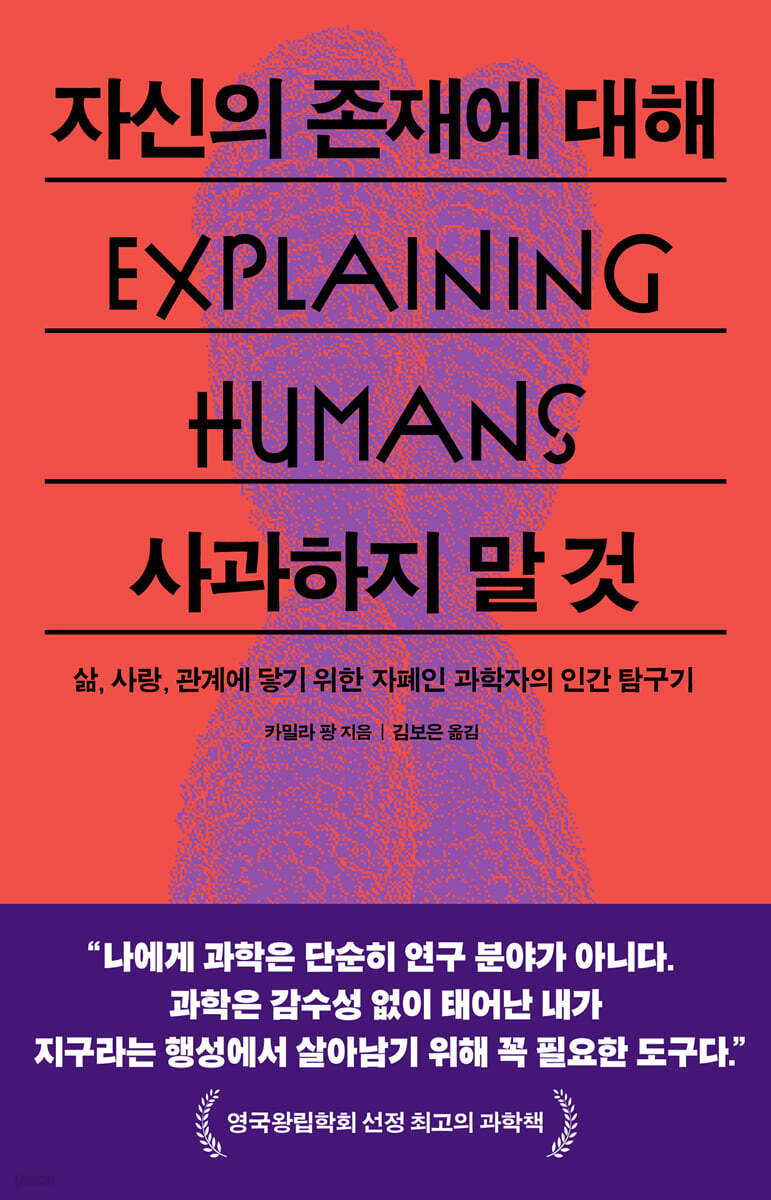
Don't apologize for your existence.
 |
Description
Book Introduction
The Royal Society's Best Science Books of 2020 A fascinating book written by a female scientist who was diagnosed with autism spectrum disorder at the age of eight and has lived with ADHD, generalized anxiety disorder, obsessive-compulsive disorder, and sensory processing disorder for a long time, using scientific knowledge such as biochemistry, physics, and statistics to explain human psychology and behavior. Above all, this book is the story of an isolated five-year-old girl who thought she had "come to the wrong planet" and grew up to be a respectable scientist, and through science, she came to understand mysterious emotions such as empathy, understanding, and trust. And the author says, "If I can do it, you can do it," and says that everyone has the right to connect with others as themselves. A touching story of a lifetime of failed experiments conducted using one's own life as a laboratory, and the most beautiful science book in the world. It won the 2020 Best Science Book Award from the Royal Society, which has produced outstanding winners over the decades, including Stephen Hawking and Bill Bryson. |
- You can preview some of the book's contents.
Preview
index
Introduction: Why I Came to This Planet
CHAPTER 1 Thinking Outside the Box: Machine Learning and Decision Making
CHAPTER 2 Embracing Your Own Weirdness: Biochemistry, Friendship, and the Power of Difference
CHAPTER 3 How to Not Obsess Over Perfection: Thermodynamics, Order and Disorder
CHAPTER 4 Dealing with Fear: Light, Refraction, and Fear
CHAPTER 5: How to Harmonize: Wave Theory, Harmonic Motion, and Finding Your Own Resonant Frequency
CHAPTER 6: How to Avoid Being Swept Along: Molecular Dynamics, Conformity, and Individuality
CHAPTER 7: Achieving Your Goals: Quantum Physics, Network Theory, and Goal Setting
CHAPTER 8: How to Empathize: Evolution, Probability, and Relationships
CHAPTER 9 Connecting with Others: Chemical Bonds, Fundamental Forces, and Relationships
CHAPTER 10 Learning from Mistakes: Deep Learning, Feedback Loops, and Human Memory
CHAPTER 11 How to Act Like a Human: Game Theory, Complex Systems, and Etiquette
What comes out: Don't apologize for your existence.
Acknowledgements
CHAPTER 1 Thinking Outside the Box: Machine Learning and Decision Making
CHAPTER 2 Embracing Your Own Weirdness: Biochemistry, Friendship, and the Power of Difference
CHAPTER 3 How to Not Obsess Over Perfection: Thermodynamics, Order and Disorder
CHAPTER 4 Dealing with Fear: Light, Refraction, and Fear
CHAPTER 5: How to Harmonize: Wave Theory, Harmonic Motion, and Finding Your Own Resonant Frequency
CHAPTER 6: How to Avoid Being Swept Along: Molecular Dynamics, Conformity, and Individuality
CHAPTER 7: Achieving Your Goals: Quantum Physics, Network Theory, and Goal Setting
CHAPTER 8: How to Empathize: Evolution, Probability, and Relationships
CHAPTER 9 Connecting with Others: Chemical Bonds, Fundamental Forces, and Relationships
CHAPTER 10 Learning from Mistakes: Deep Learning, Feedback Loops, and Human Memory
CHAPTER 11 How to Act Like a Human: Game Theory, Complex Systems, and Etiquette
What comes out: Don't apologize for your existence.
Acknowledgements
Detailed image
.jpg)
Into the book
Over time, I've come to realize that my neurodiversity, a strange cocktail of mixed traits, is also a blessing.
Neurodiversity has been a powerful weapon in my life, arming me with the mental tools to analyze problems quickly, efficiently, and perfectly.
Having autism spectrum disorder meant I saw the world differently, with less prejudice.
Anxiety and ADHD have left me flipping between states of intense focus and boredom, processing information rapidly, and mentally mapping out every possible outcome in each situation I find myself in.
My neurodiversity has raised countless questions about what it means to be human, but it has also given me the ability to answer them.
---From "Introduction: Why I Came to This Planet, p.13"
Only when you sort through your data and build a decision tree can you see how to explore the options before you and arrive at decisions based on meaningful outcomes (e.g., "Will it make me happy and fulfilled?").
This method is always more complex than the binary 'yes' or 'no' decisions we want to believe exist.
We need to dig deeper than our immediate choices to unearth the data that informs our decisions—our emotions, ambitions, hopes, and fears—and understand how they all connect and what's driving us.
Then we can see more realistically what certain choices will or will not bring us.
Make important decisions based on fundamental principles about what matters most in life, and reduce the need to fit yourself into the boxes scattered around us.
These boxes simply represent our emotional lumps and immediate instincts, and these stacked boxes often contain social 'obligations' about how we should behave ("I should have traveled the world when I was young," "I should have settled down instead of taking a dangerous job abroad," etc.).
The volatility of mental health naturally opens these boxes, so it's often seen as a losing battle.
---From "CHAPTER 1: How to Think Outside the Box, p.41"
Who hasn't argued with their mother about cleaning their room and their differing interpretations of what constitutes a mess? My messy kingdom was more a result of anxiety than laziness.
To the untrained eye it might appear a chaotic scene, but to me it was all tailored to my personal needs, everything where I had last left it, naturally placed in the optimal location for immediate use.
The belongings scattered across the floor were not placed haphazardly, but were arranged so that I could reach them from anywhere.
Although I didn't dare say it in the argument with my mother, the suspicious state of my room can be explained by thermodynamics.
Thermodynamics is a branch of physics that explains how energy moves and is transferred.
The laws of thermodynamics tell us that if left alone, the universe will inevitably become more disordered over time.
So all our efforts to establish order are a violation of the second law of thermodynamics. The second law of thermodynamics is a system (a part of the universe, real or imagined, defined by boundaries or mathematical constraints).
Depending on the relationship with the surroundings, it is divided into closed, open, and isolated systems. (Translator) In this case, entropy (roughly 'disorder') always naturally increases, and usable energy decreases.
So, a cluttered room is probably a fundamentally unavoidable consequence, no matter how hard we try.
---From "CHAPTER 3: How not to be obsessed with perfection, pp. 81-82"
For people with Asperger's syndrome, there are moments when all thoughts and fears rush in like a blinding light.
I experience everything simultaneously, yet I lack the innate ability to separate the various emotions, anxieties, impulses, and stimuli. When the fire alarm, another source of immense fear for me, goes off, a terrifying noise pierces through my entire body, sending a shiver down my spine, burning my senses.
Imagine feeling fear only in your body.
At school, when other students were lined up neatly like soldiers, I always ran away from the noise as far and as fast as I could.
At times like these, I would sit in a dark room with the blinds down, wearing noise-canceling headphones, and in the safety of a tent under my desk.
This was my survival strategy, and it still is.
---From "CHAPTER 4: How to Deal with Fear, p.111"
It is a natural human desire to try to minimize fear when faced with it.
People think that if they could just squeeze their fears into the smallest possible box and lock them away in the farthest corner of their minds, they would be free from their influence and live free from it.
But hoping to control fear in this way is like assuming that the sun will never rise.
If something causes us anxiety, it will continue to trigger it until we understand why it is causing us anxiety and what we can do to prevent it.
Denial is our first instinct, but it is not a choice.
---From "CHAPTER 4: How to Deal with Fear, p.119"
I go into the kitchen with the innocent intention of having a cup of tea, and while I'm at it, I might pick up an interesting book.
You might completely forget about the tea you were having, find a notepad, scribble a hasty note, and then suddenly go to the grocery store to buy something.
I might go to the store, buy a pack of gum to calm my anxiety, and then come back only to realize that I forgot to brew the tea and now my mug is stained with it.
I might put on rubber gloves to wash a mug, then forget about doing the dishes because I'm too busy posting pictures of myself wearing them on Instagram.
This much effort goes into a cup of tea that you will never drink.
---From "CHAPTER 6: How to Create Harmony, pp. 145-146"
After I started experiencing empathy, it became almost like a drug to me.
It was something I hadn't experienced in so long that I rushed to it at every opportunity, as if I had not seen light or eaten food for years.
For years, I've longed for solidarity with people to prove to them that I'm loved.
Some people might think I'm crazy or abnormal, but people like me are actually non-judgmental, and in that sense, they're some of the nicest people you'll ever meet.
So I think empathy is a painful happiness.
Sometimes it's hellishly painful, but it's because it's something no other emotion or experience can replicate.
---From "CHAPTER 6: How to Avoid Being Swept Away by the Crowd, p.172"
Over 20 years of research on groups has led to clear conclusions.
This is a duality that must be accepted rather than fought against.
In the struggle to create balance between me and us, there is no ultimate victor.
Both individuals and groups have essential roles to play in our lives, and both should be respected.
Both individuals and groups have something important to offer us.
To make matters worse, neither of them disappears.
No matter how much you try to change an individual's personality and characteristics, they will always exist within them.
At the same time, even if we retreat into ourselves as individuals, the world does not disappear.
No matter how hard you try to live on your own island, there is no such thing as a completely independent life.
We have emotional and practical needs that can only be satisfied through groups.
At some point, even those who embrace solitude must leave their shores, or else there will be nothing to compare our solitary efforts to.
---From "CHAPTER 6: How to Avoid Being Swept Away by the Crowd, pp. 173-174"
Actually, you might think it's strange that I say empathy is important.
Because the topic of empathy is something that people with Asperger's syndrome have no idea about.
One of the things I hear so much that I'm sick of it is, "Think from the other person's perspective."
It seems like people with autism need all the help they can get to empathize and connect with others.
But here's what I've found: The more often people talk about empathy, the less adept they are at demonstrating it.
On the other hand, even if I don't understand why someone thinks or acts a certain way, I can trust that I'm observing them closely and trying to figure it out.
Lacking innate empathy means that we have to work harder to anticipate the intentions and expectations of others.
Through my eyes, relationships become a complex equation where I have to adapt my behavior to the expectations of the other person.
It is empathy gained through observation, calculation, and experimentation.
---From "CHAPTER 8: How to Empathize, p.211"
Like everyone else, I always wanted to fit in with the crowd.
You may think you've landed on the wrong planet, but that doesn't mean you'll end up living like an alien among the locals.
Growing up in Wales, going to school in the Cotswolds, graduating from university in Bristol and landing a job in London, I've struggled to navigate the mainstream.
---From "CHAPTER 10: Learning from Mistakes, p.275"
Growing as a person can be incredibly frustrating.
Because even if you do all this, nothing will happen for a while, maybe for a very long time.
It's easy to get discouraged and give up here.
But the real reward lies in persevering and overcoming uncertainty and self-doubt until one day change creeps up on you.
We cannot plan when or how this will happen.
Just get started and trust the process.
So don't despair over plans that didn't come to fruition, goals that weren't achieved, or relationships that failed.
Instead, learn from it.
And next time let's try something a little different.
Let's also experiment with how to work in our own way.
Let us accept the human inevitability that the process of improving life is slow and gradual.
And no matter what, don't demonize your differences.
Embrace your differences as I did, with your innate superpower.
Anything will go wrong at least once before it goes right.
Things may get worse before they get better.
It's okay.
Actually, that process is necessary.
Enjoy the failed experiment.
Enjoy the process of doing it on your own.
And don't apologize for who you are.
I have never done that, and I don't plan on doing that now.
Neurodiversity has been a powerful weapon in my life, arming me with the mental tools to analyze problems quickly, efficiently, and perfectly.
Having autism spectrum disorder meant I saw the world differently, with less prejudice.
Anxiety and ADHD have left me flipping between states of intense focus and boredom, processing information rapidly, and mentally mapping out every possible outcome in each situation I find myself in.
My neurodiversity has raised countless questions about what it means to be human, but it has also given me the ability to answer them.
---From "Introduction: Why I Came to This Planet, p.13"
Only when you sort through your data and build a decision tree can you see how to explore the options before you and arrive at decisions based on meaningful outcomes (e.g., "Will it make me happy and fulfilled?").
This method is always more complex than the binary 'yes' or 'no' decisions we want to believe exist.
We need to dig deeper than our immediate choices to unearth the data that informs our decisions—our emotions, ambitions, hopes, and fears—and understand how they all connect and what's driving us.
Then we can see more realistically what certain choices will or will not bring us.
Make important decisions based on fundamental principles about what matters most in life, and reduce the need to fit yourself into the boxes scattered around us.
These boxes simply represent our emotional lumps and immediate instincts, and these stacked boxes often contain social 'obligations' about how we should behave ("I should have traveled the world when I was young," "I should have settled down instead of taking a dangerous job abroad," etc.).
The volatility of mental health naturally opens these boxes, so it's often seen as a losing battle.
---From "CHAPTER 1: How to Think Outside the Box, p.41"
Who hasn't argued with their mother about cleaning their room and their differing interpretations of what constitutes a mess? My messy kingdom was more a result of anxiety than laziness.
To the untrained eye it might appear a chaotic scene, but to me it was all tailored to my personal needs, everything where I had last left it, naturally placed in the optimal location for immediate use.
The belongings scattered across the floor were not placed haphazardly, but were arranged so that I could reach them from anywhere.
Although I didn't dare say it in the argument with my mother, the suspicious state of my room can be explained by thermodynamics.
Thermodynamics is a branch of physics that explains how energy moves and is transferred.
The laws of thermodynamics tell us that if left alone, the universe will inevitably become more disordered over time.
So all our efforts to establish order are a violation of the second law of thermodynamics. The second law of thermodynamics is a system (a part of the universe, real or imagined, defined by boundaries or mathematical constraints).
Depending on the relationship with the surroundings, it is divided into closed, open, and isolated systems. (Translator) In this case, entropy (roughly 'disorder') always naturally increases, and usable energy decreases.
So, a cluttered room is probably a fundamentally unavoidable consequence, no matter how hard we try.
---From "CHAPTER 3: How not to be obsessed with perfection, pp. 81-82"
For people with Asperger's syndrome, there are moments when all thoughts and fears rush in like a blinding light.
I experience everything simultaneously, yet I lack the innate ability to separate the various emotions, anxieties, impulses, and stimuli. When the fire alarm, another source of immense fear for me, goes off, a terrifying noise pierces through my entire body, sending a shiver down my spine, burning my senses.
Imagine feeling fear only in your body.
At school, when other students were lined up neatly like soldiers, I always ran away from the noise as far and as fast as I could.
At times like these, I would sit in a dark room with the blinds down, wearing noise-canceling headphones, and in the safety of a tent under my desk.
This was my survival strategy, and it still is.
---From "CHAPTER 4: How to Deal with Fear, p.111"
It is a natural human desire to try to minimize fear when faced with it.
People think that if they could just squeeze their fears into the smallest possible box and lock them away in the farthest corner of their minds, they would be free from their influence and live free from it.
But hoping to control fear in this way is like assuming that the sun will never rise.
If something causes us anxiety, it will continue to trigger it until we understand why it is causing us anxiety and what we can do to prevent it.
Denial is our first instinct, but it is not a choice.
---From "CHAPTER 4: How to Deal with Fear, p.119"
I go into the kitchen with the innocent intention of having a cup of tea, and while I'm at it, I might pick up an interesting book.
You might completely forget about the tea you were having, find a notepad, scribble a hasty note, and then suddenly go to the grocery store to buy something.
I might go to the store, buy a pack of gum to calm my anxiety, and then come back only to realize that I forgot to brew the tea and now my mug is stained with it.
I might put on rubber gloves to wash a mug, then forget about doing the dishes because I'm too busy posting pictures of myself wearing them on Instagram.
This much effort goes into a cup of tea that you will never drink.
---From "CHAPTER 6: How to Create Harmony, pp. 145-146"
After I started experiencing empathy, it became almost like a drug to me.
It was something I hadn't experienced in so long that I rushed to it at every opportunity, as if I had not seen light or eaten food for years.
For years, I've longed for solidarity with people to prove to them that I'm loved.
Some people might think I'm crazy or abnormal, but people like me are actually non-judgmental, and in that sense, they're some of the nicest people you'll ever meet.
So I think empathy is a painful happiness.
Sometimes it's hellishly painful, but it's because it's something no other emotion or experience can replicate.
---From "CHAPTER 6: How to Avoid Being Swept Away by the Crowd, p.172"
Over 20 years of research on groups has led to clear conclusions.
This is a duality that must be accepted rather than fought against.
In the struggle to create balance between me and us, there is no ultimate victor.
Both individuals and groups have essential roles to play in our lives, and both should be respected.
Both individuals and groups have something important to offer us.
To make matters worse, neither of them disappears.
No matter how much you try to change an individual's personality and characteristics, they will always exist within them.
At the same time, even if we retreat into ourselves as individuals, the world does not disappear.
No matter how hard you try to live on your own island, there is no such thing as a completely independent life.
We have emotional and practical needs that can only be satisfied through groups.
At some point, even those who embrace solitude must leave their shores, or else there will be nothing to compare our solitary efforts to.
---From "CHAPTER 6: How to Avoid Being Swept Away by the Crowd, pp. 173-174"
Actually, you might think it's strange that I say empathy is important.
Because the topic of empathy is something that people with Asperger's syndrome have no idea about.
One of the things I hear so much that I'm sick of it is, "Think from the other person's perspective."
It seems like people with autism need all the help they can get to empathize and connect with others.
But here's what I've found: The more often people talk about empathy, the less adept they are at demonstrating it.
On the other hand, even if I don't understand why someone thinks or acts a certain way, I can trust that I'm observing them closely and trying to figure it out.
Lacking innate empathy means that we have to work harder to anticipate the intentions and expectations of others.
Through my eyes, relationships become a complex equation where I have to adapt my behavior to the expectations of the other person.
It is empathy gained through observation, calculation, and experimentation.
---From "CHAPTER 8: How to Empathize, p.211"
Like everyone else, I always wanted to fit in with the crowd.
You may think you've landed on the wrong planet, but that doesn't mean you'll end up living like an alien among the locals.
Growing up in Wales, going to school in the Cotswolds, graduating from university in Bristol and landing a job in London, I've struggled to navigate the mainstream.
---From "CHAPTER 10: Learning from Mistakes, p.275"
Growing as a person can be incredibly frustrating.
Because even if you do all this, nothing will happen for a while, maybe for a very long time.
It's easy to get discouraged and give up here.
But the real reward lies in persevering and overcoming uncertainty and self-doubt until one day change creeps up on you.
We cannot plan when or how this will happen.
Just get started and trust the process.
So don't despair over plans that didn't come to fruition, goals that weren't achieved, or relationships that failed.
Instead, learn from it.
And next time let's try something a little different.
Let's also experiment with how to work in our own way.
Let us accept the human inevitability that the process of improving life is slow and gradual.
And no matter what, don't demonize your differences.
Embrace your differences as I did, with your innate superpower.
Anything will go wrong at least once before it goes right.
Things may get worse before they get better.
It's okay.
Actually, that process is necessary.
Enjoy the failed experiment.
Enjoy the process of doing it on your own.
And don't apologize for who you are.
I have never done that, and I don't plan on doing that now.
---From "What's Coming Out: Don't Apologize for Your Existence, p.316"
Publisher's Review
“How do we connect with others?”
Life, love, and relationships, understood through observation, calculation, and experimentation.
About five years after life on Earth began, Camilla had a thought.
'I must have landed on the wrong planet.' It was a place I lived on, yet it felt like it was out of orbit, a place I would never be able to reach.
A place where even the words spoken by family members sounded like an alien language.
“Mom, is there a human instruction manual?” Reading someone’s expression is difficult now as it was then, but five-year-old Camilla saw her mother’s heart break in that moment.
It was science that grabbed his hand as he grew more and more alienated and distant from the vitality of life.
A new world discovered in my uncle's study when I was seven years old.
For the first time in her life, Camilla encountered a language she could understand.
Every Sunday, he would lock himself in his study and bury himself in all kinds of science books.
Science never lies, hides its intentions, or goes behind people's backs.
To him, who had been endlessly searching for the certainty that the world refused to show, science was his most faithful helper and his first, truest friend.
In this way, Camilla began to understand human language through the language of science.
Every stage of life was a laboratory, and everyone I met was a subject of study.
He, who felt that emotions such as empathy, love, and trust were mysterious, was finally able to reach a place that had been unreachable by crossing the bridge of science.
It is a sense of connection obtained through observation, calculation, and experimentation.
The author says:
Everyone has the right to connect with others as themselves.
Never apologize for your existence.
“For me, science is not just a field of study.
Science is something I was born with no sensitivity to.
“It is an essential tool for survival on planet Earth.”
The author says that science is about learning from failure as much as from success.
And so is our life.
Because the process of improving life is inevitably slow and gradual.
That's why getting to know yourself is bound to be slow.
The message Camilla Pang ultimately conveys to us is that we should experiment through life, enjoy the experiments that fail, and enjoy the process of doing things on our own, just as we repeat countless experiments by changing variables.
The beginning of this book was actually the author's doctoral dissertation.
My advisor said that it was a good piece of writing, but it wasn't suitable for a thesis.
But Camilla didn't give in and created the 'human user manual' she needed.
In this book, the author shows us how to choose the best option through machine learning, how to relate to others through protein binding and wave theory, how to overcome perfectionism through thermodynamics, how to achieve goals through quantum physics, and how to learn from mistakes through deep learning.
Reading this book is literally a process of understanding life and relationships through observation, calculation, and experimentation.
For example, Chapter 1 argues that while machines may not be able to replace the human brain in terms of creativity, flexibility, or emotional awareness, they can certainly help us think and make decisions more efficiently.
Especially when we are overwhelmed by the amount of information and choices that surround us.
Here, the author contrasts two approaches to programming algorithms: "supervised learning" and "unsupervised learning," with "thinking in a box" and "thinking like a tree."
To reach meaningful decisions, we must break out of the binary box of "yes" or "no" that we want to believe exists.
We must always dig deeper than the immediate criteria for choice.
Science teaches us that only by unearthing the data—our emotions, ambitions, hopes, and fears—before making a decision and understanding how they all connect can we make truly helpful decisions.
Chapter 3 brings up an episode where she had a conflict with her mother over cleaning her room, and offers us the witty consolation that it is the law of the universe that it is difficult to keep a room organized.
According to the second law of thermodynamics, entropy always increases.
That is, if left alone, the universe, and therefore our room, will inevitably become more disordered as time passes.
The difficulty of keeping a house tidy is that we strive to lower entropy in an environment that naturally tends toward disorder, and so Mom's request to tidy up the room provides a very scientific excuse that it is not just a request to overcome laziness, but a request to go against the fundamental principles of thermodynamics.
“The most difficult thing in the world is to understand your fellow human beings.”
Camilla's life dancing on the spectrum of diversity and typicality
Living in a world of neurodiversity—including autism spectrum disorder, Asperger's syndrome, ADHD, and generalized anxiety disorder—Camilla's life is akin to playing computer games without a joystick, cooking without a pan, or playing an instrument without sheet music.
He felt like he lived on an isolated island, never having felt 'normal' or 'ordinary' for even a single moment.
At school, I was an outsider, and there was nothing more common than having kids bully outsiders.
It took me a while to even realize I was being bullied.
Even everyday physical contact like hugs or light kisses feel strange to the author, who has Asperger's syndrome, but he tries harder to live together as a member of society.
Empathy takes many forms and is expressed in many languages, but above all, it is an effort by one human being to connect with another.
In that sense, this book is a gesture of empathy itself.
The author spends more time than others thinking about what people need and how to make them happy, and uses the power of science to interpret it in his own words.
And finally, we realize that time itself is a form of empathy.
“There is one question that has dominated my life since I began to remember.
How do we connect with others if we weren't originally programmed that way? I'm someone who doesn't instinctively understand emotions like love, empathy, and trust, but I desperately want to know.
So I conducted a science experiment on my own life, testing my words, actions, and thoughts.
“Even if I wasn’t a perfect human being, I wanted to at least become a member who played a proper role among my kind.” (p. 15)
Born to a Chinese father and a Spanish mother, and raised in Wales, England, the author's environment also had a great influence.
Having grown up experiencing both cultures, I've learned that each culture has different rules, and what's cool about these rules is that they can be bent and flexible to fit the situation.
Camilla's mother is an artist and her father is a scientist and engineer, and she grew up feeling like she was stuck somewhere in between, too logical to be an artist and too emotional to be a data scientist.
This book shows what neurodiversity, the opposite of what is commonly considered "normal" in our society, can do.
“Sometimes I wish I had more autism,” the author says.
This is because they consider the various neurodiversity characteristics they possess as ‘differences,’ ‘differentiations,’ and ‘superpowers,’ rather than ‘abnormalities’ or ‘disabilities.’
No matter how similar or different you feel to the author, this book will guide you to a new approach to understanding life and relationships.
“An important book that demonstrates the power of neurodiversity in a world that considers only neurotypicality normal.
This weighty memoir illuminates the power of being on the autism spectrum.”
-<times>
“A wonderful challenge to the common belief that people with autism spectrum disorder lack empathy.
And this challenge is very successful.” ―The Guardian
“An accessible and engaging guide that introduces scientific concepts with humor.”
―〈BBC Science Focus〉
“It vividly shows how an individual with Asperger’s syndrome views the world.
“An original yet popular psychology book.”
―〈Kirkus〉
“Whether neurodiversity or neurotypicality, Pang’s witty explanations make this a must-read for anyone looking to broaden their understanding.
“A must-read for anyone who wants to broaden their understanding of life beyond what society defines as ‘normal.’”
―〈Dazed〉
“An enlightening hybrid of popular science, memoir, and self-help book.
By combining scientific theory with personal anecdotes, we create an accessible and entertaining life guide.
“It offers a unique and fresh perspective on life’s big and important questions.”
―Publisher's Weekly
“In this book, Fang uses his vast scientific knowledge to help readers understand the human world.
Through themes like thinking outside the box, forgetting about perfection and finding harmony, learning from mistakes, and building empathy and relationships, this book will help readers embrace their individuality while finding their place within the larger human race.”
―〈Booklist〉
“Pang’s personal narrative seamlessly blends with scientific concepts like machine learning, and the author’s lovely illustrations guide the reader.
“Fang delivers a memoir that is informative for readers interested in science, with a consistently calm voice.”
―〈Library Journal〉
“A scientific blueprint for human nature and a bizarre compendium of all social norms.”
―〈Busle〉
Life, love, and relationships, understood through observation, calculation, and experimentation.
About five years after life on Earth began, Camilla had a thought.
'I must have landed on the wrong planet.' It was a place I lived on, yet it felt like it was out of orbit, a place I would never be able to reach.
A place where even the words spoken by family members sounded like an alien language.
“Mom, is there a human instruction manual?” Reading someone’s expression is difficult now as it was then, but five-year-old Camilla saw her mother’s heart break in that moment.
It was science that grabbed his hand as he grew more and more alienated and distant from the vitality of life.
A new world discovered in my uncle's study when I was seven years old.
For the first time in her life, Camilla encountered a language she could understand.
Every Sunday, he would lock himself in his study and bury himself in all kinds of science books.
Science never lies, hides its intentions, or goes behind people's backs.
To him, who had been endlessly searching for the certainty that the world refused to show, science was his most faithful helper and his first, truest friend.
In this way, Camilla began to understand human language through the language of science.
Every stage of life was a laboratory, and everyone I met was a subject of study.
He, who felt that emotions such as empathy, love, and trust were mysterious, was finally able to reach a place that had been unreachable by crossing the bridge of science.
It is a sense of connection obtained through observation, calculation, and experimentation.
The author says:
Everyone has the right to connect with others as themselves.
Never apologize for your existence.
“For me, science is not just a field of study.
Science is something I was born with no sensitivity to.
“It is an essential tool for survival on planet Earth.”
The author says that science is about learning from failure as much as from success.
And so is our life.
Because the process of improving life is inevitably slow and gradual.
That's why getting to know yourself is bound to be slow.
The message Camilla Pang ultimately conveys to us is that we should experiment through life, enjoy the experiments that fail, and enjoy the process of doing things on our own, just as we repeat countless experiments by changing variables.
The beginning of this book was actually the author's doctoral dissertation.
My advisor said that it was a good piece of writing, but it wasn't suitable for a thesis.
But Camilla didn't give in and created the 'human user manual' she needed.
In this book, the author shows us how to choose the best option through machine learning, how to relate to others through protein binding and wave theory, how to overcome perfectionism through thermodynamics, how to achieve goals through quantum physics, and how to learn from mistakes through deep learning.
Reading this book is literally a process of understanding life and relationships through observation, calculation, and experimentation.
For example, Chapter 1 argues that while machines may not be able to replace the human brain in terms of creativity, flexibility, or emotional awareness, they can certainly help us think and make decisions more efficiently.
Especially when we are overwhelmed by the amount of information and choices that surround us.
Here, the author contrasts two approaches to programming algorithms: "supervised learning" and "unsupervised learning," with "thinking in a box" and "thinking like a tree."
To reach meaningful decisions, we must break out of the binary box of "yes" or "no" that we want to believe exists.
We must always dig deeper than the immediate criteria for choice.
Science teaches us that only by unearthing the data—our emotions, ambitions, hopes, and fears—before making a decision and understanding how they all connect can we make truly helpful decisions.
Chapter 3 brings up an episode where she had a conflict with her mother over cleaning her room, and offers us the witty consolation that it is the law of the universe that it is difficult to keep a room organized.
According to the second law of thermodynamics, entropy always increases.
That is, if left alone, the universe, and therefore our room, will inevitably become more disordered as time passes.
The difficulty of keeping a house tidy is that we strive to lower entropy in an environment that naturally tends toward disorder, and so Mom's request to tidy up the room provides a very scientific excuse that it is not just a request to overcome laziness, but a request to go against the fundamental principles of thermodynamics.
“The most difficult thing in the world is to understand your fellow human beings.”
Camilla's life dancing on the spectrum of diversity and typicality
Living in a world of neurodiversity—including autism spectrum disorder, Asperger's syndrome, ADHD, and generalized anxiety disorder—Camilla's life is akin to playing computer games without a joystick, cooking without a pan, or playing an instrument without sheet music.
He felt like he lived on an isolated island, never having felt 'normal' or 'ordinary' for even a single moment.
At school, I was an outsider, and there was nothing more common than having kids bully outsiders.
It took me a while to even realize I was being bullied.
Even everyday physical contact like hugs or light kisses feel strange to the author, who has Asperger's syndrome, but he tries harder to live together as a member of society.
Empathy takes many forms and is expressed in many languages, but above all, it is an effort by one human being to connect with another.
In that sense, this book is a gesture of empathy itself.
The author spends more time than others thinking about what people need and how to make them happy, and uses the power of science to interpret it in his own words.
And finally, we realize that time itself is a form of empathy.
“There is one question that has dominated my life since I began to remember.
How do we connect with others if we weren't originally programmed that way? I'm someone who doesn't instinctively understand emotions like love, empathy, and trust, but I desperately want to know.
So I conducted a science experiment on my own life, testing my words, actions, and thoughts.
“Even if I wasn’t a perfect human being, I wanted to at least become a member who played a proper role among my kind.” (p. 15)
Born to a Chinese father and a Spanish mother, and raised in Wales, England, the author's environment also had a great influence.
Having grown up experiencing both cultures, I've learned that each culture has different rules, and what's cool about these rules is that they can be bent and flexible to fit the situation.
Camilla's mother is an artist and her father is a scientist and engineer, and she grew up feeling like she was stuck somewhere in between, too logical to be an artist and too emotional to be a data scientist.
This book shows what neurodiversity, the opposite of what is commonly considered "normal" in our society, can do.
“Sometimes I wish I had more autism,” the author says.
This is because they consider the various neurodiversity characteristics they possess as ‘differences,’ ‘differentiations,’ and ‘superpowers,’ rather than ‘abnormalities’ or ‘disabilities.’
No matter how similar or different you feel to the author, this book will guide you to a new approach to understanding life and relationships.
“An important book that demonstrates the power of neurodiversity in a world that considers only neurotypicality normal.
This weighty memoir illuminates the power of being on the autism spectrum.”
-<times>
“A wonderful challenge to the common belief that people with autism spectrum disorder lack empathy.
And this challenge is very successful.” ―The Guardian
“An accessible and engaging guide that introduces scientific concepts with humor.”
―〈BBC Science Focus〉
“It vividly shows how an individual with Asperger’s syndrome views the world.
“An original yet popular psychology book.”
―〈Kirkus〉
“Whether neurodiversity or neurotypicality, Pang’s witty explanations make this a must-read for anyone looking to broaden their understanding.
“A must-read for anyone who wants to broaden their understanding of life beyond what society defines as ‘normal.’”
―〈Dazed〉
“An enlightening hybrid of popular science, memoir, and self-help book.
By combining scientific theory with personal anecdotes, we create an accessible and entertaining life guide.
“It offers a unique and fresh perspective on life’s big and important questions.”
―Publisher's Weekly
“In this book, Fang uses his vast scientific knowledge to help readers understand the human world.
Through themes like thinking outside the box, forgetting about perfection and finding harmony, learning from mistakes, and building empathy and relationships, this book will help readers embrace their individuality while finding their place within the larger human race.”
―〈Booklist〉
“Pang’s personal narrative seamlessly blends with scientific concepts like machine learning, and the author’s lovely illustrations guide the reader.
“Fang delivers a memoir that is informative for readers interested in science, with a consistently calm voice.”
―〈Library Journal〉
“A scientific blueprint for human nature and a bizarre compendium of all social norms.”
―〈Busle〉
GOODS SPECIFICS
- Date of issue: April 12, 2023
- Page count, weight, size: 320 pages | 406g | 135*210*22mm
- ISBN13: 9791156754107
- ISBN10: 1156754100
You may also like
카테고리
korean


korean

![GQ KOREA Mark (Monthly): December [2025]](http://librairie.coreenne.fr/cdn/shop/files/8ef265dbbfbf186523ed75ba7319009d.jpg?v=1765340328&width=3840)


