

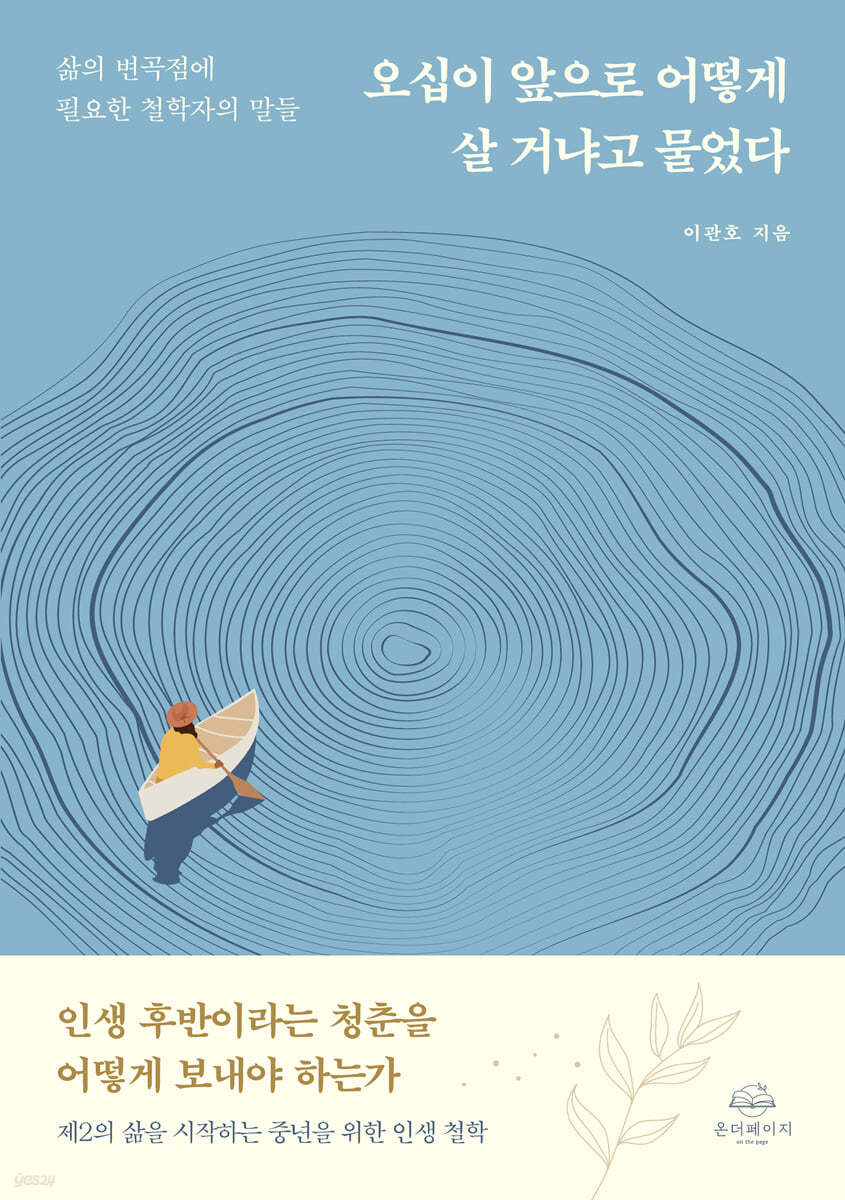
Fifty asked how he would live from now on.
 |
Description
Book Introduction
- A word from MD
-
Finding Answers to Life in the HumanitiesAdult life is ambiguous.
You have to find your own goals and values.
This book, written by author Lee Gwan-ho, who has long studied and taught humanities, seeks answers from the insights of thinkers such as Confucius, Spinoza, Nietzsche, and Schopenhauer.
In particular, it presents humanistic solutions to various problems faced by middle age.
March 31, 2023. Humanities PD Son Min-gyu
If sunrise is excitement, sunset is looking back!
To the fifty who will greet the splendid sunset
A humanities class that will impart healing, happiness, and life wisdom.
When you turn 50, you start to worry more about your future life.
How can we live without some kind of worry about how to accept and spend the rest of our lives? When we reach our fifties, having spent half our lives running without rest, we look for life's milestones that will show us where to find rest.
To do this, we learn enlightening philosophies, listen to other people's life stories, and read novels that awaken emotions.
The author, now in his fifties, also lives with concerns about middle-aged life.
I ponder how to organize and strengthen my relationships, how to maintain a healthy body and mind, and how to respect my child's life and help him or her blossom beautifully.
In an effort to find answers to these questions, the author has compiled the values he has learned throughout his life and the principles of life taught by the humanities into this book, and has unfolded them in his own unique narrative.
This book is full of stories that will fill your fading days with a series of brilliant moments.
Rather than leaving the time spent with friends, family, and lovers as mere memories, I interpret it as a philosophy that has shaped who I am today.
And it makes the reader think about how to live his or her future life.
Fifty is the time to prepare for your second life.
The author wants to convey the realization that fifty is the age to enjoy a sunset that brings feelings of 'calmness', 'maturity', and 'humility' through this one book.
To the fifty who will greet the splendid sunset
A humanities class that will impart healing, happiness, and life wisdom.
When you turn 50, you start to worry more about your future life.
How can we live without some kind of worry about how to accept and spend the rest of our lives? When we reach our fifties, having spent half our lives running without rest, we look for life's milestones that will show us where to find rest.
To do this, we learn enlightening philosophies, listen to other people's life stories, and read novels that awaken emotions.
The author, now in his fifties, also lives with concerns about middle-aged life.
I ponder how to organize and strengthen my relationships, how to maintain a healthy body and mind, and how to respect my child's life and help him or her blossom beautifully.
In an effort to find answers to these questions, the author has compiled the values he has learned throughout his life and the principles of life taught by the humanities into this book, and has unfolded them in his own unique narrative.
This book is full of stories that will fill your fading days with a series of brilliant moments.
Rather than leaving the time spent with friends, family, and lovers as mere memories, I interpret it as a philosophy that has shaped who I am today.
And it makes the reader think about how to live his or her future life.
Fifty is the time to prepare for your second life.
The author wants to convey the realization that fifty is the age to enjoy a sunset that brings feelings of 'calmness', 'maturity', and 'humility' through this one book.
- You can preview some of the book's contents.
Preview
index
Introduction - Life after 50 - Yin and Yang
Chapter 1: Resetting Your Relationships
On Friendship in Middle Age - Confucius
It's okay to be a little lonely - Arthur Schopenhauer
How Old Men Are Born - Logic: Generalization
The Way Out of the Old Man ─ Jonathan Haidt
Keep your distance from your children - Alfred Adler
Don't force your dreams
For couples breaking up - Logic: Negation
Let us live with hatred - Confucius
Chapter 2: Finding Self-Esteem
The Philosophy of Career Change and Retirement - Logic: Conjunctions
Self-Esteem in Your 50s - Marshall Rosenberg
The past is not forgotten - Sigmund Freud
To escape from regret - Baruch Spinoza
Irreplaceable Being ─ Jean-Paul Sartre
The Philosophy of Ownership - Lao Tzu
Chapter 3: How to Live Today
A Journey in Your 50s - Logic: Complex Propositions
Why We Become Unhappy──Adam Smith
If you don't want to sacrifice the present for the sake of 60 - Jean-Jacques Rousseau
The Philosophy of Joy - Baruch Spinoza
When You Want to Let Go of Life ─Logic: Sufficient Conditions
How to leverage failure
Chapter 4 If you dream of change now
When did I become old? Logic: Paradox
Let's be renewed ─ The Protagonist
Let's loosen up our plans now - Henri Bergson
It's not too late ─Friedrich Nietzsche
Reasons for reading
Chapter 5: The Philosophy of the Body for Old Age
Growing old gracefully
A Shift in Thinking About the Body - Baruch Spinoza
Let's use new muscles
How to Live Today Fully ─ Tatsuro Uchida
Not to be rude ─Confucius
Chapter 6: Virtues of the 50s
Don't be easy on yourself - Niccolò Machiavelli
Leading Flexibly - Lao Tzu
Stop before the peak ─ Lao Tzu
Studying from now on will be enjoyable. ─Confucius
Let us live moderately - Aristotle
When a friend asks to borrow money - Confucius
About Death
Coming out - Now is the time to pour everything out - Ilgwanji
Americas
Chapter 1: Resetting Your Relationships
On Friendship in Middle Age - Confucius
It's okay to be a little lonely - Arthur Schopenhauer
How Old Men Are Born - Logic: Generalization
The Way Out of the Old Man ─ Jonathan Haidt
Keep your distance from your children - Alfred Adler
Don't force your dreams
For couples breaking up - Logic: Negation
Let us live with hatred - Confucius
Chapter 2: Finding Self-Esteem
The Philosophy of Career Change and Retirement - Logic: Conjunctions
Self-Esteem in Your 50s - Marshall Rosenberg
The past is not forgotten - Sigmund Freud
To escape from regret - Baruch Spinoza
Irreplaceable Being ─ Jean-Paul Sartre
The Philosophy of Ownership - Lao Tzu
Chapter 3: How to Live Today
A Journey in Your 50s - Logic: Complex Propositions
Why We Become Unhappy──Adam Smith
If you don't want to sacrifice the present for the sake of 60 - Jean-Jacques Rousseau
The Philosophy of Joy - Baruch Spinoza
When You Want to Let Go of Life ─Logic: Sufficient Conditions
How to leverage failure
Chapter 4 If you dream of change now
When did I become old? Logic: Paradox
Let's be renewed ─ The Protagonist
Let's loosen up our plans now - Henri Bergson
It's not too late ─Friedrich Nietzsche
Reasons for reading
Chapter 5: The Philosophy of the Body for Old Age
Growing old gracefully
A Shift in Thinking About the Body - Baruch Spinoza
Let's use new muscles
How to Live Today Fully ─ Tatsuro Uchida
Not to be rude ─Confucius
Chapter 6: Virtues of the 50s
Don't be easy on yourself - Niccolò Machiavelli
Leading Flexibly - Lao Tzu
Stop before the peak ─ Lao Tzu
Studying from now on will be enjoyable. ─Confucius
Let us live moderately - Aristotle
When a friend asks to borrow money - Confucius
About Death
Coming out - Now is the time to pour everything out - Ilgwanji
Americas
Detailed image
.jpg)
Into the book
Confucius presented two criteria for a true friend.
Based on this standard, let's first look back and see if I am worthy of being a friend to others.
Let's decide whether we are treating them with 'loyalty' and not being sly, and thus whether we are a 'trustworthy' person.
--- p.20
I want my child to live happily, but that's not all I want.
I hope to become a person who knows how to be happy when he is happy and how to be sad when he is sad.
In human relationships, I hope to like people I like, love people I love, and hate people I hate.
--- p.48
According to Statistics Korea data released in September 2022, the average desired working age for the elderly (55 years old and older) is 73.
Most people want to continue working until they are in their 70s.
It takes longer to reach 70 than you might think.
So, from the age of 50, it is necessary to change to a posture of preparing for retirement in advance.
--- pp.79~81
To put it in Adlerian terms, 'I want to ~'.
However, it takes courage not to run away.
People in their 50s can easily fall into feelings of helplessness and regret compared to those in their 20s or 30s due to a decline in physical function.
The best way to shake off these feelings is to increase the things that bring you joy right now.
--- p.104
"The Old Man and the Sea" may convey a more meaningful message to the elderly, or those approaching old age, rather than to young people.
I, too, felt a sense of excitement during my second reading that I hadn't felt since I was a teenager.
After reading the novel, we can ask ourselves these questions:
Can you still challenge yourself in your old age? Or should you try now?
--- p.164
If you read a philosopher's book, you can read the 'conceptual language' (Plato's idea, Nietzsche's superman, Spinoza's conatus, etc.) that the philosopher uses.
The reason readers seek out philosophy books in bookstores is, vaguely speaking, to satisfy their intellectual curiosity, but more specifically, it's to get a feel for the conceptual language philosophers use and the framework of thought they create with it.
--- p.206
Among the books on etiquette and manners that have been passed down from ancient times, the most representative one is the Analects of Confucius.
If the word 'courtesy' sounds heavy and stuffy, it's okay to change it to 'manners'.
The reason why we need to speak appropriately, dress appropriately, and show consideration for others is because such a process makes us 'enjoyable.'
--- pp.241~242
If there is flowering, there is fading, and if there is life, there is death.
Because we don't know what happens to our souls after death, we feel emotions like anxiety, fear, regret, disappointment, sadness, and sorrow about death.
Death is an event equal to birth, neither bad nor inferior.
That is, we came out of death and lived, so we will only return to death again.
Based on this standard, let's first look back and see if I am worthy of being a friend to others.
Let's decide whether we are treating them with 'loyalty' and not being sly, and thus whether we are a 'trustworthy' person.
--- p.20
I want my child to live happily, but that's not all I want.
I hope to become a person who knows how to be happy when he is happy and how to be sad when he is sad.
In human relationships, I hope to like people I like, love people I love, and hate people I hate.
--- p.48
According to Statistics Korea data released in September 2022, the average desired working age for the elderly (55 years old and older) is 73.
Most people want to continue working until they are in their 70s.
It takes longer to reach 70 than you might think.
So, from the age of 50, it is necessary to change to a posture of preparing for retirement in advance.
--- pp.79~81
To put it in Adlerian terms, 'I want to ~'.
However, it takes courage not to run away.
People in their 50s can easily fall into feelings of helplessness and regret compared to those in their 20s or 30s due to a decline in physical function.
The best way to shake off these feelings is to increase the things that bring you joy right now.
--- p.104
"The Old Man and the Sea" may convey a more meaningful message to the elderly, or those approaching old age, rather than to young people.
I, too, felt a sense of excitement during my second reading that I hadn't felt since I was a teenager.
After reading the novel, we can ask ourselves these questions:
Can you still challenge yourself in your old age? Or should you try now?
--- p.164
If you read a philosopher's book, you can read the 'conceptual language' (Plato's idea, Nietzsche's superman, Spinoza's conatus, etc.) that the philosopher uses.
The reason readers seek out philosophy books in bookstores is, vaguely speaking, to satisfy their intellectual curiosity, but more specifically, it's to get a feel for the conceptual language philosophers use and the framework of thought they create with it.
--- p.206
Among the books on etiquette and manners that have been passed down from ancient times, the most representative one is the Analects of Confucius.
If the word 'courtesy' sounds heavy and stuffy, it's okay to change it to 'manners'.
The reason why we need to speak appropriately, dress appropriately, and show consideration for others is because such a process makes us 'enjoyable.'
--- pp.241~242
If there is flowering, there is fading, and if there is life, there is death.
Because we don't know what happens to our souls after death, we feel emotions like anxiety, fear, regret, disappointment, sadness, and sorrow about death.
Death is an event equal to birth, neither bad nor inferior.
That is, we came out of death and lived, so we will only return to death again.
--- pp.293~294
Publisher's Review
“Depending on how you think and live in the future,
“Our lives will continue to become more beautiful.”
Penetrating the worries that middle-aged people have not been able to resolve,
How to bring together accumulated experience and knowledge
The author, who calls himself the editor of a philosophy book for people in their fifties, uses messages from Eastern and Western philosophy, psychology, and literature to help resolve concerns that middle-aged people are likely to have at least once.
In philosophy, he cited Confucius and Socrates, in psychology, Freud and Adler, and in literature, Kazantzakis and Hemingway.
The author, who is actually middle-aged, has also struggled to find an answer to the question of how to live the rest of his life, and has written about this in this book.
The author suggests a desirable middle-aged life by linking his own philosophy of life with concepts such as self-esteem, emotions, and the body.
Chapters 1 and 2 talk about the moments of 'loneliness' that middle-aged people must become accustomed to and the 'self-esteem' that they must regain, and teach them how to recognize their own value.
Chapters 3 and 4 present the emotions that middle-aged people should pursue, like Spinoza, who affirmed all things that bring joy, and discuss the changes that they should accept to start a new day based on these emotions.
Chapters 5 and 6 emphasize that even those in their 50s should maintain a healthy body and that they should not stop learning to maintain a clear mind.
The worries and knowledge we have accumulated throughout our lives, the good and sad memories, all seem to be separate from each other, but they can be gathered into one pool called the 'truth of life.'
The famous quotes and writings of great people from the past contained in this book will serve as a stepping stone to a second life.
I hope this stepping stone will provide warm comfort to middle-aged people who are tired of the twists and turns of life.
“Our lives will continue to become more beautiful.”
Penetrating the worries that middle-aged people have not been able to resolve,
How to bring together accumulated experience and knowledge
The author, who calls himself the editor of a philosophy book for people in their fifties, uses messages from Eastern and Western philosophy, psychology, and literature to help resolve concerns that middle-aged people are likely to have at least once.
In philosophy, he cited Confucius and Socrates, in psychology, Freud and Adler, and in literature, Kazantzakis and Hemingway.
The author, who is actually middle-aged, has also struggled to find an answer to the question of how to live the rest of his life, and has written about this in this book.
The author suggests a desirable middle-aged life by linking his own philosophy of life with concepts such as self-esteem, emotions, and the body.
Chapters 1 and 2 talk about the moments of 'loneliness' that middle-aged people must become accustomed to and the 'self-esteem' that they must regain, and teach them how to recognize their own value.
Chapters 3 and 4 present the emotions that middle-aged people should pursue, like Spinoza, who affirmed all things that bring joy, and discuss the changes that they should accept to start a new day based on these emotions.
Chapters 5 and 6 emphasize that even those in their 50s should maintain a healthy body and that they should not stop learning to maintain a clear mind.
The worries and knowledge we have accumulated throughout our lives, the good and sad memories, all seem to be separate from each other, but they can be gathered into one pool called the 'truth of life.'
The famous quotes and writings of great people from the past contained in this book will serve as a stepping stone to a second life.
I hope this stepping stone will provide warm comfort to middle-aged people who are tired of the twists and turns of life.
GOODS SPECIFICS
- Date of issue: March 22, 2023
- Page count, weight, size: 304 pages | 448g | 148*210*19mm
- ISBN13: 9791192445274
- ISBN10: 1192445279
You may also like
카테고리
korean


korean

![GQ KOREA Mark (Monthly): December [2025]](http://librairie.coreenne.fr/cdn/shop/files/8ef265dbbfbf186523ed75ba7319009d.jpg?v=1765340328&width=3840)


