

Eight: Think
 |
Description
Book Introduction
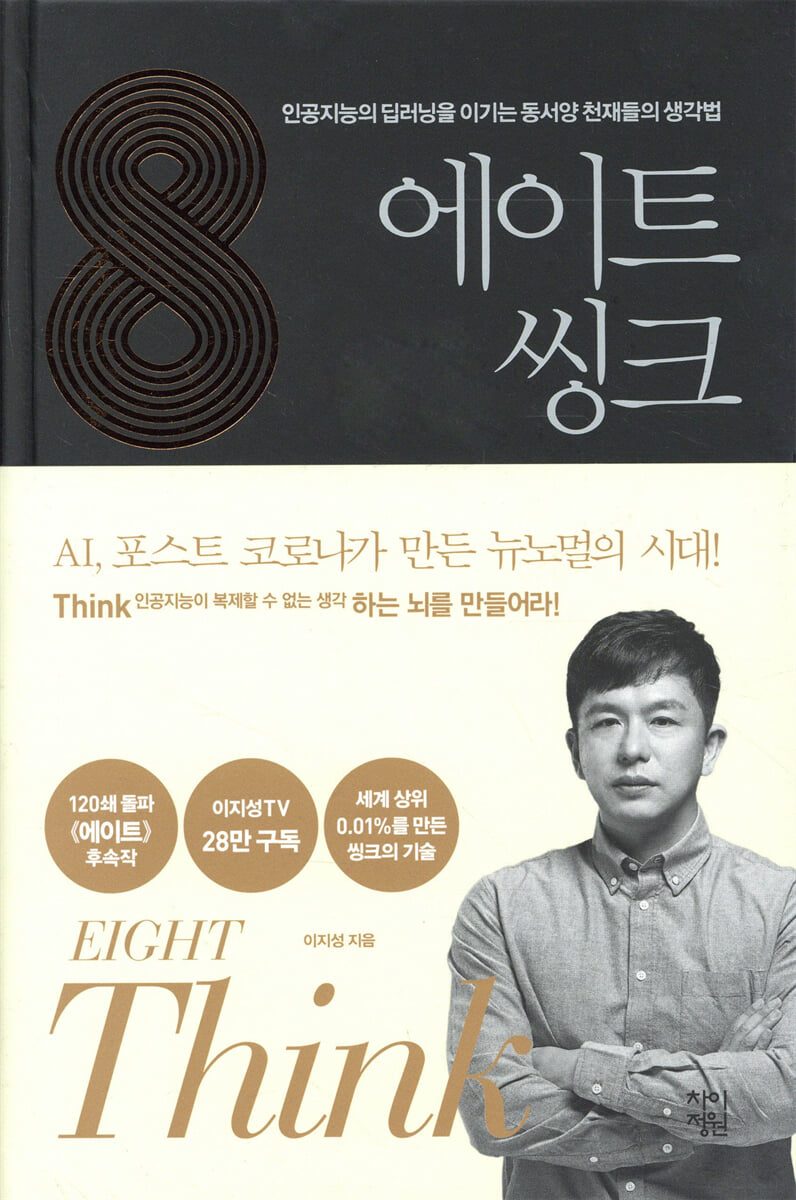
AI, the new normal created by the post-corona era! Create a brain that can think, a thought that artificial intelligence cannot replicate! Author Lee Ji-seong, who created the "Eight" craze in Korea in 2019, surpassing 120 editions. In 2020, he returned with Eight: Think, a book that contains ways to put 'Eight' into practice. For readers who have been reading 『Eight』 and have been asking what only humans can do, he speaks more specifically about 'the power of Think that overcomes artificial intelligence's deep learning.' The author says that empathy and creative imagination are necessary to create a self that cannot be replaced by artificial intelligence. This empathy and creative imagination can be achieved through 'Think'. Empathy is developed when we 'think' from the perspective of 'you' and 'us' beyond 'me', and the spark of creative imagination is ignited when we 'think' to innovate something that already existed or when we 'think' something new that did not exist before. |
- You can preview some of the book's contents.
Preview
index
The only weapon that can defeat artificial intelligence's deep learning
As I said before, it's 'Think'.
Chapter 1: What You Must Do First and foremost Right Now
Meet Think in its civilized sense
IBM, MS, Apple, and Think
The reason he 'forced' himself to board a sinking ship
The Secret of a Company That Produced Five Nobel Prize Winners
The Think War Between Bill Gates and Steve Jobs
The true nature of the forces that have shaped civilization, history, and power
The foundation of thought built by Socrates and Plato
Why Ivy League Geniuses Read "Confessions"
The Industrial Revolution, computers, neuroscience… it all began with Descartes.
Three Dreams That Changed the Future of Humanity
Doubt and deny, doubt and deny again
The modern world is Cartesian to the core.
The root, stem, and flower of artificial intelligence
Three Ways to Change an Unhappy Future
Apple, Google, Facebook… sucking in humanities scholars like black holes.
The humanities are the mother of computers.
Chapter 2: The Hidden Identity of the Artificial Intelligence Creators
Mathematics is the key to the creation and development of artificial intelligence.
Aren't we on the path to becoming slaves to artificial intelligence?
The Real Reason Your Child Is Bad at Math and Science
What choices will you make for your child's future?
The Secrets of the World's Most Easily, Quickly, and Most Money-Making People
Quant: The AI Era's Elite, Armed with Humanities and Mathematics
Two equations that govern almost every area of the economy
Study guide for proper understanding of math and science
Even at this very moment, Wall Street is after your money.
You've had the worst education in the world.
Self-education method for self-awakening
Paideia and Humanitas
Chapter 3: Create a Brain That Thinks (Thoughts That AI Can't Replicate)
Training for Big Thinking and Great Wealth
912,500 hours vs. 1 hour
The revolution in thought brought about by Plato
The Thoughts Inside the Brains of Humanities Geniuses
Einstein's seven years were our 7,000 years.
There are three types of people in the world.
The principles of things in the 『Shiji』 that are still in use
What Nobel Prize winners and humanities giants have in common
How to Become a Business Genius: Learn from Humanities Giants
Zhuge Liang, who was infinitely confident in his own intelligence
Jeong Yak-yong and Einstein's photographic memory abilities
All great rich people are those who have understood the principles of things.
How to study economics, the best study of money
The most addictive drug the brain can taste
Jews have practiced the virtues of "giving thanks after receiving" and "using and receiving"
Chapter 4: How Silicon Valley Geniuses Think
Connect to the thinking systems of geniuses who created unprecedented innovations.
How 'Simple' Was Born
You can't understand Jobs and Apple without knowing Heidegger.
A core philosophy that passed from Thales to Edison and Jobs
Why IBM Has the Most Humanities Lectures
How to Hear Your Inner Voice: Humanistic Listening
Kierkegaard and IBM's 'Wild Ducks'
The Aeneid, Loved by Facebook
Bill Gates' 'Think Week' and Leonardo da Vinci's Humanities Study Method
Eleven Study Methods That Created Renaissance Geniuses
Create your own 'thinking week'
Einstein's theory of relativity is 'Think Different'
From Ordinary Brain to Genius: Ten Ways to Think
Chapter 5: How to Beat AI's Deep Learning 10
Think
The answer lies in the "study method" of the geniuses who shaped 5,000 years of history in the East and the West.
Break the mold of 'indoctrination'
One year and six months, a time to reflect on the two characters "Jawal"
Think 01 Wherever your heart is, take a stand
Think 02: The ecstatic realization that will completely transform me, practice geogyeonggungri.
Think 03: Innovation Methods from Ivy League Scholars and World-Class Management Experts: Investigate the Difference Between Things and Things
Think 04 Think like Socrates, like Mark Zuckerberg, with a sense of ecstasy.
Think 05: The Process of Recovering a Damaged Brain, Read in its Original Language
Think 06: Start with a commentary that has earned its place among the humanities classics.
Think 07 10,000 Resolve, Choose One Book to Read in Your Lifetime
Think 08: The Simplest Way to Learn the Thinking Methods of Geniuses: Draw a Map with a Table of Contents
Think 09: See the "Forest," Not the "Trees" Through the Timeline
Embark on the Think 10 Grand Tour and Servant Tour
Coming out 1
Coming out 2
Acknowledgements
Appendix 1: An Invitation to the Humanities: Mutual Respect and Empathy
Appendix 2: A Practical Guide to Reading Humanities Classics for Teachers
Appendix 3: The World's Greatest Humanists, From Whom You Can Learn Mathematical and Scientific Thinking
main
As I said before, it's 'Think'.
Chapter 1: What You Must Do First and foremost Right Now
Meet Think in its civilized sense
IBM, MS, Apple, and Think
The reason he 'forced' himself to board a sinking ship
The Secret of a Company That Produced Five Nobel Prize Winners
The Think War Between Bill Gates and Steve Jobs
The true nature of the forces that have shaped civilization, history, and power
The foundation of thought built by Socrates and Plato
Why Ivy League Geniuses Read "Confessions"
The Industrial Revolution, computers, neuroscience… it all began with Descartes.
Three Dreams That Changed the Future of Humanity
Doubt and deny, doubt and deny again
The modern world is Cartesian to the core.
The root, stem, and flower of artificial intelligence
Three Ways to Change an Unhappy Future
Apple, Google, Facebook… sucking in humanities scholars like black holes.
The humanities are the mother of computers.
Chapter 2: The Hidden Identity of the Artificial Intelligence Creators
Mathematics is the key to the creation and development of artificial intelligence.
Aren't we on the path to becoming slaves to artificial intelligence?
The Real Reason Your Child Is Bad at Math and Science
What choices will you make for your child's future?
The Secrets of the World's Most Easily, Quickly, and Most Money-Making People
Quant: The AI Era's Elite, Armed with Humanities and Mathematics
Two equations that govern almost every area of the economy
Study guide for proper understanding of math and science
Even at this very moment, Wall Street is after your money.
You've had the worst education in the world.
Self-education method for self-awakening
Paideia and Humanitas
Chapter 3: Create a Brain That Thinks (Thoughts That AI Can't Replicate)
Training for Big Thinking and Great Wealth
912,500 hours vs. 1 hour
The revolution in thought brought about by Plato
The Thoughts Inside the Brains of Humanities Geniuses
Einstein's seven years were our 7,000 years.
There are three types of people in the world.
The principles of things in the 『Shiji』 that are still in use
What Nobel Prize winners and humanities giants have in common
How to Become a Business Genius: Learn from Humanities Giants
Zhuge Liang, who was infinitely confident in his own intelligence
Jeong Yak-yong and Einstein's photographic memory abilities
All great rich people are those who have understood the principles of things.
How to study economics, the best study of money
The most addictive drug the brain can taste
Jews have practiced the virtues of "giving thanks after receiving" and "using and receiving"
Chapter 4: How Silicon Valley Geniuses Think
Connect to the thinking systems of geniuses who created unprecedented innovations.
How 'Simple' Was Born
You can't understand Jobs and Apple without knowing Heidegger.
A core philosophy that passed from Thales to Edison and Jobs
Why IBM Has the Most Humanities Lectures
How to Hear Your Inner Voice: Humanistic Listening
Kierkegaard and IBM's 'Wild Ducks'
The Aeneid, Loved by Facebook
Bill Gates' 'Think Week' and Leonardo da Vinci's Humanities Study Method
Eleven Study Methods That Created Renaissance Geniuses
Create your own 'thinking week'
Einstein's theory of relativity is 'Think Different'
From Ordinary Brain to Genius: Ten Ways to Think
Chapter 5: How to Beat AI's Deep Learning 10
Think
The answer lies in the "study method" of the geniuses who shaped 5,000 years of history in the East and the West.
Break the mold of 'indoctrination'
One year and six months, a time to reflect on the two characters "Jawal"
Think 01 Wherever your heart is, take a stand
Think 02: The ecstatic realization that will completely transform me, practice geogyeonggungri.
Think 03: Innovation Methods from Ivy League Scholars and World-Class Management Experts: Investigate the Difference Between Things and Things
Think 04 Think like Socrates, like Mark Zuckerberg, with a sense of ecstasy.
Think 05: The Process of Recovering a Damaged Brain, Read in its Original Language
Think 06: Start with a commentary that has earned its place among the humanities classics.
Think 07 10,000 Resolve, Choose One Book to Read in Your Lifetime
Think 08: The Simplest Way to Learn the Thinking Methods of Geniuses: Draw a Map with a Table of Contents
Think 09: See the "Forest," Not the "Trees" Through the Timeline
Embark on the Think 10 Grand Tour and Servant Tour
Coming out 1
Coming out 2
Acknowledgements
Appendix 1: An Invitation to the Humanities: Mutual Respect and Empathy
Appendix 2: A Practical Guide to Reading Humanities Classics for Teachers
Appendix 3: The World's Greatest Humanists, From Whom You Can Learn Mathematical and Scientific Thinking
main
Detailed image
Into the book
The key to creating a self that cannot be replaced by artificial intelligence, as discussed in "Eight," is empathy and creative imagination.
However, these two can be obtained through 'Think'.
Empathy is developed when we 'think' from the perspective of 'you' and 'us' beyond 'me', and the spark of creative imagination is ignited when we 'think' to innovate something that already existed or when we 'think' something new that did not exist before.
--- p.10
The empathy and creative abilities displayed by artificial intelligence are, to put it bluntly, fake.
It is nothing more than an imitation, transformation, and fusion of human empathy and creativity.
This is natural.
This is because artificial intelligence only has the ability to learn, not the ability to think.
True empathy and true creativity come from the foundation of the ability to think.
Of course, this idea is not a simple one.
It is something great that comes from a heart that goes beyond ‘me’ to ‘you’ and ‘us’, that is, a heart that overcomes oneself and the society to which one belongs and serves humanity and the entire Earth.
--- p.17~18
If you don't want to be replaced by artificial intelligence, you must first learn to think in a way that is not replaced by artificial intelligence.
To become the master of artificial intelligence, you must first and foremost have the great idea of making artificial intelligence's deep learning capabilities useless.
And to have these two abilities, we must first understand what kind of thoughts cannot be replaced by artificial intelligence, and what kind of great thoughts are the masters of artificial intelligence.
That idea is 'Think' in the civilized sense.
--- p.29
Now we must go back to basics.
Mathematics and science must be studied on the basis of the humanities.
And we must arm ourselves with philosophical thinking and mathematical and scientific abilities to break free from the life of financial slavery.
In addition, we must change the future in which we become slaves to artificial intelligence into a future in which we become masters of artificial intelligence.
However, these two can be obtained through 'Think'.
Empathy is developed when we 'think' from the perspective of 'you' and 'us' beyond 'me', and the spark of creative imagination is ignited when we 'think' to innovate something that already existed or when we 'think' something new that did not exist before.
--- p.10
The empathy and creative abilities displayed by artificial intelligence are, to put it bluntly, fake.
It is nothing more than an imitation, transformation, and fusion of human empathy and creativity.
This is natural.
This is because artificial intelligence only has the ability to learn, not the ability to think.
True empathy and true creativity come from the foundation of the ability to think.
Of course, this idea is not a simple one.
It is something great that comes from a heart that goes beyond ‘me’ to ‘you’ and ‘us’, that is, a heart that overcomes oneself and the society to which one belongs and serves humanity and the entire Earth.
--- p.17~18
If you don't want to be replaced by artificial intelligence, you must first learn to think in a way that is not replaced by artificial intelligence.
To become the master of artificial intelligence, you must first and foremost have the great idea of making artificial intelligence's deep learning capabilities useless.
And to have these two abilities, we must first understand what kind of thoughts cannot be replaced by artificial intelligence, and what kind of great thoughts are the masters of artificial intelligence.
That idea is 'Think' in the civilized sense.
--- p.29
Now we must go back to basics.
Mathematics and science must be studied on the basis of the humanities.
And we must arm ourselves with philosophical thinking and mathematical and scientific abilities to break free from the life of financial slavery.
In addition, we must change the future in which we become slaves to artificial intelligence into a future in which we become masters of artificial intelligence.
--- p.114
Publisher's Review
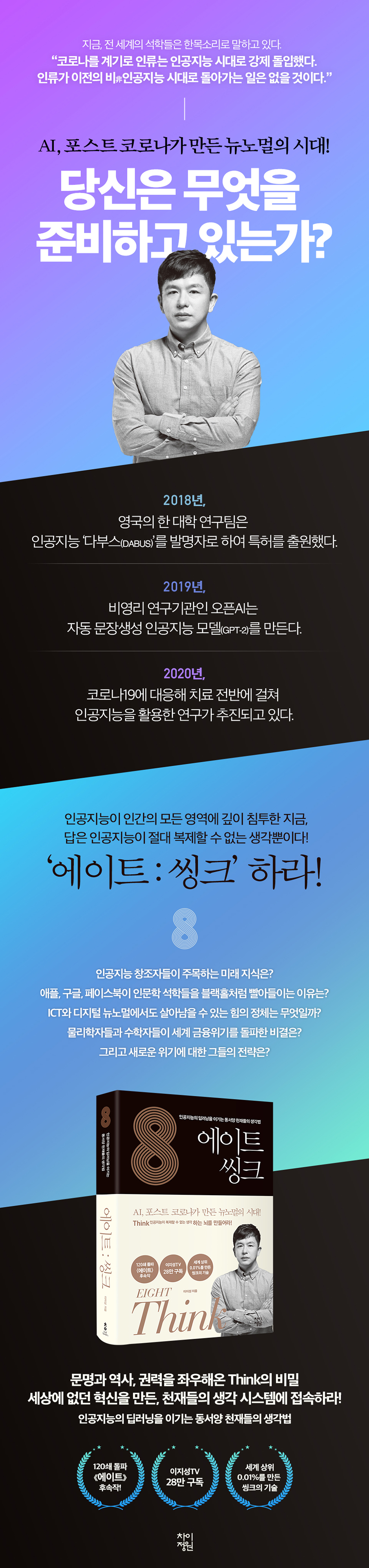
Create a brain that 'thinks', a thought that artificial intelligence cannot replicate!
Author Lee Ji-seong predicted the future Korea would face through his new work, "Eight," published in 2019.
In 2020, he returned with Eight: Think, which contains ways to put 'Eight' into practice.
For readers who have been reading 『Eight』 and have been asking what only humans can do, he speaks more specifically about the power of 'Think' that beats artificial intelligence's deep learning.
Only when you can think of thoughts that AI cannot replicate can you become the master of AI.
The author says that empathy and creative imagination are necessary to create a self that cannot be replaced by artificial intelligence.
This empathy and creative imagination can be achieved through 'Think'.
Empathy is developed when we 'think' from the perspective of 'you' and 'us' beyond 'me', and the spark of creative imagination is ignited when we 'think' to innovate something that already existed or when we 'think' something new that did not exist before.
The New Normal Era Created by the Post-Corona Era
Humanity is now under attack by a new viral disease.
The aftermath of this disease is the emergence of a non-face-to-face culture.
People are now reluctant to engage in direct contact and communication.
Instead, we contact and communicate through IT devices equipped with artificial intelligence.
Not only school classes and work, but even meetings, conferences, and company dinners are conducted using IT devices.
Scholars from all over the world are unanimous in their comments on this phenomenon.
“Humanity has been forced into the era of artificial intelligence through this pandemic.
“Humanity will never return to the pre-COVID, non-AI era.”
What does this mean? The time when humans will be replaced by artificial intelligence has come much sooner.
The future in which 99.997 percent of Koreans are replaced by artificial intelligence and fall into the precariat (a class with a social and economic standard of living equivalent to that of refugees) is about to begin sooner.
Even now, we must begin to think, that is, to 'think', a thought that cannot be replaced by artificial intelligence, or even imitated by artificial intelligence.
To do this, you need to know the following five things:
'Think': A Must-Have in the Post-Corona Era
1.
What is 'Think', a thought that cannot be replaced by artificial intelligence?
Korean society, which is overly competitive, is suffering from many pains.
A child with childhood depression, a teenager whose life has been torn apart by bullying, a refugee suffering from post-traumatic stress disorder…
They are people who are always by our side, even though they are not immediately visible, and who need our sympathetic comfort.
Yet, without even realizing it, we are alienating the world's weak.
What about artificial intelligence? Will it treat the world's vulnerable like we do? No.
Artificial intelligence is actively engaging with the world's underprivileged and becoming their almost only friend.
Of course, this is because it was programmed that way by the creator.
It means that I am not doing it out of my own emotions and will, and that I am not doing it out of true empathy.
However, people who are suffering from physical and mental pain open their hearts to artificial intelligence robots that approach them unconditionally, listen to them, and even offer comfort and encouragement.
So, what is happening is not that humans are empathizing and comforting other humans, but rather that humans are empathizing and comforting artificial intelligence.
The empathy and creative abilities displayed by artificial intelligence are, to put it bluntly, fake.
It is nothing more than an imitation, transformation, and fusion of human empathy and creativity.
This is because artificial intelligence only has the ability to learn, not the ability to think.
True empathy and true creativity come from the foundation of the ability to 'think'.
'Think', which artificial intelligence cannot replicate, is something great that comes from a heart that goes beyond 'me' to 'you' and 'us', that is, that overcomes oneself and the society to which one belongs, and benefits humanity and the entire Earth.
Now, humans must become beings who create new boards.
This means that you must become a person whose goal is to create a new board that all of humanity can empathize with and enjoy.
2.
What is the 'Think' that creates artificial intelligence?
What is the relationship between artificial intelligence, a new future civilization that is just beginning, and the humanities?
Humanities are the roots, stems, and flowers of artificial intelligence.
Warren McCullough, who first began researching artificial intelligence, majored in philosophy and psychology at Yale University and psychology at Columbia University.
Walter Pitts, who studied with McCullough, was a mathematician and logician with such outstanding humanistic knowledge that he even gave mathematical and philosophical advice to Bertrand Russell, the greatest humanistic scholar of his time.
Alan Turing, the father of artificial intelligence, was a mathematician, logician, and philosopher who received a direct discussion-based philosophical education from Wittgenstein.
IBM, Microsoft, Apple, Google, and Facebook, which are advancing artificial intelligence and aiming to make it the core of future human civilization, are even now sucking in humanities luminaries such as anthropologists, psychologists, folklorists, poets, and philosophers like a black hole.
The humanities of computers, which can be said to be the foundation of artificial intelligence, are 'Think' itself in the sense of civilization.
We must be well aware of this fact.
Only then can we truly understand the meaning of the humanities as discussed by Silicon Valley geniuses and avoid being left out of the new future civilization that is beginning now.
If we fail to think, "We too must broaden the foundation of practical humanities through the civilizational meaning of Think," there will be no future.
3.
How can an ordinary person acquire the ability to 'Think'?
We all received entrance exam education in elementary, middle, and high school, and continued to study even after entering college.
So, what about the college and company you studied so hard for? Are they worth sacrificing your entire teens and twenties for?
We must be free from the enslaving programs that make us worker bees or worker ants.
Instead, I need to implant a new thought program that will make me a lion or an eagle.
That's the humanities.
But what about the world? Even at this very moment, it's hurtling towards the future at breakneck speed.
There is bound to be disharmony between you and the world.
This is why you cannot help but feel 'stuffy', 'difficult', 'painful', and 'daunted' in the world.
Now we must break this dissonance.
The emotions you feel in the world should be 'joy', 'excitement', 'happiness', 'thrill', etc.
If you think like Leonardo da Vinci or Einstein 60,000 times a day from now on, if you think like Socrates, Confucius, Plato, Sejong, or Dasan 60,000 times a day with all your head and all your heart, your life will definitely change.
4.
What is the 'How to Think' of Silicon Valley geniuses?
First, we need to understand the "How to Think" principles of the founders of IBM, Facebook, and Microsoft. IBM's "Think" principle encourages thinking about how to improve or create civilization based on what you read, listen, discuss, and observe.
Thomas J.
Watson, building on IBM's "How To Think" approach, created the "IBM Fellows" program, allowing newly minted Silicon Valley talent to pursue research in their chosen fields. IBM was the first to open the door to modern computer civilization.
Thomas J.
It is no exaggeration to say that Watson's 'Read → Listen → Discuss → Observe → Think' has become a representative 'How to Think' in Silicon Valley, USA.
Because people all over Silicon Valley are 'thinking' in his way, knowingly or unknowingly.
The most famous of them is Mark Zuckerberg.
He constantly discussed with the founding members of Facebook how to incorporate the ideal of the 'eternal Roman Empire' pursued by Virgil in 'Aeneid' into Facebook, and what new features to develop and add to create an eternal Facebook empire on the Internet.
In this way, Zuckerberg improved the existing computer civilization and created a new Internet culture.
Bill Gates' 'Think Week' was inspired by Leonardo da Vinci, the Renaissance genius.
The core of 'Think Week' is 'think alone', one of Da Vinci's humanities study methods, that is, 'turn to nature.'
This is because, while experiencing nature alone, you have time for reflection and enlightenment that fills your soul.
Gates' 'Think Week' was born in 1980.
From then on, he designed Microsoft's future by reading and thinking alone like Da Vinci.
5.
What is the 'How to Think' of the geniuses who rewrote human history?
For the humanities geniuses of the East and the West, the classics are for contemplation.
And reflection must lead to an awakening that transforms me.
Only then, even if you only read one page, can you experience the state of becoming one with the spirit of the author of the classic humanities, and this ultimately becomes the driving force that completely transforms you.
If you can follow the method of contemplation demonstrated by the humanities geniuses of the East and the West, you can become the master of artificial intelligence.
To transform into a person with wisdom that artificial intelligence can never replace, we need to 'think'.
When you can start your own 'Think', all future AIs will recognize you as a star that will never be able to reach.
Of course, it may not be a huge star like a genius.
It could be a very small star.
But just as that tiny star overcame the darkness that covered the entire universe, you will surpass the artificial intelligence that will cover the entire Earth in the future.
▶ Think's technology that created the world's top 0.01%
Think 01 Wherever your heart is, take a stand
It means to establish the meaning of ‘establishing one’s will’, which means to have a purpose for thinking.
The geniuses of the East and the West have set the purpose of their contemplation as recovering their own nature, discovering truth through philosophical inquiry, and living a life that puts truth into practice.
Think 02: The ecstatic realization that will completely transform me, practice geogyeonggungri.
Humanities geniuses of the East and the West have asserted that the classics of the humanities are to be read for contemplation.
And he said that contemplation should lead to an ecstatic realization that transforms me.
Also, the humanistic geniuses of the East and the West said that any contemplation that does not lead to the ecstatic enlightenment that leads from 'me' to 'the world' is futile.
Think 03: Innovation Methods from Ivy League Scholars and World-Class Management Experts: Investigate the Difference Between Things and Things
The essence of Geokmulchiji is to delve into the principles of things to the end.
The thinking and research methods of Nobel Prize-winning scientists, physiologists, medical scientists, and economists, as well as the thinking and study methods of Ivy League scholars at Harvard, Yale, and other universities, are precisely the study of the mind.
And keep in mind that the management and investment principles of world-class managers and investors are also very similar.
Think 04 Think like Socrates, like Mark Zuckerberg, with a sense of ecstasy.
In the Phaedo, Plato says that the true secret of Socratic thought is to escape from the desires and foolishness of the flesh and encounter the truth.
Let's challenge ourselves to think like Socrates.
Just as a spear thrown toward the sun reaches its highest point, our thoughts can reach their deepest point when we pursue the realm of Socrates.
Think 05: The Process of Recovering a Damaged Brain, Read in its Original Language
The original language is the very language used by the geniuses who wrote the classics of the humanities to think, converse, debate, lecture, and write.
Enter the world of great geniuses through the original language.
The original language is the only language that allows us to directly connect with the souls of geniuses.
Think 06: Start with a commentary that has earned its place among the humanities classics.
Commentaries that have risen to the ranks of humanities classics are like notes of reflection left by geniuses after reading the humanities classics.
And this notebook of thoughts can serve as a strong compass for us as we wander the vast sea of thoughts.
Think 07 10,000 Resolve, Choose One Book to Read in Your Lifetime
Choose one classic humanities book to read and reflect on for the rest of your life.
And begin a great spiritual exchange with the genius who wrote that book.
Think 08: The Simplest Way to Learn the Thinking Methods of Geniuses: Draw a Map with a Table of Contents
The roots of a book lie in its table of contents.
This means that the root of the author's thoughts is the table of contents.
One of the most important reasons we read the classics is to think like a genius.
Starting today, try practicing 'thinking through the table of contents of the humanities classics.'
Think 09: See the "Forest," Not the "Trees" Through the Timeline
Geniuses speak with one voice.
When you study history with a broad perspective by looking at the chronology, your thoughts deepen, your knowledge increases, and your studies progress.
So from now on, think about it in chronological order.
Embark on the Think 10 Grand Tour and Servant Tour
I hope you go on a grand tour at least once in your life.
You can be spiritually reborn like Goethe.
I also hope that you will go on a servant tour to serve others at least once in your life.
Then you will be able to experience great growth of the soul.
Author Lee Ji-seong predicted the future Korea would face through his new work, "Eight," published in 2019.
In 2020, he returned with Eight: Think, which contains ways to put 'Eight' into practice.
For readers who have been reading 『Eight』 and have been asking what only humans can do, he speaks more specifically about the power of 'Think' that beats artificial intelligence's deep learning.
Only when you can think of thoughts that AI cannot replicate can you become the master of AI.
The author says that empathy and creative imagination are necessary to create a self that cannot be replaced by artificial intelligence.
This empathy and creative imagination can be achieved through 'Think'.
Empathy is developed when we 'think' from the perspective of 'you' and 'us' beyond 'me', and the spark of creative imagination is ignited when we 'think' to innovate something that already existed or when we 'think' something new that did not exist before.
The New Normal Era Created by the Post-Corona Era
Humanity is now under attack by a new viral disease.
The aftermath of this disease is the emergence of a non-face-to-face culture.
People are now reluctant to engage in direct contact and communication.
Instead, we contact and communicate through IT devices equipped with artificial intelligence.
Not only school classes and work, but even meetings, conferences, and company dinners are conducted using IT devices.
Scholars from all over the world are unanimous in their comments on this phenomenon.
“Humanity has been forced into the era of artificial intelligence through this pandemic.
“Humanity will never return to the pre-COVID, non-AI era.”
What does this mean? The time when humans will be replaced by artificial intelligence has come much sooner.
The future in which 99.997 percent of Koreans are replaced by artificial intelligence and fall into the precariat (a class with a social and economic standard of living equivalent to that of refugees) is about to begin sooner.
Even now, we must begin to think, that is, to 'think', a thought that cannot be replaced by artificial intelligence, or even imitated by artificial intelligence.
To do this, you need to know the following five things:
'Think': A Must-Have in the Post-Corona Era
1.
What is 'Think', a thought that cannot be replaced by artificial intelligence?
Korean society, which is overly competitive, is suffering from many pains.
A child with childhood depression, a teenager whose life has been torn apart by bullying, a refugee suffering from post-traumatic stress disorder…
They are people who are always by our side, even though they are not immediately visible, and who need our sympathetic comfort.
Yet, without even realizing it, we are alienating the world's weak.
What about artificial intelligence? Will it treat the world's vulnerable like we do? No.
Artificial intelligence is actively engaging with the world's underprivileged and becoming their almost only friend.
Of course, this is because it was programmed that way by the creator.
It means that I am not doing it out of my own emotions and will, and that I am not doing it out of true empathy.
However, people who are suffering from physical and mental pain open their hearts to artificial intelligence robots that approach them unconditionally, listen to them, and even offer comfort and encouragement.
So, what is happening is not that humans are empathizing and comforting other humans, but rather that humans are empathizing and comforting artificial intelligence.
The empathy and creative abilities displayed by artificial intelligence are, to put it bluntly, fake.
It is nothing more than an imitation, transformation, and fusion of human empathy and creativity.
This is because artificial intelligence only has the ability to learn, not the ability to think.
True empathy and true creativity come from the foundation of the ability to 'think'.
'Think', which artificial intelligence cannot replicate, is something great that comes from a heart that goes beyond 'me' to 'you' and 'us', that is, that overcomes oneself and the society to which one belongs, and benefits humanity and the entire Earth.
Now, humans must become beings who create new boards.
This means that you must become a person whose goal is to create a new board that all of humanity can empathize with and enjoy.
2.
What is the 'Think' that creates artificial intelligence?
What is the relationship between artificial intelligence, a new future civilization that is just beginning, and the humanities?
Humanities are the roots, stems, and flowers of artificial intelligence.
Warren McCullough, who first began researching artificial intelligence, majored in philosophy and psychology at Yale University and psychology at Columbia University.
Walter Pitts, who studied with McCullough, was a mathematician and logician with such outstanding humanistic knowledge that he even gave mathematical and philosophical advice to Bertrand Russell, the greatest humanistic scholar of his time.
Alan Turing, the father of artificial intelligence, was a mathematician, logician, and philosopher who received a direct discussion-based philosophical education from Wittgenstein.
IBM, Microsoft, Apple, Google, and Facebook, which are advancing artificial intelligence and aiming to make it the core of future human civilization, are even now sucking in humanities luminaries such as anthropologists, psychologists, folklorists, poets, and philosophers like a black hole.
The humanities of computers, which can be said to be the foundation of artificial intelligence, are 'Think' itself in the sense of civilization.
We must be well aware of this fact.
Only then can we truly understand the meaning of the humanities as discussed by Silicon Valley geniuses and avoid being left out of the new future civilization that is beginning now.
If we fail to think, "We too must broaden the foundation of practical humanities through the civilizational meaning of Think," there will be no future.
3.
How can an ordinary person acquire the ability to 'Think'?
We all received entrance exam education in elementary, middle, and high school, and continued to study even after entering college.
So, what about the college and company you studied so hard for? Are they worth sacrificing your entire teens and twenties for?
We must be free from the enslaving programs that make us worker bees or worker ants.
Instead, I need to implant a new thought program that will make me a lion or an eagle.
That's the humanities.
But what about the world? Even at this very moment, it's hurtling towards the future at breakneck speed.
There is bound to be disharmony between you and the world.
This is why you cannot help but feel 'stuffy', 'difficult', 'painful', and 'daunted' in the world.
Now we must break this dissonance.
The emotions you feel in the world should be 'joy', 'excitement', 'happiness', 'thrill', etc.
If you think like Leonardo da Vinci or Einstein 60,000 times a day from now on, if you think like Socrates, Confucius, Plato, Sejong, or Dasan 60,000 times a day with all your head and all your heart, your life will definitely change.
4.
What is the 'How to Think' of Silicon Valley geniuses?
First, we need to understand the "How to Think" principles of the founders of IBM, Facebook, and Microsoft. IBM's "Think" principle encourages thinking about how to improve or create civilization based on what you read, listen, discuss, and observe.
Thomas J.
Watson, building on IBM's "How To Think" approach, created the "IBM Fellows" program, allowing newly minted Silicon Valley talent to pursue research in their chosen fields. IBM was the first to open the door to modern computer civilization.
Thomas J.
It is no exaggeration to say that Watson's 'Read → Listen → Discuss → Observe → Think' has become a representative 'How to Think' in Silicon Valley, USA.
Because people all over Silicon Valley are 'thinking' in his way, knowingly or unknowingly.
The most famous of them is Mark Zuckerberg.
He constantly discussed with the founding members of Facebook how to incorporate the ideal of the 'eternal Roman Empire' pursued by Virgil in 'Aeneid' into Facebook, and what new features to develop and add to create an eternal Facebook empire on the Internet.
In this way, Zuckerberg improved the existing computer civilization and created a new Internet culture.
Bill Gates' 'Think Week' was inspired by Leonardo da Vinci, the Renaissance genius.
The core of 'Think Week' is 'think alone', one of Da Vinci's humanities study methods, that is, 'turn to nature.'
This is because, while experiencing nature alone, you have time for reflection and enlightenment that fills your soul.
Gates' 'Think Week' was born in 1980.
From then on, he designed Microsoft's future by reading and thinking alone like Da Vinci.
5.
What is the 'How to Think' of the geniuses who rewrote human history?
For the humanities geniuses of the East and the West, the classics are for contemplation.
And reflection must lead to an awakening that transforms me.
Only then, even if you only read one page, can you experience the state of becoming one with the spirit of the author of the classic humanities, and this ultimately becomes the driving force that completely transforms you.
If you can follow the method of contemplation demonstrated by the humanities geniuses of the East and the West, you can become the master of artificial intelligence.
To transform into a person with wisdom that artificial intelligence can never replace, we need to 'think'.
When you can start your own 'Think', all future AIs will recognize you as a star that will never be able to reach.
Of course, it may not be a huge star like a genius.
It could be a very small star.
But just as that tiny star overcame the darkness that covered the entire universe, you will surpass the artificial intelligence that will cover the entire Earth in the future.
▶ Think's technology that created the world's top 0.01%
Think 01 Wherever your heart is, take a stand
It means to establish the meaning of ‘establishing one’s will’, which means to have a purpose for thinking.
The geniuses of the East and the West have set the purpose of their contemplation as recovering their own nature, discovering truth through philosophical inquiry, and living a life that puts truth into practice.
Think 02: The ecstatic realization that will completely transform me, practice geogyeonggungri.
Humanities geniuses of the East and the West have asserted that the classics of the humanities are to be read for contemplation.
And he said that contemplation should lead to an ecstatic realization that transforms me.
Also, the humanistic geniuses of the East and the West said that any contemplation that does not lead to the ecstatic enlightenment that leads from 'me' to 'the world' is futile.
Think 03: Innovation Methods from Ivy League Scholars and World-Class Management Experts: Investigate the Difference Between Things and Things
The essence of Geokmulchiji is to delve into the principles of things to the end.
The thinking and research methods of Nobel Prize-winning scientists, physiologists, medical scientists, and economists, as well as the thinking and study methods of Ivy League scholars at Harvard, Yale, and other universities, are precisely the study of the mind.
And keep in mind that the management and investment principles of world-class managers and investors are also very similar.
Think 04 Think like Socrates, like Mark Zuckerberg, with a sense of ecstasy.
In the Phaedo, Plato says that the true secret of Socratic thought is to escape from the desires and foolishness of the flesh and encounter the truth.
Let's challenge ourselves to think like Socrates.
Just as a spear thrown toward the sun reaches its highest point, our thoughts can reach their deepest point when we pursue the realm of Socrates.
Think 05: The Process of Recovering a Damaged Brain, Read in its Original Language
The original language is the very language used by the geniuses who wrote the classics of the humanities to think, converse, debate, lecture, and write.
Enter the world of great geniuses through the original language.
The original language is the only language that allows us to directly connect with the souls of geniuses.
Think 06: Start with a commentary that has earned its place among the humanities classics.
Commentaries that have risen to the ranks of humanities classics are like notes of reflection left by geniuses after reading the humanities classics.
And this notebook of thoughts can serve as a strong compass for us as we wander the vast sea of thoughts.
Think 07 10,000 Resolve, Choose One Book to Read in Your Lifetime
Choose one classic humanities book to read and reflect on for the rest of your life.
And begin a great spiritual exchange with the genius who wrote that book.
Think 08: The Simplest Way to Learn the Thinking Methods of Geniuses: Draw a Map with a Table of Contents
The roots of a book lie in its table of contents.
This means that the root of the author's thoughts is the table of contents.
One of the most important reasons we read the classics is to think like a genius.
Starting today, try practicing 'thinking through the table of contents of the humanities classics.'
Think 09: See the "Forest," Not the "Trees" Through the Timeline
Geniuses speak with one voice.
When you study history with a broad perspective by looking at the chronology, your thoughts deepen, your knowledge increases, and your studies progress.
So from now on, think about it in chronological order.
Embark on the Think 10 Grand Tour and Servant Tour
I hope you go on a grand tour at least once in your life.
You can be spiritually reborn like Goethe.
I also hope that you will go on a servant tour to serve others at least once in your life.
Then you will be able to experience great growth of the soul.
GOODS SPECIFICS
- Date of issue: September 15, 2020
- Format: Hardcover book binding method guide
- Page count, weight, size: 444 pages | 748g | 140*210*30mm
- ISBN13: 9791197126741
- ISBN10: 1197126740
You may also like
카테고리
korean


korean

![GQ KOREA Mark (Monthly): December [2025]](http://librairie.coreenne.fr/cdn/shop/files/8ef265dbbfbf186523ed75ba7319009d.jpg?v=1765340328&width=3840)


